
Truest
Banned
- Joined
- Dec 1, 2025
- Posts
- 99
- Reputation
- 68
Design
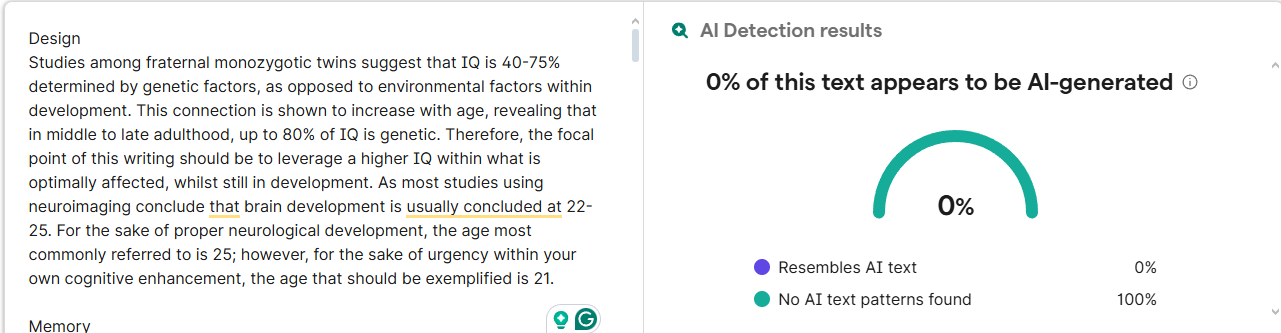
Studies among fraternal monozygotic twins suggest that IQ is 40-75% determined by genetic factors, as opposed to environmental factors within development. This connection is shown to increase with age, revealing that in middle to late adulthood, up to 80% of IQ is genetic. Therefore, the focal point of this writing should be to leverage a higher IQ within what is optimally affected, whilst still in development. As most studies using neuroimaging conclude that brain development is usually concluded at 22-25. For the sake of proper neurological development, the age most commonly referred to is 25; however, for the sake of urgency within your own cognitive enhancement, the age that should be exemplified is 21.
Memory
Long-term meta-analysis links cognitive training to enhanced encoding and retention. The most optimal form of this in research is referred to as computerized cognitive training, which has been studied as a cure for memory loss with age-related cognitive decay. This has been shown to greatly improve verbal and working memory, which is deal for those not only trying to improve memory but also improve perceived memory. 25-30 minutes a day, 6 days a week, has been shown for ideal timing for those under 60. Mindfulness meditation has also been linked with improved by decreasing mind wandering. 10-15 minutes increased to a 20-minute duration has been shown to work best for memory.
Attention
Meta-analysis of 209 studies concludes that regular meditation is linked to improved cognitive performance and attention control. Although research is mixed, CCT is also linked to minor improvements in focus. Another practice connected is Journaling, which is shown to improve concentration and decrease stress. Reduced stress level creates optimal conditions for concentration. Neurofeedback methods often used in ADHD treatment have also been shown to train brain waves, resulting in improved sustained attention.
Executive Function
CCT yet again has been seen as an effective method for improving executive function. Another process that should be explored is forcing motivation and willpower over which is linked to the eventual increase in the neural pathways that increase these functions naturally. Similarly to how a bodybuilder finds difficulties in exercising initially but finds enjoyment with it over time. As the brain begins to “feed in” to these behaviors. Although this process is extensive (8 weeks minimum) and widely debated about its full effectiveness. As well as there are clear mechanisms connecting how your genetics affect your executive function.
Cognitive Perception
Perhaps the most important tenet of this project is improving how your intelligence is perceived. As often, even those placed above average in the IQ distribution bell curve receive negative connotation around their circumstance. The most commonly observed example of this is the “nerd” or “geek” archetype placed on those who apply high effort toward their academic pursuits. One of the most effective ways to prevent this is by increasing one's attractiveness, which haloes all aspects of one’s life, including their perceived attractiveness. A study conducted by DOAJ found an extremely positive correlation between attractiveness and perceived IQ for men. This, however, was not correlated with women. And of course, it should be noted that DOAJ is not the only notable study linking this. The particular traits that had the most positive impact were health indicators. Facial symmetry, straight white teeth, Norwood 0 full-groomed hair, clear sclerae, and skin clarity; however, there were incredibly important traits based on good development and ideal genetic characteristics. Eye spacing, prominent brow ridge, facial width to height ratio, and canthal tilt. Other halos for positive IQ perception include multiple oratory habits, which can be developed over time. For men, a deep, steady voice that lacks upspeak is measured continuously as ideal. Please note that the steadiness of your voice should be monitored, as enunciation that's perceived as too slow will result in a lack of interest. Enthusiasm in speech can also prevent disinterest in your talking points. And finally, your slight open hand gestures with ideal posture can improve engagement and increase IQ perception.
Bioactive Compounds
Dihexa - A synthetic peptide derived from Angiotensin IV. Dihexa binds to the modulate hepatocyte growth factor and the c-Met receptor system, crucial for neuroplasticity, neuroprotection, and synaptogenesis. Because of its mechanism of action, it can lead to more robust neural networks, resulting in a potential for more memory consolidation and decreased cognitive decline.
Semax - A synthetic peptide analog of ACTH (4-7), a fragment of adrenocorticotropic hormone. In models, semax has been shown to upregulate brain-derived neurotrophic factor. In Russian clinical studies, patients were shown to improve long-term functional improvement; however, most improvements have been transient, marginal improvements in focus and reinforced learning rather than broad IQ.
Caffeine - One of the most widely used psychoactive substances that works by antagonising the adenosine receptor, and because of this, it results in indirect stimulation of dopamine, norepinephrine, and glutamate. Resulting in improved focus, memory speed, alertness, and motivation. With regular use, the brain responds by upregulating the adenosine receptors, resulting in an effective dosage and cycling ideal for long-term use. As well as this, caffeine is not shown to result in any long-term effects.
Dr. Happy Stack - Urine Monophosphate, Alpha-GPC, and DHA work in multiple mechanisms to support synaptogenesis, receptor density, and neurotransmitter activity; however, it should be noted that it doesn’t directly upregulate your natural pathways. And only supplies the natural building blocks for these systems to work, because of this effects are less substantial and long-term.
Maladaptive Cognitive Practices
Pornography has been shown to reduce grey matter volume in the reward system for heavy users, as well as alter prefrontal cortex activity, making it harder to regulate urges and focus on non-porn activities. Excess porn is also linked with increased risk of anxiety, depression, and loneliness, although it’s commonly debated whether porn causes this or if people with these pre-existing conditions flee to porn as comfort. And finally, excess porn can lower one's overall dopamine baseline, resulting in worse focus and attention as well as anhedonia. Other lifestyle habits that are unideal for cognitive enhancement include social isolation, sedentary lifestyle, high-stress living, ultra-processed foods or stimulants, negative thought patterns, lack of mental novelty, circadian rhythm disruption, constant multitasking, and extreme sleep deprivation.
Practical Framework
CCT: 1-2/weeks 3-4x/week 10-15 minutes | 3-6 weeks/15-20 minutes | 6+ weeks 3-5/week 20-25 minutes (Please note to increase CCT difficulty within app as well)
Meditation: 2-3/weeks 5-10 minutes daily | 3-6/weeks 15-20 minutes daily | 6/weeks 20+ minutes daily
Journaling: 2-4/weeks 5 minutes daily | 4-8/weeks 10-15 minutes daily | 2-3/months onward 15-30 minutes
Reading: An ideal range of 30-60 minutes daily is recommended
As well as following the maladaptive protocols.
Work Cited
Arain, Mariam, et al. “Maturation of the Adolescent Brain.” Neuropsychiatric Disease and Treatment, vol. 9, 2013, pp. 449–461.
Arns, Martijn, et al. “Efficacy of Neurofeedback Treatment in ADHD: The Effects on Inattention, Impulsivity and Hyperactivity: A Meta-Analysis.” Clinical EEG and Neuroscience, vol. 40, no. 3, 2009, pp. 180–189.
Au, Jacky, et al. “Improving Fluid Intelligence with Training on Working Memory: A Meta-Analysis.” Psychonomic Bulletin & Review, vol. 22, no. 2, 2015, pp. 366–377.
Ball, Karlene, et al. “Effects of Cognitive Training Interventions with Older Adults.” JAMA, vol. 288, no. 18, 2002, pp. 2271–2281.
Baumeister, Roy F., et al. “Self-Control as a Limited Resource.” Journal of Personality and Social Psychology, vol. 74, no. 5, 1998, pp. 1252–1265.
Benoist, Christophe C., et al. “The Prodrug Dihexa Promotes Cognitive Enhancement by Stabilizing the HGF/c-Met System.” Journal of Pharmacology and Experimental Therapeutics, vol. 354, no. 3, 2015, pp. 378–388.
Bouchard, Thomas J., and Matt McGue. “Genetic and Environmental Influences on Human Psychological Differences.” Journal of Neurobiology, vol. 54, no. 1, 2003, pp. 4–45.
Carney, Dana R., Amy J. C. Cuddy, and Andy J. Yap. “Power Posing: Brief Nonverbal Displays Affect Neuroendocrine Levels and Risk Tolerance.” Psychological Science, vol. 21, no. 10, 2010, pp. 1363–1368.
Casey, B. J., et al. “Imaging the Developing Brain.” Trends in Cognitive Sciences, vol. 9, no. 3, 2005, pp. 104–110.
Diamond, Adele, and Daphne S. Ling. “Conclusions about Interventions, Programs, and Approaches for Improving Executive Functions.” Developmental Cognitive Neuroscience, vol. 18, 2016, pp. 34–48.
Giedd, Jay N., et al. “Brain Development during Childhood and Adolescence: A Longitudinal MRI Study.” Nature Neuroscience, vol. 2, no. 10, 1999, pp. 861–863.
Haworth, Claire M. A., et al. “The Heritability of General Cognitive Ability Increases Linearly from Childhood to Young Adulthood.” Molecular Psychiatry, vol. 15, no. 11, 2010, pp. 1112–1120.
Hughes, Sarah M., et al. “The Perception of Intelligence from Voices.” Intelligence, vol. 44, 2014, pp. 98–107.
Kanazawa, Satoshi. “Intelligence and Physical Attractiveness.” Intelligence, vol. 39, no. 1, 2011, pp. 7–14.
Karbach, Julia, and Patricia Schubert. “Training-Induced Cognitive and Neural Plasticity.” Frontiers in Human Neuroscience, vol. 7, 2013, article 48.
Karbach, Julia, and Paul Verhaeghen. “Making Working Memory Work: A Meta-Analysis.” Psychological Science, vol. 25, no. 11, 2014, pp. 2027–2037.
Kleisner, Karel, et al. “Perceived Intelligence Is Associated with Measured Intelligence in Men but Not Women.” PLOS ONE, vol. 9, no. 3, 2014, e81237.
Kühn, Simone, and Jürgen Gallinat. “Brain Structure and Functional Connectivity Associated with Pornography Consumption.” JAMA Psychiatry, vol. 71, no. 7, 2014, pp. 827–834.
Lampit, Amit, et al. “Computerized Cognitive Training in Cognitively Healthy Older Adults: A Meta-Analysis.” PLOS Medicine, vol. 11, no. 11, 2014, e1001756.
Lutz, Antoine, et al. “Attention Regulation and Monitoring in Meditation.” Trends in Cognitive Sciences, vol. 12, no. 4, 2008, pp. 163–169.
Mehrabian, Albert. Nonverbal Communication. Aldine-Atherton, 1972.
Mrazek, Michael D., et al. “Mindfulness Training Improves Working Memory Capacity and GRE Performance.” Psychological Science, vol. 24, no. 5, 2013, pp. 776–781.
Nehlig, Astrid. “Is Caffeine a Cognitive Enhancer?” Journal of Alzheimer’s Disease, vol. 20, suppl. 1, 2010, pp. S85–S94.
Plomin, Robert, and Ian J. Deary. “Genetics and Intelligence Differences: Five Special Findings.” Nature Reviews Genetics, vol. 16, 2015, pp. 359–371.
Rebok, George W., et al. “Ten-Year Effects of the ACTIVE Cognitive Training Trial.” Journal of the American Geriatrics Society, vol. 62, no. 1, 2014, pp. 16–24.
Sedlmeier, Peter, et al. “The Psychological Effects of Meditation: A Meta-Analysis.” Psychological Bulletin, vol. 138, no. 6, 2012, pp. 1139–1171.
Smith, Andrew. “Effects of Caffeine on Human Behavior.” Food and Chemical Toxicology, vol. 40, no. 9, 2002, pp. 1243–1255.
Tang, Yi-Yuan, et al. “The Neuroscience of Mindfulness Meditation.” Nature Reviews Neuroscience, vol. 16, 2015, pp. 213–225.
Voon, Valerie, et al. “Neural Correlates of Sexual Cue Reactivity.” PLOS ONE, vol. 9, no. 7, 2014, e102419.
Zebrowitz, Leslie A., Judith A. Hall, and Nora A. Murphy. “Looking Smart and Looking Good: Facial Cues to Intelligence and Attractiveness.” Journal of Personality and Social Psychology, vol. 82, no. 4, 2002, pp. 603–620.
Studies among fraternal monozygotic twins suggest that IQ is 40-75% determined by genetic factors, as opposed to environmental factors within development. This connection is shown to increase with age, revealing that in middle to late adulthood, up to 80% of IQ is genetic. Therefore, the focal point of this writing should be to leverage a higher IQ within what is optimally affected, whilst still in development. As most studies using neuroimaging conclude that brain development is usually concluded at 22-25. For the sake of proper neurological development, the age most commonly referred to is 25; however, for the sake of urgency within your own cognitive enhancement, the age that should be exemplified is 21.
Memory
Long-term meta-analysis links cognitive training to enhanced encoding and retention. The most optimal form of this in research is referred to as computerized cognitive training, which has been studied as a cure for memory loss with age-related cognitive decay. This has been shown to greatly improve verbal and working memory, which is deal for those not only trying to improve memory but also improve perceived memory. 25-30 minutes a day, 6 days a week, has been shown for ideal timing for those under 60. Mindfulness meditation has also been linked with improved by decreasing mind wandering. 10-15 minutes increased to a 20-minute duration has been shown to work best for memory.
Attention
Meta-analysis of 209 studies concludes that regular meditation is linked to improved cognitive performance and attention control. Although research is mixed, CCT is also linked to minor improvements in focus. Another practice connected is Journaling, which is shown to improve concentration and decrease stress. Reduced stress level creates optimal conditions for concentration. Neurofeedback methods often used in ADHD treatment have also been shown to train brain waves, resulting in improved sustained attention.
Executive Function
CCT yet again has been seen as an effective method for improving executive function. Another process that should be explored is forcing motivation and willpower over which is linked to the eventual increase in the neural pathways that increase these functions naturally. Similarly to how a bodybuilder finds difficulties in exercising initially but finds enjoyment with it over time. As the brain begins to “feed in” to these behaviors. Although this process is extensive (8 weeks minimum) and widely debated about its full effectiveness. As well as there are clear mechanisms connecting how your genetics affect your executive function.
Cognitive Perception
Perhaps the most important tenet of this project is improving how your intelligence is perceived. As often, even those placed above average in the IQ distribution bell curve receive negative connotation around their circumstance. The most commonly observed example of this is the “nerd” or “geek” archetype placed on those who apply high effort toward their academic pursuits. One of the most effective ways to prevent this is by increasing one's attractiveness, which haloes all aspects of one’s life, including their perceived attractiveness. A study conducted by DOAJ found an extremely positive correlation between attractiveness and perceived IQ for men. This, however, was not correlated with women. And of course, it should be noted that DOAJ is not the only notable study linking this. The particular traits that had the most positive impact were health indicators. Facial symmetry, straight white teeth, Norwood 0 full-groomed hair, clear sclerae, and skin clarity; however, there were incredibly important traits based on good development and ideal genetic characteristics. Eye spacing, prominent brow ridge, facial width to height ratio, and canthal tilt. Other halos for positive IQ perception include multiple oratory habits, which can be developed over time. For men, a deep, steady voice that lacks upspeak is measured continuously as ideal. Please note that the steadiness of your voice should be monitored, as enunciation that's perceived as too slow will result in a lack of interest. Enthusiasm in speech can also prevent disinterest in your talking points. And finally, your slight open hand gestures with ideal posture can improve engagement and increase IQ perception.
Bioactive Compounds
Dihexa - A synthetic peptide derived from Angiotensin IV. Dihexa binds to the modulate hepatocyte growth factor and the c-Met receptor system, crucial for neuroplasticity, neuroprotection, and synaptogenesis. Because of its mechanism of action, it can lead to more robust neural networks, resulting in a potential for more memory consolidation and decreased cognitive decline.
Semax - A synthetic peptide analog of ACTH (4-7), a fragment of adrenocorticotropic hormone. In models, semax has been shown to upregulate brain-derived neurotrophic factor. In Russian clinical studies, patients were shown to improve long-term functional improvement; however, most improvements have been transient, marginal improvements in focus and reinforced learning rather than broad IQ.
Caffeine - One of the most widely used psychoactive substances that works by antagonising the adenosine receptor, and because of this, it results in indirect stimulation of dopamine, norepinephrine, and glutamate. Resulting in improved focus, memory speed, alertness, and motivation. With regular use, the brain responds by upregulating the adenosine receptors, resulting in an effective dosage and cycling ideal for long-term use. As well as this, caffeine is not shown to result in any long-term effects.
Dr. Happy Stack - Urine Monophosphate, Alpha-GPC, and DHA work in multiple mechanisms to support synaptogenesis, receptor density, and neurotransmitter activity; however, it should be noted that it doesn’t directly upregulate your natural pathways. And only supplies the natural building blocks for these systems to work, because of this effects are less substantial and long-term.
Maladaptive Cognitive Practices
Pornography has been shown to reduce grey matter volume in the reward system for heavy users, as well as alter prefrontal cortex activity, making it harder to regulate urges and focus on non-porn activities. Excess porn is also linked with increased risk of anxiety, depression, and loneliness, although it’s commonly debated whether porn causes this or if people with these pre-existing conditions flee to porn as comfort. And finally, excess porn can lower one's overall dopamine baseline, resulting in worse focus and attention as well as anhedonia. Other lifestyle habits that are unideal for cognitive enhancement include social isolation, sedentary lifestyle, high-stress living, ultra-processed foods or stimulants, negative thought patterns, lack of mental novelty, circadian rhythm disruption, constant multitasking, and extreme sleep deprivation.
Practical Framework
CCT: 1-2/weeks 3-4x/week 10-15 minutes | 3-6 weeks/15-20 minutes | 6+ weeks 3-5/week 20-25 minutes (Please note to increase CCT difficulty within app as well)
Meditation: 2-3/weeks 5-10 minutes daily | 3-6/weeks 15-20 minutes daily | 6/weeks 20+ minutes daily
Journaling: 2-4/weeks 5 minutes daily | 4-8/weeks 10-15 minutes daily | 2-3/months onward 15-30 minutes
Reading: An ideal range of 30-60 minutes daily is recommended
As well as following the maladaptive protocols.
Work Cited
Arain, Mariam, et al. “Maturation of the Adolescent Brain.” Neuropsychiatric Disease and Treatment, vol. 9, 2013, pp. 449–461.
Arns, Martijn, et al. “Efficacy of Neurofeedback Treatment in ADHD: The Effects on Inattention, Impulsivity and Hyperactivity: A Meta-Analysis.” Clinical EEG and Neuroscience, vol. 40, no. 3, 2009, pp. 180–189.
Au, Jacky, et al. “Improving Fluid Intelligence with Training on Working Memory: A Meta-Analysis.” Psychonomic Bulletin & Review, vol. 22, no. 2, 2015, pp. 366–377.
Ball, Karlene, et al. “Effects of Cognitive Training Interventions with Older Adults.” JAMA, vol. 288, no. 18, 2002, pp. 2271–2281.
Baumeister, Roy F., et al. “Self-Control as a Limited Resource.” Journal of Personality and Social Psychology, vol. 74, no. 5, 1998, pp. 1252–1265.
Benoist, Christophe C., et al. “The Prodrug Dihexa Promotes Cognitive Enhancement by Stabilizing the HGF/c-Met System.” Journal of Pharmacology and Experimental Therapeutics, vol. 354, no. 3, 2015, pp. 378–388.
Bouchard, Thomas J., and Matt McGue. “Genetic and Environmental Influences on Human Psychological Differences.” Journal of Neurobiology, vol. 54, no. 1, 2003, pp. 4–45.
Carney, Dana R., Amy J. C. Cuddy, and Andy J. Yap. “Power Posing: Brief Nonverbal Displays Affect Neuroendocrine Levels and Risk Tolerance.” Psychological Science, vol. 21, no. 10, 2010, pp. 1363–1368.
Casey, B. J., et al. “Imaging the Developing Brain.” Trends in Cognitive Sciences, vol. 9, no. 3, 2005, pp. 104–110.
Diamond, Adele, and Daphne S. Ling. “Conclusions about Interventions, Programs, and Approaches for Improving Executive Functions.” Developmental Cognitive Neuroscience, vol. 18, 2016, pp. 34–48.
Giedd, Jay N., et al. “Brain Development during Childhood and Adolescence: A Longitudinal MRI Study.” Nature Neuroscience, vol. 2, no. 10, 1999, pp. 861–863.
Haworth, Claire M. A., et al. “The Heritability of General Cognitive Ability Increases Linearly from Childhood to Young Adulthood.” Molecular Psychiatry, vol. 15, no. 11, 2010, pp. 1112–1120.
Hughes, Sarah M., et al. “The Perception of Intelligence from Voices.” Intelligence, vol. 44, 2014, pp. 98–107.
Kanazawa, Satoshi. “Intelligence and Physical Attractiveness.” Intelligence, vol. 39, no. 1, 2011, pp. 7–14.
Karbach, Julia, and Patricia Schubert. “Training-Induced Cognitive and Neural Plasticity.” Frontiers in Human Neuroscience, vol. 7, 2013, article 48.
Karbach, Julia, and Paul Verhaeghen. “Making Working Memory Work: A Meta-Analysis.” Psychological Science, vol. 25, no. 11, 2014, pp. 2027–2037.
Kleisner, Karel, et al. “Perceived Intelligence Is Associated with Measured Intelligence in Men but Not Women.” PLOS ONE, vol. 9, no. 3, 2014, e81237.
Kühn, Simone, and Jürgen Gallinat. “Brain Structure and Functional Connectivity Associated with Pornography Consumption.” JAMA Psychiatry, vol. 71, no. 7, 2014, pp. 827–834.
Lampit, Amit, et al. “Computerized Cognitive Training in Cognitively Healthy Older Adults: A Meta-Analysis.” PLOS Medicine, vol. 11, no. 11, 2014, e1001756.
Lutz, Antoine, et al. “Attention Regulation and Monitoring in Meditation.” Trends in Cognitive Sciences, vol. 12, no. 4, 2008, pp. 163–169.
Mehrabian, Albert. Nonverbal Communication. Aldine-Atherton, 1972.
Mrazek, Michael D., et al. “Mindfulness Training Improves Working Memory Capacity and GRE Performance.” Psychological Science, vol. 24, no. 5, 2013, pp. 776–781.
Nehlig, Astrid. “Is Caffeine a Cognitive Enhancer?” Journal of Alzheimer’s Disease, vol. 20, suppl. 1, 2010, pp. S85–S94.
Plomin, Robert, and Ian J. Deary. “Genetics and Intelligence Differences: Five Special Findings.” Nature Reviews Genetics, vol. 16, 2015, pp. 359–371.
Rebok, George W., et al. “Ten-Year Effects of the ACTIVE Cognitive Training Trial.” Journal of the American Geriatrics Society, vol. 62, no. 1, 2014, pp. 16–24.
Sedlmeier, Peter, et al. “The Psychological Effects of Meditation: A Meta-Analysis.” Psychological Bulletin, vol. 138, no. 6, 2012, pp. 1139–1171.
Smith, Andrew. “Effects of Caffeine on Human Behavior.” Food and Chemical Toxicology, vol. 40, no. 9, 2002, pp. 1243–1255.
Tang, Yi-Yuan, et al. “The Neuroscience of Mindfulness Meditation.” Nature Reviews Neuroscience, vol. 16, 2015, pp. 213–225.
Voon, Valerie, et al. “Neural Correlates of Sexual Cue Reactivity.” PLOS ONE, vol. 9, no. 7, 2014, e102419.
Zebrowitz, Leslie A., Judith A. Hall, and Nora A. Murphy. “Looking Smart and Looking Good: Facial Cues to Intelligence and Attractiveness.” Journal of Personality and Social Psychology, vol. 82, no. 4, 2002, pp. 603–620.