



Deroga

- Joined
- Feb 12, 2026
- Posts
- 782
- Reputation
- 1,371
I've had a deep interest in cognition and intelligence since I was around 13 years old. From my research, there are numerous ways to categorize cognition, but for now, let's focus primarily on the broader index structure of the WAIS-V (basically FSIQ) which breaks into Working Memory (WMI), Processing Speed (PSI), Visual Spatial (VSI), Verbal Comprehension (VCI), and Fluid Reasoning (FRI).
Full Scale Intelligence Quotient (FSIQ) is a comprehensive scoring system that measures an individual's cognitive capacity. It represents the total score obtained from the Wechsler Scales, such as the WISC-V for children or the WAIS-IV for adults (the most widely used intelligence tests in the world) and is used to express human intelligence numerically. Although the sub-categories of the IQ test vary from version to version, it generally consists of five widely accepted tests: Processing Speed Index (PSI), Working Memory Index (WMI), Fluid Reasoning Index (FRI), Verbal Comprehension Index (VCI), and Visual Spatial Index (VSI). What I mentioned before.
(Note: Inductive, deductive, adaptability and abstract reasoning are not individual subtests; these concepts are used to explain which thought processes the subtests activate.)
Matrix Reasoning subtest is a non-verbal assessment that measures an individual’s ability to identify the hidden rule in a visual pattern and fill in the missing piece. In this test, you are presented with a grid of shapes arranged according to a specific logic, and you are asked to identify which option should be placed in the empty box.
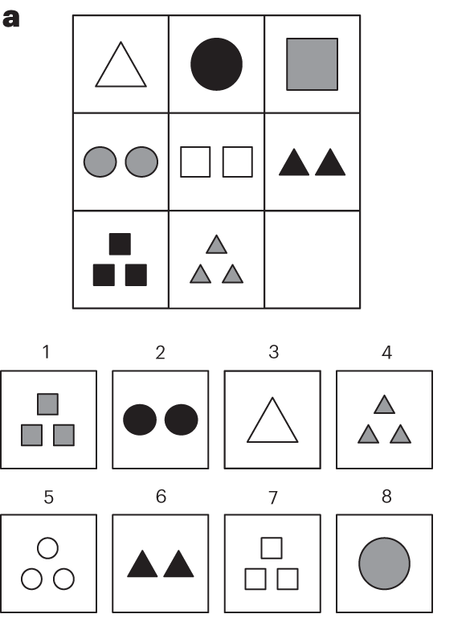
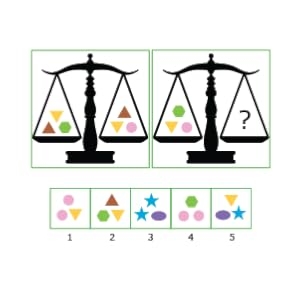
Figure Weights is a visual subtest that measures an individual’s logical and quantitative reasoning skills. In this test, you are shown a set of balances with various geometric shapes on them; you are then asked which options should be placed on the empty pan to keep the final balance in equilibrium.
Full Scale Intelligence Quotient (FSIQ) is a comprehensive scoring system that measures an individual's cognitive capacity. It represents the total score obtained from the Wechsler Scales, such as the WISC-V for children or the WAIS-IV for adults (the most widely used intelligence tests in the world) and is used to express human intelligence numerically. Although the sub-categories of the IQ test vary from version to version, it generally consists of five widely accepted tests: Processing Speed Index (PSI), Working Memory Index (WMI), Fluid Reasoning Index (FRI), Verbal Comprehension Index (VCI), and Visual Spatial Index (VSI). What I mentioned before.
PSI
Processing Speed Index (PSI) is the speed at which an individual perceives visual stimuli, processes the relationships between these stimuli mentally, and subsequently produces a motor response. PSI essentially measures three inseparable stages: visual perception, cognitive processing, and motor response. Efficiency across all three of these stages is reflected in the PSI score. It measures how rapidly and accurately you process visual information and convert it into a response.WMI
Working Memory Index (WMI) measures the capacity to actively hold information in the mental workspace, perform simultaneous processing on that information, and subsequently produce an output. As an example of this, we can cite an individual mentally sequencing numbers they have seen. Typically, in WAIS/WISC tests, you are presented with a series of numbers and asked to list them either in the order you saw them or in reverse order. However, these do not necessarily have to be numbers; pictures (similar visual elements) or sounds can also be incorporated into this process in the same manner.Example feat for these 2 categories
The best example feat we can provide in this regard is probably FMA (Flash Mental Arithmetic) feat. In FMA tests, you must first visually perceive the data that flashes on the screen in a fraction of a second. After perceiving it, you need to hold these numbers in your mind and simultaneously add them up. In other words, you are required to instantly process the visual information, manipulate it mentally (perform mathematical operations on it), and ultimately put it into practice by producing the correct answer (output).FRI
The Fluid Reasoning Index (FRI) is an index that measures an individual's capacity to solve new and unfamiliar problems they encounter, independent of what they have previously learned. Three fundamental forms of thinking come into play here. The first is inductive reasoning: the individual looks at multiple clues presented to them and independently discovers the underlying common rule; finding the missing matrix piece in the Matrix Reasoning subtest requires exactly this. The second is deductive reasoning, and contrary to popular belief, it is also used in the FRI; in the Figure Weights subtest, the individual derives a rule of balance from observations on a scale and applies this rule to a situation they have never seen before, meaning they first find the rule and then use it. The third is abstract reasoning: the individual can think solely through shapes and relationships without needing concrete objects or words; this characteristic makes the FRI one of the indices most independent of cultural and educational background. It also covers how you adapt to new situations and problems; since most of the questions you’re asked involve new and unique patterns, they require you to adapt to these problems.(Note: Inductive, deductive, adaptability and abstract reasoning are not individual subtests; these concepts are used to explain which thought processes the subtests activate.)
Matrix Reasoning subtest is a non-verbal assessment that measures an individual’s ability to identify the hidden rule in a visual pattern and fill in the missing piece. In this test, you are presented with a grid of shapes arranged according to a specific logic, and you are asked to identify which option should be placed in the empty box.
Figure Weights is a visual subtest that measures an individual’s logical and quantitative reasoning skills. In this test, you are shown a set of balances with various geometric shapes on them; you are then asked which options should be placed on the empty pan to keep the final balance in equilibrium.


