S
Subfiven
Iron
- Joined
- Nov 22, 2025
- Posts
- 2
- Reputation
- 2
Hi, I wanna to learn more about a few compounds. I’ll send them below.
Has anyone actually grown from this, and can it at least support height growth? Also, could it be a double-edged sword and potentially accelerate growth-plate closure?
Like this for example?
Abaloparatide 80 µg ED (until plates close)
Meclizine 25 mg ED (PM)
Lithium Orotate 20 mg ED
Epitalon 5 mg daily × 10 days → 20 days off
Vesugen 5 mg daily × 10 days → 20 days off
Senolytics – Fisetin 2 g + Quercetin 1 g ED for 2 days 1×/month (no antioxidants those 2 days)
Cartalax 1 mg daily
EPO 1000 IU × 2 per week
Thymalin 5 mg × 10 days / month (support runx1)
Support:
Glow stack
Ergothioneine 5 mg
Silicon (Orthosilicic Acid) 20 mg ED
PQQ 20 mg
MCHA Calcium+Phosphate (am)
Strontium Citrate 680 mg (pm)
Another slop from looksmax forums
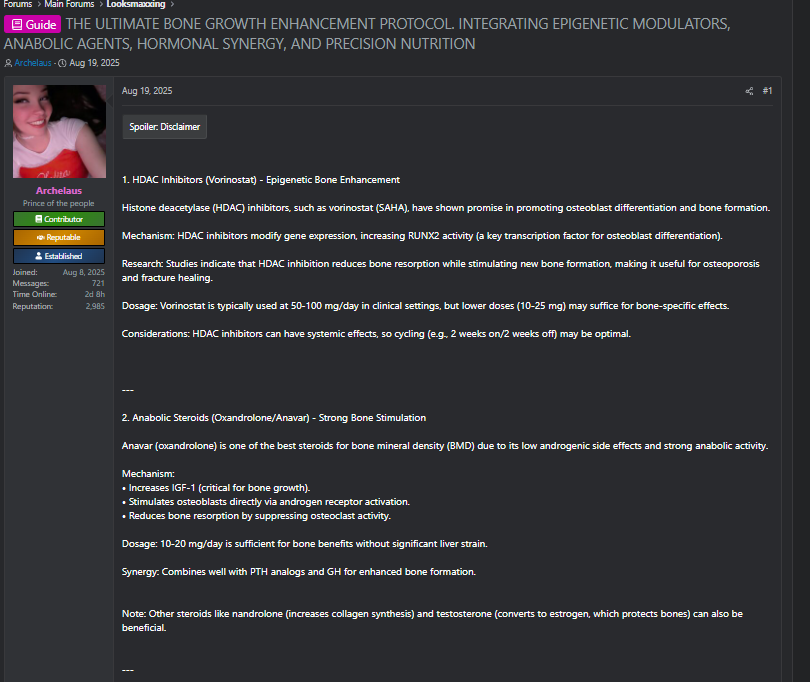
1. HDAC Inhibitors (Vorinostat) - Epigenetic Bone Enhancement
Histone deacetylase (HDAC) inhibitors, such as vorinostat (SAHA), have shown promise in promoting osteoblast differentiation and bone formation.
Mechanism: HDAC inhibitors modify gene expression, increasing RUNX2 activity (a key transcription factor for osteoblast differentiation).
Research: Studies indicate that HDAC inhibition reduces bone resorption while stimulating new bone formation, making it useful for osteoporosis and fracture healing.
Dosage: Vorinostat is typically used at 50-100 mg/day in clinical settings, but lower doses (10-25 mg) may suffice for bone-specific effects.
Considerations: HDAC inhibitors can have systemic effects, so cycling (e.g., 2 weeks on/2 weeks off) may be optimal.
---
2. Anabolic Steroids (Oxandrolone/Anavar) - Strong Bone Stimulation
Anavar (oxandrolone) is one of the best steroids for bone mineral density (BMD) due to its low androgenic side effects and strong anabolic activity.
Mechanism:
• Increases IGF-1 (critical for bone growth).
• Stimulates osteoblasts directly via androgen receptor activation.
• Reduces bone resorption by suppressing osteoclast activity.
Dosage: 10-20 mg/day is sufficient for bone benefits without significant liver strain.
Synergy: Combines well with PTH analogs and GH for enhanced bone formation.
Note: Other steroids like nandrolone (increases collagen synthesis) and testosterone (converts to estrogen, which protects bones) can also be beneficial.
---
3. Parathyroid Hormone (PTH) Analogs - The Gold Standard for Bone Growth
Teriparatide (Forteo) is an FDA-approved PTH(1-34) analog that dramatically increases bone density by stimulating osteoblasts.
Mechanism:
• Intermittent PTH (daily injections) boosts osteoblast activity.
• Increases calcium absorption in the gut and kidneys.
Dosage: 20 mcg/day subcutaneously (standard protocol).
Cycling: Limited to 18-24 months due to osteosarcoma risk (rare).
Alternative: Abaloparatide (a modified PTHrP analog) may be even more potent.
---
4. Aromatase Inhibitors (AIs) - Epiphyseal Plate Closure
Inhibiting estrogen is important for preventing/delaying epiphyseal plate closure to ensure that the long bones (arms, legs, spine, clavicles) remain in growth phase for longer.
---
5. Growth Hormone (GH) & IGF-1 - Critical for Bone Elongation & Density
GH and IGF-1 are essential for bone elongation (epiphyseal plate stimulation) and collagen synthesis.
Mechanism:
• GH → ↑ IGF-1 → osteoblast proliferation.
• Enhances calcium retention.
Dosage:
• 2-4 IU/day (for bone-specific benefits).
• IGF-1 LR3 (20-50 mcg/day) can be used alternatively.
Note: GH works best with adequate protein and resistance training.
---
6. Nutrition - The Foundation of Bone Growth
A. High Protein (mTOR Stimulation)
Mechanism: Leucine activates mTOR, increasing osteoblast activity.
Dosage: 1.6-2.2 g/kg bodyweight (prioritize whey, collagen, and bone broth).
B. Optimized Carbohydrate Intake (Insulin-Mediated Bone Formation)
Mechanism:
• Insulin is an anabolic hormone that enhances osteoblast activity and collagen synthesis.
• Carbohydrates post-workout spike insulin, improving nutrient delivery to bones.
Dosage: 3-5 g/kg bodyweight (adjust based on activity level).
Prioritize peri-workout carbs (e.g., dextrose, rice, oats) for maximal insulin sensitivity.
C. Vitamin D3 + K2 (Osteocalcin Activation)
D3 (5000-10,000 IU/day) → calcium absorption.
K2 (MK-4/MK-7) → activates osteocalcin, directing calcium into bones.
D. Magnesium, Zinc, Boron
Magnesium (400-600 mg/day) → cofactor for bone enzymes.
Zinc (30-50 mg/day) → collagen synthesis.
Boron (3-10 mg/day) → reduces calcium excretion.
E. Collagen & Hyaluronic Acid
Type II collagen (10-20 g/day) supports bone matrix formation.
---
7. Additional Considerations
A. Mechanical Loading (Weight-Bearing Exercise)
Resistance training and impact exercises (jumping) stimulate bone remodeling.
B. Progesterone (Potential Synergy)
Low-dose progesterone may enhance osteoblast activity (needs more research).
C. Pentoxifylline (TNF-α Inhibition)
Reduces bone resorption by suppressing inflammatory cytokines.
---
Bone Growth Stack
Vorinostat 50mg per day
Anavar - 50mg per day
Testosterone - only use if you can maintain low estradiol with an AI
Teriparatide - 20mcg per day
GH 5iu per day
Letrozole 0.5mg every other day
Vitamin K2 MK4 - 100mg per day (consumed with 10g+ fat)
Vitamin D3 - 10K IU per day (consumed with 10g + fat)
Protein 0.8g/lb bodyweight
Carbohydrates - 3-4g/lb bodyweight
---
Conclusion
The optimal bone growth stack combines pharmaceutical agents (HDAC inhibitors, PTH, steroids, GH) with targeted nutrition (high protein, strategic carbohydrate intake, D3/K2, collagen). Anavar and teriparatide are particularly potent, while vorinostat offers a novel epigenetic approach. Carbohydrate timing around workouts maximizes insulin's anabolic effects on bone, while protein and micronutrients provide the building blocks for osteogenesis. Aromatase inhibitors can delay ephiphyseal plate closure which means a longer time for these compounds to exert their effects.
For best results, pair this stack with progressive resistance training, adequate recovery, and periodic blood work to monitor biomarkers like IGF-1, estrogen, and calcium levels.
TGF-B's Role in Bone Growth
1. Mechanisms of Action
TGF-B signaling influences bone development through:
Stimulation of Mesenchymal Stem Cells (MSCs) → Drives osteoblast and chondrocyte differentiation.
Enhancement of Extracellular Matrix (ECM) Deposition → Boosts collagen, osteocalcin, and alkaline phosphatase activity.
Modulation of Growth Plate Chondrocytes → Supports longitudinal bone growth before epiphyseal closure.
---
2. TGF-B vs. BMP Signaling
While BMPs primarily drive osteoblast differentiation, TGF-B has a broader regulatory role:
Early-stage osteogenesis (MSC recruitment)
Bone remodeling (coupling osteoblast-osteoclast activity)
Chondrocyte maintenance (critical for growth plate function)
---
TGF-B Agonists for Targeted Bone Growth
1. Height Growth (Epiphyseal Plate Stimulation)
TGF-B1 and TGF-B3 promote chondrocyte proliferation in growth plates.
Synergy with IGF-1: TGF-ẞ enhances IGF-1 receptor sensitivity, further stimulating long bone elongation.
HDACI Combo: HDAC inhibition may prolong TGF-B effects by preventing Smad7-mediated suppression of TGF-B signaling.
2. Clavicle Expansion (Intramembranous Ossification)
TGF-B agonists increase periosteal bone formation, widening clavicles.
Androgen Combo: Testosterone/SARMS + TGF-ẞ could enhance lateral clavicle growth for broader shoulders.
3. Mandibular & Maxillary Growth
Mandible: TGF-ẞ stimulates condylar cartilage growth and ramus elongation.
Maxilla: Enhances sutural expansion (midface projection).
HDACI Combo: Acetylation of Runx2/Smad4 may amplify osteogenic effects.
---
Synergistic Strategies: TGF-B + HDACI + Androgens/Growth Factors
1. TGF-B + HDAC Inhibition
HDACI prevent Smad7 suppression → Prolonged TGF-B/Smad signaling.
Increased BMP-2 expression → Further osteoblast stimulation.
2. TGF-B + Androgens (Testosterone/DHT/SARMs)
Androgens upregulate TGF-ẞ receptors in osteoblasts.
Enhanced mandibular and clavicular growth in androgen-sensitive areas.
3. TGF-B + IGF-1/BMPs
IGF-1 boosts chondrocyte proliferation, while TGF-ẞ maintains cartilage health.
BMP-2 + TGF-ẞ creates a stronger osteogenic signal than either alone.
---
Potential Clinical Applications
1. Orthopedics & Height Enhancement
Pediatric short stature: TGF-ẞ agonists + GH/IGF-1 therapy.
Late-stage growth plate stimulation: Before epiphyseal fusion.
2. Orthognathic & Aesthetic Bone Remodeling
Maxillary hypoplasia: TGF-B + palatal expanders.
Mandibular retrognathia: TGF-B + functional appliances.
3. Fracture Healing & Bone Grafting
Accelerates callus formation when combined with BMP-2/HDACI.
---
Risks & Limitations
1. Overgrowth & Asymmetry
Uncontrolled TGF-ẞ may cause heterotopic ossification or uneven bone growth.
2. Fibrotic Side Effects
Excessive TGF-ẞ can lead to tissue fibrosis (e.g., muscle stiffness, joint scarring).
3. Systemic vs. Localized Delivery
Local injections (e.g., mandibular condyle) may reduce side effects.
---
Introduction: BMPs and Bone Development
Bone Morphogenetic Proteins (BMPs) are master regulators of skeletal formation, playing critical roles in embryonic development and postnatal bone remodeling. As members of the TGF-B superfamily, BMPs stimulate osteoblast differentiation, bone mineralization, and fracture repair. This article explores how BMP agonists enhance osteoblast activity, their effects on bone development, and their therapeutic applications in orthopedics, dentistry, and skeletal regeneration.
---
BMP Signaling and Osteoblast Regulation
1. BMP Receptor Activation
BMPs bind to type I and type II serine/threonine kinase receptors, triggering downstream signaling via:
Smad-dependent pathway: Smad1/5/8 phosphorylation → complex with Smad4 → nuclear translocation.
Non-Smad pathways: MAPK, PI3K/AKT.
2. Osteoblast Differentiation
BMP signaling drives bone formation by:
Inducing Runx2 and Osterix — Master transcription factors for osteoblast lineage commitment.
Enhancing ALP and Osteocalcin — Key markers of mature osteoblasts.
Stimulating Collagen I Synthesis — Essential for bone matrix deposition.
3. Cross-Talk with Other Pathways
Wnt/β-catenin: BMPs synergize with Wnt to amplify osteogenesis.
Hedgehog (Ihh): Critical for endochondral ossification during development.
IGF-1 & FGF: Enhance BMP-mediated bone formation.
---
BMP Agonists and Their Effects on Bone Development
1. Natural BMP Ligands
BMP-2 & BMP-7 (OP-1) — Most studied for osteoinduction; used clinically in spinal fusion and fracture repair.
BMP-4 & BMP-6 — Also potent, but with varying tissue specificity.
GDF-5 (BMP-14) — Important for joint and cartilage formation.
2. Synthetic & Small-Molecule BMP Agonists
KUS121 (a VCP modulator) — Enhances BMP-2-induced osteogenesis.
Thiazovivin (ROCK inhibitor) — Boosts BMP signaling in mesenchymal stem cells (MSCs).
Strontium ranelate — Mimics BMP effects by activating calcium-sensing receptors.
3. Effects on Different Bone Types
Long Bones (Height Growth): Stimulates growth plate chondrocytes → endochondral ossification.
Clavicle (Intramembranous Bone): Directly increases osteoblast-mediated bone deposition.
Mandible/Maxilla (Craniofacial Bones): Enhances sutural expansion and condylar growth.
Trabecular Bone (Spine/Hips): Improves bone density by increasing osteoblast activity.
---
Therapeutic Applications
1. Orthopedics & Fracture Healing
FDA-approved BMP-2 (Infuse®) — Used in spinal fusion, tibial non-unions.
BMP-7 (OP-1) — Approved for recalcitrant long bone fractures.
2. Dental & Maxillofacial Reconstruction
Alveolar ridge augmentation — BMP-2 accelerates jawbone regeneration.
Sinus lift procedures — BMP-soaked collagen sponges enhance bone graft success.
3. Osteoporosis & Age-Related Bone Loss
Local BMP delivery may counteract age-related osteoblast decline.
Combination with PTH (teriparatide) — Potential for stronger anabolic effects.
---
Challenges & Limitations
1. Overactive Bone Formation
Ectopic ossification — Uncontrolled BMP signaling can cause abnormal bone growth in soft tissues.
Dose-dependent side effects — High BMP doses may lead to inflammation or resorption.
2. Delivery Issues
Short half-life — Requires carrier systems (e.g., collagen scaffolds, hydrogels).
Cost — Recombinant BMP therapies are expensive.
3. Alternative Strategies
BMP gene therapy (e.g., viral vectors encoding BMP-2).
Small-molecule enhancers (e.g., LDN-193189 derivatives that fine-tune BMPR activity).
---
Conclusion
BMP agonists are powerful stimulators of osteoblast differentiation and bone formation, with wide-ranging applications in orthopedics, dentistry, and skeletal repair. While challenges like ectopic ossification and high costs remain, advances in targeted delivery and combination therapies (e.g., with HDAC inhibitors or IGF-1) could unlock new treatments for bone defects, osteoporosis, and craniofacial reconstruction. Future rese
arch should focus on precision modulation of BMP signaling to maximize efficacy while minimizing risks.
or this low dose tren like 5mg ED
TREN FOR HEIGHT GROWTH (RAW)
TREN (from file):
- activates satellite cells
- affects mesenchymal stem cells (MSC)
- MSCs → control final bone growth
- normal doses → chondrocyte maturation (plate closure)
TREN
- Satellite cells → MSCs
- theoretical microdose
AND
Vosotiride but this is is very expensive
Reduces columnar chondrocyte proliferation
Disrupts endochondral ossification
Reduces growth plate thickness
Increases chondrocyte terminal differentiation gene expression
The doses I’ve seen online seem random, since most of them come from looksmaxing forums. I’m mainly interested in learning about how PTH analogs and other related compounds are supposed to work.
Somebody grow from this ?
I'm probally will buy HGH and AI because it's promising .
For context, I’m 17 and around 186.5 cm tall in the morning, and I believe my growth plates are still open. I’d like to understand whether there is any real scientific basis for influencing height at my age. In Europe people tend to be very tall, so I’m curious whether late growth is still possible.
Two months ago my height have been 184.5 cm and i'm still growing but i think i will do wrist scan to rate my boneage .
I’ve been working during the holidays, so I have the resources to research proper medical guidance. I just want to make sure I’m not looking into anything that could be harmful or accelerate growth plate closure.
Has anyone actually grown from this, and can it at least support height growth? Also, could it be a double-edged sword and potentially accelerate growth-plate closure?
Like this for example?
Abaloparatide 80 µg ED (until plates close)
Meclizine 25 mg ED (PM)
Lithium Orotate 20 mg ED
Epitalon 5 mg daily × 10 days → 20 days off
Vesugen 5 mg daily × 10 days → 20 days off
Senolytics – Fisetin 2 g + Quercetin 1 g ED for 2 days 1×/month (no antioxidants those 2 days)
Cartalax 1 mg daily
EPO 1000 IU × 2 per week
Thymalin 5 mg × 10 days / month (support runx1)
Support:
Glow stack
Ergothioneine 5 mg
Silicon (Orthosilicic Acid) 20 mg ED
PQQ 20 mg
MCHA Calcium+Phosphate (am)
Strontium Citrate 680 mg (pm)
Another slop from looksmax forums
1. HDAC Inhibitors (Vorinostat) - Epigenetic Bone Enhancement
Histone deacetylase (HDAC) inhibitors, such as vorinostat (SAHA), have shown promise in promoting osteoblast differentiation and bone formation.
Mechanism: HDAC inhibitors modify gene expression, increasing RUNX2 activity (a key transcription factor for osteoblast differentiation).
Research: Studies indicate that HDAC inhibition reduces bone resorption while stimulating new bone formation, making it useful for osteoporosis and fracture healing.
Dosage: Vorinostat is typically used at 50-100 mg/day in clinical settings, but lower doses (10-25 mg) may suffice for bone-specific effects.
Considerations: HDAC inhibitors can have systemic effects, so cycling (e.g., 2 weeks on/2 weeks off) may be optimal.
---
2. Anabolic Steroids (Oxandrolone/Anavar) - Strong Bone Stimulation
Anavar (oxandrolone) is one of the best steroids for bone mineral density (BMD) due to its low androgenic side effects and strong anabolic activity.
Mechanism:
• Increases IGF-1 (critical for bone growth).
• Stimulates osteoblasts directly via androgen receptor activation.
• Reduces bone resorption by suppressing osteoclast activity.
Dosage: 10-20 mg/day is sufficient for bone benefits without significant liver strain.
Synergy: Combines well with PTH analogs and GH for enhanced bone formation.
Note: Other steroids like nandrolone (increases collagen synthesis) and testosterone (converts to estrogen, which protects bones) can also be beneficial.
---
3. Parathyroid Hormone (PTH) Analogs - The Gold Standard for Bone Growth
Teriparatide (Forteo) is an FDA-approved PTH(1-34) analog that dramatically increases bone density by stimulating osteoblasts.
Mechanism:
• Intermittent PTH (daily injections) boosts osteoblast activity.
• Increases calcium absorption in the gut and kidneys.
Dosage: 20 mcg/day subcutaneously (standard protocol).
Cycling: Limited to 18-24 months due to osteosarcoma risk (rare).
Alternative: Abaloparatide (a modified PTHrP analog) may be even more potent.
---
4. Aromatase Inhibitors (AIs) - Epiphyseal Plate Closure
Inhibiting estrogen is important for preventing/delaying epiphyseal plate closure to ensure that the long bones (arms, legs, spine, clavicles) remain in growth phase for longer.
---
5. Growth Hormone (GH) & IGF-1 - Critical for Bone Elongation & Density
GH and IGF-1 are essential for bone elongation (epiphyseal plate stimulation) and collagen synthesis.
Mechanism:
• GH → ↑ IGF-1 → osteoblast proliferation.
• Enhances calcium retention.
Dosage:
• 2-4 IU/day (for bone-specific benefits).
• IGF-1 LR3 (20-50 mcg/day) can be used alternatively.
Note: GH works best with adequate protein and resistance training.
---
6. Nutrition - The Foundation of Bone Growth
A. High Protein (mTOR Stimulation)
Mechanism: Leucine activates mTOR, increasing osteoblast activity.
Dosage: 1.6-2.2 g/kg bodyweight (prioritize whey, collagen, and bone broth).
B. Optimized Carbohydrate Intake (Insulin-Mediated Bone Formation)
Mechanism:
• Insulin is an anabolic hormone that enhances osteoblast activity and collagen synthesis.
• Carbohydrates post-workout spike insulin, improving nutrient delivery to bones.
Dosage: 3-5 g/kg bodyweight (adjust based on activity level).
Prioritize peri-workout carbs (e.g., dextrose, rice, oats) for maximal insulin sensitivity.
C. Vitamin D3 + K2 (Osteocalcin Activation)
D3 (5000-10,000 IU/day) → calcium absorption.
K2 (MK-4/MK-7) → activates osteocalcin, directing calcium into bones.
D. Magnesium, Zinc, Boron
Magnesium (400-600 mg/day) → cofactor for bone enzymes.
Zinc (30-50 mg/day) → collagen synthesis.
Boron (3-10 mg/day) → reduces calcium excretion.
E. Collagen & Hyaluronic Acid
Type II collagen (10-20 g/day) supports bone matrix formation.
---
7. Additional Considerations
A. Mechanical Loading (Weight-Bearing Exercise)
Resistance training and impact exercises (jumping) stimulate bone remodeling.
B. Progesterone (Potential Synergy)
Low-dose progesterone may enhance osteoblast activity (needs more research).
C. Pentoxifylline (TNF-α Inhibition)
Reduces bone resorption by suppressing inflammatory cytokines.
---
Bone Growth Stack
Vorinostat 50mg per day
Anavar - 50mg per day
Testosterone - only use if you can maintain low estradiol with an AI
Teriparatide - 20mcg per day
GH 5iu per day
Letrozole 0.5mg every other day
Vitamin K2 MK4 - 100mg per day (consumed with 10g+ fat)
Vitamin D3 - 10K IU per day (consumed with 10g + fat)
Protein 0.8g/lb bodyweight
Carbohydrates - 3-4g/lb bodyweight
---
Conclusion
The optimal bone growth stack combines pharmaceutical agents (HDAC inhibitors, PTH, steroids, GH) with targeted nutrition (high protein, strategic carbohydrate intake, D3/K2, collagen). Anavar and teriparatide are particularly potent, while vorinostat offers a novel epigenetic approach. Carbohydrate timing around workouts maximizes insulin's anabolic effects on bone, while protein and micronutrients provide the building blocks for osteogenesis. Aromatase inhibitors can delay ephiphyseal plate closure which means a longer time for these compounds to exert their effects.
For best results, pair this stack with progressive resistance training, adequate recovery, and periodic blood work to monitor biomarkers like IGF-1, estrogen, and calcium levels.
TGF-B's Role in Bone Growth
1. Mechanisms of Action
TGF-B signaling influences bone development through:
Stimulation of Mesenchymal Stem Cells (MSCs) → Drives osteoblast and chondrocyte differentiation.
Enhancement of Extracellular Matrix (ECM) Deposition → Boosts collagen, osteocalcin, and alkaline phosphatase activity.
Modulation of Growth Plate Chondrocytes → Supports longitudinal bone growth before epiphyseal closure.
---
2. TGF-B vs. BMP Signaling
While BMPs primarily drive osteoblast differentiation, TGF-B has a broader regulatory role:
Early-stage osteogenesis (MSC recruitment)
Bone remodeling (coupling osteoblast-osteoclast activity)
Chondrocyte maintenance (critical for growth plate function)
---
TGF-B Agonists for Targeted Bone Growth
1. Height Growth (Epiphyseal Plate Stimulation)
TGF-B1 and TGF-B3 promote chondrocyte proliferation in growth plates.
Synergy with IGF-1: TGF-ẞ enhances IGF-1 receptor sensitivity, further stimulating long bone elongation.
HDACI Combo: HDAC inhibition may prolong TGF-B effects by preventing Smad7-mediated suppression of TGF-B signaling.
2. Clavicle Expansion (Intramembranous Ossification)
TGF-B agonists increase periosteal bone formation, widening clavicles.
Androgen Combo: Testosterone/SARMS + TGF-ẞ could enhance lateral clavicle growth for broader shoulders.
3. Mandibular & Maxillary Growth
Mandible: TGF-ẞ stimulates condylar cartilage growth and ramus elongation.
Maxilla: Enhances sutural expansion (midface projection).
HDACI Combo: Acetylation of Runx2/Smad4 may amplify osteogenic effects.
---
Synergistic Strategies: TGF-B + HDACI + Androgens/Growth Factors
1. TGF-B + HDAC Inhibition
HDACI prevent Smad7 suppression → Prolonged TGF-B/Smad signaling.
Increased BMP-2 expression → Further osteoblast stimulation.
2. TGF-B + Androgens (Testosterone/DHT/SARMs)
Androgens upregulate TGF-ẞ receptors in osteoblasts.
Enhanced mandibular and clavicular growth in androgen-sensitive areas.
3. TGF-B + IGF-1/BMPs
IGF-1 boosts chondrocyte proliferation, while TGF-ẞ maintains cartilage health.
BMP-2 + TGF-ẞ creates a stronger osteogenic signal than either alone.
---
Potential Clinical Applications
1. Orthopedics & Height Enhancement
Pediatric short stature: TGF-ẞ agonists + GH/IGF-1 therapy.
Late-stage growth plate stimulation: Before epiphyseal fusion.
2. Orthognathic & Aesthetic Bone Remodeling
Maxillary hypoplasia: TGF-B + palatal expanders.
Mandibular retrognathia: TGF-B + functional appliances.
3. Fracture Healing & Bone Grafting
Accelerates callus formation when combined with BMP-2/HDACI.
---
Risks & Limitations
1. Overgrowth & Asymmetry
Uncontrolled TGF-ẞ may cause heterotopic ossification or uneven bone growth.
2. Fibrotic Side Effects
Excessive TGF-ẞ can lead to tissue fibrosis (e.g., muscle stiffness, joint scarring).
3. Systemic vs. Localized Delivery
Local injections (e.g., mandibular condyle) may reduce side effects.
---
Introduction: BMPs and Bone Development
Bone Morphogenetic Proteins (BMPs) are master regulators of skeletal formation, playing critical roles in embryonic development and postnatal bone remodeling. As members of the TGF-B superfamily, BMPs stimulate osteoblast differentiation, bone mineralization, and fracture repair. This article explores how BMP agonists enhance osteoblast activity, their effects on bone development, and their therapeutic applications in orthopedics, dentistry, and skeletal regeneration.
---
BMP Signaling and Osteoblast Regulation
1. BMP Receptor Activation
BMPs bind to type I and type II serine/threonine kinase receptors, triggering downstream signaling via:
Smad-dependent pathway: Smad1/5/8 phosphorylation → complex with Smad4 → nuclear translocation.
Non-Smad pathways: MAPK, PI3K/AKT.
2. Osteoblast Differentiation
BMP signaling drives bone formation by:
Inducing Runx2 and Osterix — Master transcription factors for osteoblast lineage commitment.
Enhancing ALP and Osteocalcin — Key markers of mature osteoblasts.
Stimulating Collagen I Synthesis — Essential for bone matrix deposition.
3. Cross-Talk with Other Pathways
Wnt/β-catenin: BMPs synergize with Wnt to amplify osteogenesis.
Hedgehog (Ihh): Critical for endochondral ossification during development.
IGF-1 & FGF: Enhance BMP-mediated bone formation.
---
BMP Agonists and Their Effects on Bone Development
1. Natural BMP Ligands
BMP-2 & BMP-7 (OP-1) — Most studied for osteoinduction; used clinically in spinal fusion and fracture repair.
BMP-4 & BMP-6 — Also potent, but with varying tissue specificity.
GDF-5 (BMP-14) — Important for joint and cartilage formation.
2. Synthetic & Small-Molecule BMP Agonists
KUS121 (a VCP modulator) — Enhances BMP-2-induced osteogenesis.
Thiazovivin (ROCK inhibitor) — Boosts BMP signaling in mesenchymal stem cells (MSCs).
Strontium ranelate — Mimics BMP effects by activating calcium-sensing receptors.
3. Effects on Different Bone Types
Long Bones (Height Growth): Stimulates growth plate chondrocytes → endochondral ossification.
Clavicle (Intramembranous Bone): Directly increases osteoblast-mediated bone deposition.
Mandible/Maxilla (Craniofacial Bones): Enhances sutural expansion and condylar growth.
Trabecular Bone (Spine/Hips): Improves bone density by increasing osteoblast activity.
---
Therapeutic Applications
1. Orthopedics & Fracture Healing
FDA-approved BMP-2 (Infuse®) — Used in spinal fusion, tibial non-unions.
BMP-7 (OP-1) — Approved for recalcitrant long bone fractures.
2. Dental & Maxillofacial Reconstruction
Alveolar ridge augmentation — BMP-2 accelerates jawbone regeneration.
Sinus lift procedures — BMP-soaked collagen sponges enhance bone graft success.
3. Osteoporosis & Age-Related Bone Loss
Local BMP delivery may counteract age-related osteoblast decline.
Combination with PTH (teriparatide) — Potential for stronger anabolic effects.
---
Challenges & Limitations
1. Overactive Bone Formation
Ectopic ossification — Uncontrolled BMP signaling can cause abnormal bone growth in soft tissues.
Dose-dependent side effects — High BMP doses may lead to inflammation or resorption.
2. Delivery Issues
Short half-life — Requires carrier systems (e.g., collagen scaffolds, hydrogels).
Cost — Recombinant BMP therapies are expensive.
3. Alternative Strategies
BMP gene therapy (e.g., viral vectors encoding BMP-2).
Small-molecule enhancers (e.g., LDN-193189 derivatives that fine-tune BMPR activity).
---
Conclusion
BMP agonists are powerful stimulators of osteoblast differentiation and bone formation, with wide-ranging applications in orthopedics, dentistry, and skeletal repair. While challenges like ectopic ossification and high costs remain, advances in targeted delivery and combination therapies (e.g., with HDAC inhibitors or IGF-1) could unlock new treatments for bone defects, osteoporosis, and craniofacial reconstruction. Future rese
arch should focus on precision modulation of BMP signaling to maximize efficacy while minimizing risks.
or this low dose tren like 5mg ED
TREN FOR HEIGHT GROWTH (RAW)
TREN (from file):
- activates satellite cells
- affects mesenchymal stem cells (MSC)
- MSCs → control final bone growth
- normal doses → chondrocyte maturation (plate closure)
TREN
- Satellite cells → MSCs
- theoretical microdose
AND
Vosotiride but this is is very expensive
Reduces columnar chondrocyte proliferation
Disrupts endochondral ossification
Reduces growth plate thickness
Increases chondrocyte terminal differentiation gene expression
The doses I’ve seen online seem random, since most of them come from looksmaxing forums. I’m mainly interested in learning about how PTH analogs and other related compounds are supposed to work.
Somebody grow from this ?
I'm probally will buy HGH and AI because it's promising .
For context, I’m 17 and around 186.5 cm tall in the morning, and I believe my growth plates are still open. I’d like to understand whether there is any real scientific basis for influencing height at my age. In Europe people tend to be very tall, so I’m curious whether late growth is still possible.
Two months ago my height have been 184.5 cm and i'm still growing but i think i will do wrist scan to rate my boneage .
I’ve been working during the holidays, so I have the resources to research proper medical guidance. I just want to make sure I’m not looking into anything that could be harmful or accelerate growth plate closure.