

lightswinning
Bronze
- Joined
- Oct 3, 2023
- Posts
- 431
- Reputation
- 478
INTRODUCTION
The significant issue one faces when trying to maximize their eyearea is the fear of underye and orbital subcutaneous fatloss caused by compounds such as Latisse and Tropical Minoxidil, when trying to increase their eyelash and eyebrow density. We all know tropical minoxidil has its own unwanted side effects such as severe bloating, hence that cannot be an option that can be resorted to.
STUDIES
"The mean volume of orbital fat and the mean enophthalmos value on the treated side were significantly smaller than those on the untreated side, whereas there were no significant differences in the mean orbital fat volumes of the other measured tissues (i.e., extraocular muscles, eyeball, optic nerve). Hence, this study quantitatively revealed that enophthalmos could be caused by the bimatoprost-induced decrease in orbital fat. In addition, the orbital fat volumes showed statistically significant positive correlations with the enophthalmos values on both the treated and untreated sides. These correlations support our hypothesized mechanism. Jayaprakasam and Ghazi-Nouri reported the MRI features of orbital fat atrophy in one patient using bimatoprost [25], but they did not show quantitatively that the decrease in orbital fat was due to bimatoprost. Our current study quantitatively revealed not only the decrease in orbital fat but also its relation to enophthalmos."
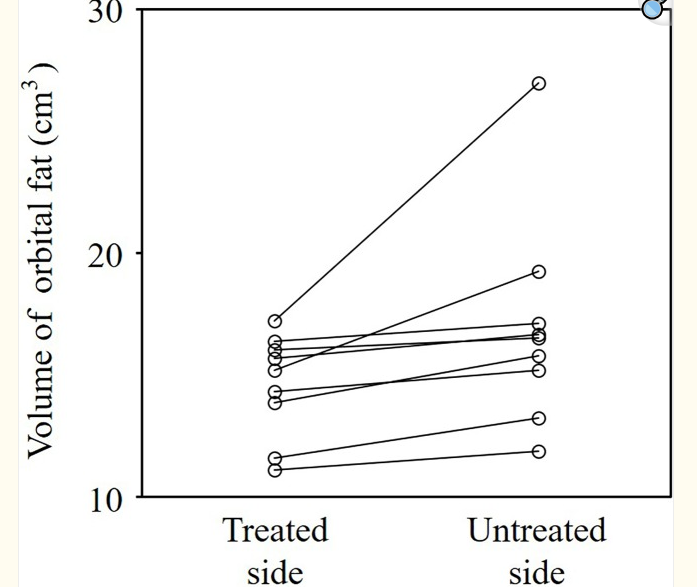
As you can clearly see here, the orbital fat volume for those treated with bimatoprost is comparatively lower as compared to the treated side.
POSSIBLE MECHANISM OF ACTION:
Enophthalmos is the inward displacement of the eyeball within the orbit, causing the eye to appear sunken. It is caused by a reduction in orbital volume, which can result from conditions like orbital fractures, fat atrophy, enlargement of the bony orbit, or tumors. The opposite condition is exophthalmos, where the eye protrudes forward.
It is well documented that prostaglandin analogues (PGAs) used topically (for glaucoma or for lash-growth) can cause a syndrome called Prostaglandin‑Associated Periorbitopathy (PAP) — characterized by periorbital fat atrophy, deepening of the upper-eyelid sulcus, “sunken eyes,” lower eyelid hollowing, and even enophthalmos
The mechanism of PAP (e.g., enophthalmos) due to PGF2α analogs remains unclear. The important regulators of fat cell lipolysis are hormones—mainly insulin, catecholamines, natriuretic peptides—and paracrine factors such as prostaglandins, cytokines, and adenosine [26]. Some reports stated that activation of PGF2α receptors could inhibit adipocyte differentiation [27–29]. Serrero and Lepak investigated the effect of receptor agonists on the differentiation of newborn rat adipocytes in primary cultures and reported that PGF2α receptor agonists were indeed potent inhibitors of adipocyte differentiation [28]. Thus, PAPs due to PGF2α analogs could be caused by that mechanism.
MINOXIDIL ( Tropical) :
There is no scientific literature that evidently shows a positive correlation between preorbital fatloss caused by tropical minoxidil, however plenty of anecdotal experiences show that it might be a possibility.
THE POTENTIAL USE OF PETRALOTUM( VASELINE) AND AQUAPHOR AS A SOLUTION:
In short: Vaseline / Aquaphor create a physical, hydrophobic barrier on skin — like an “invisible tarp” — which can block or slow down water-soluble or partially water/ alcohol-soluble substances from penetrating, or at least prevent them from directly contacting delicate skin.
Therefore, in theory — and likely in practice — applying a sufficiently thick, intact layer of Vaseline/Aquaphor under the eyes or on the eyelids before applying a topical agent (like Minoxidil or Latisse) should significantly reduce or block direct contact of the active drug with the periorbital skin. That means:
HOW TO APPLY:
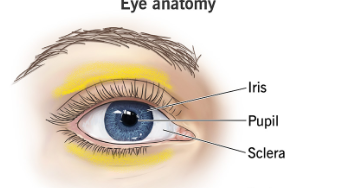
Apply the vaseline gently on the yellow region marked here and your focus must be to cover the FAT layer and not the upper eyelid itself, apply the cream steadily and make sure it dosent stick onto your lashes or brows and only the region with subcutaneous fat pads here, your latisse might not work effectively if you get vaseline or aquaphor all over your lashes.
Now, carefully apply your latisse/ tropical minox over your lashes ( moderate amount) dont fucking paper it all over, wipe off all excess gently with a tissue.
Also make sure to reapply the cream post your minox and latisse usage for extra protection and reapply once every 4-5 hours carefully as the vaseline might dry off.
Thank you bhais
The significant issue one faces when trying to maximize their eyearea is the fear of underye and orbital subcutaneous fatloss caused by compounds such as Latisse and Tropical Minoxidil, when trying to increase their eyelash and eyebrow density. We all know tropical minoxidil has its own unwanted side effects such as severe bloating, hence that cannot be an option that can be resorted to.
STUDIES
"The mean volume of orbital fat and the mean enophthalmos value on the treated side were significantly smaller than those on the untreated side, whereas there were no significant differences in the mean orbital fat volumes of the other measured tissues (i.e., extraocular muscles, eyeball, optic nerve). Hence, this study quantitatively revealed that enophthalmos could be caused by the bimatoprost-induced decrease in orbital fat. In addition, the orbital fat volumes showed statistically significant positive correlations with the enophthalmos values on both the treated and untreated sides. These correlations support our hypothesized mechanism. Jayaprakasam and Ghazi-Nouri reported the MRI features of orbital fat atrophy in one patient using bimatoprost [25], but they did not show quantitatively that the decrease in orbital fat was due to bimatoprost. Our current study quantitatively revealed not only the decrease in orbital fat but also its relation to enophthalmos."
Fig 3. Orbital fat volumes on the treated and untreated sides
As you can clearly see here, the orbital fat volume for those treated with bimatoprost is comparatively lower as compared to the treated side.
POSSIBLE MECHANISM OF ACTION:
Enophthalmos is the inward displacement of the eyeball within the orbit, causing the eye to appear sunken. It is caused by a reduction in orbital volume, which can result from conditions like orbital fractures, fat atrophy, enlargement of the bony orbit, or tumors. The opposite condition is exophthalmos, where the eye protrudes forward.
It is well documented that prostaglandin analogues (PGAs) used topically (for glaucoma or for lash-growth) can cause a syndrome called Prostaglandin‑Associated Periorbitopathy (PAP) — characterized by periorbital fat atrophy, deepening of the upper-eyelid sulcus, “sunken eyes,” lower eyelid hollowing, and even enophthalmos
The mechanism of PAP (e.g., enophthalmos) due to PGF2α analogs remains unclear. The important regulators of fat cell lipolysis are hormones—mainly insulin, catecholamines, natriuretic peptides—and paracrine factors such as prostaglandins, cytokines, and adenosine [26]. Some reports stated that activation of PGF2α receptors could inhibit adipocyte differentiation [27–29]. Serrero and Lepak investigated the effect of receptor agonists on the differentiation of newborn rat adipocytes in primary cultures and reported that PGF2α receptor agonists were indeed potent inhibitors of adipocyte differentiation [28]. Thus, PAPs due to PGF2α analogs could be caused by that mechanism.
MINOXIDIL ( Tropical) :
There is no scientific literature that evidently shows a positive correlation between preorbital fatloss caused by tropical minoxidil, however plenty of anecdotal experiences show that it might be a possibility.
THE POTENTIAL USE OF PETRALOTUM( VASELINE) AND AQUAPHOR AS A SOLUTION:
What are Vaseline / Aquaphor and how they work as a barrier
- Petroleum jelly (the main ingredient in Vaseline) — and petrolatum-based ointments more broadly — are classic occlusive moisturizers/barrier protectants. NCBI+2WebMD+2
- “Occlusive” means they form a hydrophobic film on the skin surface that dramatically reduces transepidermal water loss (TEWL) and helps the skin retain moisture. NCBI+2PubMed+2
- Because petrolatum doesn’t readily absorb into deeper skin layers or undergo chemical change in the skin — it remains mostly inert on top of the skin surface — it’s considered a safe, non-irritating option for barrier protection, even on sensitive skin. MDPI+2PubMed+2
- When applied, it can help restore/protect the skin barrier, reducing dryness, irritation, and making skin more resistant to external insults/irritants. PubMed+2US Dermatology Partners+2
In short: Vaseline / Aquaphor create a physical, hydrophobic barrier on skin — like an “invisible tarp” — which can block or slow down water-soluble or partially water/ alcohol-soluble substances from penetrating, or at least prevent them from directly contacting delicate skin.
- In a classic human-skin study, researchers found that petrolatum (e.g., Vaseline) not only is occlusive but accelerates skin barrier recovery after barrier disruption — it integrates into the outer skin (stratum corneum) and helps restore barrier function. PubMed+1
- Petrolatum boosts skin barrier repair: it upregulates skin-barrier proteins (like filaggrin, loricrin), improves stratum corneum integrity, reduces inflammation and helps epidermal differentiation. PubMed+1
- Compared head-to-head with other oils, mineral oils, vegetable oils, petrolatum was shown to have the strongest occlusive effect (i.e. best reduction of water loss / strongest barrier). PubMed+2PubMed+2
- Petrolatum-based barrier ointments are widely used in wound care, eczema, skin-irritation prevention, and postoperative care — contexts where barrier protection is essential and the skin ought to avoid contact with irritants/medications.
Therefore, in theory — and likely in practice — applying a sufficiently thick, intact layer of Vaseline/Aquaphor under the eyes or on the eyelids before applying a topical agent (like Minoxidil or Latisse) should significantly reduce or block direct contact of the active drug with the periorbital skin. That means:
- If some liquid or foam “drips” or “migrates” downward, it lands on the barrier rather than skin, and can be wiped off.
- Absorption into the thin under-eye skin is minimized because the barrier acts as a physical blockade.
- This reduces risk of irritation, dryness, or any potential compound-induced damage (e.g. fat-cell effects, atrophy, etc.) — assuming the barrier stays intact and is properly applied.
HOW TO APPLY:
Apply the vaseline gently on the yellow region marked here and your focus must be to cover the FAT layer and not the upper eyelid itself, apply the cream steadily and make sure it dosent stick onto your lashes or brows and only the region with subcutaneous fat pads here, your latisse might not work effectively if you get vaseline or aquaphor all over your lashes.
Now, carefully apply your latisse/ tropical minox over your lashes ( moderate amount) dont fucking paper it all over, wipe off all excess gently with a tissue.
Also make sure to reapply the cream post your minox and latisse usage for extra protection and reapply once every 4-5 hours carefully as the vaseline might dry off.
Thank you bhais