
Alexanderr

Admin
- Joined
- Mar 5, 2019
- Posts
- 22,497
- Reputation
- 48,892
Introduction
In feedback on earlier surveys, several users asked whether high-activity posters differ from newer or less active users. To check this, I ran two identical surveys: one sent to users with <1K posts and one to users with >1K posts.
This thread shows only the differences between those two groups, where they’re meaningful. I’m not doing a separate write-up of the >1K results here.
For transparency, the full >1K survey results will be posted below via Google Forms, so anyone can inspect the raw distributions themselves.
 High-posters are older on average, especially concentrated in 18–25.
High-posters are taller on average.
High-posters are less North-American, more European.
High-posters are more educated.
High-posters are less institutionally anchored.
High-posters are more secular / anti-religious.
High-posters are poorer relative to peers.
High-posters are more financially dependent.
High-posters show class polarization.
High-posters are less physically active.
High-posters are more likely to have had surgery.
High-posters are more committed, less ambivalent.
Slightly higher impairment among high-posters.
High-posters leave home somewhat less often overall.
Differences are small and not clearly directional.
High-posters are more aggressive medically.
High-posters are more likely to report never receiving compliments.
High-posters are more likely to report no or online-only friendships.
High-posters are slightly less likely to want children.
High-posters are more willing to exit local dating markets.
High-posters are less happy overall.
Same virginity rate, but polarization increases.
High-posters skew more extreme at both ends.
High-posters are more self-critical.
High-posters report noticeably less frequent interaction with women.
High-posters spend more time on the forum overall, with a heavier tail of very high-use users.
High-posters express more negative sentiment toward women.
High-posters report lower satisfaction than <1K, but a majority (~59%) are still satisfied.
Neurodivergence more common or more suspected.
High-posters report greater appearance improvement overall, with more respondents reporting large gains.
High-posters are less convinced improvement pays off.
High-posters are slightly angrier.
High-posters are more confident cognitively, not emotionally.
High-posters are deeply disillusioned.
High-posters entered earlier, slower pipelines.
What the data actually shows about >1K posters
Not here to moralize, just looking at what actually separates people here. The question is: what kind of selection process produces someone who hits 1000+ posts?
The data suggests high-posters aren't just "more engaged normies"; they're a functionally different population. Here's what separates them:
Social isolation is way more pronounced.
High-posters are older, spend more time here, interact with women less, and are less socially connected. Classic substitution pattern: the forum isn't supplementing their social life, it's increasingly becoming it.
Mental state is noticeably darker.
Lower happiness, higher anger/hostility, more frequent mockery of others, and more negative sentiment toward women But here's the twist: self-ratings don't tank. Most still rate themselves average-to-above. Translation: the bitterness is outward-facing, not just self-hatred spiraling.
Looksmaxxing effort goes up, faith in it goes down.
More prescriptions, more surgeries considered/done, bigger reported improvements. But also way more skepticism that any of it actually changes how people treat them. Diminishing returns in action-- the more you invest, the less each gain seems to matter.
Romantic outcomes don't improve, they polarize.
Virgin rates stay similar, but high-posters show more extremes: more escortcelling, more rejection stories, more complete isolation, and a small minority with unusually high counts. It's not a linear progression upward, it's forking into opposite ends.
Long-term users are blackpilled on the forum itself.
Despite being the most active, they're more likely to say it's declining and less likely to recommend it. They're not here because it's working-- they're here because everything else feels worse or nonexistent.
The model that fits best: selection + reinforcement loop
TLDR: >1K posters are more isolated, more bitter, looksmax harder while believing in it less, and have worse outcomes. Post count tracks who's trapped here, not who's making it.
Complete survey results (>1K users) are available here:

 docs.google.com
In feedback on earlier surveys, several users asked whether high-activity posters differ from newer or less active users. To check this, I ran two identical surveys: one sent to users with <1K posts and one to users with >1K posts.
This thread shows only the differences between those two groups, where they’re meaningful. I’m not doing a separate write-up of the >1K results here.
For transparency, the full >1K survey results will be posted below via Google Forms, so anyone can inspect the raw distributions themselves.
1. Age
Significant difference- <1K posts: ~90% under 21, heavily under 18
- >1K posts:Older skew
- Under 18 drops sharply
- 18–25 dominates
- Noticeable 26–30 presence
High-posters are older on average, especially concentrated in 18–25.2. Sex
No difference- Both groups: ~100% male
3. Height
Moderate but real difference- <1K: Balanced 170–189 cm distribution
- >1K: Heavily concentrated in 180–189 cm
- Taller on average
- Fewer short respondents proportionally
High-posters are taller on average.4. Region
Moderate difference- <1K: Strong North America + Western Europe
- >1K: More Europe-heavy, especially:
- Northern Europe
- Eastern Europe
- Southern Europe
High-posters are less North-American, more European.5. Ethnicity
No major difference- Both: ~60–67% White
- Similar minority distributions
6. Education
Significant difference- <1K: Mostly secondary / high school
- >1K:Much higher:
- Some college ↑
- Bachelor’s / Master’s ↑
High-posters are more educated.7. Work / Study Status
Significant difference- <1K: Mostly students
- >1K:
- More “study + work”
- More unemployed / NEET
- Fewer pure students
High-posters are less institutionally anchored.8. Sexual Orientation
No meaningful difference- ~90% heterosexual in both
9. Religion
Significant difference- <1K: Christianity plurality
- >1K:
- Atheism + agnosticism dominate
- Christianity lower
High-posters are more secular / anti-religious.10. Income
Significant difference- <1K: Many “prefer not to say”
- >1K:
- More “below average”
- Fewer “about average”
- Slightly more “well below”
High-posters are poorer relative to peers.11. Financial Independence
Large difference- <1K: Mostly “no”
- >1K: Overwhelmingly not independent
- “Partially” ↑
- “Yes” still low
High-posters are more financially dependent.12. Social Class (Self-Perceived)
Major inversion- <1K: Mostly middle class
- >1K:
- Middle class drops
- Upper class ↑
- Lower class ↑
High-posters show class polarization.13. Exercise
Moderate difference- <1K: Majority exercise several times/week
- >1K:
- “Practically never” ↑
- “Almost daily” ↓
High-posters are less physically active.14. Disabilities
No difference- ~93–95% no disabilities
15. Hair Loss
No major difference- Similar rates of loss / uncertainty
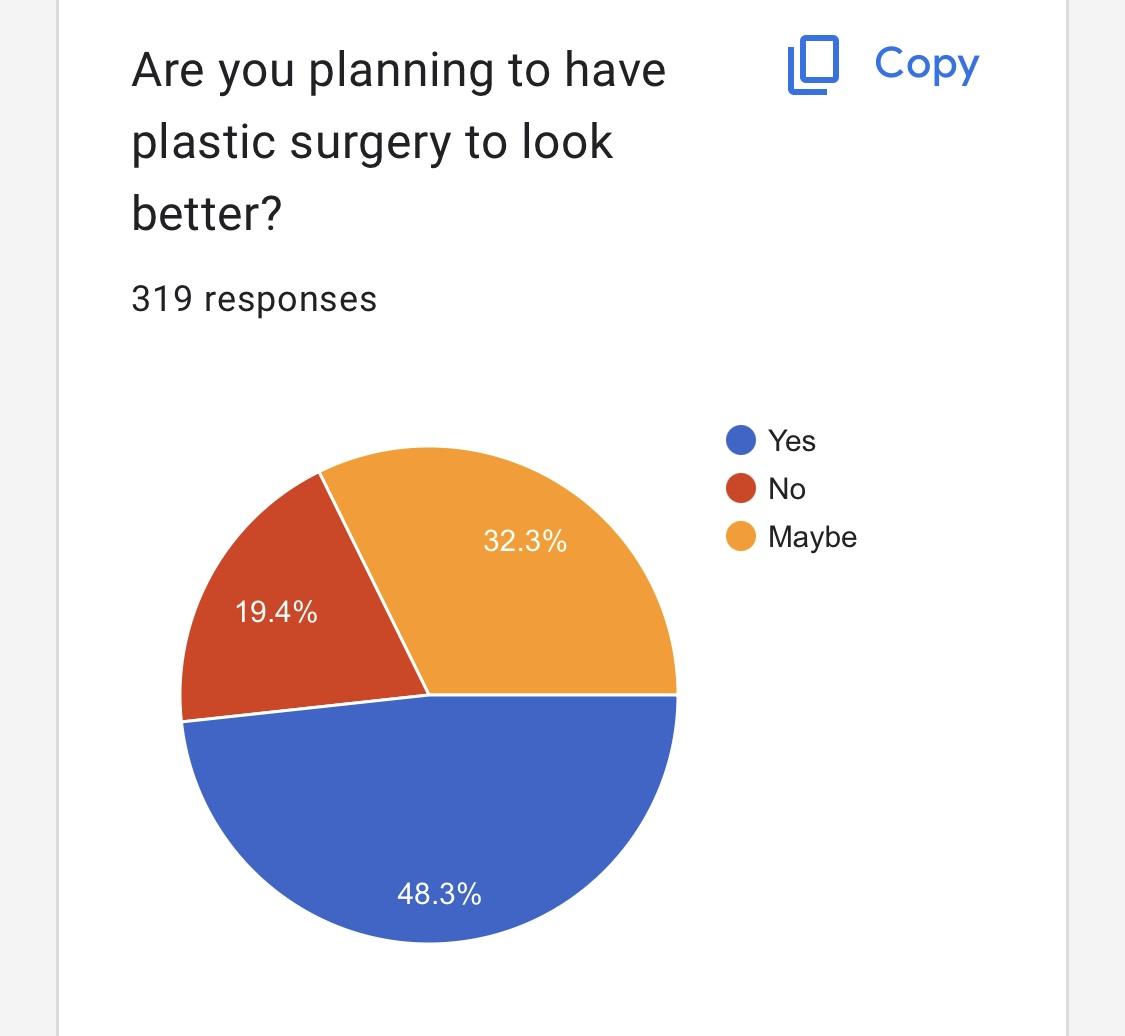
16. Plastic Surgery (Past)
Significant difference- <1K: ~3% yes
- >1K: 8.5% yes
High-posters are more likely to have had surgery.17. Plastic Surgery (Future)
Significant difference- <1K: Mostly yes / maybe
- >1K:
- “Yes” ↑
- “Maybe” still high
- Fewer outright “no”
High-posters are more committed, less ambivalent.18. Body Weight
No major difference- Both center on “about average”
19. Physical Conditions Affecting Interaction
Moderate difference- <1K: ~14% yes
- >1K: 17% yes
Slightly higher impairment among high-posters.20. Leaving Home Frequency
Moderate difference- <1K: Mostly daily / weekly
- >1K:
- Slightly fewer daily outings
- More respondents in monthly / rare categories
High-posters leave home somewhat less often overall.21. Mocked for Appearance
Slight difference- <1K: “Never” ~30%
- >1K: “Never” ~31%
- The breakdown is very similar between groups.
Differences are small and not clearly directional.22. Appearance Meds / Supplements
Moderate difference- <1K: Supplements dominant
- >1K:
- Prescription meds ↑
- Total intervention ↑
High-posters are more aggressive medically.23. Substance Use
No difference- ~15% yes in both
24. Upbringing
No meaningful difference- ~75–78% two-parent households
25. Compliments
Moderate difference- <1K: “Never” ~17%
- >1K: “Never” 25%
High-posters are more likely to report never receiving compliments.26. Friends
Moderate difference- <1K: ~82% yes
- >1K: 69% yes
- “No” + “online only” ↑
High-posters are more likely to report no or online-only friendships.27. Desire for Children
Moderate difference- <1K: 84% yes
- >1K: ~75% yes
High-posters are slightly less likely to want children.28. Seeking Relationships Abroad
Moderate difference- <1K: ~49% yes
- >1K: 54% yes
High-posters are more willing to exit local dating markets.29. Happiness
Significant difference- <1K: Peaks at 5–6
- >1K:Shifts downward
- More 1–3
- Fewer 7–8
High-posters are less happy overall.30. Sexual Partners
Very large difference (distributional)- <1K: 63% zero
- >1K: 64% zero BUT:
- Paid sex ↑
- Very high counts exist
Same virginity rate, but polarization increases.31. Romantic / Sexual Experience
Moderate difference- >1K:
- “No experience” ↑
- Paid sex ↑
- Rejection ↑
High-posters skew more extreme at both ends.32. Voice Satisfaction
Significant difference- <1K: Neutral dominant
- >1K: “Dislike (high-pitched)” ↑ sharply
High-posters are more self-critical.33. Interaction With Women
Large difference- <1K: Daily / weekly dominant
- >1K:
- Rarely + never: ~42%
High-posters report noticeably less frequent interaction with women.34. Time Spent on Forum
Large difference- <1K: Mostly non-daily
- >1K:
- 3–6h + 6h ↑
High-posters spend more time on the forum overall, with a heavier tail of very high-use users.35. Posting Frequency
Obvious difference (by definition)- >1K: 26% post 50+ times/week
36. Sentiment Toward Women
Large difference- <1K: 22% negative
- >1K: 32% negative
High-posters express more negative sentiment toward women.37. Penis Size Satisfaction
Slight difference- <1K: 63% satisfied
- >1K: 59% satisfied
High-posters report lower satisfaction than <1K, but a majority (~59%) are still satisfied.38. Autism Spectrum
Moderate difference- <1K: ~9% diagnosed
- >1K: 13% diagnosed
- Unsure ↑ strongly
Neurodivergence more common or more suspected.39. Appearance Improvement
Moderate difference- <1K: Mostly “a little bit”
- >1K: Higher reports of improvement overall
High-posters report greater appearance improvement overall, with more respondents reporting large gains.40. Treated Better After Improvement
Opposite perception- <1K: 86% say yes
- >1K: 82% say yes but:
- More skepticism
- Higher “no”
High-posters are less convinced improvement pays off.41. Bullying
Moderate difference- Both high childhood bullying
- >1K: Teen bullying ↑
- Adult bullying slightly ↑
42. Anger / Hostility
Moderate difference- <1K: “Often + always” ~35%
- >1K: “Often + always” ~40%
High-posters are slightly angrier.43. Self-Rating (1–10)
Shift upward paradox- >1K: More 6s and 7s
- Fewer 1–2s
High-posters are more confident cognitively, not emotionally.44. Forum Sentiment
Very large difference- <1K: 53% say declining
- >1K: 70% say declining
High-posters are deeply disillusioned.45. Recommendation
Major inversion- <1K: 26% yes
- >1K: 19% yes
- “No” ↑ sharply
46. Discovery Source
Significant difference- <1K: TikTok dominant
- >1K:
- TikTok ↓
- YouTube, search, legacy forums ↑
High-posters entered earlier, slower pipelines.
What the data actually shows about >1K posters
Not here to moralize, just looking at what actually separates people here. The question is: what kind of selection process produces someone who hits 1000+ posts?
The data suggests high-posters aren't just "more engaged normies"; they're a functionally different population. Here's what separates them:
Social isolation is way more pronounced.
High-posters are older, spend more time here, interact with women less, and are less socially connected. Classic substitution pattern: the forum isn't supplementing their social life, it's increasingly becoming it.
Mental state is noticeably darker.
Lower happiness, higher anger/hostility, more frequent mockery of others, and more negative sentiment toward women But here's the twist: self-ratings don't tank. Most still rate themselves average-to-above. Translation: the bitterness is outward-facing, not just self-hatred spiraling.
Looksmaxxing effort goes up, faith in it goes down.
More prescriptions, more surgeries considered/done, bigger reported improvements. But also way more skepticism that any of it actually changes how people treat them. Diminishing returns in action-- the more you invest, the less each gain seems to matter.
Romantic outcomes don't improve, they polarize.
Virgin rates stay similar, but high-posters show more extremes: more escortcelling, more rejection stories, more complete isolation, and a small minority with unusually high counts. It's not a linear progression upward, it's forking into opposite ends.
Long-term users are blackpilled on the forum itself.
Despite being the most active, they're more likely to say it's declining and less likely to recommend it. They're not here because it's working-- they're here because everything else feels worse or nonexistent.
The model that fits best: selection + reinforcement loop
- Guys who are reasonably integrated socially or see early wins tend to leave
- Guys who are isolated, stuck, or frustrated stay and post heavily
- Over time, high activity becomes less a success metric and more a marker of being trapped
TLDR: >1K posters are more isolated, more bitter, looksmax harder while believing in it less, and have worse outcomes. Post count tracks who's trapped here, not who's making it.
Complete survey results (>1K users) are available here:
Looksmax.org 2025 Survey
Welcome to our annual Looksmax.org Survey! Share your honest thoughts—it's anonymous and only takes a few minutes. We promise! We'll reveal the results to the community soon.
docs.google.com
Last edited: