ascendrx
TRUECEL
- Joined
- Feb 6, 2026
- Posts
- 1,044
- Reputation
- 1,273
.
Last edited:
Follow along with the video below to see how to install our site as a web app on your home screen.

Note: this_feature_currently_requires_accessing_site_using_safari



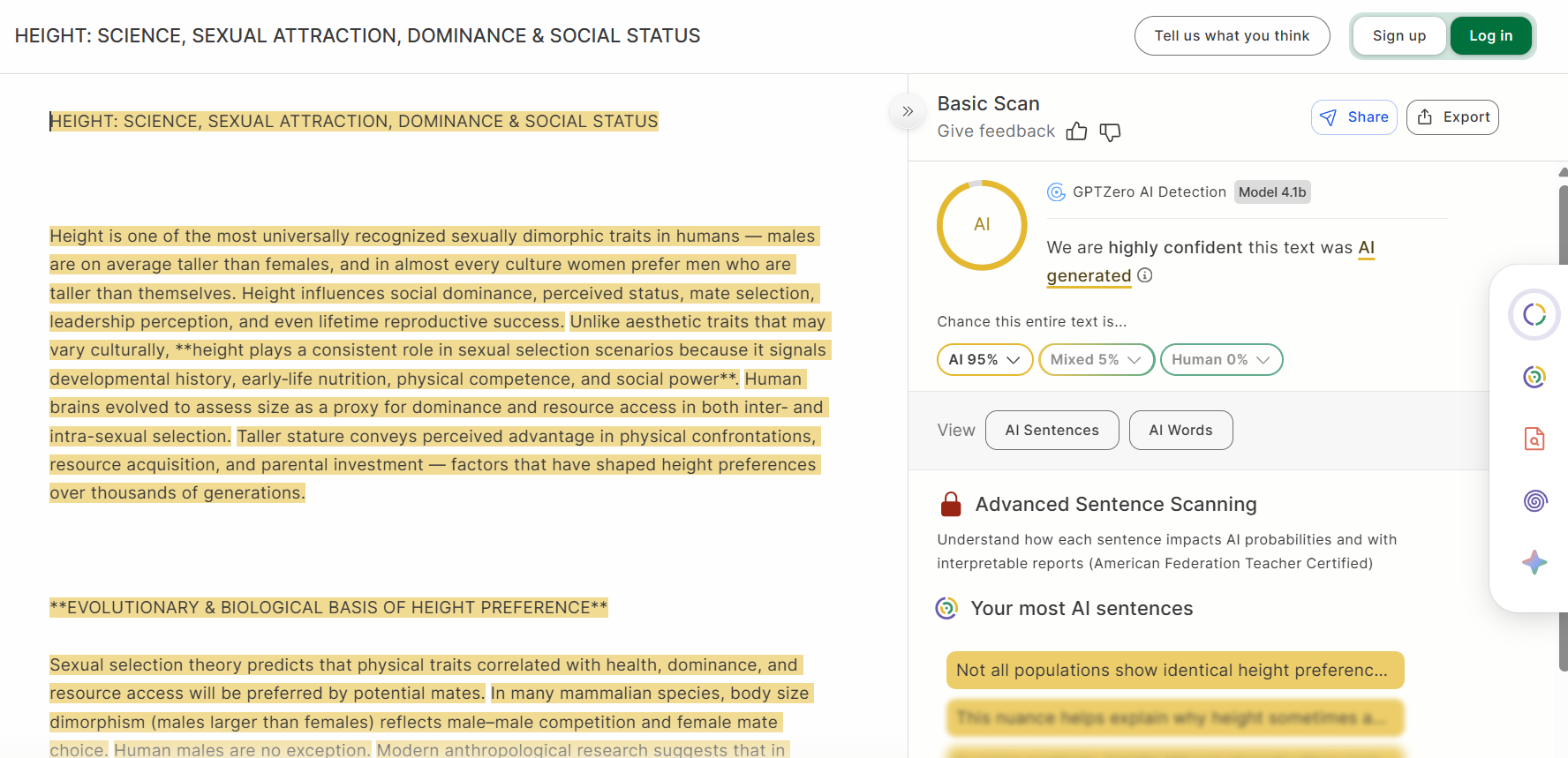
already know its chat gpt from the double --HEIGHT: SCIENCE, SEXUAL ATTRACTION, DOMINANCE & SOCIAL STATUS
Height is one of the most universally recognized sexually dimorphic traits in humans — males are on average taller than females, and in almost every culture women prefer men who are taller than themselves. Height influences social dominance, perceived status, mate selection, leadership perception, and even lifetime reproductive success. Unlike aesthetic traits that may vary culturally, **height plays a consistent role in sexual selection scenarios because it signals developmental history, early‑life nutrition, physical competence, and social power**. Human brains evolved to assess size as a proxy for dominance and resource access in both inter‑ and intra-sexual selection. Taller stature conveys perceived advantage in physical confrontations, resource acquisition, and parental investment — factors that have shaped height preferences over thousands of generations.
**EVOLUTIONARY & BIOLOGICAL BASIS OF HEIGHT PREFERENCE**
Sexual selection theory predicts that physical traits correlated with health, dominance, and resource access will be preferred by potential mates. In many mammalian species, body size dimorphism (males larger than females) reflects male–male competition and female mate choice. Human males are no exception. Modern anthropological research suggests that in ancestral environments tall stature would have conferred advantages in hunting success, defensive ability, and social leadership — all traits with implications for reproductive success.
A large international study on height preferences found that, across populations, there is a strong “male‑taller” norm, where women prefer male partners who are taller than themselves. This is consistent with predictions from evolutionary psychology regarding mate choice and sexual dimorphism ([https://link.springer.com/article/10.1007/s12110-025-09504-x?(https://link.springer.com/article/10.1007/s12110-025-09504-x?
Genetic analyses of mate choice demonstrate that **height influences partner selection itself**, not just superficial preference. A large study of over 13,000 couples showed that height‑related genetic variation is correlated between partners, indicating that height plays a real role in human sexual pairing patterns and not just culture or chance ([https://genomebiology.biomedcentral.com/articles/10.1186/s13059-015-0833-8?(https://genomebiology.biomedcentral.com/articles/10.1186/s13059-015-0833-8?
Research also shows that height is condition‑dependent — meaning that both early‑life health and environmental conditions influence ultimate adult stature. As ecological harshness decreases (better nutrition, lower disease burden), male height increases disproportionately relative to females, magnifying the sex‑based size differences that sexual selection can act upon ([https://arxiv.org/abs/2503.23376?(https://arxiv.org/abs/2503.23376?
## **HEIGHT, ATTRACTIVENESS & MATING OUTCOMES**
Large experimental and survey research confirms that height is correlated with perceived attractiveness, mating opportunities, and reproductive outcomes. In controlled studies using personal advertisements and speed‑dating contexts, both men and women preferred couples where the man was taller than the woman, indicating a strong normative preference on human mate markets ([https://www.sciencedirect.com/science/article/pii/S0191886907002814?(https://www.sciencedirect.com/science/article/pii/S0191886907002814)). Women’s preferences for taller partners are not just a social convention: multiple studies find that height satisfies criteria for sexually selected traits — it predicts differential mating behavior, selection outcomes, and social strategies ([https://pubmed.ncbi.nlm.nih.gov/33126024/? (https://pubmed.ncbi.nlm.nih.gov/33126024/?
Height correlates with **mate value and self‑perceived attractiveness** in men. Research among Chilean couples revealed that as male height increased, so did measures of perceived attractiveness and mate value, indicating that women often perceive taller men as more desirable ([https://www.ovid.com/journals/evobs/pdf/10.1037/ebs0000132~height-as-related-to-self-perceived-mate-value-and?](https://www.ovid.com/journals/evobs/pdf/10.1037/ebs0000132~height-as-related-to-self-perceived-mate-value-and?
Importantly, height doesn’t act alone. Evolutionary psychological research combining height with shoulder‑to‑hip ratio (SHR) — another sexually dimorphic trait — found that increases in height and a wider upper body synergistically predicted higher ratings of attractiveness, masculinity, dominance, and fighting ability. Women rated taller men with strong upper‑body proportions as more attractive in both short‑term and long‑term mating judgments ([https://link.springer.com/article/10.1007/s40806-024-00394-3?](https://link.springer.com/article/10.1007/s40806-024-00394-3?
**HEIGHT & SOCIAL PSYCHOLOGY: DOMINANCE, STATUS, JEALOUSY, AND MATE RETENTION**
Height influences more than just mate choice: it affects **social dominance and psychological dynamics** within relationships. In research on jealousy and height, taller men reported lower levels of jealousy in response to competitive rivals compared to shorter men. This suggests that height confers confidence and perceived dominance even in social and emotional dynamics — a deeper social effect beyond immediate attractiveness ratings ([https://cris.maastrichtuniversity.nl/en/publications/height-predicts-jealousy-differently-for-men-and-women/](https://cris.maastrichtuniversity.nl/en/publications/height-predicts-jealousy-differently-for-men-and-women/?
Height also interacts with gender norms. A study investigating gender‑role ideology and height preference found that women’s preference for taller male partners was stronger than men’s preference for shorter female partners, and that societal norms correlated with how strict these height preferences were. This aligns with the idea that height preference has both **biological foundations and cultural modulation** ([https://pubmed.ncbi.nlm.nih.gov/33126024/?(https://pubmed.ncbi.nlm.nih.gov/33126024/?
**HEIGHT & REPRODUCTIVE SUCCESS**
Historical and contemporary research suggests that taller men have reproductive advantages. Classic work in evolutionary psychology and population biology shows that taller men are more likely to be married and have children than their shorter counterparts, supporting Darwin’s sexual selection theory. Reanalysis of medical records in large populations confirms that childless men and bachelors tend to be shorter than married men, implying that height predicts reproductive outcomes in real demographic data ([https://www.wired.com/2000/01/height-makes-mr-right?](https://www.wired.com/2000/01/height-makes-mr-right?
More recent large‑sample sexual activity data analyses (controlling for BMI, education, ethnicity, etc.) show that very short men report fewer sexual partners on average than taller men, with the trend increasing across the height continuum. Although the effect is not extremely large, **the data consistently places very short men at a disadvantage in mating markets** compared to average or taller men ([https://pubmed.ncbi.nlm.nih.gov/37924179/(https://pubmed.ncbi.nlm.nih.gov/37924179/?
**CULTURAL VARIABILITY & CONTEXT**
Not all populations show identical height preferences. Research among non‑Western societies like the Hadza (Tanzania) and the Tsimane’ (Bolivia) found different patterns in height preference and actual mate choice compared to Western samples. In some contexts, height did not strongly drive partner selection, highlighting that **ecological and social environments interact with evolved preferences** to shape mating strategies ([https://pubmed.ncbi.nlm.nih.gov/26079105/?(https://pubmed.ncbi.nlm.nih.gov/26079105/?
This nuance helps explain why height sometimes appears less predictive in local or specific social niches — but it does not negate the broad patterns observed across a wide range of populations where women generally prefer taller male partners.
**THE BIOLOGY OF HEIGHT: DEVELOPMENT, HEALTH & INDICATORS**
Height is primarily influenced by genetics, nutrition, childhood health, and environmental stressors. Genome‑wide association studies and complex trait prediction models reveal that **height is highly heritable and polygenic**, meaning many genetic loci contribute to ultimate stature, but environmental factors like early‑life nutrition and disease burden significantly modulate the expression of genetic potential ([https://arxiv.org/abs/1709.06489](https://arxiv.org/abs/1709.06489?
Adult height reflects a lifetime of biological history — it integrates early immune challenges, diet, stress, and genetic predispositions. Because these factors also correlate with overall health and physical robustness, height becomes a **reliable signal of developmental stability**, which is what sexual selection theories predict will be attractive in mates.
PRACTICAL HEIGHT REALISM
Unlike traits like voice pitch or facial structure that can be altered to some extent, adult height is largely fixed after puberty. However, **posture optimization, spine alignment, and decompression exercises** can help ensure individuals stand at their maximum natural height. Proper posture not only maximizes stature but also increases perceived dominance and confidence, which compounds the psychological and social effects of height.
For men who are naturally shorter, focusing on complementary traits — upper‑body strength, shoulder breadth (SHR), confident gait, facial symmetry, and charisma — can mitigate some of the disadvantage posed by shorter stature. HS/SHR research shows that these dimensions can integrate with height perception to influence attractiveness more broadly ([https://link.springer.com/article/10.1007/s40806-024-00394-3?(https://link.springer.com/article/10.1007/s40806-024-00394-3?
Temporary height enhancements through footwear (elevator shoes) provide a **perceptual boost** in social situations but do not alter the biological realities of height. They can be useful for confidence and initial social impressions when appropriate.
CONCLUSION: HEIGHT AS A SEXUALLY SELECTED TRAIT
Height is more than cosmetic; it is a body size trait shaped by genetic, developmental, and environmental influences that has been repeatedly linked to **sexual attractiveness, dominance perception, reproductive outcomes, and mate selection** across cultures and research paradigms. Scientific evidence from genotypic mate choice studies, psychological experiments, and large demographic datasets consistently shows that taller men are perceived as more attractive, dominant, and socially desirable in many contexts. While cultural variation exists, the overarching pattern supports height as a sexually selected trait that interacts with other sexually dimorphic traits to shape mating outcomes and social perception.
REP WOULD BE APPRECIATED SINCE THIS TOOK A WHILE TO MAKE

was obv a joke bro I purposely left it in the links jfl lmao
was obv a joke bro I purposely left it in the links jfl lmao
no lmao I left it in the links bro it was so obviously a joke. lost a bet and had to keep it up for 5 minutesnah u were just too stupid to even paraphrase or change it
lost a bet and so you had to leave a org thread up for 5min?no lmao I left it in the links bro it was so obviously a joke. lost a bet and had to keep it up for 5 minutes
lost to org user brolost a bet and so you had to leave a org thread up for 5min?