TheNigreriaNigtmare
Subhuman
- Joined
- Jun 20, 2025
- Posts
- 256
- Reputation
- 234
After going down the rabbit hole of every cognitive enhancer imaginable (Semax, Cerebrolysin, Dihexa, etc.), I ended up following the 80/20 rule.
Instead of chasing the last 20% for 5× the cost, I wanted the compounds with the best human evidence and highest ROI.
My stack ended up being:
Originally I was interested in Semax because the mechanism looks insane on paper (BDNF, neuroplasticity, dopamine modulation, etc.), but once I started digging through PubMed, the human evidence just wasn’t there compared to Vortioxetine.
Semax has a really cool mechanism but mostly animal studies and relatively small human studies.
Vortioxetine, on the other hand, has multiple randomized controlled trials showing improvements in cognitive symptoms in people with depression. It also has a much more established safety profile.
The ROI just seemed way higher.
Basically:
80% of the benefit with 20% of the cost and uncertainty.
IQ Test
I finally decided to get an IQ test.
Obviously I don’t have a baseline from before starting treatment, so I can’t claim the stack increased my IQ. That would be impossible to prove from one test.
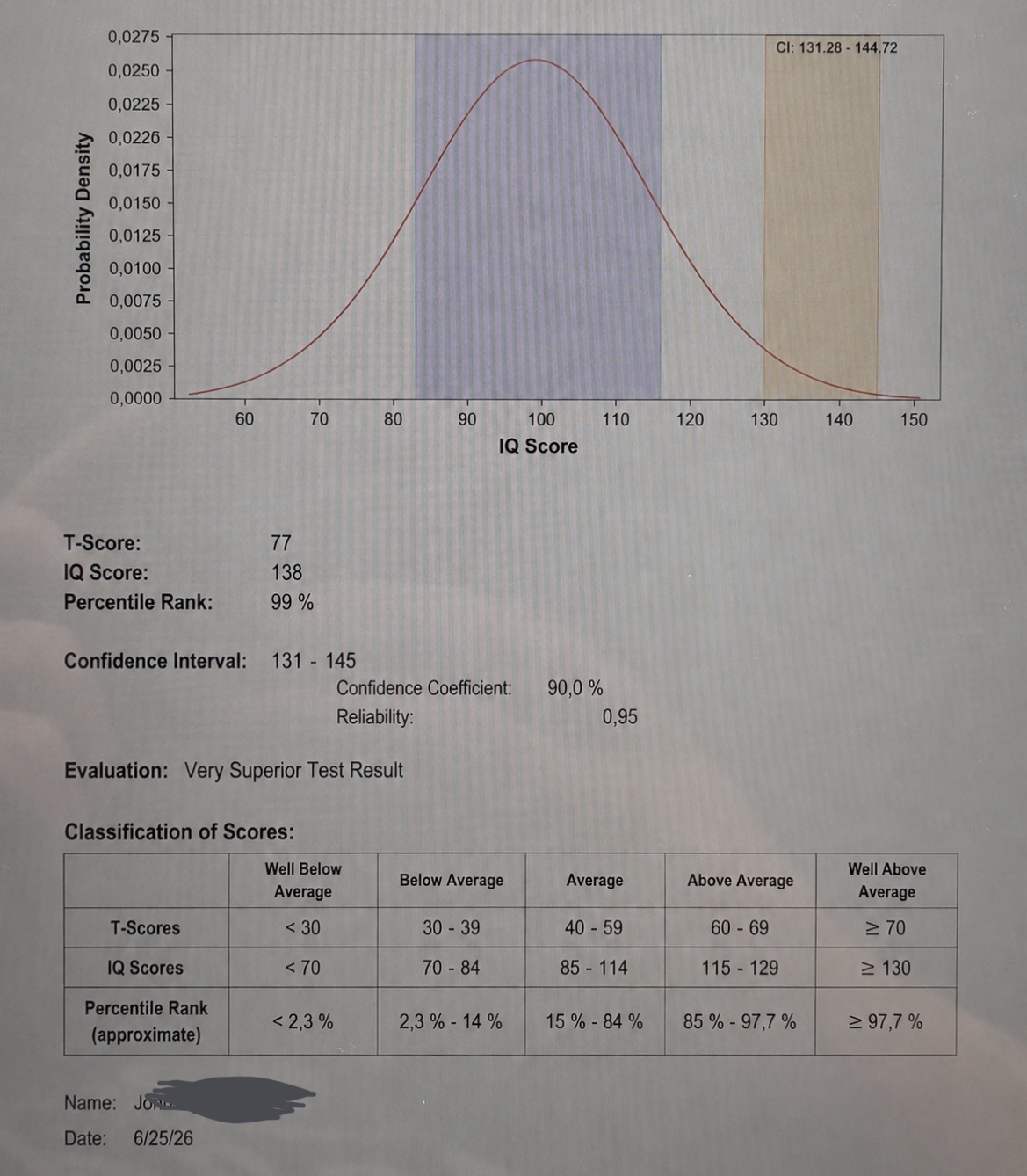
These were the results:
According to the report:
T-Score: 77
Reliability: 0.95
The confidence interval is actually what I found most interesting because it means the estimate isn’t “exactly 138.” Rather, based on the test’s reliability, my true score is estimated to lie between 131 and 145 with the stated confidence level.
Thoughts
I’m not claiming Vyvanse + Vortioxetine magically made me a genius.
Without a pre-treatment baseline, there’s no way to separate:
All I can honestly say is that I perform well on this assessment and subjectively feel that treating my ADHD has improved my focus and day-to-day cognitive function.
If I were starting over today, I’d probably make the same decision: spend money on the interventions with the strongest human evidence first, and leave the expensive experimental peptides until there’s better clinical data showing they provide meaningful additional benefit.
Instead of chasing the last 20% for 5× the cost, I wanted the compounds with the best human evidence and highest ROI.
My stack ended up being:
- Vyvanse (prescribed for ADHD)
- Vortioxetine
Originally I was interested in Semax because the mechanism looks insane on paper (BDNF, neuroplasticity, dopamine modulation, etc.), but once I started digging through PubMed, the human evidence just wasn’t there compared to Vortioxetine.
Semax has a really cool mechanism but mostly animal studies and relatively small human studies.
Vortioxetine, on the other hand, has multiple randomized controlled trials showing improvements in cognitive symptoms in people with depression. It also has a much more established safety profile.
The ROI just seemed way higher.
Basically:
80% of the benefit with 20% of the cost and uncertainty.
IQ Test
I finally decided to get an IQ test.
Obviously I don’t have a baseline from before starting treatment, so I can’t claim the stack increased my IQ. That would be impossible to prove from one test.
These were the results:
- IQ: 138
- Percentile: 99th
- Confidence Interval: 131–145
- Classification: Very Superior
According to the report:
T-Score: 77
Reliability: 0.95
The confidence interval is actually what I found most interesting because it means the estimate isn’t “exactly 138.” Rather, based on the test’s reliability, my true score is estimated to lie between 131 and 145 with the stated confidence level.
Thoughts
I’m not claiming Vyvanse + Vortioxetine magically made me a genius.
Without a pre-treatment baseline, there’s no way to separate:
- genetics,
- education,
- ADHD treatment,
- practice effects,
- or normal variation.
All I can honestly say is that I perform well on this assessment and subjectively feel that treating my ADHD has improved my focus and day-to-day cognitive function.
If I were starting over today, I’d probably make the same decision: spend money on the interventions with the strongest human evidence first, and leave the expensive experimental peptides until there’s better clinical data showing they provide meaningful additional benefit.