

Hello to all looksmaxers, this is the first article I’ve written, so I ask you to be understanding. It will focus on the importance of height in society and in life, and how to improve it as much as possible.
The first part of my article will be about the importance of height in society and in life, and the second part will focus on maximizing height naturally.

The numbers don't lie. In a comprehensive study on partner preferences, 96% of women reported preferring to date a man taller than them. Not a majority — ninety-six percent. That leaves only 4% of women who are indifferent or prefer shorter men.
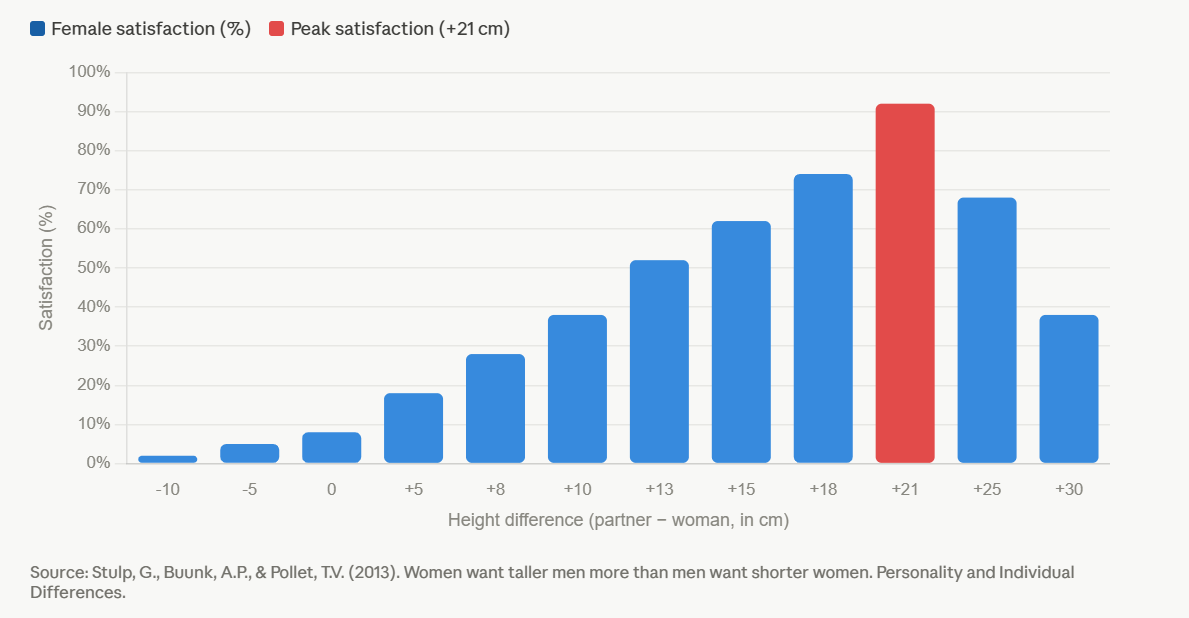
But it goes deeper than just "taller is better." Research by Stulp et al. (2013) — one of the most cited studies on height and mate preference — found that women are most satisfied when their partner is 21 cm (8 inches) taller than them. This is not a small gap. This is a very specific, consistent preference that shows up across cultures and age groups.
The average height for women is 168 cm (5'6"), and the ideal height to reach is around 188–192 cm (6'2"–6'4").

Surveys are one thing. But what happens when you observe actual choices in real time?
A landmark study analyzed over 128,000 choices made by 5,782 speed-daters. The results were clear: women most frequently selected men who were 25 cm (nearly 10 inches) taller than themselves. Men, by contrast, only preferred women about 7 cm shorter
showing that women's height preferences are significantly stronger and more consistent than men's.
Your bones grow through a process called endochondral ossification, where cartilage in the growth plates is gradually replaced by bone tissue. This process is driven by three hormones: Human Growth Hormone, IGF-1, and testosterone. All three are directly influenced by what you eat. If your body is underfed, it prioritizes survival over growth. Bone development slows down. If your body has everything it needs, it builds upward.
This is not a figure of speech. Your body releases around 70 to 80 percent of its daily Human Growth Hormone during slow wave sleep, specifically during the first few hours after falling asleep. If you are sleeping less than 8 hours as a teenager, you are literally limiting your own growth at a hormonal level.
A landmark study published in the Journal of Clinical Endocrinology found a direct correlation between sleep duration and growth hormone secretion in adolescents. Every hour of sleep lost is an hour where the peak growth hormone pulse does not fire. Over months and years, this adds up to real, measurable height differences.
The protocol is simple. Sleep between 8 and 10 hours every night during the growth years. Prioritize sleep quality with a dark room, no screens for at least an hour before bed, and consistent sleep and wake times. These conditions maximize deep slow wave sleep, which is exactly when the growth hormone pulses happen.
Exercise stimulates height through three main mechanisms.
The first is mechanical loading. When bones are subjected to stress through running, jumping, and lifting, they respond by reinforcing and lengthening. This is part of why athletes who train through their teenage years often reach slightly greater heights than sedentary peers with the same genetics.
The second is growth hormone stimulation. High intensity exercise is one of the most powerful natural triggers of Human Growth Hormone release. A study published in the Journal of Applied Physiology found that intense exercise can increase growth hormone levels by up to 300 to 500 percent above baseline. Sprinting, high intensity intervals, and heavy compound lifts are particularly effective.
The third is spinal decompression. The spine accounts for roughly 35 percent of your total height. Gravity compresses your intervertebral discs throughout the day, which is why you are measurably shorter in the evening than in the morning. Exercises that decompress the spine allow the discs to re-expand fully and over time improve posture significantly.
Dead hangs from a pull-up bar are among the most effective tools available. The spine elongates under its own weight. Three to five sets of 30 to 60 seconds daily produces real postural improvements over weeks.
Swimming is consistently cited in research as one of the best activities for height development. The full body stretching, combined with the absence of gravitational compression, creates an ideal environment for spinal elongation. A long-term Chinese study found competitive swimmers were on average taller than non-swimming peers of the same age and genetic background.
Sprint training is the most underrated height tool. Short explosive sprints create the kind of mechanical stress that stimulates bone adaptation in growing teenagers. This is partly why track athletes and basketball players tend to be tall.
Compound lifts like squats, deadlifts, and rows stimulate growth hormone and testosterone release, reinforce posture, and build the muscular foundation that makes height more visually apparent. Contrary to the popular myth, lifting weights does not stunt growth. This claim has been thoroughly debunked in the scientific literature.
One of the most powerful pieces of evidence for the role of nutrition in height comes not from a laboratory but from real populations living in radically different conditions.
The Dinka and Nuer tribes of South Sudan are among the tallest populations ever recorded. The average Dinka male stands at around 6 feet tall, with many individuals reaching 6 feet 3 or taller. Their diet is built around cattle, meaning high quality protein, raw milk, blood, and organ meats consumed in large quantities from childhood. Their access to animal protein and fat during the growth years is exceptional.
Compare this to populations in parts of Southeast Asia or Central America where childhood diets are built around rice and corn with minimal protein and fat. Average male heights in those regions sit between 5 feet 4 and 5 feet 6. The genetic difference between these populations is real but far smaller than the height difference suggests. Research consistently shows that when children from historically short populations are raised in environments with abundant nutrition, they reach significantly greater heights than their parents and grandparents.
Japan is the most documented example of this. In 1900 the average Japanese male stood at around 5 feet 2. After World War II, Japan massively increased protein consumption, particularly dairy and meat. By 2000 the average Japanese male stood at 5 feet 7, an increase of nearly 5 inches in three generations with no meaningful genetic change. The variable was nutrition.
The conclusion is clear. Your genes set a ceiling, but your diet determines how close you get to it.
I hope this article helped you on your journey to maximizing your height.
My english is very bad i was a lil bit helped by Claude.
The first part of my article will be about the importance of height in society and in life, and the second part will focus on maximizing height naturally.
Women's Preferences Are Overwhelming
The numbers don't lie. In a comprehensive study on partner preferences, 96% of women reported preferring to date a man taller than them. Not a majority — ninety-six percent. That leaves only 4% of women who are indifferent or prefer shorter men.
But it goes deeper than just "taller is better." Research by Stulp et al. (2013) — one of the most cited studies on height and mate preference — found that women are most satisfied when their partner is 21 cm (8 inches) taller than them. This is not a small gap. This is a very specific, consistent preference that shows up across cultures and age groups.
The average height for women is 168 cm (5'6"), and the ideal height to reach is around 188–192 cm (6'2"–6'4").
Real Behavior, Not Just Surveys
Surveys are one thing. But what happens when you observe actual choices in real time?
A landmark study analyzed over 128,000 choices made by 5,782 speed-daters. The results were clear: women most frequently selected men who were 25 cm (nearly 10 inches) taller than themselves. Men, by contrast, only preferred women about 7 cm shorter
showing that women's height preferences are significantly stronger and more consistent than men's.
Height doesn't just affect how you look .
It directly affects how much you earn, how fast you get promoted, and how likely you are to end up in a leadership position. The data on this is some of the most robust in all of height research.
The foundational study here comes from Judge & Cable (2004), published in the Journal of Applied Psychology. Their conclusion after analyzing four large longitudinal datasets across the US and UK:
Each inch in height amounts to about $789 more per year in salary. Someone who is 7 inches taller , say 6 feet versus 5 feet 5 inches ,would be expected to earn $5,525 more annually.
That sounds manageable until you run the math over time. Someone who is 6 feet tall earns, on average, nearly $166,000 more during a 30-year career than someone who is 5 feet 5 inches, even when controlling for gender, age and weight.
That is not a rounding error. That is a HOUSE.
The salary gap is striking. The leadership gap is staggering.
Only around 14.5% of men in the US population are over 6 feet tall. Among CEOs of Fortune 500 companies, that number is 58%. And while only 3.9% of adult men are over 6'2", a full 30% of Fortune 500 CEOs stand that tall.
A study of 1.3 million Swedish men found that those who headed large companies averaged 6 feet tall, compared to an average male height of 5'10.5". Furthermore, when an executive was one standard deviation ,about 6.5 cm , above the mean height, he was likely to earn 4% above the average CEO salary.
So the premium doesn't just get you into the C-suite. It keeps paying once you're there.
It directly affects how much you earn, how fast you get promoted, and how likely you are to end up in a leadership position. The data on this is some of the most robust in all of height research.
The Salary Gap Is Enormous
The foundational study here comes from Judge & Cable (2004), published in the Journal of Applied Psychology. Their conclusion after analyzing four large longitudinal datasets across the US and UK:
Each inch in height amounts to about $789 more per year in salary. Someone who is 7 inches taller , say 6 feet versus 5 feet 5 inches ,would be expected to earn $5,525 more annually.
That sounds manageable until you run the math over time. Someone who is 6 feet tall earns, on average, nearly $166,000 more during a 30-year career than someone who is 5 feet 5 inches, even when controlling for gender, age and weight.
That is not a rounding error. That is a HOUSE.
The CEO Effect
The salary gap is striking. The leadership gap is staggering.
Only around 14.5% of men in the US population are over 6 feet tall. Among CEOs of Fortune 500 companies, that number is 58%. And while only 3.9% of adult men are over 6'2", a full 30% of Fortune 500 CEOs stand that tall.
A study of 1.3 million Swedish men found that those who headed large companies averaged 6 feet tall, compared to an average male height of 5'10.5". Furthermore, when an executive was one standard deviation ,about 6.5 cm , above the mean height, he was likely to earn 4% above the average CEO salary.
So the premium doesn't just get you into the C-suite. It keeps paying once you're there.
How food actually makes you grow
Your bones grow through a process called endochondral ossification, where cartilage in the growth plates is gradually replaced by bone tissue. This process is driven by three hormones: Human Growth Hormone, IGF-1, and testosterone. All three are directly influenced by what you eat. If your body is underfed, it prioritizes survival over growth. Bone development slows down. If your body has everything it needs, it builds upward.
Protein: the foundation of everything
Protein is the most important nutrient for height, full stop. Bones, cartilage, and the growth hormone system all depend on it. Research shows that teenagers with higher protein intake consistently reach greater adult heights. The target is at least 1.5 to 2 grams of protein per kilogram of bodyweight per day. The best sources are eggs, red meat, chicken, fish, dairy, and legumes.Calcium: the building block of bone
Calcium is the main structural mineral in bone tissue. Without enough of it during the growth years, your body cannot build dense, long bones. The recommended intake for teenagers is around 1300 mg per day, which most people do not reach. The best dietary sources are milk, yogurt, cheese, sardines, canned salmon with bones, kale, broccoli, and fortified plant milks.Vitamin D: the key that unlocks calcium
Vitamin D is what allows your body to absorb calcium from food. Without adequate Vitamin D, up to 90 percent of the calcium you consume passes through your body without being absorbed. A 2019 meta-analysis found that Vitamin D deficiency during childhood is directly linked to reduced adult height. The primary source is sunlight exposure of at least 20 to 30 minutes per day on bare skin. Dietary sources include fatty fish like salmon and mackerel, egg yolks, liver, and fortified foods.Zinc: the growth activator
Zinc plays a direct role in cell division and protein synthesis, both of which are essential for bone growth. Studies conducted in zinc-deficient populations in the Middle East and Africa found severe height deficits that were partially reversed when zinc was reintroduced to the diet. The best sources are red meat, oysters, shellfish, pumpkin seeds, hemp seeds, cashews, and chickpeas.Magnesium: the forgotten mineral
Magnesium works alongside calcium in bone mineralization and is involved in over 300 enzymatic reactions in the body, many of which relate to protein synthesis and energy production. Most teenagers are chronically low in magnesium without knowing it. The best sources are dark leafy greens like spinach, pumpkin seeds, dark chocolate, almonds, black beans, avocado, and whole grains.Phosphorus: calcium's partner
Phosphorus works directly with calcium to form hydroxyapatite, the mineral compound that gives bones their hardness and strength. Around 85 percent of the body's phosphorus is stored in bones and teeth. Without adequate phosphorus, bone mineralization is incomplete. The best sources are meat, fish, dairy, eggs, nuts, and seeds.Vitamin K2: the traffic controller
Vitamin K2 is one of the least known but most important nutrients for bone development. Its job is to direct calcium into bones and teeth rather than into soft tissue and arteries. Without K2, calcium can actually build up in the wrong places. The best sources are fermented foods like natto, hard cheeses, egg yolks, and grass-fed butter.Sleep is when you actually grow
This is not a figure of speech. Your body releases around 70 to 80 percent of its daily Human Growth Hormone during slow wave sleep, specifically during the first few hours after falling asleep. If you are sleeping less than 8 hours as a teenager, you are literally limiting your own growth at a hormonal level.
A landmark study published in the Journal of Clinical Endocrinology found a direct correlation between sleep duration and growth hormone secretion in adolescents. Every hour of sleep lost is an hour where the peak growth hormone pulse does not fire. Over months and years, this adds up to real, measurable height differences.
The protocol is simple. Sleep between 8 and 10 hours every night during the growth years. Prioritize sleep quality with a dark room, no screens for at least an hour before bed, and consistent sleep and wake times. These conditions maximize deep slow wave sleep, which is exactly when the growth hormone pulses happen.
How exercise makes you taller
Exercise stimulates height through three main mechanisms.
The first is mechanical loading. When bones are subjected to stress through running, jumping, and lifting, they respond by reinforcing and lengthening. This is part of why athletes who train through their teenage years often reach slightly greater heights than sedentary peers with the same genetics.
The second is growth hormone stimulation. High intensity exercise is one of the most powerful natural triggers of Human Growth Hormone release. A study published in the Journal of Applied Physiology found that intense exercise can increase growth hormone levels by up to 300 to 500 percent above baseline. Sprinting, high intensity intervals, and heavy compound lifts are particularly effective.
The third is spinal decompression. The spine accounts for roughly 35 percent of your total height. Gravity compresses your intervertebral discs throughout the day, which is why you are measurably shorter in the evening than in the morning. Exercises that decompress the spine allow the discs to re-expand fully and over time improve posture significantly.
The best exercises
Dead hangs from a pull-up bar are among the most effective tools available. The spine elongates under its own weight. Three to five sets of 30 to 60 seconds daily produces real postural improvements over weeks.
Swimming is consistently cited in research as one of the best activities for height development. The full body stretching, combined with the absence of gravitational compression, creates an ideal environment for spinal elongation. A long-term Chinese study found competitive swimmers were on average taller than non-swimming peers of the same age and genetic background.
Sprint training is the most underrated height tool. Short explosive sprints create the kind of mechanical stress that stimulates bone adaptation in growing teenagers. This is partly why track athletes and basketball players tend to be tall.
Compound lifts like squats, deadlifts, and rows stimulate growth hormone and testosterone release, reinforce posture, and build the muscular foundation that makes height more visually apparent. Contrary to the popular myth, lifting weights does not stunt growth. This claim has been thoroughly debunked in the scientific literature.
The proof is in the tribes
One of the most powerful pieces of evidence for the role of nutrition in height comes not from a laboratory but from real populations living in radically different conditions.
The Dinka and Nuer tribes of South Sudan are among the tallest populations ever recorded. The average Dinka male stands at around 6 feet tall, with many individuals reaching 6 feet 3 or taller. Their diet is built around cattle, meaning high quality protein, raw milk, blood, and organ meats consumed in large quantities from childhood. Their access to animal protein and fat during the growth years is exceptional.
Compare this to populations in parts of Southeast Asia or Central America where childhood diets are built around rice and corn with minimal protein and fat. Average male heights in those regions sit between 5 feet 4 and 5 feet 6. The genetic difference between these populations is real but far smaller than the height difference suggests. Research consistently shows that when children from historically short populations are raised in environments with abundant nutrition, they reach significantly greater heights than their parents and grandparents.
Japan is the most documented example of this. In 1900 the average Japanese male stood at around 5 feet 2. After World War II, Japan massively increased protein consumption, particularly dairy and meat. By 2000 the average Japanese male stood at 5 feet 7, an increase of nearly 5 inches in three generations with no meaningful genetic change. The variable was nutrition.
The conclusion is clear. Your genes set a ceiling, but your diet determines how close you get to it.
I hope this article helped you on your journey to maximizing your height.
My english is very bad i was a lil bit helped by Claude.


