YoloHatesFoids666
V!
- Joined
- Apr 20, 2026
- Posts
- 439
- Reputation
- 625
INTRODUCTION
It is well known that since ancient times humans have had an inherent tendency to believe in something greater than themselves.
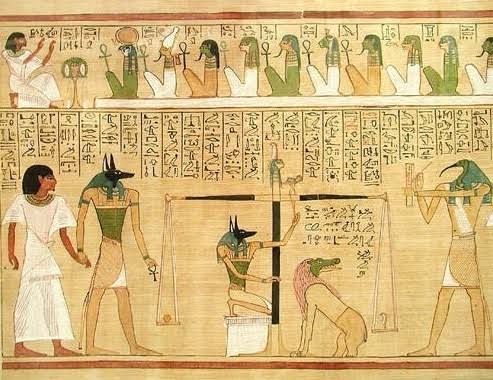
Usually, this is a supreme entity, the creator of the world, who sees everything, helps the good, and punishes the wicked.
This entity is called "God."
In this thread, I will present some arguments that are said to prove His existence.
Before we begin, we should address the concept of "God," since its definition is not clear. Every person and every religion may interpret it differently.
This creates confusion and does not help proper communication.
Some may simply mean the cause that created the universe without necessarily attributing to it the characteristics of an intelligent being.
Others may mean the totality of the universe itself, as Baruch Spinoza did, while others may mean an invisible omnipotent being who helps them through difficult times.
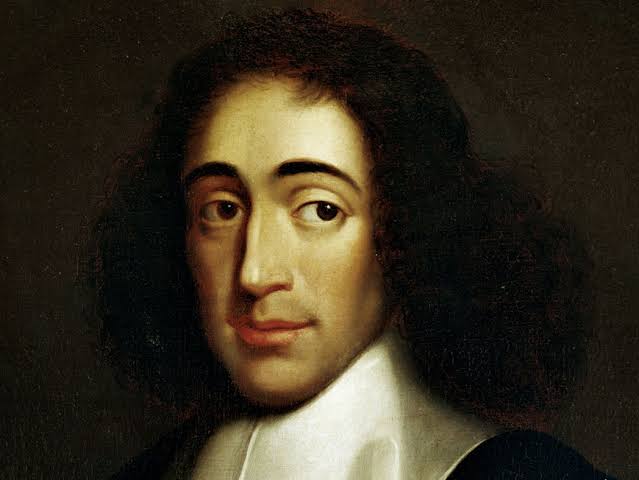
Baruch Spinoza
According to most monotheistic religions, however, God is a supreme entity, creator of the world, omnipotent, all-loving, and all-knowing.
This definition, of course, contains many contradictions that essentially make the existence of such an entity self-defeating, but in order to proceed with the arguments, we will overlook that.
This thread will focus mainly on the characteristic of "creator."
Let me now examine three widely known arguments that are used to prove the existence of God.
Attention! The existence of an intelligent being in the role of creator is a claim that does not meet the criterion of falsifiability.
We can neither prove nor disprove it. However, the burden of proof lies with the person who claims it exists.
Therefore, we will attempt to analyze the most well-known efforts to prove the existence of this entity.
The Cosmological Argument
Everything that exists has a cause.
The universe exists.
Therefore, the universe has a cause.
Those who invoke this argument usually claim that this cause is God. We observe that the form of the argument is logically valid.
If the two premises are true, then the conclusion must also be true. The problem lies in the validity of the premises themselves.
Let us examine the first premise: "Everything that exists has a cause."
Here we axiomatically accept that everything has a cause, based on our everyday observations.
This is a flawed inductive method: we incorrectly move from the particular to the general, without accepting that the set of possibilities may be larger.
But even if this is true, the cause that created the universe must itself have a cause, and that cause another cause, and so on endlessly.
This process is known as "infinite regress".
However, because most definitions of "God" include self-existence, which would contradict the argument's premise, and because it is difficult for the human mind to grasp the concept of
eternity while the idea that everything has a beginning is easier to understand, the cosmological argument was refined into what is called the "Kalam Cosmological Argument".
This new version claims that nothing can have infinitely many causal relationships, a position known as "causal finitism", and is structured as follows:
Everything that begins to exist has a cause.
The universe began to exist.
Therefore, the universe has a cause.
In this way, God remains self-existent while the universe becomes a created thing with a cause. Problem solved, right?
Not necessarily.
Here we encounter the fallacy of equivocation: the phrase "began to exist" is used with two different meanings.
Everything around us that "began to exist," at least in the sense implied by the first premise, is the result of modifying already existing matter.
Whether through human intervention or natural processes.
Our phones, televisions, and watches were made by humans through the transformation and processing of pre-existing raw materials.
On the other hand, mountains formed by tectonic movements,

craters created by meteor impacts,

and rocks shaped by waves

are simply consequences of natural laws and do not necessarily imply intelligence.
The meaning of "began to exist" when applied to the universe is different.
Here we are speaking about the creation of space, time, matter, and energy not merely modification.
Also, the two premises use the same phrase with different meanings, making the argument problematic.
But even if the universe was created from pre-existing matter, consider a variation of the argument that removes this ambiguity:
Everything that began to exist was made from pre-existing matter and energy.
The universe began to exist.
Therefore, the universe was made from pre-existing matter and energy.
This conclusion conflicts with the theistic view that God created the universe out of nothing.
However, let us take a broader perspective, because even this argument does not necessarily lead to a correct conclusion.
We examine causal relationships using rules that we know and understand within the existing universe.
If the universe is the result of some larger "superset," it may be impossible for us to understand how the two interact.
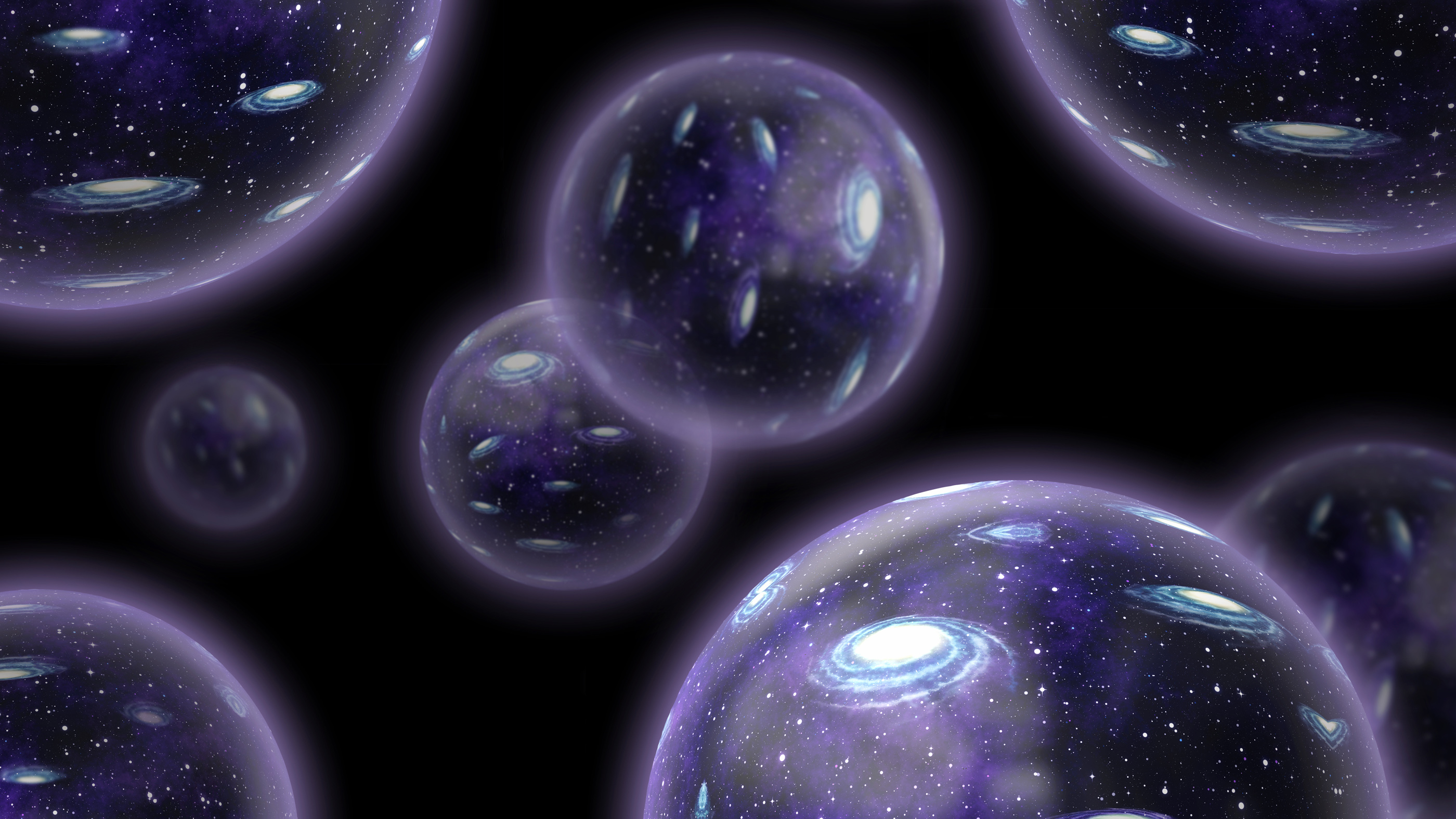
The "Bubble Universe" idea
It is like being built to understand only football and being asked to analyze a basketball game.
Something so incomprehensible and beyond the limits of human perception is not enough to make some of us accept our ignorance, because our desire to know is immense.
The causal relationships we know require time.
Yet in this argument we assume causal relationships even when time itself does not exist.
Not only do we fail to admit ignorance, but we also attribute human characteristics to the cause we imagine—purposes, desires, love, and punishment.
This is clearly a manifestation of anthropocentrism.
Finally, we should not forget "Occam's Razor".
(read my thread about Occam's Razor: https://looksmax.org/threads/occams...tion-necessary-for-critical-thinking.2170870/ )
It is unnecessary to multiply assumptions and entities when it is not required, because the simplest explanation is usually the most likely.
The Ontological Argument
God is, by definition, the most perfect being the mind can conceive.
If we assume that He does not exist, then because existence is superior to nonexistence, we can imagine a being greater than God.
Therefore, the original assumption that God does not exist must be false.
Put more simply:
Since God is perfect, He must necessarily exist.
Existence is considered a characteristic of perfection, and because God is perfect, He must possess it.
If He does not, then He is not perfect.
The main response to this argument is that existence precedes the attributes of a being and is not itself one of those attributes.
In other words, existence is not a property.
Put differently, a being does not need to exist in order to be perfect.
Likewise, the claim that existence is superior to nonexistence is itself subjective.
The Teleological Argument (Fine-Tuning Argument)
Perhaps the most appealing argument for the existence of God.
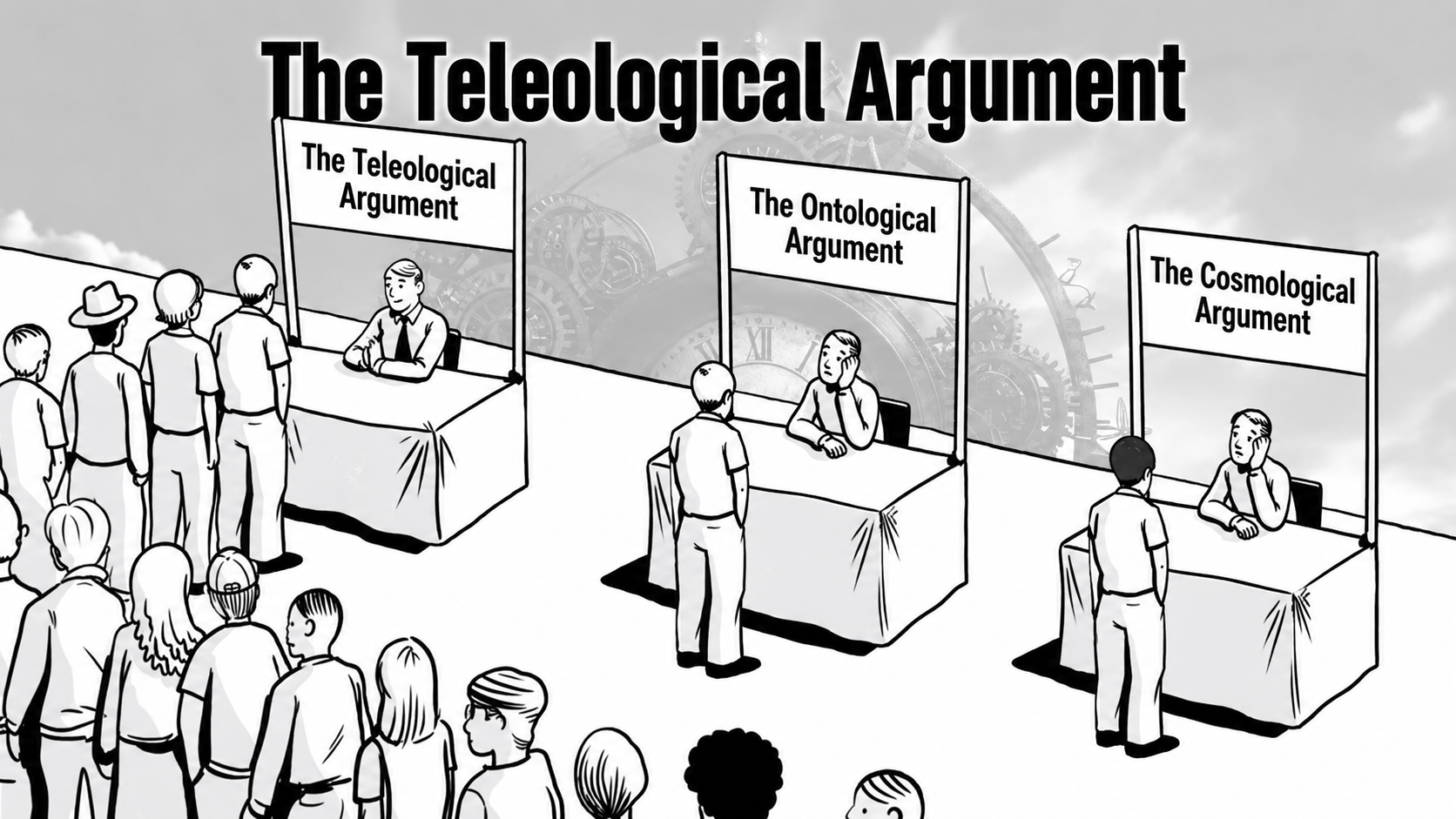
There are many versions, but the core idea is:
Everything complex has a designer.
The universe is complex.
Therefore, the universe has a designer.
It is true that some things around us require thought, planning, and dedication.
Take a watch, for example.
To function properly, it requires great precision from the manufacture of its components to their assembly by a technician.
So why not the universe itself ?
After all, it contains highly complex beings such as all living organisms.
The biochemistry and structure of living organisms seem so complex that it appears impossible that there is not a designer behind them.
Or perhaps not.
The flaw appears in the first premise, which claims that everything complex must have a designer.
This is not necessarily true.
After all, what counts as “complex” is subjective.
To an eight-year-old child, a quadratic equation may be complex; to a mathematician, it is not.
Consider stars. Are they complex? If so, could we say that the nebulae from which they form are their designers?
But let us assume that living organisms are the complexity we are concerned with.
Why do we observe such complexity around us?
Remember the "survivorship bias".
We observe a condition because it is capable of being observed.
Like airplanes in World War II.
The planes that returned to base rarely had bullet holes in the cockpit or engine.
Quite simply because those hit in those critical areas did not return and therefore could not be observed.
Likewise, we observe complex organisms because they are capable of surviving and reproducing.
In fact, more than 99% of all species that have ever existed on this planet are extinct.
Life adapts to the environment, not the other way around.
This process is called "natural selection", one of the most important mechanisms of evolution.
And no, it is not an intelligent agent it is simply a mechanism governed by natural laws.
As for how life originated from non-living matter, a process known as "abiogenesis", we may not know very much.
But that does not mean we should jump to a more complicated hypothesis by adding entities and assumptions.
This fallacy is known as the "argument from ignorance", and it is very common in such discussions.
One might say:
"Yes, but the probability of life existing as we know it is extremely small. It could not have happened by chance."
The problem with this reasoning is that we are calculating the probability of something that we already observe.
Moreover, we automatically perceive it as special because we ourselves are part of the outcome.
EPILOGUE
We should clarify something to avoid misunderstandings.
In this thread I did not try to prove anything or strengthen any particular position.
The purpose is to make the viewer think, not become dogmatic.
We are all human beings living in this world, thinking, reflecting, and wondering.
We are all in this together, facing ignorance.
We see the world through human eyes, and from that perspective we are capable of seeing gods, demons, angels, dragons, and ghosts.
You do not need to base your faith on logic.
You may simply believe because you want to, and leave it at that.
The flawed reasoning often used regarding God's existence works as follows:
First, we arrive at something we would like to be true and then our brain focuses on how to justify it, constructing its own logic around that conclusion.
Extraordinary claims, require extraordinary evidence.
And the existence of a higher intelligent entity that created the world is an extraordinarily large claim.
If humanity ever manages to prove the existence of such an entity, it may be the greatest discovery ever made.
But the evidence we currently have for such a claim is almost nonexistent.
Most of it is based on books written many years ago, often under various centers of power that had motives for spreading them.
Finally, to anticipate replies telling me not to deal with theological issues:
No one has the right to claim ownership over the domains of theology and philosophy.
As long as the data used to draw conclusions do not follow a strict method and lack a solid foundation, these domains remain public spaces into which anyone may enter.
sources:
 en.wikipedia.org

 credomag.com

 tidings.org

 www.freethinkingministries.com

 learn.ligonier.org

 journalofabsolutetruth.substack.com

 1000wordphilosophy.com
@"hixx" @subhuman37 @vigor @Quetila
It is well known that since ancient times humans have had an inherent tendency to believe in something greater than themselves.
Usually, this is a supreme entity, the creator of the world, who sees everything, helps the good, and punishes the wicked.
This entity is called "God."
In this thread, I will present some arguments that are said to prove His existence.
Before we begin, we should address the concept of "God," since its definition is not clear. Every person and every religion may interpret it differently.
This creates confusion and does not help proper communication.
Some may simply mean the cause that created the universe without necessarily attributing to it the characteristics of an intelligent being.
Others may mean the totality of the universe itself, as Baruch Spinoza did, while others may mean an invisible omnipotent being who helps them through difficult times.
Baruch Spinoza
According to most monotheistic religions, however, God is a supreme entity, creator of the world, omnipotent, all-loving, and all-knowing.
This definition, of course, contains many contradictions that essentially make the existence of such an entity self-defeating, but in order to proceed with the arguments, we will overlook that.
This thread will focus mainly on the characteristic of "creator."
Let me now examine three widely known arguments that are used to prove the existence of God.
Attention! The existence of an intelligent being in the role of creator is a claim that does not meet the criterion of falsifiability.
We can neither prove nor disprove it. However, the burden of proof lies with the person who claims it exists.
Therefore, we will attempt to analyze the most well-known efforts to prove the existence of this entity.
The Cosmological Argument
Everything that exists has a cause.
The universe exists.
Therefore, the universe has a cause.
Those who invoke this argument usually claim that this cause is God. We observe that the form of the argument is logically valid.
If the two premises are true, then the conclusion must also be true. The problem lies in the validity of the premises themselves.
Let us examine the first premise: "Everything that exists has a cause."
Here we axiomatically accept that everything has a cause, based on our everyday observations.
This is a flawed inductive method: we incorrectly move from the particular to the general, without accepting that the set of possibilities may be larger.
But even if this is true, the cause that created the universe must itself have a cause, and that cause another cause, and so on endlessly.
This process is known as "infinite regress".
However, because most definitions of "God" include self-existence, which would contradict the argument's premise, and because it is difficult for the human mind to grasp the concept of
eternity while the idea that everything has a beginning is easier to understand, the cosmological argument was refined into what is called the "Kalam Cosmological Argument".
This new version claims that nothing can have infinitely many causal relationships, a position known as "causal finitism", and is structured as follows:
Everything that begins to exist has a cause.
The universe began to exist.
Therefore, the universe has a cause.
In this way, God remains self-existent while the universe becomes a created thing with a cause. Problem solved, right?
Not necessarily.
Here we encounter the fallacy of equivocation: the phrase "began to exist" is used with two different meanings.
Everything around us that "began to exist," at least in the sense implied by the first premise, is the result of modifying already existing matter.
Whether through human intervention or natural processes.
Our phones, televisions, and watches were made by humans through the transformation and processing of pre-existing raw materials.
On the other hand, mountains formed by tectonic movements,
craters created by meteor impacts,
and rocks shaped by waves
are simply consequences of natural laws and do not necessarily imply intelligence.
The meaning of "began to exist" when applied to the universe is different.
Here we are speaking about the creation of space, time, matter, and energy not merely modification.
Also, the two premises use the same phrase with different meanings, making the argument problematic.
But even if the universe was created from pre-existing matter, consider a variation of the argument that removes this ambiguity:
Everything that began to exist was made from pre-existing matter and energy.
The universe began to exist.
Therefore, the universe was made from pre-existing matter and energy.
This conclusion conflicts with the theistic view that God created the universe out of nothing.
However, let us take a broader perspective, because even this argument does not necessarily lead to a correct conclusion.
We examine causal relationships using rules that we know and understand within the existing universe.
If the universe is the result of some larger "superset," it may be impossible for us to understand how the two interact.
The "Bubble Universe" idea
It is like being built to understand only football and being asked to analyze a basketball game.
Something so incomprehensible and beyond the limits of human perception is not enough to make some of us accept our ignorance, because our desire to know is immense.
The causal relationships we know require time.
Yet in this argument we assume causal relationships even when time itself does not exist.
Not only do we fail to admit ignorance, but we also attribute human characteristics to the cause we imagine—purposes, desires, love, and punishment.
This is clearly a manifestation of anthropocentrism.
Finally, we should not forget "Occam's Razor".
(read my thread about Occam's Razor: https://looksmax.org/threads/occams...tion-necessary-for-critical-thinking.2170870/ )
It is unnecessary to multiply assumptions and entities when it is not required, because the simplest explanation is usually the most likely.
The Ontological Argument
God is, by definition, the most perfect being the mind can conceive.
If we assume that He does not exist, then because existence is superior to nonexistence, we can imagine a being greater than God.
Therefore, the original assumption that God does not exist must be false.
Put more simply:
Since God is perfect, He must necessarily exist.
Existence is considered a characteristic of perfection, and because God is perfect, He must possess it.
If He does not, then He is not perfect.
The main response to this argument is that existence precedes the attributes of a being and is not itself one of those attributes.
In other words, existence is not a property.
Put differently, a being does not need to exist in order to be perfect.
Likewise, the claim that existence is superior to nonexistence is itself subjective.
The Teleological Argument (Fine-Tuning Argument)
Perhaps the most appealing argument for the existence of God.
There are many versions, but the core idea is:
Everything complex has a designer.
The universe is complex.
Therefore, the universe has a designer.
It is true that some things around us require thought, planning, and dedication.
Take a watch, for example.
To function properly, it requires great precision from the manufacture of its components to their assembly by a technician.
So why not the universe itself ?
After all, it contains highly complex beings such as all living organisms.
The biochemistry and structure of living organisms seem so complex that it appears impossible that there is not a designer behind them.
Or perhaps not.
The flaw appears in the first premise, which claims that everything complex must have a designer.
This is not necessarily true.
After all, what counts as “complex” is subjective.
To an eight-year-old child, a quadratic equation may be complex; to a mathematician, it is not.
Consider stars. Are they complex? If so, could we say that the nebulae from which they form are their designers?
But let us assume that living organisms are the complexity we are concerned with.
Why do we observe such complexity around us?
Remember the "survivorship bias".
We observe a condition because it is capable of being observed.
Like airplanes in World War II.
The planes that returned to base rarely had bullet holes in the cockpit or engine.
Quite simply because those hit in those critical areas did not return and therefore could not be observed.
Likewise, we observe complex organisms because they are capable of surviving and reproducing.
In fact, more than 99% of all species that have ever existed on this planet are extinct.
Life adapts to the environment, not the other way around.
This process is called "natural selection", one of the most important mechanisms of evolution.
And no, it is not an intelligent agent it is simply a mechanism governed by natural laws.
As for how life originated from non-living matter, a process known as "abiogenesis", we may not know very much.
But that does not mean we should jump to a more complicated hypothesis by adding entities and assumptions.
This fallacy is known as the "argument from ignorance", and it is very common in such discussions.
One might say:
"Yes, but the probability of life existing as we know it is extremely small. It could not have happened by chance."
The problem with this reasoning is that we are calculating the probability of something that we already observe.
Moreover, we automatically perceive it as special because we ourselves are part of the outcome.
EPILOGUE
We should clarify something to avoid misunderstandings.
In this thread I did not try to prove anything or strengthen any particular position.
The purpose is to make the viewer think, not become dogmatic.
We are all human beings living in this world, thinking, reflecting, and wondering.
We are all in this together, facing ignorance.
We see the world through human eyes, and from that perspective we are capable of seeing gods, demons, angels, dragons, and ghosts.
You do not need to base your faith on logic.
You may simply believe because you want to, and leave it at that.
The flawed reasoning often used regarding God's existence works as follows:
First, we arrive at something we would like to be true and then our brain focuses on how to justify it, constructing its own logic around that conclusion.
Extraordinary claims, require extraordinary evidence.
And the existence of a higher intelligent entity that created the world is an extraordinarily large claim.
If humanity ever manages to prove the existence of such an entity, it may be the greatest discovery ever made.
But the evidence we currently have for such a claim is almost nonexistent.
Most of it is based on books written many years ago, often under various centers of power that had motives for spreading them.
Finally, to anticipate replies telling me not to deal with theological issues:
No one has the right to claim ownership over the domains of theology and philosophy.
As long as the data used to draw conclusions do not follow a strict method and lack a solid foundation, these domains remain public spaces into which anyone may enter.
sources:
Teleological argument - Wikipedia
A Teleological Argument for God's Existence - Credo Magazine
An undisclosed number of years ago, I shared a house with four other young lads while we attended a nearby Bible college. I was the youngest at eighteen years old and the eldest was in his early twenties. One of the stipulations of our staying in the house was that…
credomag.com
Apologetics (10) - The Hard Questions: Does God Really Exist? Introducing the Teleological Argument - Tidings
The heavens declare the glory of God, and the firmament shows his handiwork. Psa. 19:1 This month we will begin a consideration of facts and ideas within the general category of natural theology.
tidings.org
My 5 Favorite Arguments for God's Existence
A few months ago in a Facebook group (I think it was either Molinist - Official Page or The Christian Apologetics Support Group), someone made a poll asking what everyone's favorite argument for God's existence was. The poll creator exempted the historical case for the resurrection of Jesus from...
www.freethinkingministries.com
The Ontological Argument
If it is even possible that God exists, then it follows logically that God does exist. Today, Barry Cooper walks us through Anselm's famous argument for the existence of God.
learn.ligonier.org
The Cosmological Argument for Dummies
Given that I’m the author of several For Dummies books and a title on natural theology, I thought I might be qualified to offer some simplified (but hopefully not simplistic!) thoughts on cosmological arguments.
journalofabsolutetruth.substack.com
Cosmological Arguments for the Existence of God
An introduction to cosmological, often first-cause, arguments for the existence of God.
1000wordphilosophy.com
@"hixx" @subhuman37 @vigor @Quetila