ATHEISTS GTFIH

Mogger

Mogger

Thomist
Joined
Apr 25, 2025
Posts
5,337
Reputation
15,230
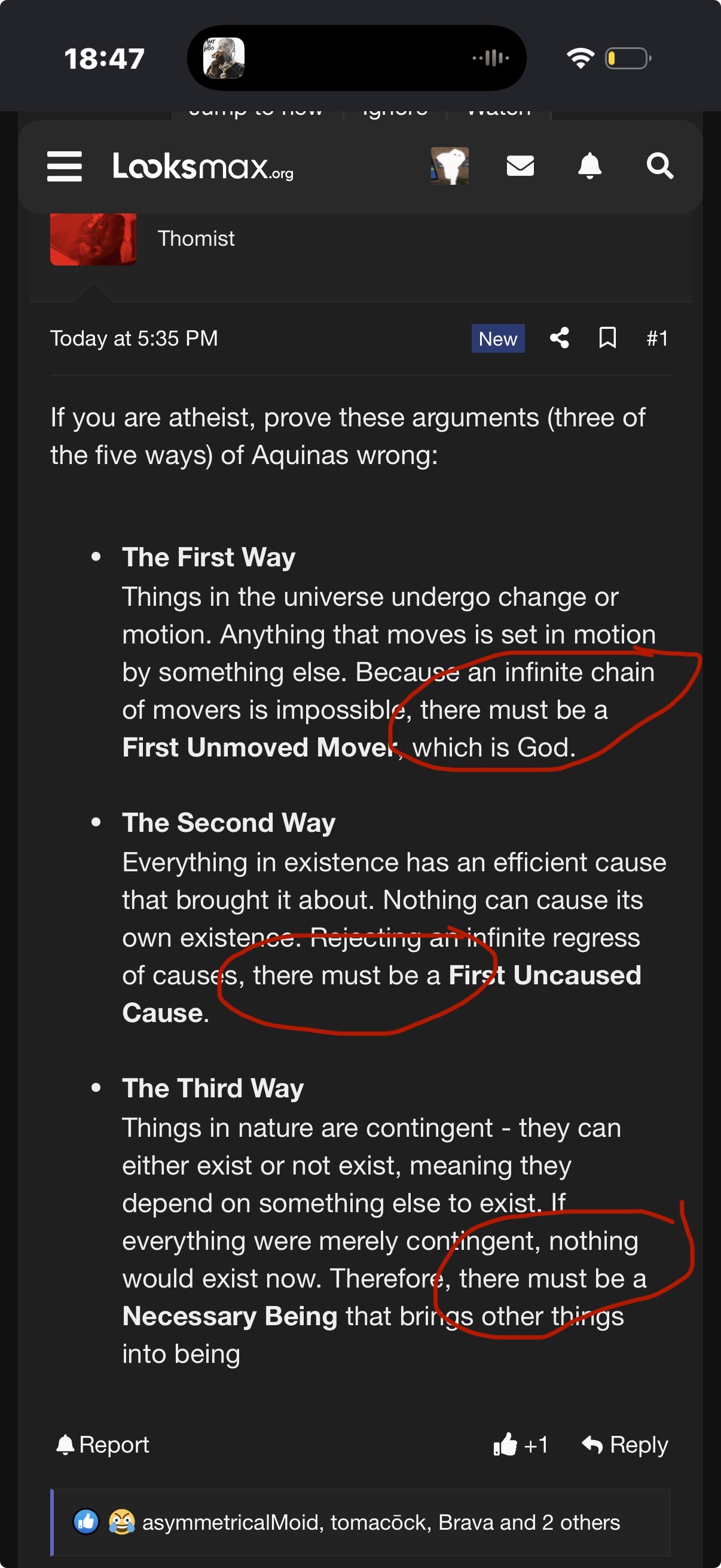
If you are atheist, prove these arguments (three of the five ways) of Aquinas wrong:

  • The First Way
    Things in the universe undergo change or motion. Anything that moves is set in motion by something else. Because an infinite chain of movers is impossible, there must be a First Unmoved Mover, which is God.

  • The Second Way
    Everything in existence has an efficient cause that brought it about. Nothing can cause its own existence. Rejecting an infinite regress of causes, there must be a First Uncaused Cause.

  • The Third Way
    Things in nature are contingent - they can either exist or not exist, meaning they depend on something else to exist. If everything were merely contingent, nothing would exist now. Therefore, there must be a Necessary Being that brings other things into being
 
  • +1
  • JFL
Reactions: YoloHatesFoids666, Subhuman, Ꭰarwin and 8 others
If you are atheist, prove these arguments (three of the five ways) of Aquinas wrong:

  • The First Way
    Things in the universe undergo change or motion. Anything that moves is set in motion by something else. Because an infinite chain of movers is impossible, there must be a First Unmoved Mover, which is God.

  • The Second Way
    Everything in existence has an efficient cause that brought it about. Nothing can cause its own existence. Rejecting an infinite regress of causes, there must be a First Uncaused Cause.

  • The Third Way
    Things in nature are contingent - they can either exist or not exist, meaning they depend on something else to exist. If everything were merely contingent, nothing would exist now. Therefore, there must be a Necessary Being that brings other things into being

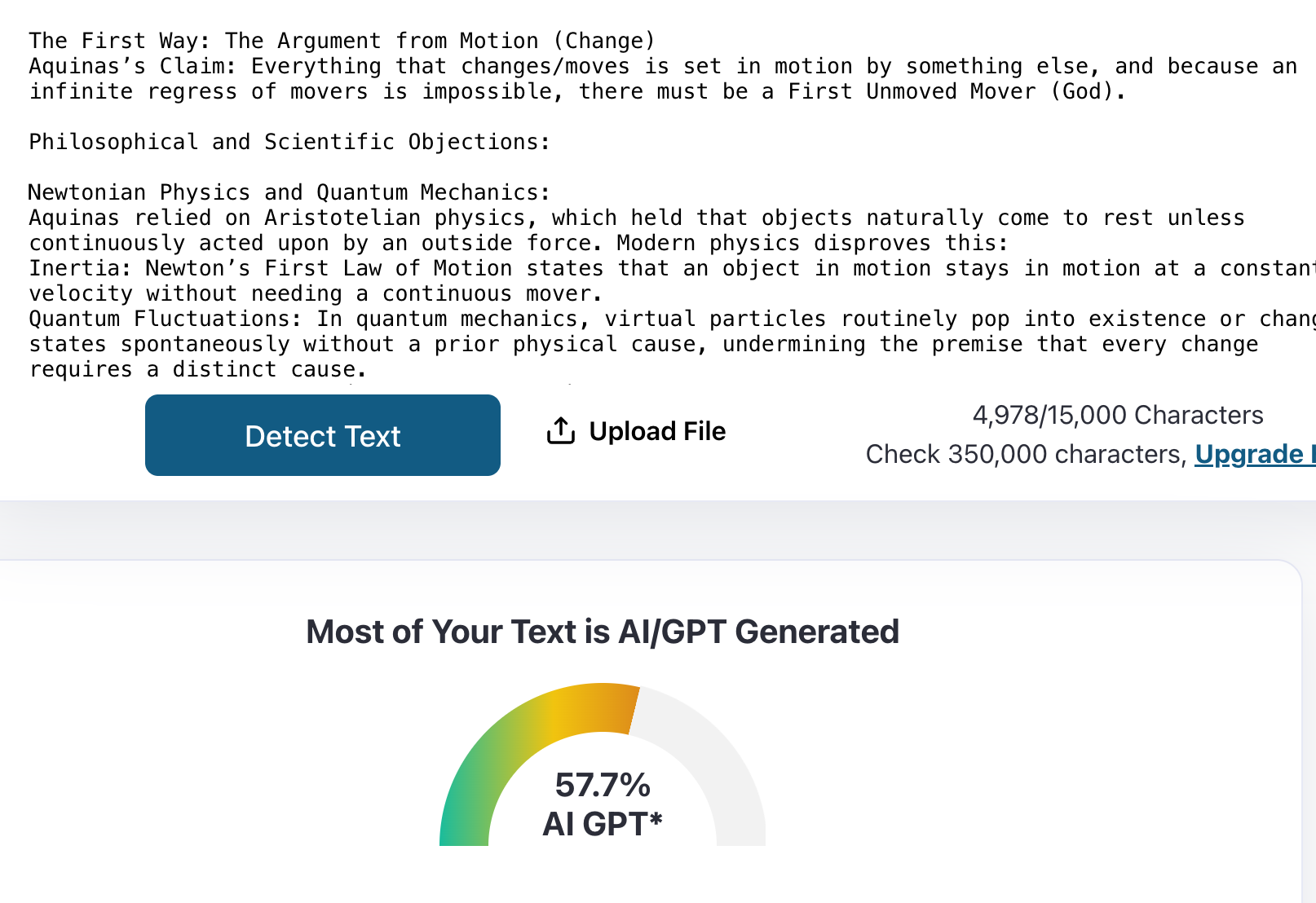
The First Way: The Argument from Motion (Change)​

Aquinas’s Claim: Everything that changes/moves is set in motion by something else, and because an infinite regress of movers is impossible, there must be a First Unmoved Mover (God).

Philosophical and Scientific Objections:

  1. Newtonian Physics and Quantum Mechanics:
    Aquinas relied on Aristotelian physics, which held that objects naturally come to rest unless continuously acted upon by an outside force. Modern physics disproves this:
    • Inertia: Newton’s First Law of Motion states that an object in motion stays in motion at a constant velocity without needing a continuous mover.
    • Quantum Fluctuations: In quantum mechanics, virtual particles routinely pop into existence or change states spontaneously without a prior physical cause, undermining the premise that every change requires a distinct cause.
  2. The Arbitrary Exception (Special Pleading):
    The argument establishes a strict rule: everything in motion requires a mover. But it resolves this by making an unevidenced exception for God (an "Unmoved Mover"). If God can exist without a mover, then the universe or energy itself could exist without a prior mover, rendering the premise inconsistent.
  3. Fallacy of Infinite Regress Prohibition:
    The argument simply asserts that an infinite regress of causes is impossible. However, mathematics and modern cosmology show that infinite sets and infinite series are logically sound and mathematically coherent.

The Second Way: The First Cause Argument (Efficient Cause)​

Aquinas’s Claim: Everything has an efficient cause; nothing can cause itself. An infinite chain of causes is impossible, so there must be a First Uncaused Cause.

Philosophical and Scientific Objections:

  1. Equating "First Cause" with God:
    Even if one accepts that the universe had a "first cause" (such as the Big Bang or a quantum fluctuation), there is no logical link showing that this cause must be a sentient, all-knowing, omnibenevolent, or personal deity. The cause could simply be an impersonal, natural physical event or field.
  2. Temporal vs. Hierarchical Causation Confusion:
    Cosmologists point out that "cause and effect" are temporal concepts that operate within spacetime. Because time itself began with the Big Bang, applying cause-and-effect language "before" or "outside" the universe misapplies our localized concepts of cause and time to a realm where they may not operate.
  3. Logical Self-Contradiction:
    Similar to the First Way:
    • Premise 1: Nothing can exist without a cause.
    • Conclusion: Therefore, something (God) exists without a cause.
    • If the fundamental rule can be broken by God, it can just as easily be broken by the fundamental matter/energy of the universe itself (e.g., the Law of Conservation of Energy, which states energy cannot be created or destroyed).

The Third Way: The Argument from Contingency​

Aquinas’s Claim: Things in nature are contingent (they can exist or not exist). If everything were merely contingent, then at some point in infinite past time, nothing would have existed. But since things exist now, there must be a Necessary Being (one that must exist).

Philosophical and Scientific Objections:

  1. The Fallacy of Composition:
    Aquinas assumes that because every individual object within the universe is contingent, the universe as a whole must also be contingent. This is a logical fallacy: just because every brick in a wall is small does not mean the wall itself is small. The universe as a collective system may be necessary, even if its constituent parts are temporary.
  2. Flawed Logic on Time and Non-Existence:
    Aquinas claims: "If everything is contingent, at some point nothing would exist." This is logically unsound for two reasons:
    • Even if every individual item has a finite lifespan, their overlapping existence throughout an infinite past can ensure that there is never a moment of pure emptiness (just as there is no point on an infinitely long timeline without numbers, even if no single number covers the whole line).
    • Energy and fundamental matter cannot be destroyed—only transformed. Therefore, at the most basic level, physical reality may be necessary rather than contingent.
  3. Defining "Necessary Being" into Existence:
    Philosophers like David Hume and Immanuel Kant argued that the concept of a "necessary being" is logically problematic. Necessity applies to propositions (like $2 + 2 = 4$), not to physical existence. Any being whose existence can be conceived can also be conceived as not existing without creating a logical contradiction.

Key Takeaway​

All three arguments rely on two core assumptions:

  1. An infinite regress is impossible.
  2. A fundamental entity must exist exempt from the rules governing everything else.
Critical analysis reveals that infinite regresses are mathematically viable, modern physics does not support a strict Aristotelian view of causation, and exempting a deity while denying the same self-existence to the physical universe itself remains an unsupported leap in logic
 
  • +1
  • JFL
Reactions: YoloHatesFoids666, vision_n, Shrek2OnDvD and 10 others

The First Way: The Argument from Motion (Change)​

Aquinas’s Claim: Everything that changes/moves is set in motion by something else, and because an infinite regress of movers is impossible, there must be a First Unmoved Mover (God).

Philosophical and Scientific Objections:

  1. Newtonian Physics and Quantum Mechanics:
    Aquinas relied on Aristotelian physics, which held that objects naturally come to rest unless continuously acted upon by an outside force. Modern physics disproves this:
    • Inertia: Newton’s First Law of Motion states that an object in motion stays in motion at a constant velocity without needing a continuous mover.
    • Quantum Fluctuations: In quantum mechanics, virtual particles routinely pop into existence or change states spontaneously without a prior physical cause, undermining the premise that every change requires a distinct cause.
  2. The Arbitrary Exception (Special Pleading):
    The argument establishes a strict rule: everything in motion requires a mover. But it resolves this by making an unevidenced exception for God (an "Unmoved Mover"). If God can exist without a mover, then the universe or energy itself could exist without a prior mover, rendering the premise inconsistent.
  3. Fallacy of Infinite Regress Prohibition:
    The argument simply asserts that an infinite regress of causes is impossible. However, mathematics and modern cosmology show that infinite sets and infinite series are logically sound and mathematically coherent.

The Second Way: The First Cause Argument (Efficient Cause)​

Aquinas’s Claim: Everything has an efficient cause; nothing can cause itself. An infinite chain of causes is impossible, so there must be a First Uncaused Cause.

Philosophical and Scientific Objections:

  1. Equating "First Cause" with God:
    Even if one accepts that the universe had a "first cause" (such as the Big Bang or a quantum fluctuation), there is no logical link showing that this cause must be a sentient, all-knowing, omnibenevolent, or personal deity. The cause could simply be an impersonal, natural physical event or field.
  2. Temporal vs. Hierarchical Causation Confusion:
    Cosmologists point out that "cause and effect" are temporal concepts that operate within spacetime. Because time itself began with the Big Bang, applying cause-and-effect language "before" or "outside" the universe misapplies our localized concepts of cause and time to a realm where they may not operate.
  3. Logical Self-Contradiction:
    Similar to the First Way:
    • Premise 1: Nothing can exist without a cause.
    • Conclusion: Therefore, something (God) exists without a cause.
    • If the fundamental rule can be broken by God, it can just as easily be broken by the fundamental matter/energy of the universe itself (e.g., the Law of Conservation of Energy, which states energy cannot be created or destroyed).

The Third Way: The Argument from Contingency​

Aquinas’s Claim: Things in nature are contingent (they can exist or not exist). If everything were merely contingent, then at some point in infinite past time, nothing would have existed. But since things exist now, there must be a Necessary Being (one that must exist).

Philosophical and Scientific Objections:

  1. The Fallacy of Composition:
    Aquinas assumes that because every individual object within the universe is contingent, the universe as a whole must also be contingent. This is a logical fallacy: just because every brick in a wall is small does not mean the wall itself is small. The universe as a collective system may be necessary, even if its constituent parts are temporary.
  2. Flawed Logic on Time and Non-Existence:
    Aquinas claims: "If everything is contingent, at some point nothing would exist."This is logically unsound for two reasons:
    • Even if every individual item has a finite lifespan, their overlapping existence throughout an infinite past can ensure that there is never a moment of pure emptiness (just as there is no point on an infinitely long timeline without numbers, even if no single number covers the whole line).
    • Energy and fundamental matter cannot be destroyed—only transformed. Therefore, at the most basic level, physical reality may be necessary rather than contingent.
  3. Defining "Necessary Being" into Existence:
    Philosophers like David Hume and Immanuel Kant argued that the concept of a "necessary being" is logically problematic. Necessity applies to propositions (like $2 + 2 = 4$), not to physical existence. Any being whose existence can be conceived can also be conceived as not existing without creating a logical contradiction.

Key Takeaway​

All three arguments rely on two core assumptions:

  1. An infinite regress is impossible.
  2. A fundamental entity must exist exempt from the rules governing everything else.
Critical analysis reveals that infinite regresses are mathematically viable, modern physics does not support a strict Aristotelian view of causation, and exempting a deity while denying the same self-existence to the physical universe itself remains an unsupported leap in logic
So you don’t have an argument?
 

The First Way: The Argument from Motion (Change)​

Aquinas’s Claim: Everything that changes/moves is set in motion by something else, and because an infinite regress of movers is impossible, there must be a First Unmoved Mover (God).

Philosophical and Scientific Objections:

  1. Newtonian Physics and Quantum Mechanics:
    Aquinas relied on Aristotelian physics, which held that objects naturally come to rest unless continuously acted upon by an outside force. Modern physics disproves this:
    • Inertia: Newton’s First Law of Motion states that an object in motion stays in motion at a constant velocity without needing a continuous mover.
    • Quantum Fluctuations: In quantum mechanics, virtual particles routinely pop into existence or change states spontaneously without a prior physical cause, undermining the premise that every change requires a distinct cause.
  2. The Arbitrary Exception (Special Pleading):
    The argument establishes a strict rule: everything in motion requires a mover. But it resolves this by making an unevidenced exception for God (an "Unmoved Mover"). If God can exist without a mover, then the universe or energy itself could exist without a prior mover, rendering the premise inconsistent.
  3. Fallacy of Infinite Regress Prohibition:
    The argument simply asserts that an infinite regress of causes is impossible. However, mathematics and modern cosmology show that infinite sets and infinite series are logically sound and mathematically coherent.

The Second Way: The First Cause Argument (Efficient Cause)​

Aquinas’s Claim: Everything has an efficient cause; nothing can cause itself. An infinite chain of causes is impossible, so there must be a First Uncaused Cause.

Philosophical and Scientific Objections:

  1. Equating "First Cause" with God:
    Even if one accepts that the universe had a "first cause" (such as the Big Bang or a quantum fluctuation), there is no logical link showing that this cause must be a sentient, all-knowing, omnibenevolent, or personal deity. The cause could simply be an impersonal, natural physical event or field.
  2. Temporal vs. Hierarchical Causation Confusion:
    Cosmologists point out that "cause and effect" are temporal concepts that operate within spacetime. Because time itself began with the Big Bang, applying cause-and-effect language "before" or "outside" the universe misapplies our localized concepts of cause and time to a realm where they may not operate.
  3. Logical Self-Contradiction:
    Similar to the First Way:
    • Premise 1: Nothing can exist without a cause.
    • Conclusion: Therefore, something (God) exists without a cause.
    • If the fundamental rule can be broken by God, it can just as easily be broken by the fundamental matter/energy of the universe itself (e.g., the Law of Conservation of Energy, which states energy cannot be created or destroyed).

The Third Way: The Argument from Contingency​

Aquinas’s Claim: Things in nature are contingent (they can exist or not exist). If everything were merely contingent, then at some point in infinite past time, nothing would have existed. But since things exist now, there must be a Necessary Being (one that must exist).

Philosophical and Scientific Objections:

  1. The Fallacy of Composition:
    Aquinas assumes that because every individual object within the universe is contingent, the universe as a whole must also be contingent. This is a logical fallacy: just because every brick in a wall is small does not mean the wall itself is small. The universe as a collective system may be necessary, even if its constituent parts are temporary.
  2. Flawed Logic on Time and Non-Existence:
    Aquinas claims: "If everything is contingent, at some point nothing would exist."This is logically unsound for two reasons:
    • Even if every individual item has a finite lifespan, their overlapping existence throughout an infinite past can ensure that there is never a moment of pure emptiness (just as there is no point on an infinitely long timeline without numbers, even if no single number covers the whole line).
    • Energy and fundamental matter cannot be destroyed—only transformed. Therefore, at the most basic level, physical reality may be necessary rather than contingent.
  3. Defining "Necessary Being" into Existence:
    Philosophers like David Hume and Immanuel Kant argued that the concept of a "necessary being" is logically problematic. Necessity applies to propositions (like $2 + 2 = 4$), not to physical existence. Any being whose existence can be conceived can also be conceived as not existing without creating a logical contradiction.

Key Takeaway​

All three arguments rely on two core assumptions:

  1. An infinite regress is impossible.
  2. A fundamental entity must exist exempt from the rules governing everything else.
Critical analysis reveals that infinite regresses are mathematically viable, modern physics does not support a strict Aristotelian view of causation, and exempting a deity while denying the same self-existence to the physical universe itself remains an unsupported leap in logic
1790178149226

Niggas will stare u dead in the eye and quote ai and switch a few words
 
  • +1
  • JFL
  • So Sad
Reactions: IndecentEyes, EK0, Sulfuras and 6 others
Atheism win nigga there is no sky daddy that somehow created the universe and somehow was able to hide away a garden for centuries and was able to turn water into wine
 
  • +1
  • Hmm...
Reactions: YoloHatesFoids666, vision_n, Shrek2OnDvD and 6 others
christianity is outdated and was used as an explanation to explain how everything could have been made, yes i DNR and no i wont read cause i know im right
 
  • JFL
  • Hmm...
  • +1
Reactions: YoloHatesFoids666, Shrek2OnDvD and Mogger
dnr

there’s no sky daddy that’s watching over you g
 
  • Hmm...
  • +1
Reactions: truedexy and Mogger
Atheism win nigga there is no sky daddy that somehow created the universe and somehow was able to hide away a garden for centuries and was able to turn water into wine
So prove the arguments wrong
 
  • +1
Reactions: mangotimer
christianity is outdated and was used as an explanation to explain how everything could have been made, yes i DNR and no i wont read cause i know im right
Those are arguments for god not christianity
 
Dnr.

Im a miserable ltn while o connor is a 6'7 Chad trillionere.

Fuck god
 
  • +1
Reactions: IndecentEyes
If you are atheist, prove these arguments (three of the five ways) of Aquinas wrong:

  • The First Way
    Things in the universe undergo change or motion. Anything that moves is set in motion by something else. Because an infinite chain of movers is impossible, there must be a First Unmoved Mover, which is God.

  • The Second Way
    Everything in existence has an efficient cause that brought it about. Nothing can cause its own existence. Rejecting an infinite regress of causes, there must be a First Uncaused Cause.

  • The Third Way
    Things in nature are contingent - they can either exist or not exist, meaning they depend on something else to exist. If everything were merely contingent, nothing would exist now. Therefore, there must be a Necessary Being that brings other things into being
Dnr
 
Those are arguments for god not christianity
yo what, all the religions are under one god, if god dont exist then what are the religions even about
 
  • Hmm...
Reactions: Mogger
Based on what?
you want me to disprove the existence of something that doesn’t exist

how about u provide evidence for its existence
 
  • +1
  • JFL
Reactions: Shrek2OnDvD and Mogger
yo what, all the religions are under one god, if god dont exist then what are the religions even about
No you are incorrect, also i’m talking about if god is real, not about which religion is true
 
I agree but disagree with Christianity
 
  • +1
Reactions: Mogger
you want me to disprove the existence of something that doesn’t exist

how about u provide evidence for its existence
Read my post, i literally did
 

The First Way: The Argument from Motion (Change)​

Aquinas’s Claim: Everything that changes/moves is set in motion by something else, and because an infinite regress of movers is impossible, there must be a First Unmoved Mover (God).

Philosophical and Scientific Objections:

  1. Newtonian Physics and Quantum Mechanics:
    Aquinas relied on Aristotelian physics, which held that objects naturally come to rest unless continuously acted upon by an outside force. Modern physics disproves this:
    • Inertia: Newton’s First Law of Motion states that an object in motion stays in motion at a constant velocity without needing a continuous mover.
    • Quantum Fluctuations: In quantum mechanics, virtual particles routinely pop into existence or change states spontaneously without a prior physical cause, undermining the premise that every change requires a distinct cause.
  2. The Arbitrary Exception (Special Pleading):
    The argument establishes a strict rule: everything in motion requires a mover. But it resolves this by making an unevidenced exception for God (an "Unmoved Mover"). If God can exist without a mover, then the universe or energy itself could exist without a prior mover, rendering the premise inconsistent.
  3. Fallacy of Infinite Regress Prohibition:
    The argument simply asserts that an infinite regress of causes is impossible. However, mathematics and modern cosmology show that infinite sets and infinite series are logically sound and mathematically coherent.

The Second Way: The First Cause Argument (Efficient Cause)​

Aquinas’s Claim: Everything has an efficient cause; nothing can cause itself. An infinite chain of causes is impossible, so there must be a First Uncaused Cause.

Philosophical and Scientific Objections:

  1. Equating "First Cause" with God:
    Even if one accepts that the universe had a "first cause" (such as the Big Bang or a quantum fluctuation), there is no logical link showing that this cause must be a sentient, all-knowing, omnibenevolent, or personal deity. The cause could simply be an impersonal, natural physical event or field.
  2. Temporal vs. Hierarchical Causation Confusion:
    Cosmologists point out that "cause and effect" are temporal concepts that operate within spacetime. Because time itself began with the Big Bang, applying cause-and-effect language "before" or "outside" the universe misapplies our localized concepts of cause and time to a realm where they may not operate.
  3. Logical Self-Contradiction:
    Similar to the First Way:
    • Premise 1: Nothing can exist without a cause.
    • Conclusion: Therefore, something (God) exists without a cause.
    • If the fundamental rule can be broken by God, it can just as easily be broken by the fundamental matter/energy of the universe itself (e.g., the Law of Conservation of Energy, which states energy cannot be created or destroyed).

The Third Way: The Argument from Contingency​

Aquinas’s Claim: Things in nature are contingent (they can exist or not exist). If everything were merely contingent, then at some point in infinite past time, nothing would have existed. But since things exist now, there must be a Necessary Being (one that must exist).

Philosophical and Scientific Objections:

  1. The Fallacy of Composition:
    Aquinas assumes that because every individual object within the universe is contingent, the universe as a whole must also be contingent. This is a logical fallacy: just because every brick in a wall is small does not mean the wall itself is small. The universe as a collective system may be necessary, even if its constituent parts are temporary.
  2. Flawed Logic on Time and Non-Existence:
    Aquinas claims: "If everything is contingent, at some point nothing would exist."This is logically unsound for two reasons:
    • Even if every individual item has a finite lifespan, their overlapping existence throughout an infinite past can ensure that there is never a moment of pure emptiness (just as there is no point on an infinitely long timeline without numbers, even if no single number covers the whole line).
    • Energy and fundamental matter cannot be destroyed—only transformed. Therefore, at the most basic level, physical reality may be necessary rather than contingent.
  3. Defining "Necessary Being" into Existence:
    Philosophers like David Hume and Immanuel Kant argued that the concept of a "necessary being" is logically problematic. Necessity applies to propositions (like $2 + 2 = 4$), not to physical existence. Any being whose existence can be conceived can also be conceived as not existing without creating a logical contradiction.

Key Takeaway​

All three arguments rely on two core assumptions:

  1. An infinite regress is impossible.
  2. A fundamental entity must exist exempt from the rules governing everything else.
Critical analysis reveals that infinite regresses are mathematically viable, modern physics does not support a strict Aristotelian view of causation, and exempting a deity while denying the same self-existence to the physical universe itself remains an unsupported leap in logic
Nothing can move by itself. We do not deny the possibility of instantaneous movement causing infinite changes but first movement must happen somehow
And you cannot pass infinite time. Infinite movement chains require that, which means that infinite regress implies that before existence an infinite time passed which means existence never happened
 
  • +1
Reactions: Mogger and jp212
acc caging at this retard
 
Niggas will swear it isnt true but they only dont believe it bc it doesnt benefit them in the sense of them being showered with riches
 
No you are incorrect, also i’m talking about if god is real, not about which religion is true
im sorry but it seems you are low iq. God says he loves everyone yet he is still willing to send them to eternal burning? sounds like something to draw people in to make money of off them. God gives people cancer, god makes people ugly sound a little fishy.
 
  • +1
Reactions: Shrek2OnDvD
If you are atheist, prove these arguments (three of the five ways) of Aquinas wrong:

  • The First Way
    Things in the universe undergo change or motion. Anything that moves is set in motion by something else. Because an infinite chain of movers is impossible, there must be a First Unmoved Mover, which is God.

  • The Second Way
    Everything in existence has an efficient cause that brought it about. Nothing can cause its own existence. Rejecting an infinite regress of causes, there must be a First Uncaused Cause.

  • The Third Way
    Things in nature are contingent - they can either exist or not exist, meaning they depend on something else to exist. If everything were merely contingent, nothing would exist now. Therefore, there must be a Necessary Being that brings other things into being

If you are atheist, prove these arguments (three of the five ways) of Aquinas wrong:

  • The First Way
    Things in the universe undergo change or motion. Anything that moves is set in motion by something else. Because an infinite chain of movers is impossible, there must be a First Unmoved Mover, which is God.

  • The Second Way
    Everything in existence has an efficient cause that brought it about. Nothing can cause its own existence. Rejecting an infinite regress of causes, there must be a First Uncaused Cause.

  • The Third Way
    Things in nature are contingent - they can either exist or not exist, meaning they depend on something else to exist. If everything were merely contingent, nothing would exist now. Therefore, there must be a Necessary Being that brings other things into being


These arguments don’t prove God. If everything needs a mover or a cause, then God would need one too. You can’t just say “everything except God.” . And even if something started the universe, that doesn’t mean it’s a God who thinks, talks, or cares about humans. It could just be the universe itself. You’re taking a gap in explanation and calling it God. That’s not proof.
Also there are multiple videos on YouTube debunking thomas aquanis
 
  • +1
Reactions: Shrek2OnDvD and accinr
im sorry but it seems you are low iq. God says he loves everyone yet he is still willing to send them to eternal burning? sounds like something to draw people in to make money of off them. God gives people cancer, god makes people ugly sound a little fishy.
Dude, i’m talking about the existence of god, not about is he good or bad
 
Dude, i’m talking about the existence of god, not about is he good or bad
thats what the fuck im saying are you not reading. He doesnt exist there was a huge explosion taht made what we know as planet earth, if god would exist then why would he not make eternal peace, people giga chads, give everyone the best health possible. gotta read between the lines
 
  • +1
Reactions: Shrek2OnDvD
If you are atheist, prove these arguments (three of the five ways) of Aquinas wrong:

  • The First Way
    Things in the universe undergo change or motion. Anything that moves is set in motion by something else. Because an infinite chain of movers is impossible, there must be a First Unmoved Mover, which is God.

  • The Second Way
    Everything in existence has an efficient cause that brought it about. Nothing can cause its own existence. Rejecting an infinite regress of causes, there must be a First Uncaused Cause.

  • The Third Way
    Things in nature are contingent - they can either exist or not exist, meaning they depend on something else to exist. If everything were merely contingent, nothing would exist now. Therefore, there must be a Necessary Being that brings other things into being
"Because an infinite chain of movers is impossible"

It's not impossible

"there must be a First Uncaused Cause."
Not if something always existed

"there must be a Necessary Being that brings other things into being"

There's no evidence of that
 
  • +1
Reactions: Shrek2OnDvD, Krivi. and Mogger
These arguments don’t prove God. If everything needs a mover or a cause, then God would need one too. You can’t just say “everything except God.” . And even if something started the universe, that doesn’t mean it’s a God who thinks, talks, or cares about humans. It could just be the universe itself. You’re taking a gap in explanation and calling it God. That’s not proof.
Also there are multiple videos on YouTube debunking thomas aquanis
Aquinas doesn’t say that everything needs a cause. Also it’s not god of the gaps because Aquinas is arguing about the fundamental explanation of reality instead of gaps in science knowledge
 
Aquinas doesn’t say that everything needs a cause. Also it’s not god of the gaps because Aquinas is arguing about the fundamental explanation of reality instead of gaps in science knowledge


He still just made God the exception. And even if something fundamental exists, that doesn’t make it God.
 
  • +1
Reactions: Shrek2OnDvD and Turkic Albanian
"Because an infinite chain of movers is impossible"

It's not impossible

"there must be a First Uncaused Cause."
Not if something always existed

"there must be a Necessary Being that brings other things into being"

There's no evidence of that
Aquinas isn’t saying everything needs a cause. He’s saying an infinite chain of dependent causes can’t ultimately explain why anything has causal power in the first place. Saying something could have always existed doesn’t really answer that, since an eternal chain could still be dependent. If you reject a necessary being, you’d still have to explain why an infinite chain of contingent things is enough as an ultimate explanation.
 
Aquinas isn’t saying everything needs a cause. He’s saying an infinite chain of dependent causes can’t ultimately explain why anything has causal power in the first place. Saying something could have always existed doesn’t really answer that, since an eternal chain could still be dependent. If you reject a necessary being, you’d still have to explain why an infinite chain of contingent things is enough as an ultimate explanation.
"you’d still have to explain why an infinite chain of contingent things is enough as an ultimate explanation.".

Brute fact.

Why should it have been any other way?
 
  • +1
Reactions: Shrek2OnDvD and Mogger
"you’d still have to explain why an infinite chain of contingent things is enough as an ultimate explanation.".

Brute fact.

Why should it have been any other way?
Why should brute facts be acceptable as an ultimate explanation?
 
Why should brute facts be acceptable as an ultimate explanation?
Your God hypothesis is a brute fact

Why cant I use a brute fact of my own but with naturalism as the mechanism instead of God

Double standards
 
  • +1
Reactions: Shrek2OnDvD
Your God hypothesis is a brute fact

Why cant I use a brute fact of my own but with naturalism as the mechanism instead of God

Double standards
The difference is that Aquinas isn’t proposing God as an arbitrary brute fact. He’s arguing for a necessary being that doesn’t depend on anything else for its existence. Saying nature is a brute fact doesn’t show that nature is necessary or self explanatory.
 
The difference is that Aquinas isn’t proposing God as an arbitrary brute fact. He’s arguing for a necessary being that doesn’t depend on anything else for its existence. Saying nature is a brute fact doesn’t show that nature is necessary or self explanatory.
If God can exist independently then why can't nature also exist independently?
 
  • +1
Reactions: Shrek2OnDvD
If God can exist independently then why can't nature also exist independently?
Nature is made of contingent things, so it can’t be the necessary foundation.
You’d have to show that nature itself is necessary, rather than asserting it can exist independently.
 
Nature is made of contingent things, so it can’t be the necessary foundation.
You’d have to show that nature itself is necessary, rather than asserting it can exist independently.
Maybe nature itself is necessary, the absence of nature was perhaps not even a possibility, true nothingness or the absence of a natural reality Was perhaps never on the cards.

True nothingness doesn't exist, it's a made up abstraction of the human mind used for thought experiments
 
  • +1
Reactions: Shrek2OnDvD and iblamechico
god is tales
im manlet ltn with giga high inhib while o connor is a 6'7 chad slayying a stacy as we speak
jfl id be damned if i believed in this all powerful deity
actual cage if you believe god exists
 
  • +1
Reactions: Shrek2OnDvD and Turkic Albanian
If you are atheist, prove these arguments (three of the five ways) of Aquinas wrong:

  • The First Way
    Things in the universe undergo change or motion. Anything that moves is set in motion by something else. Because an infinite chain of movers is impossible, there must be a First Unmoved Mover, which is God.

  • The Second Way
    Everything in existence has an efficient cause that brought it about. Nothing can cause its own existence. Rejecting an infinite regress of causes, there must be a First Uncaused Cause.

  • The Third Way
    Things in nature are contingent - they can either exist or not exist, meaning they depend on something else to exist. If everything were merely contingent, nothing would exist now. Therefore, there must be a Necessary Being that brings other things into being

First you’ll have to prove these assumptions and then we can debate

IMG 0152
 
  • +1
Reactions: Shrek2OnDvD, Mogger and Turkic Albanian
Maybe nature itself is necessary, the absence of nature was perhaps not even a possibility, true nothingness or the absence of a natural reality Was perhaps never on the cards.

True nothingness doesn't exist, it's a made up abstraction of the human mind used for thought experiments
Could be, but it still needs an argument
 

Similar threads

dxo
Replies
3
Views
18
Thief
Thief
Bellona
Replies
5
Views
64
Bellona
Bellona
height maxxer
Replies
11
Views
110
sonic55555
S
Upsilon
Replies
3
Views
59
Upsilon
Upsilon
incomplete
Replies
8
Views
59
incomplete
incomplete

Users who are viewing this thread

  • Turkic Albanian
  • muhajudin21
  • grymhackare
  • YoloHatesFoids666
  • Subhuman
  • canthohexum
  • BaldingBabyFace
  • SpanishManlett
  • egyptianslayr
  • ssTOL
  • DrRodger
  • Krivi.
Back
Top