


Norilsk
Iron
- Joined
- Oct 28, 2024
- Posts
- 147
- Reputation
- 68
There is a persistent misconception among the normies that beauty is entirely subjective : a matter of taste, culture, and era. This view is partially true, but it misses a more fundamental phenomenon: aesthetic subjectivity does not operate in an absolute vacuum. It functions within an interval defined by objective biological criteria, themselves rooted in signals of health and genetic integrity.
For millennia, human beings have unconsciously evaluated potential partners through an evolutionary lens. Perceived attractiveness is, in large part, an aesthetic translation of health signals. A symmetrical face, luminous skin, even being overweight in a time when food was hard to come by
This is not a cultural construction. Cross-cultural studies (Langlois et al., 2000; Sugiyama, 2005) show that certain attractiveness criteria are remarkably stable across very different societies, suggesting a universal substrate.
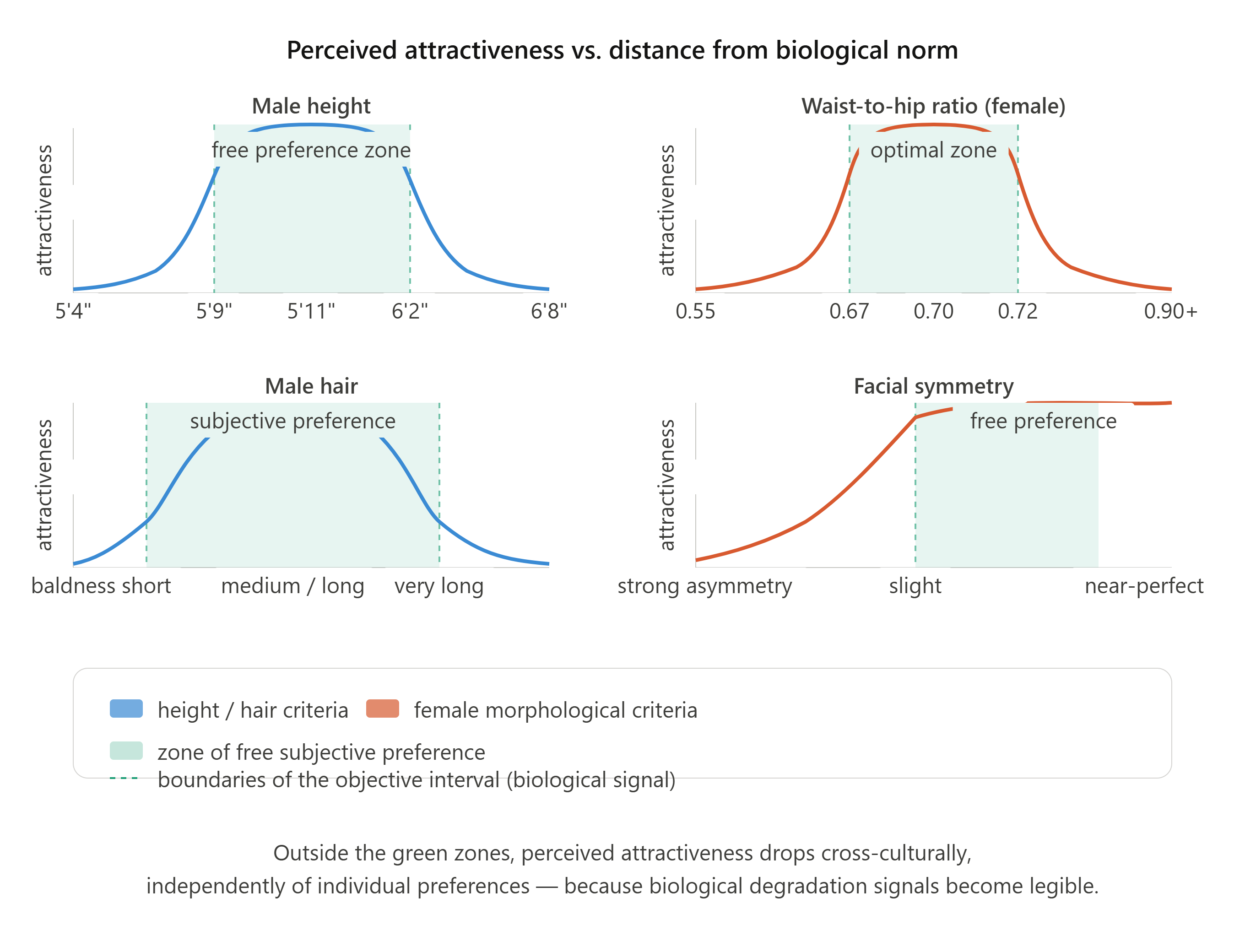
The most accurate model is neither "everything is objective" nor "everything is subjective." It is this: There exists an interval of biological normality within which preferences vary freely. But the further one strays from this interval, the more the consensus of attractiveness diminishes.
Think of it as a bell curve: at the centre, a wide zone where preference is sovereign. At the extremes, a zone where a signal of genetic degradation or poor health begins to inhibit attraction, regardless of culture.
Male Height (sorry )
)
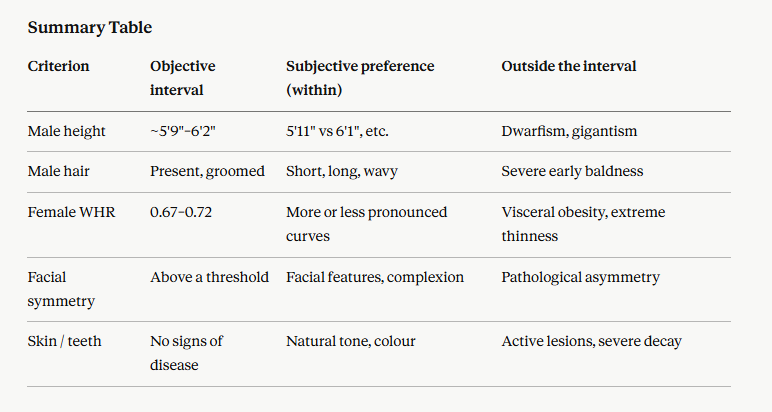
Studies in evolutionary psychology (Stulp et al., 2013) document that in Western populations, men perceived as most attractive generally fall between 5'9" and 6'2" (175 -188 cm). Within this interval, preferences are real and varied: some women prefer a man at 5'11", others at 6'1" — pure subjectivity. But outside this interval, the attractiveness curve drops progressively. A man at 5'4" or 6'8" will statistically be perceived as less attractive, not through arbitrary prejudice, but because the extremes evoke hormonal or genetic growth anomalies. The lower limit suggests a growth hormone deficit; the upper limit, pathological overproduction (gigantism).
Male Hair: Length vs. Baldness
Preferences vary freely regarding hair length. Short, medium, or longer hair, all remain within the acceptable interval. This is the domain of cultural and personal aesthetics. Howeve, baldness exits this interval: it is universally associated with a drop in perceived attractiveness, because it reveals genetic flaws
Female Waist-to-Hip Ratio (WHR)
One of the best-documented examples in evolutionary biology. Studies conducted across dozens of different cultures (Singh, 1993; Yu & Shepard, 1998) identify a ratio of approximately 0.67 to 0.72 as universally perceived as most attractive in women. This ratio corresponds precisely to the morphology associated with optimal hormonal balance (oestrogen/progesterone), maximum fertility, and good resistance to metabolic disease. Within this interval, tastes vary: some prefer more pronounced curves, others more subtle ones. But severe visceral obesity (ratio > 0.85) or extreme thinness both signal metabolic dysregulation and cause perceived attractiveness to drop cross-culturally.
Skin and Teeth
Skin texture and radiance, along with dental condition, act as visible indicators of health. The range of what is considered "normal" is wide: skin tones vary greatly, teeth can be slightly irregular, and personal preferences differ within these limits. However, severe skin lesions, blackened teeth, or widespread hair loss are generally associated with underlying health problems, such as infections, nutritional deficiencies, or autoimmune disorders, and are perceived almost universally as falling outside this normal range.
None of this implies that beauty can be reduced entirely to biology. Culture, personal experience, emotional bonds, and local standards of attractiveness all play an important role in shaping individual preferences. Yet these preferences do not exist in a limitless space. They operate within a framework influenced by our evolutionary history.
A useful comparison is that of a football pitch. The boundaries of the field represent the broad biological constraints within which the game is played. Inside those boundaries, players are free to develop different strategies, and express their individuality. Beauty works in much the same way: there is considerable room for variation and personal taste, but that variation unfolds within certain underlying limits.
The Biological Foundation: Beauty as a Reading of Health
For millennia, human beings have unconsciously evaluated potential partners through an evolutionary lens. Perceived attractiveness is, in large part, an aesthetic translation of health signals. A symmetrical face, luminous skin, even being overweight in a time when food was hard to come by
This is not a cultural construction. Cross-cultural studies (Langlois et al., 2000; Sugiyama, 2005) show that certain attractiveness criteria are remarkably stable across very different societies, suggesting a universal substrate.
The Two-Level Structure: Objective Interval + Subjective Preference
The most accurate model is neither "everything is objective" nor "everything is subjective." It is this: There exists an interval of biological normality within which preferences vary freely. But the further one strays from this interval, the more the consensus of attractiveness diminishes.
Think of it as a bell curve: at the centre, a wide zone where preference is sovereign. At the extremes, a zone where a signal of genetic degradation or poor health begins to inhibit attraction, regardless of culture.
4 concrete Examples :
Male Height (sorry
)Studies in evolutionary psychology (Stulp et al., 2013) document that in Western populations, men perceived as most attractive generally fall between 5'9" and 6'2" (175 -188 cm). Within this interval, preferences are real and varied: some women prefer a man at 5'11", others at 6'1" — pure subjectivity. But outside this interval, the attractiveness curve drops progressively. A man at 5'4" or 6'8" will statistically be perceived as less attractive, not through arbitrary prejudice, but because the extremes evoke hormonal or genetic growth anomalies. The lower limit suggests a growth hormone deficit; the upper limit, pathological overproduction (gigantism).
Male Hair: Length vs. Baldness
Preferences vary freely regarding hair length. Short, medium, or longer hair, all remain within the acceptable interval. This is the domain of cultural and personal aesthetics. Howeve, baldness exits this interval: it is universally associated with a drop in perceived attractiveness, because it reveals genetic flaws
Female Waist-to-Hip Ratio (WHR)
One of the best-documented examples in evolutionary biology. Studies conducted across dozens of different cultures (Singh, 1993; Yu & Shepard, 1998) identify a ratio of approximately 0.67 to 0.72 as universally perceived as most attractive in women. This ratio corresponds precisely to the morphology associated with optimal hormonal balance (oestrogen/progesterone), maximum fertility, and good resistance to metabolic disease. Within this interval, tastes vary: some prefer more pronounced curves, others more subtle ones. But severe visceral obesity (ratio > 0.85) or extreme thinness both signal metabolic dysregulation and cause perceived attractiveness to drop cross-culturally.
Skin and Teeth
Skin texture and radiance, along with dental condition, act as visible indicators of health. The range of what is considered "normal" is wide: skin tones vary greatly, teeth can be slightly irregular, and personal preferences differ within these limits. However, severe skin lesions, blackened teeth, or widespread hair loss are generally associated with underlying health problems, such as infections, nutritional deficiencies, or autoimmune disorders, and are perceived almost universally as falling outside this normal range.
Conclusion : The Role of Subjectivity
None of this implies that beauty can be reduced entirely to biology. Culture, personal experience, emotional bonds, and local standards of attractiveness all play an important role in shaping individual preferences. Yet these preferences do not exist in a limitless space. They operate within a framework influenced by our evolutionary history.
A useful comparison is that of a football pitch. The boundaries of the field represent the broad biological constraints within which the game is played. Inside those boundaries, players are free to develop different strategies, and express their individuality. Beauty works in much the same way: there is considerable room for variation and personal taste, but that variation unfolds within certain underlying limits.
Illustration :
Attachments
Last edited:


