Seth Walsh

Iconoclast
Contributor
- Joined
- Jan 12, 2020
- Posts
- 11,075
- Reputation
- 22,654
THE CLASS COMPOUNDING MACHINE
No hysteria. No morality play. Just the incentives.
THE SHORT VERSION
Class is not merely “rich versus poor.” It is a conversion machine: an initial advantage becomes lower variance, more attempts, and better conversion of ability into outcomes.
The affluent do not need to be perfect. They own a larger error budget. A bad job, a bad year, a wrong degree, a failed business, a relocation, or a health shock can be absorbed without ending the whole route. They can wait for a better offer, try again, move, hire help, or take a temporary loss.
For someone with thin buffers, the same events can change the route itself. A rent shortfall, an unreliable car, a hospital bill, a family crisis, or one missed paycheque does not only cost money. It confiscates time, attention and choice.
That is the basic class pill: the people with more do not just have more resources. Their resources make their future decisions less forced.
────────────────────
1. TIME IS NOT FREE
Money purchases calendar space.
A person with a buffer can study before the interview, take the low-paid internship that turns into a credential, recover from a bad manager, stay in a good area, or refuse a predatory loan. Someone living close to zero has to optimise for the next bill. That is not a different personality. It is a different time horizon.
The same raw ability produces different outcomes when one person can spend a year compounding a skill and the other must constantly interrupt compounding to solve emergencies.
2. PRIVATE INFORMATION ARRIVES EARLY
Most valuable opportunities do not look like job-board listings. They arrive through people, institutions and norms: which course matters, which recruiter is real, which neighbourhood is quietly rising, what a “good” application looks like, what an employer actually pays, when to negotiate, who can make an introduction.
This is not always corruption. It is often ordinary trust and repeated proximity. But it means opportunity is filtered before it ever becomes public.
3. NETWORKS ARE NOT JUST CONTACT LISTS
A useful network gives three things at once:
• information before the crowd;
• a reputation you can borrow; and
• someone who can interpret a mistake as recoverable rather than disqualifying.
That last point is underrated. People with status are often granted a “bad year.” People without it are more likely to be read as the bad year.
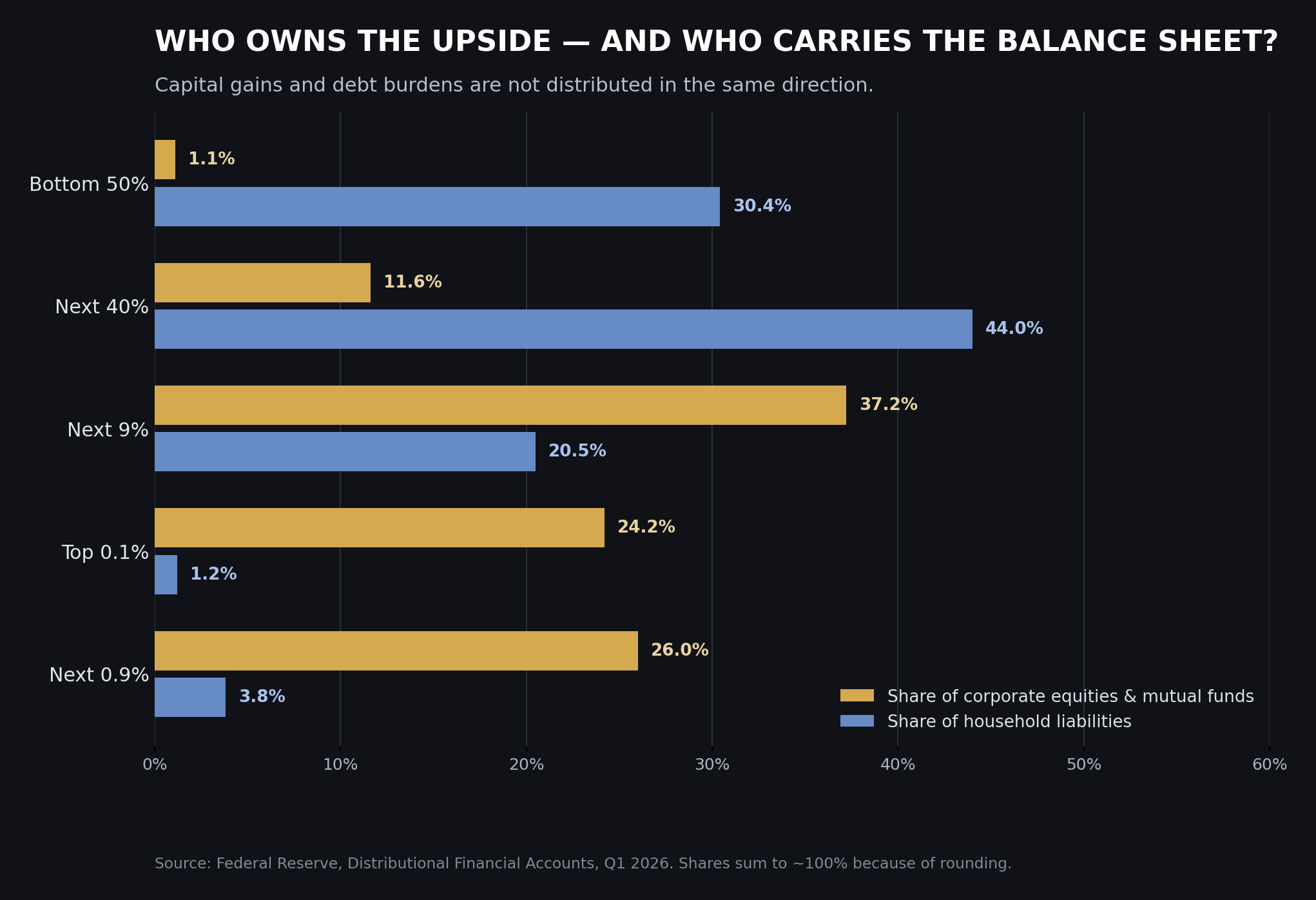
4. CAPITAL OWNS THE UPSIDE; DEBT OWNS THE DOWNSIDE
The Federal Reserve’s latest Distributional Financial Accounts make this brutally plain.
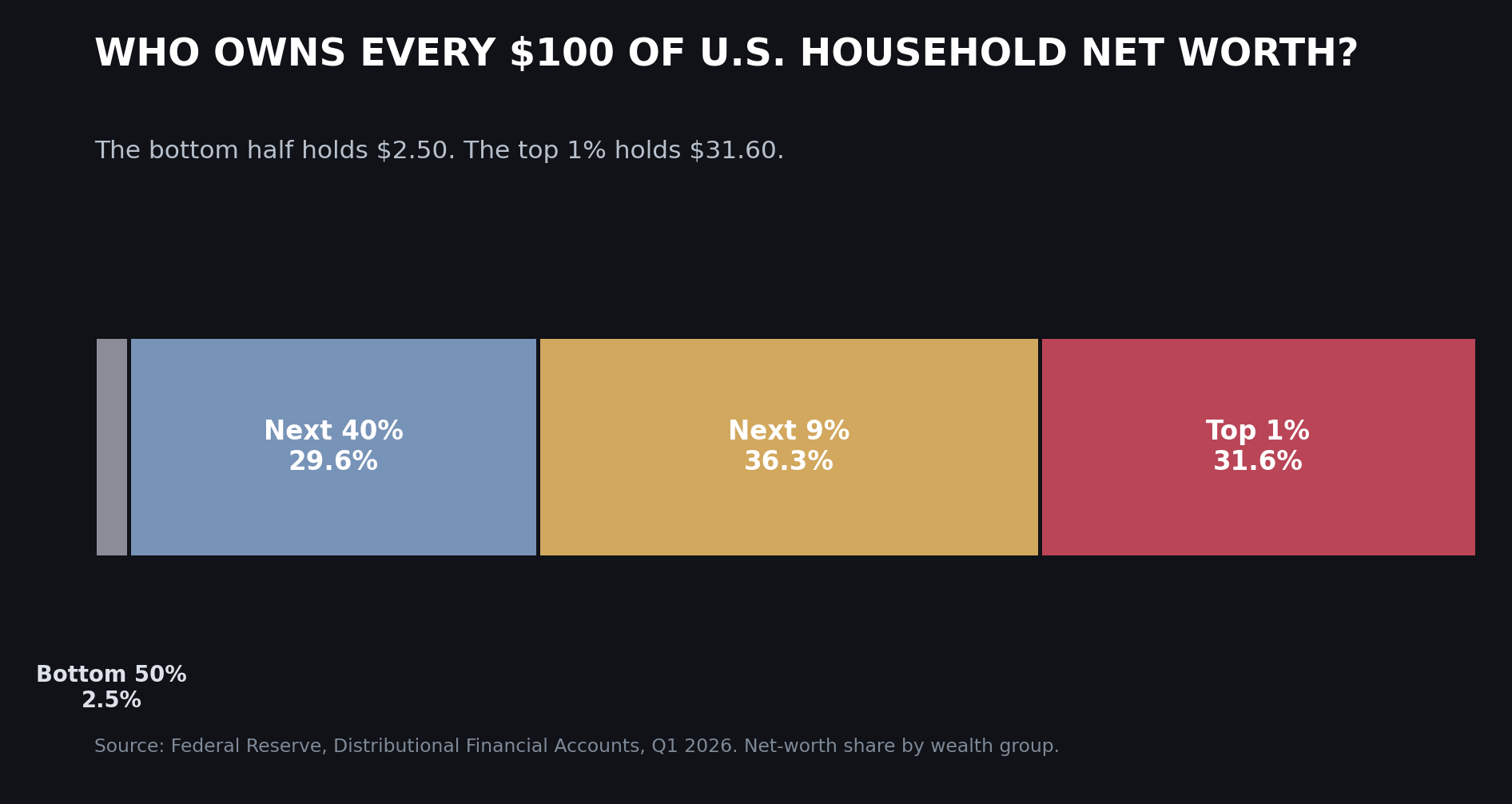
In Q1 2026, the bottom 50% held 2.5% of U.S. household net worth. The top 1% held 31.6%.
The more revealing split is in what each group owns versus owes:
• Bottom 50%: 1.1% of corporate equities and mutual-fund shares; 30.4% of household liabilities.
• Top 1%: 50.2% of corporate equities and mutual-fund shares; 5.0% of household liabilities.
So “the rich get richer” is too vague. The ownership map gives the top a disproportionate claim on appreciation and a disproportionately small share of debt drag. When assets rise, they participate heavily. When rates and repayments bite, the burden is distributed elsewhere.
5. THE LOOP COMPOUNDS
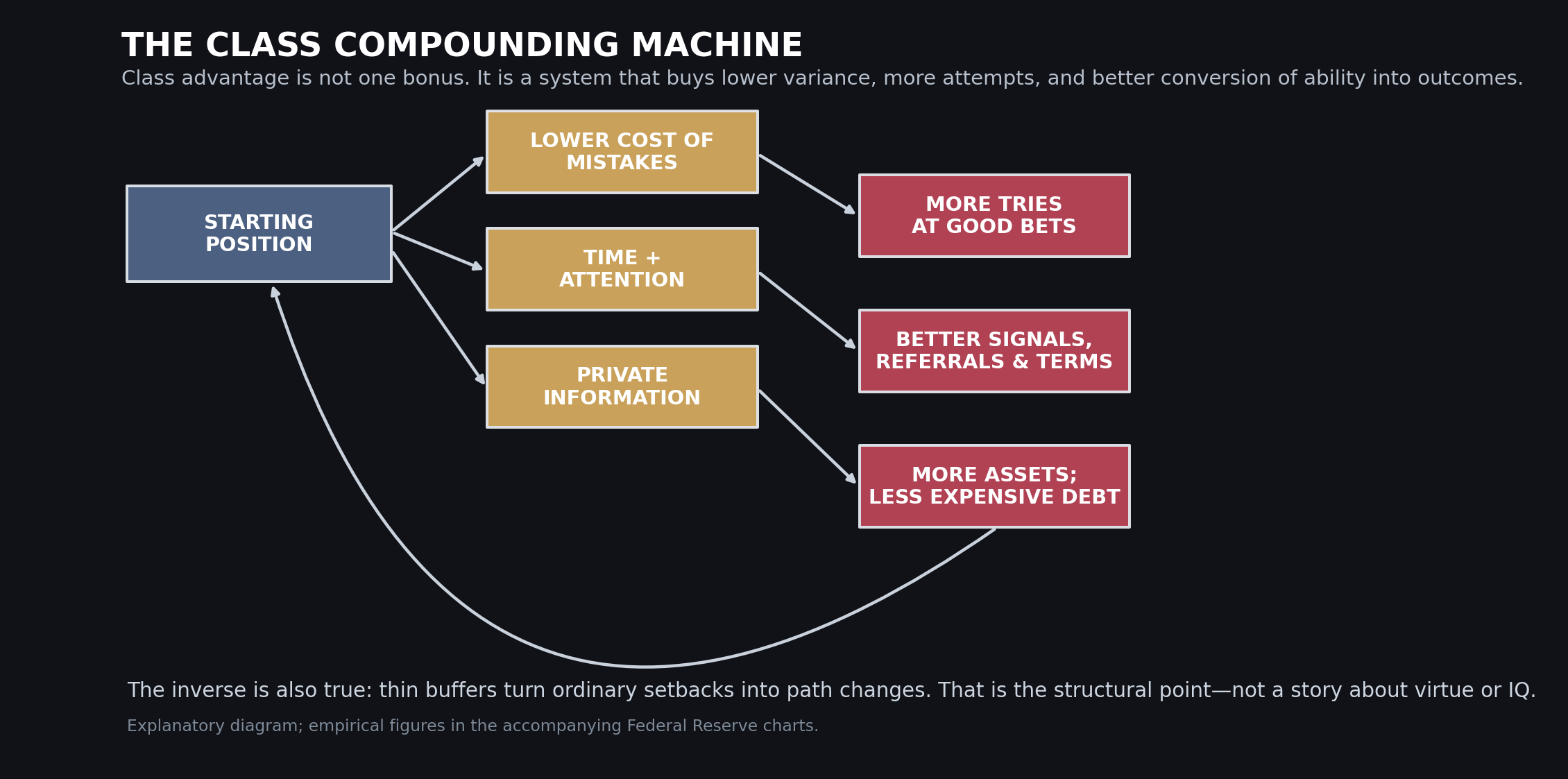
Starting position → lower cost of mistakes, more time and private information → more high-quality attempts → better signals, referrals and terms → more assets and cheaper debt → a stronger starting position for the next round.
The inverse loop is not a character flaw either. Thin buffers make ordinary setbacks path-changing. The class gradient becomes deeper because each miss costs more and each recovery takes longer.
────────────────────
WHAT THIS IS NOT
This is not a claim that poor people do not work, or that individual choices are irrelevant. It is not an excuse to turn every rich person into a cartoon villain.
It is a claim about the odds. Stories of somebody escaping the distribution are not measurements of the distribution. “I know someone who made it” tells you that escape is possible; it tells you almost nothing about how wide the runway was for everyone else.
The world mostly judges the result at the end of the process. Class reshapes the process before performance is even observed. Same ability does not mean the same number of shots, the same downside, the same audience, or the same conversion rate.
THE ACTUAL BLACKPILL
The relevant unit is not effort alone. It is:
effort × runway × feedback × ownership.
Starting conditions alter all four before a person makes their first serious choice. That is why class gaps feel wider than income gaps. Income is a flow; class also determines the stock of buffers, the quality of information, the price of errors and the right to try again.
The non-dramatic response is to stop mistaking structural constraints for personal mystery. Ask what is actually binding: fixed costs, expensive debt, lack of a credential, lack of a reference, lack of time, or lack of a cash buffer. Different constraints need different moves. Pretending all players are solving the same problem is the cope.
DATA / METHOD
Charts use Federal Reserve Distributional Financial Accounts, Q1 2026, “Net worth,” “Corporate equities and mutual fund shares,” and “Liabilities” shares by wealth group. Top 1% in the charts combines the top 0.1% and remaining top 0.9%; values can differ by 0.1 point from rounding.
Source: https://www.federalreserve.gov/releases/z1/dataviz/dfa/
No hysteria. No morality play. Just the incentives.
THE SHORT VERSION
Class is not merely “rich versus poor.” It is a conversion machine: an initial advantage becomes lower variance, more attempts, and better conversion of ability into outcomes.
The affluent do not need to be perfect. They own a larger error budget. A bad job, a bad year, a wrong degree, a failed business, a relocation, or a health shock can be absorbed without ending the whole route. They can wait for a better offer, try again, move, hire help, or take a temporary loss.
For someone with thin buffers, the same events can change the route itself. A rent shortfall, an unreliable car, a hospital bill, a family crisis, or one missed paycheque does not only cost money. It confiscates time, attention and choice.
That is the basic class pill: the people with more do not just have more resources. Their resources make their future decisions less forced.
────────────────────
1. TIME IS NOT FREE
Money purchases calendar space.
A person with a buffer can study before the interview, take the low-paid internship that turns into a credential, recover from a bad manager, stay in a good area, or refuse a predatory loan. Someone living close to zero has to optimise for the next bill. That is not a different personality. It is a different time horizon.
The same raw ability produces different outcomes when one person can spend a year compounding a skill and the other must constantly interrupt compounding to solve emergencies.
2. PRIVATE INFORMATION ARRIVES EARLY
Most valuable opportunities do not look like job-board listings. They arrive through people, institutions and norms: which course matters, which recruiter is real, which neighbourhood is quietly rising, what a “good” application looks like, what an employer actually pays, when to negotiate, who can make an introduction.
This is not always corruption. It is often ordinary trust and repeated proximity. But it means opportunity is filtered before it ever becomes public.
3. NETWORKS ARE NOT JUST CONTACT LISTS
A useful network gives three things at once:
• information before the crowd;
• a reputation you can borrow; and
• someone who can interpret a mistake as recoverable rather than disqualifying.
That last point is underrated. People with status are often granted a “bad year.” People without it are more likely to be read as the bad year.
4. CAPITAL OWNS THE UPSIDE; DEBT OWNS THE DOWNSIDE
The Federal Reserve’s latest Distributional Financial Accounts make this brutally plain.
In Q1 2026, the bottom 50% held 2.5% of U.S. household net worth. The top 1% held 31.6%.
The more revealing split is in what each group owns versus owes:
• Bottom 50%: 1.1% of corporate equities and mutual-fund shares; 30.4% of household liabilities.
• Top 1%: 50.2% of corporate equities and mutual-fund shares; 5.0% of household liabilities.
So “the rich get richer” is too vague. The ownership map gives the top a disproportionate claim on appreciation and a disproportionately small share of debt drag. When assets rise, they participate heavily. When rates and repayments bite, the burden is distributed elsewhere.
5. THE LOOP COMPOUNDS
Starting position → lower cost of mistakes, more time and private information → more high-quality attempts → better signals, referrals and terms → more assets and cheaper debt → a stronger starting position for the next round.
The inverse loop is not a character flaw either. Thin buffers make ordinary setbacks path-changing. The class gradient becomes deeper because each miss costs more and each recovery takes longer.
────────────────────
WHAT THIS IS NOT
This is not a claim that poor people do not work, or that individual choices are irrelevant. It is not an excuse to turn every rich person into a cartoon villain.
It is a claim about the odds. Stories of somebody escaping the distribution are not measurements of the distribution. “I know someone who made it” tells you that escape is possible; it tells you almost nothing about how wide the runway was for everyone else.
The world mostly judges the result at the end of the process. Class reshapes the process before performance is even observed. Same ability does not mean the same number of shots, the same downside, the same audience, or the same conversion rate.
THE ACTUAL BLACKPILL
The relevant unit is not effort alone. It is:
effort × runway × feedback × ownership.
Starting conditions alter all four before a person makes their first serious choice. That is why class gaps feel wider than income gaps. Income is a flow; class also determines the stock of buffers, the quality of information, the price of errors and the right to try again.
The non-dramatic response is to stop mistaking structural constraints for personal mystery. Ask what is actually binding: fixed costs, expensive debt, lack of a credential, lack of a reference, lack of time, or lack of a cash buffer. Different constraints need different moves. Pretending all players are solving the same problem is the cope.
DATA / METHOD
Charts use Federal Reserve Distributional Financial Accounts, Q1 2026, “Net worth,” “Corporate equities and mutual fund shares,” and “Liabilities” shares by wealth group. Top 1% in the charts combines the top 0.1% and remaining top 0.9%; values can differ by 0.1 point from rounding.
Source: https://www.federalreserve.gov/releases/z1/dataviz/dfa/
Last edited: