Blackpill: Why Social Class Can't Be Faked

Seth Walsh

Seth Walsh

Iconoclast
Contributor
Joined
Jan 12, 2020
Posts
10,581
Reputation
21,556
Prerequisite:

Rent turns labour into survival.
Low-burn/backstop turns labour into capital.
Capital turns into shots.
Shots create convexity.
Convexity is where class mobility actually happens.

1777991112089
1777991123663
1777991138544
1777991145504
1777991157645

Why social class can’t be faked


1/
People think class is school, postcode, accent, manners, clothes, holidays, or taste.

Wrong.

Those are surfaces.

The engine is deeper:

capital, risk absorption, family programming, network access, and the ability to survive mistakes.

2/
The real class question is not:

“Where did you go to school?”

It is:

What happens if you fail for 18 months?

Do you move home?
Get bailed out?
Have family legal/accounting help?
Keep preparing?
Or are you forced into the nearest wage?

That is class.

3/
In Ireland, the wealth gap is brutally visible.

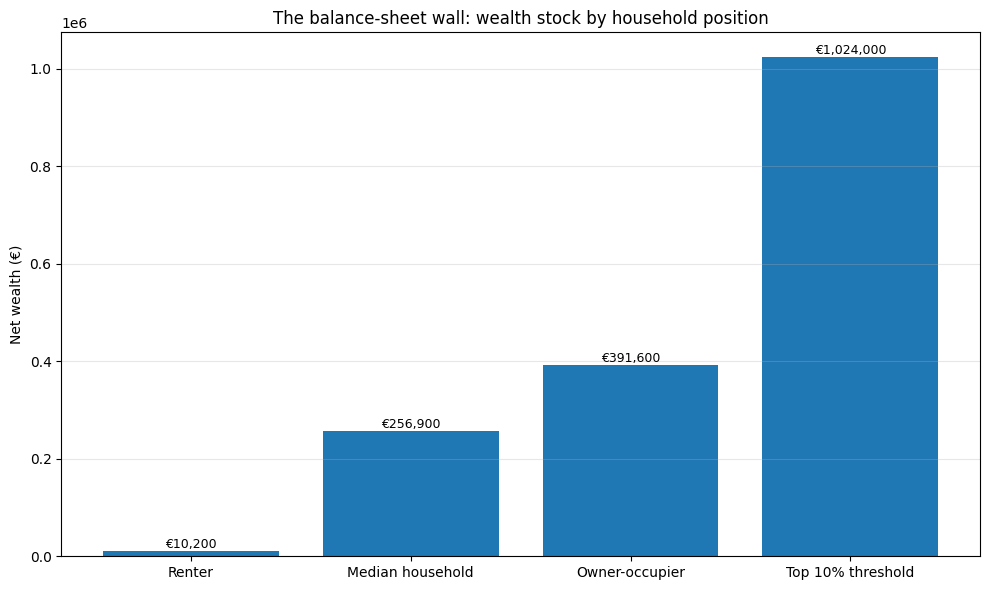
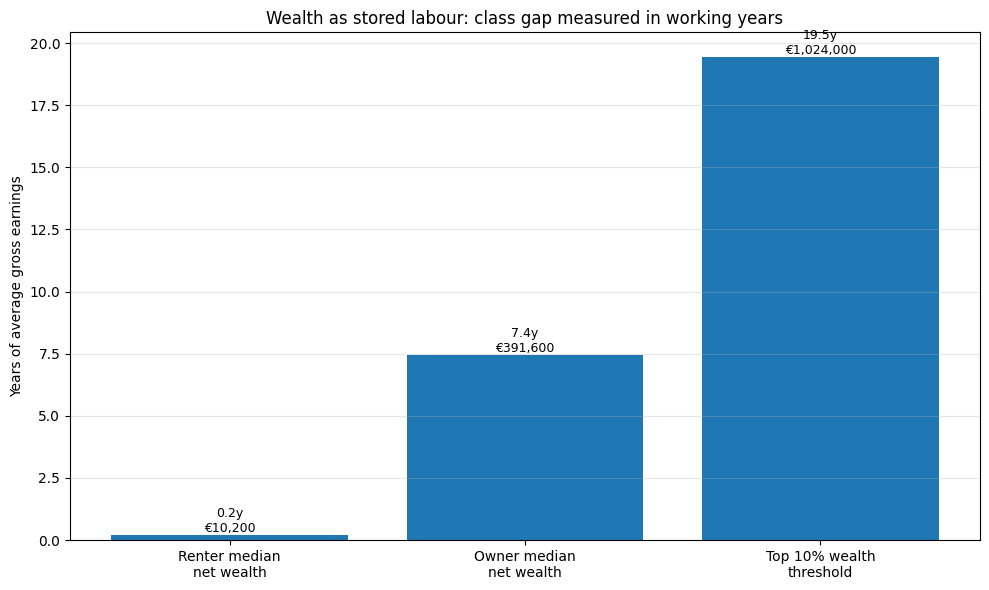
CSO 2023 data: owner-occupiers had median net wealth of €391,600.

Renters had €10,200.

The top 10% of households had over €1.024m net wealth.
The bottom 10% had less than €2,400.

That is not accent. That is balance sheet.

4/
Postcode is not the engine.

Postcode is usually the receipt.

It reflects parental asset ownership, school access, peer group, commute burden, safety, quiet study space, inheritance path, and who your family already knows.

The postcode is downstream from capital.

5/
Accent and manners are not the engine either.

They are class signals.

Sutton Trust research says Received Pronunciation is used by less than 10% of the population, yet remains dominant in authority-heavy spaces like media, politics, courtrooms, civil service, and corporate life.

Accent helps reveal class. It does not create it.

6/
School is also downstream.

Elite schools matter because they package several upstream advantages at once:

money, stable home life, parental ambition, peer competition, confidence around authority, tutoring, alumni networks, and early belief that elite rooms are “normal.”

The school is a transmission belt. Not the original power source.

7/
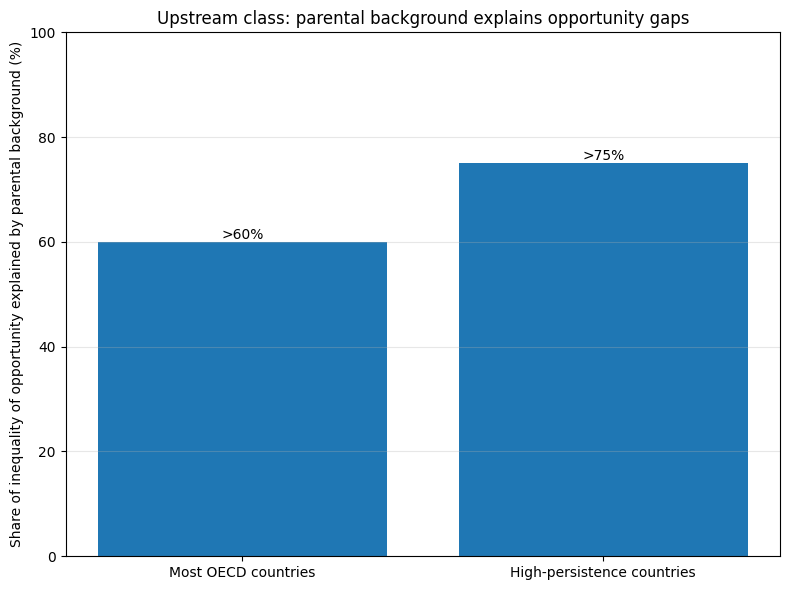
The OECD says parental background explains over 60% of inequality of opportunity in most countries, and over 75% in some.

That is the quiet truth.

Before “merit” even starts, the board is already tilted by family structure, wealth, education, housing, health, and place.

8/
Even when people from working-class backgrounds break into elite jobs, the gap does not disappear.

LSE research on the “class ceiling” found that people from working-class backgrounds in elite occupations earned about 16% less than colleagues from privileged backgrounds.

Same room. Different backing. Different trajectory.

9/
Why?

Because the privileged person can play differently.

They can take unpaid internships.
Move city.
Wait for a better role.
Ask family contacts.
Take reputational risk.
Negotiate harder.
Avoid panic.
Recover from failure.

The poorer person often has to optimize for survival.

10/
The deepest class structure is this:

Family balance sheet → housing security → risk capacity → education access → network access → career convexity → capital accumulation → mate selection → inheritance loop.

Everything else is surface.

11/
This is why social class can’t really be faked.

You can fake the accent.
You can fake the clothes.
You can learn the manners.
You can enter the room.

But you cannot easily fake:

runway, bailout capacity, inherited networks, emotional security, compounding capital, and the right to fail without ruin.

12/
Class is not aesthetics.

Class is how much downside your family can absorb while you pursue upside.

That is the real hierarchy.


1777991277799


1777991310770


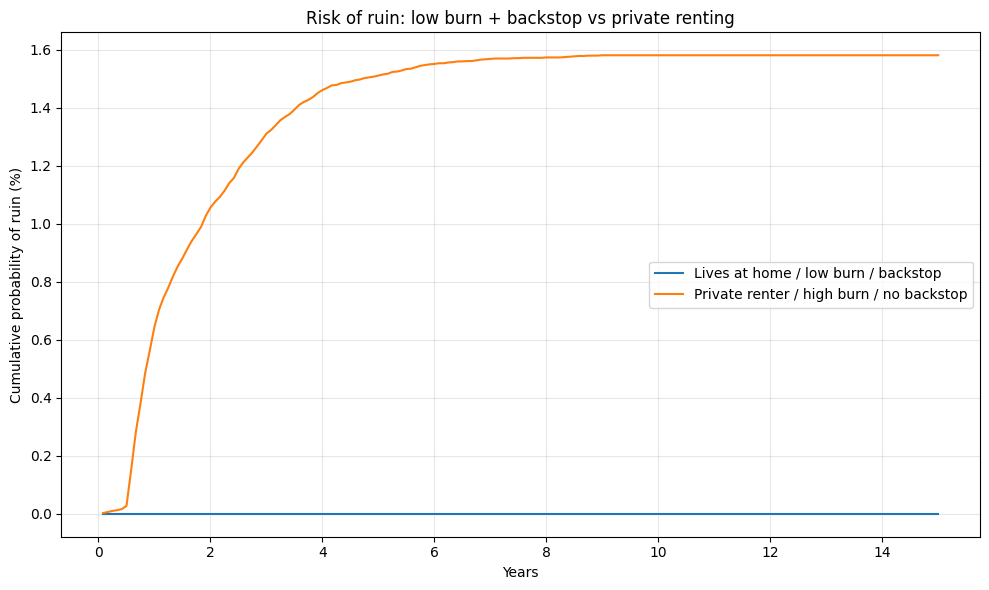
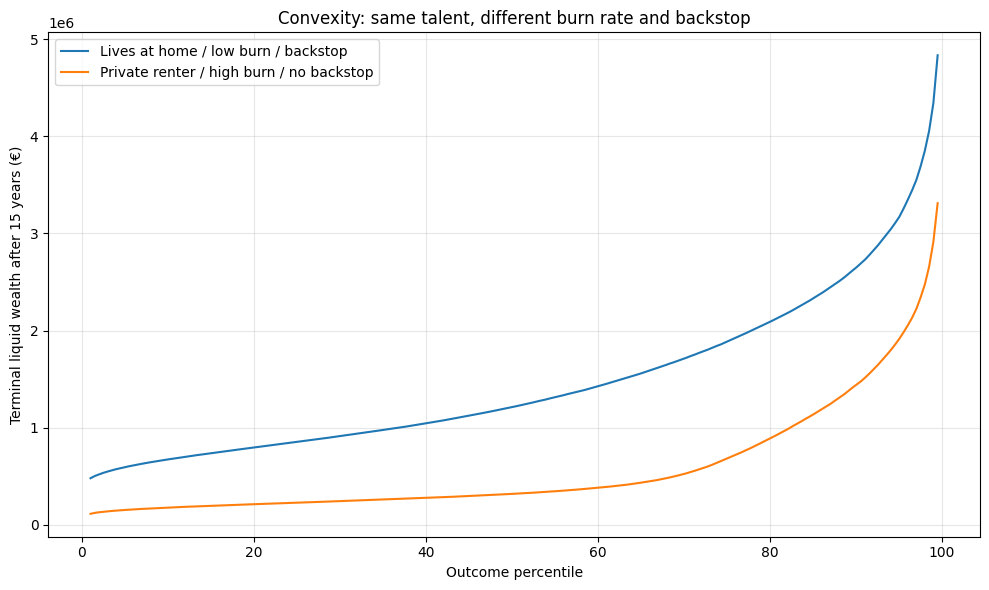
ScenarioRuin riskCaptured convexityMedian terminal wealthP99 terminal wealth
Live at home / low burn / backstop0.0%53.7%€1.21m€4.34m
Private renter / high burn / no backstop1.6%35.3%€318k€2.91m

The model assumes same starting wealth, same labour income, same talent, same market returns. Difference is burn rate + backstop.


Core interpretation:


Rent does not just reduce savings. It reduces optionality.


The renter loses in three ways:


  1. Lower monthly surplus.
  2. Higher chance of forced exit after shocks.
  3. Lower ability to wait for, prepare for, or take high-upside opportunities.

That is the class mechanism.


The reason the low-burn person’s right tail explodes is not magic investing. It is survival + surplus + repeated optionality. They stay liquid long enough to catch convex jumps.


This is exactly why “risk of ruin” matters more than average salary. Kelly-style capital growth logic is about maximizing long-run geometric growth while avoiding destructive overbetting; the original Kelly paper framed informed betting as exponential capital growth, and modern summaries emphasize the balance between growth and ruin control.


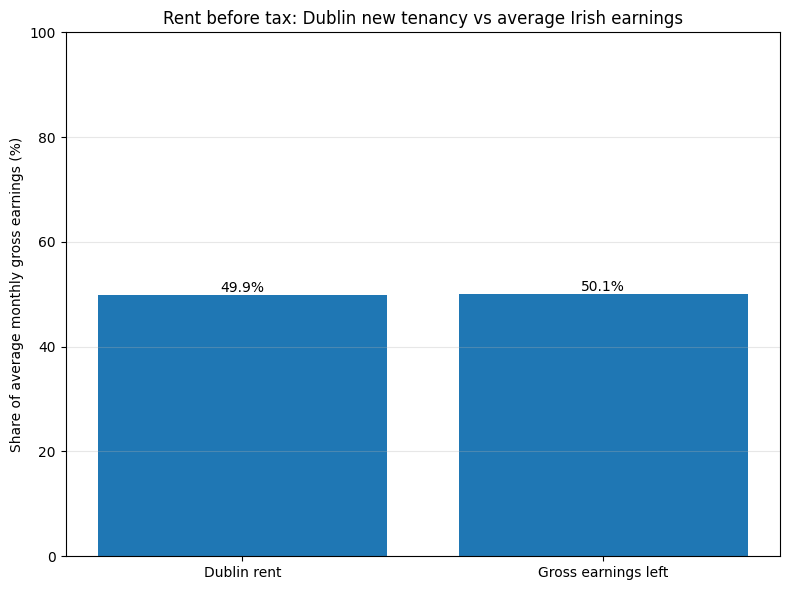
For Irish context, the rent drag is not theoretical: RTB’s Q1 2025 Rent Index put Dublin new-tenancy standardised average rent at €2,186/month, while CSO’s Q4 2025 average weekly earnings were about €1,011.88. That means Dublin rent can absorb a huge share of ordinary labour income before investing even begins.


The deeper class point is Piketty-compatible: when capital compounds faster than labour income, the person able to convert surplus into assets pulls away from the person forced to consume income just to remain housed. Harvard’s summary of Capital in the Twenty-First Century describes Piketty’s dataset across 20 countries since the eighteenth century; the r > g idea is the clean macro version of the same mechanism.


@Orka @chang cypionate @anondude @Glorious King @Foreverbrad


And just want to remind you all about forevergymcelling's thread 2 years ago that ignited all this https://looksmax.org/threads/the-social-class-pill-is-the-biggest-load-of-shit.972387
 
Last edited:
  • +1
  • Love it
Reactions: yex, kisslessvirgin, Scars and 21 others
Read everything, very interesting
 
  • +1
  • Love it
Reactions: trueedgar, kisslessvirgin, Seven and 8 others
good threads back to back? who is this guy
 
  • +1
  • JFL
  • Love it
Reactions: FutureExoticChad, zakachiti, chang cypionate and 3 others
High iq tbh
 
  • Love it
  • +1
Reactions: zakachiti and Seth Walsh
Stop using AI faggot - Automatons can only do parts of it, not the totality of it all !
 
  • +1
Reactions: Luquier
Dude you can't be serious .. You're using an AI bought by the AI used to create the generated text; you're the pawn to a very noticeable scheme.
so show proof the text is ai generated other than your feelings
 
  • +1
Reactions: Seth Walsh and Sigma
This is nothing like ai bro
It is - he used Grok to humanize it via independent editing; this just shows the statuspilliality - it's an odd but verifiable phenomena
 
  • JFL
Reactions: irrumator praetor and Seth Walsh
Additional stats

MetricValue
Owner-occupier median net wealth
391600.00​
Renter median net wealth
10200.00​
Owner/renter median wealth multiple38.4x
Top 10% household wealth threshold1,024,000+
Bottom 10% household wealth threshold<2,400
Dublin new-tenancy rent2,186/month
Average monthly gross earnings4,385/month
Dublin rent as share of avg gross earnings0.50
Stylized monthly surplus: living at home2,650.00
Stylized monthly surplus: private renter700.00
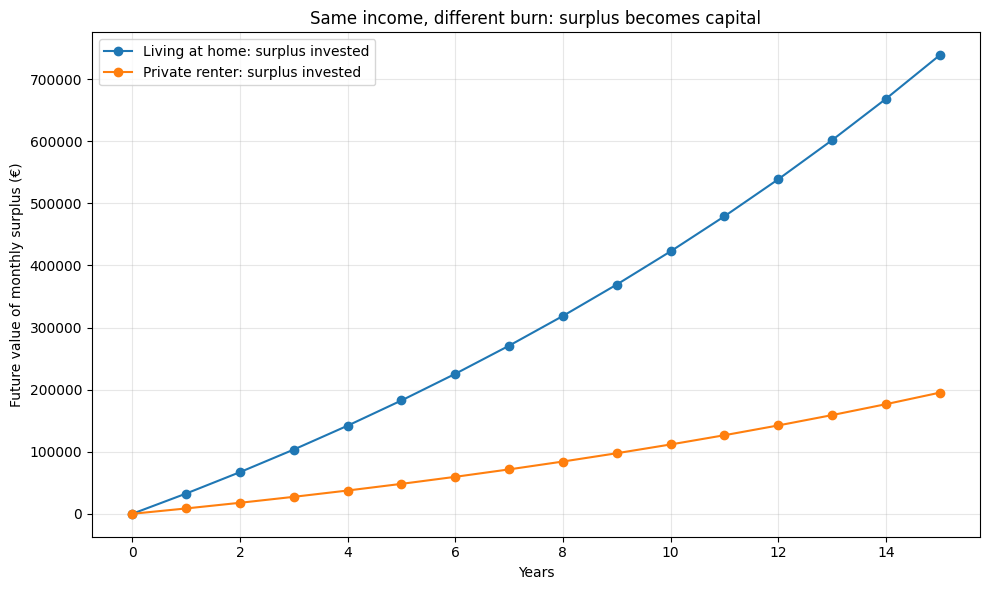
15y invested surplus: living at home738,676.00
15y invested surplus: private renter195,122.00

1777992107401
1777992117725
1777992141122
1777992173927
1777992154143


Most brutal takeaways:
1. Owner vs renter is not a lifestyle gap. It is a balance-sheet chasm.
CSO 2023 data shows owner-occupiers had median net wealth of €391,600, versus €10,200 for renters. That is a 38.4x gap. The top 10% household wealth threshold was over €1.024m.
2. Dublin rent destroys compounding before investing begins.
RTB Q1 2025 put Dublin new-tenancy standardised average rent at €2,186/month. CSO Q4 2025 average weekly earnings were €1,011.88, or about €4,385/month gross. That means rent alone is roughly 49.9% of average gross earnings before tax.
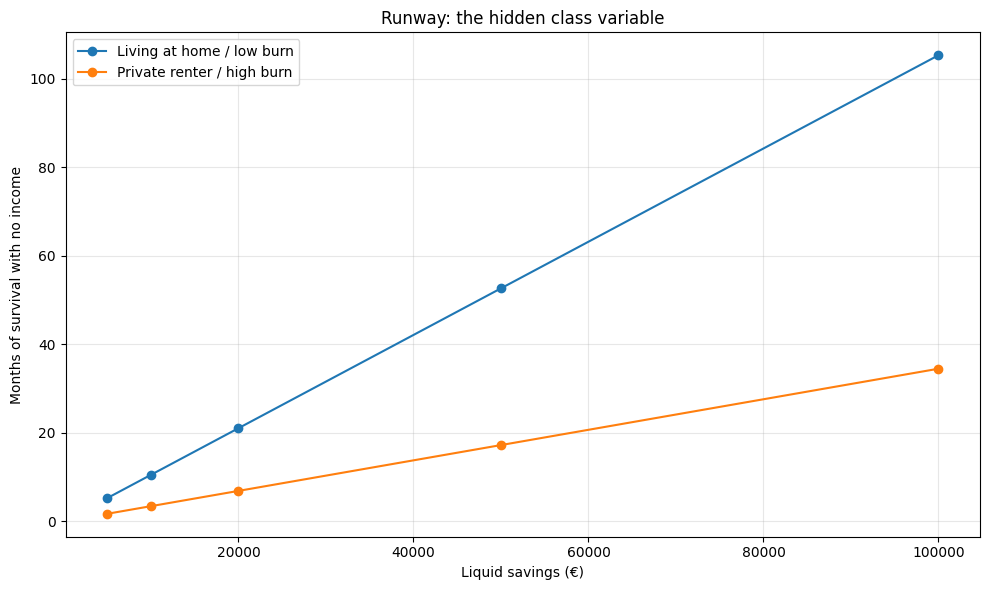
3. Runway is the hidden class variable.
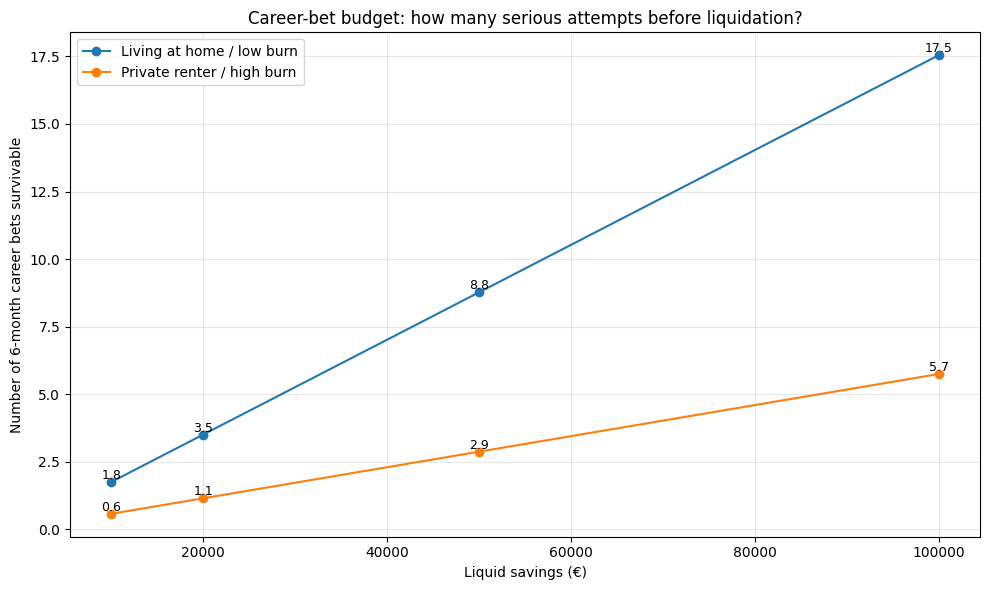
At €50k liquid savings, someone burning €950/month has about 52.6 months of no-income runway. Someone burning €2,900/month has about 17.2 months. Same savings. Totally different risk capacity.
4. Same income, different burn becomes a giant capital gap.
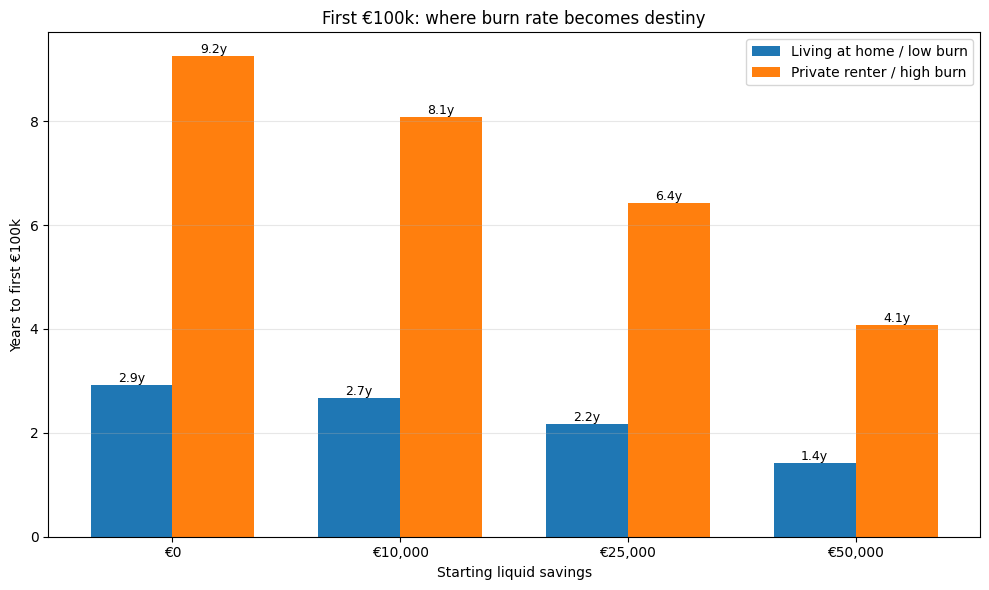
Using a stylized €3,600/month net income and 5.5% annual return, the low-burn person investing surplus reaches about €738k after 15 years. The private renter reaches about €195k. That is before inheritance, housing gains, or career convexity.
5. The upstream variable is parental background.
OECD 2025 says parental socio-economic background explains over 60% of inequality of opportunity in three-quarters of countries, and over 75% in a quarter of countries.
The real chart title:
Class is not taste. Class is surplus, runway, and the right to fail without liquidation.


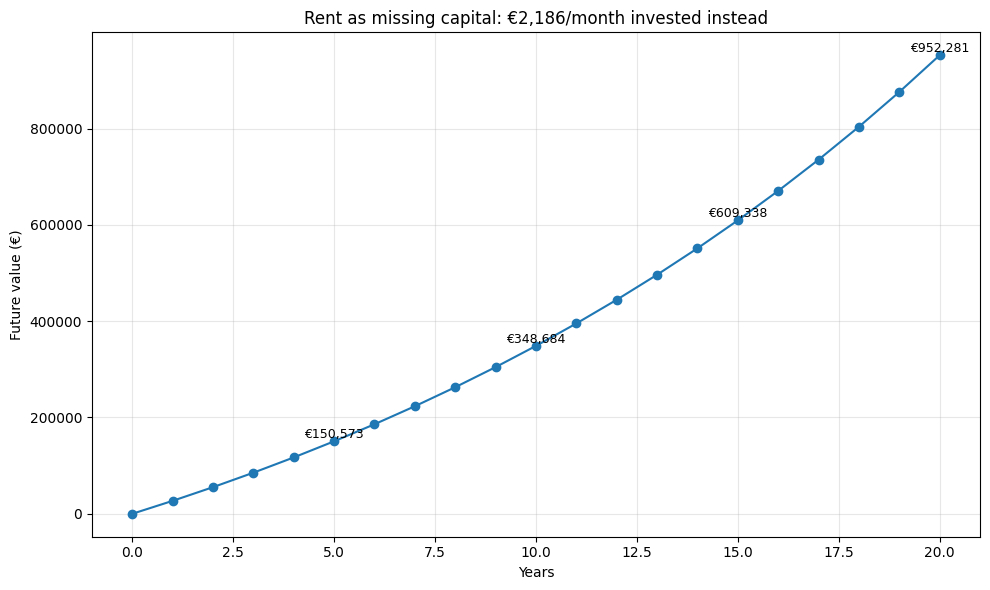
LET'S GET EVEN MORE BRUTAL. RENT SPENT AS OPPORTUNITY COST WHEN LOOKED AT AS COMPOUNDING INVESTMENT

1777992392588
1777992415868
1777992452380
1777992485785
1777992520282


MetricValueMeaning
Dublin rent FV after 20y at 5.5%
952,281​
Opportunity cost of paying 2,186/month instead of investing it
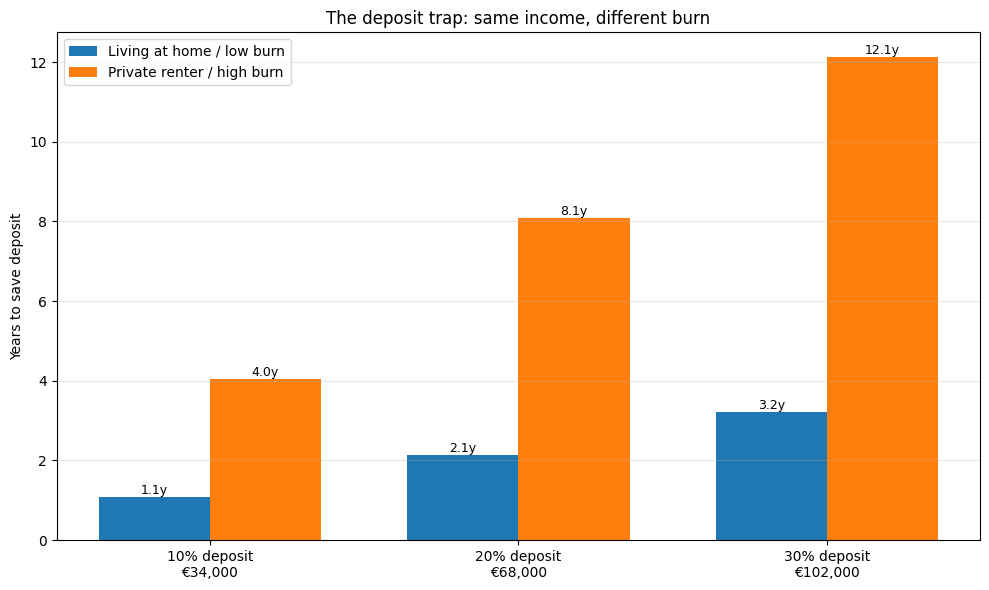
20% deposit target on median HMR
68,000​
Median HMR value assumed 340k
Years to 20% deposit, living at home2.1 yearsMonthly surplus 2,650
Years to 20% deposit, private renter8.1 yearsMonthly surplus 700
Owner median wealth in gross earning years7.4 yearsBefore tax and before living costs
Top 10% threshold in gross earning years19.5 yearsBefore tax and before living costs
50k career-bet budget, living at home8.8 six-month shotsLow burn creates repeated attempts
50k career-bet budget, private renter2.9 six-month shotsHigh burn forces fast re-employment
Years from 0 to 100k, living at home2.9 yearsAssumes 3.6k net income, 950 burn, 5.5% return
Years from 0 to 100k, private renter9.2 yearsAssumes 3.6k net income, 2.9k burn, 5.5% return
 

Attachments

  • 1777992643338.png
    1777992643338.png
    19.1 KB · Views: 0
Last edited:
  • +1
Reactions: Lemur and chang cypionate
@Seth Walsh thanks for tag, will read after studying :feelsokman:
 
  • Love it
Reactions: Seth Walsh
Seriously BUMPing this
 
  • +1
Reactions: Lemur
Forgot to talk about speech
A lot of the working class speech that you see online that is more colloquiall
is purged out of people of a higher class very early on
 
  • +1
Reactions: Seth Walsh and Lemur
amazing thread

read every molecule
 
  • Love it
Reactions: Seth Walsh
Forgot to talk about speech
A lot of the working class speech that you see online that is more colloquiall
is purged out of people of a higher class very early on
Yep.

But accent is the outcome. The engine behind how someone becomes high class over generations is much more interesting. And capital allocation and return on capital while managing ruin risk is the engine.

Look into "non-ergodicity", one of the most interesting concepts when it comes to understanding how to further your social class.
 
  • +1
Reactions: Chadeep and krieg
This is exactly why “risk of ruin” matters more than average salary. Kelly-style capital growth logic is about maximizing long-run geometric growth while avoiding destructive overbetting; the original Kelly paper framed informed betting as exponential capital growth, and modern summaries emphasize the balance between growth and ruin control.
interesting. On a more positive note, for the average person, we can conclude that everyone has some leeway to "bet/risk" for geometrical/exponential growth, in whatever they're lacking.

Utilizing that at key moments (periods of security/risk taking for growth or intentional chaos/instability allowed by whatever context: saved up money, encouraging environment with support, ...) the earliest you can versus always playing safe would make your trajectory more convex (assuming the investment/risk makes you dip lower in the short-term), but that would always be highly specific to time and the individual, context and location.

In other words, you'd have to identify your environment, if you can take the investment risk, if it would result in profits, how long/much, and if/how you'd be supported during that period. An example is how someone saves up to execute a tactic they've been thinking about to blow up as a twitch streamer (marlon but he had luck too, with nick who was hit ticket, lest he was planted by the CIA). Or learning some skill they know will bring them higher yields for some time period or in some new environment.

Universally applicable algorithm would be: enter new environment, assess risk/safety, assess the environment and see how to succeed the best (meta). Then move towards securing a period for investment risk (highest ROI for success). Then do so. Stabilization post risk, getting higher yields... Either repeat if theres anything else high ROI or simply enjoy until you change into new environment. That would be called adaptation or transformation according to the environment for the purposes of success. The stable thing to do would be to do no such thing and keep getting minimal results for maximal effort for the sake of stability and no other reason.
 
  • +1
Reactions: Seth Walsh
interesting. On a more positive note, for the average person, we can conclude that everyone has some leeway to "bet/risk" for geometrical/exponential growth, in whatever they're lacking.

Utilizing that at key moments (periods of security/risk taking for growth or intentional chaos/instability allowed by whatever context: saved up money, encouraging environment with support, ...) the earliest you can versus always playing safe would make your trajectory more convex (assuming the investment/risk makes you dip lower in the short-term), but that would always be highly specific to time and the individual, context and location.

In other words, you'd have to identify your environment, if you can take the investment risk, if it would result in profits, how long/much, and if/how you'd be supported during that period. An example is how someone saves up to execute a tactic they've been thinking about to blow up as a twitch streamer (marlon but he had luck too, with nick who was hit ticket, lest he was planted by the CIA). Or learning some skill they know will bring them higher yields for some time period or in some new environment.

Universally applicable algorithm would be: enter new environment, assess risk/safety, assess the environment and see how to succeed the best (meta). Then move towards securing a period for investment risk (highest ROI for success). Then do so. Stabilization post risk, getting higher yields... Either repeat if theres anything else high ROI or simply enjoy until you change into new environment. That would be called adaptation or transformation according to the environment for the purposes of success. The stable thing to do would be to do no such thing and keep getting minimal results for maximal effort for the sake of stability and no other reason.
Yes exactly. Non ergodicity is basically the explanation that the average outcome for a group, is not the same as the average outcome of an individual of that same group/set over time.

Life is non-ergodic. People look at averages too much, but life outcome is not a bell curve distribution.

For example. You fill a stadium full of 80,000 people. A 3+ stdev tail guy (6'7 walks in) or even 50 6'7 guys walk in; they're not going to change the average height at all.

If Elon Musk entered the sample, the average net worth would jump instantly.

That's one of the things about a "stable salary". Your life is optimized and constrained, you are completely reliant on the next stipend, and there is no upside. There's also hidden fragility behind "stable respectable office jobs", which we will encounter with AI disrupting white collar further in the coming months.

The ability to take convex shots and survive, is what matters. Really, instead of looking at averages, people should be looking at high upside paths, and one of the only ways to persist in doing that, is to have ruin-risk almost completely ruled out.

Clavicular is an example of someone who survived enough to participate in extreme upside, due to his mental model being focused on payoff curvature (while his risk of ruin was eliminated... rich parents idk). If he had even worked years to get some normie job, his life would be worse in 10 years, than it otherwise is now, and for the future.

My claim is that path dependency follows exposure asymmetry under survival constraints.
The people who end up in radically different states 10–20 years later are usually not those maximizing expected monthly stability, but those maximizing repeated exposure to positive convexity while avoiding terminal downside.
Non-ergodicity means your personal trajectory compounds sequentially through time. You do not get the ensemble average outcome. You get one path. One realized sequence. Therefore avoiding ruin matters disproportionately, because once your path terminates financially, cognitively, socially, or biologically, future upside disappears permanently.
This is why payoff distribution dominates salary optics. A capped linear path with low variance can appear rational locally while being globally fragile under technological or economic regime shifts. Meanwhile, a convex path can appear irrational short term while dominating over long horizons because a small number of asymmetric outcomes determine the entire distribution of final states.
In other words:
  • Survival is prerequisite.
  • Optionality is multiplicative.
  • Convex upside dominates linear accumulation.
  • Tail outcomes dominate lifetime trajectories.
  • Path dependency means early positioning compounds into future opportunity access.
So the relevant question is not “what is the average outcome?”
It is:
“What paths keep me alive long enough to repeatedly encounter extreme positive asymmetry?”

Clav had ruin risk insured, and no local optima to optimize within, and while appearing volatile and fit for a spiral (which everyone lowkey believed), he actually survived long enough to let himself benefit from uncertainty.

@Clavicular
 
  • +1
Reactions: Luquier and irrumator praetor
over for us middle class cels
 
  • So Sad
Reactions: Glorious King and Seth Walsh
Prerequisite:

Rent turns labour into survival.
Low-burn/backstop turns labour into capital.
Capital turns into shots.
Shots create convexity.
Convexity is where class mobility actually happens.

View attachment 5012130View attachment 5012131View attachment 5012132View attachment 5012133View attachment 5012134
Why social class can’t be faked


1/
People think class is school, postcode, accent, manners, clothes, holidays, or taste.

Wrong.

Those are surfaces.

The engine is deeper:

capital, risk absorption, family programming, network access, and the ability to survive mistakes.

2/
The real class question is not:

“Where did you go to school?”

It is:

What happens if you fail for 18 months?

Do you move home?
Get bailed out?
Have family legal/accounting help?
Keep preparing?
Or are you forced into the nearest wage?

That is class.

3/
In Ireland, the wealth gap is brutally visible.

CSO 2023 data: owner-occupiers had median net wealth of €391,600.

Renters had €10,200.

The top 10% of households had over €1.024m net wealth.
The bottom 10% had less than €2,400.

That is not accent. That is balance sheet.

4/
Postcode is not the engine.

Postcode is usually the receipt.

It reflects parental asset ownership, school access, peer group, commute burden, safety, quiet study space, inheritance path, and who your family already knows.

The postcode is downstream from capital.

5/
Accent and manners are not the engine either.

They are class signals.

Sutton Trust research says Received Pronunciation is used by less than 10% of the population, yet remains dominant in authority-heavy spaces like media, politics, courtrooms, civil service, and corporate life.

Accent helps reveal class. It does not create it.

6/
School is also downstream.

Elite schools matter because they package several upstream advantages at once:

money, stable home life, parental ambition, peer competition, confidence around authority, tutoring, alumni networks, and early belief that elite rooms are “normal.”

The school is a transmission belt. Not the original power source.

7/
The OECD says parental background explains over 60% of inequality of opportunity in most countries, and over 75% in some.

That is the quiet truth.

Before “merit” even starts, the board is already tilted by family structure, wealth, education, housing, health, and place.

8/
Even when people from working-class backgrounds break into elite jobs, the gap does not disappear.

LSE research on the “class ceiling” found that people from working-class backgrounds in elite occupations earned about 16% less than colleagues from privileged backgrounds.

Same room. Different backing. Different trajectory.

9/
Why?

Because the privileged person can play differently.

They can take unpaid internships.
Move city.
Wait for a better role.
Ask family contacts.
Take reputational risk.
Negotiate harder.
Avoid panic.
Recover from failure.

The poorer person often has to optimize for survival.

10/
The deepest class structure is this:

Family balance sheet → housing security → risk capacity → education access → network access → career convexity → capital accumulation → mate selection → inheritance loop.

Everything else is surface.

11/
This is why social class can’t really be faked.

You can fake the accent.
You can fake the clothes.
You can learn the manners.
You can enter the room.

But you cannot easily fake:

runway, bailout capacity, inherited networks, emotional security, compounding capital, and the right to fail without ruin.

12/
Class is not aesthetics.

Class is how much downside your family can absorb while you pursue upside.

That is the real hierarchy.


View attachment 5012140

View attachment 5012142


ScenarioRuin riskCaptured convexityMedian terminal wealthP99 terminal wealth
Live at home / low burn / backstop0.0%53.7%€1.21m€4.34m
Private renter / high burn / no backstop1.6%35.3%€318k€2.91m

The model assumes same starting wealth, same labour income, same talent, same market returns. Difference is burn rate + backstop.


Core interpretation:


Rent does not just reduce savings. It reduces optionality.


The renter loses in three ways:


  1. Lower monthly surplus.
  2. Higher chance of forced exit after shocks.
  3. Lower ability to wait for, prepare for, or take high-upside opportunities.

That is the class mechanism.


The reason the low-burn person’s right tail explodes is not magic investing. It is survival + surplus + repeated optionality. They stay liquid long enough to catch convex jumps.


This is exactly why “risk of ruin” matters more than average salary. Kelly-style capital growth logic is about maximizing long-run geometric growth while avoiding destructive overbetting; the original Kelly paper framed informed betting as exponential capital growth, and modern summaries emphasize the balance between growth and ruin control.


For Irish context, the rent drag is not theoretical: RTB’s Q1 2025 Rent Index put Dublin new-tenancy standardised average rent at €2,186/month, while CSO’s Q4 2025 average weekly earnings were about €1,011.88. That means Dublin rent can absorb a huge share of ordinary labour income before investing even begins.


The deeper class point is Piketty-compatible: when capital compounds faster than labour income, the person able to convert surplus into assets pulls away from the person forced to consume income just to remain housed. Harvard’s summary of Capital in the Twenty-First Century describes Piketty’s dataset across 20 countries since the eighteenth century; the r > g idea is the clean macro version of the same mechanism.


@Orka @chang cypionate @anondude @Glorious King @Foreverbrad


And just want to remind you all about forevergymcelling's thread 2 years ago that ignited all this https://looksmax.org/threads/the-social-class-pill-is-the-biggest-load-of-shit.972387

Your title is the meta. Mirin.

I think you're attributing too much weight to economics in your conception of class, though.

To be clear, your model is fundamental in understanding modern career and startup mobility, but it reduces social class to wealth generation, at least in the scope of this post.

You're probably aware of Weberian stratification- it integrates the core economic realities of class differences with social and political power, which are distinct from economics.

How many armies were raised or coalitions formed throughout history? Capital might have enabled the logistics, but historical movements and social hierarchies are steered by status, lineage, and power- way fewer people are willing to fight as mercenaries than for a cause and leader they believe in.

For example, the clergy, throughout Christendom, held massive leverage over even the nobility, despite technically being forbidden from owning shit.

My bad if I've mischaracterised your position here. What are your thoughts? Don't you think class is defined by more than simply who has the largest financial backstop?

There's something qualitative that you can't measure...
 
  • +1
Reactions: Luquier and Seth Walsh
Your title is the meta. Mirin.

I think you're attributing too much weight to economics in your conception of class, though.

To be clear, your model is fundamental in understanding modern career and startup mobility, but it reduces social class to wealth generation, at least in the scope of this post.

You're probably aware of Weberian stratification- it integrates the core economic realities of class differences with social and political power, which are distinct from economics.

How many armies were raised or coalitions formed throughout history? Capital might have enabled the logistics, but historical movements and social hierarchies are steered by status, lineage, and power- way fewer people are willing to fight as mercenaries than for a cause and leader they believe in.

For example, the clergy, throughout Christendom, held massive leverage over even the nobility, despite technically being forbidden from owning shit.

My bad if I've mischaracterised your position here. What are your thoughts? Don't you think class is defined by more than simply who has the largest financial backstop?

There's something qualitative that you can't measure...
Status and legitimacy can temporarily override economics, yet durable power structures usually still require economic substrate somewhere underneath them.

The clergy could not own property individually, but the Church as an institution controlled land, literacy, administration, education, moral legitimacy, and political coordination across Europe. That is still resource control. Same with dynasties, aristocracies, or ideological movements. The mechanism changes, but the underlying capacity to mobilise humans, absorb losses, and sustain institutions remains.

My thread focused almost entirely on economic capital because modern liberal societies increasingly disguise class as “merit” while silently reproducing it through balance sheets, housing security, and optionality.

Two men with identical net worths can occupy completely different positions in the social hierarchy depending on pedigree, network density, institutional legitimacy, and cultural status.

I’d probably frame it this way now:

Economics determines survival capacity.
Status determines social navigation.
Power determines rule-setting capacity.

Class emerges from the interaction of all three.

The reason I weighted economics so heavily is because, in modern capitalist societies, money increasingly acts as a universal converter between domains. It buys time, geography, education, legal insulation, health, aesthetics, network access, and second chances. It quietly amplifies nearly every other form of capital.

But no, I don’t think class is only wealth.

There absolutely is something qualitative, historical, and psychological that survives even when balance sheets equalise. (maybe something genetic???)
 
  • +1
Reactions: Luquier and CollioureViews
My thread focused almost entirely on economic capital because modern liberal societies increasingly disguise class as “merit” while silently reproducing it through balance sheets, housing security, and optionality.
Fitting angle to attack the problem from.
maybe something genetic???
Great man theory of history, perhaps?
Though often, direct successors could cause ruin.

Mirin your takes overall.
Hasbullabulla GIF
 
  • Love it
Reactions: Seth Walsh
Fitting angle to attack the problem from.

Great man theory of history, perhaps?
Though often, direct successors could cause ruin.

Mirin your takes overall.
Hasbullabulla GIF
Thanks man! And yeah I've no idea how some family lines last so long at the highest echelons of society and is it purely due to intergenerational wealth and power retention?

Marriage also reproduces class too.
 
  • +1
Reactions: CollioureViews
2. Dublin rent destroys compounding before investing begins.
interesting, wouldn't striking a balance between debt, relocation and economic opportunity in a more favorable location in terms of housing AND a job (according to your education) be the way out? Supposing the interest rate is ok, that would be better than being skinned alive by landlords.
 
LET'S GET EVEN MORE BRUTAL. RENT SPENT AS OPPORTUNITY COST WHEN LOOKED AT AS COMPOUNDING INVESTMENT
the difference between being an asset or business owner and your bloodline dealing with future catastrophies
 
  • +1
Reactions: Seth Walsh
Your title is the meta. Mirin.

I think you're attributing too much weight to economics in your conception of class, though.

To be clear, your model is fundamental in understanding modern career and startup mobility, but it reduces social class to wealth generation, at least in the scope of this post.

You're probably aware of Weberian stratification- it integrates the core economic realities of class differences with social and political power, which are distinct from economics.

How many armies were raised or coalitions formed throughout history? Capital might have enabled the logistics, but historical movements and social hierarchies are steered by status, lineage, and power- way fewer people are willing to fight as mercenaries than for a cause and leader they believe in.

For example, the clergy, throughout Christendom, held massive leverage over even the nobility, despite technically being forbidden from owning shit.

My bad if I've mischaracterised your position here. What are your thoughts? Don't you think class is defined by more than simply who has the largest financial backstop?

There's something qualitative that you can't measure...
... first comes the capital in form of MONEY then political and social power... yes you can't be a retard and get rich but MONEY is the ultimate thing to look at as its the MEDIUM between ALL forms of capital. Literally all. THE medium

You don't need medieval christian examples to get this, but high IQ nonetheless

I just dislike when people say money is not the ultimate factor, it absolutely is

He is right to define social class purely by money as its the most common denominator

Less skill goes into the creation of money than is attained once money is no longer the limiting factor. You need other forms of capital before you're able to make a lot of money. Once you breach a certain threshold, the amount of money you make severely expands your horizons, you are able to learn a lot more skills in order to continue the feedback loop. Money, being the GREATER UNIVERSAL MEDIUM for CAPITAL makes it more SCALEABLE than other segmented/isolated/specific forms of capital (political, social... power) and it grows fastest out of all capitals. The international economic, globalized MARKET is a bigger source to tap into than social skills or localized systems/petri-dishes of political arenas, social circles, etc... They are more limited than how MONEY is global
 
Last edited:
  • +1
Reactions: Seth Walsh
I just dislike when people say money is not the ultimate factor, it absolutely is

He is right to define social class purely by money as its the most common denominator
fucking based and high iq
 
  • +1
Reactions: irrumator praetor
... first comes the capital in form of MONEY then political and social power... yes you can't be a retard and get rich but MONEY is the ultimate thing to look at as its the MEDIUM between ALL forms of capital. Literally all. THE medium

You don't need medieval christian examples to get this, but high IQ nonetheless

I just dislike when people say money is not the ultimate factor, it absolutely is

He is right to define social class purely by money as its the most common denominator

Less skill goes into the creation of money than is attained once money is no longer the limiting factor. You need other forms of capital before you're able to make a lot of money. Once you breach a certain threshold, the amount of money you make severely expands your horizons, you are able to learn a lot more skills in order to continue the feedback loop. Money, being the GREATER UNIVERSAL MEDIUM for CAPITAL makes it more SCALEABLE than other segmented/isolated/specific forms of capital (political, social... power) and it grows fastest out of all capitals. The international economic, globalized MARKET is a bigger source to tap into than social skills or localized systems/petri-dishes of political arenas, social circles, etc... They are more limited than how MONEY is global
Money is the root capital because every other form of capital eventually bottlenecks through it.
 
  • +1
Reactions: irrumator praetor and Seven
good thread
 
  • Love it
Reactions: Seth Walsh
Yes exactly. Non ergodicity is basically the explanation that the average outcome for a group, is not the same as the average outcome of an individual of that same group/set over time.

Life is non-ergodic. People look at averages too much, but life outcome is not a bell curve distribution.

For example. You fill a stadium full of 80,000 people. A 3+ stdev tail guy (6'7 walks in) or even 50 6'7 guys walk in; they're not going to change the average height at all.

If Elon Musk entered the sample, the average net worth would jump instantly.

That's one of the things about a "stable salary". Your life is optimized and constrained, you are completely reliant on the next stipend, and there is no upside. There's also hidden fragility behind "stable respectable office jobs", which we will encounter with AI disrupting white collar further in the coming months.

The ability to take convex shots and survive, is what matters. Really, instead of looking at averages, people should be looking at high upside paths, and one of the only ways to persist in doing that, is to have ruin-risk almost completely ruled out.

Clavicular is an example of someone who survived enough to participate in extreme upside, due to his mental model being focused on payoff curvature (while his risk of ruin was eliminated... rich parents idk). If he had even worked years to get some normie job, his life would be worse in 10 years, than it otherwise is now, and for the future.

My claim is that path dependency follows exposure asymmetry under survival constraints.
The people who end up in radically different states 10–20 years later are usually not those maximizing expected monthly stability, but those maximizing repeated exposure to positive convexity while avoiding terminal downside.
Non-ergodicity means your personal trajectory compounds sequentially through time. You do not get the ensemble average outcome. You get one path. One realized sequence. Therefore avoiding ruin matters disproportionately, because once your path terminates financially, cognitively, socially, or biologically, future upside disappears permanently.
This is why payoff distribution dominates salary optics. A capped linear path with low variance can appear rational locally while being globally fragile under technological or economic regime shifts. Meanwhile, a convex path can appear irrational short term while dominating over long horizons because a small number of asymmetric outcomes determine the entire distribution of final states.
In other words:
  • Survival is prerequisite.
  • Optionality is multiplicative.
  • Convex upside dominates linear accumulation.
  • Tail outcomes dominate lifetime trajectories.
  • Path dependency means early positioning compounds into future opportunity access.
So the relevant question is not “what is the average outcome?”
It is:
“What paths keep me alive long enough to repeatedly encounter extreme positive asymmetry?”

Clav had ruin risk insured, and no local optima to optimize within, and while appearing volatile and fit for a spiral (which everyone lowkey believed), he actually survived long enough to let himself benefit from uncertainty.

@Clavicular
unfortunately or fortunately, people are able to do this most of the time, some do intuitively, and others/most do not. Interesting to note: those that do it intuitively rather than intentionally, don't tend to apply the same principle to other/new situations. The tragedy of not knowing the metaphysics of life
 
Last edited:
  • +1
Reactions: Luquier and Seth Walsh
@mohito tagging high iq
 
  • +1
Reactions: mohito
... first comes the capital in form of MONEY then political and social power... yes you can't be a retard and get rich but MONEY is the ultimate thing to look at as its the MEDIUM between ALL forms of capital. Literally all. THE medium

You don't need medieval christian examples to get this, but high IQ nonetheless

I just dislike when people say money is not the ultimate factor, it absolutely is

He is right to define social class purely by money as its the most common denominator

Less skill goes into the creation of money than is attained once money is no longer the limiting factor. You need other forms of capital before you're able to make a lot of money. Once you breach a certain threshold, the amount of money you make severely expands your horizons, you are able to learn a lot more skills in order to continue the feedback loop. Money, being the GREATER UNIVERSAL MEDIUM for CAPITAL makes it more SCALEABLE than other segmented/isolated/specific forms of capital (political, social... power) and it grows fastest out of all capitals. The international economic, globalized MARKET is a bigger source to tap into than social skills or localized systems/petri-dishes of political arenas, social circles, etc... They are more limited than how MONEY is global
Money is the ultimate medium, no doubt about that, but it's power that can seize your capital overnight with a "fuck you very much :)"

Jack Ma had crazy capital and a truly global presence; that didn't stop him from dropping off the map for months, getting his company restructured, and losing billions. Russian oligarchs drop like flies when Putin's in the mood.

If money were the main denominator, to the extent that it made the other forms of social credit inconsequential, there'd be no difference between a Rothschild and a lottery winner.

And why would elites continue sending their kids to selective institutions a la Harvard, et al., if they already secured the posterity of their next 10 generations?

Raw capital is fragile without the network and legitimacy to protect it.
 
  • +1
Reactions: Luquier
Money is the ultimate medium, no doubt about that, but it's power that can seize your capital overnight with a "fuck you very much :)"

Jack Ma had crazy capital and a truly global presence; that didn't stop him from dropping off the map for months, getting his company restructured, and losing billions. Russian oligarchs drop like flies when Putin's in the mood.

If money were the main denominator, to the extent that it made the other forms of social credit inconsequential, there'd be no difference between a Rothschild and a lottery winner.

And why would elites continue sending their kids to selective institutions a la Harvard, et al., if they already secured the posterity of their next 10 generations?

Raw capital is fragile without the network and legitimacy to protect it.
No, money is the driver to improve your social class. Power in the highest social class is a different game altogether. I am talking about constraints affecting the average person.
 
  • +1
Reactions: irrumator praetor
@mohito tagging high iq
I don’t think social capital (networks) is simply downstream of wealth, it can be independent of it or even come first (elite schools, class-coded behavior, etc). Class reproduction is really a multi dimensional system
 
  • +1
Reactions: Seth Walsh and irrumator praetor
I don’t think social capital (networks) is simply downstream of wealth, it can be independent of it or even come first (elite schools, class-coded behavior, etc). Class reproduction is really a multi dimensional system
I don't think it's simply downstream of wealth either. But I don't believe you can be high class without controlling various forms of capital.
 
  • +1
Reactions: irrumator praetor and mohito
I don’t think social capital (networks) is simply downstream of wealth, it can be independent of it or even come first (elite schools, class-coded behavior, etc). Class reproduction is really a multi dimensional system
yep but I said you develop it to a point, get a lot of money (or rather SCALE income) then it explodes (new social possibilities/skills). And my argument is, since money is more scalable/abstract, you will be allowed a greater extent of skill/capital development that is social, political, mental, whatever, AFTER the greater scaling of money income, rather than the progress you've made before reaching a threshold where you were able to meaningfully scale your monetary income in the first place

Example: lower/working class, scales the skills/segmented or smaller forms of capital required to enter higher class -> middle class, repeats the same process -> asset ownership: the scaling of income is now greater than of other forms of capital -> wealth explosion, leaving space for furthering of skills/other forms of capital. Basically breaches the event horizon of possibilities (seemingly but not literally of course); possibilities open up a lot more. Like entering a wide gate
 
  • +1
Reactions: mohito
No, money is the driver to improve your social class. Power in the highest social class is a different game altogether. I am talking about constraints affecting the average person.
Fair, but your OP mentioned P99 wealth and intergenerational inheritance loops, so we are definitely blurring the lines into the highest echelons.

Just to focus on the average Joe? You're 100% right.

For us regular fuckers, money is the escape velocity. I can't argue with that.
 
No, money is the driver to improve your social class. Power in the highest social class is a different game altogether. I am talking about constraints affecting the average person.
like the maturing of a flower
 
  • +1
Reactions: Seth Walsh
Fair, but your OP mentioned P99 wealth and intergenerational inheritance loops, so we are definitely blurring the lines into the highest echelons.

Just to focus on the average Joe? You're 100% right.

For us regular fuckers, money is the escape velocity. I can't argue with that.
even at higher echelons, yes purely money is barely the only game being played, but since its so "meta", abstract, universal, the medium of exchange, all other forms of power and capital reflect through asset ownership. You will get political power, and transform it to even greater WEALTH (money capital). Its actually the first thing people do because it flowers from there. Look at the triumvirate. It's been the way things go for a while

So even those various mini-games are just under the mask of money. They will be reflected in the money you have, as you use them to get even more money. Money is fundamental and cannot be singled out, it is behind every other form of capital, as the medium of exchange. Because we all accept money
 
  • Hmm...
Reactions: CollioureViews
even at higher echelons, yes purely money is barely the only game being played, but since its so "meta", abstract, universal, the medium of exchange, all other forms of power and capital reflect through asset ownership. You will get political power, and transform it to even greater WEALTH (money capital). Its actually the first thing people do because it flowers from there. Look at the triumvirate. It's been the way things go for a while

So even those various mini-games are just under the mask of money. They will be reflected in the money you have, as you use them to get even more money. Money is fundamental and cannot be singled out, it is behind every other form of capital, as the medium of exchange. Because we all accept money
No...

I guess all a hammer sees is nails.
 
Prerequisite:

Rent turns labour into survival.
Low-burn/backstop turns labour into capital.
Capital turns into shots.
Shots create convexity.
Convexity is where class mobility actually happens.

View attachment 5012130View attachment 5012131View attachment 5012132View attachment 5012133View attachment 5012134
Why social class can’t be faked


1/
People think class is school, postcode, accent, manners, clothes, holidays, or taste.

Wrong.

Those are surfaces.

The engine is deeper:

capital, risk absorption, family programming, network access, and the ability to survive mistakes.

2/
The real class question is not:

“Where did you go to school?”

It is:

What happens if you fail for 18 months?

Do you move home?
Get bailed out?
Have family legal/accounting help?
Keep preparing?
Or are you forced into the nearest wage?

That is class.

3/
In Ireland, the wealth gap is brutally visible.

CSO 2023 data: owner-occupiers had median net wealth of €391,600.

Renters had €10,200.

The top 10% of households had over €1.024m net wealth.
The bottom 10% had less than €2,400.

That is not accent. That is balance sheet.

4/
Postcode is not the engine.

Postcode is usually the receipt.

It reflects parental asset ownership, school access, peer group, commute burden, safety, quiet study space, inheritance path, and who your family already knows.

The postcode is downstream from capital.

5/
Accent and manners are not the engine either.

They are class signals.

Sutton Trust research says Received Pronunciation is used by less than 10% of the population, yet remains dominant in authority-heavy spaces like media, politics, courtrooms, civil service, and corporate life.

Accent helps reveal class. It does not create it.

6/
School is also downstream.

Elite schools matter because they package several upstream advantages at once:

money, stable home life, parental ambition, peer competition, confidence around authority, tutoring, alumni networks, and early belief that elite rooms are “normal.”

The school is a transmission belt. Not the original power source.

7/
The OECD says parental background explains over 60% of inequality of opportunity in most countries, and over 75% in some.

That is the quiet truth.

Before “merit” even starts, the board is already tilted by family structure, wealth, education, housing, health, and place.

8/
Even when people from working-class backgrounds break into elite jobs, the gap does not disappear.

LSE research on the “class ceiling” found that people from working-class backgrounds in elite occupations earned about 16% less than colleagues from privileged backgrounds.

Same room. Different backing. Different trajectory.

9/
Why?

Because the privileged person can play differently.

They can take unpaid internships.
Move city.
Wait for a better role.
Ask family contacts.
Take reputational risk.
Negotiate harder.
Avoid panic.
Recover from failure.

The poorer person often has to optimize for survival.

10/
The deepest class structure is this:

Family balance sheet → housing security → risk capacity → education access → network access → career convexity → capital accumulation → mate selection → inheritance loop.

Everything else is surface.

11/
This is why social class can’t really be faked.

You can fake the accent.
You can fake the clothes.
You can learn the manners.
You can enter the room.

But you cannot easily fake:

runway, bailout capacity, inherited networks, emotional security, compounding capital, and the right to fail without ruin.

12/
Class is not aesthetics.

Class is how much downside your family can absorb while you pursue upside.

That is the real hierarchy.

View attachment 5012140

View attachment 5012142


ScenarioRuin riskCaptured convexityMedian terminal wealthP99 terminal wealth
Live at home / low burn / backstop0.0%53.7%€1.21m€4.34m
Private renter / high burn / no backstop1.6%35.3%€318k€2.91m

The model assumes same starting wealth, same labour income, same talent, same market returns. Difference is burn rate + backstop.


Core interpretation:


Rent does not just reduce savings. It reduces optionality.


The renter loses in three ways:


  1. Lower monthly surplus.
  2. Higher chance of forced exit after shocks.
  3. Lower ability to wait for, prepare for, or take high-upside opportunities.

That is the class mechanism.


The reason the low-burn person’s right tail explodes is not magic investing. It is survival + surplus + repeated optionality. They stay liquid long enough to catch convex jumps.


This is exactly why “risk of ruin” matters more than average salary. Kelly-style capital growth logic is about maximizing long-run geometric growth while avoiding destructive overbetting; the original Kelly paper framed informed betting as exponential capital growth, and modern summaries emphasize the balance between growth and ruin control.


For Irish context, the rent drag is not theoretical: RTB’s Q1 2025 Rent Index put Dublin new-tenancy standardised average rent at €2,186/month, while CSO’s Q4 2025 average weekly earnings were about €1,011.88. That means Dublin rent can absorb a huge share of ordinary labour income before investing even begins.


The deeper class point is Piketty-compatible: when capital compounds faster than labour income, the person able to convert surplus into assets pulls away from the person forced to consume income just to remain housed. Harvard’s summary of Capital in the Twenty-First Century describes Piketty’s dataset across 20 countries since the eighteenth century; the r > g idea is the clean macro version of the same mechanism.


@Orka @chang cypionate @anondude @Glorious King @Foreverbrad


And just want to remind you all about forevergymcelling's thread 2 years ago that ignited all this https://looksmax.org/threads/the-social-class-pill-is-the-biggest-load-of-shit.972387
read every word
 
  • Love it
Reactions: Seth Walsh
Fair, but your OP mentioned P99 wealth and intergenerational inheritance loops, so we are definitely blurring the lines into the highest echelons.

Just to focus on the average Joe? You're 100% right.

For us regular fuckers, money is the escape velocity. I can't argue with that.
OP is just comparing the structural brutality between home-ownernship layers and forever renters.

Then there are different classes based on primary property valuations. Postcodes, local class affect downstream of that ownership.

The real focus was on capital vs labour class. Not extreme outlier hyper elites
 
  • +1
Reactions: CollioureViews

Similar threads

Matrix88
Replies
48
Views
184
Nodal
Nodal
lookingforadvicecel
Replies
2
Views
38
Euron
Euron
anthony111553
Replies
3
Views
33
oxiwoxi
oxiwoxi
betterthanyouxxx
Replies
2
Views
19
betterthanyouxxx
betterthanyouxxx
AS12
Replies
8
Views
29
PassionateNT
PassionateNT

Users who are viewing this thread

Back
Top