





Seth Walsh

Iconoclast
Contributor
- Joined
- Jan 12, 2020
- Posts
- 11,229
- Reputation
- 22,983
Born after 1980. Experience bad economics
Get educated.
Get a respectable job.
Save money.
Avoid doing anything catastrophically stupid.
Then discover that the house you were working towards has been appreciating faster than you can save.
Some bloke who bought it decades ago explains that your problem is discipline.
He bought the asset before the repricing. You get a lecture after it.
jfl.
1. Your salary is quoted in the wrong units
Nobody actually wants a large number on a payslip.
They want somewhere decent to live. Privacy. A family. Enough reserves that losing a job doesn't turn their entire existence into an emergency.
So measure your income against those things.
How much housing can your labour buy?
How many years does the deposit take?
How long can you survive without permission from an employer?

In England, the median home cost 7.7 times the median full-time worker's annual earnings in 2024.
Across England and Wales, 88% of local authority areas had median homes selling for less than five times local earnings in 1997.
By 2024: 9%.
That is an enormous change in the price of entry.
Yes, mortgage rates matter. Yes, affordability improved after 2021. A price-to-income ratio doesn't capture every financing cost.
The long-run deterioration is still sitting there on the fucking chart.
Source: ONS, housing affordability, 2024.
2. Your parents' ordinary outcome became your competitive achievement
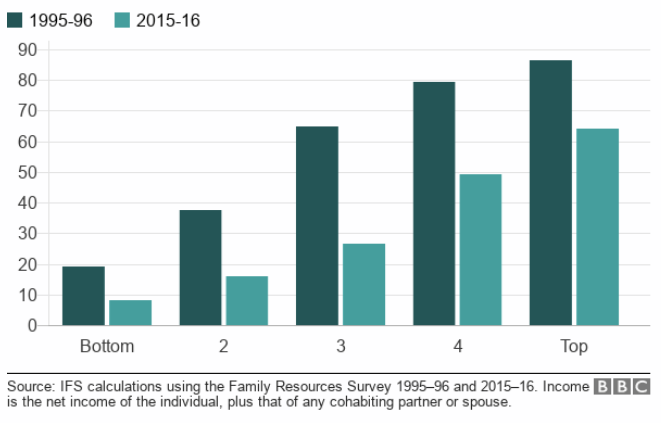
Look at the middle-income group.
Among British 25–34-year-olds, homeownership fell from roughly 65% in 1995–96 to 27% in 2015–16.
Same age range. Same relative income position.
A radically different probability of owning somewhere to live.
These are historical comparisons, not today's ownership rates. They show when the ladder started being pulled further away.
“Just be average and responsible” stopped purchasing the same result.
You can outperform your parents educationally, compete harder professionally, and still struggle to reproduce their housing situation.
Then get told you have unrealistic expectations.
The unrealistic expectation apparently being a front door that belongs to you.
Source: Institute for Fiscal Studies, 2018.
3. The same house can produce two opposite economic realities
Take a hypothetical €500,000 house.
It rises 5%.
Owner: €25,000 more gross property value.
Prospective buyer: the target costs €25,000 more.
No extra bedroom.
No better insulation.
No increase in the amount of shelter.
The same physical object. A different distribution of claims over it.
The owner calls it a good year.
The buyer saves €15,000 and finishes the year further behind the purchase price.
That's before considering borrowing limits, deposit requirements or financing costs.
Of course, an owner who needs to buy an equally expensive replacement cannot spend the entire paper gain freely. Someone trading up can also lose ground.
But someone who already owns adequate housing has secured something the entrant still has to acquire.
“Property is doing well” is an incomplete sentence.
Doing well for whom?
4. The birth-year pill is only half the story
A 1997-born renter with no family support and a 1997-born heir are the same generation.
Economically, that tells you very little.
One is buying access to everything from current wages.
The other may have:
Both upload “delighted to announce” on LinkedIn.
One has a salary.
The other has a salary backed by a family balance sheet.
“Born after 1980” is shorthand for entering adulthood after important economic conditions changed. It isn't a magical cutoff or a claim about every country.
The deeper divide is between people who must buy security from wages and people whose families already own some.
Age affects the entry price. Family determines how much of it you personally have to pay.
5. Family support compounds before anyone dies
People obsess over inheritance.
Meanwhile, the earlier transfer can happen every month without a bank transaction.
Illustrative example. Two people each take home €3,200 a month and spend €900 on everything outside housing.
Person A: contributes €300 at home.
Remaining: €2,000.
Person B: pays €1,300 in rent and housing bills.
Remaining: €1,000.
Over five years, that difference alone is €60,000, before investment returns.
Identical earnings.
Identical non-housing spending.
Double the savings.
Living independently buys real things: privacy, location, autonomy. A family home isn't necessarily available, suitable or free of conflict.
But the financial arithmetic doesn't disappear because someone calls moving out “being an adult”.
A moral judgment cannot tell you whether someone is accumulating capital.
6. Risk tolerance can be inherited without inheriting a euro
Consider two people taking the same career gamble.
If it fails, one returns to a comfortable family home.
The other misses rent.
Calling the first person more entrepreneurial leaves out the most important part of the experiment.
The downside is different.
A safety net changes which risks you can take, how long you can wait, and whether you can try again.
Then the person with the survivable downside writes a post about believing in yourself.
Watch out for preachers.
Some people have mistaken the terms of their own insurance policy for a universal philosophy.
7. “The market recovers” doesn't mean YOU recover
This is where the spreadsheet advice becomes especially stupid.
Suppose your investments fall at the same time you lose your job.
You still need to pay for food and housing.
If you must sell, a recovery three years later doesn't restore the shares you no longer own.
A good eventual return is useless on capital you couldn't afford to keep invested.
Your wages, investments and housing situation can all deteriorate together.
The relevant question is therefore bigger than “what returns the most?”
What can you hold through the actual sequence of events your life might experience?
Cash reserves, manageable obligations and reliable support affect that answer.
People like talking about compounding.
They talk much less about who gets to remain invested when life goes wrong.
8. The American Dream has an actual chart
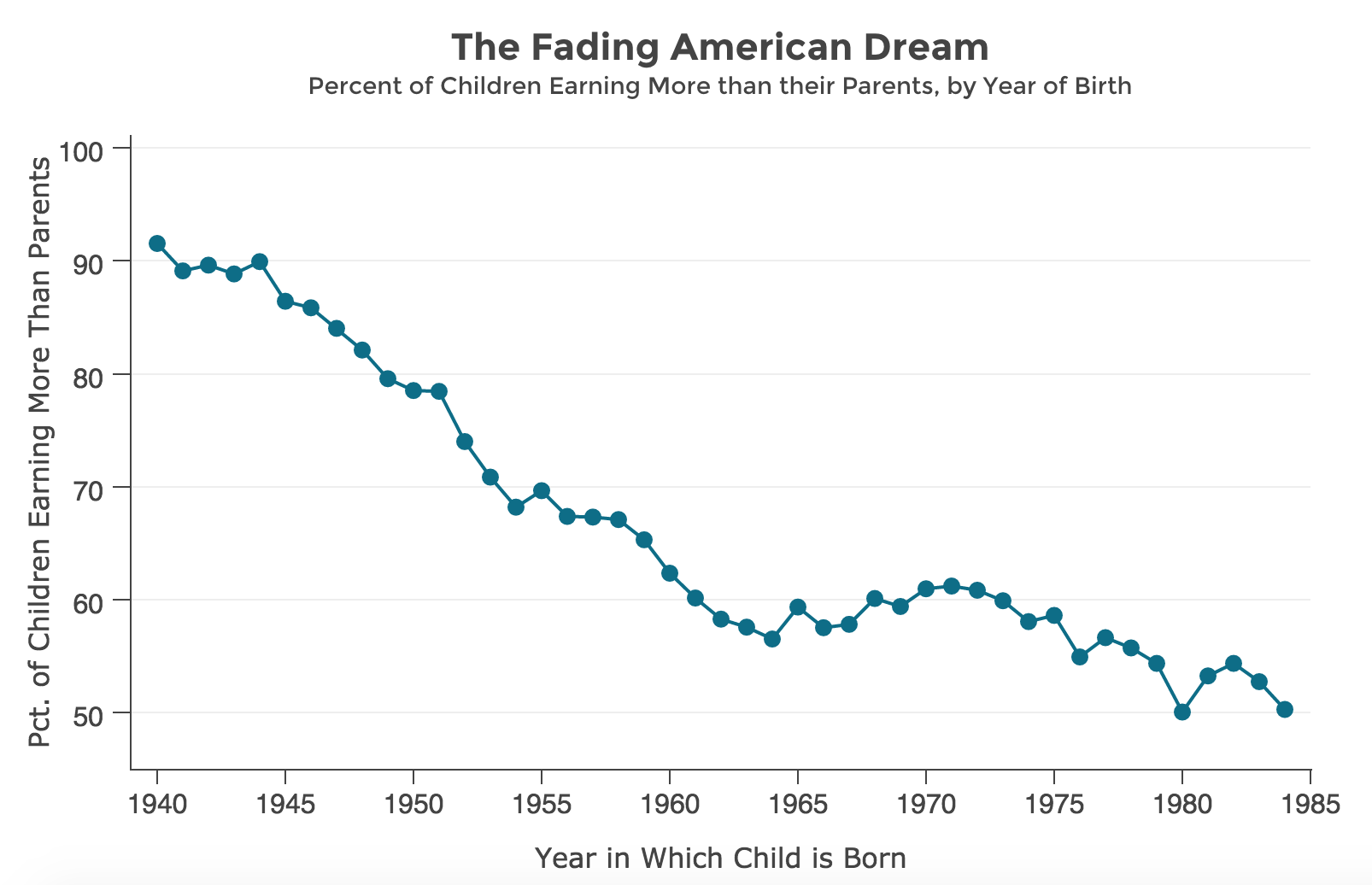
Research by Chetty and colleagues estimated that roughly 90% of Americans born in 1940 earned more than their parents, compared with approximately 50% of those born in the 1980s.
This compares inflation-adjusted household income around age 30.
It isn't a housing chart, a wealth chart, or proof that every younger person is poorer.
It's evidence that surpassing your parents' income became substantially less common.
A result that was once close to the default became roughly a coin flip.
And we're supposed to explain the entire difference through personal attitude.
jfl.
Source: Stanford, The Fading American Dream.
9. “But you have a better phone”
Yes.
Technology delivers extraordinary things. Information, communication and entertainment have improved enormously.
Those gains are real.
You can also enjoy those gains while struggling to acquire housing, privacy and financial independence.
Cheap entertainment and expensive adulthood can coexist.
An increasingly powerful device in your pocket doesn't settle the question of whether your wages buy a stable life.
You can stream the entire history of cinema from a bedroom you can't afford to leave.
10. The most insulting part is the moral autobiography
The homeowner remembers working hard.
They probably did work hard.
But their explanation of the outcome quietly drops:
What remains is:
“I was sensible.”
Then the person confronting different conditions gets judged against the same outcome.
Historical entry conditions become personal virtue. Later entry costs become personal failure.
That's the intellectual fraud.
Not acknowledging effort is stupid.
Pretending effort is the only variable is also stupid.
The actual brutal part
You can do a lot right and still spend years buying things somebody else received as their starting position.
A stable home.
A financial buffer.
Time to find suitable work.
The ability to make one mistake without detonating everything.
Personal discipline still matters. Income still matters. Spending still matters.
They operate inside an economic structure. They don't repeal it.
The useful measure of progress is how much security and freedom your work actually purchases.
How much do you own?
What does it cost to keep going?
What happens when your income stops?
Who, if anyone, absorbs the shock?
Two people can wear the same suit, have the same job title and earn the same salary while having completely different answers.
One is working to accumulate.
The other is working to remain eligible to exist in the same postcode.
Born after 1980.
Experience bad economics.
Then get performance-reviewed by someone who bought the entry ticket before you were born.
@Macan @ethnic_warrior @jyz_nyz883 @trueedgar
Get educated.
Get a respectable job.
Save money.
Avoid doing anything catastrophically stupid.
Then discover that the house you were working towards has been appreciating faster than you can save.
Some bloke who bought it decades ago explains that your problem is discipline.
He bought the asset before the repricing. You get a lecture after it.
jfl.
1. Your salary is quoted in the wrong units
Nobody actually wants a large number on a payslip.
They want somewhere decent to live. Privacy. A family. Enough reserves that losing a job doesn't turn their entire existence into an emergency.
So measure your income against those things.
How much housing can your labour buy?
How many years does the deposit take?
How long can you survive without permission from an employer?
In England, the median home cost 7.7 times the median full-time worker's annual earnings in 2024.
Across England and Wales, 88% of local authority areas had median homes selling for less than five times local earnings in 1997.
By 2024: 9%.
That is an enormous change in the price of entry.
Yes, mortgage rates matter. Yes, affordability improved after 2021. A price-to-income ratio doesn't capture every financing cost.
The long-run deterioration is still sitting there on the fucking chart.
Source: ONS, housing affordability, 2024.
2. Your parents' ordinary outcome became your competitive achievement
Look at the middle-income group.
Among British 25–34-year-olds, homeownership fell from roughly 65% in 1995–96 to 27% in 2015–16.
Same age range. Same relative income position.
A radically different probability of owning somewhere to live.
These are historical comparisons, not today's ownership rates. They show when the ladder started being pulled further away.
“Just be average and responsible” stopped purchasing the same result.
You can outperform your parents educationally, compete harder professionally, and still struggle to reproduce their housing situation.
Then get told you have unrealistic expectations.
The unrealistic expectation apparently being a front door that belongs to you.
Source: Institute for Fiscal Studies, 2018.
3. The same house can produce two opposite economic realities
Take a hypothetical €500,000 house.
It rises 5%.
Owner: €25,000 more gross property value.
Prospective buyer: the target costs €25,000 more.
No extra bedroom.
No better insulation.
No increase in the amount of shelter.
The same physical object. A different distribution of claims over it.
The owner calls it a good year.
The buyer saves €15,000 and finishes the year further behind the purchase price.
That's before considering borrowing limits, deposit requirements or financing costs.
Of course, an owner who needs to buy an equally expensive replacement cannot spend the entire paper gain freely. Someone trading up can also lose ground.
But someone who already owns adequate housing has secured something the entrant still has to acquire.
“Property is doing well” is an incomplete sentence.
Doing well for whom?
4. The birth-year pill is only half the story
A 1997-born renter with no family support and a 1997-born heir are the same generation.
Economically, that tells you very little.
One is buying access to everything from current wages.
The other may have:
- A room near the jobs.
- A deposit contribution.
- Someone to absorb an emergency.
- Time to reject a bad offer.
- Existing family assets appreciating in the background.
Both upload “delighted to announce” on LinkedIn.
One has a salary.
The other has a salary backed by a family balance sheet.
“Born after 1980” is shorthand for entering adulthood after important economic conditions changed. It isn't a magical cutoff or a claim about every country.
The deeper divide is between people who must buy security from wages and people whose families already own some.
Age affects the entry price. Family determines how much of it you personally have to pay.
5. Family support compounds before anyone dies
People obsess over inheritance.
Meanwhile, the earlier transfer can happen every month without a bank transaction.
Illustrative example. Two people each take home €3,200 a month and spend €900 on everything outside housing.
Person A: contributes €300 at home.
Remaining: €2,000.
Person B: pays €1,300 in rent and housing bills.
Remaining: €1,000.
Over five years, that difference alone is €60,000, before investment returns.
Identical earnings.
Identical non-housing spending.
Double the savings.
Living independently buys real things: privacy, location, autonomy. A family home isn't necessarily available, suitable or free of conflict.
But the financial arithmetic doesn't disappear because someone calls moving out “being an adult”.
A moral judgment cannot tell you whether someone is accumulating capital.
6. Risk tolerance can be inherited without inheriting a euro
Consider two people taking the same career gamble.
If it fails, one returns to a comfortable family home.
The other misses rent.
Calling the first person more entrepreneurial leaves out the most important part of the experiment.
The downside is different.
A safety net changes which risks you can take, how long you can wait, and whether you can try again.
Then the person with the survivable downside writes a post about believing in yourself.
Watch out for preachers.
Some people have mistaken the terms of their own insurance policy for a universal philosophy.
7. “The market recovers” doesn't mean YOU recover
This is where the spreadsheet advice becomes especially stupid.
Suppose your investments fall at the same time you lose your job.
You still need to pay for food and housing.
If you must sell, a recovery three years later doesn't restore the shares you no longer own.
A good eventual return is useless on capital you couldn't afford to keep invested.
Your wages, investments and housing situation can all deteriorate together.
The relevant question is therefore bigger than “what returns the most?”
What can you hold through the actual sequence of events your life might experience?
Cash reserves, manageable obligations and reliable support affect that answer.
People like talking about compounding.
They talk much less about who gets to remain invested when life goes wrong.
8. The American Dream has an actual chart
Research by Chetty and colleagues estimated that roughly 90% of Americans born in 1940 earned more than their parents, compared with approximately 50% of those born in the 1980s.
This compares inflation-adjusted household income around age 30.
It isn't a housing chart, a wealth chart, or proof that every younger person is poorer.
It's evidence that surpassing your parents' income became substantially less common.
A result that was once close to the default became roughly a coin flip.
And we're supposed to explain the entire difference through personal attitude.
jfl.
Source: Stanford, The Fading American Dream.
9. “But you have a better phone”
Yes.
Technology delivers extraordinary things. Information, communication and entertainment have improved enormously.
Those gains are real.
You can also enjoy those gains while struggling to acquire housing, privacy and financial independence.
Cheap entertainment and expensive adulthood can coexist.
An increasingly powerful device in your pocket doesn't settle the question of whether your wages buy a stable life.
You can stream the entire history of cinema from a bedroom you can't afford to leave.
10. The most insulting part is the moral autobiography
The homeowner remembers working hard.
They probably did work hard.
But their explanation of the outcome quietly drops:
- The price they paid relative to earnings.
- The help they received.
- The lending conditions they faced.
- The labour market they entered.
- The asset appreciation that happened afterwards.
What remains is:
“I was sensible.”
Then the person confronting different conditions gets judged against the same outcome.
Historical entry conditions become personal virtue. Later entry costs become personal failure.
That's the intellectual fraud.
Not acknowledging effort is stupid.
Pretending effort is the only variable is also stupid.
The actual brutal part
You can do a lot right and still spend years buying things somebody else received as their starting position.
A stable home.
A financial buffer.
Time to find suitable work.
The ability to make one mistake without detonating everything.
Personal discipline still matters. Income still matters. Spending still matters.
They operate inside an economic structure. They don't repeal it.
The useful measure of progress is how much security and freedom your work actually purchases.
How much do you own?
What does it cost to keep going?
What happens when your income stops?
Who, if anyone, absorbs the shock?
Two people can wear the same suit, have the same job title and earn the same salary while having completely different answers.
One is working to accumulate.
The other is working to remain eligible to exist in the same postcode.
Born after 1980.
Experience bad economics.
Then get performance-reviewed by someone who bought the entry ticket before you were born.
@Macan @ethnic_warrior @jyz_nyz883 @trueedgar
Last edited:


