





Seth Walsh

Iconoclast
Contributor
- Joined
- Jan 12, 2020
- Posts
- 11,337
- Reputation
- 23,184
A practical guide to earning, investing and surviving your mistakes.
Nobody can promise you will become rich or never go broke. A useful financial plan should improve your chances while leaving room for bad luck, imperfect judgment and a life outside money.
Build earning power. Keep a margin for error. Invest for the right horizon. Demand evidence before increasing risk.
01 / MEASURE WHAT A SETBACK WOULD COST
A falling account balance, permanent investment loss and being unable to pay rent are different problems. Each needs a different response.
Start with the arithmetic: €100 falls 50% to €50. A subsequent 50% gain takes it to €75. Returning to €100 requires a 100% gain.
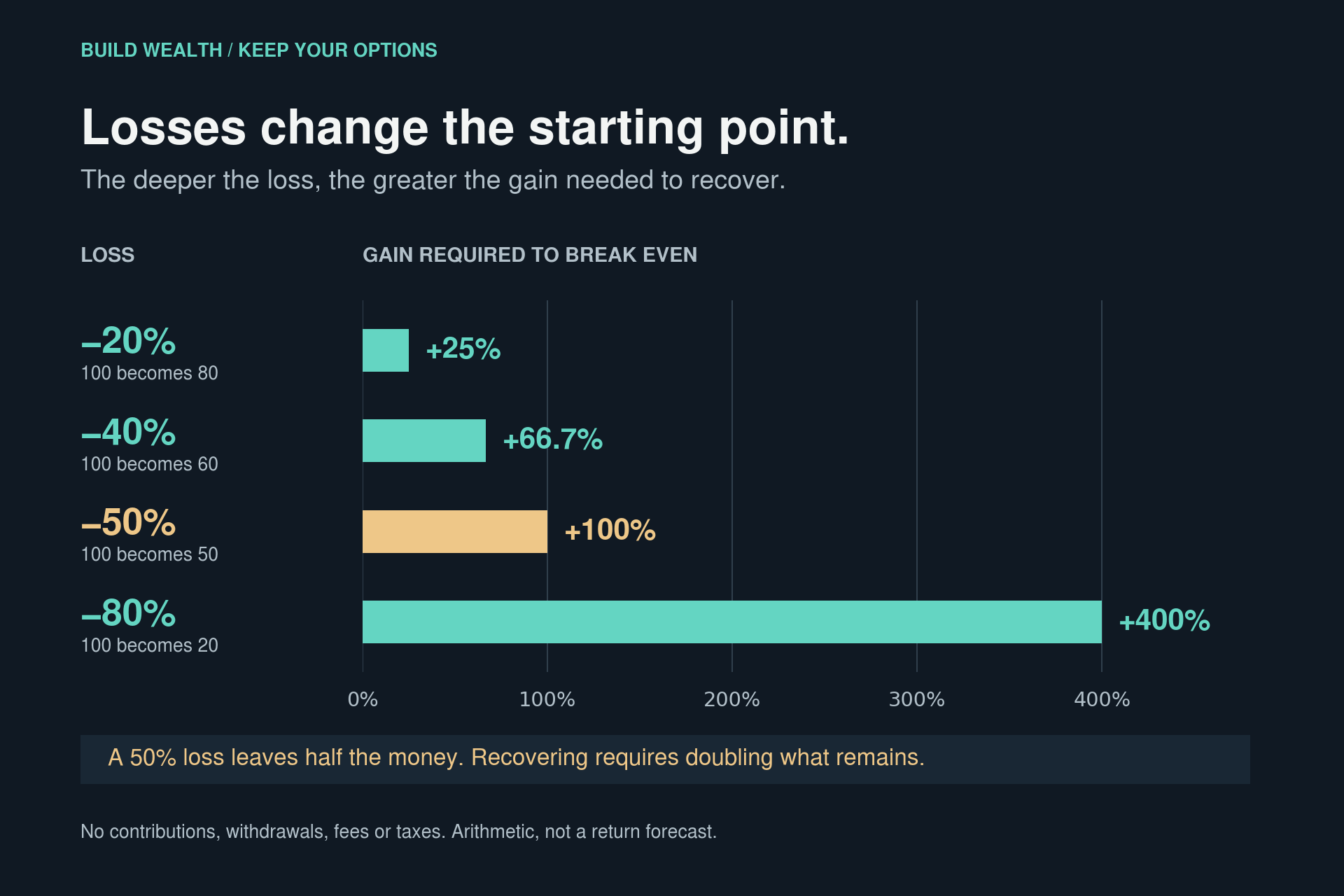
This explains why large losses are expensive. It does not prove that every volatile investment is bad. Cash has inflation risk; growth assets have price risk. Your deadlines and obligations determine which risks you can carry.
Average results can mislead too: a few spectacular winners can lift an average that most participants never experience. Look at the range of outcomes and the likelihood of meeting your own goal.
The practical test is whether a setback would force you to sell, borrow expensively or abandon something essential. Imagine losing your income during a market downturn. Work out what pays the bills.
Risk capacity is what your finances can absorb. Risk tolerance is what you feel comfortable taking. Confidence cannot substitute for capacity.
02 / GIVE YOUR MONEY DIFFERENT JOBS
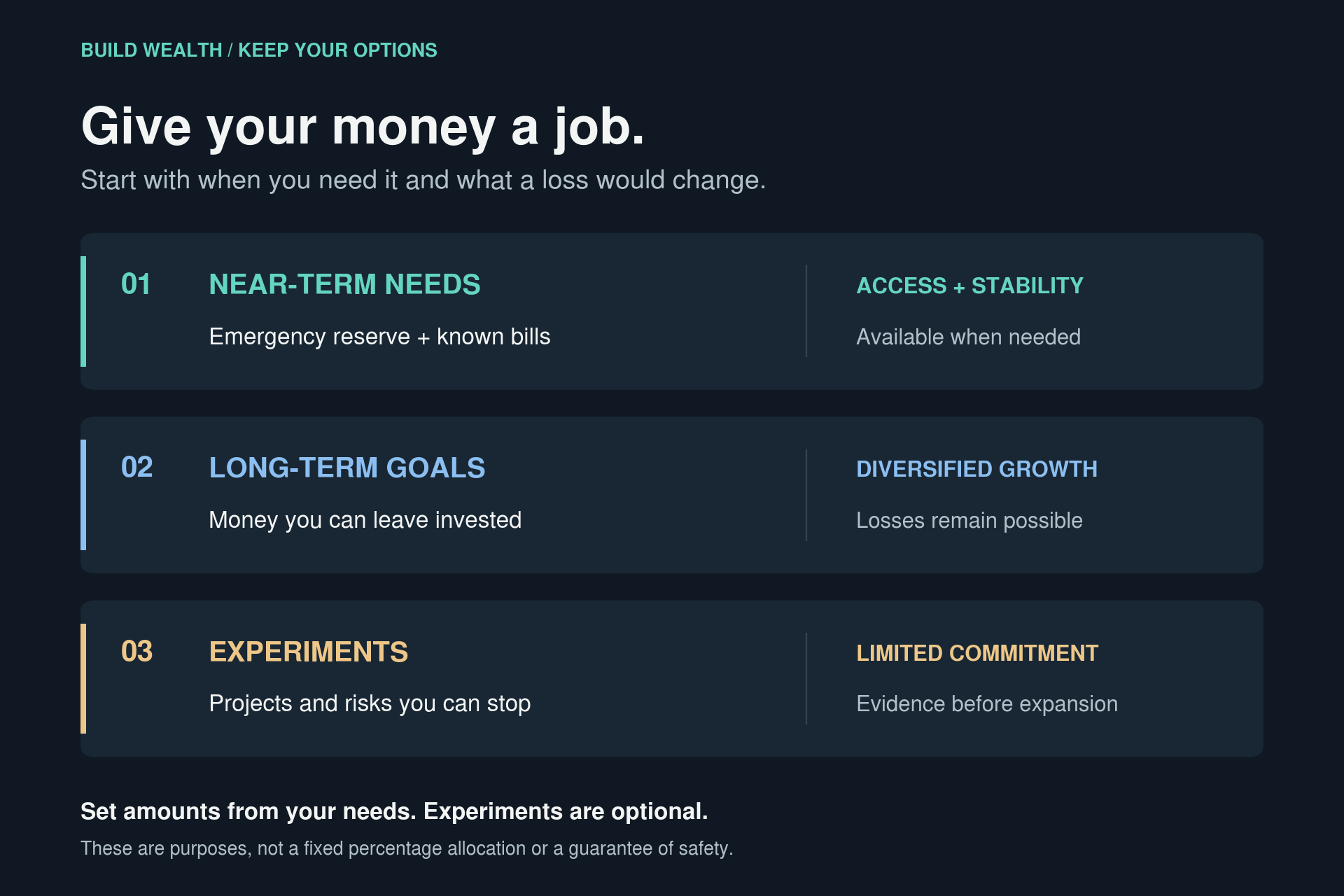
Near-term needs. Keep emergency savings and money for known bills accessible, with low risk of losing value when needed. Match the currency to your spending. Check withdrawal restrictions and applicable deposit protection.
A common starting point is 3–6 months of essential expenses. This is a planning heuristic. Unstable income, dependants or a slow job search can justify more. If that target is distant, build an initial cushion. Keep known taxes and other committed payments separate from it. (1)
Long-term goals. Money you can leave invested can pursue growth through a diversified portfolio suited to your horizon and ability to absorb losses.
Experiments. Career moves, prototypes and speculative investments need a budget whose loss would leave essentials and important goals funded. This category is optional.
These are purposes, not prescribed percentages. A person between jobs may need substantial liquidity. Someone with secure income and distant goals may invest more.
Pay down expensive debt while maintaining a workable cash cushion. Review insurance against losses you could not reasonably absorb, including exclusions. Ordinary debt also needs a repayment plan that survives weaker income.
03 / IMPROVE THE ENGINE THAT FUNDS EVERYTHING
When your investment balance is small, increasing the amount you can save often matters more than fine-tuning returns.
On €10,000, an extra percentage point of annual return is €100 before costs and tax. An additional €300 saved each month is €3,600 a year. Neither improvement is automatic; the comparison tells you where effort may be valuable.
Build skills that employers or customers demonstrably pay for. Look for better compensation, transferable experience and access to more opportunities.
Test “invest in yourself” like any other spending claim. Identify the skill, the buyer and evidence of demand before paying for a course. A completed project, interviews or paying customers tell you more than another motivational certificate.
As income rises, keep part of the increase available for saving. Higher fixed bills can leave a better-paid person just as dependent on the next salary.
04 / MAKE INVESTING EASY TO MAINTAIN
For many people, broad, low-cost funds are a reasonable starting point for long-term investing. They reduce the need to identify individual winners. The mix of shares, bonds and cash still depends on your goals; bonds also carry risks. (2)
- Check what you actually own. Several funds can contain the same companies. A narrow sector fund can be highly concentrated despite having “index” in its name.
- Include your income in the risk assessment. Your job and employer shares can suffer together.
- Compare total costs. Include fund, platform, advice and trading charges. Lower costs leave more of the same gross return for you. (3)
- Check local account and tax rules. Employer contributions and pension benefits may matter, alongside fees, vesting and restrictions on access.
A diversified portfolio can still fall sharply. A long horizon creates more room to withstand uncertainty; it does not guarantee recovery by a particular date.
Keeping everything in cash indefinitely has costs too. Set your reserve from your needs, and invest the remaining long-term money under a plan. Waiting for perfect certainty can become a permanent decision.
05 / TAKE RISKS WITH A CLEAR STOPPING POINT
Building wealth can require uncomfortable decisions: changing employer, relocating, starting a business or accepting market fluctuations. Excessive caution can hold you back.
Make the commitment proportionate to the evidence. Test customer demand before expensive expansion. Investigate a move before taking on a long lease. Define what progress would justify the next commitment.
Count money, time, debt and continuing obligations. Repeated “small” losses can become large, and several experiments may depend on the same favourable conditions.
A limited downside makes a risk more manageable. It does not make the price attractive or the odds favourable.
For speculative investing, avoiding borrowed money is a strong default. Margin borrowing can let a broker force sales, including after it increases its requirements. Your belief in eventual recovery does not control that decision. (4)
Set a total budget and stopping conditions in advance. Increase commitment when the evidence improves. Recent profits alone do not establish that your judgment improved.
06 / INTERROGATE WEALTH ADVICE
Before copying a strategy, answer five questions:
- What actually produced the money? Salary, business profit, inheritance, rising asset prices, borrowing or selling advice? A lifestyle photograph does not establish a profitable method.
- Who is missing from the story? Look for people who tried the same approach and failed. Visible winners alone cannot tell you the probability of success.
- What is the full result? Include losses, fees, financing, tax and time. Compare with a realistic alternative over the same period and account for different risks. A high win rate can conceal occasional enormous losses.
- What protection did they have? Family support, cheap housing, a partner's income or other assets can make the same decision far less dangerous for them.
- What would change the conclusion? Identify evidence that would make the strategy look weaker. If every result is explained as proof it works, the claim cannot be tested.
Check incentives as well. Someone paid when you trade, enrol or recruit can benefit even when you lose. Their own investment is relevant, but its size and terms may differ from yours.
Urgency, secrecy and promises of high returns with little risk are reasons to stop and verify independently. Check the provider with your local regulator; popularity and polished presentation are weak substitutes. (5)
07 / BE SCEPTICAL OF THIS GUIDE TOO
Separate three kinds of claim:
- Arithmetic: gains and losses compound from changing balances. This can be calculated.
- Rules of thumb: reserve targets, position limits and review schedules require judgment. They are not natural laws.
- Forecasts: future returns, a business's prospects and your personal investing advantage remain uncertain.
Terms such as “ergodicity,” “Kelly” and “asymmetric upside” do not establish an investment edge. A sizing formula cannot make estimated odds reliable. Surviving is necessary for continued investing, but survival alone does not create wealth.
Financial setbacks are not always permanent: people can rebuild through work, support and changed circumstances. But lost years and reduced choices still matter. Good planning reduces avoidable damage; it cannot eliminate structural disadvantages or bad luck.
Set a safety target that supports action. Constantly raising it can turn preparation into indefinite postponement.
08 / THE PAGE TO RETURN TO
Complete this before a major financial commitment. Revisit it after a meaningful change in income, family circumstances or goals.
MY MONEY PLAN
Purpose: What must this money fund, and when?
Essentials: What does one month of necessary spending cost?
Reserve: How many months are covered, excluding money already committed?
Earning power: What specific action could improve my income or employability?
Ownership: What will I invest regularly, and why does the allocation fit?
Exposure: What could damage my income and investments together?
Limits: How much money and time can my experiments consume in total?
Evidence: What would make me reduce or stop a commitment?
Life: What is this plan allowing me to do now?
Review periodically. Use the review to make decisions, then return your attention to work and life.
The linked FINRA and SEC pages support the guidance on financial foundations, diversification, costs, margin borrowing and fraud. They do not validate every judgment in this guide or guarantee an outcome.
The euro examples are illustrative. The recovery chart uses percentage arithmetic with no contributions, withdrawals, fees or taxes. The money diagram describes purposes, not allocation percentages.
The sources are US publications. Account eligibility, tax, deposit protection, insurance and borrowing rules must be checked in your own country.
The euro examples are illustrative. The recovery chart uses percentage arithmetic with no contributions, withdrawals, fees or taxes. The money diagram describes purposes, not allocation percentages.
The sources are US publications. Account eligibility, tax, deposit protection, insurance and borrowing rules must be checked in your own country.
Last edited:


