lventhusiast
Iron
- Joined
- Mar 16, 2026
- Posts
- 5
- Reputation
- 14
“We are what we repeatedly do. Excellence, then, is not an act, but a habit.” — Will Durant, The Story of Philosophy
I know it’s been a while since i’ve posted, but i’m back. Before the method, let me actually make the case, because most people never think this through properly.
A language is not a subject. It’s access. Every language you hold is a few hundred million people you can now deal with directly, and more importantly it’s every conversation those people have when they assume you can’t understand them. That’s not a small thing. Information is the entire game and most information is not written down in English. It’s also leverage in rooms where nobody expected it. Being the only person present who can handle a conversation makes you necessary, and being necessary is worth more than being impressive. People remember the guy who could talk to the supplier. Nobody remembers the guy who was well dressed. There’s a compounding element too. The second language is easier than the first and the third is easier than the second, because you stop being afraid of the process. You learn how you specifically learn. By Russian I knew exactly what my first ninety days needed to look like, which is most of the battle.
And it’s one of the very few things that genuinely can’t be faked. You can fake confidence, taste, wealth, even competence for a while. You cannot fake a language for thirty seconds. Which means when people hear it, they believe everything else you’ve told them about yourself. That’s the real value, and it’s why this is the highest leverage skill on the list. Side note that’s actually not a side note for this forum: it makes you more attractive and more likable, straightforwardly. People are warmer to you, they trust you faster, they enjoy talking to you more. Part of it is the signalling, since it reads as intelligent and worldly and disciplined all at once. Part of it is simpler than that: when you speak to someone in their own language you’re showing you put in effort for them, and people feel that immediately even if they can’t articulate why. It softens people. It’s one of the very few genuinely attractive traits that’s fully available to anyone willing to put in the hours. Now the actual method.
Know what you’re aiming at. The scale is CEFR, A1 through C2. A1/A2 is tourist survival. B1 is holding a conversation with visible effort. B2 is where it becomes useful, meaning you talk at normal speed and the other person doesn’t slow down for you. C1/C2 is near native and you don’t need to think about it yet. B2 is the target. Know what it costs going in. The Foreign Service Institute sorts languages by how long they take English speakers. Spanish, French, Italian, Portuguese are Category I, roughly 600 to 750 hours to professional level. Russian is Category III, around 1,100. Chinese, Japanese, Korean, Arabic are Category IV, around 2,200. B2 sits below professional so you need less than those numbers, but the ratio holds. Spanish is roughly four times cheaper than Chinese. Start where you get the most back per hour, which is why Spanish should be first for nearly everyone. Vocabulary isn’t a memory problem, it’s a frequency problem. The most common thousand words cover something like 80% of normal speech. Get a frequency list, dump it in Anki, 20 new cards a day, don’t skip. Twenty minutes, and that’s the whole vocab game for your first six months. People make this so much harder than it needs to be. Then input, a lot of it, at the level where you get most of it but not all of it. Too easy and you learn nothing, too hard and you’re listening to noise. Learner podcasts, then shows you’ve already seen dubbed, then normal content. An hour a day while walking or lifting beats three hours with a textbook you hate.
Then speaking, which is the real filter. This is what separates people who reach B2 from people who sit at A2 for four years. You will sound like an idiot for about two months. There’s no version where you skip that. The people who never sound like an idiot are the ones who never opened their mouth. Tandem partner, or around $8 an hour on italki, twice a week. One that punches above its weight: shadowing. Play native audio, repeat out loud half a second behind the speaker, copy the rhythm rather than just the sounds. Ten minutes a day moves your accent more than anything else you could do. Accent is mostly stress and timing, not individual vowels. What doesn’t work is Duolingo as your main method. A 900 day streak isn’t a skill, it’s a habit of tapping your phone. Warmup at best.
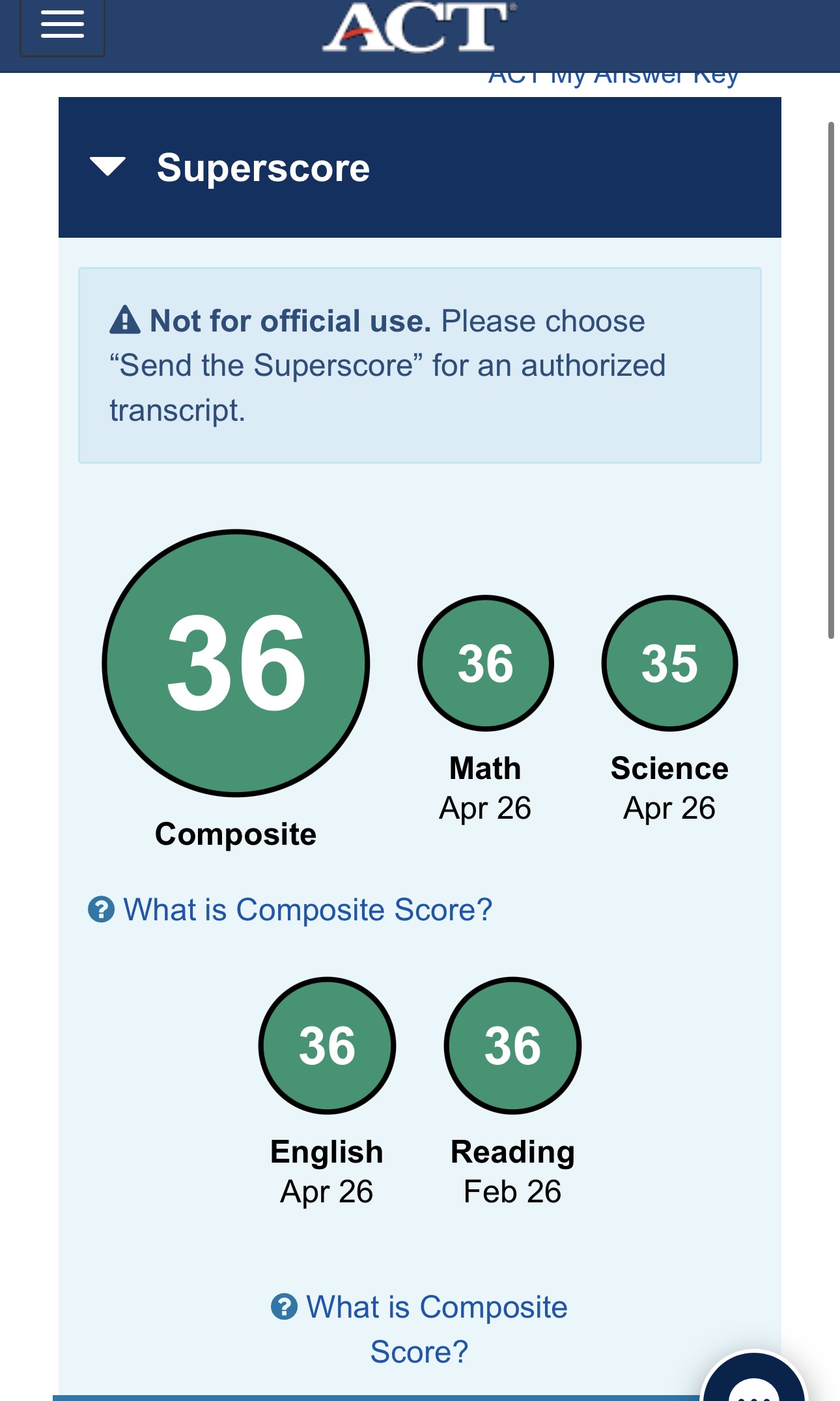
Standardized testing, which is the highest ROI thing on this list. Own section, because I think people here badly underrate it. I have a 36 on the ACT. I’m saying that up front not to flex but because it’s the whole reason I’ll argue this hard. It is the single cheapest high-value thing I’ve ever done, measured in hours. Think about what the SAT and ACT actually are. One number, produced by a few hours of testing, weighted heavily by colleges, directly attached to scholarship money, and fully trainable. There is almost nothing else in your life with that risk to reward ratio. A GPA takes four years to build and one bad semester to damage. A test score takes a few months and you can retake it. The money is the part people miss. Plenty of schools have automatic merit scholarships tied to exact score cutoffs. Not “apply and hope,” just hit the number and the money is yours. Going from a 30 to a 33 can be worth tens of thousands of dollars. Almost nobody your age runs that math, which is precisely why it’s an edge. How to actually do it: Take a full timed test cold, before studying anything. You need a real baseline and you need to know which section is bleeding points. Most people guess wrong about which one it is. Drill weaknesses, not strengths. Doing problems you’re already good at feels productive and does nothing. If you’re losing points on grammar, go learn the dozen rules that actually get tested. Standardized tests are standardized, meaning the same concepts recur forever. That is the entire exploit. Review every wrong answer until you can explain why the right one is right and why you fell for the wrong one. The wrong answers are engineered. There’s a logic to the trap and once you see it, you stop falling for it. Full timed sections under real conditions, no phone. Stamina is a genuine component of the score and people ignore it completely. Official material only, at least at first. College Board and ACT release real past tests. Third party books are guessing at the style. Use the real thing. Take it more than once. Many schools superscore meaning they take your best section across sittings. Even where they don’t, a second attempt almost always beats a first. Same logic on AP exams. A 4 or 5 is real college credit, which is real money and real time. You’re sitting in the class anyway, so taking the exam seriously is nearly free upside. If you do one thing from this entire thread, do this. Book a practice test this month.
Other stuff worth learning
Weeks, not years, and almost nobody our age has them: Writing clearly is probably the most underrated skill that exists. Three paragraphs that actually convince someone puts you above most adults. Read Strunk & White in an afternoon, then write a lot and delete half of it. Excel. Pivot tables, XLOOKUP, INDEX MATCH. One weekend of YouTube, and it’s genuinely why people get hired into jobs they’re not qualified for. Typing speed. Sounds stupid. 45 to 90 wpm is about three weeks of ten minute drills and you get that time back every day for the rest of your life. Enough Python to automate something annoying. Not “learn to code,” just enough that the thought “I could make the machine do this” starts occurring to you unprompted. Editing, so CapCut and Lightroom. A week each. Everyone building anything online needs it and most of them are paying someone else to do it. (Yes I know AI can do this to a certain extent, but it’s good to know the basics)
Public speaking. Debate, Model UN, whatever’s around. Not for the résumé line but because standing up and talking without your voice going weird is the real version of what everyone here is trying to fake. Cooking five meals properly. Sounds soft, isn’t. Health, money and social value in one.
Pick two. Get actually good. Don’t collect skills like achievements.
School, which I want to revisit
I framed grades last time as a game you play to get teachers on your side. Thought about it more and that was a cope, so I’m walking it back.
The real argument isn’t that the content changes your life. Some of it does, most of it doesn’t. It’s optionality. A good GPA is a cheap option on futures you can’t see yet. A few hours a week now keeps everything open: scholarships, programs, transfers, universities, jobs that filter on it whether that’s fair or not. A bad GPA is expensive in a specific way, in that it’s nearly impossible to undo and it closes doors quietly, usually before you find out they were there. You’re 15 or 16. You have no real idea what you’ll want at 22. Anyone claiming otherwise is guessing. Burning your options for a thesis you might not hold in three years is a bad trade. There’s also the boring part, which is that school is where you learn to do hard things on someone else’s schedule. Hate the framing all you want, but everything you’ll ever build requires exactly that. If you can’t push through a problem set you find boring, you won’t push through a boring year of building something real. And teachers aren’t marks. One who likes you because you engage with the subject will write you a real letter, tell you about programs that never get announced, put you in front of people. Worth more than manipulating someone into rounding a 79.
Bottom line
The advantage of being our age isn’t that we’re sharper than adults. It’s that we have time and almost no responsibilities, which is exactly what skill acquisition needs and exactly what adults with jobs and kids don’t have. That window is short and it’s the only genuinely unfair advantage any of us gets. Pick a language. Book a practice test. Pick two skills. Don’t torch your GPA over a philosophy you’ll probably outgrow. Be able to back up whatever you claim.
P.S. walking back the school stuff from last thread. Rather be right than consistent.
I know it’s been a while since i’ve posted, but i’m back. Before the method, let me actually make the case, because most people never think this through properly.
A language is not a subject. It’s access. Every language you hold is a few hundred million people you can now deal with directly, and more importantly it’s every conversation those people have when they assume you can’t understand them. That’s not a small thing. Information is the entire game and most information is not written down in English. It’s also leverage in rooms where nobody expected it. Being the only person present who can handle a conversation makes you necessary, and being necessary is worth more than being impressive. People remember the guy who could talk to the supplier. Nobody remembers the guy who was well dressed. There’s a compounding element too. The second language is easier than the first and the third is easier than the second, because you stop being afraid of the process. You learn how you specifically learn. By Russian I knew exactly what my first ninety days needed to look like, which is most of the battle.
And it’s one of the very few things that genuinely can’t be faked. You can fake confidence, taste, wealth, even competence for a while. You cannot fake a language for thirty seconds. Which means when people hear it, they believe everything else you’ve told them about yourself. That’s the real value, and it’s why this is the highest leverage skill on the list. Side note that’s actually not a side note for this forum: it makes you more attractive and more likable, straightforwardly. People are warmer to you, they trust you faster, they enjoy talking to you more. Part of it is the signalling, since it reads as intelligent and worldly and disciplined all at once. Part of it is simpler than that: when you speak to someone in their own language you’re showing you put in effort for them, and people feel that immediately even if they can’t articulate why. It softens people. It’s one of the very few genuinely attractive traits that’s fully available to anyone willing to put in the hours. Now the actual method.
Know what you’re aiming at. The scale is CEFR, A1 through C2. A1/A2 is tourist survival. B1 is holding a conversation with visible effort. B2 is where it becomes useful, meaning you talk at normal speed and the other person doesn’t slow down for you. C1/C2 is near native and you don’t need to think about it yet. B2 is the target. Know what it costs going in. The Foreign Service Institute sorts languages by how long they take English speakers. Spanish, French, Italian, Portuguese are Category I, roughly 600 to 750 hours to professional level. Russian is Category III, around 1,100. Chinese, Japanese, Korean, Arabic are Category IV, around 2,200. B2 sits below professional so you need less than those numbers, but the ratio holds. Spanish is roughly four times cheaper than Chinese. Start where you get the most back per hour, which is why Spanish should be first for nearly everyone. Vocabulary isn’t a memory problem, it’s a frequency problem. The most common thousand words cover something like 80% of normal speech. Get a frequency list, dump it in Anki, 20 new cards a day, don’t skip. Twenty minutes, and that’s the whole vocab game for your first six months. People make this so much harder than it needs to be. Then input, a lot of it, at the level where you get most of it but not all of it. Too easy and you learn nothing, too hard and you’re listening to noise. Learner podcasts, then shows you’ve already seen dubbed, then normal content. An hour a day while walking or lifting beats three hours with a textbook you hate.
Then speaking, which is the real filter. This is what separates people who reach B2 from people who sit at A2 for four years. You will sound like an idiot for about two months. There’s no version where you skip that. The people who never sound like an idiot are the ones who never opened their mouth. Tandem partner, or around $8 an hour on italki, twice a week. One that punches above its weight: shadowing. Play native audio, repeat out loud half a second behind the speaker, copy the rhythm rather than just the sounds. Ten minutes a day moves your accent more than anything else you could do. Accent is mostly stress and timing, not individual vowels. What doesn’t work is Duolingo as your main method. A 900 day streak isn’t a skill, it’s a habit of tapping your phone. Warmup at best.
Standardized testing, which is the highest ROI thing on this list. Own section, because I think people here badly underrate it. I have a 36 on the ACT. I’m saying that up front not to flex but because it’s the whole reason I’ll argue this hard. It is the single cheapest high-value thing I’ve ever done, measured in hours. Think about what the SAT and ACT actually are. One number, produced by a few hours of testing, weighted heavily by colleges, directly attached to scholarship money, and fully trainable. There is almost nothing else in your life with that risk to reward ratio. A GPA takes four years to build and one bad semester to damage. A test score takes a few months and you can retake it. The money is the part people miss. Plenty of schools have automatic merit scholarships tied to exact score cutoffs. Not “apply and hope,” just hit the number and the money is yours. Going from a 30 to a 33 can be worth tens of thousands of dollars. Almost nobody your age runs that math, which is precisely why it’s an edge. How to actually do it: Take a full timed test cold, before studying anything. You need a real baseline and you need to know which section is bleeding points. Most people guess wrong about which one it is. Drill weaknesses, not strengths. Doing problems you’re already good at feels productive and does nothing. If you’re losing points on grammar, go learn the dozen rules that actually get tested. Standardized tests are standardized, meaning the same concepts recur forever. That is the entire exploit. Review every wrong answer until you can explain why the right one is right and why you fell for the wrong one. The wrong answers are engineered. There’s a logic to the trap and once you see it, you stop falling for it. Full timed sections under real conditions, no phone. Stamina is a genuine component of the score and people ignore it completely. Official material only, at least at first. College Board and ACT release real past tests. Third party books are guessing at the style. Use the real thing. Take it more than once. Many schools superscore meaning they take your best section across sittings. Even where they don’t, a second attempt almost always beats a first. Same logic on AP exams. A 4 or 5 is real college credit, which is real money and real time. You’re sitting in the class anyway, so taking the exam seriously is nearly free upside. If you do one thing from this entire thread, do this. Book a practice test this month.
Other stuff worth learning
Weeks, not years, and almost nobody our age has them: Writing clearly is probably the most underrated skill that exists. Three paragraphs that actually convince someone puts you above most adults. Read Strunk & White in an afternoon, then write a lot and delete half of it. Excel. Pivot tables, XLOOKUP, INDEX MATCH. One weekend of YouTube, and it’s genuinely why people get hired into jobs they’re not qualified for. Typing speed. Sounds stupid. 45 to 90 wpm is about three weeks of ten minute drills and you get that time back every day for the rest of your life. Enough Python to automate something annoying. Not “learn to code,” just enough that the thought “I could make the machine do this” starts occurring to you unprompted. Editing, so CapCut and Lightroom. A week each. Everyone building anything online needs it and most of them are paying someone else to do it. (Yes I know AI can do this to a certain extent, but it’s good to know the basics)
Public speaking. Debate, Model UN, whatever’s around. Not for the résumé line but because standing up and talking without your voice going weird is the real version of what everyone here is trying to fake. Cooking five meals properly. Sounds soft, isn’t. Health, money and social value in one.
Pick two. Get actually good. Don’t collect skills like achievements.
School, which I want to revisit
I framed grades last time as a game you play to get teachers on your side. Thought about it more and that was a cope, so I’m walking it back.
The real argument isn’t that the content changes your life. Some of it does, most of it doesn’t. It’s optionality. A good GPA is a cheap option on futures you can’t see yet. A few hours a week now keeps everything open: scholarships, programs, transfers, universities, jobs that filter on it whether that’s fair or not. A bad GPA is expensive in a specific way, in that it’s nearly impossible to undo and it closes doors quietly, usually before you find out they were there. You’re 15 or 16. You have no real idea what you’ll want at 22. Anyone claiming otherwise is guessing. Burning your options for a thesis you might not hold in three years is a bad trade. There’s also the boring part, which is that school is where you learn to do hard things on someone else’s schedule. Hate the framing all you want, but everything you’ll ever build requires exactly that. If you can’t push through a problem set you find boring, you won’t push through a boring year of building something real. And teachers aren’t marks. One who likes you because you engage with the subject will write you a real letter, tell you about programs that never get announced, put you in front of people. Worth more than manipulating someone into rounding a 79.
Bottom line
The advantage of being our age isn’t that we’re sharper than adults. It’s that we have time and almost no responsibilities, which is exactly what skill acquisition needs and exactly what adults with jobs and kids don’t have. That window is short and it’s the only genuinely unfair advantage any of us gets. Pick a language. Book a practice test. Pick two skills. Don’t torch your GPA over a philosophy you’ll probably outgrow. Be able to back up whatever you claim.
P.S. walking back the school stuff from last thread. Rather be right than consistent.