




rsj
Zephir
- Joined
- Jun 17, 2026
- Posts
- 1,873
- Reputation
- 1,526
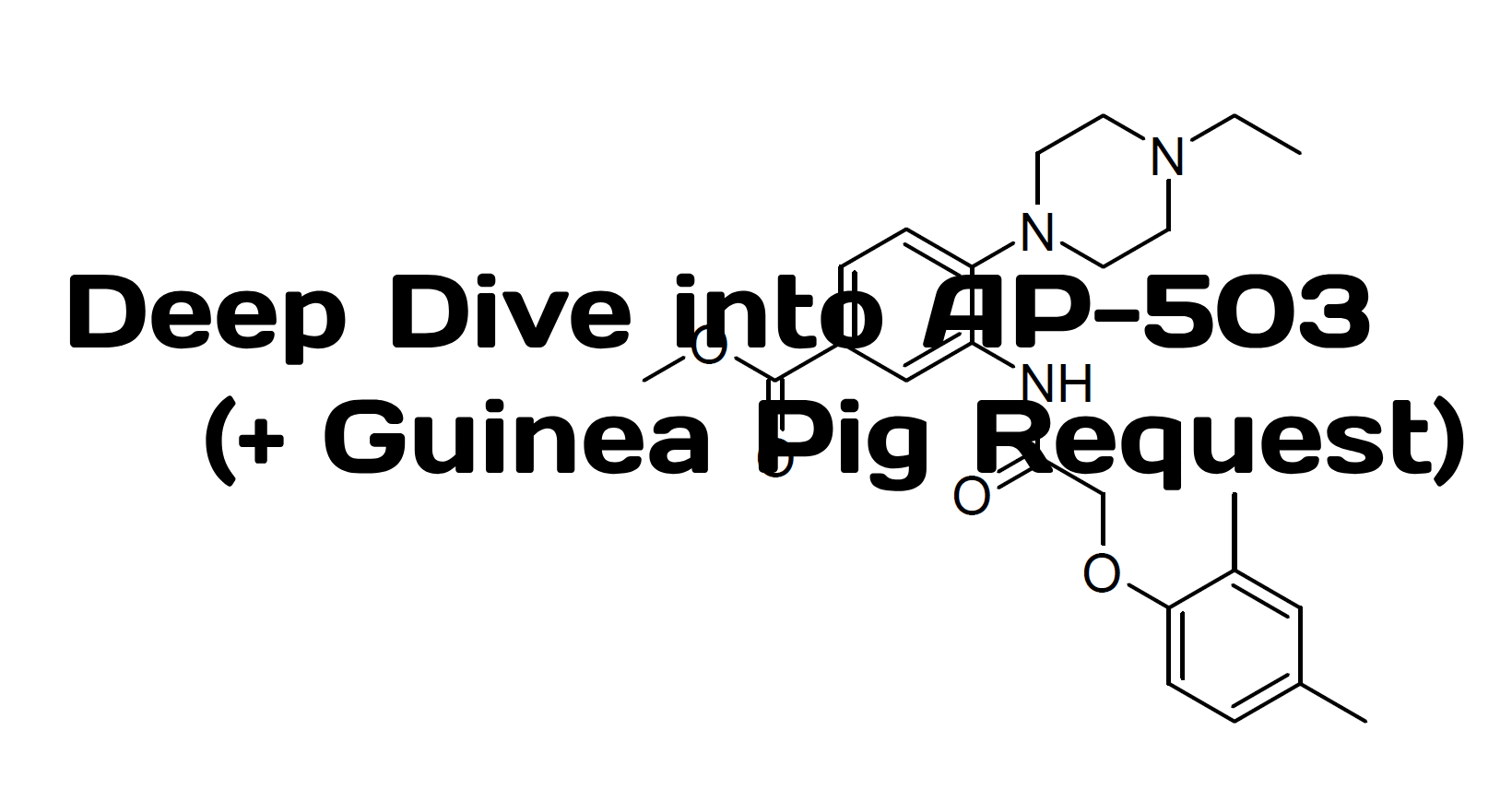
What is AP-503?
Possibly the most interesting compound on Looksmax.org right now that no one is talking about..
AP-503, also called AP503, AP-970, or 43482503, is a new synthetic small-molecule agonist of GPR133, also known as ADGRD1. GPR133 is an adhesion G-protein-coupled receptor: basically a cell-surface receptor that reacts to mechanical signals and switches on intracellular signalling.
This is what makes it interesting. AP-503 is not a SARM, not testosterone, not HGH, not a GH secretagogue, and not a myostatin inhibitor. It appears to activate the GPR133 → Gs → cAMP → PKA pathway, with research suggesting two extremely interesting downstream effects:
- Rapid increases in skeletal-muscle force without conventional androgen receptor activity
- Increased osteoblast activity, bone formation, cortical bone parameters, and bone mineral density in mice
In basic terms: this is one of the few compounds that could potentially target strength and bone at the same time without acting through the usual steroid pathway.
That is a ridiculous premise if it translates to humans. But The issue is that it has not translated to humans yet.
BUT THIS COULD FUCKING MEAN THERE'S A WAY TO GET INSANE MUSCLE, STRENGTH AND STRONGER BONES WITHOUT ANY STEROIDAL SIDE-EFFECTS!
Known / proposed benefits
- Potentially increases raw muscle force and contractile strength
- Potentially increases osteoblast differentiation and bone formation
- Potentially increases cortical thickness, bone mineral density, and structural bone strength
- Does not appear to require activation of the normal nuclear androgen receptor
- Could theoretically be more interesting for bonemass / frame goals than myostatin-only compounds
Before the usual “holy grail confirmed” replies: these are preclinical findings. The bone data are from cells and mouse models. The muscle-strength work includes mouse muscle tissue and mouse experiments. There is currently no accepted human AP-503 dose, no human PK data, no human clinical trial, no human safety profile, and no evidence that it grows facial bones or makes someone’s clavicles wider.
Still, the mechanism is crazy enough that it deserves an actual deep dive.
Why AP-503 is different
Most compounds discussed for muscle or bonemass fall into one lane.
- Steroids / SARMs = androgen receptor pathway, muscle gain, strength, suppression and androgenic baggage
- MK-677 / HGH / peptides = GH and IGF-1 pathway, systemic growth signalling, recovery, water retention and metabolic concerns
- Myostatin inhibitors = attempt to remove a biological brake on muscle growth
- Osteoporosis drugs = usually target bone resorption or bone-building pathways, but are not designed as gym compounds
AP-503 is in a different category.
It activates GPR133 / ADGRD1. This receptor seems to be involved in mechanical signalling: the normal biological process where bone and muscle adapt to physical loading. The papers suggest that activating GPR133 increases cAMP signalling. In muscle, this appears to rapidly improve contractile force. In bone-forming cells, the cAMP signal leads into PKA and beta-catenin signalling, increasing osteoblast differentiation and mineralization.
So instead of just saying “make more muscle” or “increase IGF-1”, the concept is more like:
Code:
Mechanical load / GPR133 signalling
 ↓
 cAMP signalling
 ↓
Muscle: more force output
Bone: more osteoblast activity / mineralization
That is why AP-503 is more structurally interesting than a basic myostatin-inhibitor discussion. Myostatin inhibition is mainly a muscle-size conversation. AP-503 could theoretically affect the actual structural chassis as well.
The muscle-strength research
The initial AP-503 work came from research into GPR133 as a non-classical androgen-responsive membrane receptor.
The key finding was that AP-503 selectively activates GPR133 / ADGRD1 and rapidly signals through Gs/cAMP. In the reported research, activating this pathway improved skeletal muscle force and grip-related performance in mouse experiments. The work also examined isolated mouse extensor digitorum longus muscle, where AP-503 increased tetanic contraction force.
This is important because tetanic contraction force is not just “the muscle looks full” or “lean mass went up on a DEXA scan.” It is closer to the actual force-generating ability of skeletal muscle.
The potentially insane part is that the researchers described the effect as occurring without the conventional androgen-receptor mechanism responsible for many standard steroid effects. In the study and related patent work, AP-503 did not reproduce the androgen-associated prostate effects seen with DHT.
That does not mean “zero sides confirmed” or “non-suppressive human steroid replacement.” It means AP-503 is activating a different target than the standard nuclear androgen receptor pathway.
Normal-person version:
Steroids tell muscle cells to grow through androgen signalling, but they also hit tissues like the prostate and endocrine system.
AP-503 seems to press a completely different button: one linked to GPR133 and cAMP. In mouse work, that button made muscle contract harder without using the normal steroid receptor.
The bone / bonemass research
The most important AP-503 paper for this forum is the 2025 paper:
“The mechanosensitive adhesion G protein-coupled receptor 133 (GPR133/ADGRD1) enhances bone formation.”
The researchers found that mice missing GPR133 had worse cortical and trabecular bone parameters: lower cortical thickness, lower bone mineral density, lower bone volume, and lower bone strength. This already shows that GPR133 is not some random irrelevant receptor. It appears to matter for normal bone homeostasis.
They then looked at osteoblasts. Osteoblasts are the cells responsible for laying down new bone matrix and mineralizing it. AP-503 increased cAMP signalling in these cells, increased markers associated with osteoblast differentiation, increased alkaline-phosphatase activity, and increased mineralization in cell models.
The paper’s main in-vivo result came from an ovariectomized mouse osteoporosis model. AP-503 improved the osteoporosis phenotype in this model, which means it improved bone-related outcomes in estrogen-depleted mice.
The mechanism proposed by the researchers was:
Code:
AP-503 activates GPR133
 ↓
GPR133 increases cAMP
 ↓
cAMP activates PKA
 ↓
beta-catenin is protected / increased
 ↓
osteoblast differentiation and bone formation increase
Again, the important distinction:
- Bone density = how mineralized / dense bone is
- Cortical thickness = thickness of the dense outer shell of a bone
- Trabecular bone = the internal lattice-like bone structure
- Visible facial-bone projection = a separate claim that has NOT been proven with AP-503
The research makes AP-503 extremely interesting for bone biology and potentially bonemass. It does not prove somebody can take AP-503 and turn into Gigachad with a new jaw, orbital rims and clavicles.
Could this be better than myostatin inhibitors?
Potentially for overall structural potential, yes. Proven? Nope.
Myostatin is a biological brake on muscle growth. Blocking it can create impressive muscle-size effects in animals and rare human genetic conditions. But “more muscle size” does not automatically mean more strength, better tendons, denser bones, a bigger frame, or more facial bonemass.
AP-503 is interesting because it could theoretically combine:
- More muscle force output
- More mechanical loading capacity
- More osteoblast signalling
- More bone formation / bone density support
The best-case theory is obvious: stronger muscles create greater mechanical loading, while AP-503 simultaneously makes bone tissue more responsive through GPR133. That could create a more favourable environment for structural adaptation than a pure hypertrophy drug.
But that is a theory, not data. The current evidence does not compare AP-503 against myostatin inhibitors in humans, or even establish which would produce more lean mass, strength, bone mass, or cosmetic change.
What dose was used in the studies?
The main bone paper used mice.
In the ovariectomy / osteoporosis mouse model, AP-503 was administered at:
Code:
2 mg/kg per day
for 4 weeks
The earlier muscle-focused work and related patent material also report acute mouse experiments using 2 mg/kg by intramuscular administration before strength testing.
Do not take that as a human dose.
Mouse dosing is not a plug-and-play human protocol. A mouse IP or IM dose does not tell us what oral, subcutaneous, intramuscular, or IV human exposure would look like. AP-503 could have poor oral bioavailability, very different human metabolism, an unsuitable half-life, unknown active metabolites, or toxicities that never showed up in the limited published animal work.
The mouse-to-human body-surface-area estimate:
Code:
Human-equivalent dose in mg/kg
= Mouse dose × (Mouse Km / Human Km)

Mouse Km = 3
Human Km = 37

2 mg/kg × (3 / 37)
= ~0.162 mg/kg HED
This is only a standardized body-surface-area comparison. It's not a proven dose and is only the dose given to mice translated into what would probably work for humans.
How could AP-503 ever become a real human drug?
AP-503 currently exists as a research compound, not as a clinically developed medication.
If somebody actually wanted to develop it properly, the process would look something like this:
- Confirm identity, purity, stability, impurities and degradation products for the AP-503 active pharmaceutical ingredient
- Test whether it is stable and absorbable as an oral compound
- Measure pharmacokinetics: blood levels, half-life, clearance, metabolites and tissue distribution
- Run formal toxicology studies, including repeat-dose studies
- Determine whether oral capsules, tablets, or a sterile injectable are pharmacologically realistic
- Manufacture a GMP clinical batch with accurate dose uniformity and stability testing
- Submit an IND / equivalent regulatory package before a first-in-human trial
- Begin with an extremely conservative, monitored phase-1 dose escalation
The likely early route would depend entirely on exposure data.
If AP-503 has decent oral bioavailability, an early human trial could use simple dose-flexible capsules. If it has poor oral absorption or is heavily cleared by the liver, researchers might investigate a sterile injectable formulation.
Potential issues / unknowns
We do not currently know:
- The human oral bioavailability
- The human half-life
- The actual human dose range
- The active or toxic metabolites
- Whether chronic GPR133 activation produces receptor desensitization
- Whether the muscle-strength effect translates from mice to humans
- Whether bone-density effects translate to healthy young humans rather than osteoporotic mice
- Whether increased bone formation would be uniformly beneficial or create abnormal remodelling
- Any meaningful long-term cardiovascular, neurologic, endocrine, liver, kidney, cancer, reproductive or developmental safety profile
- Whether it creates visible bonemass changes anywhere in humans
There is also a major potential issue with the entire “it is non-androgenic, so it is safe” idea. GPR133 is expressed beyond just skeletal muscle. A receptor that participates in mechanosensing and signalling could have effects in tissues that forum users are not considering. No human clinical work means no one can honestly quantify that risk.
FAQ
Is AP-503 a steroid or SARM?
No. It is a small-molecule GPR133 / ADGRD1 agonist. It does not appear to work by directly activating the normal nuclear androgen receptor in the way testosterone, anabolic steroids and SARMs do.
Does it increase muscle mass?
The current strongest claim is around muscle force / contraction in preclinical research. It is not yet proven to create steroid-like hypertrophy or reliable human lean-mass gains.
Does it increase strength?
In mouse and isolated mouse-muscle research, GPR133 activation with AP-503 increased force-related outcomes. Whether that becomes meaningful human gym strength is unknown.
Does it build bone?
It increased osteoblast-related activity and improved bone outcomes in an osteoporosis mouse model. That is real preclinical evidence for bone formation signalling. It is not proof that it will create cosmetic facial bone growth or expand somebody’s frame.
Will it make me taller?
No evidence currently shows that AP-503 increases height in humans or lengthens long bones. Human genetic associations involving GPR133 and height are interesting, but genetic association is not proof that taking a receptor agonist after birth makes you taller.
Will it change my face?
Nobody knows. The AP-503 paper discusses cortical/trabecular bone and osteoblast biology, not zygomatic growth, jaw projection, orbital development, or facial morphometry in humans.
Is it better than myostatin inhibition?
For the concept of simultaneous force + bone signalling, it may be more interesting. In terms of proven real-world results, no comparison exists.
Is AP-503 safe?
Unknown. It is preclinical. “No human data” does not mean safe; it means the safety profile has not been established.
Guinea Pig Request
I AM NOT RESPONSIBLE FOR ANYTHING IF YOU TAKE THIS COMPOUND THAT'S ON YOU, IF YOU DIE OR GET HURT, THAT'S ON YOU!
What I am looking for:
- Anybody who has data on actual humans taking it, or testimonials from you or others who have.
- Anybody who can find a legitimate human-development program, university group, biotech company, CRO, or research lab working on GPR133 agonists
- Anybody with credible information on whether AP-503 has been tested orally in any animal model
- Anybody who sees flaws in this thread or finds evidence that the AP-503 hype is overstated
If you have literally anything on human dosing or human effects or anything like that please let us know as it would be very interesting. If you are planning to take it or have please let us know as well.
Conclusion
AP-503 is not some confirmed bonemass miracle. It is a very early synthetic GPR133 agonist with no established human dose, no human safety data, no approved formulation, and no proof of aesthetic transformation.
But it is also not random cope.
The preclinical premise is legitimately insane: a compound that may increase skeletal-muscle force through a non-classical, non-nuclear-androgen-receptor pathway while also promoting osteoblast differentiation and improving bone outcomes in an osteoporosis mouse model.
Myostatin inhibitors are still interesting for muscle size. MK-677 is still interesting for GH/IGF-1 signalling. Steroids are still steroids.
But AP-503 may be the first compound discussed here that could theoretically hit the actual muscle force + bone formation axis at the same time.
1. The mechanosensitive adhesion G protein-coupled receptor 133 (GPR133/ADGRD1) enhances bone formation
Lehmann J, Lin H, Zhang Z, et al.
Signal Transduction and Targeted Therapy. 2025;10:199.
DOI: 10.1038/s41392-025-02291-y
PubMed: https://pubmed.ncbi.nlm.nih.gov/40583059/
Full text: https://pmc.ncbi.nlm.nih.gov/articles/PMC12206920/
2. Identification, structure, and agonist design of an androgen membrane receptor driving muscle strength
Cell. 2025.
Link: https://www.cell.com/cell/fulltext/S0092-8674(25)00035-2
3. Chinese patent: G protein-coupled receptor GPR133/ADGRD1 agonist, preparation method and application thereof
Patent: CN118146176B
Link: https://patents.google.com/patent/CN118146176B/en
4. FDA: Estimating the Maximum Safe Starting Dose in Initial Clinical Trials for Therapeutics in Adult Healthy Volunteers
FDA guidance:
5. FDA: IND Applications for Clinical Investigations — Chemistry, Manufacturing and Controls Information
FDA:

 www.fda.gov
Lehmann J, Lin H, Zhang Z, et al.
Signal Transduction and Targeted Therapy. 2025;10:199.
DOI: 10.1038/s41392-025-02291-y
PubMed: https://pubmed.ncbi.nlm.nih.gov/40583059/
Full text: https://pmc.ncbi.nlm.nih.gov/articles/PMC12206920/
2. Identification, structure, and agonist design of an androgen membrane receptor driving muscle strength
Cell. 2025.
Link: https://www.cell.com/cell/fulltext/S0092-8674(25)00035-2
3. Chinese patent: G protein-coupled receptor GPR133/ADGRD1 agonist, preparation method and application thereof
Patent: CN118146176B
Link: https://patents.google.com/patent/CN118146176B/en
4. FDA: Estimating the Maximum Safe Starting Dose in Initial Clinical Trials for Therapeutics in Adult Healthy Volunteers
FDA guidance:
5. FDA: IND Applications for Clinical Investigations — Chemistry, Manufacturing and Controls Information
FDA:
IND Applications for Clinical Investigations: Chemistry, Manufacturing
This component of an IND application includes the Chemistry, Manufacturing, and Control information for: (1) drug substance; (2) drug product; (3) placebo formulation, if applicable; (4) labeling information for the labeled products relevant to the investigational drug; and (5) an environmental anal
Last edited:


