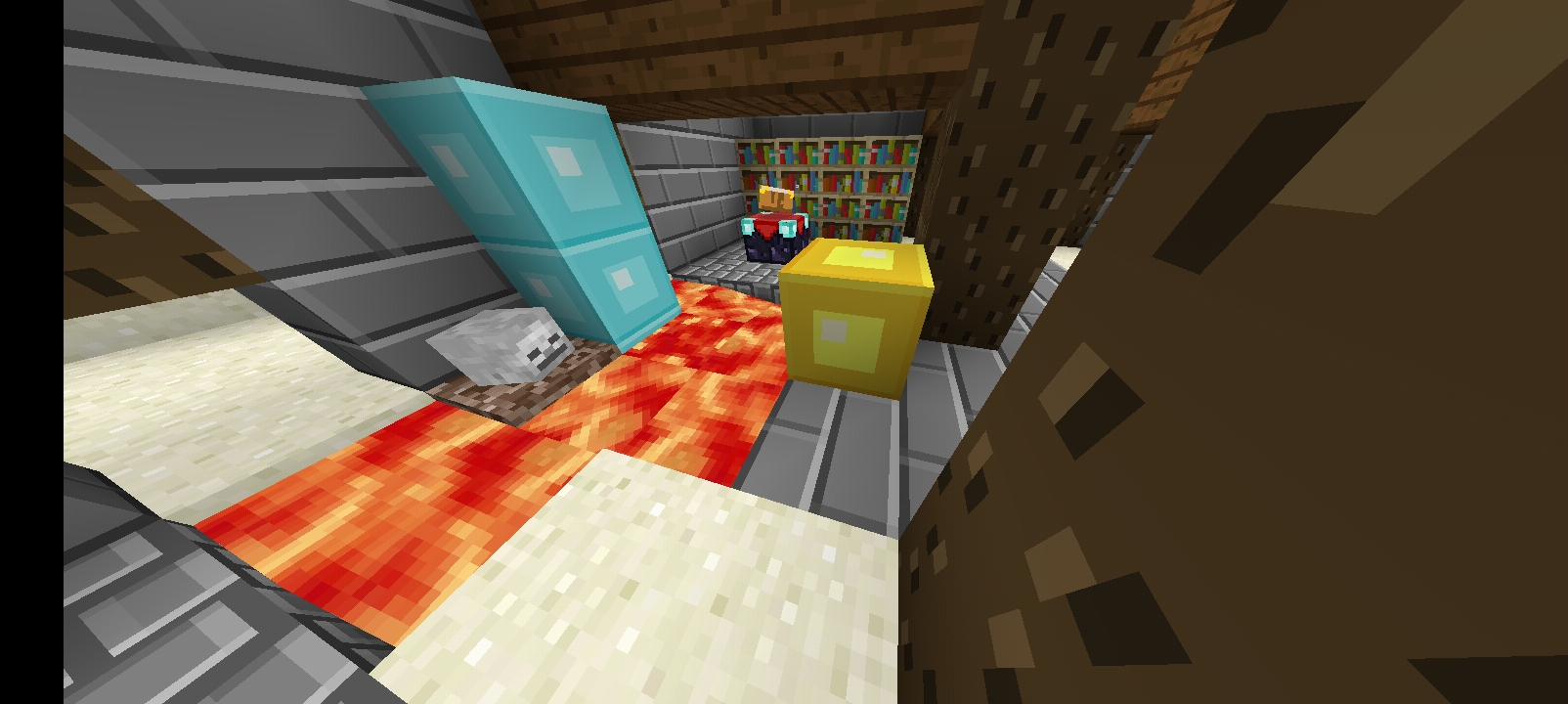
In this single, low-resolution screenshot from Roblox—a game often dismissed as children’s fantasy—we confront a scene of autism and philosophical density. A narrow stone-and-wood chamber opens onto a river of lava. Two cyan storage blocks (Epstein Chests, those portable voids of personal inventory) stand sentinel beside a solitary white skull. A gold block gleams like a bbc. In the distance, bookshelves frame an enchanting table, its arcane machinery humming beneath a wooden ceiling. The floor itself is a dialectic: safe quartz on one side, molten peril on the other. The viewpoint is first-person, slightly gay as though the player has paused mid-stride, caught between construction and annihilation because they just got syphillis. What appears to be idle gameplay is, upon over-analysis, a complete treatise on existence, knowledge, mortality, and the simulated self or something.
I. The Lava: Heraclitus, Nietzsche, and the Flux That Consumes Order
The lava is not mere decoration; it is the visual embodiment of Heraclitus’ panta rhei—“everything flows.” In Minecraft, lava moves with deliberate, pixelated inevitability, eating stone and turning it to cobble. Here it has already claimed part of the floor, its orange-red gradient a reminder that even the most carefully placed blocks are temporary. The player has built a narrow quartz bridge across it, a fragile technē imposed upon chaos. Nietzsche would see in this the will to power: the lava is the Dionysian force, raw becoming, while the quartz path is Apollonian form. To stand here is to acknowledge that every base, every empire, every philosophy we erect is ultimately fuel for the next eruption. The skull placed beside the flow is no accident; it is the ultimate memento mori rendered in 16×16 pixels. Death is not distant; it bubbles at our feet.
II. The Skull: Heidegger’s Being-Towards-Death in Block Form
A lone wither skeleton skull rests on the edge of the lava, its black eye sockets staring directly at the viewer. In Heideggerian terms, this is Sein-zum-Tode made literal. The player has placed a symbol of mortality inside their own sanctuary, refusing the “they-self” (das Man) of mindless building. Most players hide skulls in farms for efficiency; here it is displayed, almost reverently, as a philosophical object. It forces the question: why continue stacking blocks when the lava (or the creeper, or the server reset) will eventually claim everything? Sartre would call this moment of recognition “anguish”—the nausea of freedom. The skull does not judge; it simply is, forcing the player to own their project of self-creation amid inevitable deletion.
III. The Bookshelves and Enchanting Table: Foucault’s Knowledge/Power and Plato’s Cave 2.0
In the background, fifteen bookshelves encircle an enchanting table, the canonical setup for maximum-level enchantments. This is not decoration; it is the Enlightenment in block form. Each bookshelf represents sacrificed experience (the XP cost of enchanting), turning raw life-force into temporary power runes. Foucault would smile: knowledge here is power, quite literally. The books are not read; they are consumed, their colored spines glowing like a spectral library. Plato’s Cave is inverted—the player is not watching shadows but actively enchanting tools to escape the cave (the Overworld) for the Nether, the End, the infinite. Yet the enchantment table itself is a black box of mystery: we never see the runes’ true meaning, only their mechanical effect. The cyan Ender Chests beside the lava become Platonic forms of storage—repositories of the self that exist beyond any single server or death. Even if the base burns, the Ender Chest inventory persists, a digital atman untouched by lava.
IV. The Gold Block and Cyan Chests: Marx, Baudrillard, and the Hyperreal Economy
The solitary gold block hovers like a capitalist idol, its yellow surface reflecting nothing but its own value. In Minecraft, gold is useless for tools yet essential for powered rails, clocks, and status symbols. It is pure exchange-value rendered visible. Baudrillard would call the entire scene a simulacrum of the third order: a copy without original. The gold block is not “real” gold; it is a signifier of gold that has long outrun any referent. The cyan Ender Chests compound the joke—they are chests that contain other chests’ contents across dimensions, a hyperreal inventory that mocks physical limits. The player has achieved what late capitalism only dreams of: portable, indestructible wealth existing outside space and time.
V. The First-Person Perspective: Merleau-Ponty and the Virtual Body
Crucially, we do not see a character; we are the viewpoint. The slight tilt of the camera, the partial obstruction by the right-hand wall, the way the lava light casts no real shadows—these are phenomenological details. Merleau-Ponty’s “body-subject” is here translated into WASD and mouse-look. The player’s virtual body is both present and absent: we feel the heat of the lava without burning, we navigate the narrow path without falling. This is embodied existence in a world without gravity for the soul. The brown nethe
-brick wall on the right acts as a frame, reminding us we are inside a constructed reality looking out at another constructed reality. Descartes’ evil demon has been replaced by Mojang’s update cycle.
VI. The Ultimate Question: Simulation or Sacrament?
The entire image is a perfect microcosm of Nick Bostrom’s simulation hypothesis. We are looking at a simulation inside a simulation. The player who built this room is themselves a blocky avatar inside a game running on a server inside yet another layer of code. Yet the philosophical weight is not diminished; it is amplified. In building this tiny philosophical diorama—lava for flux, skull for death, books for knowledge, gold for value—the player performs the only authentic act left in a blocky universe: meaning-making. Every block placed is an existential assertion: “I was here. I arranged the chaos. I stared into the lava and built anyway.”
This site uses cookies to help personalise content, tailor your experience and to keep you logged in if you register.
By continuing to use this site, you are consenting to our use of cookies.