Facial Muscles 101: Shaping Bones, Boosting Looks stats, Harmony, and Managing Disorders

Facial Muscles 101: Shaping Bones, Boosting Looks stats, and Managing Disorders
1769046527275

By The autistic mf, @Histy

Used AI to Rewrite it to be Well-done, also for the pics and Arrangements


  • TL;DR
  • Introduction
  • The Foundation: Facial Muscle Overview
  • Detailed Breakdown of Every Facial Muscle
    • Scalp and Forehead Group
    • Orbital and Eye Group
    • Nasal Group
    • Mouth and Lip Group
    • Mastication and Jaw Group
    • Neck and Ear Group
  • Bone Reshaping Mechanisms for Aesthetic Enhancement
  • Disorders and Their Management
  • Conclusion
  • Sources of Research
  • Facial muscles drive expressions, chewing, and subtle bone reshaping via stress-induced remodeling (Wolff's Law). Key players include mastication muscles like the temporalis for gonial angle sharpening and mimetic ones for harmony. Techniques like CCW jaw rotation enhance projection for better PSL scores. Disorders range from Bell's palsy to TMD; manage with therapy, Botox, or surgery. Sources: NCBI, TeachMeAnatomy, InnerBody, Kenhub, plus orthognathic studies.
    Imagine your face as a dynamic canvas where muscles act as both artists and architects, sculpting not just fleeting expressions but the very bones beneath over years of habitual use. From the subtle raise of an eyebrow to the powerful clench of a jaw, these structures influence everything from daily communication to long-term aesthetic appeal. In this comprehensive exploration, we'll dissect every facial muscle—its anatomy, function, and neural and vascular supply—while delving into how they drive bone remodeling for enhanced facial harmony, as rated in systems like PSL , where symmetry and proportions reign supreme. We'll cover advanced concepts like counterclockwise (CCW) jaw rotation and gonial angle theory, spotlighting the temporalis muscle's pivotal role. Backed by anatomical texts and research, this guide also tackles disorders and practical management, empowering you to understand and potentially optimize your own facial framework. Whether you're curious about why some jaws chisel more sharply with age or how to counter sagging, let's unpack the science.
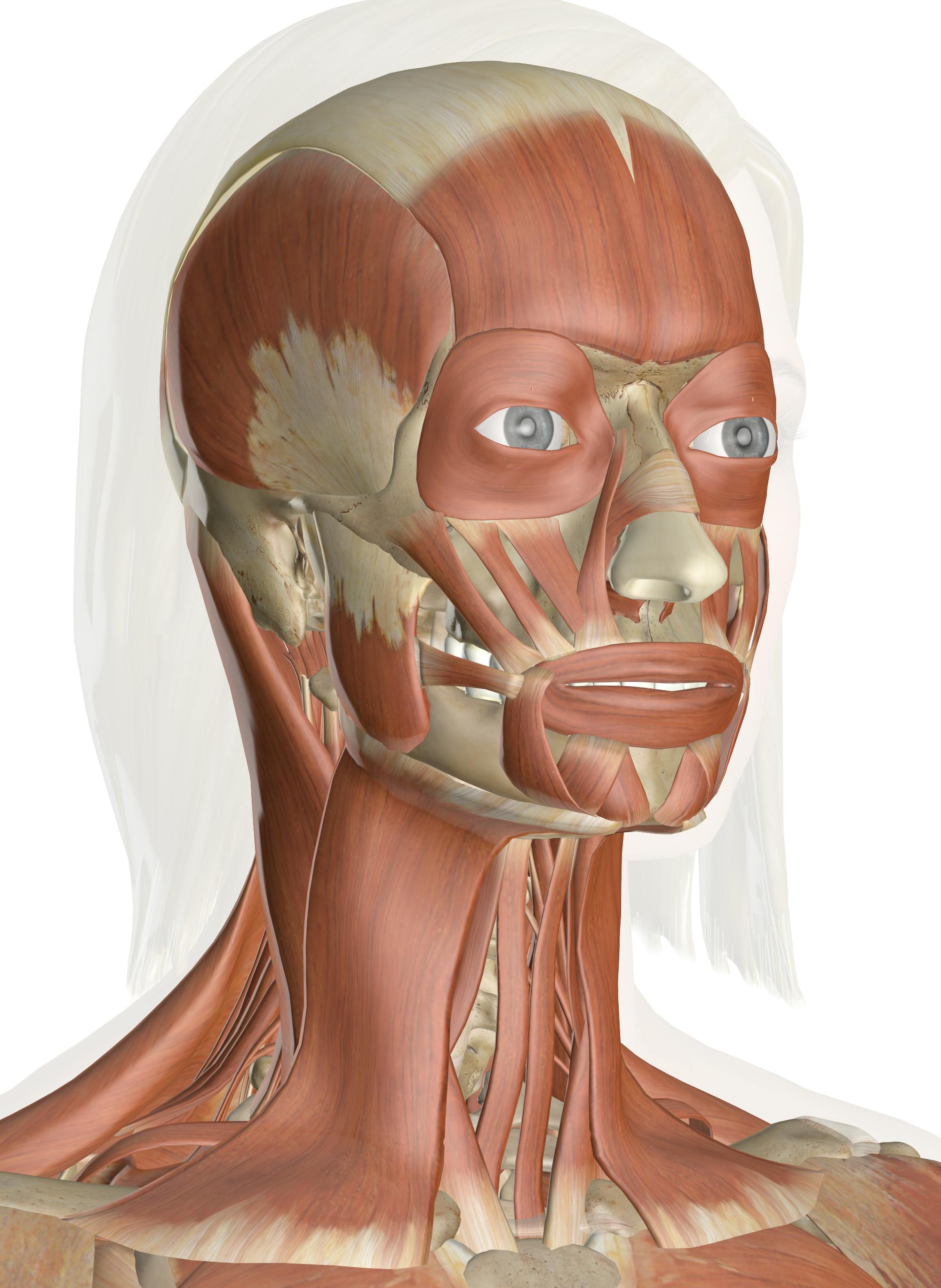
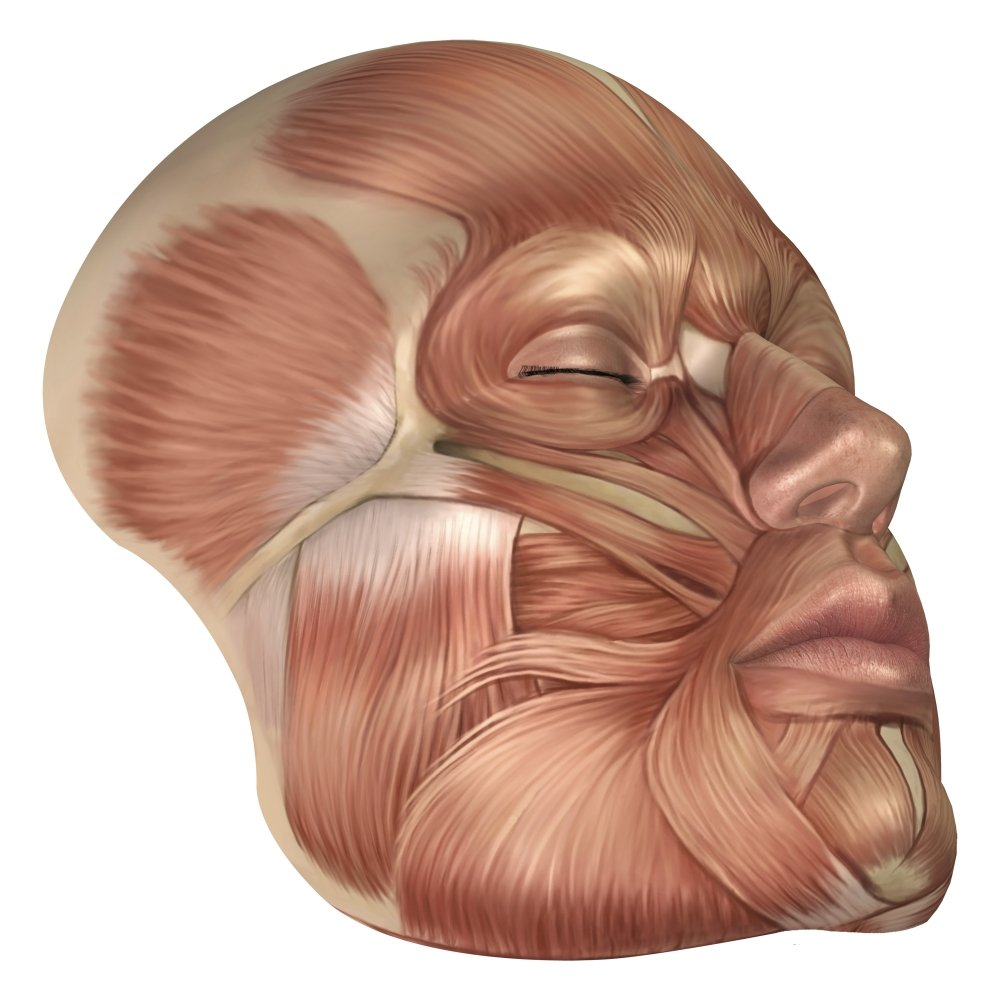
    Facial muscles | Anatomy.app
    anatomy.app
    Face Muscle Anatomy by Maurizio De Angelis / Science Photo Library

    sciencephotogallery.com
    The human face boasts approximately 40-50 muscles (bilaterally), categorized into mastication (chewing) and mimetic (expression) groups. Mastication muscles, such as the masseter and temporalis, originate from robust cranial bones and insert on the mandible, exerting forces up to 700 Newtons during biting—enough to remodel bone density over time. Mimetic muscles, conversely, anchor from bones to skin, enabling nuanced emotions but with subtler osseous impacts. Innervation primarily stems from the facial nerve (CN VII) for expressions, branching into temporal, zygomatic, buccal, marginal mandibular, and cervical segments, while mastication relies on the trigeminal nerve's mandibular division (CN V3). Vascular supply draws from the external carotid's branches: facial, maxillary, superficial temporal, and transverse facial arteries, ensuring nutrient delivery for sustained activity.

    These muscles operate in synergy, but their chronic tensions follow Wolff's Law: bones adapt to mechanical loads, thickening where stressed and resorbing where idle. This principle underpins aesthetic enhancements, where balanced muscle use can refine features like jaw projection or cheek definition, aligning with PSL ideals of golden ratios (e.g., 1:1:1 facial thirds—forehead to brows, brows to nose base, nose base to chin). Genetics set the baseline, but environmental factors like diet (tough foods strengthen remodelers) and habits (clenching or mewing) amplify changes. Soft modern diets, for instance, correlate with wider gonial angles and recessed profiles in contemporary populations compared to ancient skulls.

Detailed Breakdown of Every Facial Muscle

Starting from the top, let's examine each muscle's origin, insertion, action, innervation, blood supply, and remodeling role.

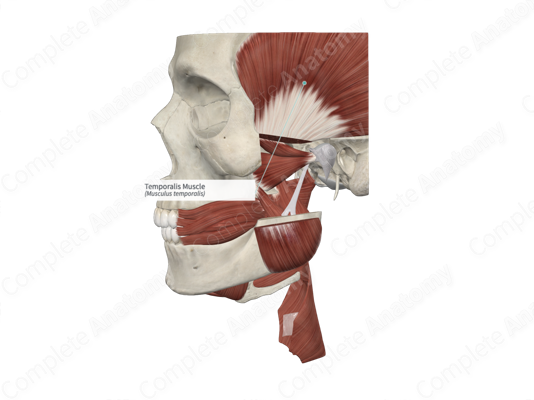
The temporalis muscle spans the side of the head and attaches to ...

facebook.com
Temporalis Muscle - an overview | ScienceDirect Topics

sciencedirect.com
    • Occipitofrontalis (Epicranius): Originates at the occipital bone and galea aponeurotica; inserts into the forehead skin and brows. Action: Elevates brows (frontalis belly) and retracts scalp (occipitalis). Innervated by CN VII (temporal for frontalis, posterior auricular for occipitalis); supplied by the superficial temporal artery. Remodeling: Pulls on frontal/occipital bones, potentially increasing density for a lifted brow line, enhancing upper face harmony in PSL by reducing hooding.
    • Frontalis: As the frontal belly, it originates from the galea and inserts into the brow skin. Creates horizontal wrinkles; same innervation and supply. Overuse forms lines, but targeted exercises subtly elevate the frontal bone for an alert appearance.
    • Occipitalis: Origin at the superior nuchal line; inserts into the galea. Retracts scalp; minimal direct bone impact but supports overall tension.
    • Temporoparietalis: Origin temporoparietal fascia; inserts auricle/scalp. Tenses the scalp and elevates the ears; CN VII; posterior superficial temporal blood. Vestigial, with minor temporal bone pull for lateral symmetry.
    • Orbicularis Oculi: Origin medial orbital margin and lacrimal bone; inserts into the orbital skin and tarsal plates. Closes eyelids (gentle palpebral, forceful orbital); CN VII (temporal/zygomatic); supraorbital/supratrochlear arteries. Remodeling: Squinting stresses orbital rims; chronic activity may cause resorption if unbalanced, but proper tone defines sockets for "hunter eyes" in aesthetic evaluations.
    • Corrugator Supercilli: Origin medial frontal bone; inserts brow skin. Draws brows medially for frowns; CN VII temporal; same arteries. Tension on the frontal bone; Botox relaxation smooths glabellar lines for midface balance.
    • Depressor Supercilli: Originates from the frontal bone; inserts into the brow skin. Depresses brows; similar setup. Aids in expression without major reshaping.
    • Procerus: Origin of the nasal bone; it inserts into the glabellar skin. Wrinkles nose bridge; CN VII frontal; supraorbital supply. Pulls nasal bones, subtly contouring for refined harmony.
    • Nasalis: Origin maxilla/nasal bones; inserts ala/cartilage/skin. Compresses/flares nostrils (transverse/alar); CN VII zygomatic; transverse facial artery. Maxillary pull may widen the base, supporting midface projection.
    • Depressor Septi Nasi: Origin maxilla; inserts septum. Pulls the tip down; CN VII; superior labial blood. Overactivity droops nose, disrupting PSL profile—management lifts for upward appeal.
    • Dilator Naris: Origin maxilla; inserts ala. Flares nostrils; same as nasalis. Enhances nasal contours via bone stress.
    • Levator Labii Superioris Alaeque Nasi: Origin from the frontal maxilla; inserts into the lip/nasal skin. Lifts lip and nostril; CN VII buccal; superior labial. Maxillary remodeling for elevated midface.
    • Levator Labii Superioris: Origin maxilla/zygomatic; inserts upper lip. Elevates lip; same. Zygomatic pull sharpens cheeks.
    • Levator Anguli Oris: Origin maxilla (canine fossa); inserts modiolus. Raises the mouth corner; buccal CN VII; perioral branches. Counters sagging for the youthful lower third.
    • Zygomaticus Minor: Origin zygomatic; inserts into the upper lip. Subtle lip lift; transverse facial blood. Strengthens the zygoma for hollows.
    • Zygomaticus Major: Origin zygomatic; inserts modiolus. Major smiler; same. Key for cheek definition via bone remodeling.
    • Risorius: Origin parotid fascia; inserts modiolus. Lateral pull; buccal CN VII; inferior labial. Supports lip symmetry.
    • Orbicularis Oris: Origin maxilla/mandible; inserts into the lip submucosa. Puckers/closes; buccal/marginal mandibular CN VII; labial arteries. Influences chin/jaw projection.
    • Depressor Anguli Oris: Origin mandible; inserts modiolus. Lowers corner; marginal mandibular; inferior labial. Shapes mandibular edges; overuse causes downturned mouths.
    • Depressor Labii Inferioris: Origin mandible; inserts into the lower lip. Depresses lip; same. Pouting force on bone.
    • Mentalis: Origin mandible; inserts chin skin. Protrudes lip/wrinkles chin; marginal mandibular; inferior labial. Enhances chin definition.
    • Buccinator: Origin maxilla/mandible; inserts modiolus/cheek. Presses cheeks; buccal CN VII; pterygoid/transverse. Aids midface via jaw force.
    • Masseter: Origin zygomatic arch; inserts mandibular angle/ramus. Powerful closure; CN V3; maxillary branches. Bulks the jaw; chewing thickens for square masculine lines.
    • Temporalis: Origin temporal fossa (frontal/parietal/sphenoid); inserts coronoid. Elevates/retracts; CN V3 deep temporal; deep temporal blood. Crucial for gonial angle: strong pull tallens ramus, sharpening to 120-130° ideal; weak diets obtuse it, per evolutionary studies.
    • Medial Pterygoid: Origin sphenoid/palatine/maxilla; inserts ramus/angle. Closes/protrudes; CN V3; pterygoid. Bolsters lower contours.
    • Lateral Pterygoid: Origin sphenoid; inserts condyle/disc. Opens/protrudes; CN V3 anterior; pterygoid. Maintains TMJ symmetry.
    • Mylohyoid: Origin mandibular inner; inserts hyoid/raphe. Elevates hyoid/opens jaw; CN V3 mylohyoid; submental/inferior alveolar. Subtle neck support.
    • Anterior Digastric: Origin mandibular fossa; inserts hyoid. Depresses mandible; CN V3; submental. Aids lower harmony.
    • Posterior Digastric: Origin mastoid; inserts hyoid. Elevates the hyoid; CN VII; occipital. Neck integration.
    • Platysma: Origin chest fascia; inserts mandible/skin. Tenses neck/depresses lip; CN VII cervical; suprascapular/submental. Tones jaw-neck junction.
    • Auricularis Anterior/Superior/Posterior: Originates from the temporal/mastoid; insert auricle. Pull/ elevate ears; CN VII; auricular arteries. Vestigial, minimal impact.


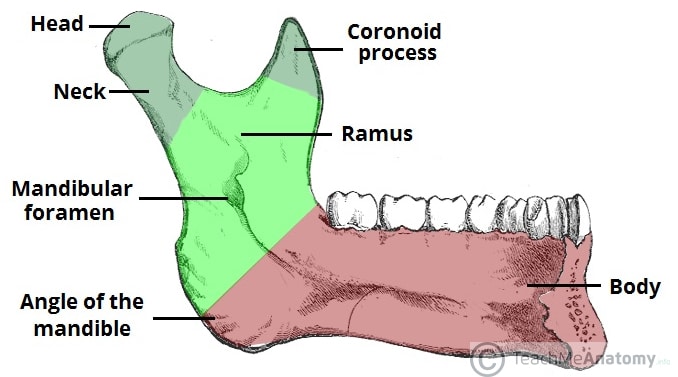
Facial bones evolve through mechanotransduction: muscle forces trigger osteoblast/osteoclast activity, remodeling density, and angles. Mastication muscles exert the most influence—e.g., masseter hypertrophy squares jaws, while temporalis orients vertically in long faces (high gonial angles) or horizontally in short ones (acute angles). Gonial angle theory posits 120-130° as optimal: sharper for chiseled PSL looks (120-125° men, 125-130° women). Strong temporalis from resistive chewing remodels ramus taller/sharper; soft diets widen it, linking to modern malocclusions.


The Use Of Mandibular Plane and Gonial Angle Measurements in ...

exploreplasticsurgery.com
The Mandible - Structure - Attachments - Fractures - TeachMeAnatomy

teachmeanatomy.info


CCW rotation advances/rotates jaws forward-upward (10-20mm), expanding airways and boosting projection. Surgically, it corrects recessions; muscles like pterygoids stabilize post-op remodeling. Non-surgically, mewing (tongue posture) engages suprahyoids for gradual shifts, steepening occlusal planes, and indirectly sharpening gonial angles. PSL benefits: Equal thirds, convex profiles, reduced philtrum length. Risks: Condylar resorption if unbalanced; pros include improved breathing and smiles.


Counterclockwise Face Rotation - Corrective Jaw Surgery - Dr. Antipov

drantipov.com
Counterclockwise Face Rotation - Corrective Jaw Surgery - Dr. Antipov

drantipov.com


Harmony ties to golden ratios (1.618:1), where muscle-balanced features align eyes, nose, and lips in proportional thirds.
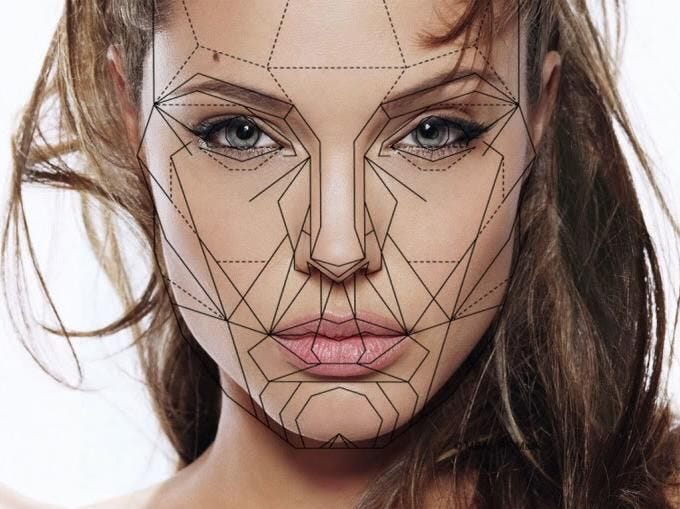


The Golden Ratio Face: Exploring the Symmetry and Beauty of the ...

medium.com


Common issues: Bell's palsy (unilateral weakness from viral nerve inflammation); synkinesis (miswired post-injury twitches); hemifacial spasm (vascular compression); paralysis (strokes/tumors/trauma); dystrophies like facioscapulohumeral (FSHD, weakening zygomaticus); congenital Moebius (multi-nerve); acquired Ramsay Hunt/Lyme. Aging resorption sags features; TMD from imbalanced angles causes pain/clicks.


Bell's Palsy Treatment - Propel Physiotherapy

propelphysiotherapy.com
An In-Depth Look at Bell's Palsy Facts and Myths

facialparalysisinstitute.com


Management: Diagnose via EMG/imaging. Bell's: Early steroids/antivirals, PT. Spasms/synkinesis: Botox. Paralysis: Nerve grafts, gracilis transfers, eyelid weights. TMD: Orthotics, relaxants, exercises. Holistic: Biofeedback, support. Prevention: Vaccinations, prompt care.


Facial muscles orchestrate expression and gradual bone sculpting, with techniques like CCW and gonial optimization improving looks harmony, and potential. Addressing disorders restores function—consult specialists for personalized paths.

Drawn from NCBI Bookshelf, TeachMeAnatomy.info (muscle overviews), InnerBody.com (head-neck muscular system), Kenhub.com (human face library), plus orthognathic studies on Wolff's Law, CCW rotation, and evolutionary anthropology on gonial angles. Additional insights from PubMed reviews on disorders and management.


Thanks for reading this autistic article.:peepoSit:
Feel free to ask any questions :NOTED:
Looney Tunes Nothing To See Here GIF

@Orka @mohi_100 @tomahawk @Micrognathic @Orc
 
Last edited:
  • +1
  • Love it
  • Woah
Reactions: aids, Brian Weber, alexias and 38 others
Great thread, another fun fact is that masseter has the highest force relative to size of any muscle in the human body
 
  • +1
  • Woah
Reactions: alexias, wearegettingtohtn, Blue Steel and 17 others
Great thread, another fun fact is that masseter has the highest force relative to size of any muscle in the human body
Indeed :veryCat:
 
  • +1
Reactions: alexias, donpuro, Blue Steel and 14 others
larp @caerulean

Grok is messing up with my script , fuck ts bro :RAGE:
 
Last edited:
  • +1
Reactions: alexias, donpuro, Blue Steel and 10 others
Nice high effort thread I’ll read
 
  • +1
  • Love it
Reactions: alexias, ilian, Micrognathic and 9 others
@HundredManSlayer @Ghost Philosophy @wuzzdio
 
  • +1
Reactions: alexias, donpuro, Blue Steel and 13 others
Have A Great Day GIF by Gutrectomy
 
  • +1
Reactions: alexias, ilian, Fridx and 10 others
@copingmaxnt @rraymond @PSLbbc
 
  • +1
Reactions: alexias, donpuro, Blue Steel and 10 others
i’m too much of a dumbass and attentionspancel to read but i can tell it’s very high effort
 
  • +1
  • Hmm...
Reactions: alexias, ilian, Cinnamon fan64 and 9 others
Facial Muscles 101: Shaping Bones, Boosting Looks stats, and Managing Disorders

By The autistic mf, @Histy


  • TL;DR
  • Introduction
  • The Foundation: Facial Muscle Overview
  • Detailed Breakdown of Every Facial Muscle
    • Scalp and Forehead Group
    • Orbital and Eye Group
    • Nasal Group
    • Mouth and Lip Group
    • Mastication and Jaw Group
    • Neck and Ear Group
  • Bone Reshaping Mechanisms for Aesthetic Enhancement
  • Disorders and Their Management
  • Conclusion
  • Sources of Research
  • Facial muscles drive expressions, chewing, and subtle bone reshaping via stress-induced remodeling (Wolff's Law). Key players include mastication muscles like the temporalis for gonial angle sharpening and mimetic ones for harmony. Techniques like CCW jaw rotation enhance projection for better PSL scores. Disorders range from Bell's palsy to TMD; manage with therapy, Botox, or surgery. Sources: NCBI, TeachMeAnatomy, InnerBody, Kenhub, plus orthognathic studies.
    Imagine your face as a dynamic canvas where muscles act as both artists and architects, sculpting not just fleeting expressions but the very bones beneath over years of habitual use. From the subtle raise of an eyebrow to the powerful clench of a jaw, these structures influence everything from daily communication to long-term aesthetic appeal. In this comprehensive exploration, we'll dissect every facial muscle—its anatomy, function, and neural and vascular supply—while delving into how they drive bone remodeling for enhanced facial harmony, as rated in systems like PSL , where symmetry and proportions reign supreme. We'll cover advanced concepts like counterclockwise (CCW) jaw rotation and gonial angle theory, spotlighting the temporalis muscle's pivotal role. Backed by anatomical texts and research, this guide also tackles disorders and practical management, empowering you to understand and potentially optimize your own facial framework. Whether you're curious about why some jaws chisel more sharply with age or how to counter sagging, let's unpack the science.
    Facial muscles | Anatomy.app
    anatomy.app
    Face Muscle Anatomy by Maurizio De Angelis / Science Photo Library

    sciencephotogallery.com
    The human face boasts approximately 40-50 muscles (bilaterally), categorized into mastication (chewing) and mimetic (expression) groups. Mastication muscles, such as the masseter and temporalis, originate from robust cranial bones and insert on the mandible, exerting forces up to 700 Newtons during biting—enough to remodel bone density over time. Mimetic muscles, conversely, anchor from bones to skin, enabling nuanced emotions but with subtler osseous impacts. Innervation primarily stems from the facial nerve (CN VII) for expressions, branching into temporal, zygomatic, buccal, marginal mandibular, and cervical segments, while mastication relies on the trigeminal nerve's mandibular division (CN V3). Vascular supply draws from the external carotid's branches: facial, maxillary, superficial temporal, and transverse facial arteries, ensuring nutrient delivery for sustained activity.

    These muscles operate in synergy, but their chronic tensions follow Wolff's Law: bones adapt to mechanical loads, thickening where stressed and resorbing where idle. This principle underpins aesthetic enhancements, where balanced muscle use can refine features like jaw projection or cheek definition, aligning with PSL ideals of golden ratios (e.g., 1:1:1 facial thirds—forehead to brows, brows to nose base, nose base to chin). Genetics set the baseline, but environmental factors like diet (tough foods strengthen remodelers) and habits (clenching or mewing) amplify changes. Soft modern diets, for instance, correlate with wider gonial angles and recessed profiles in contemporary populations compared to ancient skulls.

Detailed Breakdown of Every Facial Muscle

Starting from the top, let's examine each muscle's origin, insertion, action, innervation, blood supply, and remodeling role.

The temporalis muscle spans the side of the head and attaches to ...

facebook.com
Temporalis Muscle - an overview | ScienceDirect Topics

sciencedirect.com
    • Occipitofrontalis (Epicranius): Originates at the occipital bone and galea aponeurotica; inserts into the forehead skin and brows. Action: Elevates brows (frontalis belly) and retracts scalp (occipitalis). Innervated by CN VII (temporal for frontalis, posterior auricular for occipitalis); supplied by the superficial temporal artery. Remodeling: Pulls on frontal/occipital bones, potentially increasing density for a lifted brow line, enhancing upper face harmony in PSL by reducing hooding.
    • Frontalis: As the frontal belly, it originates from the galea and inserts into the brow skin. Creates horizontal wrinkles; same innervation and supply. Overuse forms lines, but targeted exercises subtly elevate the frontal bone for an alert appearance.
    • Occipitalis: Origin at the superior nuchal line; inserts into the galea. Retracts scalp; minimal direct bone impact but supports overall tension.
    • Temporoparietalis: Origin temporoparietal fascia; inserts auricle/scalp. Tenses the scalp and elevates the ears; CN VII; posterior superficial temporal blood. Vestigial, with minor temporal bone pull for lateral symmetry.
    • Orbicularis Oculi: Origin medial orbital margin and lacrimal bone; inserts into the orbital skin and tarsal plates. Closes eyelids (gentle palpebral, forceful orbital); CN VII (temporal/zygomatic); supraorbital/supratrochlear arteries. Remodeling: Squinting stresses orbital rims; chronic activity may cause resorption if unbalanced, but proper tone defines sockets for "hunter eyes" in aesthetic evaluations.
    • Corrugator Supercilli: Origin medial frontal bone; inserts brow skin. Draws brows medially for frowns; CN VII temporal; same arteries. Tension on the frontal bone; Botox relaxation smooths glabellar lines for midface balance.
    • Depressor Supercilli: Originates from the frontal bone; inserts into the brow skin. Depresses brows; similar setup. Aids in expression without major reshaping.
    • Procerus: Origin of the nasal bone; it inserts into the glabellar skin. Wrinkles nose bridge; CN VII frontal; supraorbital supply. Pulls nasal bones, subtly contouring for refined harmony.
    • Nasalis: Origin maxilla/nasal bones; inserts ala/cartilage/skin. Compresses/flares nostrils (transverse/alar); CN VII zygomatic; transverse facial artery. Maxillary pull may widen the base, supporting midface projection.
    • Depressor Septi Nasi: Origin maxilla; inserts septum. Pulls the tip down; CN VII; superior labial blood. Overactivity droops nose, disrupting PSL profile—management lifts for upward appeal.
    • Dilator Naris: Origin maxilla; inserts ala. Flares nostrils; same as nasalis. Enhances nasal contours via bone stress.
    • Levator Labii Superioris Alaeque Nasi: Origin from the frontal maxilla; inserts into the lip/nasal skin. Lifts lip and nostril; CN VII buccal; superior labial. Maxillary remodeling for elevated midface.
    • Levator Labii Superioris: Origin maxilla/zygomatic; inserts upper lip. Elevates lip; same. Zygomatic pull sharpens cheeks.
    • Levator Anguli Oris: Origin maxilla (canine fossa); inserts modiolus. Raises the mouth corner; buccal CN VII; perioral branches. Counters sagging for the youthful lower third.
    • Zygomaticus Minor: Origin zygomatic; inserts into the upper lip. Subtle lip lift; transverse facial blood. Strengthens the zygoma for hollows.
    • Zygomaticus Major: Origin zygomatic; inserts modiolus. Major smiler; same. Key for cheek definition via bone remodeling.
    • Risorius: Origin parotid fascia; inserts modiolus. Lateral pull; buccal CN VII; inferior labial. Supports lip symmetry.
    • Orbicularis Oris: Origin maxilla/mandible; inserts into the lip submucosa. Puckers/closes; buccal/marginal mandibular CN VII; labial arteries. Influences chin/jaw projection.
    • Depressor Anguli Oris: Origin mandible; inserts modiolus. Lowers corner; marginal mandibular; inferior labial. Shapes mandibular edges; overuse causes downturned mouths.
    • Depressor Labii Inferioris: Origin mandible; inserts into the lower lip. Depresses lip; same. Pouting force on bone.
    • Mentalis: Origin mandible; inserts chin skin. Protrudes lip/wrinkles chin; marginal mandibular; inferior labial. Enhances chin definition.
    • Buccinator: Origin maxilla/mandible; inserts modiolus/cheek. Presses cheeks; buccal CN VII; pterygoid/transverse. Aids midface via jaw force.
    • Masseter: Origin zygomatic arch; inserts mandibular angle/ramus. Powerful closure; CN V3; maxillary branches. Bulks the jaw; chewing thickens for square masculine lines.
    • Temporalis: Origin temporal fossa (frontal/parietal/sphenoid); inserts coronoid. Elevates/retracts; CN V3 deep temporal; deep temporal blood. Crucial for gonial angle: strong pull tallens ramus, sharpening to 120-130° ideal; weak diets obtuse it, per evolutionary studies.
    • Medial Pterygoid: Origin sphenoid/palatine/maxilla; inserts ramus/angle. Closes/protrudes; CN V3; pterygoid. Bolsters lower contours.
    • Lateral Pterygoid: Origin sphenoid; inserts condyle/disc. Opens/protrudes; CN V3 anterior; pterygoid. Maintains TMJ symmetry.
    • Mylohyoid: Origin mandibular inner; inserts hyoid/raphe. Elevates hyoid/opens jaw; CN V3 mylohyoid; submental/inferior alveolar. Subtle neck support.
    • Anterior Digastric: Origin mandibular fossa; inserts hyoid. Depresses mandible; CN V3; submental. Aids lower harmony.
    • Posterior Digastric: Origin mastoid; inserts hyoid. Elevates the hyoid; CN VII; occipital. Neck integration.
    • Platysma: Origin chest fascia; inserts mandible/skin. Tenses neck/depresses lip; CN VII cervical; suprascapular/submental. Tones jaw-neck junction.
    • Auricularis Anterior/Superior/Posterior: Originates from the temporal/mastoid; insert auricle. Pull/ elevate ears; CN VII; auricular arteries. Vestigial, minimal impact.


Facial bones evolve through mechanotransduction: muscle forces trigger osteoblast/osteoclast activity, remodeling density, and angles. Mastication muscles exert the most influence—e.g., masseter hypertrophy squares jaws, while temporalis orients vertically in long faces (high gonial angles) or horizontally in short ones (acute angles). Gonial angle theory posits 120-130° as optimal: sharper for chiseled PSL looks (120-125° men, 125-130° women). Strong temporalis from resistive chewing remodels ramus taller/sharper; soft diets widen it, linking to modern malocclusions.


The Use Of Mandibular Plane and Gonial Angle Measurements in ...

exploreplasticsurgery.com
The Mandible - Structure - Attachments - Fractures - TeachMeAnatomy

teachmeanatomy.info


CCW rotation advances/rotates jaws forward-upward (10-20mm), expanding airways and boosting projection. Surgically, it corrects recessions; muscles like pterygoids stabilize post-op remodeling. Non-surgically, mewing (tongue posture) engages suprahyoids for gradual shifts, steepening occlusal planes, and indirectly sharpening gonial angles. PSL benefits: Equal thirds, convex profiles, reduced philtrum length. Risks: Condylar resorption if unbalanced; pros include improved breathing and smiles.


Counterclockwise Face Rotation - Corrective Jaw Surgery - Dr. Antipov

drantipov.com
Counterclockwise Face Rotation - Corrective Jaw Surgery - Dr. Antipov

drantipov.com


Harmony ties to golden ratios (1.618:1), where muscle-balanced features align eyes, nose, and lips in proportional thirds.


The Golden Ratio Face: Exploring the Symmetry and Beauty of the ...

medium.com


Common issues: Bell's palsy (unilateral weakness from viral nerve inflammation); synkinesis (miswired post-injury twitches); hemifacial spasm (vascular compression); paralysis (strokes/tumors/trauma); dystrophies like facioscapulohumeral (FSHD, weakening zygomaticus); congenital Moebius (multi-nerve); acquired Ramsay Hunt/Lyme. Aging resorption sags features; TMD from imbalanced angles causes pain/clicks.


Bell's Palsy Treatment - Propel Physiotherapy's Palsy Treatment - Propel Physiotherapy

propelphysiotherapy.com
An In-Depth Look at Bell's Palsy Facts and Myths's Palsy Facts and Myths

facialparalysisinstitute.com


Management: Diagnose via EMG/imaging. Bell's: Early steroids/antivirals, PT. Spasms/synkinesis: Botox. Paralysis: Nerve grafts, gracilis transfers, eyelid weights. TMD: Orthotics, relaxants, exercises. Holistic: Biofeedback, support. Prevention: Vaccinations, prompt care.


Facial muscles orchestrate expression and gradual bone sculpting, with techniques like CCW and gonial optimization improving looks harmony, and potential. Addressing disorders restores function—consult specialists for personalized paths.

Drawn from NCBI Bookshelf, TeachMeAnatomy.info (muscle overviews), InnerBody.com (head-neck muscular system), Kenhub.com (human face library), plus orthognathic studies on Wolff's Law, CCW rotation, and evolutionary anthropology on gonial angles. Additional insights from PubMed reviews on disorders and management.


Thanks for reading this autistic article.:peepoSit:
Feel free to ask any questions :NOTED:
Looney Tunes Nothing To See Here GIF

@Orka @mohi_100 @tomahawk @Micrognathic @Orc
Holy effort:oops:
 
  • +1
  • Love it
Reactions: alexias, ilian, Micrognathic and 8 others
High effort threads on my shitpost website? Alright buddy 🙄
 
  • +1
  • JFL
Reactions: alexias, ilian, Micrognathic and 8 others
Nice thread. Does this mean orbiculus oculari training isn't cope?
 
  • +1
  • Love it
Reactions: alexias, ilian, Micrognathic and 7 others
  • +1
Reactions: alexias, Blue Steel, ilian and 10 others
Nice thread. Does this mean orbiculus oculari training isn't cope?
Wont give you "hunter eyes" but it'll definitely be an improvement
 
  • +1
Reactions: alexias, ilian, Cinnamon fan64 and 7 others
delightful thread did read
 
  • +1
  • Love it
Reactions: alexias, ilian, Cinnamon fan64 and 6 others
delightful thread did read
High effort threads on my shitpost website? Alright buddy 🙄
Holy effort:oops:
i’m too much of a dumbass and attentionspancel to read but i can tell it’s very high effort
Nice high effort thread I’ll read
Great thread, another fun fact is that masseter has the highest force relative to size of any muscle in the human body
Thank y'all for the support :peepoSit:
 
  • +1
  • Love it
Reactions: alexias, Blue Steel, ilian and 11 others
@tuberculosisinmybal @TechnoBoss @Alexanderr @BigBallsLarry @Blue Steel
 
  • +1
Reactions: alexias, ilian, Micrognathic and 7 others
Will read every molecule
 
  • +1
  • Love it
Reactions: alexias, ilian, Micrognathic and 4 others
Thoughts on isolating or training specific muscles to fraud proper bone development?
 
  • +1
  • Hmm...
Reactions: alexias, ilian, Micrognathic and 4 others
Thoughts on isolating or training specific muscles to fraud proper bone development?
Will works for CCW rotation as mentioned
Muscles such as Temproails and Masseter to move the angle of the bone , which causes good forward growth and chin projection
 
  • +1
Reactions: alexias, Blue Steel, ilian and 6 others
Thoughts on isolating or training specific muscles to fraud proper bone development?
Will works for CCW rotation as mentioned
Muscles such as Temproails and Masseter to move the angle of the bone , which causes good forward growth and chin projection
You can also do the same with the Orbital muscles and others alot
 
  • +1
Reactions: alexias, Blue Steel, ilian and 5 others
Good job. Looks high effort & I'll review it later on.

If any mods decide this deserves a pin in the meantime, then they are totally free to pin it.
 
  • +1
  • Love it
  • Hmm...
Reactions: alexias, ilian, Micrognathic and 6 others
Good job. Looks high effort & I'll review it later on.

If any mods decide this deserves a pin in the meantime, then they are totally free to pin it.
Thanks techno :BongocatLove::BongocatLove:
 
  • +1
  • Love it
Reactions: alexias, Blue Steel, ilian and 7 others
Facial Muscles 101: Shaping Bones, Boosting Looks stats, and Managing Disorders

By The autistic mf, @Histy


  • TL;DR
  • Introduction
  • The Foundation: Facial Muscle Overview
  • Detailed Breakdown of Every Facial Muscle
    • Scalp and Forehead Group
    • Orbital and Eye Group
    • Nasal Group
    • Mouth and Lip Group
    • Mastication and Jaw Group
    • Neck and Ear Group
  • Bone Reshaping Mechanisms for Aesthetic Enhancement
  • Disorders and Their Management
  • Conclusion
  • Sources of Research
  • Facial muscles drive expressions, chewing, and subtle bone reshaping via stress-induced remodeling (Wolff's Law). Key players include mastication muscles like the temporalis for gonial angle sharpening and mimetic ones for harmony. Techniques like CCW jaw rotation enhance projection for better PSL scores. Disorders range from Bell's palsy to TMD; manage with therapy, Botox, or surgery. Sources: NCBI, TeachMeAnatomy, InnerBody, Kenhub, plus orthognathic studies.
    Imagine your face as a dynamic canvas where muscles act as both artists and architects, sculpting not just fleeting expressions but the very bones beneath over years of habitual use. From the subtle raise of an eyebrow to the powerful clench of a jaw, these structures influence everything from daily communication to long-term aesthetic appeal. In this comprehensive exploration, we'll dissect every facial muscle—its anatomy, function, and neural and vascular supply—while delving into how they drive bone remodeling for enhanced facial harmony, as rated in systems like PSL , where symmetry and proportions reign supreme. We'll cover advanced concepts like counterclockwise (CCW) jaw rotation and gonial angle theory, spotlighting the temporalis muscle's pivotal role. Backed by anatomical texts and research, this guide also tackles disorders and practical management, empowering you to understand and potentially optimize your own facial framework. Whether you're curious about why some jaws chisel more sharply with age or how to counter sagging, let's unpack the science.
    Facial muscles | Anatomy.app
    anatomy.app
    Face Muscle Anatomy by Maurizio De Angelis / Science Photo Library

    sciencephotogallery.com
    The human face boasts approximately 40-50 muscles (bilaterally), categorized into mastication (chewing) and mimetic (expression) groups. Mastication muscles, such as the masseter and temporalis, originate from robust cranial bones and insert on the mandible, exerting forces up to 700 Newtons during biting—enough to remodel bone density over time. Mimetic muscles, conversely, anchor from bones to skin, enabling nuanced emotions but with subtler osseous impacts. Innervation primarily stems from the facial nerve (CN VII) for expressions, branching into temporal, zygomatic, buccal, marginal mandibular, and cervical segments, while mastication relies on the trigeminal nerve's mandibular division (CN V3). Vascular supply draws from the external carotid's branches: facial, maxillary, superficial temporal, and transverse facial arteries, ensuring nutrient delivery for sustained activity.

    These muscles operate in synergy, but their chronic tensions follow Wolff's Law: bones adapt to mechanical loads, thickening where stressed and resorbing where idle. This principle underpins aesthetic enhancements, where balanced muscle use can refine features like jaw projection or cheek definition, aligning with PSL ideals of golden ratios (e.g., 1:1:1 facial thirds—forehead to brows, brows to nose base, nose base to chin). Genetics set the baseline, but environmental factors like diet (tough foods strengthen remodelers) and habits (clenching or mewing) amplify changes. Soft modern diets, for instance, correlate with wider gonial angles and recessed profiles in contemporary populations compared to ancient skulls.

Detailed Breakdown of Every Facial Muscle

Starting from the top, let's examine each muscle's origin, insertion, action, innervation, blood supply, and remodeling role.

The temporalis muscle spans the side of the head and attaches to ...

facebook.com
Temporalis Muscle - an overview | ScienceDirect Topics

sciencedirect.com
    • Occipitofrontalis (Epicranius): Originates at the occipital bone and galea aponeurotica; inserts into the forehead skin and brows. Action: Elevates brows (frontalis belly) and retracts scalp (occipitalis). Innervated by CN VII (temporal for frontalis, posterior auricular for occipitalis); supplied by the superficial temporal artery. Remodeling: Pulls on frontal/occipital bones, potentially increasing density for a lifted brow line, enhancing upper face harmony in PSL by reducing hooding.
    • Frontalis: As the frontal belly, it originates from the galea and inserts into the brow skin. Creates horizontal wrinkles; same innervation and supply. Overuse forms lines, but targeted exercises subtly elevate the frontal bone for an alert appearance.
    • Occipitalis: Origin at the superior nuchal line; inserts into the galea. Retracts scalp; minimal direct bone impact but supports overall tension.
    • Temporoparietalis: Origin temporoparietal fascia; inserts auricle/scalp. Tenses the scalp and elevates the ears; CN VII; posterior superficial temporal blood. Vestigial, with minor temporal bone pull for lateral symmetry.
    • Orbicularis Oculi: Origin medial orbital margin and lacrimal bone; inserts into the orbital skin and tarsal plates. Closes eyelids (gentle palpebral, forceful orbital); CN VII (temporal/zygomatic); supraorbital/supratrochlear arteries. Remodeling: Squinting stresses orbital rims; chronic activity may cause resorption if unbalanced, but proper tone defines sockets for "hunter eyes" in aesthetic evaluations.
    • Corrugator Supercilli: Origin medial frontal bone; inserts brow skin. Draws brows medially for frowns; CN VII temporal; same arteries. Tension on the frontal bone; Botox relaxation smooths glabellar lines for midface balance.
    • Depressor Supercilli: Originates from the frontal bone; inserts into the brow skin. Depresses brows; similar setup. Aids in expression without major reshaping.
    • Procerus: Origin of the nasal bone; it inserts into the glabellar skin. Wrinkles nose bridge; CN VII frontal; supraorbital supply. Pulls nasal bones, subtly contouring for refined harmony.
    • Nasalis: Origin maxilla/nasal bones; inserts ala/cartilage/skin. Compresses/flares nostrils (transverse/alar); CN VII zygomatic; transverse facial artery. Maxillary pull may widen the base, supporting midface projection.
    • Depressor Septi Nasi: Origin maxilla; inserts septum. Pulls the tip down; CN VII; superior labial blood. Overactivity droops nose, disrupting PSL profile—management lifts for upward appeal.
    • Dilator Naris: Origin maxilla; inserts ala. Flares nostrils; same as nasalis. Enhances nasal contours via bone stress.
    • Levator Labii Superioris Alaeque Nasi: Origin from the frontal maxilla; inserts into the lip/nasal skin. Lifts lip and nostril; CN VII buccal; superior labial. Maxillary remodeling for elevated midface.
    • Levator Labii Superioris: Origin maxilla/zygomatic; inserts upper lip. Elevates lip; same. Zygomatic pull sharpens cheeks.
    • Levator Anguli Oris: Origin maxilla (canine fossa); inserts modiolus. Raises the mouth corner; buccal CN VII; perioral branches. Counters sagging for the youthful lower third.
    • Zygomaticus Minor: Origin zygomatic; inserts into the upper lip. Subtle lip lift; transverse facial blood. Strengthens the zygoma for hollows.
    • Zygomaticus Major: Origin zygomatic; inserts modiolus. Major smiler; same. Key for cheek definition via bone remodeling.
    • Risorius: Origin parotid fascia; inserts modiolus. Lateral pull; buccal CN VII; inferior labial. Supports lip symmetry.
    • Orbicularis Oris: Origin maxilla/mandible; inserts into the lip submucosa. Puckers/closes; buccal/marginal mandibular CN VII; labial arteries. Influences chin/jaw projection.
    • Depressor Anguli Oris: Origin mandible; inserts modiolus. Lowers corner; marginal mandibular; inferior labial. Shapes mandibular edges; overuse causes downturned mouths.
    • Depressor Labii Inferioris: Origin mandible; inserts into the lower lip. Depresses lip; same. Pouting force on bone.
    • Mentalis: Origin mandible; inserts chin skin. Protrudes lip/wrinkles chin; marginal mandibular; inferior labial. Enhances chin definition.
    • Buccinator: Origin maxilla/mandible; inserts modiolus/cheek. Presses cheeks; buccal CN VII; pterygoid/transverse. Aids midface via jaw force.
    • Masseter: Origin zygomatic arch; inserts mandibular angle/ramus. Powerful closure; CN V3; maxillary branches. Bulks the jaw; chewing thickens for square masculine lines.
    • Temporalis: Origin temporal fossa (frontal/parietal/sphenoid); inserts coronoid. Elevates/retracts; CN V3 deep temporal; deep temporal blood. Crucial for gonial angle: strong pull tallens ramus, sharpening to 120-130° ideal; weak diets obtuse it, per evolutionary studies.
    • Medial Pterygoid: Origin sphenoid/palatine/maxilla; inserts ramus/angle. Closes/protrudes; CN V3; pterygoid. Bolsters lower contours.
    • Lateral Pterygoid: Origin sphenoid; inserts condyle/disc. Opens/protrudes; CN V3 anterior; pterygoid. Maintains TMJ symmetry.
    • Mylohyoid: Origin mandibular inner; inserts hyoid/raphe. Elevates hyoid/opens jaw; CN V3 mylohyoid; submental/inferior alveolar. Subtle neck support.
    • Anterior Digastric: Origin mandibular fossa; inserts hyoid. Depresses mandible; CN V3; submental. Aids lower harmony.
    • Posterior Digastric: Origin mastoid; inserts hyoid. Elevates the hyoid; CN VII; occipital. Neck integration.
    • Platysma: Origin chest fascia; inserts mandible/skin. Tenses neck/depresses lip; CN VII cervical; suprascapular/submental. Tones jaw-neck junction.
    • Auricularis Anterior/Superior/Posterior: Originates from the temporal/mastoid; insert auricle. Pull/ elevate ears; CN VII; auricular arteries. Vestigial, minimal impact.


Facial bones evolve through mechanotransduction: muscle forces trigger osteoblast/osteoclast activity, remodeling density, and angles. Mastication muscles exert the most influence—e.g., masseter hypertrophy squares jaws, while temporalis orients vertically in long faces (high gonial angles) or horizontally in short ones (acute angles). Gonial angle theory posits 120-130° as optimal: sharper for chiseled PSL looks (120-125° men, 125-130° women). Strong temporalis from resistive chewing remodels ramus taller/sharper; soft diets widen it, linking to modern malocclusions.


The Use Of Mandibular Plane and Gonial Angle Measurements in ...

exploreplasticsurgery.com
The Mandible - Structure - Attachments - Fractures - TeachMeAnatomy

teachmeanatomy.info


CCW rotation advances/rotates jaws forward-upward (10-20mm), expanding airways and boosting projection. Surgically, it corrects recessions; muscles like pterygoids stabilize post-op remodeling. Non-surgically, mewing (tongue posture) engages suprahyoids for gradual shifts, steepening occlusal planes, and indirectly sharpening gonial angles. PSL benefits: Equal thirds, convex profiles, reduced philtrum length. Risks: Condylar resorption if unbalanced; pros include improved breathing and smiles.


Counterclockwise Face Rotation - Corrective Jaw Surgery - Dr. Antipov

drantipov.com
Counterclockwise Face Rotation - Corrective Jaw Surgery - Dr. Antipov

drantipov.com


Harmony ties to golden ratios (1.618:1), where muscle-balanced features align eyes, nose, and lips in proportional thirds.


The Golden Ratio Face: Exploring the Symmetry and Beauty of the ...

medium.com


Common issues: Bell's palsy (unilateral weakness from viral nerve inflammation); synkinesis (miswired post-injury twitches); hemifacial spasm (vascular compression); paralysis (strokes/tumors/trauma); dystrophies like facioscapulohumeral (FSHD, weakening zygomaticus); congenital Moebius (multi-nerve); acquired Ramsay Hunt/Lyme. Aging resorption sags features; TMD from imbalanced angles causes pain/clicks.


Bell's Palsy Treatment - Propel Physiotherapy's Palsy Treatment - Propel Physiotherapy

propelphysiotherapy.com
An In-Depth Look at Bell's Palsy Facts and Myths's Palsy Facts and Myths

facialparalysisinstitute.com


Management: Diagnose via EMG/imaging. Bell's: Early steroids/antivirals, PT. Spasms/synkinesis: Botox. Paralysis: Nerve grafts, gracilis transfers, eyelid weights. TMD: Orthotics, relaxants, exercises. Holistic: Biofeedback, support. Prevention: Vaccinations, prompt care.


Facial muscles orchestrate expression and gradual bone sculpting, with techniques like CCW and gonial optimization improving looks harmony, and potential. Addressing disorders restores function—consult specialists for personalized paths.

Drawn from NCBI Bookshelf, TeachMeAnatomy.info (muscle overviews), InnerBody.com (head-neck muscular system), Kenhub.com (human face library), plus orthognathic studies on Wolff's Law, CCW rotation, and evolutionary anthropology on gonial angles. Additional insights from PubMed reviews on disorders and management.


Thanks for reading this autistic article.:peepoSit:
Feel free to ask any questions :NOTED:
Looney Tunes Nothing To See Here GIF

@Orka @mohi_100 @tomahawk @Micrognathic @Orc
mirin high effort high iq, will read later as i gotta go to school :feelsyay:
 
  • +1
Reactions: alexias, mohi_100, ilian and 4 others
Facial Muscles 101: Shaping Bones, Boosting Looks stats, and Managing Disorders

By The autistic mf, @Histy


  • TL;DR
  • Introduction
  • The Foundation: Facial Muscle Overview
  • Detailed Breakdown of Every Facial Muscle
    • Scalp and Forehead Group
    • Orbital and Eye Group
    • Nasal Group
    • Mouth and Lip Group
    • Mastication and Jaw Group
    • Neck and Ear Group
  • Bone Reshaping Mechanisms for Aesthetic Enhancement
  • Disorders and Their Management
  • Conclusion
  • Sources of Research
  • Facial muscles drive expressions, chewing, and subtle bone reshaping via stress-induced remodeling (Wolff's Law). Key players include mastication muscles like the temporalis for gonial angle sharpening and mimetic ones for harmony. Techniques like CCW jaw rotation enhance projection for better PSL scores. Disorders range from Bell's palsy to TMD; manage with therapy, Botox, or surgery. Sources: NCBI, TeachMeAnatomy, InnerBody, Kenhub, plus orthognathic studies.
    Imagine your face as a dynamic canvas where muscles act as both artists and architects, sculpting not just fleeting expressions but the very bones beneath over years of habitual use. From the subtle raise of an eyebrow to the powerful clench of a jaw, these structures influence everything from daily communication to long-term aesthetic appeal. In this comprehensive exploration, we'll dissect every facial muscle—its anatomy, function, and neural and vascular supply—while delving into how they drive bone remodeling for enhanced facial harmony, as rated in systems like PSL , where symmetry and proportions reign supreme. We'll cover advanced concepts like counterclockwise (CCW) jaw rotation and gonial angle theory, spotlighting the temporalis muscle's pivotal role. Backed by anatomical texts and research, this guide also tackles disorders and practical management, empowering you to understand and potentially optimize your own facial framework. Whether you're curious about why some jaws chisel more sharply with age or how to counter sagging, let's unpack the science.
    Facial muscles | Anatomy.app
    anatomy.app
    Face Muscle Anatomy by Maurizio De Angelis / Science Photo Library

    sciencephotogallery.com
    The human face boasts approximately 40-50 muscles (bilaterally), categorized into mastication (chewing) and mimetic (expression) groups. Mastication muscles, such as the masseter and temporalis, originate from robust cranial bones and insert on the mandible, exerting forces up to 700 Newtons during biting—enough to remodel bone density over time. Mimetic muscles, conversely, anchor from bones to skin, enabling nuanced emotions but with subtler osseous impacts. Innervation primarily stems from the facial nerve (CN VII) for expressions, branching into temporal, zygomatic, buccal, marginal mandibular, and cervical segments, while mastication relies on the trigeminal nerve's mandibular division (CN V3). Vascular supply draws from the external carotid's branches: facial, maxillary, superficial temporal, and transverse facial arteries, ensuring nutrient delivery for sustained activity.

    These muscles operate in synergy, but their chronic tensions follow Wolff's Law: bones adapt to mechanical loads, thickening where stressed and resorbing where idle. This principle underpins aesthetic enhancements, where balanced muscle use can refine features like jaw projection or cheek definition, aligning with PSL ideals of golden ratios (e.g., 1:1:1 facial thirds—forehead to brows, brows to nose base, nose base to chin). Genetics set the baseline, but environmental factors like diet (tough foods strengthen remodelers) and habits (clenching or mewing) amplify changes. Soft modern diets, for instance, correlate with wider gonial angles and recessed profiles in contemporary populations compared to ancient skulls.

Detailed Breakdown of Every Facial Muscle

Starting from the top, let's examine each muscle's origin, insertion, action, innervation, blood supply, and remodeling role.

The temporalis muscle spans the side of the head and attaches to ...

facebook.com
Temporalis Muscle - an overview | ScienceDirect Topics

sciencedirect.com
    • Occipitofrontalis (Epicranius): Originates at the occipital bone and galea aponeurotica; inserts into the forehead skin and brows. Action: Elevates brows (frontalis belly) and retracts scalp (occipitalis). Innervated by CN VII (temporal for frontalis, posterior auricular for occipitalis); supplied by the superficial temporal artery. Remodeling: Pulls on frontal/occipital bones, potentially increasing density for a lifted brow line, enhancing upper face harmony in PSL by reducing hooding.
    • Frontalis: As the frontal belly, it originates from the galea and inserts into the brow skin. Creates horizontal wrinkles; same innervation and supply. Overuse forms lines, but targeted exercises subtly elevate the frontal bone for an alert appearance.
    • Occipitalis: Origin at the superior nuchal line; inserts into the galea. Retracts scalp; minimal direct bone impact but supports overall tension.
    • Temporoparietalis: Origin temporoparietal fascia; inserts auricle/scalp. Tenses the scalp and elevates the ears; CN VII; posterior superficial temporal blood. Vestigial, with minor temporal bone pull for lateral symmetry.
    • Orbicularis Oculi: Origin medial orbital margin and lacrimal bone; inserts into the orbital skin and tarsal plates. Closes eyelids (gentle palpebral, forceful orbital); CN VII (temporal/zygomatic); supraorbital/supratrochlear arteries. Remodeling: Squinting stresses orbital rims; chronic activity may cause resorption if unbalanced, but proper tone defines sockets for "hunter eyes" in aesthetic evaluations.
    • Corrugator Supercilli: Origin medial frontal bone; inserts brow skin. Draws brows medially for frowns; CN VII temporal; same arteries. Tension on the frontal bone; Botox relaxation smooths glabellar lines for midface balance.
    • Depressor Supercilli: Originates from the frontal bone; inserts into the brow skin. Depresses brows; similar setup. Aids in expression without major reshaping.
    • Procerus: Origin of the nasal bone; it inserts into the glabellar skin. Wrinkles nose bridge; CN VII frontal; supraorbital supply. Pulls nasal bones, subtly contouring for refined harmony.
    • Nasalis: Origin maxilla/nasal bones; inserts ala/cartilage/skin. Compresses/flares nostrils (transverse/alar); CN VII zygomatic; transverse facial artery. Maxillary pull may widen the base, supporting midface projection.
    • Depressor Septi Nasi: Origin maxilla; inserts septum. Pulls the tip down; CN VII; superior labial blood. Overactivity droops nose, disrupting PSL profile—management lifts for upward appeal.
    • Dilator Naris: Origin maxilla; inserts ala. Flares nostrils; same as nasalis. Enhances nasal contours via bone stress.
    • Levator Labii Superioris Alaeque Nasi: Origin from the frontal maxilla; inserts into the lip/nasal skin. Lifts lip and nostril; CN VII buccal; superior labial. Maxillary remodeling for elevated midface.
    • Levator Labii Superioris: Origin maxilla/zygomatic; inserts upper lip. Elevates lip; same. Zygomatic pull sharpens cheeks.
    • Levator Anguli Oris: Origin maxilla (canine fossa); inserts modiolus. Raises the mouth corner; buccal CN VII; perioral branches. Counters sagging for the youthful lower third.
    • Zygomaticus Minor: Origin zygomatic; inserts into the upper lip. Subtle lip lift; transverse facial blood. Strengthens the zygoma for hollows.
    • Zygomaticus Major: Origin zygomatic; inserts modiolus. Major smiler; same. Key for cheek definition via bone remodeling.
    • Risorius: Origin parotid fascia; inserts modiolus. Lateral pull; buccal CN VII; inferior labial. Supports lip symmetry.
    • Orbicularis Oris: Origin maxilla/mandible; inserts into the lip submucosa. Puckers/closes; buccal/marginal mandibular CN VII; labial arteries. Influences chin/jaw projection.
    • Depressor Anguli Oris: Origin mandible; inserts modiolus. Lowers corner; marginal mandibular; inferior labial. Shapes mandibular edges; overuse causes downturned mouths.
    • Depressor Labii Inferioris: Origin mandible; inserts into the lower lip. Depresses lip; same. Pouting force on bone.
    • Mentalis: Origin mandible; inserts chin skin. Protrudes lip/wrinkles chin; marginal mandibular; inferior labial. Enhances chin definition.
    • Buccinator: Origin maxilla/mandible; inserts modiolus/cheek. Presses cheeks; buccal CN VII; pterygoid/transverse. Aids midface via jaw force.
    • Masseter: Origin zygomatic arch; inserts mandibular angle/ramus. Powerful closure; CN V3; maxillary branches. Bulks the jaw; chewing thickens for square masculine lines.
    • Temporalis: Origin temporal fossa (frontal/parietal/sphenoid); inserts coronoid. Elevates/retracts; CN V3 deep temporal; deep temporal blood. Crucial for gonial angle: strong pull tallens ramus, sharpening to 120-130° ideal; weak diets obtuse it, per evolutionary studies.
    • Medial Pterygoid: Origin sphenoid/palatine/maxilla; inserts ramus/angle. Closes/protrudes; CN V3; pterygoid. Bolsters lower contours.
    • Lateral Pterygoid: Origin sphenoid; inserts condyle/disc. Opens/protrudes; CN V3 anterior; pterygoid. Maintains TMJ symmetry.
    • Mylohyoid: Origin mandibular inner; inserts hyoid/raphe. Elevates hyoid/opens jaw; CN V3 mylohyoid; submental/inferior alveolar. Subtle neck support.
    • Anterior Digastric: Origin mandibular fossa; inserts hyoid. Depresses mandible; CN V3; submental. Aids lower harmony.
    • Posterior Digastric: Origin mastoid; inserts hyoid. Elevates the hyoid; CN VII; occipital. Neck integration.
    • Platysma: Origin chest fascia; inserts mandible/skin. Tenses neck/depresses lip; CN VII cervical; suprascapular/submental. Tones jaw-neck junction.
    • Auricularis Anterior/Superior/Posterior: Originates from the temporal/mastoid; insert auricle. Pull/ elevate ears; CN VII; auricular arteries. Vestigial, minimal impact.


Facial bones evolve through mechanotransduction: muscle forces trigger osteoblast/osteoclast activity, remodeling density, and angles. Mastication muscles exert the most influence—e.g., masseter hypertrophy squares jaws, while temporalis orients vertically in long faces (high gonial angles) or horizontally in short ones (acute angles). Gonial angle theory posits 120-130° as optimal: sharper for chiseled PSL looks (120-125° men, 125-130° women). Strong temporalis from resistive chewing remodels ramus taller/sharper; soft diets widen it, linking to modern malocclusions.


The Use Of Mandibular Plane and Gonial Angle Measurements in ...

exploreplasticsurgery.com
The Mandible - Structure - Attachments - Fractures - TeachMeAnatomy

teachmeanatomy.info


CCW rotation advances/rotates jaws forward-upward (10-20mm), expanding airways and boosting projection. Surgically, it corrects recessions; muscles like pterygoids stabilize post-op remodeling. Non-surgically, mewing (tongue posture) engages suprahyoids for gradual shifts, steepening occlusal planes, and indirectly sharpening gonial angles. PSL benefits: Equal thirds, convex profiles, reduced philtrum length. Risks: Condylar resorption if unbalanced; pros include improved breathing and smiles.


Counterclockwise Face Rotation - Corrective Jaw Surgery - Dr. Antipov

drantipov.com
Counterclockwise Face Rotation - Corrective Jaw Surgery - Dr. Antipov

drantipov.com


Harmony ties to golden ratios (1.618:1), where muscle-balanced features align eyes, nose, and lips in proportional thirds.


The Golden Ratio Face: Exploring the Symmetry and Beauty of the ...

medium.com


Common issues: Bell's palsy (unilateral weakness from viral nerve inflammation); synkinesis (miswired post-injury twitches); hemifacial spasm (vascular compression); paralysis (strokes/tumors/trauma); dystrophies like facioscapulohumeral (FSHD, weakening zygomaticus); congenital Moebius (multi-nerve); acquired Ramsay Hunt/Lyme. Aging resorption sags features; TMD from imbalanced angles causes pain/clicks.


Bell's Palsy Treatment - Propel Physiotherapy's Palsy Treatment - Propel Physiotherapy

propelphysiotherapy.com
An In-Depth Look at Bell's Palsy Facts and Myths's Palsy Facts and Myths

facialparalysisinstitute.com


Management: Diagnose via EMG/imaging. Bell's: Early steroids/antivirals, PT. Spasms/synkinesis: Botox. Paralysis: Nerve grafts, gracilis transfers, eyelid weights. TMD: Orthotics, relaxants, exercises. Holistic: Biofeedback, support. Prevention: Vaccinations, prompt care.


Facial muscles orchestrate expression and gradual bone sculpting, with techniques like CCW and gonial optimization improving looks harmony, and potential. Addressing disorders restores function—consult specialists for personalized paths.

Drawn from NCBI Bookshelf, TeachMeAnatomy.info (muscle overviews), InnerBody.com (head-neck muscular system), Kenhub.com (human face library), plus orthognathic studies on Wolff's Law, CCW rotation, and evolutionary anthropology on gonial angles. Additional insights from PubMed reviews on disorders and management.


Thanks for reading this autistic article.:peepoSit:
Feel free to ask any questions :NOTED:
Looney Tunes Nothing To See Here GIF

@Orka @mohi_100 @tomahawk @Micrognathic @Orc
BTOB
WILL READ LATER
 
  • +1
  • Love it
Reactions: alexias, mohi_100, ilian and 2 others
  • Levator Labii Superioris Alaeque Nasi: Origin from the frontal maxilla; inserts into the lip/nasal skin. Lifts lip and nostril; CN VII buccal; superior labial. Maxillary remodeling for elevated midface.
  • Levator Labii Superioris: Origin maxilla/zygomatic; inserts upper lip. Elevates lip; same. Zygomatic pull sharpens cheeks.
  • Levator Anguli Oris: Origin maxilla (canine fossa); inserts modiolus. Raises the mouth corner; buccal CN VII; perioral branches. Counters sagging for the youthful lower third.
  • Zygomaticus Minor: Origin zygomatic; inserts into the upper lip. Subtle lip lift; transverse facial blood. Strengthens the zygoma for hollows.
  • Zygomaticus Major: Origin zygomatic; inserts modiolus. Major smiler; same. Key for cheek definition via bone remodeling.
  • Risorius: Origin parotid fascia; inserts modiolus. Lateral pull; buccal CN VII; inferior labial. Supports lip symmetry.
  • Orbicularis Oris: Origin maxilla/mandible; inserts into the lip submucosa. Puckers/closes; buccal/marginal mandibular CN VII; labial arteries. Influences chin/jaw projection.
  • Depressor Anguli Oris: Origin mandible; inserts modiolus. Lowers corner; marginal mandibular; inferior labial. Shapes mandibular edges; overuse causes downturned mouths.
  • Depressor Labii Inferioris: Origin mandible; inserts into the lower lip. Depresses lip; same. Pouting force on bone.
  • Mentalis: Origin mandible; inserts chin skin. Protrudes lip/wrinkles chin; marginal mandibular; inferior labial. Enhances chin definition.
  • Buccinator: Origin maxilla/mandible; inserts modiolus/cheek. Presses cheeks; buccal CN VII; pterygoid/transverse. Aids midface via jaw force.
Good way to learn muscle anatomy quickly, I might need this for my botox.

Good thread overall, skimmed through it & can't verify much since I'm not experienced
 
  • +1
  • Love it
Reactions: alexias, mohi_100, ilian and 4 others
@Gargantuan
@Menas
@polonaecel
 
  • +1
Reactions: alexias, Menas, Blue Steel and 4 others
Good way to learn muscle anatomy quickly, I might need this for my botox.
Mirin , hope it helps as I thought.
Btw will you make a video about the Botox thing?.:BongocatLove:
Good thread overall, skimmed through it & can't verify much since I'm not experienced
Thanks man :paimonNOMMING:
 
  • +1
Reactions: mohi_100, alexias, Blue Steel and 4 others
Facial Muscles 101: Shaping Bones, Boosting Looks stats, and Managing Disorders

By The autistic mf, @Histy


  • TL;DR
  • Introduction
  • The Foundation: Facial Muscle Overview
  • Detailed Breakdown of Every Facial Muscle
    • Scalp and Forehead Group
    • Orbital and Eye Group
    • Nasal Group
    • Mouth and Lip Group
    • Mastication and Jaw Group
    • Neck and Ear Group
  • Bone Reshaping Mechanisms for Aesthetic Enhancement
  • Disorders and Their Management
  • Conclusion
  • Sources of Research
  • Facial muscles drive expressions, chewing, and subtle bone reshaping via stress-induced remodeling (Wolff's Law). Key players include mastication muscles like the temporalis for gonial angle sharpening and mimetic ones for harmony. Techniques like CCW jaw rotation enhance projection for better PSL scores. Disorders range from Bell's palsy to TMD; manage with therapy, Botox, or surgery. Sources: NCBI, TeachMeAnatomy, InnerBody, Kenhub, plus orthognathic studies.
    Imagine your face as a dynamic canvas where muscles act as both artists and architects, sculpting not just fleeting expressions but the very bones beneath over years of habitual use. From the subtle raise of an eyebrow to the powerful clench of a jaw, these structures influence everything from daily communication to long-term aesthetic appeal. In this comprehensive exploration, we'll dissect every facial muscle—its anatomy, function, and neural and vascular supply—while delving into how they drive bone remodeling for enhanced facial harmony, as rated in systems like PSL , where symmetry and proportions reign supreme. We'll cover advanced concepts like counterclockwise (CCW) jaw rotation and gonial angle theory, spotlighting the temporalis muscle's pivotal role. Backed by anatomical texts and research, this guide also tackles disorders and practical management, empowering you to understand and potentially optimize your own facial framework. Whether you're curious about why some jaws chisel more sharply with age or how to counter sagging, let's unpack the science.
    Facial muscles | Anatomy.app
    anatomy.app
    Face Muscle Anatomy by Maurizio De Angelis / Science Photo Library

    sciencephotogallery.com
    The human face boasts approximately 40-50 muscles (bilaterally), categorized into mastication (chewing) and mimetic (expression) groups. Mastication muscles, such as the masseter and temporalis, originate from robust cranial bones and insert on the mandible, exerting forces up to 700 Newtons during biting—enough to remodel bone density over time. Mimetic muscles, conversely, anchor from bones to skin, enabling nuanced emotions but with subtler osseous impacts. Innervation primarily stems from the facial nerve (CN VII) for expressions, branching into temporal, zygomatic, buccal, marginal mandibular, and cervical segments, while mastication relies on the trigeminal nerve's mandibular division (CN V3). Vascular supply draws from the external carotid's branches: facial, maxillary, superficial temporal, and transverse facial arteries, ensuring nutrient delivery for sustained activity.

    These muscles operate in synergy, but their chronic tensions follow Wolff's Law: bones adapt to mechanical loads, thickening where stressed and resorbing where idle. This principle underpins aesthetic enhancements, where balanced muscle use can refine features like jaw projection or cheek definition, aligning with PSL ideals of golden ratios (e.g., 1:1:1 facial thirds—forehead to brows, brows to nose base, nose base to chin). Genetics set the baseline, but environmental factors like diet (tough foods strengthen remodelers) and habits (clenching or mewing) amplify changes. Soft modern diets, for instance, correlate with wider gonial angles and recessed profiles in contemporary populations compared to ancient skulls.

Detailed Breakdown of Every Facial Muscle

Starting from the top, let's examine each muscle's origin, insertion, action, innervation, blood supply, and remodeling role.

The temporalis muscle spans the side of the head and attaches to ...

facebook.com
Temporalis Muscle - an overview | ScienceDirect Topics

sciencedirect.com
    • Occipitofrontalis (Epicranius): Originates at the occipital bone and galea aponeurotica; inserts into the forehead skin and brows. Action: Elevates brows (frontalis belly) and retracts scalp (occipitalis). Innervated by CN VII (temporal for frontalis, posterior auricular for occipitalis); supplied by the superficial temporal artery. Remodeling: Pulls on frontal/occipital bones, potentially increasing density for a lifted brow line, enhancing upper face harmony in PSL by reducing hooding.
    • Frontalis: As the frontal belly, it originates from the galea and inserts into the brow skin. Creates horizontal wrinkles; same innervation and supply. Overuse forms lines, but targeted exercises subtly elevate the frontal bone for an alert appearance.
    • Occipitalis: Origin at the superior nuchal line; inserts into the galea. Retracts scalp; minimal direct bone impact but supports overall tension.
    • Temporoparietalis: Origin temporoparietal fascia; inserts auricle/scalp. Tenses the scalp and elevates the ears; CN VII; posterior superficial temporal blood. Vestigial, with minor temporal bone pull for lateral symmetry.
    • Orbicularis Oculi: Origin medial orbital margin and lacrimal bone; inserts into the orbital skin and tarsal plates. Closes eyelids (gentle palpebral, forceful orbital); CN VII (temporal/zygomatic); supraorbital/supratrochlear arteries. Remodeling: Squinting stresses orbital rims; chronic activity may cause resorption if unbalanced, but proper tone defines sockets for "hunter eyes" in aesthetic evaluations.
    • Corrugator Supercilli: Origin medial frontal bone; inserts brow skin. Draws brows medially for frowns; CN VII temporal; same arteries. Tension on the frontal bone; Botox relaxation smooths glabellar lines for midface balance.
    • Depressor Supercilli: Originates from the frontal bone; inserts into the brow skin. Depresses brows; similar setup. Aids in expression without major reshaping.
    • Procerus: Origin of the nasal bone; it inserts into the glabellar skin. Wrinkles nose bridge; CN VII frontal; supraorbital supply. Pulls nasal bones, subtly contouring for refined harmony.
    • Nasalis: Origin maxilla/nasal bones; inserts ala/cartilage/skin. Compresses/flares nostrils (transverse/alar); CN VII zygomatic; transverse facial artery. Maxillary pull may widen the base, supporting midface projection.
    • Depressor Septi Nasi: Origin maxilla; inserts septum. Pulls the tip down; CN VII; superior labial blood. Overactivity droops nose, disrupting PSL profile—management lifts for upward appeal.
    • Dilator Naris: Origin maxilla; inserts ala. Flares nostrils; same as nasalis. Enhances nasal contours via bone stress.
    • Levator Labii Superioris Alaeque Nasi: Origin from the frontal maxilla; inserts into the lip/nasal skin. Lifts lip and nostril; CN VII buccal; superior labial. Maxillary remodeling for elevated midface.
    • Levator Labii Superioris: Origin maxilla/zygomatic; inserts upper lip. Elevates lip; same. Zygomatic pull sharpens cheeks.
    • Levator Anguli Oris: Origin maxilla (canine fossa); inserts modiolus. Raises the mouth corner; buccal CN VII; perioral branches. Counters sagging for the youthful lower third.
    • Zygomaticus Minor: Origin zygomatic; inserts into the upper lip. Subtle lip lift; transverse facial blood. Strengthens the zygoma for hollows.
    • Zygomaticus Major: Origin zygomatic; inserts modiolus. Major smiler; same. Key for cheek definition via bone remodeling.
    • Risorius: Origin parotid fascia; inserts modiolus. Lateral pull; buccal CN VII; inferior labial. Supports lip symmetry.
    • Orbicularis Oris: Origin maxilla/mandible; inserts into the lip submucosa. Puckers/closes; buccal/marginal mandibular CN VII; labial arteries. Influences chin/jaw projection.
    • Depressor Anguli Oris: Origin mandible; inserts modiolus. Lowers corner; marginal mandibular; inferior labial. Shapes mandibular edges; overuse causes downturned mouths.
    • Depressor Labii Inferioris: Origin mandible; inserts into the lower lip. Depresses lip; same. Pouting force on bone.
    • Mentalis: Origin mandible; inserts chin skin. Protrudes lip/wrinkles chin; marginal mandibular; inferior labial. Enhances chin definition.
    • Buccinator: Origin maxilla/mandible; inserts modiolus/cheek. Presses cheeks; buccal CN VII; pterygoid/transverse. Aids midface via jaw force.
    • Masseter: Origin zygomatic arch; inserts mandibular angle/ramus. Powerful closure; CN V3; maxillary branches. Bulks the jaw; chewing thickens for square masculine lines.
    • Temporalis: Origin temporal fossa (frontal/parietal/sphenoid); inserts coronoid. Elevates/retracts; CN V3 deep temporal; deep temporal blood. Crucial for gonial angle: strong pull tallens ramus, sharpening to 120-130° ideal; weak diets obtuse it, per evolutionary studies.
    • Medial Pterygoid: Origin sphenoid/palatine/maxilla; inserts ramus/angle. Closes/protrudes; CN V3; pterygoid. Bolsters lower contours.
    • Lateral Pterygoid: Origin sphenoid; inserts condyle/disc. Opens/protrudes; CN V3 anterior; pterygoid. Maintains TMJ symmetry.
    • Mylohyoid: Origin mandibular inner; inserts hyoid/raphe. Elevates hyoid/opens jaw; CN V3 mylohyoid; submental/inferior alveolar. Subtle neck support.
    • Anterior Digastric: Origin mandibular fossa; inserts hyoid. Depresses mandible; CN V3; submental. Aids lower harmony.
    • Posterior Digastric: Origin mastoid; inserts hyoid. Elevates the hyoid; CN VII; occipital. Neck integration.
    • Platysma: Origin chest fascia; inserts mandible/skin. Tenses neck/depresses lip; CN VII cervical; suprascapular/submental. Tones jaw-neck junction.
    • Auricularis Anterior/Superior/Posterior: Originates from the temporal/mastoid; insert auricle. Pull/ elevate ears; CN VII; auricular arteries. Vestigial, minimal impact.


Facial bones evolve through mechanotransduction: muscle forces trigger osteoblast/osteoclast activity, remodeling density, and angles. Mastication muscles exert the most influence—e.g., masseter hypertrophy squares jaws, while temporalis orients vertically in long faces (high gonial angles) or horizontally in short ones (acute angles). Gonial angle theory posits 120-130° as optimal: sharper for chiseled PSL looks (120-125° men, 125-130° women). Strong temporalis from resistive chewing remodels ramus taller/sharper; soft diets widen it, linking to modern malocclusions.


The Use Of Mandibular Plane and Gonial Angle Measurements in ...

exploreplasticsurgery.com
The Mandible - Structure - Attachments - Fractures - TeachMeAnatomy

teachmeanatomy.info


CCW rotation advances/rotates jaws forward-upward (10-20mm), expanding airways and boosting projection. Surgically, it corrects recessions; muscles like pterygoids stabilize post-op remodeling. Non-surgically, mewing (tongue posture) engages suprahyoids for gradual shifts, steepening occlusal planes, and indirectly sharpening gonial angles. PSL benefits: Equal thirds, convex profiles, reduced philtrum length. Risks: Condylar resorption if unbalanced; pros include improved breathing and smiles.


Counterclockwise Face Rotation - Corrective Jaw Surgery - Dr. Antipov

drantipov.com
Counterclockwise Face Rotation - Corrective Jaw Surgery - Dr. Antipov

drantipov.com


Harmony ties to golden ratios (1.618:1), where muscle-balanced features align eyes, nose, and lips in proportional thirds.


The Golden Ratio Face: Exploring the Symmetry and Beauty of the ...

medium.com


Common issues: Bell's palsy (unilateral weakness from viral nerve inflammation); synkinesis (miswired post-injury twitches); hemifacial spasm (vascular compression); paralysis (strokes/tumors/trauma); dystrophies like facioscapulohumeral (FSHD, weakening zygomaticus); congenital Moebius (multi-nerve); acquired Ramsay Hunt/Lyme. Aging resorption sags features; TMD from imbalanced angles causes pain/clicks.


Bell's Palsy Treatment - Propel Physiotherapy's Palsy Treatment - Propel Physiotherapy

propelphysiotherapy.com
An In-Depth Look at Bell's Palsy Facts and Myths's Palsy Facts and Myths

facialparalysisinstitute.com


Management: Diagnose via EMG/imaging. Bell's: Early steroids/antivirals, PT. Spasms/synkinesis: Botox. Paralysis: Nerve grafts, gracilis transfers, eyelid weights. TMD: Orthotics, relaxants, exercises. Holistic: Biofeedback, support. Prevention: Vaccinations, prompt care.


Facial muscles orchestrate expression and gradual bone sculpting, with techniques like CCW and gonial optimization improving looks harmony, and potential. Addressing disorders restores function—consult specialists for personalized paths.

Drawn from NCBI Bookshelf, TeachMeAnatomy.info (muscle overviews), InnerBody.com (head-neck muscular system), Kenhub.com (human face library), plus orthognathic studies on Wolff's Law, CCW rotation, and evolutionary anthropology on gonial angles. Additional insights from PubMed reviews on disorders and management.


Thanks for reading this autistic article.:peepoSit:
Feel free to ask any questions :NOTED:
Looney Tunes Nothing To See Here GIF

@Orka @mohi_100 @tomahawk @Micrognathic @Orc
Bookmarked for later, looks high iq
 
  • +1
  • Love it
Reactions: alexias, ilian, Micrognathic and 2 others
@Sayori
@acm
@Cinnamon fan64
@Fridx
@Chad
 
  • +1
Reactions: alexias, Sayori, Blue Steel and 4 others
Bookmarked
 
  • +1
Reactions: alexias, mohi_100, Micrognathic and 1 other person
@surgerymaxxingsoon @ilian @EthiopianMaxxer @Feuerwehr @moggerofhumanity
 
  • +1
Reactions: alexias, surgerymaxxingsoon, Blue Steel and 2 others
Facial Muscles 101: Shaping Bones, Boosting Looks stats, and Managing Disorders

By The autistic mf, @Histy


  • TL;DR
  • Introduction
  • The Foundation: Facial Muscle Overview
  • Detailed Breakdown of Every Facial Muscle
    • Scalp and Forehead Group
    • Orbital and Eye Group
    • Nasal Group
    • Mouth and Lip Group
    • Mastication and Jaw Group
    • Neck and Ear Group
  • Bone Reshaping Mechanisms for Aesthetic Enhancement
  • Disorders and Their Management
  • Conclusion
  • Sources of Research
  • Facial muscles drive expressions, chewing, and subtle bone reshaping via stress-induced remodeling (Wolff's Law). Key players include mastication muscles like the temporalis for gonial angle sharpening and mimetic ones for harmony. Techniques like CCW jaw rotation enhance projection for better PSL scores. Disorders range from Bell's palsy to TMD; manage with therapy, Botox, or surgery. Sources: NCBI, TeachMeAnatomy, InnerBody, Kenhub, plus orthognathic studies.
    Imagine your face as a dynamic canvas where muscles act as both artists and architects, sculpting not just fleeting expressions but the very bones beneath over years of habitual use. From the subtle raise of an eyebrow to the powerful clench of a jaw, these structures influence everything from daily communication to long-term aesthetic appeal. In this comprehensive exploration, we'll dissect every facial muscle—its anatomy, function, and neural and vascular supply—while delving into how they drive bone remodeling for enhanced facial harmony, as rated in systems like PSL , where symmetry and proportions reign supreme. We'll cover advanced concepts like counterclockwise (CCW) jaw rotation and gonial angle theory, spotlighting the temporalis muscle's pivotal role. Backed by anatomical texts and research, this guide also tackles disorders and practical management, empowering you to understand and potentially optimize your own facial framework. Whether you're curious about why some jaws chisel more sharply with age or how to counter sagging, let's unpack the science.
    Facial muscles | Anatomy.app
    anatomy.app
    Face Muscle Anatomy by Maurizio De Angelis / Science Photo Library

    sciencephotogallery.com
    The human face boasts approximately 40-50 muscles (bilaterally), categorized into mastication (chewing) and mimetic (expression) groups. Mastication muscles, such as the masseter and temporalis, originate from robust cranial bones and insert on the mandible, exerting forces up to 700 Newtons during biting—enough to remodel bone density over time. Mimetic muscles, conversely, anchor from bones to skin, enabling nuanced emotions but with subtler osseous impacts. Innervation primarily stems from the facial nerve (CN VII) for expressions, branching into temporal, zygomatic, buccal, marginal mandibular, and cervical segments, while mastication relies on the trigeminal nerve's mandibular division (CN V3). Vascular supply draws from the external carotid's branches: facial, maxillary, superficial temporal, and transverse facial arteries, ensuring nutrient delivery for sustained activity.

    These muscles operate in synergy, but their chronic tensions follow Wolff's Law: bones adapt to mechanical loads, thickening where stressed and resorbing where idle. This principle underpins aesthetic enhancements, where balanced muscle use can refine features like jaw projection or cheek definition, aligning with PSL ideals of golden ratios (e.g., 1:1:1 facial thirds—forehead to brows, brows to nose base, nose base to chin). Genetics set the baseline, but environmental factors like diet (tough foods strengthen remodelers) and habits (clenching or mewing) amplify changes. Soft modern diets, for instance, correlate with wider gonial angles and recessed profiles in contemporary populations compared to ancient skulls.

Detailed Breakdown of Every Facial Muscle

Starting from the top, let's examine each muscle's origin, insertion, action, innervation, blood supply, and remodeling role.

The temporalis muscle spans the side of the head and attaches to ...

facebook.com
Temporalis Muscle - an overview | ScienceDirect Topics

sciencedirect.com
    • Occipitofrontalis (Epicranius): Originates at the occipital bone and galea aponeurotica; inserts into the forehead skin and brows. Action: Elevates brows (frontalis belly) and retracts scalp (occipitalis). Innervated by CN VII (temporal for frontalis, posterior auricular for occipitalis); supplied by the superficial temporal artery. Remodeling: Pulls on frontal/occipital bones, potentially increasing density for a lifted brow line, enhancing upper face harmony in PSL by reducing hooding.
    • Frontalis: As the frontal belly, it originates from the galea and inserts into the brow skin. Creates horizontal wrinkles; same innervation and supply. Overuse forms lines, but targeted exercises subtly elevate the frontal bone for an alert appearance.
    • Occipitalis: Origin at the superior nuchal line; inserts into the galea. Retracts scalp; minimal direct bone impact but supports overall tension.
    • Temporoparietalis: Origin temporoparietal fascia; inserts auricle/scalp. Tenses the scalp and elevates the ears; CN VII; posterior superficial temporal blood. Vestigial, with minor temporal bone pull for lateral symmetry.
    • Orbicularis Oculi: Origin medial orbital margin and lacrimal bone; inserts into the orbital skin and tarsal plates. Closes eyelids (gentle palpebral, forceful orbital); CN VII (temporal/zygomatic); supraorbital/supratrochlear arteries. Remodeling: Squinting stresses orbital rims; chronic activity may cause resorption if unbalanced, but proper tone defines sockets for "hunter eyes" in aesthetic evaluations.
    • Corrugator Supercilli: Origin medial frontal bone; inserts brow skin. Draws brows medially for frowns; CN VII temporal; same arteries. Tension on the frontal bone; Botox relaxation smooths glabellar lines for midface balance.
    • Depressor Supercilli: Originates from the frontal bone; inserts into the brow skin. Depresses brows; similar setup. Aids in expression without major reshaping.
    • Procerus: Origin of the nasal bone; it inserts into the glabellar skin. Wrinkles nose bridge; CN VII frontal; supraorbital supply. Pulls nasal bones, subtly contouring for refined harmony.
    • Nasalis: Origin maxilla/nasal bones; inserts ala/cartilage/skin. Compresses/flares nostrils (transverse/alar); CN VII zygomatic; transverse facial artery. Maxillary pull may widen the base, supporting midface projection.
    • Depressor Septi Nasi: Origin maxilla; inserts septum. Pulls the tip down; CN VII; superior labial blood. Overactivity droops nose, disrupting PSL profile—management lifts for upward appeal.
    • Dilator Naris: Origin maxilla; inserts ala. Flares nostrils; same as nasalis. Enhances nasal contours via bone stress.
    • Levator Labii Superioris Alaeque Nasi: Origin from the frontal maxilla; inserts into the lip/nasal skin. Lifts lip and nostril; CN VII buccal; superior labial. Maxillary remodeling for elevated midface.
    • Levator Labii Superioris: Origin maxilla/zygomatic; inserts upper lip. Elevates lip; same. Zygomatic pull sharpens cheeks.
    • Levator Anguli Oris: Origin maxilla (canine fossa); inserts modiolus. Raises the mouth corner; buccal CN VII; perioral branches. Counters sagging for the youthful lower third.
    • Zygomaticus Minor: Origin zygomatic; inserts into the upper lip. Subtle lip lift; transverse facial blood. Strengthens the zygoma for hollows.
    • Zygomaticus Major: Origin zygomatic; inserts modiolus. Major smiler; same. Key for cheek definition via bone remodeling.
    • Risorius: Origin parotid fascia; inserts modiolus. Lateral pull; buccal CN VII; inferior labial. Supports lip symmetry.
    • Orbicularis Oris: Origin maxilla/mandible; inserts into the lip submucosa. Puckers/closes; buccal/marginal mandibular CN VII; labial arteries. Influences chin/jaw projection.
    • Depressor Anguli Oris: Origin mandible; inserts modiolus. Lowers corner; marginal mandibular; inferior labial. Shapes mandibular edges; overuse causes downturned mouths.
    • Depressor Labii Inferioris: Origin mandible; inserts into the lower lip. Depresses lip; same. Pouting force on bone.
    • Mentalis: Origin mandible; inserts chin skin. Protrudes lip/wrinkles chin; marginal mandibular; inferior labial. Enhances chin definition.
    • Buccinator: Origin maxilla/mandible; inserts modiolus/cheek. Presses cheeks; buccal CN VII; pterygoid/transverse. Aids midface via jaw force.
    • Masseter: Origin zygomatic arch; inserts mandibular angle/ramus. Powerful closure; CN V3; maxillary branches. Bulks the jaw; chewing thickens for square masculine lines.
    • Temporalis: Origin temporal fossa (frontal/parietal/sphenoid); inserts coronoid. Elevates/retracts; CN V3 deep temporal; deep temporal blood. Crucial for gonial angle: strong pull tallens ramus, sharpening to 120-130° ideal; weak diets obtuse it, per evolutionary studies.
    • Medial Pterygoid: Origin sphenoid/palatine/maxilla; inserts ramus/angle. Closes/protrudes; CN V3; pterygoid. Bolsters lower contours.
    • Lateral Pterygoid: Origin sphenoid; inserts condyle/disc. Opens/protrudes; CN V3 anterior; pterygoid. Maintains TMJ symmetry.
    • Mylohyoid: Origin mandibular inner; inserts hyoid/raphe. Elevates hyoid/opens jaw; CN V3 mylohyoid; submental/inferior alveolar. Subtle neck support.
    • Anterior Digastric: Origin mandibular fossa; inserts hyoid. Depresses mandible; CN V3; submental. Aids lower harmony.
    • Posterior Digastric: Origin mastoid; inserts hyoid. Elevates the hyoid; CN VII; occipital. Neck integration.
    • Platysma: Origin chest fascia; inserts mandible/skin. Tenses neck/depresses lip; CN VII cervical; suprascapular/submental. Tones jaw-neck junction.
    • Auricularis Anterior/Superior/Posterior: Originates from the temporal/mastoid; insert auricle. Pull/ elevate ears; CN VII; auricular arteries. Vestigial, minimal impact.


Facial bones evolve through mechanotransduction: muscle forces trigger osteoblast/osteoclast activity, remodeling density, and angles. Mastication muscles exert the most influence—e.g., masseter hypertrophy squares jaws, while temporalis orients vertically in long faces (high gonial angles) or horizontally in short ones (acute angles). Gonial angle theory posits 120-130° as optimal: sharper for chiseled PSL looks (120-125° men, 125-130° women). Strong temporalis from resistive chewing remodels ramus taller/sharper; soft diets widen it, linking to modern malocclusions.


The Use Of Mandibular Plane and Gonial Angle Measurements in ...

exploreplasticsurgery.com
The Mandible - Structure - Attachments - Fractures - TeachMeAnatomy

teachmeanatomy.info


CCW rotation advances/rotates jaws forward-upward (10-20mm), expanding airways and boosting projection. Surgically, it corrects recessions; muscles like pterygoids stabilize post-op remodeling. Non-surgically, mewing (tongue posture) engages suprahyoids for gradual shifts, steepening occlusal planes, and indirectly sharpening gonial angles. PSL benefits: Equal thirds, convex profiles, reduced philtrum length. Risks: Condylar resorption if unbalanced; pros include improved breathing and smiles.


Counterclockwise Face Rotation - Corrective Jaw Surgery - Dr. Antipov

drantipov.com
Counterclockwise Face Rotation - Corrective Jaw Surgery - Dr. Antipov

drantipov.com


Harmony ties to golden ratios (1.618:1), where muscle-balanced features align eyes, nose, and lips in proportional thirds.


The Golden Ratio Face: Exploring the Symmetry and Beauty of the ...

medium.com


Common issues: Bell's palsy (unilateral weakness from viral nerve inflammation); synkinesis (miswired post-injury twitches); hemifacial spasm (vascular compression); paralysis (strokes/tumors/trauma); dystrophies like facioscapulohumeral (FSHD, weakening zygomaticus); congenital Moebius (multi-nerve); acquired Ramsay Hunt/Lyme. Aging resorption sags features; TMD from imbalanced angles causes pain/clicks.


Bell's Palsy Treatment - Propel Physiotherapy's Palsy Treatment - Propel Physiotherapy

propelphysiotherapy.com
An In-Depth Look at Bell's Palsy Facts and Myths's Palsy Facts and Myths

facialparalysisinstitute.com


Management: Diagnose via EMG/imaging. Bell's: Early steroids/antivirals, PT. Spasms/synkinesis: Botox. Paralysis: Nerve grafts, gracilis transfers, eyelid weights. TMD: Orthotics, relaxants, exercises. Holistic: Biofeedback, support. Prevention: Vaccinations, prompt care.


Facial muscles orchestrate expression and gradual bone sculpting, with techniques like CCW and gonial optimization improving looks harmony, and potential. Addressing disorders restores function—consult specialists for personalized paths.

Drawn from NCBI Bookshelf, TeachMeAnatomy.info (muscle overviews), InnerBody.com (head-neck muscular system), Kenhub.com (human face library), plus orthognathic studies on Wolff's Law, CCW rotation, and evolutionary anthropology on gonial angles. Additional insights from PubMed reviews on disorders and management.


Thanks for reading this autistic article.:peepoSit:
Feel free to ask any questions :NOTED:
Looney Tunes Nothing To See Here GIF

@Orka @mohi_100 @tomahawk @Micrognathic @Orc
Whoa good thread botb
 
  • +1
  • Love it
Reactions: alexias, Micrognathic, Fridx and 1 other person
bokmarked
 
  • +1
  • Love it
Reactions: alexias, Micrognathic and Histy
Facial Muscles 101: Shaping Bones, Boosting Looks stats, and Managing Disorders

By The autistic mf, @Histy


  • TL;DR
  • Introduction
  • The Foundation: Facial Muscle Overview
  • Detailed Breakdown of Every Facial Muscle
    • Scalp and Forehead Group
    • Orbital and Eye Group
    • Nasal Group
    • Mouth and Lip Group
    • Mastication and Jaw Group
    • Neck and Ear Group
  • Bone Reshaping Mechanisms for Aesthetic Enhancement
  • Disorders and Their Management
  • Conclusion
  • Sources of Research
  • Facial muscles drive expressions, chewing, and subtle bone reshaping via stress-induced remodeling (Wolff's Law). Key players include mastication muscles like the temporalis for gonial angle sharpening and mimetic ones for harmony. Techniques like CCW jaw rotation enhance projection for better PSL scores. Disorders range from Bell's palsy to TMD; manage with therapy, Botox, or surgery. Sources: NCBI, TeachMeAnatomy, InnerBody, Kenhub, plus orthognathic studies.
    Imagine your face as a dynamic canvas where muscles act as both artists and architects, sculpting not just fleeting expressions but the very bones beneath over years of habitual use. From the subtle raise of an eyebrow to the powerful clench of a jaw, these structures influence everything from daily communication to long-term aesthetic appeal. In this comprehensive exploration, we'll dissect every facial muscle—its anatomy, function, and neural and vascular supply—while delving into how they drive bone remodeling for enhanced facial harmony, as rated in systems like PSL , where symmetry and proportions reign supreme. We'll cover advanced concepts like counterclockwise (CCW) jaw rotation and gonial angle theory, spotlighting the temporalis muscle's pivotal role. Backed by anatomical texts and research, this guide also tackles disorders and practical management, empowering you to understand and potentially optimize your own facial framework. Whether you're curious about why some jaws chisel more sharply with age or how to counter sagging, let's unpack the science.
    Facial muscles | Anatomy.app
    anatomy.app
    Face Muscle Anatomy by Maurizio De Angelis / Science Photo Library

    sciencephotogallery.com
    The human face boasts approximately 40-50 muscles (bilaterally), categorized into mastication (chewing) and mimetic (expression) groups. Mastication muscles, such as the masseter and temporalis, originate from robust cranial bones and insert on the mandible, exerting forces up to 700 Newtons during biting—enough to remodel bone density over time. Mimetic muscles, conversely, anchor from bones to skin, enabling nuanced emotions but with subtler osseous impacts. Innervation primarily stems from the facial nerve (CN VII) for expressions, branching into temporal, zygomatic, buccal, marginal mandibular, and cervical segments, while mastication relies on the trigeminal nerve's mandibular division (CN V3). Vascular supply draws from the external carotid's branches: facial, maxillary, superficial temporal, and transverse facial arteries, ensuring nutrient delivery for sustained activity.

    These muscles operate in synergy, but their chronic tensions follow Wolff's Law: bones adapt to mechanical loads, thickening where stressed and resorbing where idle. This principle underpins aesthetic enhancements, where balanced muscle use can refine features like jaw projection or cheek definition, aligning with PSL ideals of golden ratios (e.g., 1:1:1 facial thirds—forehead to brows, brows to nose base, nose base to chin). Genetics set the baseline, but environmental factors like diet (tough foods strengthen remodelers) and habits (clenching or mewing) amplify changes. Soft modern diets, for instance, correlate with wider gonial angles and recessed profiles in contemporary populations compared to ancient skulls.

Detailed Breakdown of Every Facial Muscle

Starting from the top, let's examine each muscle's origin, insertion, action, innervation, blood supply, and remodeling role.

The temporalis muscle spans the side of the head and attaches to ...

facebook.com
Temporalis Muscle - an overview | ScienceDirect Topics

sciencedirect.com
    • Occipitofrontalis (Epicranius): Originates at the occipital bone and galea aponeurotica; inserts into the forehead skin and brows. Action: Elevates brows (frontalis belly) and retracts scalp (occipitalis). Innervated by CN VII (temporal for frontalis, posterior auricular for occipitalis); supplied by the superficial temporal artery. Remodeling: Pulls on frontal/occipital bones, potentially increasing density for a lifted brow line, enhancing upper face harmony in PSL by reducing hooding.
    • Frontalis: As the frontal belly, it originates from the galea and inserts into the brow skin. Creates horizontal wrinkles; same innervation and supply. Overuse forms lines, but targeted exercises subtly elevate the frontal bone for an alert appearance.
    • Occipitalis: Origin at the superior nuchal line; inserts into the galea. Retracts scalp; minimal direct bone impact but supports overall tension.
    • Temporoparietalis: Origin temporoparietal fascia; inserts auricle/scalp. Tenses the scalp and elevates the ears; CN VII; posterior superficial temporal blood. Vestigial, with minor temporal bone pull for lateral symmetry.
    • Orbicularis Oculi: Origin medial orbital margin and lacrimal bone; inserts into the orbital skin and tarsal plates. Closes eyelids (gentle palpebral, forceful orbital); CN VII (temporal/zygomatic); supraorbital/supratrochlear arteries. Remodeling: Squinting stresses orbital rims; chronic activity may cause resorption if unbalanced, but proper tone defines sockets for "hunter eyes" in aesthetic evaluations.
    • Corrugator Supercilli: Origin medial frontal bone; inserts brow skin. Draws brows medially for frowns; CN VII temporal; same arteries. Tension on the frontal bone; Botox relaxation smooths glabellar lines for midface balance.
    • Depressor Supercilli: Originates from the frontal bone; inserts into the brow skin. Depresses brows; similar setup. Aids in expression without major reshaping.
    • Procerus: Origin of the nasal bone; it inserts into the glabellar skin. Wrinkles nose bridge; CN VII frontal; supraorbital supply. Pulls nasal bones, subtly contouring for refined harmony.
    • Nasalis: Origin maxilla/nasal bones; inserts ala/cartilage/skin. Compresses/flares nostrils (transverse/alar); CN VII zygomatic; transverse facial artery. Maxillary pull may widen the base, supporting midface projection.
    • Depressor Septi Nasi: Origin maxilla; inserts septum. Pulls the tip down; CN VII; superior labial blood. Overactivity droops nose, disrupting PSL profile—management lifts for upward appeal.
    • Dilator Naris: Origin maxilla; inserts ala. Flares nostrils; same as nasalis. Enhances nasal contours via bone stress.
    • Levator Labii Superioris Alaeque Nasi: Origin from the frontal maxilla; inserts into the lip/nasal skin. Lifts lip and nostril; CN VII buccal; superior labial. Maxillary remodeling for elevated midface.
    • Levator Labii Superioris: Origin maxilla/zygomatic; inserts upper lip. Elevates lip; same. Zygomatic pull sharpens cheeks.
    • Levator Anguli Oris: Origin maxilla (canine fossa); inserts modiolus. Raises the mouth corner; buccal CN VII; perioral branches. Counters sagging for the youthful lower third.
    • Zygomaticus Minor: Origin zygomatic; inserts into the upper lip. Subtle lip lift; transverse facial blood. Strengthens the zygoma for hollows.
    • Zygomaticus Major: Origin zygomatic; inserts modiolus. Major smiler; same. Key for cheek definition via bone remodeling.
    • Risorius: Origin parotid fascia; inserts modiolus. Lateral pull; buccal CN VII; inferior labial. Supports lip symmetry.
    • Orbicularis Oris: Origin maxilla/mandible; inserts into the lip submucosa. Puckers/closes; buccal/marginal mandibular CN VII; labial arteries. Influences chin/jaw projection.
    • Depressor Anguli Oris: Origin mandible; inserts modiolus. Lowers corner; marginal mandibular; inferior labial. Shapes mandibular edges; overuse causes downturned mouths.
    • Depressor Labii Inferioris: Origin mandible; inserts into the lower lip. Depresses lip; same. Pouting force on bone.
    • Mentalis: Origin mandible; inserts chin skin. Protrudes lip/wrinkles chin; marginal mandibular; inferior labial. Enhances chin definition.
    • Buccinator: Origin maxilla/mandible; inserts modiolus/cheek. Presses cheeks; buccal CN VII; pterygoid/transverse. Aids midface via jaw force.
    • Masseter: Origin zygomatic arch; inserts mandibular angle/ramus. Powerful closure; CN V3; maxillary branches. Bulks the jaw; chewing thickens for square masculine lines.
    • Temporalis: Origin temporal fossa (frontal/parietal/sphenoid); inserts coronoid. Elevates/retracts; CN V3 deep temporal; deep temporal blood. Crucial for gonial angle: strong pull tallens ramus, sharpening to 120-130° ideal; weak diets obtuse it, per evolutionary studies.
    • Medial Pterygoid: Origin sphenoid/palatine/maxilla; inserts ramus/angle. Closes/protrudes; CN V3; pterygoid. Bolsters lower contours.
    • Lateral Pterygoid: Origin sphenoid; inserts condyle/disc. Opens/protrudes; CN V3 anterior; pterygoid. Maintains TMJ symmetry.
    • Mylohyoid: Origin mandibular inner; inserts hyoid/raphe. Elevates hyoid/opens jaw; CN V3 mylohyoid; submental/inferior alveolar. Subtle neck support.
    • Anterior Digastric: Origin mandibular fossa; inserts hyoid. Depresses mandible; CN V3; submental. Aids lower harmony.
    • Posterior Digastric: Origin mastoid; inserts hyoid. Elevates the hyoid; CN VII; occipital. Neck integration.
    • Platysma: Origin chest fascia; inserts mandible/skin. Tenses neck/depresses lip; CN VII cervical; suprascapular/submental. Tones jaw-neck junction.
    • Auricularis Anterior/Superior/Posterior: Originates from the temporal/mastoid; insert auricle. Pull/ elevate ears; CN VII; auricular arteries. Vestigial, minimal impact.


Facial bones evolve through mechanotransduction: muscle forces trigger osteoblast/osteoclast activity, remodeling density, and angles. Mastication muscles exert the most influence—e.g., masseter hypertrophy squares jaws, while temporalis orients vertically in long faces (high gonial angles) or horizontally in short ones (acute angles). Gonial angle theory posits 120-130° as optimal: sharper for chiseled PSL looks (120-125° men, 125-130° women). Strong temporalis from resistive chewing remodels ramus taller/sharper; soft diets widen it, linking to modern malocclusions.


The Use Of Mandibular Plane and Gonial Angle Measurements in ...

exploreplasticsurgery.com
The Mandible - Structure - Attachments - Fractures - TeachMeAnatomy

teachmeanatomy.info


CCW rotation advances/rotates jaws forward-upward (10-20mm), expanding airways and boosting projection. Surgically, it corrects recessions; muscles like pterygoids stabilize post-op remodeling. Non-surgically, mewing (tongue posture) engages suprahyoids for gradual shifts, steepening occlusal planes, and indirectly sharpening gonial angles. PSL benefits: Equal thirds, convex profiles, reduced philtrum length. Risks: Condylar resorption if unbalanced; pros include improved breathing and smiles.


Counterclockwise Face Rotation - Corrective Jaw Surgery - Dr. Antipov

drantipov.com
Counterclockwise Face Rotation - Corrective Jaw Surgery - Dr. Antipov

drantipov.com


Harmony ties to golden ratios (1.618:1), where muscle-balanced features align eyes, nose, and lips in proportional thirds.


The Golden Ratio Face: Exploring the Symmetry and Beauty of the ...

medium.com


Common issues: Bell's palsy (unilateral weakness from viral nerve inflammation); synkinesis (miswired post-injury twitches); hemifacial spasm (vascular compression); paralysis (strokes/tumors/trauma); dystrophies like facioscapulohumeral (FSHD, weakening zygomaticus); congenital Moebius (multi-nerve); acquired Ramsay Hunt/Lyme. Aging resorption sags features; TMD from imbalanced angles causes pain/clicks.


Bell's Palsy Treatment - Propel Physiotherapy's Palsy Treatment - Propel Physiotherapy

propelphysiotherapy.com
An In-Depth Look at Bell's Palsy Facts and Myths's Palsy Facts and Myths

facialparalysisinstitute.com


Management: Diagnose via EMG/imaging. Bell's: Early steroids/antivirals, PT. Spasms/synkinesis: Botox. Paralysis: Nerve grafts, gracilis transfers, eyelid weights. TMD: Orthotics, relaxants, exercises. Holistic: Biofeedback, support. Prevention: Vaccinations, prompt care.


Facial muscles orchestrate expression and gradual bone sculpting, with techniques like CCW and gonial optimization improving looks harmony, and potential. Addressing disorders restores function—consult specialists for personalized paths.

Drawn from NCBI Bookshelf, TeachMeAnatomy.info (muscle overviews), InnerBody.com (head-neck muscular system), Kenhub.com (human face library), plus orthognathic studies on Wolff's Law, CCW rotation, and evolutionary anthropology on gonial angles. Additional insights from PubMed reviews on disorders and management.


Thanks for reading this autistic article.:peepoSit:
Feel free to ask any questions :NOTED:
Looney Tunes Nothing To See Here GIF

@Orka @mohi_100 @tomahawk @Micrognathic @Orc
Holy shit looks good bro imma take a deeper dive into it later
 
  • +1
  • Love it
Reactions: alexias, mohi_100, Micrognathic and 1 other person
Facial Muscles 101: Shaping Bones, Boosting Looks stats, and Managing Disorders

By The autistic mf, @Histy


  • TL;DR
  • Introduction
  • The Foundation: Facial Muscle Overview
  • Detailed Breakdown of Every Facial Muscle
    • Scalp and Forehead Group
    • Orbital and Eye Group
    • Nasal Group
    • Mouth and Lip Group
    • Mastication and Jaw Group
    • Neck and Ear Group
  • Bone Reshaping Mechanisms for Aesthetic Enhancement
  • Disorders and Their Management
  • Conclusion
  • Sources of Research
  • Facial muscles drive expressions, chewing, and subtle bone reshaping via stress-induced remodeling (Wolff's Law). Key players include mastication muscles like the temporalis for gonial angle sharpening and mimetic ones for harmony. Techniques like CCW jaw rotation enhance projection for better PSL scores. Disorders range from Bell's palsy to TMD; manage with therapy, Botox, or surgery. Sources: NCBI, TeachMeAnatomy, InnerBody, Kenhub, plus orthognathic studies.
    Imagine your face as a dynamic canvas where muscles act as both artists and architects, sculpting not just fleeting expressions but the very bones beneath over years of habitual use. From the subtle raise of an eyebrow to the powerful clench of a jaw, these structures influence everything from daily communication to long-term aesthetic appeal. In this comprehensive exploration, we'll dissect every facial muscle—its anatomy, function, and neural and vascular supply—while delving into how they drive bone remodeling for enhanced facial harmony, as rated in systems like PSL , where symmetry and proportions reign supreme. We'll cover advanced concepts like counterclockwise (CCW) jaw rotation and gonial angle theory, spotlighting the temporalis muscle's pivotal role. Backed by anatomical texts and research, this guide also tackles disorders and practical management, empowering you to understand and potentially optimize your own facial framework. Whether you're curious about why some jaws chisel more sharply with age or how to counter sagging, let's unpack the science.
    Facial muscles | Anatomy.app
    anatomy.app
    Face Muscle Anatomy by Maurizio De Angelis / Science Photo Library

    sciencephotogallery.com
    The human face boasts approximately 40-50 muscles (bilaterally), categorized into mastication (chewing) and mimetic (expression) groups. Mastication muscles, such as the masseter and temporalis, originate from robust cranial bones and insert on the mandible, exerting forces up to 700 Newtons during biting—enough to remodel bone density over time. Mimetic muscles, conversely, anchor from bones to skin, enabling nuanced emotions but with subtler osseous impacts. Innervation primarily stems from the facial nerve (CN VII) for expressions, branching into temporal, zygomatic, buccal, marginal mandibular, and cervical segments, while mastication relies on the trigeminal nerve's mandibular division (CN V3). Vascular supply draws from the external carotid's branches: facial, maxillary, superficial temporal, and transverse facial arteries, ensuring nutrient delivery for sustained activity.

    These muscles operate in synergy, but their chronic tensions follow Wolff's Law: bones adapt to mechanical loads, thickening where stressed and resorbing where idle. This principle underpins aesthetic enhancements, where balanced muscle use can refine features like jaw projection or cheek definition, aligning with PSL ideals of golden ratios (e.g., 1:1:1 facial thirds—forehead to brows, brows to nose base, nose base to chin). Genetics set the baseline, but environmental factors like diet (tough foods strengthen remodelers) and habits (clenching or mewing) amplify changes. Soft modern diets, for instance, correlate with wider gonial angles and recessed profiles in contemporary populations compared to ancient skulls.

Detailed Breakdown of Every Facial Muscle

Starting from the top, let's examine each muscle's origin, insertion, action, innervation, blood supply, and remodeling role.

The temporalis muscle spans the side of the head and attaches to ...

facebook.com
Temporalis Muscle - an overview | ScienceDirect Topics

sciencedirect.com
    • Occipitofrontalis (Epicranius): Originates at the occipital bone and galea aponeurotica; inserts into the forehead skin and brows. Action: Elevates brows (frontalis belly) and retracts scalp (occipitalis). Innervated by CN VII (temporal for frontalis, posterior auricular for occipitalis); supplied by the superficial temporal artery. Remodeling: Pulls on frontal/occipital bones, potentially increasing density for a lifted brow line, enhancing upper face harmony in PSL by reducing hooding.
    • Frontalis: As the frontal belly, it originates from the galea and inserts into the brow skin. Creates horizontal wrinkles; same innervation and supply. Overuse forms lines, but targeted exercises subtly elevate the frontal bone for an alert appearance.
    • Occipitalis: Origin at the superior nuchal line; inserts into the galea. Retracts scalp; minimal direct bone impact but supports overall tension.
    • Temporoparietalis: Origin temporoparietal fascia; inserts auricle/scalp. Tenses the scalp and elevates the ears; CN VII; posterior superficial temporal blood. Vestigial, with minor temporal bone pull for lateral symmetry.
    • Orbicularis Oculi: Origin medial orbital margin and lacrimal bone; inserts into the orbital skin and tarsal plates. Closes eyelids (gentle palpebral, forceful orbital); CN VII (temporal/zygomatic); supraorbital/supratrochlear arteries. Remodeling: Squinting stresses orbital rims; chronic activity may cause resorption if unbalanced, but proper tone defines sockets for "hunter eyes" in aesthetic evaluations.
    • Corrugator Supercilli: Origin medial frontal bone; inserts brow skin. Draws brows medially for frowns; CN VII temporal; same arteries. Tension on the frontal bone; Botox relaxation smooths glabellar lines for midface balance.
    • Depressor Supercilli: Originates from the frontal bone; inserts into the brow skin. Depresses brows; similar setup. Aids in expression without major reshaping.
    • Procerus: Origin of the nasal bone; it inserts into the glabellar skin. Wrinkles nose bridge; CN VII frontal; supraorbital supply. Pulls nasal bones, subtly contouring for refined harmony.
    • Nasalis: Origin maxilla/nasal bones; inserts ala/cartilage/skin. Compresses/flares nostrils (transverse/alar); CN VII zygomatic; transverse facial artery. Maxillary pull may widen the base, supporting midface projection.
    • Depressor Septi Nasi: Origin maxilla; inserts septum. Pulls the tip down; CN VII; superior labial blood. Overactivity droops nose, disrupting PSL profile—management lifts for upward appeal.
    • Dilator Naris: Origin maxilla; inserts ala. Flares nostrils; same as nasalis. Enhances nasal contours via bone stress.
    • Levator Labii Superioris Alaeque Nasi: Origin from the frontal maxilla; inserts into the lip/nasal skin. Lifts lip and nostril; CN VII buccal; superior labial. Maxillary remodeling for elevated midface.
    • Levator Labii Superioris: Origin maxilla/zygomatic; inserts upper lip. Elevates lip; same. Zygomatic pull sharpens cheeks.
    • Levator Anguli Oris: Origin maxilla (canine fossa); inserts modiolus. Raises the mouth corner; buccal CN VII; perioral branches. Counters sagging for the youthful lower third.
    • Zygomaticus Minor: Origin zygomatic; inserts into the upper lip. Subtle lip lift; transverse facial blood. Strengthens the zygoma for hollows.
    • Zygomaticus Major: Origin zygomatic; inserts modiolus. Major smiler; same. Key for cheek definition via bone remodeling.
    • Risorius: Origin parotid fascia; inserts modiolus. Lateral pull; buccal CN VII; inferior labial. Supports lip symmetry.
    • Orbicularis Oris: Origin maxilla/mandible; inserts into the lip submucosa. Puckers/closes; buccal/marginal mandibular CN VII; labial arteries. Influences chin/jaw projection.
    • Depressor Anguli Oris: Origin mandible; inserts modiolus. Lowers corner; marginal mandibular; inferior labial. Shapes mandibular edges; overuse causes downturned mouths.
    • Depressor Labii Inferioris: Origin mandible; inserts into the lower lip. Depresses lip; same. Pouting force on bone.
    • Mentalis: Origin mandible; inserts chin skin. Protrudes lip/wrinkles chin; marginal mandibular; inferior labial. Enhances chin definition.
    • Buccinator: Origin maxilla/mandible; inserts modiolus/cheek. Presses cheeks; buccal CN VII; pterygoid/transverse. Aids midface via jaw force.
    • Masseter: Origin zygomatic arch; inserts mandibular angle/ramus. Powerful closure; CN V3; maxillary branches. Bulks the jaw; chewing thickens for square masculine lines.
    • Temporalis: Origin temporal fossa (frontal/parietal/sphenoid); inserts coronoid. Elevates/retracts; CN V3 deep temporal; deep temporal blood. Crucial for gonial angle: strong pull tallens ramus, sharpening to 120-130° ideal; weak diets obtuse it, per evolutionary studies.
    • Medial Pterygoid: Origin sphenoid/palatine/maxilla; inserts ramus/angle. Closes/protrudes; CN V3; pterygoid. Bolsters lower contours.
    • Lateral Pterygoid: Origin sphenoid; inserts condyle/disc. Opens/protrudes; CN V3 anterior; pterygoid. Maintains TMJ symmetry.
    • Mylohyoid: Origin mandibular inner; inserts hyoid/raphe. Elevates hyoid/opens jaw; CN V3 mylohyoid; submental/inferior alveolar. Subtle neck support.
    • Anterior Digastric: Origin mandibular fossa; inserts hyoid. Depresses mandible; CN V3; submental. Aids lower harmony.
    • Posterior Digastric: Origin mastoid; inserts hyoid. Elevates the hyoid; CN VII; occipital. Neck integration.
    • Platysma: Origin chest fascia; inserts mandible/skin. Tenses neck/depresses lip; CN VII cervical; suprascapular/submental. Tones jaw-neck junction.
    • Auricularis Anterior/Superior/Posterior: Originates from the temporal/mastoid; insert auricle. Pull/ elevate ears; CN VII; auricular arteries. Vestigial, minimal impact.


Facial bones evolve through mechanotransduction: muscle forces trigger osteoblast/osteoclast activity, remodeling density, and angles. Mastication muscles exert the most influence—e.g., masseter hypertrophy squares jaws, while temporalis orients vertically in long faces (high gonial angles) or horizontally in short ones (acute angles). Gonial angle theory posits 120-130° as optimal: sharper for chiseled PSL looks (120-125° men, 125-130° women). Strong temporalis from resistive chewing remodels ramus taller/sharper; soft diets widen it, linking to modern malocclusions.


The Use Of Mandibular Plane and Gonial Angle Measurements in ...

exploreplasticsurgery.com
The Mandible - Structure - Attachments - Fractures - TeachMeAnatomy

teachmeanatomy.info


CCW rotation advances/rotates jaws forward-upward (10-20mm), expanding airways and boosting projection. Surgically, it corrects recessions; muscles like pterygoids stabilize post-op remodeling. Non-surgically, mewing (tongue posture) engages suprahyoids for gradual shifts, steepening occlusal planes, and indirectly sharpening gonial angles. PSL benefits: Equal thirds, convex profiles, reduced philtrum length. Risks: Condylar resorption if unbalanced; pros include improved breathing and smiles.


Counterclockwise Face Rotation - Corrective Jaw Surgery - Dr. Antipov

drantipov.com
Counterclockwise Face Rotation - Corrective Jaw Surgery - Dr. Antipov

drantipov.com


Harmony ties to golden ratios (1.618:1), where muscle-balanced features align eyes, nose, and lips in proportional thirds.


The Golden Ratio Face: Exploring the Symmetry and Beauty of the ...

medium.com


Common issues: Bell's palsy (unilateral weakness from viral nerve inflammation); synkinesis (miswired post-injury twitches); hemifacial spasm (vascular compression); paralysis (strokes/tumors/trauma); dystrophies like facioscapulohumeral (FSHD, weakening zygomaticus); congenital Moebius (multi-nerve); acquired Ramsay Hunt/Lyme. Aging resorption sags features; TMD from imbalanced angles causes pain/clicks.


Bell's Palsy Treatment - Propel Physiotherapy's Palsy Treatment - Propel Physiotherapy

propelphysiotherapy.com
An In-Depth Look at Bell's Palsy Facts and Myths's Palsy Facts and Myths

facialparalysisinstitute.com


Management: Diagnose via EMG/imaging. Bell's: Early steroids/antivirals, PT. Spasms/synkinesis: Botox. Paralysis: Nerve grafts, gracilis transfers, eyelid weights. TMD: Orthotics, relaxants, exercises. Holistic: Biofeedback, support. Prevention: Vaccinations, prompt care.


Facial muscles orchestrate expression and gradual bone sculpting, with techniques like CCW and gonial optimization improving looks harmony, and potential. Addressing disorders restores function—consult specialists for personalized paths.

Drawn from NCBI Bookshelf, TeachMeAnatomy.info (muscle overviews), InnerBody.com (head-neck muscular system), Kenhub.com (human face library), plus orthognathic studies on Wolff's Law, CCW rotation, and evolutionary anthropology on gonial angles. Additional insights from PubMed reviews on disorders and management.


Thanks for reading this autistic article.:peepoSit:
Feel free to ask any questions :NOTED:
Looney Tunes Nothing To See Here GIF

@Orka @mohi_100 @tomahawk @Micrognathic @Orc
@ryuken
@atra
 
  • +1
  • Woah
Reactions: alexias, Blue Steel, Micrognathic and 1 other person
Upon rereading feels AI :forcedsmile:
 
  • +1
Reactions: alexias, mohi_100 and Histy
  • +1
  • So Sad
Reactions: alexias, Blue Steel and tomahawk
Mirin effort :feelsokman:
 
  • +1
  • Love it
Reactions: alexias and Histy
Bump
 
  • +1
Reactions: alexias
l
Facial Muscles 101: Shaping Bones, Boosting Looks stats, and Managing Disorders

By The autistic mf, @Histy


  • TL;DR
  • Introduction
  • The Foundation: Facial Muscle Overview
  • Detailed Breakdown of Every Facial Muscle
    • Scalp and Forehead Group
    • Orbital and Eye Group
    • Nasal Group
    • Mouth and Lip Group
    • Mastication and Jaw Group
    • Neck and Ear Group
  • Bone Reshaping Mechanisms for Aesthetic Enhancement
  • Disorders and Their Management
  • Conclusion
  • Sources of Research
  • Facial muscles drive expressions, chewing, and subtle bone reshaping via stress-induced remodeling (Wolff's Law). Key players include mastication muscles like the temporalis for gonial angle sharpening and mimetic ones for harmony. Techniques like CCW jaw rotation enhance projection for better PSL scores. Disorders range from Bell's palsy to TMD; manage with therapy, Botox, or surgery. Sources: NCBI, TeachMeAnatomy, InnerBody, Kenhub, plus orthognathic studies.
    Imagine your face as a dynamic canvas where muscles act as both artists and architects, sculpting not just fleeting expressions but the very bones beneath over years of habitual use. From the subtle raise of an eyebrow to the powerful clench of a jaw, these structures influence everything from daily communication to long-term aesthetic appeal. In this comprehensive exploration, we'll dissect every facial muscle—its anatomy, function, and neural and vascular supply—while delving into how they drive bone remodeling for enhanced facial harmony, as rated in systems like PSL , where symmetry and proportions reign supreme. We'll cover advanced concepts like counterclockwise (CCW) jaw rotation and gonial angle theory, spotlighting the temporalis muscle's pivotal role. Backed by anatomical texts and research, this guide also tackles disorders and practical management, empowering you to understand and potentially optimize your own facial framework. Whether you're curious about why some jaws chisel more sharply with age or how to counter sagging, let's unpack the science.
    Facial muscles | Anatomy.app
    anatomy.app
    Face Muscle Anatomy by Maurizio De Angelis / Science Photo Library

    sciencephotogallery.com
    The human face boasts approximately 40-50 muscles (bilaterally), categorized into mastication (chewing) and mimetic (expression) groups. Mastication muscles, such as the masseter and temporalis, originate from robust cranial bones and insert on the mandible, exerting forces up to 700 Newtons during biting—enough to remodel bone density over time. Mimetic muscles, conversely, anchor from bones to skin, enabling nuanced emotions but with subtler osseous impacts. Innervation primarily stems from the facial nerve (CN VII) for expressions, branching into temporal, zygomatic, buccal, marginal mandibular, and cervical segments, while mastication relies on the trigeminal nerve's mandibular division (CN V3). Vascular supply draws from the external carotid's branches: facial, maxillary, superficial temporal, and transverse facial arteries, ensuring nutrient delivery for sustained activity.

    These muscles operate in synergy, but their chronic tensions follow Wolff's Law: bones adapt to mechanical loads, thickening where stressed and resorbing where idle. This principle underpins aesthetic enhancements, where balanced muscle use can refine features like jaw projection or cheek definition, aligning with PSL ideals of golden ratios (e.g., 1:1:1 facial thirds—forehead to brows, brows to nose base, nose base to chin). Genetics set the baseline, but environmental factors like diet (tough foods strengthen remodelers) and habits (clenching or mewing) amplify changes. Soft modern diets, for instance, correlate with wider gonial angles and recessed profiles in contemporary populations compared to ancient skulls.

Detailed Breakdown of Every Facial Muscle

Starting from the top, let's examine each muscle's origin, insertion, action, innervation, blood supply, and remodeling role.

The temporalis muscle spans the side of the head and attaches to ...

facebook.com
Temporalis Muscle - an overview | ScienceDirect Topics

sciencedirect.com
    • Occipitofrontalis (Epicranius): Originates at the occipital bone and galea aponeurotica; inserts into the forehead skin and brows. Action: Elevates brows (frontalis belly) and retracts scalp (occipitalis). Innervated by CN VII (temporal for frontalis, posterior auricular for occipitalis); supplied by the superficial temporal artery. Remodeling: Pulls on frontal/occipital bones, potentially increasing density for a lifted brow line, enhancing upper face harmony in PSL by reducing hooding.
    • Frontalis: As the frontal belly, it originates from the galea and inserts into the brow skin. Creates horizontal wrinkles; same innervation and supply. Overuse forms lines, but targeted exercises subtly elevate the frontal bone for an alert appearance.
    • Occipitalis: Origin at the superior nuchal line; inserts into the galea. Retracts scalp; minimal direct bone impact but supports overall tension.
    • Temporoparietalis: Origin temporoparietal fascia; inserts auricle/scalp. Tenses the scalp and elevates the ears; CN VII; posterior superficial temporal blood. Vestigial, with minor temporal bone pull for lateral symmetry.
    • Orbicularis Oculi: Origin medial orbital margin and lacrimal bone; inserts into the orbital skin and tarsal plates. Closes eyelids (gentle palpebral, forceful orbital); CN VII (temporal/zygomatic); supraorbital/supratrochlear arteries. Remodeling: Squinting stresses orbital rims; chronic activity may cause resorption if unbalanced, but proper tone defines sockets for "hunter eyes" in aesthetic evaluations.
    • Corrugator Supercilli: Origin medial frontal bone; inserts brow skin. Draws brows medially for frowns; CN VII temporal; same arteries. Tension on the frontal bone; Botox relaxation smooths glabellar lines for midface balance.
    • Depressor Supercilli: Originates from the frontal bone; inserts into the brow skin. Depresses brows; similar setup. Aids in expression without major reshaping.
    • Procerus: Origin of the nasal bone; it inserts into the glabellar skin. Wrinkles nose bridge; CN VII frontal; supraorbital supply. Pulls nasal bones, subtly contouring for refined harmony.
    • Nasalis: Origin maxilla/nasal bones; inserts ala/cartilage/skin. Compresses/flares nostrils (transverse/alar); CN VII zygomatic; transverse facial artery. Maxillary pull may widen the base, supporting midface projection.
    • Depressor Septi Nasi: Origin maxilla; inserts septum. Pulls the tip down; CN VII; superior labial blood. Overactivity droops nose, disrupting PSL profile—management lifts for upward appeal.
    • Dilator Naris: Origin maxilla; inserts ala. Flares nostrils; same as nasalis. Enhances nasal contours via bone stress.
    • Levator Labii Superioris Alaeque Nasi: Origin from the frontal maxilla; inserts into the lip/nasal skin. Lifts lip and nostril; CN VII buccal; superior labial. Maxillary remodeling for elevated midface.
    • Levator Labii Superioris: Origin maxilla/zygomatic; inserts upper lip. Elevates lip; same. Zygomatic pull sharpens cheeks.
    • Levator Anguli Oris: Origin maxilla (canine fossa); inserts modiolus. Raises the mouth corner; buccal CN VII; perioral branches. Counters sagging for the youthful lower third.
    • Zygomaticus Minor: Origin zygomatic; inserts into the upper lip. Subtle lip lift; transverse facial blood. Strengthens the zygoma for hollows.
    • Zygomaticus Major: Origin zygomatic; inserts modiolus. Major smiler; same. Key for cheek definition via bone remodeling.
    • Risorius: Origin parotid fascia; inserts modiolus. Lateral pull; buccal CN VII; inferior labial. Supports lip symmetry.
    • Orbicularis Oris: Origin maxilla/mandible; inserts into the lip submucosa. Puckers/closes; buccal/marginal mandibular CN VII; labial arteries. Influences chin/jaw projection.
    • Depressor Anguli Oris: Origin mandible; inserts modiolus. Lowers corner; marginal mandibular; inferior labial. Shapes mandibular edges; overuse causes downturned mouths.
    • Depressor Labii Inferioris: Origin mandible; inserts into the lower lip. Depresses lip; same. Pouting force on bone.
    • Mentalis: Origin mandible; inserts chin skin. Protrudes lip/wrinkles chin; marginal mandibular; inferior labial. Enhances chin definition.
    • Buccinator: Origin maxilla/mandible; inserts modiolus/cheek. Presses cheeks; buccal CN VII; pterygoid/transverse. Aids midface via jaw force.
    • Masseter: Origin zygomatic arch; inserts mandibular angle/ramus. Powerful closure; CN V3; maxillary branches. Bulks the jaw; chewing thickens for square masculine lines.
    • Temporalis: Origin temporal fossa (frontal/parietal/sphenoid); inserts coronoid. Elevates/retracts; CN V3 deep temporal; deep temporal blood. Crucial for gonial angle: strong pull tallens ramus, sharpening to 120-130° ideal; weak diets obtuse it, per evolutionary studies.
    • Medial Pterygoid: Origin sphenoid/palatine/maxilla; inserts ramus/angle. Closes/protrudes; CN V3; pterygoid. Bolsters lower contours.
    • Lateral Pterygoid: Origin sphenoid; inserts condyle/disc. Opens/protrudes; CN V3 anterior; pterygoid. Maintains TMJ symmetry.
    • Mylohyoid: Origin mandibular inner; inserts hyoid/raphe. Elevates hyoid/opens jaw; CN V3 mylohyoid; submental/inferior alveolar. Subtle neck support.
    • Anterior Digastric: Origin mandibular fossa; inserts hyoid. Depresses mandible; CN V3; submental. Aids lower harmony.
    • Posterior Digastric: Origin mastoid; inserts hyoid. Elevates the hyoid; CN VII; occipital. Neck integration.
    • Platysma: Origin chest fascia; inserts mandible/skin. Tenses neck/depresses lip; CN VII cervical; suprascapular/submental. Tones jaw-neck junction.
    • Auricularis Anterior/Superior/Posterior: Originates from the temporal/mastoid; insert auricle. Pull/ elevate ears; CN VII; auricular arteries. Vestigial, minimal impact.


Facial bones evolve through mechanotransduction: muscle forces trigger osteoblast/osteoclast activity, remodeling density, and angles. Mastication muscles exert the most influence—e.g., masseter hypertrophy squares jaws, while temporalis orients vertically in long faces (high gonial angles) or horizontally in short ones (acute angles). Gonial angle theory posits 120-130° as optimal: sharper for chiseled PSL looks (120-125° men, 125-130° women). Strong temporalis from resistive chewing remodels ramus taller/sharper; soft diets widen it, linking to modern malocclusions.


The Use Of Mandibular Plane and Gonial Angle Measurements in ...

exploreplasticsurgery.com
The Mandible - Structure - Attachments - Fractures - TeachMeAnatomy

teachmeanatomy.info


CCW rotation advances/rotates jaws forward-upward (10-20mm), expanding airways and boosting projection. Surgically, it corrects recessions; muscles like pterygoids stabilize post-op remodeling. Non-surgically, mewing (tongue posture) engages suprahyoids for gradual shifts, steepening occlusal planes, and indirectly sharpening gonial angles. PSL benefits: Equal thirds, convex profiles, reduced philtrum length. Risks: Condylar resorption if unbalanced; pros include improved breathing and smiles.


Counterclockwise Face Rotation - Corrective Jaw Surgery - Dr. Antipov

drantipov.com
Counterclockwise Face Rotation - Corrective Jaw Surgery - Dr. Antipov

drantipov.com


Harmony ties to golden ratios (1.618:1), where muscle-balanced features align eyes, nose, and lips in proportional thirds.


The Golden Ratio Face: Exploring the Symmetry and Beauty of the ...

medium.com


Common issues: Bell's palsy (unilateral weakness from viral nerve inflammation); synkinesis (miswired post-injury twitches); hemifacial spasm (vascular compression); paralysis (strokes/tumors/trauma); dystrophies like facioscapulohumeral (FSHD, weakening zygomaticus); congenital Moebius (multi-nerve); acquired Ramsay Hunt/Lyme. Aging resorption sags features; TMD from imbalanced angles causes pain/clicks.


Bell's Palsy Treatment - Propel Physiotherapy's Palsy Treatment - Propel Physiotherapy

propelphysiotherapy.com
An In-Depth Look at Bell's Palsy Facts and Myths's Palsy Facts and Myths

facialparalysisinstitute.com


Management: Diagnose via EMG/imaging. Bell's: Early steroids/antivirals, PT. Spasms/synkinesis: Botox. Paralysis: Nerve grafts, gracilis transfers, eyelid weights. TMD: Orthotics, relaxants, exercises. Holistic: Biofeedback, support. Prevention: Vaccinations, prompt care.


Facial muscles orchestrate expression and gradual bone sculpting, with techniques like CCW and gonial optimization improving looks harmony, and potential. Addressing disorders restores function—consult specialists for personalized paths.

Drawn from NCBI Bookshelf, TeachMeAnatomy.info (muscle overviews), InnerBody.com (head-neck muscular system), Kenhub.com (human face library), plus orthognathic studies on Wolff's Law, CCW rotation, and evolutionary anthropology on gonial angles. Additional insights from PubMed reviews on disorders and management.


Thanks for reading this autistic article.:peepoSit:
Feel free to ask any questions :NOTED:
Looney Tunes Nothing To See Here GIF

@Orka @mohi_100 @tomahawk @Micrognathic @Orc
looks promising mooty will read after work :catKISS:
 
  • +1
  • Love it
Reactions: mohi_100, alexias and Histy
bookmarked will read the cope later
 
  • +1
Reactions: alexias and Histy
bookmarked should go on botb
 
  • Love it
  • +1
Reactions: Histy and mohi_100
Entirely GPT'd thread with no actual value.
Which mod pinned this?
 

Similar threads

BoneLord67
Replies
74
Views
6K
unknownslay3r
unknownslay3r

Users who are viewing this thread

  • Kaires
  • rjchudjak
  • J99
  • Stewmaster
  • valentino pereira
  • maxx92765
  • secondtry
  • lookmaxxer123
  • mcstyles
Back
Top