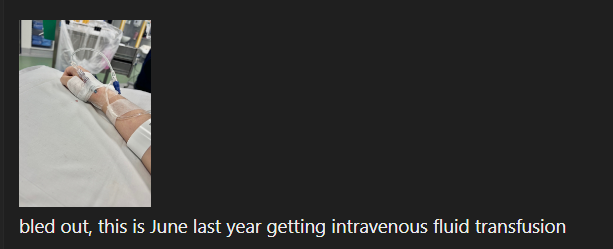
brotato78
Apricot
- Joined
- Apr 13, 2025
- Posts
- 4,071
- Reputation
- 6,478
no way an foid would partake in this autismDIYing it with my gf.
if ur the first to diy this and have it go good youd prob expload on ur tiktok
Follow along with the video below to see how to install our site as a web app on your home screen.
Note: this_feature_currently_requires_accessing_site_using_safari
no way an foid would partake in this autismDIYing it with my gf.
She already agreed to helping, I just need to fully educate her on the topic, she's wonderfulno way an foid would partake in this autism
if ur the first to diy this and have it go good youd prob expload on ur tiktok
bruh i can just imagine her sticking that canula in uShe already agreed to helping, I just need to fully educate her on the topic, she's wonderful
hotbruh i can just imagine her sticking that canula in u![]()
I'm considering making a similar one for rhinoplastyYeah I think ill just pay at bit more BUT these threads do reveal the medical process and shit amd give a lot of infirmation so thanks bhai
W. Almost everyone needs a rhonoplasty so this woukd be really helpfull. Can you imclude some info about rhino for ethnics and the one with large base of nose compared to mouth.I'm considering making a similar one for rhinoplasty
I wouldn't attempt DIY rhinoplasty, and DIYing it has a 100% botch rate, but just for informational purposes
what do you think?
If I end up making one (low priority as I have a lot of unfinished projects) it would include rhinoplasty, septoplasty & alarplastyW. Almost everyone needs a rhonoplasty so this woukd be really helpfull. Can you imclude some info about rhino for ethnics and the one with large base of nose compared to mouth.
Fat Grafting: Biology, Technique, Risk and is DIY Fat Grafting possible?
Tagging fellow DIY autists
@dawooddX @aids @Tigermoggerlol @ivan.kuk @Zuffster
Do not DIY this you fucking retards, if you do its NOT my fault if you botch yourself.
Table Of Contents:
1. What is Fat Grafting?
2. Extraction & Technique
3. Cleaning & Purification
4. Filtering & Dividing Fat Cells
5. Injection site
6. Recovery process
7. Disclaimer
1. What is Fat Grafting?
Fat grafting, or Fat Transfer is a procedure where a patient’s own fat is extracted, then reinjected into another part of their face. This is a semi-permanent procedure done to add volume & improve shape.
The fat is taken from areas with extra fat, like the stomach or thighs, and injected into the face, breasts or other areas that require volume.
After the fat is transferred, not all of the fat survives, but the fat that does survive typically stays forever.
Fat grafting is a popular semi-permanent solution because fat is living tissue, meaning once the injected fat gets a blood supply, it can stay there for decades. For the first few days after the procedure, the fat keeps itself alive by soaking up oxygen & nutrients from surrounding tissue fluid. This is why surgeons inject fat in tiny strands/drops instead of one big spot, smaller bits of fat have more surface area touching the healthy tissue, so they can absorb nutrients & oxygen from that while the body starts creating a new blood supply for the fat.
After that, the area releases signals that bring in new capillaries, and the tiny blood vessels from the surrounding tissue grow into the graft (angiogenesis). If the fat was placed in small enough amounts & close to the well supplied tissue, the new vessels can connect and the fat becomes connected & alive long term. If too much fat is packed into one spot, the center of that fat doesn’t get enough oxygen before the vessels reach it, which can result in that area of fat dying, making the result underwhelming.
2. Extraction & Technique
To extract & collect the fat, surgeons use liposuction with a blunt cannula in a 2-3mm cut created on your body. The cannula is moved back & forth to loosen the fat so it can be removed evenly. This movement looks really rough but usually doesn’t hurt. The area is injected with lidocaine/a numbing agent before this process occurs.
The way the fat is removed can vary depending on the surgeons preference & the area being treated. For somebody DIYing this, this method would be far too aggressive. It is possible to extract in a much slower manner without this much force being used using a regular low gauge syringe, but the method above is far more effective. If you’re DIYing this I would suggest getting 2 people to do it, as some of this stuff is hard to do on yourself without feeling lightheaded.
Regardless of the technique, at the end of the extraction you’ll be left with a syringe full of an orange substance. This is a mix of fat tissue, blood & oils.
View attachment 4594516
Once the surgeon sees this, the extraction process is over.
3. Cleaning & Purification
Now there’s syringes full of blood, oil & fat. You can’t inject the mixed dirty substance, the oil can cause irritation to the area surrounding it and is usually released by other destroyed fat cells, damaged fat cells can’t connect to new blood supplies, rendering them useless in this process.
Now, the goal is to remove the blood & oils from this mixture, there’s a few methods for that.
1. Centrifugation
View attachment 4594503
The mixture is spun in a centrifuge, which separates it into layers of blood that sits at the bottom, fat that sits in the middle, and oil that rises to the top. The blood & oil layer is removed, and the fat might be spun again to make sure no blood or oils are left.
2. Gravity Separation
View attachment 4594505
The mixture is left to sit and gravity separates them into the 3 layers I mentioned. This is a far slower process and unpopular in professional medical spaces. Gravity separates the layers in around 30-40 minutes, the fat cells do not die in this timeframe and rely on stored energy to survive.
3. Filtration
View attachment 4594513
The fat is passed through specialized filters (such as PUREGRAFT bags) that strain out fluid, oil, and tissue fragments while preserving intact fat cells. Many modern surgeons use this method.
4. Filtering & Dividing fat cells
View attachment 4594512
When fat is harvested, it comes in different sizes, and the sizes matter depending on where the fat is placed. Through filtering, we’re able to separate out debris and damaged tissue, but this also results in fat being divided into smaller or larger clusters.
Smaller clusters of fat are better for delicate areas like the lips & undereyes (which we’re dealing with), where the skin is thinner and uneven texture is much more noticeable if you place large clusters of fat too superficially. Smaller fat clusters spread more evenly, integrate more smoothly with surrounding tissue, and have an easier time receiving oxygen and nutrients early on.
View attachment 4594510
A filter like this one is placed between two syringes, then filtered through around 10-15 times to achieve the micron size needed.
5. Injection Site
I’ll be going over two injection sites in this thread, lips & undereyes. If you’re curious about other areas, research for yourself.
1. Infra & Supraorbital area
View attachment 4594509
The eye area is one of the most vascular areas on your face, there’s several nerves & arteries running through the area. Injections are done in MICRODROPLETS in this area, they’re injected bone-deep or just above the bone, since that region already has a good blood supply for the fat to connect to and because this decreases the chances of lumps of fat being visible texture.
View attachment 4594507
A small real-time ultrasound is common practice to find where arteries are for filler injections. This is not a guarantee at all though, this would just be good to see what areas are most populated with vessels, the likelihood of you using an ultrasound to accurately map out where all the vessels on your face are are close to zero.
View attachment 4594506
This is an image from a Color Doppler ultrasound, these types of ultrasounds highlight bloodflow, meaning the red you see on the screen is a vein, artery or any vessel that carries blood.
(Red = blood is flowing towards the device, blue = blood is flowing away from it).
Buying these machines is expensive, usually $2k+ (at which point you can literally just get professional fat grafting). But thankfully you’re able to rent these kinds of machines online, I found a place local to me that rents it & lets me take it home for just a few hundred euros.
Personally I don't like ultrasounds for this as it gives you a false sense of security, but I need to include this as a safety measure incase some idiot uses this as a guide.
If you’re not financially able to afford an ultrasound (which I would not say is a worthwhile investment), then you can still rely on injection technique.
The main risk when injecting anything solid into somebody, like filler or fat, is a vascular occlusion, a vascular occlusion is when a foreign substance either fills an artery/vessel, or sits next to it and puts enough pressure onto it to clog it and slow down or block blood flow. With filler this is reversible using hyaluronidase, in this instance with fat it is not possible to reverse or dissolve fat if you get it stuck inside.
Using a cannula, you’re able to evenly spread out the microdroplets of fat through different areas, the logic behind injecting microdroplets should be obvious, the less you’re injecting at once the less likely you are to inject a large enough amount to block off vessels.
View attachment 4594514
On both the supra & infraorbital region you want to place the fat graft on the bone itself or a tiny bit above the bone. I would not recommend even attempting to DIY this if you haven’t already had filler done professionally, or preferably DIY’d filler by this point.
2. Lips
Your lips are also a highly vascular region, this along with the eye region are both the highest risk areas for filler, and you’re seriously contemplating injecting your own fat into here huh, i wonder what brought us to this situation.
Anyways, you’ll typically want to inject into the vermillion border or vermillion body of your lips, this helps shape your lips & add volume.
View attachment 4594508
Microdroplet injections into the aforementioned areas is standard. But if you’re considering doing this, do your own research & analyze filler techniques for lips, injecting fat is fairly similar.
6. Recovery Process
View attachment 4594504View attachment 4594511
Recovery after fat grafting isn’t immediate, and results don’t show right away. Swelling and bruising are normal at first, especially in areas like the face, and this can make things look fuller or uneven early on. During the first few days, the fat doesn't have a blood supply yet and survives by pulling oxygen and nutrients from the surrounding tissue.
Over the next few weeks, your body starts growing new blood vessels into the fat graft. Fat that successfully connects will stay (like 50-70% when done professionally), while fat that doesn’t is slowly absorbed. As swelling goes down, the area softens and the final result becomes clearer.
7. Disclaimer & Conclusion
You read a thread made by a high school student, if you seriously consider using this thread as instructions to DIY fat grafting instead of doing your own research you’re a retard, this is a thread about hypotheticals & an explanation of how professionals do fat grafting
As a conclusion, yes, DIY Fat grafting is possible, whether or not it's a good idea is up to you. I might attempt this, but I'm lower inhib than you are, so maybe wait until I botch myself before considering this.
bimax or trimax would probably get more reps tbhI'm considering making a similar one for rhinoplasty
I wouldn't attempt DIY rhinoplasty, and DIYing it has a 100% botch rate, but just for informational purposes
what do you think?
bro ts so performative and corny pls stopno way an foid would partake in this autism
if ur the first to diy this and have it go good youd prob expload on ur tiktok
yea there's no way I could accurately cover everything done in this, realistically RSM would do a better job at that, but that could damage his medical license for providing step by step medical procedure instructionsbimax or trimax would probably get more reps tbh
mfs love talking about procedures they will never get done and all the other mental jerk offs
fair enoughyea there's no way I could accurately cover everything done in this, realistically RSM would do a better job at that, but that could damage his medical license for providing step by step medical procedure instructions
orka i mean the “an foid” partbro ts so performative and corny pls stop
ah yea makes sense then lolorka i mean the “an foid” part
Pic in thread, advice since it’s DIY the bioavailability of fat is very low (50-60% for me) and hard to predict. My results were definitely subtle and I recommend being conservative since this would be a mess to undo.@J3nnn3r supposedly did it
Pic in thread, advice since it’s DIY the bioavailability of fat is very low (50-60% for me) and hard to predict. My results were definitely subtle and I recommend being conservative since this would be a mess to undo.
I had before and after infra pics too, I did it myself & hit my superficial femoral artery being doped asf on analgesics and couldn’t stop bleeding.View attachment 4601718
Is this the photo you were referring to? How did you bleed out during the procedure & did somebody help you with it? (ex. a friend)
I just saw the B&A's but honestly I can't see much from the photosI had before and after infra pics too, I did it myself & hit my superficial femoral artery being doped asf on analgesics and couldn’t stop bleeding.
Same, from the front it’s not noticeable, from the side I had a difference of about 3ish mms.I just saw the B&A's but honestly I can't see much from the photos
what made you opt for extractions in your thigh as opposed to abdomen? is the pain different?
and I'm assuming you stopped after you hit your artery and tried again afterwards.
How sterile was your environment?
Apologies for bombarding you with questions
where? in a room in your house, bathroom, rented a place?Very sterile, operating theatre standards. I definitely wouldn’t have attempted otherwise.
Makes sense, what depth did you go?I chose thighs since my abdomen is leaner & probably couldn’t insert the cannula at req depth.
Did you have itachi lines before? if you did, did those dissapear afterwards?Same, from the front it’s not noticeable, from the side I had a difference of about 3ish mms.
At homewhere? in a room in your house, bathroom, rented a place?
Makes sense, what depth did you go?
Did you have itachi lines before? if you did, did those dissapear afterwards?
View attachment 4601760
Appreciate it, I'm doing research into the possibility of creating a sterile aseptic environment at home, I've added you to my tag list for future threads, would love more of your input.At home
In the subcutaneous plane, it’s different for everyone. I’d guess a bit more than 2cm deep.
I had minor recession, no itachi lines though, pretty much not a concern now.
Dawg it was added for humor it’s not that deeporka i mean the “an foid” part
lame ass humor gDawg it was added for humor it’s not that deep
lame ass humor g
Thanks will doDIY Fat Grafting possible?
Wbu just doing it at a 100 repsIf this gets like 500 reps or something I'll attempt DIYing it with my gf. (since DIY is a 2 person job in this case)
Might do it anyway tbhWbu just doing it at a 100 reps
If you have a gf leave this forum manIf this gets like 500 reps or something I'll attempt DIYing it with my gf. (since DIY is a 2 person job in this case)
Fat Grafting: Biology, Technique, Risk and is DIY Fat Grafting possible?
Tagging fellow DIY autists
@dawooddX @aids @Tigermoggerlol @ivan.kuk @Zuffster
Do not DIY this you fucking retards, if you do its NOT my fault if you botch yourself.
Table Of Contents:
1. What is Fat Grafting?
2. Extraction & Technique
3. Cleaning & Purification
4. Filtering & Dividing Fat Cells
5. Injection site
6. Recovery process
7. Disclaimer
1. What is Fat Grafting?
Fat grafting, or Fat Transfer is a procedure where a patient’s own fat is extracted, then reinjected into another part of their face. This is a semi-permanent procedure done to add volume & improve shape.
The fat is taken from areas with extra fat, like the stomach or thighs, and injected into the face, breasts or other areas that require volume.
After the fat is transferred, not all of the fat survives, but the fat that does survive typically stays forever.
Fat grafting is a popular semi-permanent solution because fat is living tissue, meaning once the injected fat gets a blood supply, it can stay there for decades. For the first few days after the procedure, the fat keeps itself alive by soaking up oxygen & nutrients from surrounding tissue fluid. This is why surgeons inject fat in tiny strands/drops instead of one big spot, smaller bits of fat have more surface area touching the healthy tissue, so they can absorb nutrients & oxygen from that while the body starts creating a new blood supply for the fat.
After that, the area releases signals that bring in new capillaries, and the tiny blood vessels from the surrounding tissue grow into the graft (angiogenesis). If the fat was placed in small enough amounts & close to the well supplied tissue, the new vessels can connect and the fat becomes connected & alive long term. If too much fat is packed into one spot, the center of that fat doesn’t get enough oxygen before the vessels reach it, which can result in that area of fat dying, making the result underwhelming.
2. Extraction & Technique
To extract & collect the fat, surgeons use liposuction with a blunt cannula in a 2-3mm cut created on your body. The cannula is moved back & forth to loosen the fat so it can be removed evenly. This movement looks really rough but usually doesn’t hurt. The area is injected with lidocaine/a numbing agent before this process occurs.
The way the fat is removed can vary depending on the surgeons preference & the area being treated. For somebody DIYing this, this method would be far too aggressive. It is possible to extract in a much slower manner without this much force being used using a regular low gauge syringe, but the method above is far more effective. If you’re DIYing this I would suggest getting 2 people to do it, as some of this stuff is hard to do on yourself without feeling lightheaded.
Regardless of the technique, at the end of the extraction you’ll be left with a syringe full of an orange substance. This is a mix of fat tissue, blood & oils.
View attachment 4594516
Once the surgeon sees this, the extraction process is over.
3. Cleaning & Purification
Now there’s syringes full of blood, oil & fat. You can’t inject the mixed dirty substance, the oil can cause irritation to the area surrounding it and is usually released by other destroyed fat cells, damaged fat cells can’t connect to new blood supplies, rendering them useless in this process.
Now, the goal is to remove the blood & oils from this mixture, there’s a few methods for that.
1. Centrifugation
View attachment 4594503
The mixture is spun in a centrifuge, which separates it into layers of blood that sits at the bottom, fat that sits in the middle, and oil that rises to the top. The blood & oil layer is removed, and the fat might be spun again to make sure no blood or oils are left.
2. Gravity Separation
View attachment 4594505
The mixture is left to sit and gravity separates them into the 3 layers I mentioned. This is a far slower process and unpopular in professional medical spaces. Gravity separates the layers in around 30-40 minutes, the fat cells do not die in this timeframe and rely on stored energy to survive.
3. Filtration
View attachment 4594513
The fat is passed through specialized filters (such as PUREGRAFT bags) that strain out fluid, oil, and tissue fragments while preserving intact fat cells. Many modern surgeons use this method.
4. Filtering & Dividing fat cells
View attachment 4594512
When fat is harvested, it comes in different sizes, and the sizes matter depending on where the fat is placed. Through filtering, we’re able to separate out debris and damaged tissue, but this also results in fat being divided into smaller or larger clusters.
Smaller clusters of fat are better for delicate areas like the lips & undereyes (which we’re dealing with), where the skin is thinner and uneven texture is much more noticeable if you place large clusters of fat too superficially. Smaller fat clusters spread more evenly, integrate more smoothly with surrounding tissue, and have an easier time receiving oxygen and nutrients early on.
View attachment 4594510
A filter like this one is placed between two syringes, then filtered through around 10-15 times to achieve the micron size needed.
5. Injection Site
I’ll be going over two injection sites in this thread, lips & undereyes. If you’re curious about other areas, research for yourself.
1. Infra & Supraorbital area
View attachment 4594509
The eye area is one of the most vascular areas on your face, there’s several nerves & arteries running through the area. Injections are done in MICRODROPLETS in this area, they’re injected bone-deep or just above the bone, since that region already has a good blood supply for the fat to connect to and because this decreases the chances of lumps of fat being visible texture.
View attachment 4594507
A small real-time ultrasound is common practice to find where arteries are for filler injections. This is not a guarantee at all though, this would just be good to see what areas are most populated with vessels, the likelihood of you using an ultrasound to accurately map out where all the vessels on your face are are close to zero.
View attachment 4594506
This is an image from a Color Doppler ultrasound, these types of ultrasounds highlight bloodflow, meaning the red you see on the screen is a vein, artery or any vessel that carries blood.
(Red = blood is flowing towards the device, blue = blood is flowing away from it).
Buying these machines is expensive, usually $2k+ (at which point you can literally just get professional fat grafting). But thankfully you’re able to rent these kinds of machines online, I found a place local to me that rents it & lets me take it home for just a few hundred euros.
Personally I don't like ultrasounds for this as it gives you a false sense of security, but I need to include this as a safety measure incase some idiot uses this as a guide.
If you’re not financially able to afford an ultrasound (which I would not say is a worthwhile investment), then you can still rely on injection technique.
The main risk when injecting anything solid into somebody, like filler or fat, is a vascular occlusion, a vascular occlusion is when a foreign substance either fills an artery/vessel, or sits next to it and puts enough pressure onto it to clog it and slow down or block blood flow. With filler this is reversible using hyaluronidase, in this instance with fat it is not possible to reverse or dissolve fat if you get it stuck inside.
Using a cannula, you’re able to evenly spread out the microdroplets of fat through different areas, the logic behind injecting microdroplets should be obvious, the less you’re injecting at once the less likely you are to inject a large enough amount to block off vessels.
View attachment 4594514
On both the supra & infraorbital region you want to place the fat graft on the bone itself or a tiny bit above the bone. I would not recommend even attempting to DIY this if you haven’t already had filler done professionally, or preferably DIY’d filler by this point.
2. Lips
Your lips are also a highly vascular region, this along with the eye region are both the highest risk areas for filler, and you’re seriously contemplating injecting your own fat into here huh, i wonder what brought us to this situation.
Anyways, you’ll typically want to inject into the vermillion border or vermillion body of your lips, this helps shape your lips & add volume.
View attachment 4594508
Microdroplet injections into the aforementioned areas is standard. But if you’re considering doing this, do your own research & analyze filler techniques for lips, injecting fat is fairly similar.
6. Recovery Process
View attachment 4594504View attachment 4594511
Recovery after fat grafting isn’t immediate, and results don’t show right away. Swelling and bruising are normal at first, especially in areas like the face, and this can make things look fuller or uneven early on. During the first few days, the fat doesn't have a blood supply yet and survives by pulling oxygen and nutrients from the surrounding tissue.
Over the next few weeks, your body starts growing new blood vessels into the fat graft. Fat that successfully connects will stay (like 50-70% when done professionally), while fat that doesn’t is slowly absorbed. As swelling goes down, the area softens and the final result becomes clearer.
7. Disclaimer & Conclusion
You read a thread made by a high school student, if you seriously consider using this thread as instructions to DIY fat grafting instead of doing your own research you’re a retard, this is a thread about hypotheticals & an explanation of how professionals do fat grafting
As a conclusion, yes, DIY Fat grafting is possible, whether or not it's a good idea is up to you. I might attempt this, but I'm lower inhib than you are, so maybe wait until I botch myself before considering this.
Professionally? or DIY?great thread, im planning to do infraorbital and upper eyelid fat grafting in the future. bookmarked
at this stage, professionally. i haven't researched diy fat grafting at all. i'll definitely be doing diy chin filler thoughProfessionally? or DIY?
Fat Grafting: Biology, Technique, Risk and is DIY Fat Grafting possible?
Tagging fellow DIY autists
@dawooddX @aids @Tigermoggerlol @ivan.kuk @Zuffster
Do not DIY this you fucking retards, if you do its NOT my fault if you botch yourself.
Table Of Contents:
1. What is Fat Grafting?
2. Extraction & Technique
3. Cleaning & Purification
4. Filtering & Dividing Fat Cells
5. Injection site
6. Recovery process
7. Disclaimer
1. What is Fat Grafting?
Fat grafting, or Fat Transfer is a procedure where a patient’s own fat is extracted, then reinjected into another part of their face. This is a semi-permanent procedure done to add volume & improve shape.
The fat is taken from areas with extra fat, like the stomach or thighs, and injected into the face, breasts or other areas that require volume.
After the fat is transferred, not all of the fat survives, but the fat that does survive typically stays forever.
Fat grafting is a popular semi-permanent solution because fat is living tissue, meaning once the injected fat gets a blood supply, it can stay there for decades. For the first few days after the procedure, the fat keeps itself alive by soaking up oxygen & nutrients from surrounding tissue fluid. This is why surgeons inject fat in tiny strands/drops instead of one big spot, smaller bits of fat have more surface area touching the healthy tissue, so they can absorb nutrients & oxygen from that while the body starts creating a new blood supply for the fat.
After that, the area releases signals that bring in new capillaries, and the tiny blood vessels from the surrounding tissue grow into the graft (angiogenesis). If the fat was placed in small enough amounts & close to the well supplied tissue, the new vessels can connect and the fat becomes connected & alive long term. If too much fat is packed into one spot, the center of that fat doesn’t get enough oxygen before the vessels reach it, which can result in that area of fat dying, making the result underwhelming.
2. Extraction & Technique
To extract & collect the fat, surgeons use liposuction with a blunt cannula in a 2-3mm cut created on your body. The cannula is moved back & forth to loosen the fat so it can be removed evenly. This movement looks really rough but usually doesn’t hurt. The area is injected with lidocaine/a numbing agent before this process occurs.
The way the fat is removed can vary depending on the surgeons preference & the area being treated. For somebody DIYing this, this method would be far too aggressive. It is possible to extract in a much slower manner without this much force being used using a regular low gauge syringe, but the method above is far more effective. If you’re DIYing this I would suggest getting 2 people to do it, as some of this stuff is hard to do on yourself without feeling lightheaded.
Regardless of the technique, at the end of the extraction you’ll be left with a syringe full of an orange substance. This is a mix of fat tissue, blood & oils.
View attachment 4594516
Once the surgeon sees this, the extraction process is over.
3. Cleaning & Purification
Now there’s syringes full of blood, oil & fat. You can’t inject the mixed dirty substance, the oil can cause irritation to the area surrounding it and is usually released by other destroyed fat cells, damaged fat cells can’t connect to new blood supplies, rendering them useless in this process.
Now, the goal is to remove the blood & oils from this mixture, there’s a few methods for that.
1. Centrifugation
View attachment 4594503
The mixture is spun in a centrifuge, which separates it into layers of blood that sits at the bottom, fat that sits in the middle, and oil that rises to the top. The blood & oil layer is removed, and the fat might be spun again to make sure no blood or oils are left.
2. Gravity Separation
View attachment 4594505
The mixture is left to sit and gravity separates them into the 3 layers I mentioned. This is a far slower process and unpopular in professional medical spaces. Gravity separates the layers in around 30-40 minutes, the fat cells do not die in this timeframe and rely on stored energy to survive.
3. Filtration
View attachment 4594513
The fat is passed through specialized filters (such as PUREGRAFT bags) that strain out fluid, oil, and tissue fragments while preserving intact fat cells. Many modern surgeons use this method.
4. Filtering & Dividing fat cells
View attachment 4594512
When fat is harvested, it comes in different sizes, and the sizes matter depending on where the fat is placed. Through filtering, we’re able to separate out debris and damaged tissue, but this also results in fat being divided into smaller or larger clusters.
Smaller clusters of fat are better for delicate areas like the lips & undereyes (which we’re dealing with), where the skin is thinner and uneven texture is much more noticeable if you place large clusters of fat too superficially. Smaller fat clusters spread more evenly, integrate more smoothly with surrounding tissue, and have an easier time receiving oxygen and nutrients early on.
View attachment 4594510
A filter like this one is placed between two syringes, then filtered through around 10-15 times to achieve the micron size needed.
5. Injection Site
I’ll be going over two injection sites in this thread, lips & undereyes. If you’re curious about other areas, research for yourself.
1. Infra & Supraorbital area
View attachment 4594509
The eye area is one of the most vascular areas on your face, there’s several nerves & arteries running through the area. Injections are done in MICRODROPLETS in this area, they’re injected bone-deep or just above the bone, since that region already has a good blood supply for the fat to connect to and because this decreases the chances of lumps of fat being visible texture.
View attachment 4594507
A small real-time ultrasound is common practice to find where arteries are for filler injections. This is not a guarantee at all though, this would just be good to see what areas are most populated with vessels, the likelihood of you using an ultrasound to accurately map out where all the vessels on your face are are close to zero.
View attachment 4594506
This is an image from a Color Doppler ultrasound, these types of ultrasounds highlight bloodflow, meaning the red you see on the screen is a vein, artery or any vessel that carries blood.
(Red = blood is flowing towards the device, blue = blood is flowing away from it).
Buying these machines is expensive, usually $2k+ (at which point you can literally just get professional fat grafting). But thankfully you’re able to rent these kinds of machines online, I found a place local to me that rents it & lets me take it home for just a few hundred euros.
Personally I don't like ultrasounds for this as it gives you a false sense of security, but I need to include this as a safety measure incase some idiot uses this as a guide.
If you’re not financially able to afford an ultrasound (which I would not say is a worthwhile investment), then you can still rely on injection technique.
The main risk when injecting anything solid into somebody, like filler or fat, is a vascular occlusion, a vascular occlusion is when a foreign substance either fills an artery/vessel, or sits next to it and puts enough pressure onto it to clog it and slow down or block blood flow. With filler this is reversible using hyaluronidase, in this instance with fat it is not possible to reverse or dissolve fat if you get it stuck inside.
Using a cannula, you’re able to evenly spread out the microdroplets of fat through different areas, the logic behind injecting microdroplets should be obvious, the less you’re injecting at once the less likely you are to inject a large enough amount to block off vessels.
View attachment 4594514
On both the supra & infraorbital region you want to place the fat graft on the bone itself or a tiny bit above the bone. I would not recommend even attempting to DIY this if you haven’t already had filler done professionally, or preferably DIY’d filler by this point.
2. Lips
Your lips are also a highly vascular region, this along with the eye region are both the highest risk areas for filler, and you’re seriously contemplating injecting your own fat into here huh, i wonder what brought us to this situation.
Anyways, you’ll typically want to inject into the vermillion border or vermillion body of your lips, this helps shape your lips & add volume.
View attachment 4594508
Microdroplet injections into the aforementioned areas is standard. But if you’re considering doing this, do your own research & analyze filler techniques for lips, injecting fat is fairly similar.
6. Recovery Process
View attachment 4594504View attachment 4594511
Recovery after fat grafting isn’t immediate, and results don’t show right away. Swelling and bruising are normal at first, especially in areas like the face, and this can make things look fuller or uneven early on. During the first few days, the fat doesn't have a blood supply yet and survives by pulling oxygen and nutrients from the surrounding tissue.
Over the next few weeks, your body starts growing new blood vessels into the fat graft. Fat that successfully connects will stay (like 50-70% when done professionally), while fat that doesn’t is slowly absorbed. As swelling goes down, the area softens and the final result becomes clearer.
7. Disclaimer & Conclusion
You read a thread made by a high school student, if you seriously consider using this thread as instructions to DIY fat grafting instead of doing your own research you’re a retard, this is a thread about hypotheticals & an explanation of how professionals do fat grafting
As a conclusion, yes, DIY Fat grafting is possible, whether or not it's a good idea is up to you. I might attempt this, but I'm lower inhib than you are, so maybe wait until I botch myself before considering this.
Nice effort. Congrats on the GF. That filler really paid offIf this gets like 500 reps or something I'll attempt DIYing it with my gf. (since DIY is a 2 person job in this case)
Fat Grafting: Biology, Technique, Risk and is DIY Fat Grafting possible?
Tagging fellow DIY autists
@dawooddX @aids @Tigermoggerlol @ivan.kuk @Zuffster
Do not DIY this you fucking retards, if you do its NOT my fault if you botch yourself.
Table Of Contents:
1. What is Fat Grafting?
2. Extraction & Technique
3. Cleaning & Purification
4. Filtering & Dividing Fat Cells
5. Injection site
6. Recovery process
7. Disclaimer
1. What is Fat Grafting?
Fat grafting, or Fat Transfer is a procedure where a patient’s own fat is extracted, then reinjected into another part of their face. This is a semi-permanent procedure done to add volume & improve shape.
The fat is taken from areas with extra fat, like the stomach or thighs, and injected into the face, breasts or other areas that require volume.
After the fat is transferred, not all of the fat survives, but the fat that does survive typically stays forever.
Fat grafting is a popular semi-permanent solution because fat is living tissue, meaning once the injected fat gets a blood supply, it can stay there for decades. For the first few days after the procedure, the fat keeps itself alive by soaking up oxygen & nutrients from surrounding tissue fluid. This is why surgeons inject fat in tiny strands/drops instead of one big spot, smaller bits of fat have more surface area touching the healthy tissue, so they can absorb nutrients & oxygen from that while the body starts creating a new blood supply for the fat.
After that, the area releases signals that bring in new capillaries, and the tiny blood vessels from the surrounding tissue grow into the graft (angiogenesis). If the fat was placed in small enough amounts & close to the well supplied tissue, the new vessels can connect and the fat becomes connected & alive long term. If too much fat is packed into one spot, the center of that fat doesn’t get enough oxygen before the vessels reach it, which can result in that area of fat dying, making the result underwhelming.
2. Extraction & Technique
To extract & collect the fat, surgeons use liposuction with a blunt cannula in a 2-3mm cut created on your body. The cannula is moved back & forth to loosen the fat so it can be removed evenly. This movement looks really rough but usually doesn’t hurt. The area is injected with lidocaine/a numbing agent before this process occurs.
The way the fat is removed can vary depending on the surgeons preference & the area being treated. For somebody DIYing this, this method would be far too aggressive. It is possible to extract in a much slower manner without this much force being used using a regular low gauge syringe, but the method above is far more effective. If you’re DIYing this I would suggest getting 2 people to do it, as some of this stuff is hard to do on yourself without feeling lightheaded.
Regardless of the technique, at the end of the extraction you’ll be left with a syringe full of an orange substance. This is a mix of fat tissue, blood & oils.
View attachment 4594516
Once the surgeon sees this, the extraction process is over.
3. Cleaning & Purification
Now there’s syringes full of blood, oil & fat. You can’t inject the mixed dirty substance, the oil can cause irritation to the area surrounding it and is usually released by other destroyed fat cells, damaged fat cells can’t connect to new blood supplies, rendering them useless in this process.
Now, the goal is to remove the blood & oils from this mixture, there’s a few methods for that.
1. Centrifugation
View attachment 4594503
The mixture is spun in a centrifuge, which separates it into layers of blood that sits at the bottom, fat that sits in the middle, and oil that rises to the top. The blood & oil layer is removed, and the fat might be spun again to make sure no blood or oils are left.
2. Gravity Separation
View attachment 4594505
The mixture is left to sit and gravity separates them into the 3 layers I mentioned. This is a far slower process and unpopular in professional medical spaces. Gravity separates the layers in around 30-40 minutes, the fat cells do not die in this timeframe and rely on stored energy to survive.
3. Filtration
View attachment 4594513
The fat is passed through specialized filters (such as PUREGRAFT bags) that strain out fluid, oil, and tissue fragments while preserving intact fat cells. Many modern surgeons use this method.
4. Filtering & Dividing fat cells
View attachment 4594512
When fat is harvested, it comes in different sizes, and the sizes matter depending on where the fat is placed. Through filtering, we’re able to separate out debris and damaged tissue, but this also results in fat being divided into smaller or larger clusters.
Smaller clusters of fat are better for delicate areas like the lips & undereyes (which we’re dealing with), where the skin is thinner and uneven texture is much more noticeable if you place large clusters of fat too superficially. Smaller fat clusters spread more evenly, integrate more smoothly with surrounding tissue, and have an easier time receiving oxygen and nutrients early on.
View attachment 4594510
A filter like this one is placed between two syringes, then filtered through around 10-15 times to achieve the micron size needed.
5. Injection Site
I’ll be going over two injection sites in this thread, lips & undereyes. If you’re curious about other areas, research for yourself.
1. Infra & Supraorbital area
View attachment 4594509
The eye area is one of the most vascular areas on your face, there’s several nerves & arteries running through the area. Injections are done in MICRODROPLETS in this area, they’re injected bone-deep or just above the bone, since that region already has a good blood supply for the fat to connect to and because this decreases the chances of lumps of fat being visible texture.
View attachment 4594507
A small real-time ultrasound is common practice to find where arteries are for filler injections. This is not a guarantee at all though, this would just be good to see what areas are most populated with vessels, the likelihood of you using an ultrasound to accurately map out where all the vessels on your face are are close to zero.
View attachment 4594506
This is an image from a Color Doppler ultrasound, these types of ultrasounds highlight bloodflow, meaning the red you see on the screen is a vein, artery or any vessel that carries blood.
(Red = blood is flowing towards the device, blue = blood is flowing away from it).
Buying these machines is expensive, usually $2k+ (at which point you can literally just get professional fat grafting). But thankfully you’re able to rent these kinds of machines online, I found a place local to me that rents it & lets me take it home for just a few hundred euros.
Personally I don't like ultrasounds for this as it gives you a false sense of security, but I need to include this as a safety measure incase some idiot uses this as a guide.
If you’re not financially able to afford an ultrasound (which I would not say is a worthwhile investment), then you can still rely on injection technique.
The main risk when injecting anything solid into somebody, like filler or fat, is a vascular occlusion, a vascular occlusion is when a foreign substance either fills an artery/vessel, or sits next to it and puts enough pressure onto it to clog it and slow down or block blood flow. With filler this is reversible using hyaluronidase, in this instance with fat it is not possible to reverse or dissolve fat if you get it stuck inside.
Using a cannula, you’re able to evenly spread out the microdroplets of fat through different areas, the logic behind injecting microdroplets should be obvious, the less you’re injecting at once the less likely you are to inject a large enough amount to block off vessels.
View attachment 4594514
On both the supra & infraorbital region you want to place the fat graft on the bone itself or a tiny bit above the bone. I would not recommend even attempting to DIY this if you haven’t already had filler done professionally, or preferably DIY’d filler by this point.
2. Lips
Your lips are also a highly vascular region, this along with the eye region are both the highest risk areas for filler, and you’re seriously contemplating injecting your own fat into here huh, i wonder what brought us to this situation.
Anyways, you’ll typically want to inject into the vermillion border or vermillion body of your lips, this helps shape your lips & add volume.
View attachment 4594508
Microdroplet injections into the aforementioned areas is standard. But if you’re considering doing this, do your own research & analyze filler techniques for lips, injecting fat is fairly similar.
6. Recovery Process
View attachment 4594504View attachment 4594511
Recovery after fat grafting isn’t immediate, and results don’t show right away. Swelling and bruising are normal at first, especially in areas like the face, and this can make things look fuller or uneven early on. During the first few days, the fat doesn't have a blood supply yet and survives by pulling oxygen and nutrients from the surrounding tissue.
Over the next few weeks, your body starts growing new blood vessels into the fat graft. Fat that successfully connects will stay (like 50-70% when done professionally), while fat that doesn’t is slowly absorbed. As swelling goes down, the area softens and the final result becomes clearer.
7. Disclaimer & Conclusion
You read a thread made by a high school student, if you seriously consider using this thread as instructions to DIY fat grafting instead of doing your own research you’re a retard, this is a thread about hypotheticals & an explanation of how professionals do fat grafting
As a conclusion, yes, DIY Fat grafting is possible, whether or not it's a good idea is up to you. I might attempt this, but I'm lower inhib than you are, so maybe wait until I botch myself before considering this.
to DIY? absolutelywouldnt filler be safer?
wont filler give you already good results? also do you need to redo the underye filler every once in a while? or dissolve?to DIY? absolutely
I would probably do some sort of mix if I end up DIYing this (Filler + Fat grafting)
yes you need to redo the filler every 1.5-2 years (the sooner the less migration you'll need to deal with most of the time)wont filler give you already good results? also do you need to redo the underye filler every once in a while? or dissolve?
my idea is injecting aqualyx/lemonbottle into eyebags and then filling it out with just filler or fat graft. what do u think. do you need to redo fat grafts tho? or are they permanent? also wht is filler migrationyes you need to redo the filler every 1.5-2 years (the sooner the less migration you'll need to deal with most of the time)
the idea is that I would mimick bone structure with strong filler, then use the graft to fill in missing fat
Unfortunately even with undereye filler most people have visible eyebags / hollowing / discoloration
Can't believe I need to say this but no, don't dissolve the fat under your eyesmy idea is injecting aqualyx/lemonbottle into eyebags and then filling it out with just filler or fat graft. what do u think. do you need to redo fat grafts tho? or are they permanent? also wht is filler migration
i heard you need to redo grafts every 4years. also how much woukd DIY grafting undereyes cost overall? like have you looked into it that much? i meant aqualyx into the eyebag since i have like very small bags on the inner corner of my eyeCan't believe I need to say this but no, don't dissolve the fat under your eyes
It's better to need 0.5ml of filler to even it out than to reset it completely, not to mention the possible complication risks
Fat grafts are permanent for the most part, it just depends how much your body reabsorbs and how much stays
You can google things about filler migrating
$1300 on the higher endi heard you need to redo grafts every 4years. also how much woukd DIY grafting undereyes cost overall? like have you looked into it that much?
Get filler for thisi meant aqualyx into the eyebag since i have like very small bags on the inner corner of my eye
any good filler guides? would you say im inexperienced enough to do this if i just diy’d aqualyx on my cheeks in a piblic bathroom like 8 months ago? also how kuch would the whole DIY filler cost? on the higher end or lower end. And btw i only see my eyebags under light thats above my head (if that makes sense)$1300 on the higher end
Get filler for this