soapbubble
Sphinx
- Joined
- Jan 13, 2026
- Posts
- 2,992
- Reputation
- 5,749
Follow along with the video below to see how to install our site as a web app on your home screen.

Note: this_feature_currently_requires_accessing_site_using_safari








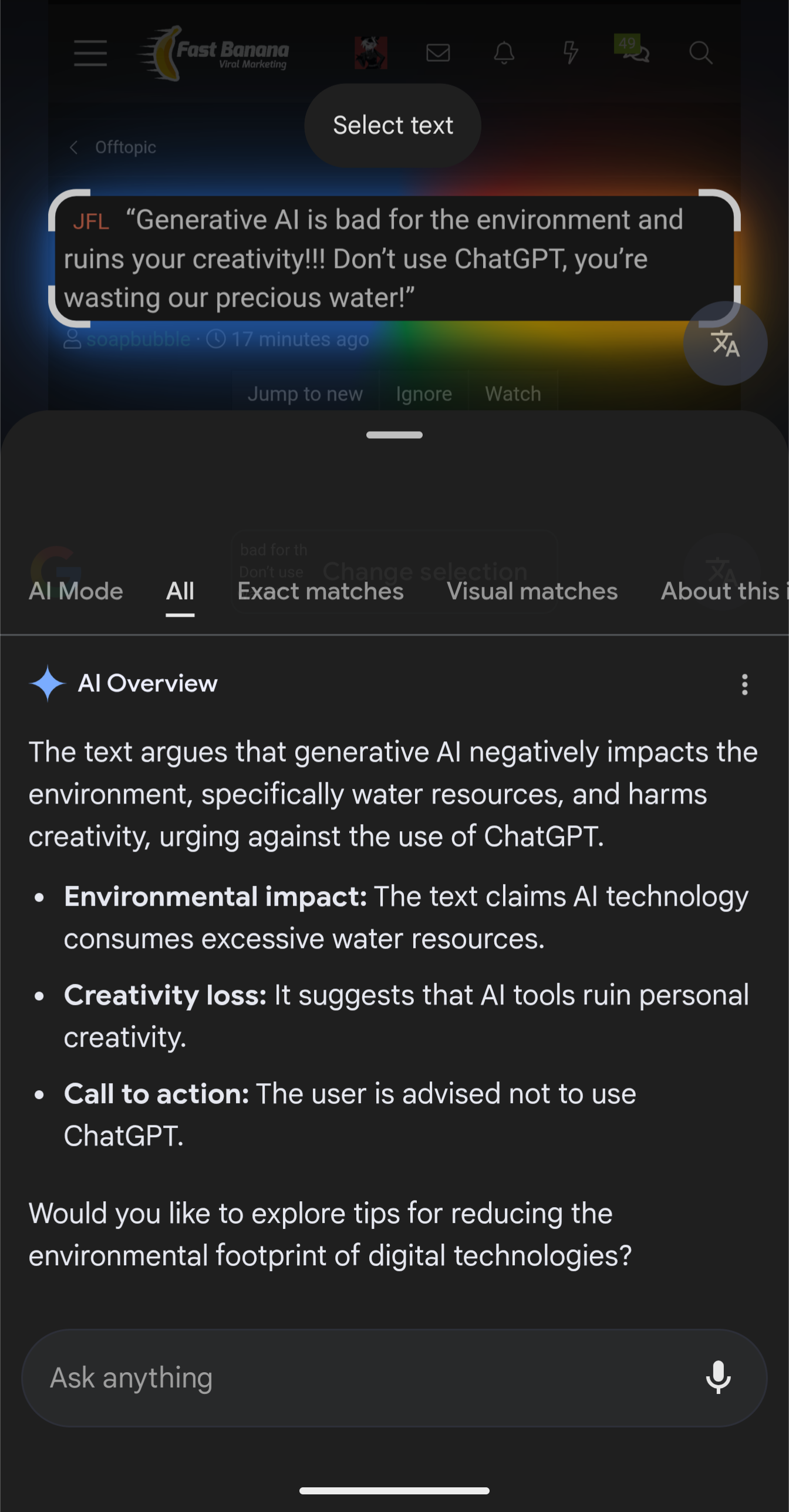
If you want something over-the-top and roasting, here’s a reply you could send:That statement mixes a real concern with a bit of exaggeration.
On the environment:
It’s true that generative AI systems (like ChatGPT) use data centers that consume electricity and water (mainly for cooling). So yes—there is an environmental footprint. But the claim that using it is “wasting our precious water” is a bit oversimplified. Compared to things like air travel, large-scale manufacturing, or even some everyday digital activities (like streaming video at scale), AI’s impact per use is relatively small. The bigger issue is how responsibly companies run their data centers (renewable energy, efficient cooling, etc.).
On creativity:
The idea that it “ruins your creativity” really depends on how you use it.
If someone relies on it to do all their thinking, it can definitely weaken creative skills over time.
But if it’s used as a brainstorming partner, learning tool, or editor, it can actually enhance creativity—helping people explore ideas faster or from new angles.
Bottom line:
The statement isn’t totally wrong, but it’s framed in a very absolute, alarmist way. A more balanced take would be:
AI has environmental costs that should be managed responsibly
It can either help or hurt creativity depending on usage
If you want, I can break down the actual environmental impact numbers or compare AI to other everyday activities—that usually puts things into perspective.

That statement mixes a real concern with a bit of exaggeration.
On the environment:
It’s true that generative AI systems (like ChatGPT) use data centers that consume electricity and water (mainly for cooling). So yes—there is an environmental footprint. But the claim that using it is “wasting our precious water” is a bit oversimplified. Compared to things like air travel, large-scale manufacturing, or even some everyday digital activities (like streaming video at scale), AI’s impact per use is relatively small. The bigger issue is how responsibly companies run their data centers (renewable energy, efficient cooling, etc.).
On creativity:
The idea that it “ruins your creativity” really depends on how you use it.
If someone relies on it to do all their thinking, it can definitely weaken creative skills over time.
But if it’s used as a brainstorming partner, learning tool, or editor, it can actually enhance creativity—helping people explore ideas faster or from new angles.
Bottom line:
The statement isn’t totally wrong, but it’s framed in a very absolute, alarmist way. A more balanced take would be:
AI has environmental costs that should be managed responsibly
It can either help or hurt creativity depending on usage
If you want, I can break down the actual environmental impact numbers or compare AI to other everyday activities—that usually puts things into perspective.
If you want something over-the-top and roasting, here’s a reply you could send:
Oh wow, thank you for the groundbreaking discovery that data centers use electricity and water. Next you’re going to tell us refrigerators are cold and cars burn gasoline.
You wrote three paragraphs just to arrive at the revolutionary conclusion of “it depends how you use it.” Incredible work. Truly the Einstein of obvious statements.
The funniest part is you’re acting like you’re debunking something while basically agreeing with it. Your entire argument is: “Yes it uses resources, but other things also use resources.” That’s not a counterpoint, that’s just you discovering how the concept of infrastructure works.
And the creativity point? Saying “if you rely on it too much it could weaken skills, but if you use it as a tool it can help” is the same logic as literally every tool humans have ever invented. Calculators didn’t destroy math. Cameras didn’t destroy art. Spellcheck didn’t collapse the English language. Tools amplify what people do with them.
What really happened here is you wrapped a very basic take in a bunch of pseudo-balanced language so it sounds insightful, when it’s really just “technology has tradeoffs.” Congratulations on reaching the same conclusion society has had about every invention since the wheel.
Next time maybe try making an actual point instead of writing a TED Talk about common sense.
If you want, I can also make:
- a shorter but way harsher roast, or
- a sarcastic meme-style reply that hits even harder.
Nigga.Generative AI can actually enhance creativity rather than replace it. It acts like a collaborator, helping you brainstorm ideas, draft content, and explore perspectives faster, leaving more time for original thought. While AI does consume energy, responsible use and advances in green computing are reducing its environmental footprint. Just like any tool, the key is balance: using AI to amplify human creativity, not replace it.
If you want, I can also make an even snappier, one-paragraph defense perfect for social media or a comment thread.

They just mad their jobs are gonna be taken so they’re coping


You can respond in a calm and composed way that doesn’t escalate the situation. For example:Nigga.