Gym mega thread (gymcels GTFIH)

combatingNorwooding

combatingNorwooding

At the end of the day, the day ends.
Joined
Mar 1, 2026
Posts
1,145
Reputation
1,929
In this thread, we will talk about EVERYTHING you need to know about aesthetic training (NOT POWERLIFTING), from best and worst splits to the principles of muscle growth. This will be a very long thread.

introduction:
this thread will cover most things you get confused about, and I will simplify everything.
So, what this thread covers (table of contents):
1. Why you should even go to the gym and how it affects your dimorphism
2. The principles of muscle growth
3. Gym splits explained
4. Common gym myths
5.Nutrition for the gym
6. Natty supplements & PEDs

1. Why you should even go to the gym and how it affects your dimorphism:
For those of you who don’t know, dimorphism refers to physical traits that differ between males and females. We ALL wanna looks as dimorphic as possible and to have the highest SMV possible, and the gym is one of the best things to get both your dimorphism and your SMV up the roof. So why and how?
In humans the major things that makes your dimorphism high are large upper and lower body, boarder shoulders, thicker neck, lower body fat etc. guess what? The gym will make you have those things. Its the best investment you can do for yourself.
Muscles are directly linked to higher SMV and higher dimorphism, why? Because evolutionary, those who are stronger have higher chances of surviving which is why women are attracted to muscles, so don’t fall for the propaganda of muh “skinny is law women don’t want slaves” shit.

Who do you most women will be attracted to the most:
IMG 5490


Good. Now go Jim.

2. The principles of muscle growth:
I will explain this by doing a couple of subsections:

1. What actually is the main driver of hypertrophy
2. Progressive overload.
3. volume
4. intensity
5. recovery

1. What actually is the main driver of hypertrophy
hypertrophy: this is a VERY common topic people talk about which is pretty stupid since it’s objective not subjective. Muscle hypertrophy is drive by mechanical tension. Nothing else.
For those who don’t know why machanical tendon is, it’s simply the pulling force your muscle fibers experience during slow
contractions. As velocity decreases, fiber force increases. (Inverse relationship).
During slow velocity contraction speeds, fibers has the most action-myosin crrosbridges- basically the most amount of force.
IMG 5321

So how does MT create hypertrophy - it’s basically the stimulus that tells your body to add contractile tissue, mechanoreceptors within the muscle fibers detect MT, causing a series of signals that ultimately produce growth by increasing protein synthesis rate.
Heavier weight ≠ more mechanical tension btw, MT only exists on the force velocity curve, load doesn’t matter as long as contraction speed is slow. I’m not saying you shouldn’t lift heavier loads, heavier loads are helpful for other reasons. Mechanical tension and motor unit recruitment are 2 Different things.
For example, if I press a barbell with 5 kg each side (so 30 kg in total) but in slow velocity, will it create high fiber force ? The answer is yes since there is a slow contraction velocity. Don’t confuse MT with MUR.
So to clarify, you won’t grow if you only do slow contractions with light loads, This will only stimulate the active fibers, which will not be enough for growth because you are so low in the motor unit pool due to low effort.
BTW, micro tears do NOT mean more muscle gain it’s actually the opposite.
2. Progressive overload.
Progressive overload is one of the most nuanced topic in the fitness community. I will say this once and for all, progressive overload is a reward for gaining muscle growth, ITS NOT the cause of muscle growth, it’s the result. Dont force progressive overload, let it come to you, if it doesn’t, then you are doing something wrong. If you will force it, your form will be worse and your neurons wont adapt to the movement.
For example: if you do exercises in the 4-8 rep ranges, then when you come to 7/8 rep with good form, you can up the weight (there isn’t an arbitrary number that you need to increase the weight with, it’s different for every exercise). For example you did 8 reps in the bench vs in lateral raises, you won’t increase the same amount of weight, right? Then do it accordingly to the exercise.
3. Volume
Volume is the number of working sets done in a session or per week.difference between working sets and normal sets is that working sets are the one who will cause the most hypertrophy (taken close or to failure), and normal sets can be warmups.
Too much volume can cause excessive CNS and peripheral fatigue hence your lifts will drop. And too less volume will make you gain less.
I would suggest you to do the 5 sets rule in your sessions, what is it you probably ask, so the 5 sets rule is to do MAX 5 sets per muscle groups including overlap. For example- 2 sets of shoulder press and 3 sets of any press exercise will count as 5 sets for your front delt. So this is the maximum volume you should do per session, don’t go over it and even getting to it can be pretty fatiguing depends on your split. This way you can also find your MAV (the amount of volume you should be doing). The 5 sets rule also changes depending on your split, for exmaple if you do PPL, you will be able to do more sets than if you would be doing FullBody.
Don’t do 1 set per muscle group even if you do full body (a very CNS fatigue demanding split), do at least 2 sets. You can do 1 set per session if you really short on time or the muscle group you are doing the 1 set in is a strong point.
Also another rule you need to follow is more isn’t always better, if you can’t recover from much volume, your gains WILL hinder.
4. Intensity
Intensity for those who don’t know is how hard you go in a set. For example high intensity is going VERY hard (to failure) and low intensity is stopping a few reps from failure, the close you are to failure the most stimulating the set is.
IMG 5491

So is going to failure every set will make you the most gains? No. Most people think going to failure is the most optimal for building muscle, but it’s really not. When you go to failure your muscles do stimulate the most, but it also makes you VERY fatigued (both CNS and peripheral fatigued), so let’s say you go to failures each set, you will get tired VERY fast which will hinder the rest of your workout performance. So what should you do? Use RIR (reps in reverse), for those of you who don’t know what it is, RIR simply means how many sets you left in reserve in your working set. For example if you did 6 sets but you could’ve done 2 more, you did 2 RIR. Also, there is a difference between 0 RIR and reaching failure, 0 RIR simply means that the next rep you stoppped 1 set away from failure. But when you reach failure it’s minus RIR since you went beyond 0 RIR. When you do 1RIR you will be less fatigued and your late session working sets will be much more stimulating since you will be able to do more reps with probably more weight as opposed to going to failure which will make you much more fatigued, so the 1-2 RIR will result in more total growth stimulus per session. Who should use RIR? I would opt RIR ONLY to advanced trainers since they are probably the only ones who can gauge their RIR and they can know what failure feels like considering they went to failure in most of their working sets. New trainers can’t gauge RIR since they don’t know what failure looks like, so I would opt for new trainers to reach failure for a few months before starting to use RIR.
So why 1 RIR can be better than 0 RIR/failure? Even tho we know failure is more stimulating, it’s also more fatiguing, which as I already said, will be worse for later sets performance. 1 RIR can be just as stimulating as well while being much less fatiguing, so you will be able to perform great in later sets. I will give you an example- if you would do a push session with 12 sets, if you take each one to failure you will get less total stimulus since after the set 5/6 ish you will get very fatigued, as opposed to if you would do 1-2 RIR you will create more stimulus since you will get dramatically less fatigue with more or less the same stimulus per set.

So how can we use it in our training to maximize hypertrophy ? It really depends on your split and how many set you got in your sessions, but I would opt for 1-2 RIR for compounds and very fatigue demanding exercises, and 0-1 RIR for isolation/single joint exercises.
5. Recovery
I will talk here about both intra session and inter session recovery.

Intra session recovery:
intra session recovery means recovery during your workout, so mainly recovery between your sets and how to keep being recovered during your whole workout. After a set that is very hard, ATP and phosphocreatine stored are depleted, metabolic byproducts like lactate and hydrogen ions accumulate, and your nervous system become temporarily fatigued, between sets, your body partially restores these systems so you can perform the next set effectively. That’s why you need to take a long rest until your next set, if rest time is too short you start the next set too fatigued which will lead to fewer reps and your CNS will be able to recruit less high threshold motor units. so how can you be 100% recovered in your workouts? First thing is resting time between sets. Most people rest 1.5-2.5 minutes per set, which is great if you are not going hard enough lol. If you go hard enough 0-2 RIR, you will need more resting time. Without much BS: for compounds I would opt for 4-5 minutes and for single joint exercise I would opt for 3-4 minutes considering you go hard in your sets. But in general, if your heart beat (get a watch to check it) is fine and went back to normal and when you feel recovered, you can start the set before the time you have set it to. During your exercises don’t be on your phone or at least don’t do anything that distracts you and take your focus away from your next set. Also, another thing 99% of people don’t do but can make your workout much much better, is to take intra workout carbs. So a bit before you reach the half of your session, take fast digesting carbs and I would opt for 30-45 G of carbs.

Inter session recovery:
Inter session is basically between each session. You get the stimulus in your training while you build it in your recovery days. So to maximize your recovery between sessions, you need to and this will be surprising, to REST:ROFLMAO:, yeah, don’t do any thing that will make your muscles tired (as examples blue collar jobs), eat a lot of carbs (200-250g). Nothing to say really, it’s that simple.
Another thing to mention is how to know if you’re recovered. So how to know that? Simple, considering you are with the same sleep or at least in the normal sleep time range (8+ hours) and you took the same preworkout and the variables before the workouts are pretty much the same then if last workout you did for example 8 sets for chest and you come this session and your strength has dropped, then you probably did too much volume for chest last time. So what to do? Get your chest volume down (so in this case to 3-4 sets) since you probably done too many last session and you can’t recover from that. So now let’s say you dropped it to 4 sets and you start progressing faster than when you did 8 sets,then that’s a great sign and it probably means 4 is close or is the amount of sets you should be doing but that’s only is assumption, so what you should do is to try different things, if you can recover from 4 sets and you progress in this sets ranges it doesn’t mean it’s how much you should do, since you didn’t try 5 sets, so what you should do is to try 5 sets for a week or two and see if you can progress on it and you recover from it, if you do, that’s great, try 6 and so on. Same goes for going backwards, so for example going to 3 sets maybe would be better and you would do the same progress as with 3 with less fatigue. So what I would recommend it’s to experiment, everyone’s got a difference genetic and there isn’t a magical number everyone should be doing in order to make progress, so check what’s better for you.

3.Gym splits explained:
splits are probably the most common thing intermediate and new people in the gym get confused about, and i get why, there’s a lot of misinfo out there, but im here to guide you on what’s the Best split and Worst split to run as a gym goer. I’m talking about naturals here btw, if you’re enhanced then just do what ever you enjoy the most lol.

In each split I will divide into
1. What is it
2. Pros & cons
3. Best way to program it
4. When the split is best for you
5. Summary & rating (1-10)

at the end of this section i will teach you how to build your own split.


Let’s start with the most popular one that everyone are glazing but it’s the most overrated split to exist: PPL.

Push Pull Legs:
1. What is it
PPL is a split where, exactly like it sounds, will be a separated split with 3 different days who are push pull and legs. Day 1 push, day 2 pull, day 3 legs. Most people do it 6 times a week while getting 2 times frequency, which is not quite optimal, but we’ll talk about this later on.


2. Pros & cons
So, PPL like every other split, has its own pros and cons. So let’s talk about it
Let’s start with the cons:

  • frequency. Like I said before, 6 times a week and 2 times frequency is kinda ass, especially when comparing to other splits. The fact you NEED to train 6 times a week for mid frequency makes this so much worse, if you go 3 times it will be 1 time frequency which is maintenance or even less. If you have a life, don’t do this split. If you don’t wanna go 6 times a week, then there are better splits for you.
  • Possible risk of inter workout fatigue and lack of rest days. Even tho you’re not training a muscle group back to back, CNS fatigue can hinder your gains like crazy, since you’re training 6 times a week back to back, with only 1 rest day, your nervous system is overstimulated, hence even tho you didn’t train the same muscle group day after day, you still feel tired and you perform worse than usual.

Now that we went over the main cons of PPL, let’s talk about the pros:

  • No overlap between muscles and more recoverable volume intra session. You can do 3 exercises for the chest and still be able to recover from that since you have 72 hours rest till your next session for that muscle group, which is more than enough so your peripheral (local) fatigue is less demanding. You can do 3 sets of bench press in 1 workout and still recover from it unlike other splits.
  • Enjoyable. I mean, enjoyment, to an extent is the most important factor when it comes to getting gains since no enjoyment = less motivation. And PPL is arguably the most enjoyable split to do.

3. Best way to program it
Best way to program it imo, would be to go 6 times a week (duh), do it PPLPPLR, you can put the rest days wherever you want it won’t really matter that much.

For each day, that’s what I would do-

Push-
  • Pec deck/chest press
  • any incline press where you can do shoulder flexion
  • Lateral raises (choose whatever variation you would like)
  • Shoulder press
  • Tricep extension
  • JM press
Muscle groups biased- chest, shoulders (front and side), triceps.

Pull-
  • Wide grip lat pulldown (shoulder adduction)
  • Close grip row/one arm lat pulldown (shoulder extension)
  • T bar row
  • Reverse pec deck for rear delts (optional)
  • Any bicep exercise you like, you can do here, but only do one exercise.
Muscle group biased- lats, upper back (traps, rhomboids), rear delt, biceps.

Legs-
  • Leg extension
  • Hack squat (any squat variation is decent)
  • Seated/lying leg curl
  • Adduction machine
  • Calf raises
Muscle group biased- quads, hamstrings, adductors, calves.

That’s it, it’s as simple as that.
I didn’t put specific sets since it’s individual dependent and it’s not an arbitrary number that is good for everyone. I suggest you to do the amount of sets you can recover from. But I would still opt for 4-8 rep ranges since it’s objectively better.
Same as sets, there isn’t an exercises that are better for everyone, it’s also individual dependent. So you don’t have to do the exercises I mentioned here, but you at least get the idea of what it should be like.
Order the exercises based on your weak points.

4. When the split is best for YOU
I would say PPL 6 times a week is best when you enjoy it and get good gains with it, it’s not the best split to run 6 times a week, but as long as you make good gains with it then go ahead and do it. I would say if you love your spend time in the gym, this split is for you.


5. Summary & rating
Push Pull Legs (PPL) is a 3-day split where workouts are divided into push (chest, shoulders, triceps), pull (back, rear delts, biceps), and legs. Most people run it 6 days per week to achieve 2× weekly frequency for each muscle group.

The main advantages are minimal muscle overlap, good recovery between sessions for the same muscle (around 72 hours), and the fact that many people find it enjoyable to train this way. The main downsides are that you usually need to train 6 days per week just to reach moderate frequency, training only 3 days gives you only 1× frequency, and the high number of training days can cause systemic fatigue and hurt performance. Overall, it works best for people who enjoy being in the gym very frequently and can realistically train 6 days per week. Rating: 6/10.

Bro split:
1. What is it
Bro split is a split that works each muscle group in a specific day, for example, day 1: chest, day 2: back and so on. You do each muscle group once per week.
The idea is to do a lot of exercises and sets for one muscle in a single session, then give that muscle a full week to recover before training it again.

2. Pros & cons
Pros
:
  • in a bro split, you manage to do higher volume for a muscle per session and you got a whole week to recover from that muscle group as well. This split is very enjoyable for most and a lot of bodybuilders do. Except for that, there isn’t much pros, this split is pretty shit.

Cons:
  • Bro split doesn’t bring you good frequency, you will get 1 day frequency for each muscle which is maintenance level.
  • You get crazy CNS fatigue overlap since you go 5 times a week to the gym. You progress very slowly due to 1 times frequency. You go the the gym 5-6 times a week just to get only one time frequency. This can go on and on. if you want muscle growth, DONT do a bro split, it’s the worst split out there by far.

3. Best way to program it
There isn’t actually a best way to program it tbh, just program it however you want, doesn’t really matter since you will still hit a muscle group 1 times weekly. But to maximize gains with it, I would minimize the peripheral fatigue overlap, so for example do chest, then back, then triceps, then biceps, then shoulders. That way you get minimal local fatigue overlap from previous sessions.
I would do higher volume per muscle group than in normal splits since you can recover from that much better considering you get 1 week to recover till next session for that muscle group.

I would program it this way:
Day 1- Chest:
  • Pec deck
  • Chest press
  • Incline press
Day2- back:
  • Wide grip lat pulldown
  • one arm/close grip lat pulldown
  • close grip row
  • T bar
Day 3- arms:
  • Tricep extension
  • OH tricep extension
  • JM press
  • Bayesian curls
  • Preacher curl
day 4- legs:
  • leg extension
  • hack squat
  • leg curl
  • hip adduction
  • calf raises
Day 5- shoulders:
  • Rear delt fly
  • Lateral raises
  • Shoulder press
As simple as that. I would opt for 4-8 rep ranges with 0-1 RIR. Do any exercise you want it doesn’t really matter and you can do high sets, for example 4 sets per exercise will be fine and probably not so much overwhelming if you do it correctly.

4. When the split is best for you
The split is best for you if you are short on time in each day, and want to be only 30-45 minutes in the gym, aside of that, you are a retarded and this split is a fucking meme. Dont do it.

5. Summary and rating
Bro split is a training split where one muscle group is trained per day, so each muscle is usually trained once per week. The idea is to do a lot of exercises and sets for one muscle in a single session, then give it a full week to recover.
The main advantage is that you can do high volume for one muscle in a workout and many people find the split enjoyable. The main downside is very low frequency, since each muscle is only trained once per week, which usually leads to slower progress. It also often requires 5–6 gym days per week just to train each muscle once.
Programming does not matter much since frequency stays the same, but it is better to order muscles in a way that minimizes fatigue overlap. Overall rating: 3/10.

Anterior posterior:
1. What is it
anterior posterior is not so popular since it’s a new split, but I will clue you in on what it is. Anterior posterior is simply front and back side of your body, just like you split top and bottom in upper lower split, you split back and front in anterior posterior. For example, in posterior days you train the back of your body, so back, hamstrings, triceps etc. and in anterior you train your front, so chest, biceps quads etc.
This split is great for prioritizing the upper body since you train both lower and upper body in the same session so you can prioritize your upper body more by starting with it first in the session. Some people train anterior posterior with the biceps and triceps reversed, but we won’t talk about this way of training but rather the regular anterior posterior.

2. Pros & cons
Pros:
  • More upper body emphasis. When you are doing both lower and upper body in the same session, you can prioritize each one by whatever you train first. For example if you train upper body first it will get more overall stimulus and growth.
  • Can be more enjoyable for those who hate training legs. Since you hitting both upper and lower body in the same session you will find it easier to train legs and harder to skip them.
  • Good frequency, if you go 4 times you will get 2 times frequency and if you go 6 you will get 3 times frequency which is the best.

Cons:
  • You can get a lot of overlap. Since you train triceps for example on posterior days and chest in Anterior days then you can hinder your chest movements since your triceps probably are still recovering. Other than that it’s a great split.

3. Best way to program it.
Anterior posterior is a bit more challenging to program. I would start with 4 times a week and if I feel like the overlap doesn’t hinder my performance, only then I will increase to 6 times a week, if you start with it and right ahead do 6 times, you don’t know how you will react to it, you can get crazy overlap and that will fatigue your muscles like crazy, then better be safe than sorry.
I would program it this way:

anterior day:
  • Chest press/ pec deck
  • Incline press
  • Lateral raises
  • Shoulder press
  • Preacher curl
  • Crunches
  • Adduction machine
  • Leg extensions
  • Reverse grip curl (optional)
This bias the chest, front delt, side delt, biceps, quads, adductors, abs.

Posterior day:
  • Wide grip lat pulldown
  • One arm lat pulldown/close grip row
  • T bar
  • Reverse pec deck
  • Lying/seated leg curl
  • Tricep extension
  • JM press
  • Any deadlift variation/back extension
  • Calf raises
This bias the back, rear delts, triceps, hamstrings, calves and erectors.

Do each set in the 4-8 rep ranges and do the number of sets you can recover from while using 1-2 RIR.
If you feel like you recover and you don’t get much overlap, then increase to 6 times per week to get 3 times frequency. You don’t need to use the exercises I wrote here.

4. When the split is best for you
I would say that ant/post is better for those who would like to prioritize their upper body. If you hate training legs then maybe anterior posterior can make it more enjoyable for you.
This split is very special and that what can make it more enjoyable for you and that will help you with being consistent. I would suggest to try it for yourself and see if you make better progress out of it.

5. Summary and rating
Anterior / Posterior splits the body into front (anterior) and back (posterior) muscles. Anterior days train chest, quads, biceps and front delts, while posterior days train back, hamstrings, triceps, rear delts and calves.
You train upper and lower body in the same session, which allows you to prioritize muscles by training them first. It provides good frequency (2–3x per week) but can cause some overlap fatigue between muscle groups like triceps and chest. Overall it’s a solid split, especially for upper body prioritization.
I would rate it 6.5/10.

Upper Lower:
1. What is it
Upper Lower is one of the best splits to do, as a beginner and as an advanced lifter. This split, just like it sounds, split your upper and lower body in half. A typical upper lower week program will look like that if you go 4 times a week:
ULRULRR.
And if you go 6 times then it will look something like that:
ULULULR.
It’s a great split that can give you 3 times frequency and is also very enjoyable. In this split you can also prioritize both lower and upper body, you only need to do one more day of the upper or lower body and you will already prioritize them. For example if you want to prioritize legs, you can do ULULRL and if you go 6 times a week then you can just remove one upper day.

2. Pros & cons

Pros
:
  • Frequency. Upper lower has a great frequency and it can be either 4 times or 6 times a week, when 4 is 2 times frequency, and 6 is 3 times frequency which is great. That way you can do each upper and lower body 3 or 2 times per week compared to splits like ppl which will give you 2 times frequency while going 6 times a week which is pretty shit.
  • Prioritization. In an upper lower split you can prioritize either upper or lower body by doing more of the body part you want to prioritize.
  • More flexibility. Since you have only 2 different days throughout the week you can be more flexible in comparison to PPL which you have 3 different days. This makes it a bit easier to fit this split into your schedule.

Cons:

  • Upper days can be way more fatiguing than lower days. Since you squeeze your entire upper body into one day, it can take longer than lower days (not much longer), which can be more fatiguing than lower days.
  • If you have a busy schedule, upper lower might not be the best split for you. Since the sessions can take too long (1.5+ hours) it can be too much for some people.
  • Inter workout fatigue. Since you go 4/6 times per week and your session are very long and fatiguing, it can make you very fatigued over the week and that’s why I opt for starting 4 times a week and session how you recover from there.

3. Best way to program it
Upper Lower is one of the easiest splits to program since you need to only consider your upper and lower body when doing so.
You can choose wether you want to do it 6 or 4 times a week based on what you progress and recover best from. To minimize fatigue on upper day I would suggest you to do any dead lift variation and crunches (for abs) on lower days.

Upper day:
  • Lateral raises
  • Pec deck
  • Incline bench
  • T bar row
  • Wide grip lat pulldown
  • Tricep extension
  • JM press
  • Preacher curl
Muscle group biased: side delts, chest, upper back, lats, triceps, biceps.

Lower day:
  • Leg extension
  • Hack squat
  • Lying/seated leg curl
  • Adduction machine
  • Hip hinge
  • SLDL/45’s
  • Crunches
Muscle groups biased: quads, hamstrings, adductors, glutes, erectors, abs.


i would start with 1 set for each exercise and if you see you recover from that then only then add 1 set in specific exercises, not in each one. I would add 1 set for the exercises that you want to prioritize. Like I already said millionth time, these exercise are an example, it doesn’t mean you HAVE to do these ones specifically, you can but you don’t have to.
Do each set in the 4-8 rep ranges and use RIR, I would personally do 0-2 RIR based on how fatiguing that exercise I’m doing the set on is.

4.When the split is best for you
I would say U/L is best for those who like to spend time in the gym and for those who want to be a bit more “optimal” ( I put “ since optimal can mean several things). I would opt this split for intermediate and for advanced lifters since for new beginners this might be too fatiguing. Upper lower is very balanced as well, you get more or less the same gains for your upper and lower body (considering you train them both as hard).

5. Summary and rating
Upper/Lower is best for people who train consistently and don’t mind longer sessions. It’s usually better for intermediate and advanced lifters, since beginners may find it too fatiguing.
It’s also a very balanced split, giving similar development for upper and lower body unless you purposely prioritize one.
I would rate it 7.5/10.

Full Body:
1. What is it
So. Yh, just Ike it sounds full body is a split that trains all the muscles in your body in one session. that aims to maximize the benefits of training frequency while being in the gym for as little as possible. Since the first set of each workout is the most stimulating set, and every set done after that set will be gradually less stimulating, a split that gives you a lot of frequency will be highly effective. You can do FB either 3 times a week or EOD, EOD is more effective for hypertrophy since you get 3.5 frequency compared to 3 times a week which you get 3 times frequency.

2. Pros & cons

Pros:
  • High frequency. In a full body split, you get 3 times frequency while going only 3 times a week and 3.5 frequency if you go EOD. This makes FB by itself the best split for frequency since you go as little as possible to the gym and get high frequency for each muscle.
  • Great for each “level” of trainers. Full Body is great for beginners, intermediate, and advanced lifters since it’s a very simple split which people can be very flexible with considering you can even go 2 times per week and still get 2 times frequency for each muscle.
  • Good for people with busy schedule. Since you can still go 2-3 times per week and get high frequency for each muscle. So people who have a busy schedule and can’t go too much to the gym, a FB split can be the best solution for them since it also got a lot of rest days.
  • You never atrophy on it. Since you hit each muscle every 40-48 hours, you never get the chance of atrophy. Atrophy happens after 48 hours of training the muscle, in FB, it doesn’t since you hit each muscle group EOD (depends).
  • You got more “first sets”. More first sets basically means more stimulating first sets. Like I already explained, your first sets in a workout are the ones you stimulate the most from and in full body you got more of them.
IMG 5500


Cons:
  • Sessions can be too long for some. If you are not locked in on your pre and intra workout carbs, a FB session can be very fatiguing and just useless. Thats why you need to perfectly program it for YOU, what you recover from what you progress faster on etc. that can means your later sets will only add more fatigue and little to no stimulus.
  • very easy to fatigue. when you are squeezing your whole body into 1 session it can be quite fatiuging if you dont know how to program it perfectly for you

Aside of this, it’s a great split and probably is objectively the most optimal one.

3. Best way to program it
FB is a complicated split to program since it’s very easy to fatigue intra workout and you need to experiment what’s better for you. You can choose whether to do it EOD, 3 times per week or 2 times per week. It really depends on you and what you enjoy the most or recover best from. I would suggest to order your weak points first in the session and vice versa. I would opt for more compounds exercises and less single joints ones only for those who are short on time and want to finish the workout asap. For those who can be 1.5-2 hours in the gym, I would suggest to do as little compounds as possible since it will be very fatiguing.

A typical FB program would look like this
  • Pec deck/chest press
  • Incline press (optional)
  • Lateral raises
  • T bar row
  • Wide grip lat pulldown
  • Tricep extension
  • Shoulder press (optional)
  • Leg extension
  • Hack squat
  • SLDL/45’s
  • Adductors
  • Leg curl
  • Calf raises
  • Crunches
I would do each set in the 4-8 rep ranges and do each exercise for 1 set, if you see you recover from it, then you can increase some exercises to 2 sets. Just see what joint action each muscle do then search for exercises that do that joint action and choose the most enjoyable exercise for you. Use 1-2 RIR, even if the exercise is a single joint exercise don’t go to failure, this will still fatigue you a lot.

I would opt for taking 50-80 g of carbs as preworkout, 30-50 g of carbs in intra workout, and post workout 40+.

4. When the split is best for you
Like i already mentioned before, this split is great for those who want to maximize muscle growth, those who don’t have much time and have a busy schedule.

5. Summary and rating
Fullbody is a split where you train all muscles in one session to maximize frequency while spending minimal time in the gym. It works 2-3 times per week or every other day for slightly higher frequency. It’s great for beginners through advanced lifters, busy people, and anyone wanting to prevent atrophy because muscles get hit often. The downside is sessions can be long and fatiguing if not fueled or programmed correctly, with later sets giving diminishing returns. Program by hitting weak points first, prioritize compound lifts if short on time, or include more isolation if you have 1.5-2 hours, using 1-2 sets per exercise, 4-8 reps, and doing 1-2 RIR. Pre, intra, and post-workout carbs help recovery. Best for people wanting maximum growth efficiently and with limited gym time.
I would rate it 8/10.

how to program your own gym split :
There are a couple of steps you you need to follow in order to build. Gym program specifically for you and what you enjoy the most.

Step1. You can either build your own split which I advise you not to do it since you won’t invent the wheel by doing so, someone thought of the split you think of doing now before you and he had shitty results, stick to the basics. Now choose a split you enjoy the most and get minimum 2x times frequency for minimizing atrophy.

Step 2. Exercise selection and Exercise order. After you chose your exercises, you need to put the in a specific order. Put your weak points in the start of the workout and strong points at the end of it. try doing isolations (single joint exercises) first and compounds last.. Choose your exercises, you need to know what each muscle joint action is doing in order to look for the exercise that will bias the goal muscle. try to minimize your compound exercises.
before we get into which exercise to use based on joint actions, we need to know how to choose each exercise, so how?
check list for your exercises:
are they stable?
when an exercise isnt stable the goal muscle we are trying to bias get less targeted since our body sends more motor units to other places instead of only for the muscle we are trying to bias, so that muscle get less high threshold motor units command. for example, in squats we are not stable at all so the body sends more signals to other places in the body rather than focusing more on the goal muscle in the exercise (quads in this case), and compared to a squat variation that is more stable like hack squat which the quads work better in since its much more stable.
theyre easy to set up? in a session we want to minimize fatigue as much as possible, so the main thing we want to focus on is too spend as little time in the gym as possible, so when an exercise takes too long to set up, you end up spending more time setting up that exercise rather than actually doing it. now, it doesnt mean you shouldnt do ANY exercise that takes too long but try to minimze these exercises as much as possible.
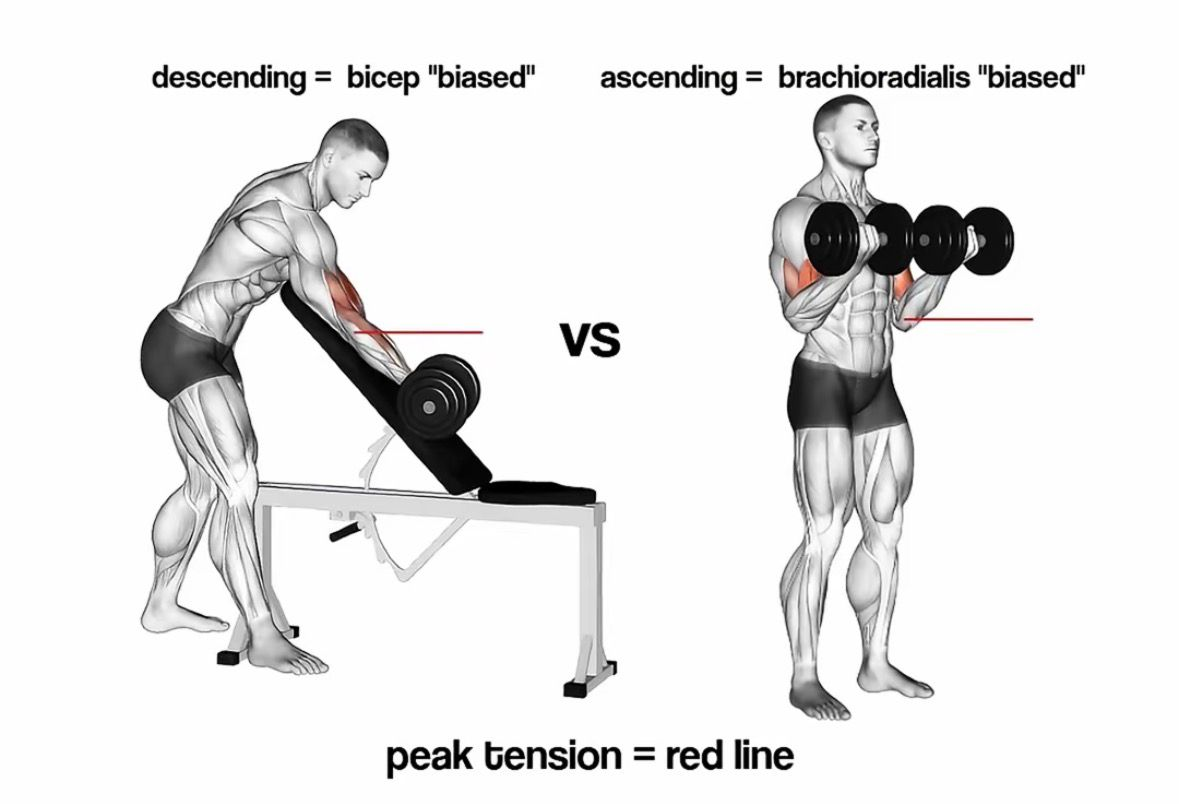
you do the correct ressistance profile for that exercise. so what is resistance profile? resistance profile of an exercise is the change of resistance throughout the range of motion of a movement. the most common ascending profile are ascending where an exercise starts of easier and gets harder and descending where it starts out harder and gets easier throughout the ROM. why does it matter to apply the correct resistance profile in each exercise? when doing an exercise where there are multiple joint actions or multiple muscles active, the resistance profile of the exercise can determinate what muscle youre biasing if you have peak tension wherever it has mechanical advantage ( produces the most force compared to other active muscles ). for example this can be seen through your curl variations when using dumbbells it will have peak tension parallel to the floor.
exhibit 1
1773407996910
and where it doesnt matterfor exmaple is in leg extension as in leg extension as only the quad muscles are active meaning they dont have to compete with any other muscle.

Joint actions:
Side delts - shoulder abduction.
Movement- moving the arm away from the body.
Exercises- Lateral raises are doing this action.

Upper back- scapula elevation & retraction.
Movement - moving the scapula back and up.
Exercises- Kelso shrug and T bar row aid in this joint action.

Lats- shoulder extension (sagittal plane) and adduction (frontal plane). shoulder extension aid in moving the arm from up (in my case) and towards the body with tucked elbow. Shoulder adduction aid in moving your elbows in the frontal plane to the side of the body with a straight torso.
Exercises-Sagittal Keenan flap for shoulder extension and wide grip lat pulldown to shoulder adduction.

pecs- shoulder horizontal adduction and shoulder flexion.
Movement - moving the arm upward and inward your torso with tucked elbows.
Exercises- smith machine supinated grip.

Quads- knee extension, hip flexion.
Movement- kicking with the leg (knee extension) and pushing the floor with the legs (hip flexion).
Exercises- leg expression, back squat.

Hamstrings- knee flexion, hip extension.
Movement- moving the leg in the opposite way of leg extension.
Exercises- lying leg curl.

Adductors- adducted thigh.
Movement- adduction the limbs towards the body.
Exercises- adduction machine.

Calves- ankle plantar flexion.
Movement- going upward with the ankle.
Exercises- standing calf raises.

Triceps- elbows extension.
Movement- extending the elbow down without moving upper arm and while it being tucked.
Exercises- cuffed tricep extension when the arm is in the 90° range (so cable is aligned with the shoulder).

Biceps- forearm supination while the elbow is flexed (elbow flexion).
Movement- curling the weight in a 45° - 90° angle.
Exercises- preacher curl.

Front delt- shoulder abduction/flexion.
Movement- moving the arm away from the body in the top half ROM of shoulder press.
Exercises- shoulder press.


Step 3. Volume. You need to find your MAV (maximum adaptive volume), you can find it by experimenting with your volume and seeing what works best for you. It depends on your split really, but for most I advise for not going past 2 sets in each exercise and doing each set in the 4-8 rep ranges with 1-2 RIR to minimize fatigue.

4. Common gym myths:
I this section I will mention common gym myths and bust them. Most people are falling for a lot of misinformation about the gym and I can’t blame them, when you see jacked people telling you to do stuff you think it’s true since it probably worked for them, so no. It’s not the case at all. I always say to DYOR before trying things out.
The main gym myths we are going to vault to in this thread are:
1. Bulking
2. Losing muscle while cutting is normal
3. You should prioritize protein


1.Bulking
:
Yes, bulking as a natural guy is one if NOT the most retarded thing someone in the fitness industry can do, and the worst part is that most lifters don’t even know that, in this thread I will give thoroughly about bulking and why it’s 100% vaulted.

I will make a few sections so you will beter understand
  • Why Bulking is vaulted and why the idea to bulk is redundant
  • What actually creates stimulus
  • When you SHOULD bulk?
  • TLDR

Why bulking is vaulted and why the idea to bulk is redundant
I’m sure you already heard that stupid phrase of “pick up the fork if you want more muscle mass”, which is true to an extent but being in a calorie surplus does NOT, and I will say again does NOT cause more muscle growth in any case (except for specific one that I will mention later).
Ever wondered why the bulk/cut cycle became popular ever since the roids became more popular as well in the body building industry ?
The idea of the bulk is to eat in a calorie surplus (between 250 to even 1,000 in some stupid cases) to give you more “energy”. the idea of eating more for more energy is definitely true, but you definitely do NOT need a surplus to have a better performance at the gym.
So, why bulking is vaulted exactly? Simple-
muscle gain is an not energy-dependent process, it’s a stimulus dependent process. muscles does require a bit energy but that amount is low, the higher end estimates that the maximum surplus you should reach for is 100-200 per day.
There is no biological mechanism that turns extra calories into muscle mass, and myofibrillar muscle protein synthesis won’t increase just because you’re in a surplus. You really think that if you ate that extra pack of Oreos you will get more muscle mass? Are you hearing yourself?
Anything beyond 100-200 calorie surplus will only result in more fat not more muscle mass and energy (100-200 surplus is also redundant but not as risky for your body fat as more than it does, also on paper you won’t actually reach 100-200 surplus you will probably eat less than that so you’re fine). The amount of fat gain you will gain in comparison to the muscle mass will get is crazy since you won’t get anymore muscle mass and only fat. so in the long term this will only hinder your progress in the gym not accelerate it since you will also spend another few months in a calorie deficit which makes you a bit more vulnerable to atrophy. So for exchange of no benefit in terms of muscle growth, the surplus will lead you to being in a calorie deficit during which you will get muscle slower.

What actually creates stimulus
the simplest thing ever- Mechanical Tension is the ONLY thing that will make your muscles hypertrophy.
For those who don’t know why machanical tendon is, it’s simply the pulling force your muscle fibers experience during slow
contractions. As velocity decreases, fiber force increases. (Inverse relationship).
During slow velocity contraction speeds, fibers has the most action-myosin crrosbridges- basically the most amount of force.
The force velocity curve (I already showed this earlier)
IMG 5321
So how does MT create hypertrophy - it’s basically the stimulus that tells your body to add contractile tissue, mechanoreceptors within the muscle fibers detect MT, causing a series of signals that ultimately produce growth by increasing protein synthesis rate.
Heavier weight ≠ more mechanical tension btw, MT only exists on the force velocity curve, load doesn’t matter as long as contraction speed is slow. I’m not saying you shouldn’t lift heavier loads, heavier loads are helpful for other reasons. Mechanical tension and motor unit recruitment are 2. Different things.
For example, if I press a barbell with 5 kg each side (so 30 kg in total) but in slow velocity, will it create high fiber force ? The answer is yes since there is a slow contraction velocity. Don’t confuse MT with MUR.
So to clarify, you won’t grow if you only do slow contractions with light loads, This will only stimulate the active fibers, which will not be enough for growth because you are so low in the motor unit pool due to low effort.
BTW, micro tears do NOT mean more muscle gain it’s actually the opposite.


When you should bulk:
so now that we covered what actually creates stimulus and why bulking is vaulted, let’s talk about when you DO need to bulk.
Let’s keep it simple- you should bulk only when you’re either starting the gym as an underweight guy (below 17 BMI) or as an enhanced guy, why?
As a skinny guy (below 17 BMI), you are in a state where you don’t function well because your calories are so low so you don’t have energy, which will hinder your progress like CRAZY. Imagine training on 1 hour of sleep, that’s how it basically feels…

As an enhanced guy, literally everything you do will make your muscles grow like crazy, but when bulking you can basically make those extra 250-600 calories of surplus efficient for muscle mass because your MPS is elevated 24/7, I won’t get to it too much since I’m talking mainly about naturals here, but you get the point.
TL;DR

Muscle growth is driven by training stimulus (mechanical tension), not by eating in a large calorie surplus. Extra calories don’t directly increase muscle protein synthesis. After a small surplus (~100–200 kcal at most), additional calories mainly increase fat gain.
It goes in this order:

1.Large bulks unnecessary fat gain
2. longer cutting phases
3. slower overall progress.

You should only intentionally bulk if:
You’re underweight (very low BMI) and lacking energy and/or whenYou’re using anabolic drugs, where elevated muscle protein synthesis makes larger surpluses more effective. For most natural lifters I would advocate training hard, recover well, and eat around maintenance or a very small surplus/deficit depending on your goals.
2.losing muscle while cutting is normal:
I guess you heard this sentence at least a couple times in your training lifespan and it’s actually not that redundant, but people actually treat it as a binary state, as you will will lose muscle mass on a cut 100% without looking at the objective. While losing muscle on a deficit is actually easier than when at maintenance, it doesn’t mean losing muscle mass is something you don’t need to worry about.
To clarify again, I’m taking about natural lifters (obviously). Some mistakes new lifters have is that they think they lost a lot of muscle in their cut while they just didn’t have any significant muscle to begin with, so if you’re not a new lifter you SHOULD worry about losing muscle in a cut.

I will make a few sections so you will understand it better:
  • Why losing muscle, strength in a cut is not normal and shouldn’t be something that is obvious to you.
  • How to properly programm your cutting phase
  • TL;DR

Why losing muscle, strength in a cut is not normal and shouldn’t be something that is obvious for you
Why losing muscle, strength on a cut shouldn’t be something that is normal to you
losing muscle and strength in a cut is something that is very easy to do and very easy to avoid as well as long as you program your diet and cardio better.
Losing muscle and strength on a cut probably means you’re either going for more than 700 calorie deficit Which is a lot or not getting enough carbs (yes carbs are that important). For knowing how to cut properly you need to find your tdee (look in google), it’s never too realistic but it can give you a good idea of how many calories you should eat daily (I will talk about it more throughly the next section).
As long as your calories are not at the floor and you’re taking your preworkout carbs you WONT lose strength and muscle.

How to properly programm your cutting phase:
Ts is literally the easiest thing ever, all you need to do is to :
1. find your TDEE (go to google search) and then fill your stats. I will give you an idea of how it should be after you fill your stats -
IMG 5324
After you found your calorie maintenance (it’s never accurate remember) you will need to remove calories by how fast you want it, for example doing a 600 deficit will result in you eating roughly 2,000 calories which is a moderate cut, by then just experiment what’s best for you etc etc.

2. Do cardio, cardio is not just running or doing HIIT, it’s also doing bunch of steps daily and being on the stair master. So for example I do 15,000 steps minimum daily and it’s easy asf tbh, I counted it and every 10 minutes I walk 750-900 steps ish.

3. COUNT YOUR CALORIES, it should be fucking obvious, right? You should know what you’re getting in your body and what are the macros, kinda reasonable right?

4. Carbs>protein, I will talk about this more throughly in the next main section but you need to understand going over 30% of protein from your calories is just redundant.
Less protein, more carbs, especially before a workout. Leave room for carbs

TL;DR:
Losing muscle and strength on a cut shouldn’t just be something you accept. Most of the time it happens because you’re cutting way too hard or you dropped carbs too low and now your workouts suck.

If you’re in a crazy deficit, yeah, your lifts are going to go down. A cut doesn’t need to be extreme. Just find roughly where your maintenance is and eat a few hundred calories below that. Don’t eat too less. Move more during the day. And actually track what you eat so you’re not guessing.

Keep protein moderate, but don’t go so high. Carbs are your best friend . If your workouts stay strong and you’re not starving yourself, you shouldn’t be watching your muscle atrophy.
3. Prioritizing protein
Prioritizing protein as a natty gotta be the worst brainwashed thing after religion.
I will make three sections:
  • Why prioritizing protein is vaulted
  • Why carbs>protein
  • TL;DR

Why prioritizing protein is vaulted :
No, more protein≠faster muscle gain and more muscle gain.
Why is that?
Your body has a plateau for how much protein it can absorb, for 99.9999% of people eating more than 140 grams of of protein (considering they’re natural) will only give them useless calories that they could instead exchange with carbs (which is FAR more beneficial for muscle mass). Your MPS has a certain point (plateau) where after specific amount of protein is absorbed, it won’t contribute to anything except for MAYBE, just maybe some energy which carbs are better for anyway. So once you hit that plateau it doesn’t cause further hypertrophy, you’re just eating pointless calories atp.

People overrate protein SO FUCKING MUCH.
You need to eat your minimum effective dose of protein and leave the rest of your calories for carbs which are FAR MORE IMPORTANT FOR BUILDING MUSCLE, so stop overeating protein and torturing yourself and start eating more carbs.

Why carbs>protein:
so why? Stimulus happens in the gym, so you need to maximize that to have the best stimulus you can achieve while you’re in the gym, so how do you maximize that? It’s simple- YOU PRIORITIZE CARBS. Also, don’t you find it easier to eat carbs then to force feed yourself with breast chicken ? So how do you carb max? Your macros should be 50-60% of carbs and the rest are protein and fat. Just eating carbs through the day is not enough tho, to fully maximize your workout, you will need to have 2/3 phases of carbs absorption:

1. pre workout carbs which will help around 60-80 g of carbs (don’t do 1g of carb per kg plz), that will give you fuel for the workout
2. but that’s not enough if your workout is more than 1 hour and 30 minutes
then you will need to also add intra workout carbs (IWC) which will give you fuel for THE WHOLE workout. I would opt for absorbing them 10 minutes before halfway the workout ( for example if your workout is 2 hours, absorb them when you reach 50 minutes), and it HAS to be fast digesting carbs (low GI, low fat) so gummies imo is the best but rice cakes is good too just eat what ever Is more comfortable for you.

3.And lastly, your post workout carbs (PWC), this is not mandatory but it’s better especially for people who run a high frequency program since it will reduce the post workout fatigue which will eventually let you push yourself harder in the gym the next session, I would opt for 40-50 g of carbs.

TL;DR:
More protein doesn’t automatically mean more muscle. Your body can only use a certain amount to stimulate growth, and once you hit that level, adding more just gives you extra calories, not extra gains. As long as you’re eating enough protein to cover your needs, pushing it higher doesn’t speed things up. Find your minimum effective protein intake and eat it.
Carbs are just as important, if not more for actual progress because they fuel your workouts. Better fuel means better performance, and better performance means better stimulus for growth. If your training suffers because carbs are too low, muscle gain will suffer too.
So instead of obsessing over extremely high protein, hit a solid amount, then prioritize carbs to support training, recovery, and overall performance.

5. Nutrition for the gym:
Nutrition is probably the most talked about topic in the fitness industry but still somehow very confusing and I can’t blame those who get confused, there is a lot of misinformation and misunderstanding when it comes to this topic. But nutrition is as if not more important than working out and the crazy part is that most people are eating like shit, then feel like shit and look like shit, guess why?


So in this section I will guide you on nutrition and everything you need to know about it.
I will do sections that will explain nutrition thoroughly.

1. Why nutrition is crucial for muscle mass
2. Calories
3. Macro & micro nutrients

1. Why nutrition is crucial for muscle mass
Nutrition is what allows your body to build muscle, recover from training, and perform well in the gym. Training provides the stimulus for growth, but without proper nutrition your body simply doesn’t have the resources to adapt. Food also provides energy for training. Most of this energy comes from carbohydrates (we will talk about this later) stored in the muscles as glycogen. If glycogen is low, strength, endurance, and training performance drop significantly.
Nutrition also plays a major role in recovery. Adequate calories, protein, carbohydrates, fats, vitamins, and minerals help reduce fatigue, replenish glycogen, support hormone production, and allow muscles to repair between workouts.
2. Calories
Calories are one of the most important factor for your results in the gym. Whether your goal is to lose fat, maintain your weight, or gain muscle depends on your current body composition and how many calories you eat.
The first step is to find your maintenance calories. You can use a TDEE calculator by entering your age, weight, height, and activity level. This will give you a starting point for your maintenance. The most accurate method is to track your calories and your weight for one to two weeks. If your weight stays stable during that time, those calories are your maintenance.
Once you know your maintenance, you can decide your goal. If you want to cut fat, you should eat below maintenance, typically around 300 to 500 calories less per day. Cutting is appropriate if your waist is growing, your abs are not visible, or your body fat is higher than you want. Eating around maintenance is ideal if you are in a healthy body fat range, approximately 12 to 15 percent, and want to maintain your current weight. If you are lean, under around 12 percent body fat, and your abs are visible, a slight surplus of 100 to 200 calories per day above maintenance is a good strategy to gain muscle without adding unnecessary fat.
It is important to check your body and not rely solely on numbers. BMI can serve as a rough guideline. A BMI below 18.5 usually indicates you are underweight and may benefit from bulking. A BMI between 18.5 and 24.9 is considered normal and suggests that maintaining or doing a lean bulk is appropriate. A BMI over 25 often means you should cut. Keep in mind that BMI is not perfect because it does not distinguish between muscle and fat. Visual assessment is crucial. If you cannot see your abs, your veins are not visible, or you just look fat overall, cutting is recommended. If you appear very lean but struggle to gain strength and muscle, a bulk may be necessary (CONSIDERING THE LIMITING FACTOR IS YOUR DIET AND NOT ANYTHING ELSE LIKE YOUR SLEEP, TRAINING PROGRAM etc).
You should adjust your calories as you go. Track your progress weekly and make small adjustments rather than large ones. This way you ensures that your diet supports your training and body composition goals while minimizing unnecessary fat gain or muscle loss.
3. Macro and micro nutrients
For those who can’t differentiate between them, it’s simple-
macros = fats, carbs, protein.
Micros = vitamins and minerals.

So I will divide this into 2 subsections which are micros and macros.

Micronutrients:
Micronutrients are the vitamins and minerals your body needs in small amounts to function properly. They are critical for performance, recovery, hormone balance, and overall health. Even if your calories and macros are on point, a deficiency in micronutrients can limit your results and leave you constantly fatigued or under-recovered.
So what are they?
Vitamins are organic compounds your body mostly cannot produce on its own, so you must get them from food. Each vitamin helps with different things, for example: Vitamin A is important for vision, immune function, and cell growth and can be found in liver, carrots, sweet potatoes, and dark leafy greens. Vitamin C supports collagen production, acts as an antioxidant, and aids recovery, and is found in citrus fruits, peppers, and broccoli. Vitamin D is crucial for bone health, immune function, and testosterone production, and can be obtained from sunlight exposure, fatty fish, and fortified foods. Vitamin E is another antioxidant that protects your cells and is abundant in nuts, seeds, and vegetable oils. Vitamin K is essential for blood clotting and bone health and is found in leafy greens, broccoli, and fermented foods. B vitamins, which include B1 through B12, help convert food into energy, support red blood cell production, and maintain nervous system function. They are found in whole grains, meat, eggs, dairy, and leafy vegetables.
Minerals are inorganic elements required for essential bodily functions like muscle contraction, nerve signaling, fluid balance, and enzyme activity. Calcium supports bones and muscle contractions and is found in dairy, leafy greens, and fortified foods. Magnesium is involved in hundreds of biochemical reactions, including energy production and muscle relaxation, and is found in nuts, seeds, and whole grains. Sodium and potassium maintain fluid balance and proper nerve and muscle function, and are found in salt, bananas, potatoes, and vegetables. Phosphorus contributes to bone structure and energy metabolism and is present in meat, dairy, and beans. Iron is critical for oxygen transport and energy levels and is found in red meat, legumes, and fortified cereals. Zinc supports immune function, hormone production, and protein synthesis, and can be obtained from meat, shellfish, and seeds. Other minerals like copper, sulfur, and fluoride play specialized roles in enzymes, tissue repair, and bone health.
Micronutrients matter for training because deficiencies can slow recovery, reduce strength gains, lower energy, and impair hormonal function. Iron deficiency can cause persistent fatigue, while low vitamin D or magnesium can affect testosterone and muscle function. B vitamin shortages can make energy production less efficient, leaving you drained during workouts. The key is consistency. Eating a variety of colorful vegetables and fruits, incorporating dairy, nuts, seeds, whole grains, meat, eggs, and fish ensures you cover most vitamins and minerals. If your diet is limited or you suspect deficiencies, a basic multivitamin or targeted supplements like vitamin D, magnesium, or zinc can help, but they are only a backup to a nutrient-rich diet. Think of micronutrients as the foundation for everything else in your training. Without them, protein, carbs, and training stimulus cannot reach their full potential.

Macronutrients:
So, macros are MUCH more simple to understand.
Macros are basically just fat, carbs and protein. Like you already know if you read the whole thread, that I promote carbs over protein. first, you need to realize what each macro is doing-
so like I said macros are fats, protein, and carbohydrates, they are the three main macronutrients, and each plays a unique role in your training and overall performance. Fats are essential for hormonal regulation, including testosterone and other key hormones that influence muscle growth, recovery, and energy levels. Including healthy sources of fats like olive oil, nuts, seeds, and fatty fish helps you feel stronger, maintain stable energy, and perform better in the gym. Protein is the building block of muscle. It stimulates muscle protein synthesis, which is the process your body uses to repair and grow muscle fibers after training. Getting enough protein from sources like meat, eggs, dairy, and legumes ensures your muscles recover efficiently and grow over time. Carbohydrates are your body’s primary source of energy, especially for high-intensity workouts. They fuel your muscles, help maintain performance during training, and aid in recovery by replenishing glycogen stores. Prioritizing carbs from whole grains, fruits, and starchy vegetables allows you to train harder, recover faster, and get the most out of your workouts.

Each macros calories are-
Protein: 4 calories
Carbs: 4 calories
Fats: 9 calories

How much of each should you consume ?
Simple-
Let’s give an example of someone who is 70 kg and his LBM is 60 kg.
I would consume 1.5-2 grams of protein per kg of Lean Body Mass, so if your LBM is 60kg, consume either 90/120 grams of protein.
Let’s say that individual is eating 120 grams of protein that means he’s eating 120x4=480 calories from protein only.
Then I would opt for him to eat 40-50 grams of fat daily, which is 50x9=450, so that’s 450 grams of fat only.
For carbs, I would fill the rest, considering he’s eating at maintenance and let’s say it’s 2,500, so he needs to fill the rest of the calories (fat and protein are 930 calories) so 2,500-930=1,570, so if we divide 1,570:4 that will equal to 392-393 grams of carbs, which is great. So we got
Fat: 50 grams
Protein: 120 grams
Carbs: 393 grams

In % it’s
fat: 18%
Protein: 19%
Carbs: 63%

Timing and meal distribution:
that’s what I would do personally

Morning: focus more on fats and protein.
Noon: focus on carbs and protein, and a bit of fats.
Preworkout: mostly carbs, aim for 1g per kg of body weight.
Evening: mostly fats, carbs and a bit of protein.

It doesn’t matter that much when you eat your fats and protein, but keep space for carbs when it’s 3-4 hours preworkout. Dont eat a lot of fats before a workout since the carbs will digest much slower.

In case you didn’t already read the intra workout and post workout carbs beforehand, then you can also use carbs intra workout and post workout to maximize recovery and energy during your workout and after it.

6. Natty Supplements & PEDs:
so, now comes the interesting part of the thread LOL, this became very popular in recent times. I will mention here what cycles you should do, and what natty supplements you can take if you want to maximize your gym performance and overall gains.

I will divide this into two parts, 1 is the supplants and 2 is the PEDs.

1. Supplements

Supplements for the gym is great, since it can help you push a little further than your body normally can. I will list all the supplements you should take if you want to maximize hypertrophy.

  • magnesium glycinate- relieves stress, help sleep and help with heart health. I would do 200-400 mg, it’s individual dependent.
  • caffeine- help with perception of effort by reducing it which allows you to train harder and stay focused during the workout. Take 3-6 mg of caffeine per kg of body weight as a pre workout. Dont consume 10 or less hours before going to sleep.
  • melatonin- not for the gym but it’s great for helping with sleep quality. I would opt for 2-15 mg depends on what works best for you. Take it 30 minutes before sleep
  • Creatine- great, S tier supplement, has no side effects and is the most researched compound ITW, I suggest you to get 5-10 grams of it daily and it doesn’t matter much when you take it. It will give you a small boost in training and it’s great for your brain as well
  • zinc- can boost your test and it activates enzymes for MPS (muscle protein synthesis). I would opt for 50 mg.
  • Electrolytes- makes you hydrated, when you are hydrated you are performing much better and taking electrolytes before the gym with your preworkout is great, also consider to take it intra workout if you sweat a lot
That’s the main ones I recommend using. Now let’s move to the PEDs.
2.PEDs
PEDs are not something you should jump into if you don’t know what you’re doing and you didn’t DYOR. I will divide this into a couple of subsections:

1. What you are going to use
2. Precautions + ancillaries
3. How to structure the cycle

1. What you are going to use
If you are a beginner, the goal should be to use the most studied and predictable compounds while keeping side effects manageable. Advanced users already know how to structure cycles, so this section is only focused on a first or early cycle.
For beginners, the main compounds you should be looking at are test E, hGH, and possibly a mild oral like anavar for cutting at the end of cycle. The reason these are chosen is because they are relatively predictable compared to harsher compounds. Compounds like tren are extremely powerful but come with severe side effects and should not be touched by beginners.
Test should always be the base of a cycle. Without a test base you risk severe hormonal suppression and other problems. hGH can help with recovery, connective tissue health, and body composition, while Anavar is often used because it is one of the milder oral steroids with relatively manageable side effects compared to most other orals and is good for cutting.
2. Precautions and ancillaries
Ancillaries:
For hair protection many people try to mitigate androgenic hair loss by blocking scalp DHT or androgen receptor activity. Common things used include topical anti‑androgens like RH, DHT inhibitors such as duta, and hair growth stimulants like topical minoxidil.

For acne just use accutane.

For estrogen control you sometimes need an aromatase inhibitor, since testosterone converts into estrogen through the aromatase enzyme.

For testicular function during cycles some people use gonadotropins like HCG or HMG to keep the testes active and maintain fertility signals.

For cardiovascular health
Bloodwork: you should get bloodwork before, a few weeks after, mid cycle, at the end of it and after it. That way you can know what ancillaries you should use, so for example if E2 is too high, up or if you didn’t already use it use an AI to mitigate the high E2 side effects.
Check those:

hormones: total testosterone, free testosterone, estradiol (E2), LH, FSH, SHBG, and prolactin to see suppression and estrogen levels.

liver enzymes (ALT, AST), since you use anavar and accutane which are liver toxic.

kidneys with creatinine and BUN.

cardiovascular risk with a lipid panel: total cholesterol, LDL, HDL, and triglycerides.

blood thickness: hemoglobin, hematocrit, and red blood cells.

If using an hGH also check your igf1.

PCT: from what I’ve seen, there isn’t much data about PCT other than anecdotal reports. I concluded that it’s not necessary and your natural hormone levels will come back to normal a month or two post cycle. HCG is the only thing you should be running.
3. How to structure the cycle
First, you need to know for how long you will be doing it, I opt for 16-20 weeks, after that myostatin levels rise and your gains are just at a plateau.
Let’s say you do it for 20 weeks. You will be using test, anavar and hGH. Dont do too much compounds. You will bulk thought the cycle as well to keep as much muscle mass as possible (yes, bulking on cycle is optimal)


Test E should be injected once per week, but you can also inject half of the goal dose twice per week which can make it more effective.
hGH should be used daily as well as anavar.

So what would a cycle look like?
Week 1-6- 300 mg test, 4-8 IUs of hGH. 500 calories surplus.
Week 6-10 400 mg of test, 4-8 IUs of hGH. 500 calories surplus
Week 10-16 500 mg of test, 4-8 IUs of hGH. 500 calories surplus
Week 16-20 500 mg test, 4-8 IUs of hGH, 40 mg anavar. Here you will start a cut of 600-700 deficit (you can use Reta and any other GLP-1)
1 week before end of cycle add HCG 500 IU and a few weeks after.


These numbers aren’t arbitrary and can change from person to person, this is what I did in my first cycle and it worked great for me.
Always remember to check your bloodworks and see what you need to add or remove (check bloodwork before, during, end and after).

I didn’t go as throughly on this since I’m tired asf but I’m pretty sure I covered all the basics and if you want more information just ask me, and you can also read this great guide ( a bit old schooled but still great) -
Thread 'First Steroid Cycle'
https://looksmax.org/threads/first-steroid-cycle.10771/

hope you found this thread helpful, if you guys see any mistake or got any question, go ahead and ask me.
@Jensonsahighlander @brootaldude @ce10098 @HubertSkeletrix @mikre
 
Last edited:
  • +1
  • Love it
  • JFL
Reactions: whatislovebaby, TheLucaOne, Malleable and 44 others
idk who to tag but bump :ogre:
 
  • +1
Reactions: Rhaegar234, cortisolman2 and looksmaxxingatitsfi
Dnr but looks high iq so bump
 
  • +1
Reactions: disco, skibidirizzler128 and combatingNorwooding
No way this shit flopped
 
  • +1
Reactions: cortisolman2
make a botb worthy post on how to get lean while also bulking its so hard man idk

mirin thread
 
  • +1
Reactions: foidslayer667, cortisolman2 and combatingNorwooding
Screenshot 20260313 191710 Chrome

This:

Screenshot 20260313 191812 Instagram
Screenshot 20260313 191833 Instagram
Screenshot 20260313 191801 Instagram
 

Attachments

  • Screenshot_20260313_191822_Instagram.jpg
    Screenshot_20260313_191822_Instagram.jpg
    267 KB · Views: 0
  • JFL
  • +1
Reactions: SoNotFunny, ledgerinmycunny, therealdeal877 and 1 other person
high IQ post
bump
 
  • +1
Reactions: combatingNorwooding
make a botb worthy post on how to get lean while also bulking its so hard man idk
Bruh, just be in a 200-350 surplus and that’s it, that’s the only way you are going to gain weight while not getting any to minimal fat gain.

Muscle gain is much slower than fat gain that’s why people gain so much fat while bulking, that’s why you need to take your times if natty, and do only a 200-350 surplus
 
  • +1
Reactions: Jensonsahighlander
High iq
 
  • +1
Reactions: combatingNorwooding
In this thread, we will talk about EVERYTHING you need to know about aesthetic training (NOT POWERLIFTING), from best and worst splits to the principles of muscle growth. This will be a very long thread.

introduction:
this thread will cover most things you get confused about, and I will simplify everything.
So, what this thread covers (table of contents):
1. Why you should even go to the gym and how it affects your dimorphism
2. The principles of muscle growth
3. Gym splits explained
4. Common gym myths
5.Nutrition for the gym
6. Natty supplements & PEDs

1. Why you should even go to the gym and how it affects your dimorphism:
For those of you who don’t know, dimorphism refers to physical traits that differ between males and females. We ALL wanna looks as dimorphic as possible and to have the highest SMV possible, and the gym is one of the best things to get both your dimorphism and your SMV up the roof. So why and how?
In humans the major things that makes your dimorphism high are large upper and lower body, boarder shoulders, thicker neck, lower body fat etc. guess what? The gym will make you have those things. Its the best investment you can do for yourself.
Muscles are directly linked to higher SMV and higher dimorphism, why? Because evolutionary, those who are stronger have higher chances of surviving which is why women are attracted to muscles, so don’t fall for the propaganda of muh “skinny is law women don’t want slaves” shit.

Who do you most women will be attracted to the most:

View attachment 4753073

Good. Now go Jim.

2. The principles of muscle growth:
I will explain this by doing a couple of subsections:

1. What actually is the main driver of hypertrophy
2. Progressive overload.
3. volume
4. intensity
5. recovery

1. What actually is the main driver of hypertrophy
hypertrophy: this is a VERY common topic people talk about which is pretty stupid since it’s objective not subjective. Muscle hypertrophy is drive by mechanical tension. Nothing else.
For those who don’t know why machanical tendon is, it’s simply the pulling force your muscle fibers experience during slow
contractions. As velocity decreases, fiber force increases. (Inverse relationship).
During slow velocity contraction speeds, fibers has the most action-myosin crrosbridges- basically the most amount of force.
View attachment 4753187
So how does MT create hypertrophy - it’s basically the stimulus that tells your body to add contractile tissue, mechanoreceptors within the muscle fibers detect MT, causing a series of signals that ultimately produce growth by increasing protein synthesis rate.
Heavier weight ≠ more mechanical tension btw, MT only exists on the force velocity curve, load doesn’t matter as long as contraction speed is slow. I’m not saying you shouldn’t lift heavier loads, heavier loads are helpful for other reasons. Mechanical tension and motor unit recruitment are 2 Different things.
For example, if I press a barbell with 5 kg each side (so 30 kg in total) but in slow velocity, will it create high fiber force ? The answer is yes since there is a slow contraction velocity. Don’t confuse MT with MUR.
So to clarify, you won’t grow if you only do slow contractions with light loads, This will only stimulate the active fibers, which will not be enough for growth because you are so low in the motor unit pool due to low effort.
BTW, micro tears do NOT mean more muscle gain it’s actually the opposite.
2. Progressive overload.
Progressive overload is one of the most nuanced topic in the fitness community. I will say this once and for all, progressive overload is a reward for gaining muscle growth, ITS NOT the cause of muscle growth, it’s the result. Dont force progressive overload, let it come to you, if it doesn’t, then you are doing something wrong. If you will force it, your form will be worse and your neurons wont adapt to the movement.
For example: if you do exercises in the 4-8 rep ranges, then when you come to 7/8 rep with good form, you can up the weight (there isn’t an arbitrary number that you need to increase the weight with, it’s different for every exercise). For example you did 8 reps in the bench vs in lateral raises, you won’t increase the same amount of weight, right? Then do it accordingly to the exercise.
3. Volume
Volume is the number of working sets done in a session or per week.difference between working sets and normal sets is that working sets are the one who will cause the most hypertrophy (taken close or to failure), and normal sets can be warmups.
Too much volume can cause excessive CNS and peripheral fatigue hence your lifts will drop. And too less volume will make you gain less.
I would suggest you to do the 5 sets rule in your sessions, what is it you probably ask, so the 5 sets rule is to do MAX 5 sets per muscle groups including overlap. For example- 2 sets of shoulder press and 3 sets of any press exercise will count as 5 sets for your front delt. So this is the maximum volume you should do per session, don’t go over it and even getting to it can be pretty fatiguing depends on your split. This way you can also find your MAV (the amount of volume you should be doing). The 5 sets rule also changes depending on your split, for exmaple if you do PPL, you will be able to do more sets than if you would be doing FullBody.
Don’t do 1 set per muscle group even if you do full body (a very CNS fatigue demanding split), do at least 2 sets. You can do 1 set per session if you really short on time or the muscle group you are doing the 1 set in is a strong point.
Also another rule you need to follow is more isn’t always better, if you can’t recover from much volume, your gains WILL hinder.
4. Intensity
Intensity for those who don’t know is how hard you go in a set. For example high intensity is going VERY hard (to failure) and low intensity is stopping a few reps from failure, the close you are to failure the most stimulating the set is.
View attachment 4754215
So is going to failure every set will make you the most gains? No. Most people think going to failure is the most optimal for building muscle, but it’s really not. When you go to failure your muscles do stimulate the most, but it also makes you VERY fatigued (both CNS and peripheral fatigued), so let’s say you go to failures each set, you will get tired VERY fast which will hinder the rest of your workout performance. So what should you do? Use RIR (reps in reverse), for those of you who don’t know what it is, RIR simply means how many sets you left in reserve in your working set. For example if you did 6 sets but you could’ve done 2 more, you did 2 RIR. Also, there is a difference between 0 RIR and reaching failure, 0 RIR simply means that the next rep you stoppped 1 set away from failure. But when you reach failure it’s minus RIR since you went beyond 0 RIR. When you do 1RIR you will be less fatigued and your late session working sets will be much more stimulating since you will be able to do more reps with probably more weight as opposed to going to failure which will make you much more fatigued, so the 1-2 RIR will result in more total growth stimulus per session. Who should use RIR? I would opt RIR ONLY to advanced trainers since they are probably the only ones who can gauge their RIR and they can know what failure feels like considering they went to failure in most of their working sets. New trainers can’t gauge RIR since they don’t know what failure looks like, so I would opt for new trainers to reach failure for a few months before starting to use RIR.
So why 1 RIR can be better than 0 RIR/failure? Even tho we know failure is more stimulating, it’s also more fatiguing, which as I already said, will be worse for later sets performance. 1 RIR can be just as stimulating as well while being much less fatiguing, so you will be able to perform great in later sets. I will give you an example- if you would do a push session with 12 sets, if you take each one to failure you will get less total stimulus since after the set 5/6 ish you will get very fatigued, as opposed to if you would do 1-2 RIR you will create more stimulus since you will get dramatically less fatigue with more or less the same stimulus per set.

So how can we use it in our training to maximize hypertrophy ? It really depends on your split and how many set you got in your sessions, but I would opt for 1-2 RIR for compounds and very fatigue demanding exercises, and 0-1 RIR for isolation/single joint exercises.
5. Recovery
I will talk here about both intra session and inter session recovery.

Intra session recovery:
intra session recovery means recovery during your workout, so mainly recovery between your sets and how to keep being recovered during your whole workout. After a set that is very hard, ATP and phosphocreatine stored are depleted, metabolic byproducts like lactate and hydrogen ions accumulate, and your nervous system become temporarily fatigued, between sets, your body partially restores these systems so you can perform the next set effectively. That’s why you need to take a long rest until your next set, if rest time is too short you start the next set too fatigued which will lead to fewer reps and your CNS will be able to recruit less high threshold motor units. so how can you be 100% recovered in your workouts? First thing is resting time between sets. Most people rest 1.5-2.5 minutes per set, which is great if you are not going hard enough lol. If you go hard enough 0-2 RIR, you will need more resting time. Without much BS: for compounds I would opt for 4-5 minutes and for single joint exercise I would opt for 3-4 minutes considering you go hard in your sets. But in general, if your heart beat (get a watch to check it) is fine and went back to normal and when you feel recovered, you can start the set before the time you have set it to. During your exercises don’t be on your phone or at least don’t do anything that distracts you and take your focus away from your next set. Also, another thing 99% of people don’t do but can make your workout much much better, is to take intra workout carbs. So a bit before you reach the half of your session, take fast digesting carbs and I would opt for 30-45 G of carbs.

Inter session recovery:
Inter session is basically between each session. You get the stimulus in your training while you build it in your recovery days. So to maximize your recovery between sessions, you need to and this will be surprising, to REST:ROFLMAO:, yeah, don’t do any thing that will make your muscles tired (as examples blue collar jobs), eat a lot of carbs (200-250g). Nothing to say really, it’s that simple.
Another thing to mention is how to know if you’re recovered. So how to know that? Simple, considering you are with the same sleep or at least in the normal sleep time range (8+ hours) and you took the same preworkout and the variables before the workouts are pretty much the same then if last workout you did for example 8 sets for chest and you come this session and your strength has dropped, then you probably did too much volume for chest last time. So what to do? Get your chest volume down (so in this case to 3-4 sets) since you probably done too many last session and you can’t recover from that. So now let’s say you dropped it to 4 sets and you start progressing faster than when you did 8 sets,then that’s a great sign and it probably means 4 is close or is the amount of sets you should be doing but that’s only is assumption, so what you should do is to try different things, if you can recover from 4 sets and you progress in this sets ranges it doesn’t mean it’s how much you should do, since you didn’t try 5 sets, so what you should do is to try 5 sets for a week or two and see if you can progress on it and you recover from it, if you do, that’s great, try 6 and so on. Same goes for going backwards, so for example going to 3 sets maybe would be better and you would do the same progress as with 3 with less fatigue. So what I would recommend it’s to experiment, everyone’s got a difference genetic and there isn’t a magical number everyone should be doing in order to make progress, so check what’s better for you.

3.Gym splits explained:
splits are probably the most common thing intermediate and new people in the gym get confused about, and i get why, there’s a lot of misinfo out there, but im here to guide you on what’s the Best split and Worst split to run as a gym goer. I’m talking about naturals here btw, if you’re enhanced then just do what ever you enjoy the most lol.

In each split I will divide into
1. What is it
2. Pros & cons
3. Best way to program it
4. When the split is best for you
5. Summary & rating (1-10)

at the end of this section i will teach you how to build your own split.


Let’s start with the most popular one that everyone are glazing but it’s the most overrated split to exist: PPL.

Push Pull Legs:
1. What is it
PPL is a split where, exactly like it sounds, will be a separated split with 3 different days who are push pull and legs. Day 1 push, day 2 pull, day 3 legs. Most people do it 6 times a week while getting 2 times frequency, which is not quite optimal, but we’ll talk about this later on.


2. Pros & cons
So, PPL like every other split, has its own pros and cons. So let’s talk about it
Let’s start with the cons:

  • frequency. Like I said before, 6 times a week and 2 times frequency is kinda ass, especially when comparing to other splits. The fact you NEED to train 6 times a week for mid frequency makes this so much worse, if you go 3 times it will be 1 time frequency which is maintenance or even less. If you have a life, don’t do this split. If you don’t wanna go 6 times a week, then there are better splits for you.
  • Possible risk of inter workout fatigue and lack of rest days. Even tho you’re not training a muscle group back to back, CNS fatigue can hinder your gains like crazy, since you’re training 6 times a week back to back, with only 1 rest day, your nervous system is overstimulated, hence even tho you didn’t train the same muscle group day after day, you still feel tired and you perform worse than usual.

Now that we went over the main cons of PPL, let’s talk about the pros:

  • No overlap between muscles and more recoverable volume intra session. You can do 3 exercises for the chest and still be able to recover from that since you have 72 hours rest till your next session for that muscle group, which is more than enough so your peripheral (local) fatigue is less demanding. You can do 3 sets of bench press in 1 workout and still recover from it unlike other splits.
  • Enjoyable. I mean, enjoyment, to an extent is the most important factor when it comes to getting gains since no enjoyment = less motivation. And PPL is arguably the most enjoyable split to do.

3. Best way to program it
Best way to program it imo, would be to go 6 times a week (duh), do it PPLPPLR, you can put the rest days wherever you want it won’t really matter that much.

For each day, that’s what I would do-

Push-
  • Pec deck/chest press
  • any incline press where you can do shoulder flexion
  • Lateral raises (choose whatever variation you would like)
  • Shoulder press
  • Tricep extension
  • JM press
Muscle groups biased- chest, shoulders (front and side), triceps.

Pull-
  • Wide grip lat pulldown (shoulder adduction)
  • Close grip row/one arm lat pulldown (shoulder extension)
  • T bar row
  • Reverse pec deck for rear delts (optional)
  • Any bicep exercise you like, you can do here, but only do one exercise.
Muscle group biased- lats, upper back (traps, rhomboids), rear delt, biceps.

Legs-
  • Leg extension
  • Hack squat (any squat variation is decent)
  • Seated/lying leg curl
  • Adduction machine
  • Calf raises
Muscle group biased- quads, hamstrings, adductors, calves.

That’s it, it’s as simple as that.
I didn’t put specific sets since it’s individual dependent and it’s not an arbitrary number that is good for everyone. I suggest you to do the amount of sets you can recover from. But I would still opt for 4-8 rep ranges since it’s objectively better.
Same as sets, there isn’t an exercises that are better for everyone, it’s also individual dependent. So you don’t have to do the exercises I mentioned here, but you at least get the idea of what it should be like.
Order the exercises based on your weak points.

4. When the split is best for YOU
I would say PPL 6 times a week is best when you enjoy it and get good gains with it, it’s not the best split to run 6 times a week, but as long as you make good gains with it then go ahead and do it. I would say if you love your spend time in the gym, this split is for you.


5. Summary & rating
Push Pull Legs (PPL) is a 3-day split where workouts are divided into push (chest, shoulders, triceps), pull (back, rear delts, biceps), and legs. Most people run it 6 days per week to achieve 2× weekly frequency for each muscle group.

The main advantages are minimal muscle overlap, good recovery between sessions for the same muscle (around 72 hours), and the fact that many people find it enjoyable to train this way. The main downsides are that you usually need to train 6 days per week just to reach moderate frequency, training only 3 days gives you only 1× frequency, and the high number of training days can cause systemic fatigue and hurt performance. Overall, it works best for people who enjoy being in the gym very frequently and can realistically train 6 days per week. Rating: 6/10.

Bro split:
1. What is it
Bro split is a split that works each muscle group in a specific day, for example, day 1: chest, day 2: back and so on. You do each muscle group once per week.
The idea is to do a lot of exercises and sets for one muscle in a single session, then give that muscle a full week to recover before training it again.

2. Pros & cons
Pros
:
  • in a bro split, you manage to do higher volume for a muscle per session and you got a whole week to recover from that muscle group as well. This split is very enjoyable for most and a lot of bodybuilders do. Except for that, there isn’t much pros, this split is pretty shit.

Cons:
  • Bro split doesn’t bring you good frequency, you will get 1 day frequency for each muscle which is maintenance level.
  • You get crazy CNS fatigue overlap since you go 5 times a week to the gym. You progress very slowly due to 1 times frequency. You go the the gym 5-6 times a week just to get only one time frequency. This can go on and on. if you want muscle growth, DONT do a bro split, it’s the worst split out there by far.

3. Best way to program it
There isn’t actually a best way to program it tbh, just program it however you want, doesn’t really matter since you will still hit a muscle group 1 times weekly. But to maximize gains with it, I would minimize the peripheral fatigue overlap, so for example do chest, then back, then triceps, then biceps, then shoulders. That way you get minimal local fatigue overlap from previous sessions.
I would do higher volume per muscle group than in normal splits since you can recover from that much better considering you get 1 week to recover till next session for that muscle group.

I would program it this way:
Day 1- Chest:
  • Pec deck
  • Chest press
  • Incline press
Day2- back:
  • Wide grip lat pulldown
  • one arm/close grip lat pulldown
  • close grip row
  • T bar
Day 3- arms:
  • Tricep extension
  • OH tricep extension
  • JM press
  • Bayesian curls
  • Preacher curl
day 4- legs:
  • leg extension
  • hack squat
  • leg curl
  • hip adduction
  • calf raises
Day 5- shoulders:
  • Rear delt fly
  • Lateral raises
  • Shoulder press
As simple as that. I would opt for 4-8 rep ranges with 0-1 RIR. Do any exercise you want it doesn’t really matter and you can do high sets, for example 4 sets per exercise will be fine and probably not so much overwhelming if you do it correctly.

4. When the split is best for you
The split is best for you if you are short on time in each day, and want to be only 30-45 minutes in the gym, aside of that, you are a retarded and this split is a fucking meme. Dont do it.

5. Summary and rating
Bro split is a training split where one muscle group is trained per day, so each muscle is usually trained once per week. The idea is to do a lot of exercises and sets for one muscle in a single session, then give it a full week to recover.
The main advantage is that you can do high volume for one muscle in a workout and many people find the split enjoyable. The main downside is very low frequency, since each muscle is only trained once per week, which usually leads to slower progress. It also often requires 5–6 gym days per week just to train each muscle once.
Programming does not matter much since frequency stays the same, but it is better to order muscles in a way that minimizes fatigue overlap. Overall rating: 3/10.

Anterior posterior:
1. What is it
anterior posterior is not so popular since it’s a new split, but I will clue you in on what it is. Anterior posterior is simply front and back side of your body, just like you split top and bottom in upper lower split, you split back and front in anterior posterior. For example, in posterior days you train the back of your body, so back, hamstrings, triceps etc. and in anterior you train your front, so chest, biceps quads etc.
This split is great for prioritizing the upper body since you train both lower and upper body in the same session so you can prioritize your upper body more by starting with it first in the session. Some people train anterior posterior with the biceps and triceps reversed, but we won’t talk about this way of training but rather the regular anterior posterior.

2. Pros & cons
Pros:
  • More upper body emphasis. When you are doing both lower and upper body in the same session, you can prioritize each one by whatever you train first. For example if you train upper body first it will get more overall stimulus and growth.
  • Can be more enjoyable for those who hate training legs. Since you hitting both upper and lower body in the same session you will find it easier to train legs and harder to skip them.
  • Good frequency, if you go 4 times you will get 2 times frequency and if you go 6 you will get 3 times frequency which is the best.

Cons:
  • You can get a lot of overlap. Since you train triceps for example on posterior days and chest in Anterior days then you can hinder your chest movements since your triceps probably are still recovering. Other than that it’s a great split.

3. Best way to program it.
Anterior posterior is a bit more challenging to program. I would start with 4 times a week and if I feel like the overlap doesn’t hinder my performance, only then I will increase to 6 times a week, if you start with it and right ahead do 6 times, you don’t know how you will react to it, you can get crazy overlap and that will fatigue your muscles like crazy, then better be safe than sorry.
I would program it this way:

anterior day:
  • Chest press/ pec deck
  • Incline press
  • Lateral raises
  • Shoulder press
  • Preacher curl
  • Crunches
  • Adduction machine
  • Leg extensions
  • Reverse grip curl (optional)
This bias the chest, front delt, side delt, biceps, quads, adductors, abs.

Posterior day:
  • Wide grip lat pulldown
  • One arm lat pulldown/close grip row
  • T bar
  • Reverse pec deck
  • Lying/seated leg curl
  • Tricep extension
  • JM press
  • Any deadlift variation/back extension
  • Calf raises
This bias the back, rear delts, triceps, hamstrings, calves and erectors.

Do each set in the 4-8 rep ranges and do the number of sets you can recover from while using 1-2 RIR.
If you feel like you recover and you don’t get much overlap, then increase to 6 times per week to get 3 times frequency. You don’t need to use the exercises I wrote here.

4. When the split is best for you
I would say that ant/post is better for those who would like to prioritize their upper body. If you hate training legs then maybe anterior posterior can make it more enjoyable for you.
This split is very special and that what can make it more enjoyable for you and that will help you with being consistent. I would suggest to try it for yourself and see if you make better progress out of it.

5. Summary and rating
Anterior / Posterior splits the body into front (anterior) and back (posterior) muscles. Anterior days train chest, quads, biceps and front delts, while posterior days train back, hamstrings, triceps, rear delts and calves.
You train upper and lower body in the same session, which allows you to prioritize muscles by training them first. It provides good frequency (2–3x per week) but can cause some overlap fatigue between muscle groups like triceps and chest. Overall it’s a solid split, especially for upper body prioritization.
I would rate it 6.5/10.

Upper Lower:
1. What is it
Upper Lower is one of the best splits to do, as a beginner and as an advanced lifter. This split, just like it sounds, split your upper and lower body in half. A typical upper lower week program will look like that if you go 4 times a week:
ULRULRR.
And if you go 6 times then it will look something like that:
ULULULR.
It’s a great split that can give you 3 times frequency and is also very enjoyable. In this split you can also prioritize both lower and upper body, you only need to do one more day of the upper or lower body and you will already prioritize them. For example if you want to prioritize legs, you can do ULULRL and if you go 6 times a week then you can just remove one upper day.

2. Pros & cons

Pros
:
  • Frequency. Upper lower has a great frequency and it can be either 4 times or 6 times a week, when 4 is 2 times frequency, and 6 is 3 times frequency which is great. That way you can do each upper and lower body 3 or 2 times per week compared to splits like ppl which will give you 2 times frequency while going 6 times a week which is pretty shit.
  • Prioritization. In an upper lower split you can prioritize either upper or lower body by doing more of the body part you want to prioritize.
  • More flexibility. Since you have only 2 different days throughout the week you can be more flexible in comparison to PPL which you have 3 different days. This makes it a bit easier to fit this split into your schedule.

Cons:

  • Upper days can be way more fatiguing than lower days. Since you squeeze your entire upper body into one day, it can take longer than lower days (not much longer), which can be more fatiguing than lower days.
  • If you have a busy schedule, upper lower might not be the best split for you. Since the sessions can take too long (1.5+ hours) it can be too much for some people.
  • Inter workout fatigue. Since you go 4/6 times per week and your session are very long and fatiguing, it can make you very fatigued over the week and that’s why I opt for starting 4 times a week and session how you recover from there.

3. Best way to program it
Upper Lower is one of the easiest splits to program since you need to only consider your upper and lower body when doing so.
You can choose wether you want to do it 6 or 4 times a week based on what you progress and recover best from. To minimize fatigue on upper day I would suggest you to do any dead lift variation and crunches (for abs) on lower days.

Upper day:
  • Lateral raises
  • Pec deck
  • Incline bench
  • T bar row
  • Wide grip lat pulldown
  • Tricep extension
  • JM press
  • Preacher curl
Muscle group biased: side delts, chest, upper back, lats, triceps, biceps.

Lower day:
  • Leg extension
  • Hack squat
  • Lying/seated leg curl
  • Adduction machine
  • Hip hinge
  • SLDL/45’s
  • Crunches
Muscle groups biased: quads, hamstrings, adductors, glutes, erectors, abs.


i would start with 1 set for each exercise and if you see you recover from that then only then add 1 set in specific exercises, not in each one. I would add 1 set for the exercises that you want to prioritize. Like I already said millionth time, these exercise are an example, it doesn’t mean you HAVE to do these ones specifically, you can but you don’t have to.
Do each set in the 4-8 rep ranges and use RIR, I would personally do 0-2 RIR based on how fatiguing that exercise I’m doing the set on is.

4.When the split is best for you
I would say U/L is best for those who like to spend time in the gym and for those who want to be a bit more “optimal” ( I put “ since optimal can mean several things). I would opt this split for intermediate and for advanced lifters since for new beginners this might be too fatiguing. Upper lower is very balanced as well, you get more or less the same gains for your upper and lower body (considering you train them both as hard).

5. Summary and rating
Upper/Lower is best for people who train consistently and don’t mind longer sessions. It’s usually better for intermediate and advanced lifters, since beginners may find it too fatiguing.
It’s also a very balanced split, giving similar development for upper and lower body unless you purposely prioritize one.
I would rate it 7.5/10.

Full Body:
1. What is it
So. Yh, just Ike it sounds full body is a split that trains all the muscles in your body in one session. that aims to maximize the benefits of training frequency while being in the gym for as little as possible. Since the first set of each workout is the most stimulating set, and every set done after that set will be gradually less stimulating, a split that gives you a lot of frequency will be highly effective. You can do FB either 3 times a week or EOD, EOD is more effective for hypertrophy since you get 3.5 frequency compared to 3 times a week which you get 3 times frequency.

2. Pros & cons

Pros:
  • High frequency. In a full body split, you get 3 times frequency while going only 3 times a week and 3.5 frequency if you go EOD. This makes FB by itself the best split for frequency since you go as little as possible to the gym and get high frequency for each muscle.
  • Great for each “level” of trainers. Full Body is great for beginners, intermediate, and advanced lifters since it’s a very simple split which people can be very flexible with considering you can even go 2 times per week and still get 2 times frequency for each muscle.
  • Good for people with busy schedule. Since you can still go 2-3 times per week and get high frequency for each muscle. So people who have a busy schedule and can’t go too much to the gym, a FB split can be the best solution for them since it also got a lot of rest days.
  • You never atrophy on it. Since you hit each muscle every 40-48 hours, you never get the chance of atrophy. Atrophy happens after 48 hours of training the muscle, in FB, it doesn’t since you hit each muscle group EOD (depends).
  • You got more “first sets”. More first sets basically means more stimulating first sets. Like I already explained, your first sets in a workout are the ones you stimulate the most from and in full body you got more of them.
View attachment 4757952

Cons:
  • Sessions can be too long for some. If you are not locked in on your pre and intra workout carbs, a FB session can be very fatiguing and just useless. Thats why you need to perfectly program it for YOU, what you recover from what you progress faster on etc. that can means your later sets will only add more fatigue and little to no stimulus.
  • very easy to fatigue. when you are squeezing your whole body into 1 session it can be quite fatiuging if you dont know how to program it perfectly for you

Aside of this, it’s a great split and probably is objectively the most optimal one.

3. Best way to program it
FB is a complicated split to program since it’s very easy to fatigue intra workout and you need to experiment what’s better for you. You can choose whether to do it EOD, 3 times per week or 2 times per week. It really depends on you and what you enjoy the most or recover best from. I would suggest to order your weak points first in the session and vice versa. I would opt for more compounds exercises and less single joints ones only for those who are short on time and want to finish the workout asap. For those who can be 1.5-2 hours in the gym, I would suggest to do as little compounds as possible since it will be very fatiguing.

A typical FB program would look like this
  • Pec deck/chest press
  • Incline press (optional)
  • Lateral raises
  • T bar row
  • Wide grip lat pulldown
  • Tricep extension
  • Shoulder press (optional)
  • Leg extension
  • Hack squat
  • SLDL/45’s
  • Adductors
  • Leg curl
  • Calf raises
  • Crunches
I would do each set in the 4-8 rep ranges and do each exercise for 1 set, if you see you recover from it, then you can increase some exercises to 2 sets. Just see what joint action each muscle do then search for exercises that do that joint action and choose the most enjoyable exercise for you. Use 1-2 RIR, even if the exercise is a single joint exercise don’t go to failure, this will still fatigue you a lot.

I would opt for taking 50-80 g of carbs as preworkout, 30-50 g of carbs in intra workout, and post workout 40+.

4. When the split is best for you
Like i already mentioned before, this split is great for those who want to maximize muscle growth, those who don’t have much time and have a busy schedule.

5. Summary and rating
Fullbody is a split where you train all muscles in one session to maximize frequency while spending minimal time in the gym. It works 2-3 times per week or every other day for slightly higher frequency. It’s great for beginners through advanced lifters, busy people, and anyone wanting to prevent atrophy because muscles get hit often. The downside is sessions can be long and fatiguing if not fueled or programmed correctly, with later sets giving diminishing returns. Program by hitting weak points first, prioritize compound lifts if short on time, or include more isolation if you have 1.5-2 hours, using 1-2 sets per exercise, 4-8 reps, and doing 1-2 RIR. Pre, intra, and post-workout carbs help recovery. Best for people wanting maximum growth efficiently and with limited gym time.
I would rate it 8/10.

how to program your own gym split :
There are a couple of steps you you need to follow in order to build. Gym program specifically for you and what you enjoy the most.

Step1. You can either build your own split which I advise you not to do it since you won’t invent the wheel by doing so, someone thought of the split you think of doing now before you and he had shitty results, stick to the basics. Now choose a split you enjoy the most and get minimum 2x times frequency for minimizing atrophy.

Step 2. Exercise selection and Exercise order. After you chose your exercises, you need to put the in a specific order. Put your weak points in the start of the workout and strong points at the end of it. try doing isolations (single joint exercises) first and compounds last.. Choose your exercises, you need to know what each muscle joint action is doing in order to look for the exercise that will bias the goal muscle. try to minimize your compound exercises.
before we get into which exercise to use based on joint actions, we need to know how to choose each exercise, so how?
check list for your exercises:
are they stable?
when an exercise isnt stable the goal muscle we are trying to bias get less targeted since our body sends more motor units to other places instead of only for the muscle we are trying to bias, so that muscle get less high threshold motor units command. for example, in squats we are not stable at all so the body sends more signals to other places in the body rather than focusing more on the goal muscle in the exercise (quads in this case), and compared to a squat variation that is more stable like hack squat which the quads work better in since its much more stable.
theyre easy to set up? in a session we want to minimize fatigue as much as possible, so the main thing we want to focus on is too spend as little time in the gym as possible, so when an exercise takes too long to set up, you end up spending more time setting up that exercise rather than actually doing it. now, it doesnt mean you shouldnt do ANY exercise that takes too long but try to minimze these exercises as much as possible.
you do the correct ressistance profile for that exercise. so what is resistance profile? resistance profile of an exercise is the change of resistance throughout the range of motion of a movement. the most common ascending profile are ascending where an exercise starts of easier and gets harder and descending where it starts out harder and gets easier throughout the ROM. why does it matter to apply the correct resistance profile in each exercise? when doing an exercise where there are multiple joint actions or multiple muscles active, the resistance profile of the exercise can determinate what muscle youre biasing if you have peak tension wherever it has mechanical advantage ( produces the most force compared to other active muscles ). for example this can be seen through your curl variations when using dumbbells it will have peak tension parallel to the floor.
and where it doesnt matterfor exmaple is in leg extension as in leg extension as only the quad muscles are active meaning they dont have to compete with any other muscle.

Joint actions:
Side delts - shoulder abduction.
Movement- moving the arm away from the body.
Exercises- Lateral raises are doing this action.

Upper back- scapula elevation & retraction.
Movement - moving the scapula back and up.
Exercises- Kelso shrug and T bar row aid in this joint action.

Lats- shoulder extension (sagittal plane) and adduction (frontal plane). shoulder extension aid in moving the arm from up (in my case) and towards the body with tucked elbow. Shoulder adduction aid in moving your elbows in the frontal plane to the side of the body with a straight torso.
Exercises-Sagittal Keenan flap for shoulder extension and wide grip lat pulldown to shoulder adduction.

pecs- shoulder horizontal adduction and shoulder flexion.
Movement - moving the arm upward and inward your torso with tucked elbows.
Exercises- smith machine supinated grip.

Quads- knee extension, hip flexion.
Movement- kicking with the leg (knee extension) and pushing the floor with the legs (hip flexion).
Exercises- leg expression, back squat.

Hamstrings- knee flexion, hip extension.
Movement- moving the leg in the opposite way of leg extension.
Exercises- lying leg curl.

Adductors- adducted thigh.
Movement- adduction the limbs towards the body.
Exercises- adduction machine.

Calves- ankle plantar flexion.
Movement- going upward with the ankle.
Exercises- standing calf raises.

Triceps- elbows extension.
Movement- extending the elbow down without moving upper arm and while it being tucked.
Exercises- cuffed tricep extension when the arm is in the 90° range (so cable is aligned with the shoulder).

Biceps- forearm supination while the elbow is flexed (elbow flexion).
Movement- curling the weight in a 45° - 90° angle.
Exercises- preacher curl.

Front delt- shoulder abduction/flexion.
Movement- moving the arm away from the body in the top half ROM of shoulder press.
Exercises- shoulder press.


Step 3. Volume. You need to find your MAV (maximum adaptive volume), you can find it by experimenting with your volume and seeing what works best for you. It depends on your split really, but for most I advise for not going past 2 sets in each exercise and doing each set in the 4-8 rep ranges with 1-2 RIR to minimize fatigue.

4. Common gym myths:
I this section I will mention common gym myths and bust them. Most people are falling for a lot of misinformation about the gym and I can’t blame them, when you see jacked people telling you to do stuff you think it’s true since it probably worked for them, so no. It’s not the case at all. I always say to DYOR before trying things out.
The main gym myths we are going to vault to in this thread are:
1. Bulking
2. Losing muscle while cutting is normal
3. You should prioritize protein


1.Bulking
:
Yes, bulking as a natural guy is one if NOT the most retarded thing someone in the fitness industry can do, and the worst part is that most lifters don’t even know that, in this thread I will give thoroughly about bulking and why it’s 100% vaulted.

I will make a few sections so you will beter understand
  • Why Bulking is vaulted and why the idea to bulk is redundant
  • What actually creates stimulus
  • When you SHOULD bulk?
  • TLDR

Why bulking is vaulted and why the idea to bulk is redundant
I’m sure you already heard that stupid phrase of “pick up the fork if you want more muscle mass”, which is true to an extent but being in a calorie surplus does NOT, and I will say again does NOT cause more muscle growth in any case (except for specific one that I will mention later).
Ever wondered why the bulk/cut cycle became popular ever since the roids became more popular as well in the body building industry ?
The idea of the bulk is to eat in a calorie surplus (between 250 to even 1,000 in some stupid cases) to give you more “energy”. the idea of eating more for more energy is definitely true, but you definitely do NOT need a surplus to have a better performance at the gym.
So, why bulking is vaulted exactly? Simple-
muscle gain is an not energy-dependent process, it’s a stimulus dependent process. muscles does require a bit energy but that amount is low, the higher end estimates that the maximum surplus you should reach for is 100-200 per day.
There is no biological mechanism that turns extra calories into muscle mass, and myofibrillar muscle protein synthesis won’t increase just because you’re in a surplus. You really think that if you ate that extra pack of Oreos you will get more muscle mass? Are you hearing yourself?
Anything beyond 100-200 calorie surplus will only result in more fat not more muscle mass and energy (100-200 surplus is also redundant but not as risky for your body fat as more than it does, also on paper you won’t actually reach 100-200 surplus you will probably eat less than that so you’re fine). The amount of fat gain you will gain in comparison to the muscle mass will get is crazy since you won’t get anymore muscle mass and only fat. so in the long term this will only hinder your progress in the gym not accelerate it since you will also spend another few months in a calorie deficit which makes you a bit more vulnerable to atrophy. So for exchange of no benefit in terms of muscle growth, the surplus will lead you to being in a calorie deficit during which you will get muscle slower.

What actually creates stimulus
the simplest thing ever- Mechanical Tension is the ONLY thing that will make your muscles hypertrophy.
For those who don’t know why machanical tendon is, it’s simply the pulling force your muscle fibers experience during slow
contractions. As velocity decreases, fiber force increases. (Inverse relationship).
During slow velocity contraction speeds, fibers has the most action-myosin crrosbridges- basically the most amount of force.
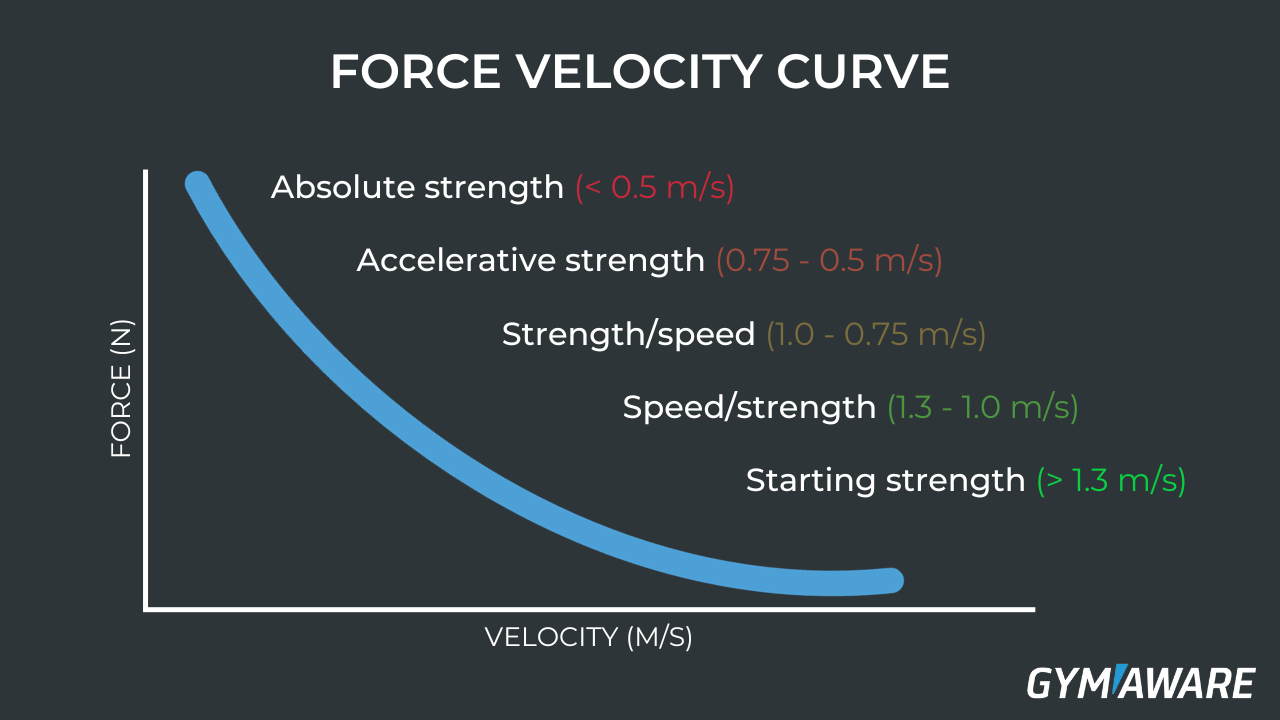
The force velocity curve (I already showed this earlier)
IMG 5321
So how does MT create hypertrophy - it’s basically the stimulus that tells your body to add contractile tissue, mechanoreceptors within the muscle fibers detect MT, causing a series of signals that ultimately produce growth by increasing protein synthesis rate.
Heavier weight ≠ more mechanical tension btw, MT only exists on the force velocity curve, load doesn’t matter as long as contraction speed is slow. I’m not saying you shouldn’t lift heavier loads, heavier loads are helpful for other reasons. Mechanical tension and motor unit recruitment are 2. Different things.
For example, if I press a barbell with 5 kg each side (so 30 kg in total) but in slow velocity, will it create high fiber force ? The answer is yes since there is a slow contraction velocity. Don’t confuse MT with MUR.
So to clarify, you won’t grow if you only do slow contractions with light loads, This will only stimulate the active fibers, which will not be enough for growth because you are so low in the motor unit pool due to low effort.
BTW, micro tears do NOT mean more muscle gain it’s actually the opposite.


When you should bulk:
so now that we covered what actually creates stimulus and why bulking is vaulted, let’s talk about when you DO need to bulk.
Let’s keep it simple- you should bulk only when you’re either starting the gym as an underweight guy (below 17 BMI) or as an enhanced guy, why?
As a skinny guy (below 17 BMI), you are in a state where you don’t function well because your calories are so low so you don’t have energy, which will hinder your progress like CRAZY. Imagine training on 1 hour of sleep, that’s how it basically feels…

As an enhanced guy, literally everything you do will make your muscles grow like crazy, but when bulking you can basically make those extra 250-600 calories of surplus efficient for muscle mass because your MPS is elevated 24/7, I won’t get to it too much since I’m talking mainly about naturals here, but you get the point.
TL;DR

Muscle growth is driven by training stimulus (mechanical tension), not by eating in a large calorie surplus. Extra calories don’t directly increase muscle protein synthesis. After a small surplus (~100–200 kcal at most), additional calories mainly increase fat gain.
It goes in this order:

1.Large bulks unnecessary fat gain
2. longer cutting phases
3. slower overall progress.

You should only intentionally bulk if:
You’re underweight (very low BMI) and lacking energy and/or whenYou’re using anabolic drugs, where elevated muscle protein synthesis makes larger surpluses more effective. For most natural lifters I would advocate training hard, recover well, and eat around maintenance or a very small surplus/deficit depending on your goals.
2.losing muscle while cutting is normal:
I guess you heard this sentence at least a couple times in your training lifespan and it’s actually not that redundant, but people actually treat it as a binary state, as you will will lose muscle mass on a cut 100% without looking at the objective. While losing muscle on a deficit is actually easier than when at maintenance, it doesn’t mean losing muscle mass is something you don’t need to worry about.
To clarify again, I’m taking about natural lifters (obviously). Some mistakes new lifters have is that they think they lost a lot of muscle in their cut while they just didn’t have any significant muscle to begin with, so if you’re not a new lifter you SHOULD worry about losing muscle in a cut.

I will make a few sections so you will understand it better:
  • Why losing muscle, strength in a cut is not normal and shouldn’t be something that is obvious to you.
  • How to properly programm your cutting phase
  • TL;DR

Why losing muscle, strength in a cut is not normal and shouldn’t be something that is obvious for you
Why losing muscle, strength on a cut shouldn’t be something that is normal to you
losing muscle and strength in a cut is something that is very easy to do and very easy to avoid as well as long as you program your diet and cardio better.
Losing muscle and strength on a cut probably means you’re either going for more than 700 calorie deficit Which is a lot or not getting enough carbs (yes carbs are that important). For knowing how to cut properly you need to find your tdee (look in google), it’s never too realistic but it can give you a good idea of how many calories you should eat daily (I will talk about it more throughly the next section).
As long as your calories are not at the floor and you’re taking your preworkout carbs you WONT lose strength and muscle.

How to properly programm your cutting phase:
Ts is literally the easiest thing ever, all you need to do is to :
1. find your TDEE (go to google search) and then fill your stats. I will give you an idea of how it should be after you fill your stats -
IMG 5324
After you found your calorie maintenance (it’s never accurate remember) you will need to remove calories by how fast you want it, for example doing a 600 deficit will result in you eating roughly 2,000 calories which is a moderate cut, by then just experiment what’s best for you etc etc.

2. Do cardio, cardio is not just running or doing HIIT, it’s also doing bunch of steps daily and being on the stair master. So for example I do 15,000 steps minimum daily and it’s easy asf tbh, I counted it and every 10 minutes I walk 750-900 steps ish.

3. COUNT YOUR CALORIES, it should be fucking obvious, right? You should know what you’re getting in your body and what are the macros, kinda reasonable right?

4. Carbs>protein, I will talk about this more throughly in the next main section but you need to understand going over 30% of protein from your calories is just redundant.
Less protein, more carbs, especially before a workout. Leave room for carbs

TL;DR:
Losing muscle and strength on a cut shouldn’t just be something you accept. Most of the time it happens because you’re cutting way too hard or you dropped carbs too low and now your workouts suck.

If you’re in a crazy deficit, yeah, your lifts are going to go down. A cut doesn’t need to be extreme. Just find roughly where your maintenance is and eat a few hundred calories below that. Don’t eat too less. Move more during the day. And actually track what you eat so you’re not guessing.

Keep protein moderate, but don’t go so high. Carbs are your best friend . If your workouts stay strong and you’re not starving yourself, you shouldn’t be watching your muscle atrophy.
3. Prioritizing protein
Prioritizing protein as a natty gotta be the worst brainwashed thing after religion.
I will make three sections:
  • Why prioritizing protein is vaulted
  • Why carbs>protein
  • TL;DR

Why prioritizing protein is vaulted :
No, more protein≠faster muscle gain and more muscle gain.
Why is that?
Your body has a plateau for how much protein it can absorb, for 99.9999% of people eating more than 140 grams of of protein (considering they’re natural) will only give them useless calories that they could instead exchange with carbs (which is FAR more beneficial for muscle mass). Your MPS has a certain point (plateau) where after specific amount of protein is absorbed, it won’t contribute to anything except for MAYBE, just maybe some energy which carbs are better for anyway. So once you hit that plateau it doesn’t cause further hypertrophy, you’re just eating pointless calories atp.

People overrate protein SO FUCKING MUCH.
You need to eat your minimum effective dose of protein and leave the rest of your calories for carbs which are FAR MORE IMPORTANT FOR BUILDING MUSCLE, so stop overeating protein and torturing yourself and start eating more carbs.

Why carbs>protein:
so why? Stimulus happens in the gym, so you need to maximize that to have the best stimulus you can achieve while you’re in the gym, so how do you maximize that? It’s simple- YOU PRIORITIZE CARBS. Also, don’t you find it easier to eat carbs then to force feed yourself with breast chicken ? So how do you carb max? Your macros should be 50-60% of carbs and the rest are protein and fat. Just eating carbs through the day is not enough tho, to fully maximize your workout, you will need to have 2/3 phases of carbs absorption:

1. pre workout carbs which will help around 60-80 g of carbs (don’t do 1g of carb per kg plz), that will give you fuel for the workout
2. but that’s not enough if your workout is more than 1 hour and 30 minutes
then you will need to also add intra workout carbs (IWC) which will give you fuel for THE WHOLE workout. I would opt for absorbing them 10 minutes before halfway the workout ( for example if your workout is 2 hours, absorb them when you reach 50 minutes), and it HAS to be fast digesting carbs (low GI, low fat) so gummies imo is the best but rice cakes is good too just eat what ever Is more comfortable for you.

3.And lastly, your post workout carbs (PWC), this is not mandatory but it’s better especially for people who run a high frequency program since it will reduce the post workout fatigue which will eventually let you push yourself harder in the gym the next session, I would opt for 40-50 g of carbs.

TL;DR:
More protein doesn’t automatically mean more muscle. Your body can only use a certain amount to stimulate growth, and once you hit that level, adding more just gives you extra calories, not extra gains. As long as you’re eating enough protein to cover your needs, pushing it higher doesn’t speed things up. Find your minimum effective protein intake and eat it.
Carbs are just as important, if not more for actual progress because they fuel your workouts. Better fuel means better performance, and better performance means better stimulus for growth. If your training suffers because carbs are too low, muscle gain will suffer too.
So instead of obsessing over extremely high protein, hit a solid amount, then prioritize carbs to support training, recovery, and overall performance.

5. Nutrition for the gym:
Nutrition is probably the most talked about topic in the fitness industry but still somehow very confusing and I can’t blame those who get confused, there is a lot of misinformation and misunderstanding when it comes to this topic. But nutrition is as if not more important than working out and the crazy part is that most people are eating like shit, then feel like shit and look like shit, guess why?


So in this section I will guide you on nutrition and everything you need to know about it.
I will do sections that will explain nutrition thoroughly.

1. Why nutrition is crucial for muscle mass
2. Calories
3. Macro & micro nutrients

1. Why nutrition is crucial for muscle mass
Nutrition is what allows your body to build muscle, recover from training, and perform well in the gym. Training provides the stimulus for growth, but without proper nutrition your body simply doesn’t have the resources to adapt. Food also provides energy for training. Most of this energy comes from carbohydrates (we will talk about this later) stored in the muscles as glycogen. If glycogen is low, strength, endurance, and training performance drop significantly.
Nutrition also plays a major role in recovery. Adequate calories, protein, carbohydrates, fats, vitamins, and minerals help reduce fatigue, replenish glycogen, support hormone production, and allow muscles to repair between workouts.
2. Calories
Calories are one of the most important factor for your results in the gym. Whether your goal is to lose fat, maintain your weight, or gain muscle depends on your current body composition and how many calories you eat.
The first step is to find your maintenance calories. You can use a TDEE calculator by entering your age, weight, height, and activity level. This will give you a starting point for your maintenance. The most accurate method is to track your calories and your weight for one to two weeks. If your weight stays stable during that time, those calories are your maintenance.
Once you know your maintenance, you can decide your goal. If you want to cut fat, you should eat below maintenance, typically around 300 to 500 calories less per day. Cutting is appropriate if your waist is growing, your abs are not visible, or your body fat is higher than you want. Eating around maintenance is ideal if you are in a healthy body fat range, approximately 12 to 15 percent, and want to maintain your current weight. If you are lean, under around 12 percent body fat, and your abs are visible, a slight surplus of 100 to 200 calories per day above maintenance is a good strategy to gain muscle without adding unnecessary fat.
It is important to check your body and not rely solely on numbers. BMI can serve as a rough guideline. A BMI below 18.5 usually indicates you are underweight and may benefit from bulking. A BMI between 18.5 and 24.9 is considered normal and suggests that maintaining or doing a lean bulk is appropriate. A BMI over 25 often means you should cut. Keep in mind that BMI is not perfect because it does not distinguish between muscle and fat. Visual assessment is crucial. If you cannot see your abs, your veins are not visible, or you just look fat overall, cutting is recommended. If you appear very lean but struggle to gain strength and muscle, a bulk may be necessary (CONSIDERING THE LIMITING FACTOR IS YOUR DIET AND NOT ANYTHING ELSE LIKE YOUR SLEEP, TRAINING PROGRAM etc).
You should adjust your calories as you go. Track your progress weekly and make small adjustments rather than large ones. This way you ensures that your diet supports your training and body composition goals while minimizing unnecessary fat gain or muscle loss.
3. Macro and micro nutrients
For those who can’t differentiate between them, it’s simple-
macros = fats, carbs, protein.
Micros = vitamins and minerals.

So I will divide this into 2 subsections which are micros and macros.

Micronutrients:
Micronutrients are the vitamins and minerals your body needs in small amounts to function properly. They are critical for performance, recovery, hormone balance, and overall health. Even if your calories and macros are on point, a deficiency in micronutrients can limit your results and leave you constantly fatigued or under-recovered.
So what are they?
Vitamins are organic compounds your body mostly cannot produce on its own, so you must get them from food. Each vitamin helps with different things, for example: Vitamin A is important for vision, immune function, and cell growth and can be found in liver, carrots, sweet potatoes, and dark leafy greens. Vitamin C supports collagen production, acts as an antioxidant, and aids recovery, and is found in citrus fruits, peppers, and broccoli. Vitamin D is crucial for bone health, immune function, and testosterone production, and can be obtained from sunlight exposure, fatty fish, and fortified foods. Vitamin E is another antioxidant that protects your cells and is abundant in nuts, seeds, and vegetable oils. Vitamin K is essential for blood clotting and bone health and is found in leafy greens, broccoli, and fermented foods. B vitamins, which include B1 through B12, help convert food into energy, support red blood cell production, and maintain nervous system function. They are found in whole grains, meat, eggs, dairy, and leafy vegetables.
Minerals are inorganic elements required for essential bodily functions like muscle contraction, nerve signaling, fluid balance, and enzyme activity. Calcium supports bones and muscle contractions and is found in dairy, leafy greens, and fortified foods. Magnesium is involved in hundreds of biochemical reactions, including energy production and muscle relaxation, and is found in nuts, seeds, and whole grains. Sodium and potassium maintain fluid balance and proper nerve and muscle function, and are found in salt, bananas, potatoes, and vegetables. Phosphorus contributes to bone structure and energy metabolism and is present in meat, dairy, and beans. Iron is critical for oxygen transport and energy levels and is found in red meat, legumes, and fortified cereals. Zinc supports immune function, hormone production, and protein synthesis, and can be obtained from meat, shellfish, and seeds. Other minerals like copper, sulfur, and fluoride play specialized roles in enzymes, tissue repair, and bone health.
Micronutrients matter for training because deficiencies can slow recovery, reduce strength gains, lower energy, and impair hormonal function. Iron deficiency can cause persistent fatigue, while low vitamin D or magnesium can affect testosterone and muscle function. B vitamin shortages can make energy production less efficient, leaving you drained during workouts. The key is consistency. Eating a variety of colorful vegetables and fruits, incorporating dairy, nuts, seeds, whole grains, meat, eggs, and fish ensures you cover most vitamins and minerals. If your diet is limited or you suspect deficiencies, a basic multivitamin or targeted supplements like vitamin D, magnesium, or zinc can help, but they are only a backup to a nutrient-rich diet. Think of micronutrients as the foundation for everything else in your training. Without them, protein, carbs, and training stimulus cannot reach their full potential.

Macronutrients:
So, macros are MUCH more simple to understand.
Macros are basically just fat, carbs and protein. Like you already know if you read the whole thread, that I promote carbs over protein. first, you need to realize what each macro is doing-
so like I said macros are fats, protein, and carbohydrates, they are the three main macronutrients, and each plays a unique role in your training and overall performance. Fats are essential for hormonal regulation, including testosterone and other key hormones that influence muscle growth, recovery, and energy levels. Including healthy sources of fats like olive oil, nuts, seeds, and fatty fish helps you feel stronger, maintain stable energy, and perform better in the gym. Protein is the building block of muscle. It stimulates muscle protein synthesis, which is the process your body uses to repair and grow muscle fibers after training. Getting enough protein from sources like meat, eggs, dairy, and legumes ensures your muscles recover efficiently and grow over time. Carbohydrates are your body’s primary source of energy, especially for high-intensity workouts. They fuel your muscles, help maintain performance during training, and aid in recovery by replenishing glycogen stores. Prioritizing carbs from whole grains, fruits, and starchy vegetables allows you to train harder, recover faster, and get the most out of your workouts.

Each macros calories are-
Protein: 4 calories
Carbs: 4 calories
Fats: 9 calories

How much of each should you consume ?
Simple-
Let’s give an example of someone who is 70 kg and his LBM is 60 kg.
I would consume 1.5-2 grams of protein per kg of Lean Body Mass, so if your LBM is 60kg, consume either 90/120 grams of protein.
Let’s say that individual is eating 120 grams of protein that means he’s eating 120x4=480 calories from protein only.
Then I would opt for him to eat 40-50 grams of fat daily, which is 50x9=450, so that’s 450 grams of fat only.
For carbs, I would fill the rest, considering he’s eating at maintenance and let’s say it’s 2,500, so he needs to fill the rest of the calories (fat and protein are 930 calories) so 2,500-930=1,570, so if we divide 1,570:4 that will equal to 392-393 grams of carbs, which is great. So we got
Fat: 50 grams
Protein: 120 grams
Carbs: 393 grams

In % it’s
fat: 18%
Protein: 19%
Carbs: 63%

Timing and meal distribution:
that’s what I would do personally

Morning: focus more on fats and protein.
Noon: focus on carbs and protein, and a bit of fats.
Preworkout: mostly carbs, aim for 1g per kg of body weight.
Evening: mostly fats, carbs and a bit of protein.

It doesn’t matter that much when you eat your fats and protein, but keep space for carbs when it’s 3-4 hours preworkout. Dont eat a lot of fats before a workout since the carbs will digest much slower.

In case you didn’t already read the intra workout and post workout carbs beforehand, then you can also use carbs intra workout and post workout to maximize recovery and energy during your workout and after it.

6. Natty Supplements & PEDs:
so, now comes the interesting part of the thread LOL, this became very popular in recent times. I will mention here what cycles you should do, and what natty supplements you can take if you want to maximize your gym performance and overall gains.

I will divide this into two parts, 1 is the supplants and 2 is the PEDs.

1. Supplements

Supplements for the gym is great, since it can help you push a little further than your body normally can. I will list all the supplements you should take if you want to maximize hypertrophy.

  • magnesium glycinate- relieves stress, help sleep and help with heart health. I would do 200-400 mg, it’s individual dependent.
  • caffeine- help with perception of effort by reducing it which allows you to train harder and stay focused during the workout. Take 3-6 mg of caffeine per kg of body weight as a pre workout. Dont consume 10 or less hours before going to sleep.
  • melatonin- not for the gym but it’s great for helping with sleep quality. I would opt for 2-15 mg depends on what works best for you. Take it 30 minutes before sleep
  • Creatine- great, S tier supplement, has no side effects and is the most researched compound ITW, I suggest you to get 5-10 grams of it daily and it doesn’t matter much when you take it. It will give you a small boost in training and it’s great for your brain as well
  • zinc- can boost your test and it activates enzymes for MPS (muscle protein synthesis). I would opt for 50 mg.
  • Electrolytes- makes you hydrated, when you are hydrated you are performing much better and taking electrolytes before the gym with your preworkout is great, also consider to take it intra workout if you sweat a lot
That’s the main ones I recommend using. Now let’s move to the PEDs.
2.PEDs
PEDs are not something you should jump into if you don’t know what you’re doing and you didn’t DYOR. I will divide this into a couple of subsections:

1. What you are going to use
2. Precautions + ancillaries
3. How to structure the cycle

1. What you are going to use
If you are a beginner, the goal should be to use the most studied and predictable compounds while keeping side effects manageable. Advanced users already know how to structure cycles, so this section is only focused on a first or early cycle.
For beginners, the main compounds you should be looking at are test E, hGH, and possibly a mild oral like anavar for cutting at the end of cycle. The reason these are chosen is because they are relatively predictable compared to harsher compounds. Compounds like tren are extremely powerful but come with severe side effects and should not be touched by beginners.
Test should always be the base of a cycle. Without a test base you risk severe hormonal suppression and other problems. hGH can help with recovery, connective tissue health, and body composition, while Anavar is often used because it is one of the milder oral steroids with relatively manageable side effects compared to most other orals and is good for cutting.
2. Precautions and ancillaries
Ancillaries:
For hair protection many people try to mitigate androgenic hair loss by blocking scalp DHT or androgen receptor activity. Common things used include topical anti‑androgens like RH, DHT inhibitors such as duta, and hair growth stimulants like topical minoxidil.

For acne just use accutane.

For estrogen control you sometimes need an aromatase inhibitor, since testosterone converts into estrogen through the aromatase enzyme.

For testicular function during cycles some people use gonadotropins like HCG or HMG to keep the testes active and maintain fertility signals.

For cardiovascular health
Bloodwork: you should get bloodwork before, a few weeks after, mid cycle, at the end of it and after it. That way you can know what ancillaries you should use, so for example if E2 is too high, up or if you didn’t already use it use an AI to mitigate the high E2 side effects.
Check those:

hormones: total testosterone, free testosterone, estradiol (E2), LH, FSH, SHBG, and prolactin to see suppression and estrogen levels.

liver enzymes (ALT, AST), since you use anavar and accutane which are liver toxic.

kidneys with creatinine and BUN.

cardiovascular risk with a lipid panel: total cholesterol, LDL, HDL, and triglycerides.

blood thickness: hemoglobin, hematocrit, and red blood cells.

If using an hGH also check your igf1.

PCT: from what I’ve seen, there isn’t much data about PCT other than anecdotal reports. I concluded that it’s not necessary and your natural hormone levels will come back to normal a month or two post cycle. HCG is the only thing you should be running.
3. How to structure the cycle
First, you need to know for how long you will be doing it, I opt for 16-20 weeks, after that myostatin levels rise and your gains are just at a plateau.
Let’s say you do it for 20 weeks. You will be using test, anavar and hGH. Dont do too much compounds. You will bulk thought the cycle as well to keep as much muscle mass as possible (yes, bulking on cycle is optimal)


Test E should be injected once per week, but you can also inject half of the goal dose twice per week which can make it more effective.
hGH should be used daily as well as anavar.

So what would a cycle look like?
Week 1-6- 300 mg test, 4-8 IUs of hGH. 500 calories surplus.
Week 6-10 400 mg of test, 4-8 IUs of hGH. 500 calories surplus
Week 10-16 500 mg of test, 4-8 IUs of hGH. 500 calories surplus
Week 16-20 500 mg test, 4-8 IUs of hGH, 40 mg anavar. Here you will start a cut of 600-700 deficit (you can use Reta and any other GLP-1)
1 week before end of cycle add HCG 500 IU and a few weeks after.


These numbers aren’t arbitrary and can change from person to person, this is what I did in my first cycle and it worked great for me.
Always remember to check your bloodworks and see what you need to add or remove (check bloodwork before, during, end and after).

I didn’t go as throughly on this since I’m tired asf but I’m pretty sure I covered all the basics and if you want more information just ask me, and you can also read this great guide ( a bit old schooled but still great) -
Thread 'First Steroid Cycle'
https://looksmax.org/threads/first-steroid-cycle.10771/

hope you found this thread helpful, if you guys see any mistake or got any question, go ahead and ask me.
@Jensonsahighlander @brootaldude @ce10098[/

[/QUOTE]
SBL pill will take over
 
  • +1
Reactions: combatingNorwooding
W thread. One minor thing is if you are using hgh or ghrps you shouldn’t be eating that many carbs esp on non training days (so you don’t get diabete)
 
  • +1
Reactions: thramer. and combatingNorwooding
W thread. One minor thing is if you are using hgh or ghrps you shouldn’t be eating that many carbs esp on non training days (so you don’t get diabete)
Yes, but you can just do the injection in the morning when you don’t eat much carbs (like I said in the thread) which will work fine.
 
  • +1
Reactions: chudpiller
@Bittersweet @Nexom @Aryan Incel can yall pin this
 
  • +1
Reactions: Aryan Incel
  • +1
Reactions: combatingNorwooding
Who do you most women will be attracted to the most:
IMG 5490


The left one i hope you meant that too cuz no girl is choosing the right freak
 
  • +1
Reactions: It'snotover, natralrivers and AryanSchizo
Who do you most women will be attracted to the most:
IMG 5490


The left one i hope you meant that too cuz no girl is choosing the right freak
Most women will definitely choose the right one
 
  • JFL
Reactions: 5.5psl
fucking he’ll mig
In this thread, we will talk about EVERYTHING you need to know about aesthetic training (NOT POWERLIFTING), from best and worst splits to the principles of muscle growth. This will be a very long thread.

introduction:
this thread will cover most things you get confused about, and I will simplify everything.
So, what this thread covers (table of contents):
1. Why you should even go to the gym and how it affects your dimorphism
2. The principles of muscle growth
3. Gym splits explained
4. Common gym myths
5.Nutrition for the gym
6. Natty supplements & PEDs

1. Why you should even go to the gym and how it affects your dimorphism:
For those of you who don’t know, dimorphism refers to physical traits that differ between males and females. We ALL wanna looks as dimorphic as possible and to have the highest SMV possible, and the gym is one of the best things to get both your dimorphism and your SMV up the roof. So why and how?
In humans the major things that makes your dimorphism high are large upper and lower body, boarder shoulders, thicker neck, lower body fat etc. guess what? The gym will make you have those things. Its the best investment you can do for yourself.
Muscles are directly linked to higher SMV and higher dimorphism, why? Because evolutionary, those who are stronger have higher chances of surviving which is why women are attracted to muscles, so don’t fall for the propaganda of muh “skinny is law women don’t want slaves” shit.

Who do you most women will be attracted to the most:
View attachment 4753073

Good. Now go Jim.

2. The principles of muscle growth:
I will explain this by doing a couple of subsections:

1. What actually is the main driver of hypertrophy
2. Progressive overload.
3. volume
4. intensity
5. recovery

1. What actually is the main driver of hypertrophy
hypertrophy: this is a VERY common topic people talk about which is pretty stupid since it’s objective not subjective. Muscle hypertrophy is drive by mechanical tension. Nothing else.
For those who don’t know why machanical tendon is, it’s simply the pulling force your muscle fibers experience during slow
contractions. As velocity decreases, fiber force increases. (Inverse relationship).
During slow velocity contraction speeds, fibers has the most action-myosin crrosbridges- basically the most amount of force.
View attachment 4753187
So how does MT create hypertrophy - it’s basically the stimulus that tells your body to add contractile tissue, mechanoreceptors within the muscle fibers detect MT, causing a series of signals that ultimately produce growth by increasing protein synthesis rate.
Heavier weight ≠ more mechanical tension btw, MT only exists on the force velocity curve, load doesn’t matter as long as contraction speed is slow. I’m not saying you shouldn’t lift heavier loads, heavier loads are helpful for other reasons. Mechanical tension and motor unit recruitment are 2 Different things.
For example, if I press a barbell with 5 kg each side (so 30 kg in total) but in slow velocity, will it create high fiber force ? The answer is yes since there is a slow contraction velocity. Don’t confuse MT with MUR.
So to clarify, you won’t grow if you only do slow contractions with light loads, This will only stimulate the active fibers, which will not be enough for growth because you are so low in the motor unit pool due to low effort.
BTW, micro tears do NOT mean more muscle gain it’s actually the opposite.
2. Progressive overload.
Progressive overload is one of the most nuanced topic in the fitness community. I will say this once and for all, progressive overload is a reward for gaining muscle growth, ITS NOT the cause of muscle growth, it’s the result. Dont force progressive overload, let it come to you, if it doesn’t, then you are doing something wrong. If you will force it, your form will be worse and your neurons wont adapt to the movement.
For example: if you do exercises in the 4-8 rep ranges, then when you come to 7/8 rep with good form, you can up the weight (there isn’t an arbitrary number that you need to increase the weight with, it’s different for every exercise). For example you did 8 reps in the bench vs in lateral raises, you won’t increase the same amount of weight, right? Then do it accordingly to the exercise.
3. Volume
Volume is the number of working sets done in a session or per week.difference between working sets and normal sets is that working sets are the one who will cause the most hypertrophy (taken close or to failure), and normal sets can be warmups.
Too much volume can cause excessive CNS and peripheral fatigue hence your lifts will drop. And too less volume will make you gain less.
I would suggest you to do the 5 sets rule in your sessions, what is it you probably ask, so the 5 sets rule is to do MAX 5 sets per muscle groups including overlap. For example- 2 sets of shoulder press and 3 sets of any press exercise will count as 5 sets for your front delt. So this is the maximum volume you should do per session, don’t go over it and even getting to it can be pretty fatiguing depends on your split. This way you can also find your MAV (the amount of volume you should be doing). The 5 sets rule also changes depending on your split, for exmaple if you do PPL, you will be able to do more sets than if you would be doing FullBody.
Don’t do 1 set per muscle group even if you do full body (a very CNS fatigue demanding split), do at least 2 sets. You can do 1 set per session if you really short on time or the muscle group you are doing the 1 set in is a strong point.
Also another rule you need to follow is more isn’t always better, if you can’t recover from much volume, your gains WILL hinder.
4. Intensity
Intensity for those who don’t know is how hard you go in a set. For example high intensity is going VERY hard (to failure) and low intensity is stopping a few reps from failure, the close you are to failure the most stimulating the set is.
View attachment 4754215
So is going to failure every set will make you the most gains? No. Most people think going to failure is the most optimal for building muscle, but it’s really not. When you go to failure your muscles do stimulate the most, but it also makes you VERY fatigued (both CNS and peripheral fatigued), so let’s say you go to failures each set, you will get tired VERY fast which will hinder the rest of your workout performance. So what should you do? Use RIR (reps in reverse), for those of you who don’t know what it is, RIR simply means how many sets you left in reserve in your working set. For example if you did 6 sets but you could’ve done 2 more, you did 2 RIR. Also, there is a difference between 0 RIR and reaching failure, 0 RIR simply means that the next rep you stoppped 1 set away from failure. But when you reach failure it’s minus RIR since you went beyond 0 RIR. When you do 1RIR you will be less fatigued and your late session working sets will be much more stimulating since you will be able to do more reps with probably more weight as opposed to going to failure which will make you much more fatigued, so the 1-2 RIR will result in more total growth stimulus per session. Who should use RIR? I would opt RIR ONLY to advanced trainers since they are probably the only ones who can gauge their RIR and they can know what failure feels like considering they went to failure in most of their working sets. New trainers can’t gauge RIR since they don’t know what failure looks like, so I would opt for new trainers to reach failure for a few months before starting to use RIR.
So why 1 RIR can be better than 0 RIR/failure? Even tho we know failure is more stimulating, it’s also more fatiguing, which as I already said, will be worse for later sets performance. 1 RIR can be just as stimulating as well while being much less fatiguing, so you will be able to perform great in later sets. I will give you an example- if you would do a push session with 12 sets, if you take each one to failure you will get less total stimulus since after the set 5/6 ish you will get very fatigued, as opposed to if you would do 1-2 RIR you will create more stimulus since you will get dramatically less fatigue with more or less the same stimulus per set.

So how can we use it in our training to maximize hypertrophy ? It really depends on your split and how many set you got in your sessions, but I would opt for 1-2 RIR for compounds and very fatigue demanding exercises, and 0-1 RIR for isolation/single joint exercises.
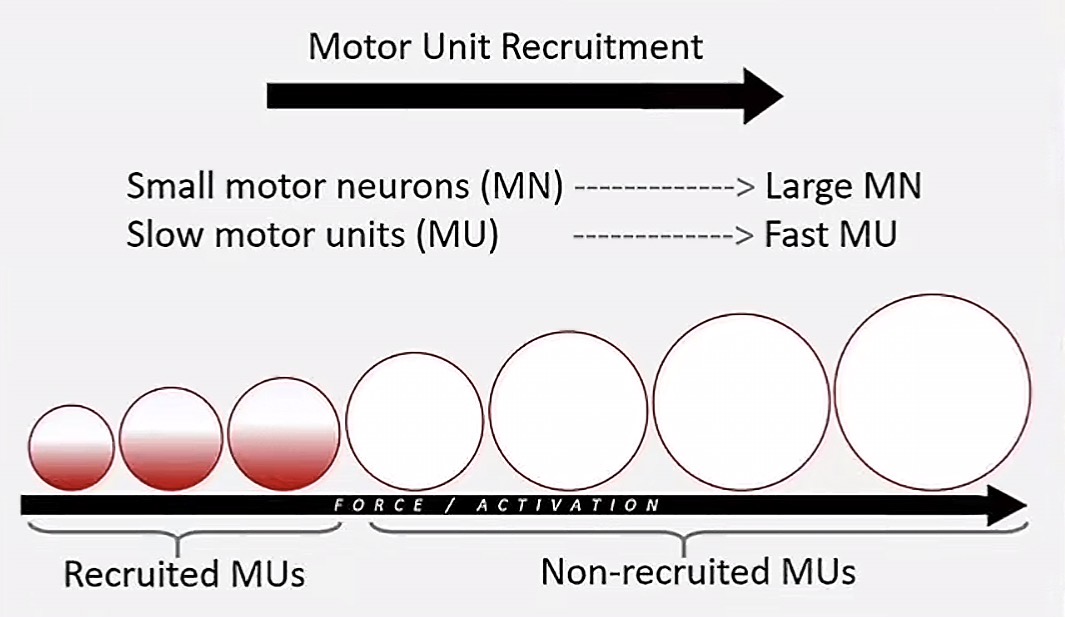
5. Recovery
I will talk here about both intra session and inter session recovery.

Intra session recovery:
intra session recovery means recovery during your workout, so mainly recovery between your sets and how to keep being recovered during your whole workout. After a set that is very hard, ATP and phosphocreatine stored are depleted, metabolic byproducts like lactate and hydrogen ions accumulate, and your nervous system become temporarily fatigued, between sets, your body partially restores these systems so you can perform the next set effectively. That’s why you need to take a long rest until your next set, if rest time is too short you start the next set too fatigued which will lead to fewer reps and your CNS will be able to recruit less high threshold motor units. so how can you be 100% recovered in your workouts? First thing is resting time between sets. Most people rest 1.5-2.5 minutes per set, which is great if you are not going hard enough lol. If you go hard enough 0-2 RIR, you will need more resting time. Without much BS: for compounds I would opt for 4-5 minutes and for single joint exercise I would opt for 3-4 minutes considering you go hard in your sets. But in general, if your heart beat (get a watch to check it) is fine and went back to normal and when you feel recovered, you can start the set before the time you have set it to. During your exercises don’t be on your phone or at least don’t do anything that distracts you and take your focus away from your next set. Also, another thing 99% of people don’t do but can make your workout much much better, is to take intra workout carbs. So a bit before you reach the half of your session, take fast digesting carbs and I would opt for 30-45 G of carbs.

Inter session recovery:
Inter session is basically between each session. You get the stimulus in your training while you build it in your recovery days. So to maximize your recovery between sessions, you need to and this will be surprising, to REST:ROFLMAO:, yeah, don’t do any thing that will make your muscles tired (as examples blue collar jobs), eat a lot of carbs (200-250g). Nothing to say really, it’s that simple.
Another thing to mention is how to know if you’re recovered. So how to know that? Simple, considering you are with the same sleep or at least in the normal sleep time range (8+ hours) and you took the same preworkout and the variables before the workouts are pretty much the same then if last workout you did for example 8 sets for chest and you come this session and your strength has dropped, then you probably did too much volume for chest last time. So what to do? Get your chest volume down (so in this case to 3-4 sets) since you probably done too many last session and you can’t recover from that. So now let’s say you dropped it to 4 sets and you start progressing faster than when you did 8 sets,then that’s a great sign and it probably means 4 is close or is the amount of sets you should be doing but that’s only is assumption, so what you should do is to try different things, if you can recover from 4 sets and you progress in this sets ranges it doesn’t mean it’s how much you should do, since you didn’t try 5 sets, so what you should do is to try 5 sets for a week or two and see if you can progress on it and you recover from it, if you do, that’s great, try 6 and so on. Same goes for going backwards, so for example going to 3 sets maybe would be better and you would do the same progress as with 3 with less fatigue. So what I would recommend it’s to experiment, everyone’s got a difference genetic and there isn’t a magical number everyone should be doing in order to make progress, so check what’s better for you.

3.Gym splits explained:
splits are probably the most common thing intermediate and new people in the gym get confused about, and i get why, there’s a lot of misinfo out there, but im here to guide you on what’s the Best split and Worst split to run as a gym goer. I’m talking about naturals here btw, if you’re enhanced then just do what ever you enjoy the most lol.

In each split I will divide into
1. What is it
2. Pros & cons
3. Best way to program it
4. When the split is best for you
5. Summary & rating (1-10)

at the end of this section i will teach you how to build your own split.


Let’s start with the most popular one that everyone are glazing but it’s the most overrated split to exist: PPL.

Push Pull Legs:
1. What is it
PPL is a split where, exactly like it sounds, will be a separated split with 3 different days who are push pull and legs. Day 1 push, day 2 pull, day 3 legs. Most people do it 6 times a week while getting 2 times frequency, which is not quite optimal, but we’ll talk about this later on.


2. Pros & cons
So, PPL like every other split, has its own pros and cons. So let’s talk about it
Let’s start with the cons:

  • frequency. Like I said before, 6 times a week and 2 times frequency is kinda ass, especially when comparing to other splits. The fact you NEED to train 6 times a week for mid frequency makes this so much worse, if you go 3 times it will be 1 time frequency which is maintenance or even less. If you have a life, don’t do this split. If you don’t wanna go 6 times a week, then there are better splits for you.
  • Possible risk of inter workout fatigue and lack of rest days. Even tho you’re not training a muscle group back to back, CNS fatigue can hinder your gains like crazy, since you’re training 6 times a week back to back, with only 1 rest day, your nervous system is overstimulated, hence even tho you didn’t train the same muscle group day after day, you still feel tired and you perform worse than usual.

Now that we went over the main cons of PPL, let’s talk about the pros:

  • No overlap between muscles and more recoverable volume intra session. You can do 3 exercises for the chest and still be able to recover from that since you have 72 hours rest till your next session for that muscle group, which is more than enough so your peripheral (local) fatigue is less demanding. You can do 3 sets of bench press in 1 workout and still recover from it unlike other splits.
  • Enjoyable. I mean, enjoyment, to an extent is the most important factor when it comes to getting gains since no enjoyment = less motivation. And PPL is arguably the most enjoyable split to do.

3. Best way to program it
Best way to program it imo, would be to go 6 times a week (duh), do it PPLPPLR, you can put the rest days wherever you want it won’t really matter that much.

For each day, that’s what I would do-

Push-
  • Pec deck/chest press
  • any incline press where you can do shoulder flexion
  • Lateral raises (choose whatever variation you would like)
  • Shoulder press
  • Tricep extension
  • JM press
Muscle groups biased- chest, shoulders (front and side), triceps.

Pull-
  • Wide grip lat pulldown (shoulder adduction)
  • Close grip row/one arm lat pulldown (shoulder extension)
  • T bar row
  • Reverse pec deck for rear delts (optional)
  • Any bicep exercise you like, you can do here, but only do one exercise.
Muscle group biased- lats, upper back (traps, rhomboids), rear delt, biceps.

Legs-
  • Leg extension
  • Hack squat (any squat variation is decent)
  • Seated/lying leg curl
  • Adduction machine
  • Calf raises
Muscle group biased- quads, hamstrings, adductors, calves.

That’s it, it’s as simple as that.
I didn’t put specific sets since it’s individual dependent and it’s not an arbitrary number that is good for everyone. I suggest you to do the amount of sets you can recover from. But I would still opt for 4-8 rep ranges since it’s objectively better.
Same as sets, there isn’t an exercises that are better for everyone, it’s also individual dependent. So you don’t have to do the exercises I mentioned here, but you at least get the idea of what it should be like.
Order the exercises based on your weak points.

4. When the split is best for YOU
I would say PPL 6 times a week is best when you enjoy it and get good gains with it, it’s not the best split to run 6 times a week, but as long as you make good gains with it then go ahead and do it. I would say if you love your spend time in the gym, this split is for you.


5. Summary & rating
Push Pull Legs (PPL) is a 3-day split where workouts are divided into push (chest, shoulders, triceps), pull (back, rear delts, biceps), and legs. Most people run it 6 days per week to achieve 2× weekly frequency for each muscle group.

The main advantages are minimal muscle overlap, good recovery between sessions for the same muscle (around 72 hours), and the fact that many people find it enjoyable to train this way. The main downsides are that you usually need to train 6 days per week just to reach moderate frequency, training only 3 days gives you only 1× frequency, and the high number of training days can cause systemic fatigue and hurt performance. Overall, it works best for people who enjoy being in the gym very frequently and can realistically train 6 days per week. Rating: 6/10.

Bro split:
1. What is it
Bro split is a split that works each muscle group in a specific day, for example, day 1: chest, day 2: back and so on. You do each muscle group once per week.
The idea is to do a lot of exercises and sets for one muscle in a single session, then give that muscle a full week to recover before training it again.

2. Pros & cons
Pros
:
  • in a bro split, you manage to do higher volume for a muscle per session and you got a whole week to recover from that muscle group as well. This split is very enjoyable for most and a lot of bodybuilders do. Except for that, there isn’t much pros, this split is pretty shit.

Cons:
  • Bro split doesn’t bring you good frequency, you will get 1 day frequency for each muscle which is maintenance level.
  • You get crazy CNS fatigue overlap since you go 5 times a week to the gym. You progress very slowly due to 1 times frequency. You go the the gym 5-6 times a week just to get only one time frequency. This can go on and on. if you want muscle growth, DONT do a bro split, it’s the worst split out there by far.

3. Best way to program it
There isn’t actually a best way to program it tbh, just program it however you want, doesn’t really matter since you will still hit a muscle group 1 times weekly. But to maximize gains with it, I would minimize the peripheral fatigue overlap, so for example do chest, then back, then triceps, then biceps, then shoulders. That way you get minimal local fatigue overlap from previous sessions.
I would do higher volume per muscle group than in normal splits since you can recover from that much better considering you get 1 week to recover till next session for that muscle group.

I would program it this way:
Day 1- Chest:
  • Pec deck
  • Chest press
  • Incline press
Day2- back:
  • Wide grip lat pulldown
  • one arm/close grip lat pulldown
  • close grip row
  • T bar
Day 3- arms:
  • Tricep extension
  • OH tricep extension
  • JM press
  • Bayesian curls
  • Preacher curl
day 4- legs:
  • leg extension
  • hack squat
  • leg curl
  • hip adduction
  • calf raises
Day 5- shoulders:
  • Rear delt fly
  • Lateral raises
  • Shoulder press
As simple as that. I would opt for 4-8 rep ranges with 0-1 RIR. Do any exercise you want it doesn’t really matter and you can do high sets, for example 4 sets per exercise will be fine and probably not so much overwhelming if you do it correctly.

4. When the split is best for you
The split is best for you if you are short on time in each day, and want to be only 30-45 minutes in the gym, aside of that, you are a retarded and this split is a fucking meme. Dont do it.

5. Summary and rating
Bro split is a training split where one muscle group is trained per day, so each muscle is usually trained once per week. The idea is to do a lot of exercises and sets for one muscle in a single session, then give it a full week to recover.
The main advantage is that you can do high volume for one muscle in a workout and many people find the split enjoyable. The main downside is very low frequency, since each muscle is only trained once per week, which usually leads to slower progress. It also often requires 5–6 gym days per week just to train each muscle once.
Programming does not matter much since frequency stays the same, but it is better to order muscles in a way that minimizes fatigue overlap. Overall rating: 3/10.

Anterior posterior:
1. What is it
anterior posterior is not so popular since it’s a new split, but I will clue you in on what it is. Anterior posterior is simply front and back side of your body, just like you split top and bottom in upper lower split, you split back and front in anterior posterior. For example, in posterior days you train the back of your body, so back, hamstrings, triceps etc. and in anterior you train your front, so chest, biceps quads etc.
This split is great for prioritizing the upper body since you train both lower and upper body in the same session so you can prioritize your upper body more by starting with it first in the session. Some people train anterior posterior with the biceps and triceps reversed, but we won’t talk about this way of training but rather the regular anterior posterior.

2. Pros & cons
Pros:
  • More upper body emphasis. When you are doing both lower and upper body in the same session, you can prioritize each one by whatever you train first. For example if you train upper body first it will get more overall stimulus and growth.
  • Can be more enjoyable for those who hate training legs. Since you hitting both upper and lower body in the same session you will find it easier to train legs and harder to skip them.
  • Good frequency, if you go 4 times you will get 2 times frequency and if you go 6 you will get 3 times frequency which is the best.

Cons:
  • You can get a lot of overlap. Since you train triceps for example on posterior days and chest in Anterior days then you can hinder your chest movements since your triceps probably are still recovering. Other than that it’s a great split.

3. Best way to program it.
Anterior posterior is a bit more challenging to program. I would start with 4 times a week and if I feel like the overlap doesn’t hinder my performance, only then I will increase to 6 times a week, if you start with it and right ahead do 6 times, you don’t know how you will react to it, you can get crazy overlap and that will fatigue your muscles like crazy, then better be safe than sorry.
I would program it this way:

anterior day:
  • Chest press/ pec deck
  • Incline press
  • Lateral raises
  • Shoulder press
  • Preacher curl
  • Crunches
  • Adduction machine
  • Leg extensions
  • Reverse grip curl (optional)
This bias the chest, front delt, side delt, biceps, quads, adductors, abs.

Posterior day:
  • Wide grip lat pulldown
  • One arm lat pulldown/close grip row
  • T bar
  • Reverse pec deck
  • Lying/seated leg curl
  • Tricep extension
  • JM press
  • Any deadlift variation/back extension
  • Calf raises
This bias the back, rear delts, triceps, hamstrings, calves and erectors.

Do each set in the 4-8 rep ranges and do the number of sets you can recover from while using 1-2 RIR.
If you feel like you recover and you don’t get much overlap, then increase to 6 times per week to get 3 times frequency. You don’t need to use the exercises I wrote here.

4. When the split is best for you
I would say that ant/post is better for those who would like to prioritize their upper body. If you hate training legs then maybe anterior posterior can make it more enjoyable for you.
This split is very special and that what can make it more enjoyable for you and that will help you with being consistent. I would suggest to try it for yourself and see if you make better progress out of it.

5. Summary and rating
Anterior / Posterior splits the body into front (anterior) and back (posterior) muscles. Anterior days train chest, quads, biceps and front delts, while posterior days train back, hamstrings, triceps, rear delts and calves.
You train upper and lower body in the same session, which allows you to prioritize muscles by training them first. It provides good frequency (2–3x per week) but can cause some overlap fatigue between muscle groups like triceps and chest. Overall it’s a solid split, especially for upper body prioritization.
I would rate it 6.5/10.

Upper Lower:
1. What is it
Upper Lower is one of the best splits to do, as a beginner and as an advanced lifter. This split, just like it sounds, split your upper and lower body in half. A typical upper lower week program will look like that if you go 4 times a week:
ULRULRR.
And if you go 6 times then it will look something like that:
ULULULR.
It’s a great split that can give you 3 times frequency and is also very enjoyable. In this split you can also prioritize both lower and upper body, you only need to do one more day of the upper or lower body and you will already prioritize them. For example if you want to prioritize legs, you can do ULULRL and if you go 6 times a week then you can just remove one upper day.

2. Pros & cons

Pros
:
  • Frequency. Upper lower has a great frequency and it can be either 4 times or 6 times a week, when 4 is 2 times frequency, and 6 is 3 times frequency which is great. That way you can do each upper and lower body 3 or 2 times per week compared to splits like ppl which will give you 2 times frequency while going 6 times a week which is pretty shit.
  • Prioritization. In an upper lower split you can prioritize either upper or lower body by doing more of the body part you want to prioritize.
  • More flexibility. Since you have only 2 different days throughout the week you can be more flexible in comparison to PPL which you have 3 different days. This makes it a bit easier to fit this split into your schedule.

Cons:

  • Upper days can be way more fatiguing than lower days. Since you squeeze your entire upper body into one day, it can take longer than lower days (not much longer), which can be more fatiguing than lower days.
  • If you have a busy schedule, upper lower might not be the best split for you. Since the sessions can take too long (1.5+ hours) it can be too much for some people.
  • Inter workout fatigue. Since you go 4/6 times per week and your session are very long and fatiguing, it can make you very fatigued over the week and that’s why I opt for starting 4 times a week and session how you recover from there.

3. Best way to program it
Upper Lower is one of the easiest splits to program since you need to only consider your upper and lower body when doing so.
You can choose wether you want to do it 6 or 4 times a week based on what you progress and recover best from. To minimize fatigue on upper day I would suggest you to do any dead lift variation and crunches (for abs) on lower days.

Upper day:
  • Lateral raises
  • Pec deck
  • Incline bench
  • T bar row
  • Wide grip lat pulldown
  • Tricep extension
  • JM press
  • Preacher curl
Muscle group biased: side delts, chest, upper back, lats, triceps, biceps.

Lower day:
  • Leg extension
  • Hack squat
  • Lying/seated leg curl
  • Adduction machine
  • Hip hinge
  • SLDL/45’s
  • Crunches
Muscle groups biased: quads, hamstrings, adductors, glutes, erectors, abs.


i would start with 1 set for each exercise and if you see you recover from that then only then add 1 set in specific exercises, not in each one. I would add 1 set for the exercises that you want to prioritize. Like I already said millionth time, these exercise are an example, it doesn’t mean you HAVE to do these ones specifically, you can but you don’t have to.
Do each set in the 4-8 rep ranges and use RIR, I would personally do 0-2 RIR based on how fatiguing that exercise I’m doing the set on is.

4.When the split is best for you
I would say U/L is best for those who like to spend time in the gym and for those who want to be a bit more “optimal” ( I put “ since optimal can mean several things). I would opt this split for intermediate and for advanced lifters since for new beginners this might be too fatiguing. Upper lower is very balanced as well, you get more or less the same gains for your upper and lower body (considering you train them both as hard).

5. Summary and rating
Upper/Lower is best for people who train consistently and don’t mind longer sessions. It’s usually better for intermediate and advanced lifters, since beginners may find it too fatiguing.
It’s also a very balanced split, giving similar development for upper and lower body unless you purposely prioritize one.
I would rate it 7.5/10.

Full Body:
1. What is it
So. Yh, just Ike it sounds full body is a split that trains all the muscles in your body in one session. that aims to maximize the benefits of training frequency while being in the gym for as little as possible. Since the first set of each workout is the most stimulating set, and every set done after that set will be gradually less stimulating, a split that gives you a lot of frequency will be highly effective. You can do FB either 3 times a week or EOD, EOD is more effective for hypertrophy since you get 3.5 frequency compared to 3 times a week which you get 3 times frequency.

2. Pros & cons

Pros:
  • High frequency. In a full body split, you get 3 times frequency while going only 3 times a week and 3.5 frequency if you go EOD. This makes FB by itself the best split for frequency since you go as little as possible to the gym and get high frequency for each muscle.
  • Great for each “level” of trainers. Full Body is great for beginners, intermediate, and advanced lifters since it’s a very simple split which people can be very flexible with considering you can even go 2 times per week and still get 2 times frequency for each muscle.
  • Good for people with busy schedule. Since you can still go 2-3 times per week and get high frequency for each muscle. So people who have a busy schedule and can’t go too much to the gym, a FB split can be the best solution for them since it also got a lot of rest days.
  • You never atrophy on it. Since you hit each muscle every 40-48 hours, you never get the chance of atrophy. Atrophy happens after 48 hours of training the muscle, in FB, it doesn’t since you hit each muscle group EOD (depends).
  • You got more “first sets”. More first sets basically means more stimulating first sets. Like I already explained, your first sets in a workout are the ones you stimulate the most from and in full body you got more of them.
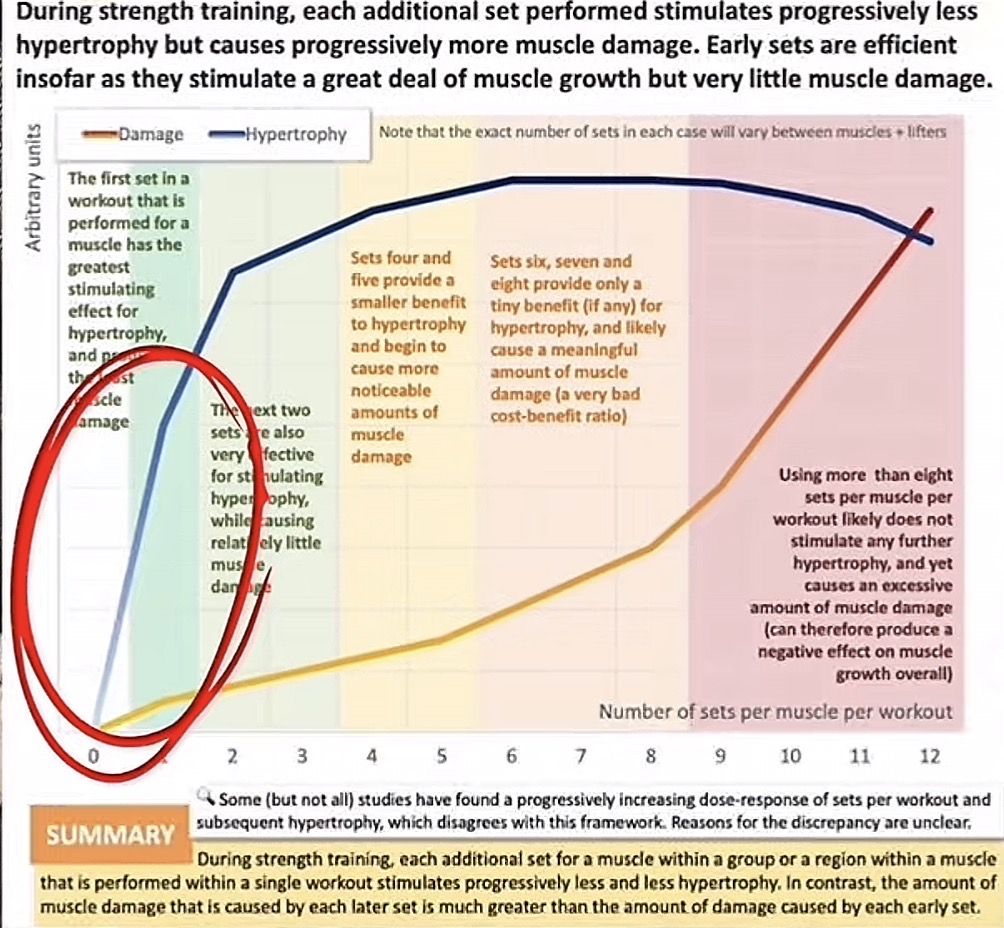
View attachment 4757952

Cons:
  • Sessions can be too long for some. If you are not locked in on your pre and intra workout carbs, a FB session can be very fatiguing and just useless. Thats why you need to perfectly program it for YOU, what you recover from what you progress faster on etc. that can means your later sets will only add more fatigue and little to no stimulus.
  • very easy to fatigue. when you are squeezing your whole body into 1 session it can be quite fatiuging if you dont know how to program it perfectly for you

Aside of this, it’s a great split and probably is objectively the most optimal one.

3. Best way to program it
FB is a complicated split to program since it’s very easy to fatigue intra workout and you need to experiment what’s better for you. You can choose whether to do it EOD, 3 times per week or 2 times per week. It really depends on you and what you enjoy the most or recover best from. I would suggest to order your weak points first in the session and vice versa. I would opt for more compounds exercises and less single joints ones only for those who are short on time and want to finish the workout asap. For those who can be 1.5-2 hours in the gym, I would suggest to do as little compounds as possible since it will be very fatiguing.

A typical FB program would look like this
  • Pec deck/chest press
  • Incline press (optional)
  • Lateral raises
  • T bar row
  • Wide grip lat pulldown
  • Tricep extension
  • Shoulder press (optional)
  • Leg extension
  • Hack squat
  • SLDL/45’s
  • Adductors
  • Leg curl
  • Calf raises
  • Crunches
I would do each set in the 4-8 rep ranges and do each exercise for 1 set, if you see you recover from it, then you can increase some exercises to 2 sets. Just see what joint action each muscle do then search for exercises that do that joint action and choose the most enjoyable exercise for you. Use 1-2 RIR, even if the exercise is a single joint exercise don’t go to failure, this will still fatigue you a lot.

I would opt for taking 50-80 g of carbs as preworkout, 30-50 g of carbs in intra workout, and post workout 40+.

4. When the split is best for you
Like i already mentioned before, this split is great for those who want to maximize muscle growth, those who don’t have much time and have a busy schedule.

5. Summary and rating
Fullbody is a split where you train all muscles in one session to maximize frequency while spending minimal time in the gym. It works 2-3 times per week or every other day for slightly higher frequency. It’s great for beginners through advanced lifters, busy people, and anyone wanting to prevent atrophy because muscles get hit often. The downside is sessions can be long and fatiguing if not fueled or programmed correctly, with later sets giving diminishing returns. Program by hitting weak points first, prioritize compound lifts if short on time, or include more isolation if you have 1.5-2 hours, using 1-2 sets per exercise, 4-8 reps, and doing 1-2 RIR. Pre, intra, and post-workout carbs help recovery. Best for people wanting maximum growth efficiently and with limited gym time.
I would rate it 8/10.

how to program your own gym split :
There are a couple of steps you you need to follow in order to build. Gym program specifically for you and what you enjoy the most.

Step1. You can either build your own split which I advise you not to do it since you won’t invent the wheel by doing so, someone thought of the split you think of doing now before you and he had shitty results, stick to the basics. Now choose a split you enjoy the most and get minimum 2x times frequency for minimizing atrophy.

Step 2. Exercise selection and Exercise order. After you chose your exercises, you need to put the in a specific order. Put your weak points in the start of the workout and strong points at the end of it. try doing isolations (single joint exercises) first and compounds last.. Choose your exercises, you need to know what each muscle joint action is doing in order to look for the exercise that will bias the goal muscle. try to minimize your compound exercises.
before we get into which exercise to use based on joint actions, we need to know how to choose each exercise, so how?
check list for your exercises:
are they stable?
when an exercise isnt stable the goal muscle we are trying to bias get less targeted since our body sends more motor units to other places instead of only for the muscle we are trying to bias, so that muscle get less high threshold motor units command. for example, in squats we are not stable at all so the body sends more signals to other places in the body rather than focusing more on the goal muscle in the exercise (quads in this case), and compared to a squat variation that is more stable like hack squat which the quads work better in since its much more stable.
theyre easy to set up? in a session we want to minimize fatigue as much as possible, so the main thing we want to focus on is too spend as little time in the gym as possible, so when an exercise takes too long to set up, you end up spending more time setting up that exercise rather than actually doing it. now, it doesnt mean you shouldnt do ANY exercise that takes too long but try to minimze these exercises as much as possible.
you do the correct ressistance profile for that exercise. so what is resistance profile? resistance profile of an exercise is the change of resistance throughout the range of motion of a movement. the most common ascending profile are ascending where an exercise starts of easier and gets harder and descending where it starts out harder and gets easier throughout the ROM. why does it matter to apply the correct resistance profile in each exercise? when doing an exercise where there are multiple joint actions or multiple muscles active, the resistance profile of the exercise can determinate what muscle youre biasing if you have peak tension wherever it has mechanical advantage ( produces the most force compared to other active muscles ). for example this can be seen through your curl variations when using dumbbells it will have peak tension parallel to the floor.
and where it doesnt matterfor exmaple is in leg extension as in leg extension as only the quad muscles are active meaning they dont have to compete with any other muscle.

Joint actions:
Side delts - shoulder abduction.
Movement- moving the arm away from the body.
Exercises- Lateral raises are doing this action.

Upper back- scapula elevation & retraction.
Movement - moving the scapula back and up.
Exercises- Kelso shrug and T bar row aid in this joint action.

Lats- shoulder extension (sagittal plane) and adduction (frontal plane). shoulder extension aid in moving the arm from up (in my case) and towards the body with tucked elbow. Shoulder adduction aid in moving your elbows in the frontal plane to the side of the body with a straight torso.
Exercises-Sagittal Keenan flap for shoulder extension and wide grip lat pulldown to shoulder adduction.

pecs- shoulder horizontal adduction and shoulder flexion.
Movement - moving the arm upward and inward your torso with tucked elbows.
Exercises- smith machine supinated grip.

Quads- knee extension, hip flexion.
Movement- kicking with the leg (knee extension) and pushing the floor with the legs (hip flexion).
Exercises- leg expression, back squat.

Hamstrings- knee flexion, hip extension.
Movement- moving the leg in the opposite way of leg extension.
Exercises- lying leg curl.

Adductors- adducted thigh.
Movement- adduction the limbs towards the body.
Exercises- adduction machine.

Calves- ankle plantar flexion.
Movement- going upward with the ankle.
Exercises- standing calf raises.

Triceps- elbows extension.
Movement- extending the elbow down without moving upper arm and while it being tucked.
Exercises- cuffed tricep extension when the arm is in the 90° range (so cable is aligned with the shoulder).

Biceps- forearm supination while the elbow is flexed (elbow flexion).
Movement- curling the weight in a 45° - 90° angle.
Exercises- preacher curl.

Front delt- shoulder abduction/flexion.
Movement- moving the arm away from the body in the top half ROM of shoulder press.
Exercises- shoulder press.


Step 3. Volume. You need to find your MAV (maximum adaptive volume), you can find it by experimenting with your volume and seeing what works best for you. It depends on your split really, but for most I advise for not going past 2 sets in each exercise and doing each set in the 4-8 rep ranges with 1-2 RIR to minimize fatigue.

4. Common gym myths:
I this section I will mention common gym myths and bust them. Most people are falling for a lot of misinformation about the gym and I can’t blame them, when you see jacked people telling you to do stuff you think it’s true since it probably worked for them, so no. It’s not the case at all. I always say to DYOR before trying things out.
The main gym myths we are going to vault to in this thread are:
1. Bulking
2. Losing muscle while cutting is normal
3. You should prioritize protein


1.Bulking
:
Yes, bulking as a natural guy is one if NOT the most retarded thing someone in the fitness industry can do, and the worst part is that most lifters don’t even know that, in this thread I will give thoroughly about bulking and why it’s 100% vaulted.

I will make a few sections so you will beter understand
  • Why Bulking is vaulted and why the idea to bulk is redundant
  • What actually creates stimulus
  • When you SHOULD bulk?
  • TLDR

Why bulking is vaulted and why the idea to bulk is redundant
I’m sure you already heard that stupid phrase of “pick up the fork if you want more muscle mass”, which is true to an extent but being in a calorie surplus does NOT, and I will say again does NOT cause more muscle growth in any case (except for specific one that I will mention later).
Ever wondered why the bulk/cut cycle became popular ever since the roids became more popular as well in the body building industry ?
The idea of the bulk is to eat in a calorie surplus (between 250 to even 1,000 in some stupid cases) to give you more “energy”. the idea of eating more for more energy is definitely true, but you definitely do NOT need a surplus to have a better performance at the gym.
So, why bulking is vaulted exactly? Simple-
muscle gain is an not energy-dependent process, it’s a stimulus dependent process. muscles does require a bit energy but that amount is low, the higher end estimates that the maximum surplus you should reach for is 100-200 per day.
There is no biological mechanism that turns extra calories into muscle mass, and myofibrillar muscle protein synthesis won’t increase just because you’re in a surplus. You really think that if you ate that extra pack of Oreos you will get more muscle mass? Are you hearing yourself?
Anything beyond 100-200 calorie surplus will only result in more fat not more muscle mass and energy (100-200 surplus is also redundant but not as risky for your body fat as more than it does, also on paper you won’t actually reach 100-200 surplus you will probably eat less than that so you’re fine). The amount of fat gain you will gain in comparison to the muscle mass will get is crazy since you won’t get anymore muscle mass and only fat. so in the long term this will only hinder your progress in the gym not accelerate it since you will also spend another few months in a calorie deficit which makes you a bit more vulnerable to atrophy. So for exchange of no benefit in terms of muscle growth, the surplus will lead you to being in a calorie deficit during which you will get muscle slower.

What actually creates stimulus
the simplest thing ever- Mechanical Tension is the ONLY thing that will make your muscles hypertrophy.
For those who don’t know why machanical tendon is, it’s simply the pulling force your muscle fibers experience during slow
contractions. As velocity decreases, fiber force increases. (Inverse relationship).
During slow velocity contraction speeds, fibers has the most action-myosin crrosbridges- basically the most amount of force.
The force velocity curve (I already showed this earlier)
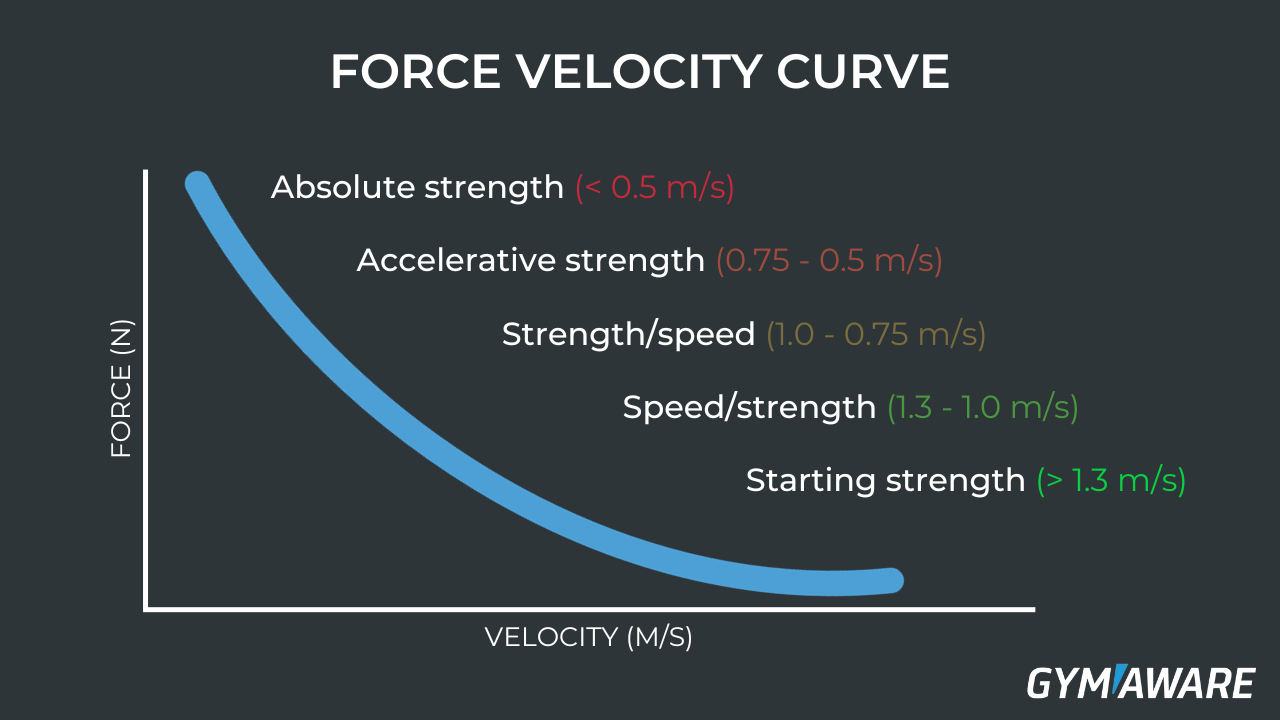
IMG 5321
So how does MT create hypertrophy - it’s basically the stimulus that tells your body to add contractile tissue, mechanoreceptors within the muscle fibers detect MT, causing a series of signals that ultimately produce growth by increasing protein synthesis rate.
Heavier weight ≠ more mechanical tension btw, MT only exists on the force velocity curve, load doesn’t matter as long as contraction speed is slow. I’m not saying you shouldn’t lift heavier loads, heavier loads are helpful for other reasons. Mechanical tension and motor unit recruitment are 2. Different things.
For example, if I press a barbell with 5 kg each side (so 30 kg in total) but in slow velocity, will it create high fiber force ? The answer is yes since there is a slow contraction velocity. Don’t confuse MT with MUR.
So to clarify, you won’t grow if you only do slow contractions with light loads, This will only stimulate the active fibers, which will not be enough for growth because you are so low in the motor unit pool due to low effort.
BTW, micro tears do NOT mean more muscle gain it’s actually the opposite.


When you should bulk:
so now that we covered what actually creates stimulus and why bulking is vaulted, let’s talk about when you DO need to bulk.
Let’s keep it simple- you should bulk only when you’re either starting the gym as an underweight guy (below 17 BMI) or as an enhanced guy, why?
As a skinny guy (below 17 BMI), you are in a state where you don’t function well because your calories are so low so you don’t have energy, which will hinder your progress like CRAZY. Imagine training on 1 hour of sleep, that’s how it basically feels…

As an enhanced guy, literally everything you do will make your muscles grow like crazy, but when bulking you can basically make those extra 250-600 calories of surplus efficient for muscle mass because your MPS is elevated 24/7, I won’t get to it too much since I’m talking mainly about naturals here, but you get the point.
TL;DR

Muscle growth is driven by training stimulus (mechanical tension), not by eating in a large calorie surplus. Extra calories don’t directly increase muscle protein synthesis. After a small surplus (~100–200 kcal at most), additional calories mainly increase fat gain.
It goes in this order:

1.Large bulks unnecessary fat gain
2. longer cutting phases
3. slower overall progress.

You should only intentionally bulk if:
You’re underweight (very low BMI) and lacking energy and/or whenYou’re using anabolic drugs, where elevated muscle protein synthesis makes larger surpluses more effective. For most natural lifters I would advocate training hard, recover well, and eat around maintenance or a very small surplus/deficit depending on your goals.
2.losing muscle while cutting is normal:
I guess you heard this sentence at least a couple times in your training lifespan and it’s actually not that redundant, but people actually treat it as a binary state, as you will will lose muscle mass on a cut 100% without looking at the objective. While losing muscle on a deficit is actually easier than when at maintenance, it doesn’t mean losing muscle mass is something you don’t need to worry about.
To clarify again, I’m taking about natural lifters (obviously). Some mistakes new lifters have is that they think they lost a lot of muscle in their cut while they just didn’t have any significant muscle to begin with, so if you’re not a new lifter you SHOULD worry about losing muscle in a cut.

I will make a few sections so you will understand it better:
  • Why losing muscle, strength in a cut is not normal and shouldn’t be something that is obvious to you.
  • How to properly programm your cutting phase
  • TL;DR

Why losing muscle, strength in a cut is not normal and shouldn’t be something that is obvious for you
Why losing muscle, strength on a cut shouldn’t be something that is normal to you
losing muscle and strength in a cut is something that is very easy to do and very easy to avoid as well as long as you program your diet and cardio better.
Losing muscle and strength on a cut probably means you’re either going for more than 700 calorie deficit Which is a lot or not getting enough carbs (yes carbs are that important). For knowing how to cut properly you need to find your tdee (look in google), it’s never too realistic but it can give you a good idea of how many calories you should eat daily (I will talk about it more throughly the next section).
As long as your calories are not at the floor and you’re taking your preworkout carbs you WONT lose strength and muscle.

How to properly programm your cutting phase:
Ts is literally the easiest thing ever, all you need to do is to :
1. find your TDEE (go to google search) and then fill your stats. I will give you an idea of how it should be after you fill your stats -
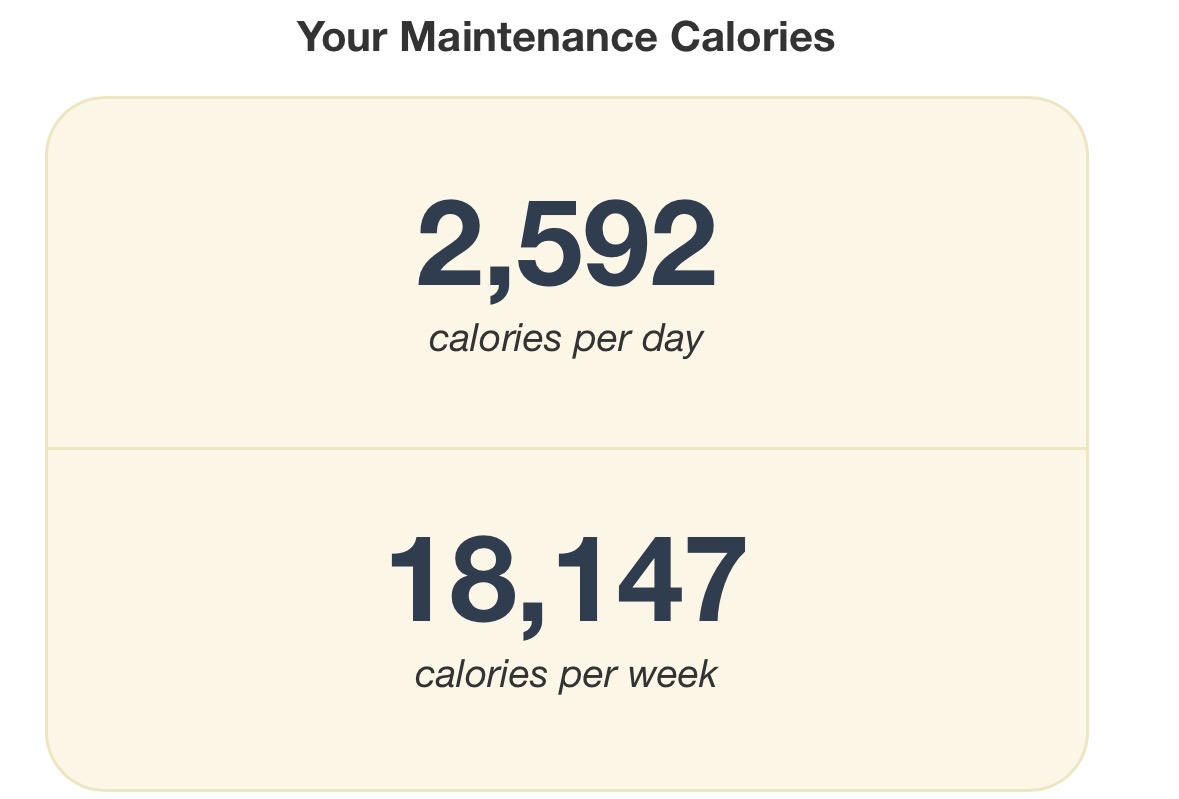
IMG 5324
After you found your calorie maintenance (it’s never accurate remember) you will need to remove calories by how fast you want it, for example doing a 600 deficit will result in you eating roughly 2,000 calories which is a moderate cut, by then just experiment what’s best for you etc etc.

2. Do cardio, cardio is not just running or doing HIIT, it’s also doing bunch of steps daily and being on the stair master. So for example I do 15,000 steps minimum daily and it’s easy asf tbh, I counted it and every 10 minutes I walk 750-900 steps ish.

3. COUNT YOUR CALORIES, it should be fucking obvious, right? You should know what you’re getting in your body and what are the macros, kinda reasonable right?

4. Carbs>protein, I will talk about this more throughly in the next main section but you need to understand going over 30% of protein from your calories is just redundant.
Less protein, more carbs, especially before a workout. Leave room for carbs

TL;DR:
Losing muscle and strength on a cut shouldn’t just be something you accept. Most of the time it happens because you’re cutting way too hard or you dropped carbs too low and now your workouts suck.

If you’re in a crazy deficit, yeah, your lifts are going to go down. A cut doesn’t need to be extreme. Just find roughly where your maintenance is and eat a few hundred calories below that. Don’t eat too less. Move more during the day. And actually track what you eat so you’re not guessing.

Keep protein moderate, but don’t go so high. Carbs are your best friend . If your workouts stay strong and you’re not starving yourself, you shouldn’t be watching your muscle atrophy.
3. Prioritizing protein
Prioritizing protein as a natty gotta be the worst brainwashed thing after religion.
I will make three sections:
  • Why prioritizing protein is vaulted
  • Why carbs>protein
  • TL;DR

Why prioritizing protein is vaulted :
No, more protein≠faster muscle gain and more muscle gain.
Why is that?
Your body has a plateau for how much protein it can absorb, for 99.9999% of people eating more than 140 grams of of protein (considering they’re natural) will only give them useless calories that they could instead exchange with carbs (which is FAR more beneficial for muscle mass). Your MPS has a certain point (plateau) where after specific amount of protein is absorbed, it won’t contribute to anything except for MAYBE, just maybe some energy which carbs are better for anyway. So once you hit that plateau it doesn’t cause further hypertrophy, you’re just eating pointless calories atp.

People overrate protein SO FUCKING MUCH.
You need to eat your minimum effective dose of protein and leave the rest of your calories for carbs which are FAR MORE IMPORTANT FOR BUILDING MUSCLE, so stop overeating protein and torturing yourself and start eating more carbs.

Why carbs>protein:
so why? Stimulus happens in the gym, so you need to maximize that to have the best stimulus you can achieve while you’re in the gym, so how do you maximize that? It’s simple- YOU PRIORITIZE CARBS. Also, don’t you find it easier to eat carbs then to force feed yourself with breast chicken ? So how do you carb max? Your macros should be 50-60% of carbs and the rest are protein and fat. Just eating carbs through the day is not enough tho, to fully maximize your workout, you will need to have 2/3 phases of carbs absorption:

1. pre workout carbs which will help around 60-80 g of carbs (don’t do 1g of carb per kg plz), that will give you fuel for the workout
2. but that’s not enough if your workout is more than 1 hour and 30 minutes
then you will need to also add intra workout carbs (IWC) which will give you fuel for THE WHOLE workout. I would opt for absorbing them 10 minutes before halfway the workout ( for example if your workout is 2 hours, absorb them when you reach 50 minutes), and it HAS to be fast digesting carbs (low GI, low fat) so gummies imo is the best but rice cakes is good too just eat what ever Is more comfortable for you.

3.And lastly, your post workout carbs (PWC), this is not mandatory but it’s better especially for people who run a high frequency program since it will reduce the post workout fatigue which will eventually let you push yourself harder in the gym the next session, I would opt for 40-50 g of carbs.

TL;DR:
More protein doesn’t automatically mean more muscle. Your body can only use a certain amount to stimulate growth, and once you hit that level, adding more just gives you extra calories, not extra gains. As long as you’re eating enough protein to cover your needs, pushing it higher doesn’t speed things up. Find your minimum effective protein intake and eat it.
Carbs are just as important, if not more for actual progress because they fuel your workouts. Better fuel means better performance, and better performance means better stimulus for growth. If your training suffers because carbs are too low, muscle gain will suffer too.
So instead of obsessing over extremely high protein, hit a solid amount, then prioritize carbs to support training, recovery, and overall performance.

5. Nutrition for the gym:
Nutrition is probably the most talked about topic in the fitness industry but still somehow very confusing and I can’t blame those who get confused, there is a lot of misinformation and misunderstanding when it comes to this topic. But nutrition is as if not more important than working out and the crazy part is that most people are eating like shit, then feel like shit and look like shit, guess why?


So in this section I will guide you on nutrition and everything you need to know about it.
I will do sections that will explain nutrition thoroughly.

1. Why nutrition is crucial for muscle mass
2. Calories
3. Macro & micro nutrients

1. Why nutrition is crucial for muscle mass
Nutrition is what allows your body to build muscle, recover from training, and perform well in the gym. Training provides the stimulus for growth, but without proper nutrition your body simply doesn’t have the resources to adapt. Food also provides energy for training. Most of this energy comes from carbohydrates (we will talk about this later) stored in the muscles as glycogen. If glycogen is low, strength, endurance, and training performance drop significantly.
Nutrition also plays a major role in recovery. Adequate calories, protein, carbohydrates, fats, vitamins, and minerals help reduce fatigue, replenish glycogen, support hormone production, and allow muscles to repair between workouts.
2. Calories
Calories are one of the most important factor for your results in the gym. Whether your goal is to lose fat, maintain your weight, or gain muscle depends on your current body composition and how many calories you eat.
The first step is to find your maintenance calories. You can use a TDEE calculator by entering your age, weight, height, and activity level. This will give you a starting point for your maintenance. The most accurate method is to track your calories and your weight for one to two weeks. If your weight stays stable during that time, those calories are your maintenance.
Once you know your maintenance, you can decide your goal. If you want to cut fat, you should eat below maintenance, typically around 300 to 500 calories less per day. Cutting is appropriate if your waist is growing, your abs are not visible, or your body fat is higher than you want. Eating around maintenance is ideal if you are in a healthy body fat range, approximately 12 to 15 percent, and want to maintain your current weight. If you are lean, under around 12 percent body fat, and your abs are visible, a slight surplus of 100 to 200 calories per day above maintenance is a good strategy to gain muscle without adding unnecessary fat.
It is important to check your body and not rely solely on numbers. BMI can serve as a rough guideline. A BMI below 18.5 usually indicates you are underweight and may benefit from bulking. A BMI between 18.5 and 24.9 is considered normal and suggests that maintaining or doing a lean bulk is appropriate. A BMI over 25 often means you should cut. Keep in mind that BMI is not perfect because it does not distinguish between muscle and fat. Visual assessment is crucial. If you cannot see your abs, your veins are not visible, or you just look fat overall, cutting is recommended. If you appear very lean but struggle to gain strength and muscle, a bulk may be necessary (CONSIDERING THE LIMITING FACTOR IS YOUR DIET AND NOT ANYTHING ELSE LIKE YOUR SLEEP, TRAINING PROGRAM etc).
You should adjust your calories as you go. Track your progress weekly and make small adjustments rather than large ones. This way you ensures that your diet supports your training and body composition goals while minimizing unnecessary fat gain or muscle loss.
3. Macro and micro nutrients
For those who can’t differentiate between them, it’s simple-
macros = fats, carbs, protein.
Micros = vitamins and minerals.

So I will divide this into 2 subsections which are micros and macros.

Micronutrients:
Micronutrients are the vitamins and minerals your body needs in small amounts to function properly. They are critical for performance, recovery, hormone balance, and overall health. Even if your calories and macros are on point, a deficiency in micronutrients can limit your results and leave you constantly fatigued or under-recovered.
So what are they?
Vitamins are organic compounds your body mostly cannot produce on its own, so you must get them from food. Each vitamin helps with different things, for example: Vitamin A is important for vision, immune function, and cell growth and can be found in liver, carrots, sweet potatoes, and dark leafy greens. Vitamin C supports collagen production, acts as an antioxidant, and aids recovery, and is found in citrus fruits, peppers, and broccoli. Vitamin D is crucial for bone health, immune function, and testosterone production, and can be obtained from sunlight exposure, fatty fish, and fortified foods. Vitamin E is another antioxidant that protects your cells and is abundant in nuts, seeds, and vegetable oils. Vitamin K is essential for blood clotting and bone health and is found in leafy greens, broccoli, and fermented foods. B vitamins, which include B1 through B12, help convert food into energy, support red blood cell production, and maintain nervous system function. They are found in whole grains, meat, eggs, dairy, and leafy vegetables.
Minerals are inorganic elements required for essential bodily functions like muscle contraction, nerve signaling, fluid balance, and enzyme activity. Calcium supports bones and muscle contractions and is found in dairy, leafy greens, and fortified foods. Magnesium is involved in hundreds of biochemical reactions, including energy production and muscle relaxation, and is found in nuts, seeds, and whole grains. Sodium and potassium maintain fluid balance and proper nerve and muscle function, and are found in salt, bananas, potatoes, and vegetables. Phosphorus contributes to bone structure and energy metabolism and is present in meat, dairy, and beans. Iron is critical for oxygen transport and energy levels and is found in red meat, legumes, and fortified cereals. Zinc supports immune function, hormone production, and protein synthesis, and can be obtained from meat, shellfish, and seeds. Other minerals like copper, sulfur, and fluoride play specialized roles in enzymes, tissue repair, and bone health.
Micronutrients matter for training because deficiencies can slow recovery, reduce strength gains, lower energy, and impair hormonal function. Iron deficiency can cause persistent fatigue, while low vitamin D or magnesium can affect testosterone and muscle function. B vitamin shortages can make energy production less efficient, leaving you drained during workouts. The key is consistency. Eating a variety of colorful vegetables and fruits, incorporating dairy, nuts, seeds, whole grains, meat, eggs, and fish ensures you cover most vitamins and minerals. If your diet is limited or you suspect deficiencies, a basic multivitamin or targeted supplements like vitamin D, magnesium, or zinc can help, but they are only a backup to a nutrient-rich diet. Think of micronutrients as the foundation for everything else in your training. Without them, protein, carbs, and training stimulus cannot reach their full potential.

Macronutrients:
So, macros are MUCH more simple to understand.
Macros are basically just fat, carbs and protein. Like you already know if you read the whole thread, that I promote carbs over protein. first, you need to realize what each macro is doing-
so like I said macros are fats, protein, and carbohydrates, they are the three main macronutrients, and each plays a unique role in your training and overall performance. Fats are essential for hormonal regulation, including testosterone and other key hormones that influence muscle growth, recovery, and energy levels. Including healthy sources of fats like olive oil, nuts, seeds, and fatty fish helps you feel stronger, maintain stable energy, and perform better in the gym. Protein is the building block of muscle. It stimulates muscle protein synthesis, which is the process your body uses to repair and grow muscle fibers after training. Getting enough protein from sources like meat, eggs, dairy, and legumes ensures your muscles recover efficiently and grow over time. Carbohydrates are your body’s primary source of energy, especially for high-intensity workouts. They fuel your muscles, help maintain performance during training, and aid in recovery by replenishing glycogen stores. Prioritizing carbs from whole grains, fruits, and starchy vegetables allows you to train harder, recover faster, and get the most out of your workouts.

Each macros calories are-
Protein: 4 calories
Carbs: 4 calories
Fats: 9 calories

How much of each should you consume ?
Simple-
Let’s give an example of someone who is 70 kg and his LBM is 60 kg.
I would consume 1.5-2 grams of protein per kg of Lean Body Mass, so if your LBM is 60kg, consume either 90/120 grams of protein.
Let’s say that individual is eating 120 grams of protein that means he’s eating 120x4=480 calories from protein only.
Then I would opt for him to eat 40-50 grams of fat daily, which is 50x9=450, so that’s 450 grams of fat only.
For carbs, I would fill the rest, considering he’s eating at maintenance and let’s say it’s 2,500, so he needs to fill the rest of the calories (fat and protein are 930 calories) so 2,500-930=1,570, so if we divide 1,570:4 that will equal to 392-393 grams of carbs, which is great. So we got
Fat: 50 grams
Protein: 120 grams
Carbs: 393 grams

In % it’s
fat: 18%
Protein: 19%
Carbs: 63%

Timing and meal distribution:
that’s what I would do personally

Morning: focus more on fats and protein.
Noon: focus on carbs and protein, and a bit of fats.
Preworkout: mostly carbs, aim for 1g per kg of body weight.
Evening: mostly fats, carbs and a bit of protein.

It doesn’t matter that much when you eat your fats and protein, but keep space for carbs when it’s 3-4 hours preworkout. Dont eat a lot of fats before a workout since the carbs will digest much slower.

In case you didn’t already read the intra workout and post workout carbs beforehand, then you can also use carbs intra workout and post workout to maximize recovery and energy during your workout and after it.

6. Natty Supplements & PEDs:
so, now comes the interesting part of the thread LOL, this became very popular in recent times. I will mention here what cycles you should do, and what natty supplements you can take if you want to maximize your gym performance and overall gains.

I will divide this into two parts, 1 is the supplants and 2 is the PEDs.

1. Supplements

Supplements for the gym is great, since it can help you push a little further than your body normally can. I will list all the supplements you should take if you want to maximize hypertrophy.

  • magnesium glycinate- relieves stress, help sleep and help with heart health. I would do 200-400 mg, it’s individual dependent.
  • caffeine- help with perception of effort by reducing it which allows you to train harder and stay focused during the workout. Take 3-6 mg of caffeine per kg of body weight as a pre workout. Dont consume 10 or less hours before going to sleep.
  • melatonin- not for the gym but it’s great for helping with sleep quality. I would opt for 2-15 mg depends on what works best for you. Take it 30 minutes before sleep
  • Creatine- great, S tier supplement, has no side effects and is the most researched compound ITW, I suggest you to get 5-10 grams of it daily and it doesn’t matter much when you take it. It will give you a small boost in training and it’s great for your brain as well
  • zinc- can boost your test and it activates enzymes for MPS (muscle protein synthesis). I would opt for 50 mg.
  • Electrolytes- makes you hydrated, when you are hydrated you are performing much better and taking electrolytes before the gym with your preworkout is great, also consider to take it intra workout if you sweat a lot
That’s the main ones I recommend using. Now let’s move to the PEDs.
2.PEDs
PEDs are not something you should jump into if you don’t know what you’re doing and you didn’t DYOR. I will divide this into a couple of subsections:

1. What you are going to use
2. Precautions + ancillaries
3. How to structure the cycle

1. What you are going to use
If you are a beginner, the goal should be to use the most studied and predictable compounds while keeping side effects manageable. Advanced users already know how to structure cycles, so this section is only focused on a first or early cycle.
For beginners, the main compounds you should be looking at are test E, hGH, and possibly a mild oral like anavar for cutting at the end of cycle. The reason these are chosen is because they are relatively predictable compared to harsher compounds. Compounds like tren are extremely powerful but come with severe side effects and should not be touched by beginners.
Test should always be the base of a cycle. Without a test base you risk severe hormonal suppression and other problems. hGH can help with recovery, connective tissue health, and body composition, while Anavar is often used because it is one of the milder oral steroids with relatively manageable side effects compared to most other orals and is good for cutting.
2. Precautions and ancillaries
Ancillaries:
For hair protection many people try to mitigate androgenic hair loss by blocking scalp DHT or androgen receptor activity. Common things used include topical anti‑androgens like RH, DHT inhibitors such as duta, and hair growth stimulants like topical minoxidil.

For acne just use accutane.

For estrogen control you sometimes need an aromatase inhibitor, since testosterone converts into estrogen through the aromatase enzyme.

For testicular function during cycles some people use gonadotropins like HCG or HMG to keep the testes active and maintain fertility signals.

For cardiovascular health
Bloodwork: you should get bloodwork before, a few weeks after, mid cycle, at the end of it and after it. That way you can know what ancillaries you should use, so for example if E2 is too high, up or if you didn’t already use it use an AI to mitigate the high E2 side effects.
Check those:

hormones: total testosterone, free testosterone, estradiol (E2), LH, FSH, SHBG, and prolactin to see suppression and estrogen levels.

liver enzymes (ALT, AST), since you use anavar and accutane which are liver toxic.

kidneys with creatinine and BUN.

cardiovascular risk with a lipid panel: total cholesterol, LDL, HDL, and triglycerides.

blood thickness: hemoglobin, hematocrit, and red blood cells.

If using an hGH also check your igf1.

PCT: from what I’ve seen, there isn’t much data about PCT other than anecdotal reports. I concluded that it’s not necessary and your natural hormone levels will come back to normal a month or two post cycle. HCG is the only thing you should be running.
3. How to structure the cycle
First, you need to know for how long you will be doing it, I opt for 16-20 weeks, after that myostatin levels rise and your gains are just at a plateau.
Let’s say you do it for 20 weeks. You will be using test, anavar and hGH. Dont do too much compounds. You will bulk thought the cycle as well to keep as much muscle mass as possible (yes, bulking on cycle is optimal)


Test E should be injected once per week, but you can also inject half of the goal dose twice per week which can make it more effective.
hGH should be used daily as well as anavar.

So what would a cycle look like?
Week 1-6- 300 mg test, 4-8 IUs of hGH. 500 calories surplus.
Week 6-10 400 mg of test, 4-8 IUs of hGH. 500 calories surplus
Week 10-16 500 mg of test, 4-8 IUs of hGH. 500 calories surplus
Week 16-20 500 mg test, 4-8 IUs of hGH, 40 mg anavar. Here you will start a cut of 600-700 deficit (you can use Reta and any other GLP-1)
1 week before end of cycle add HCG 500 IU and a few weeks after.


These numbers aren’t arbitrary and can change from person to person, this is what I did in my first cycle and it worked great for me.
Always remember to check your bloodworks and see what you need to add or remove (check bloodwork before, during, end and after).

I didn’t go as throughly on this since I’m tired asf but I’m pretty sure I covered all the basics and if you want more information just ask me, and you can also read this great guide ( a bit old schooled but still great) -
Thread 'First Steroid Cycle'
https://looksmax.org/threads/first-steroid-cycle.10771/

hope you found this thread helpful, if you guys see any mistake or got any question, go ahead and ask me.
@Jensonsahighlander @brootaldude @ce10098 @HubertSkeletrix @mikre
fucking hell nigga. mirin the effort and iq. didn’t read the entire thing but most of it and it looks great. i’ll try to make some kind of thread soon so i’ll tag you. what split do you do cuz maybe you wrote it but i didn’t read or you said but i forgot
 
  • +1
Reactions: combatingNorwooding
Who do you most women will be attracted to the most:
IMG 5490


The left one i hope you meant that too cuz no girl is choosing the right freak
Women will unironically choose the right one, extreme frame + dimo. Extremely low body fat on a man is a high T dimo indicator which is why women r attracted to it.
 
  • JFL
  • +1
Reactions: 5.5psl and combatingNorwooding
  • +1
Reactions: brootaldude
Tagging some random mfs that commented on my profile
@jfllcellular @irrumator praetor @LTNhell63
 
  • +1
Reactions: jfllcellular
will read
 
  • +1
Reactions: combatingNorwooding
In this thread, we will talk about EVERYTHING you need to know about aesthetic training (NOT POWERLIFTING), from best and worst splits to the principles of muscle growth. This will be a very long thread.

introduction:
this thread will cover most things you get confused about, and I will simplify everything.
So, what this thread covers (table of contents):
1. Why you should even go to the gym and how it affects your dimorphism
2. The principles of muscle growth
3. Gym splits explained
4. Common gym myths
5.Nutrition for the gym
6. Natty supplements & PEDs

1. Why you should even go to the gym and how it affects your dimorphism:
For those of you who don’t know, dimorphism refers to physical traits that differ between males and females. We ALL wanna looks as dimorphic as possible and to have the highest SMV possible, and the gym is one of the best things to get both your dimorphism and your SMV up the roof. So why and how?
In humans the major things that makes your dimorphism high are large upper and lower body, boarder shoulders, thicker neck, lower body fat etc. guess what? The gym will make you have those things. Its the best investment you can do for yourself.
Muscles are directly linked to higher SMV and higher dimorphism, why? Because evolutionary, those who are stronger have higher chances of surviving which is why women are attracted to muscles, so don’t fall for the propaganda of muh “skinny is law women don’t want slaves” shit.

Who do you most women will be attracted to the most:
View attachment 4753073

Good. Now go Jim.

2. The principles of muscle growth:
I will explain this by doing a couple of subsections:

1. What actually is the main driver of hypertrophy
2. Progressive overload.
3. volume
4. intensity
5. recovery

1. What actually is the main driver of hypertrophy
hypertrophy: this is a VERY common topic people talk about which is pretty stupid since it’s objective not subjective. Muscle hypertrophy is drive by mechanical tension. Nothing else.
For those who don’t know why machanical tendon is, it’s simply the pulling force your muscle fibers experience during slow
contractions. As velocity decreases, fiber force increases. (Inverse relationship).
During slow velocity contraction speeds, fibers has the most action-myosin crrosbridges- basically the most amount of force.
View attachment 4753187
So how does MT create hypertrophy - it’s basically the stimulus that tells your body to add contractile tissue, mechanoreceptors within the muscle fibers detect MT, causing a series of signals that ultimately produce growth by increasing protein synthesis rate.
Heavier weight ≠ more mechanical tension btw, MT only exists on the force velocity curve, load doesn’t matter as long as contraction speed is slow. I’m not saying you shouldn’t lift heavier loads, heavier loads are helpful for other reasons. Mechanical tension and motor unit recruitment are 2 Different things.
For example, if I press a barbell with 5 kg each side (so 30 kg in total) but in slow velocity, will it create high fiber force ? The answer is yes since there is a slow contraction velocity. Don’t confuse MT with MUR.
So to clarify, you won’t grow if you only do slow contractions with light loads, This will only stimulate the active fibers, which will not be enough for growth because you are so low in the motor unit pool due to low effort.
BTW, micro tears do NOT mean more muscle gain it’s actually the opposite.
2. Progressive overload.
Progressive overload is one of the most nuanced topic in the fitness community. I will say this once and for all, progressive overload is a reward for gaining muscle growth, ITS NOT the cause of muscle growth, it’s the result. Dont force progressive overload, let it come to you, if it doesn’t, then you are doing something wrong. If you will force it, your form will be worse and your neurons wont adapt to the movement.
For example: if you do exercises in the 4-8 rep ranges, then when you come to 7/8 rep with good form, you can up the weight (there isn’t an arbitrary number that you need to increase the weight with, it’s different for every exercise). For example you did 8 reps in the bench vs in lateral raises, you won’t increase the same amount of weight, right? Then do it accordingly to the exercise.
3. Volume
Volume is the number of working sets done in a session or per week.difference between working sets and normal sets is that working sets are the one who will cause the most hypertrophy (taken close or to failure), and normal sets can be warmups.
Too much volume can cause excessive CNS and peripheral fatigue hence your lifts will drop. And too less volume will make you gain less.
I would suggest you to do the 5 sets rule in your sessions, what is it you probably ask, so the 5 sets rule is to do MAX 5 sets per muscle groups including overlap. For example- 2 sets of shoulder press and 3 sets of any press exercise will count as 5 sets for your front delt. So this is the maximum volume you should do per session, don’t go over it and even getting to it can be pretty fatiguing depends on your split. This way you can also find your MAV (the amount of volume you should be doing). The 5 sets rule also changes depending on your split, for exmaple if you do PPL, you will be able to do more sets than if you would be doing FullBody.
Don’t do 1 set per muscle group even if you do full body (a very CNS fatigue demanding split), do at least 2 sets. You can do 1 set per session if you really short on time or the muscle group you are doing the 1 set in is a strong point.
Also another rule you need to follow is more isn’t always better, if you can’t recover from much volume, your gains WILL hinder.
4. Intensity
Intensity for those who don’t know is how hard you go in a set. For example high intensity is going VERY hard (to failure) and low intensity is stopping a few reps from failure, the close you are to failure the most stimulating the set is.
View attachment 4754215
So is going to failure every set will make you the most gains? No. Most people think going to failure is the most optimal for building muscle, but it’s really not. When you go to failure your muscles do stimulate the most, but it also makes you VERY fatigued (both CNS and peripheral fatigued), so let’s say you go to failures each set, you will get tired VERY fast which will hinder the rest of your workout performance. So what should you do? Use RIR (reps in reverse), for those of you who don’t know what it is, RIR simply means how many sets you left in reserve in your working set. For example if you did 6 sets but you could’ve done 2 more, you did 2 RIR. Also, there is a difference between 0 RIR and reaching failure, 0 RIR simply means that the next rep you stoppped 1 set away from failure. But when you reach failure it’s minus RIR since you went beyond 0 RIR. When you do 1RIR you will be less fatigued and your late session working sets will be much more stimulating since you will be able to do more reps with probably more weight as opposed to going to failure which will make you much more fatigued, so the 1-2 RIR will result in more total growth stimulus per session. Who should use RIR? I would opt RIR ONLY to advanced trainers since they are probably the only ones who can gauge their RIR and they can know what failure feels like considering they went to failure in most of their working sets. New trainers can’t gauge RIR since they don’t know what failure looks like, so I would opt for new trainers to reach failure for a few months before starting to use RIR.
So why 1 RIR can be better than 0 RIR/failure? Even tho we know failure is more stimulating, it’s also more fatiguing, which as I already said, will be worse for later sets performance. 1 RIR can be just as stimulating as well while being much less fatiguing, so you will be able to perform great in later sets. I will give you an example- if you would do a push session with 12 sets, if you take each one to failure you will get less total stimulus since after the set 5/6 ish you will get very fatigued, as opposed to if you would do 1-2 RIR you will create more stimulus since you will get dramatically less fatigue with more or less the same stimulus per set.

So how can we use it in our training to maximize hypertrophy ? It really depends on your split and how many set you got in your sessions, but I would opt for 1-2 RIR for compounds and very fatigue demanding exercises, and 0-1 RIR for isolation/single joint exercises.
5. Recovery
I will talk here about both intra session and inter session recovery.

Intra session recovery:
intra session recovery means recovery during your workout, so mainly recovery between your sets and how to keep being recovered during your whole workout. After a set that is very hard, ATP and phosphocreatine stored are depleted, metabolic byproducts like lactate and hydrogen ions accumulate, and your nervous system become temporarily fatigued, between sets, your body partially restores these systems so you can perform the next set effectively. That’s why you need to take a long rest until your next set, if rest time is too short you start the next set too fatigued which will lead to fewer reps and your CNS will be able to recruit less high threshold motor units. so how can you be 100% recovered in your workouts? First thing is resting time between sets. Most people rest 1.5-2.5 minutes per set, which is great if you are not going hard enough lol. If you go hard enough 0-2 RIR, you will need more resting time. Without much BS: for compounds I would opt for 4-5 minutes and for single joint exercise I would opt for 3-4 minutes considering you go hard in your sets. But in general, if your heart beat (get a watch to check it) is fine and went back to normal and when you feel recovered, you can start the set before the time you have set it to. During your exercises don’t be on your phone or at least don’t do anything that distracts you and take your focus away from your next set. Also, another thing 99% of people don’t do but can make your workout much much better, is to take intra workout carbs. So a bit before you reach the half of your session, take fast digesting carbs and I would opt for 30-45 G of carbs.

Inter session recovery:
Inter session is basically between each session. You get the stimulus in your training while you build it in your recovery days. So to maximize your recovery between sessions, you need to and this will be surprising, to REST:ROFLMAO:, yeah, don’t do any thing that will make your muscles tired (as examples blue collar jobs), eat a lot of carbs (200-250g). Nothing to say really, it’s that simple.
Another thing to mention is how to know if you’re recovered. So how to know that? Simple, considering you are with the same sleep or at least in the normal sleep time range (8+ hours) and you took the same preworkout and the variables before the workouts are pretty much the same then if last workout you did for example 8 sets for chest and you come this session and your strength has dropped, then you probably did too much volume for chest last time. So what to do? Get your chest volume down (so in this case to 3-4 sets) since you probably done too many last session and you can’t recover from that. So now let’s say you dropped it to 4 sets and you start progressing faster than when you did 8 sets,then that’s a great sign and it probably means 4 is close or is the amount of sets you should be doing but that’s only is assumption, so what you should do is to try different things, if you can recover from 4 sets and you progress in this sets ranges it doesn’t mean it’s how much you should do, since you didn’t try 5 sets, so what you should do is to try 5 sets for a week or two and see if you can progress on it and you recover from it, if you do, that’s great, try 6 and so on. Same goes for going backwards, so for example going to 3 sets maybe would be better and you would do the same progress as with 3 with less fatigue. So what I would recommend it’s to experiment, everyone’s got a difference genetic and there isn’t a magical number everyone should be doing in order to make progress, so check what’s better for you.

3.Gym splits explained:
splits are probably the most common thing intermediate and new people in the gym get confused about, and i get why, there’s a lot of misinfo out there, but im here to guide you on what’s the Best split and Worst split to run as a gym goer. I’m talking about naturals here btw, if you’re enhanced then just do what ever you enjoy the most lol.

In each split I will divide into
1. What is it
2. Pros & cons
3. Best way to program it
4. When the split is best for you
5. Summary & rating (1-10)

at the end of this section i will teach you how to build your own split.


Let’s start with the most popular one that everyone are glazing but it’s the most overrated split to exist: PPL.

Push Pull Legs:
1. What is it
PPL is a split where, exactly like it sounds, will be a separated split with 3 different days who are push pull and legs. Day 1 push, day 2 pull, day 3 legs. Most people do it 6 times a week while getting 2 times frequency, which is not quite optimal, but we’ll talk about this later on.


2. Pros & cons
So, PPL like every other split, has its own pros and cons. So let’s talk about it
Let’s start with the cons:

  • frequency. Like I said before, 6 times a week and 2 times frequency is kinda ass, especially when comparing to other splits. The fact you NEED to train 6 times a week for mid frequency makes this so much worse, if you go 3 times it will be 1 time frequency which is maintenance or even less. If you have a life, don’t do this split. If you don’t wanna go 6 times a week, then there are better splits for you.
  • Possible risk of inter workout fatigue and lack of rest days. Even tho you’re not training a muscle group back to back, CNS fatigue can hinder your gains like crazy, since you’re training 6 times a week back to back, with only 1 rest day, your nervous system is overstimulated, hence even tho you didn’t train the same muscle group day after day, you still feel tired and you perform worse than usual.

Now that we went over the main cons of PPL, let’s talk about the pros:

  • No overlap between muscles and more recoverable volume intra session. You can do 3 exercises for the chest and still be able to recover from that since you have 72 hours rest till your next session for that muscle group, which is more than enough so your peripheral (local) fatigue is less demanding. You can do 3 sets of bench press in 1 workout and still recover from it unlike other splits.
  • Enjoyable. I mean, enjoyment, to an extent is the most important factor when it comes to getting gains since no enjoyment = less motivation. And PPL is arguably the most enjoyable split to do.

3. Best way to program it
Best way to program it imo, would be to go 6 times a week (duh), do it PPLPPLR, you can put the rest days wherever you want it won’t really matter that much.

For each day, that’s what I would do-

Push-
  • Pec deck/chest press
  • any incline press where you can do shoulder flexion
  • Lateral raises (choose whatever variation you would like)
  • Shoulder press
  • Tricep extension
  • JM press
Muscle groups biased- chest, shoulders (front and side), triceps.

Pull-
  • Wide grip lat pulldown (shoulder adduction)
  • Close grip row/one arm lat pulldown (shoulder extension)
  • T bar row
  • Reverse pec deck for rear delts (optional)
  • Any bicep exercise you like, you can do here, but only do one exercise.
Muscle group biased- lats, upper back (traps, rhomboids), rear delt, biceps.

Legs-
  • Leg extension
  • Hack squat (any squat variation is decent)
  • Seated/lying leg curl
  • Adduction machine
  • Calf raises
Muscle group biased- quads, hamstrings, adductors, calves.

That’s it, it’s as simple as that.
I didn’t put specific sets since it’s individual dependent and it’s not an arbitrary number that is good for everyone. I suggest you to do the amount of sets you can recover from. But I would still opt for 4-8 rep ranges since it’s objectively better.
Same as sets, there isn’t an exercises that are better for everyone, it’s also individual dependent. So you don’t have to do the exercises I mentioned here, but you at least get the idea of what it should be like.
Order the exercises based on your weak points.

4. When the split is best for YOU
I would say PPL 6 times a week is best when you enjoy it and get good gains with it, it’s not the best split to run 6 times a week, but as long as you make good gains with it then go ahead and do it. I would say if you love your spend time in the gym, this split is for you.


5. Summary & rating
Push Pull Legs (PPL) is a 3-day split where workouts are divided into push (chest, shoulders, triceps), pull (back, rear delts, biceps), and legs. Most people run it 6 days per week to achieve 2× weekly frequency for each muscle group.

The main advantages are minimal muscle overlap, good recovery between sessions for the same muscle (around 72 hours), and the fact that many people find it enjoyable to train this way. The main downsides are that you usually need to train 6 days per week just to reach moderate frequency, training only 3 days gives you only 1× frequency, and the high number of training days can cause systemic fatigue and hurt performance. Overall, it works best for people who enjoy being in the gym very frequently and can realistically train 6 days per week. Rating: 6/10.

Bro split:
1. What is it
Bro split is a split that works each muscle group in a specific day, for example, day 1: chest, day 2: back and so on. You do each muscle group once per week.
The idea is to do a lot of exercises and sets for one muscle in a single session, then give that muscle a full week to recover before training it again.

2. Pros & cons
Pros
:
  • in a bro split, you manage to do higher volume for a muscle per session and you got a whole week to recover from that muscle group as well. This split is very enjoyable for most and a lot of bodybuilders do. Except for that, there isn’t much pros, this split is pretty shit.

Cons:
  • Bro split doesn’t bring you good frequency, you will get 1 day frequency for each muscle which is maintenance level.
  • You get crazy CNS fatigue overlap since you go 5 times a week to the gym. You progress very slowly due to 1 times frequency. You go the the gym 5-6 times a week just to get only one time frequency. This can go on and on. if you want muscle growth, DONT do a bro split, it’s the worst split out there by far.

3. Best way to program it
There isn’t actually a best way to program it tbh, just program it however you want, doesn’t really matter since you will still hit a muscle group 1 times weekly. But to maximize gains with it, I would minimize the peripheral fatigue overlap, so for example do chest, then back, then triceps, then biceps, then shoulders. That way you get minimal local fatigue overlap from previous sessions.
I would do higher volume per muscle group than in normal splits since you can recover from that much better considering you get 1 week to recover till next session for that muscle group.

I would program it this way:
Day 1- Chest:
  • Pec deck
  • Chest press
  • Incline press
Day2- back:
  • Wide grip lat pulldown
  • one arm/close grip lat pulldown
  • close grip row
  • T bar
Day 3- arms:
  • Tricep extension
  • OH tricep extension
  • JM press
  • Bayesian curls
  • Preacher curl
day 4- legs:
  • leg extension
  • hack squat
  • leg curl
  • hip adduction
  • calf raises
Day 5- shoulders:
  • Rear delt fly
  • Lateral raises
  • Shoulder press
As simple as that. I would opt for 4-8 rep ranges with 0-1 RIR. Do any exercise you want it doesn’t really matter and you can do high sets, for example 4 sets per exercise will be fine and probably not so much overwhelming if you do it correctly.

4. When the split is best for you
The split is best for you if you are short on time in each day, and want to be only 30-45 minutes in the gym, aside of that, you are a retarded and this split is a fucking meme. Dont do it.

5. Summary and rating
Bro split is a training split where one muscle group is trained per day, so each muscle is usually trained once per week. The idea is to do a lot of exercises and sets for one muscle in a single session, then give it a full week to recover.
The main advantage is that you can do high volume for one muscle in a workout and many people find the split enjoyable. The main downside is very low frequency, since each muscle is only trained once per week, which usually leads to slower progress. It also often requires 5–6 gym days per week just to train each muscle once.
Programming does not matter much since frequency stays the same, but it is better to order muscles in a way that minimizes fatigue overlap. Overall rating: 3/10.

Anterior posterior:
1. What is it
anterior posterior is not so popular since it’s a new split, but I will clue you in on what it is. Anterior posterior is simply front and back side of your body, just like you split top and bottom in upper lower split, you split back and front in anterior posterior. For example, in posterior days you train the back of your body, so back, hamstrings, triceps etc. and in anterior you train your front, so chest, biceps quads etc.
This split is great for prioritizing the upper body since you train both lower and upper body in the same session so you can prioritize your upper body more by starting with it first in the session. Some people train anterior posterior with the biceps and triceps reversed, but we won’t talk about this way of training but rather the regular anterior posterior.

2. Pros & cons
Pros:
  • More upper body emphasis. When you are doing both lower and upper body in the same session, you can prioritize each one by whatever you train first. For example if you train upper body first it will get more overall stimulus and growth.
  • Can be more enjoyable for those who hate training legs. Since you hitting both upper and lower body in the same session you will find it easier to train legs and harder to skip them.
  • Good frequency, if you go 4 times you will get 2 times frequency and if you go 6 you will get 3 times frequency which is the best.

Cons:
  • You can get a lot of overlap. Since you train triceps for example on posterior days and chest in Anterior days then you can hinder your chest movements since your triceps probably are still recovering. Other than that it’s a great split.

3. Best way to program it.
Anterior posterior is a bit more challenging to program. I would start with 4 times a week and if I feel like the overlap doesn’t hinder my performance, only then I will increase to 6 times a week, if you start with it and right ahead do 6 times, you don’t know how you will react to it, you can get crazy overlap and that will fatigue your muscles like crazy, then better be safe than sorry.
I would program it this way:

anterior day:
  • Chest press/ pec deck
  • Incline press
  • Lateral raises
  • Shoulder press
  • Preacher curl
  • Crunches
  • Adduction machine
  • Leg extensions
  • Reverse grip curl (optional)
This bias the chest, front delt, side delt, biceps, quads, adductors, abs.

Posterior day:
  • Wide grip lat pulldown
  • One arm lat pulldown/close grip row
  • T bar
  • Reverse pec deck
  • Lying/seated leg curl
  • Tricep extension
  • JM press
  • Any deadlift variation/back extension
  • Calf raises
This bias the back, rear delts, triceps, hamstrings, calves and erectors.

Do each set in the 4-8 rep ranges and do the number of sets you can recover from while using 1-2 RIR.
If you feel like you recover and you don’t get much overlap, then increase to 6 times per week to get 3 times frequency. You don’t need to use the exercises I wrote here.

4. When the split is best for you
I would say that ant/post is better for those who would like to prioritize their upper body. If you hate training legs then maybe anterior posterior can make it more enjoyable for you.
This split is very special and that what can make it more enjoyable for you and that will help you with being consistent. I would suggest to try it for yourself and see if you make better progress out of it.

5. Summary and rating
Anterior / Posterior splits the body into front (anterior) and back (posterior) muscles. Anterior days train chest, quads, biceps and front delts, while posterior days train back, hamstrings, triceps, rear delts and calves.
You train upper and lower body in the same session, which allows you to prioritize muscles by training them first. It provides good frequency (2–3x per week) but can cause some overlap fatigue between muscle groups like triceps and chest. Overall it’s a solid split, especially for upper body prioritization.
I would rate it 6.5/10.

Upper Lower:
1. What is it
Upper Lower is one of the best splits to do, as a beginner and as an advanced lifter. This split, just like it sounds, split your upper and lower body in half. A typical upper lower week program will look like that if you go 4 times a week:
ULRULRR.
And if you go 6 times then it will look something like that:
ULULULR.
It’s a great split that can give you 3 times frequency and is also very enjoyable. In this split you can also prioritize both lower and upper body, you only need to do one more day of the upper or lower body and you will already prioritize them. For example if you want to prioritize legs, you can do ULULRL and if you go 6 times a week then you can just remove one upper day.

2. Pros & cons

Pros
:
  • Frequency. Upper lower has a great frequency and it can be either 4 times or 6 times a week, when 4 is 2 times frequency, and 6 is 3 times frequency which is great. That way you can do each upper and lower body 3 or 2 times per week compared to splits like ppl which will give you 2 times frequency while going 6 times a week which is pretty shit.
  • Prioritization. In an upper lower split you can prioritize either upper or lower body by doing more of the body part you want to prioritize.
  • More flexibility. Since you have only 2 different days throughout the week you can be more flexible in comparison to PPL which you have 3 different days. This makes it a bit easier to fit this split into your schedule.

Cons:

  • Upper days can be way more fatiguing than lower days. Since you squeeze your entire upper body into one day, it can take longer than lower days (not much longer), which can be more fatiguing than lower days.
  • If you have a busy schedule, upper lower might not be the best split for you. Since the sessions can take too long (1.5+ hours) it can be too much for some people.
  • Inter workout fatigue. Since you go 4/6 times per week and your session are very long and fatiguing, it can make you very fatigued over the week and that’s why I opt for starting 4 times a week and session how you recover from there.

3. Best way to program it
Upper Lower is one of the easiest splits to program since you need to only consider your upper and lower body when doing so.
You can choose wether you want to do it 6 or 4 times a week based on what you progress and recover best from. To minimize fatigue on upper day I would suggest you to do any dead lift variation and crunches (for abs) on lower days.

Upper day:
  • Lateral raises
  • Pec deck
  • Incline bench
  • T bar row
  • Wide grip lat pulldown
  • Tricep extension
  • JM press
  • Preacher curl
Muscle group biased: side delts, chest, upper back, lats, triceps, biceps.

Lower day:
  • Leg extension
  • Hack squat
  • Lying/seated leg curl
  • Adduction machine
  • Hip hinge
  • SLDL/45’s
  • Crunches
Muscle groups biased: quads, hamstrings, adductors, glutes, erectors, abs.


i would start with 1 set for each exercise and if you see you recover from that then only then add 1 set in specific exercises, not in each one. I would add 1 set for the exercises that you want to prioritize. Like I already said millionth time, these exercise are an example, it doesn’t mean you HAVE to do these ones specifically, you can but you don’t have to.
Do each set in the 4-8 rep ranges and use RIR, I would personally do 0-2 RIR based on how fatiguing that exercise I’m doing the set on is.

4.When the split is best for you
I would say U/L is best for those who like to spend time in the gym and for those who want to be a bit more “optimal” ( I put “ since optimal can mean several things). I would opt this split for intermediate and for advanced lifters since for new beginners this might be too fatiguing. Upper lower is very balanced as well, you get more or less the same gains for your upper and lower body (considering you train them both as hard).

5. Summary and rating
Upper/Lower is best for people who train consistently and don’t mind longer sessions. It’s usually better for intermediate and advanced lifters, since beginners may find it too fatiguing.
It’s also a very balanced split, giving similar development for upper and lower body unless you purposely prioritize one.
I would rate it 7.5/10.

Full Body:
1. What is it
So. Yh, just Ike it sounds full body is a split that trains all the muscles in your body in one session. that aims to maximize the benefits of training frequency while being in the gym for as little as possible. Since the first set of each workout is the most stimulating set, and every set done after that set will be gradually less stimulating, a split that gives you a lot of frequency will be highly effective. You can do FB either 3 times a week or EOD, EOD is more effective for hypertrophy since you get 3.5 frequency compared to 3 times a week which you get 3 times frequency.

2. Pros & cons

Pros:
  • High frequency. In a full body split, you get 3 times frequency while going only 3 times a week and 3.5 frequency if you go EOD. This makes FB by itself the best split for frequency since you go as little as possible to the gym and get high frequency for each muscle.
  • Great for each “level” of trainers. Full Body is great for beginners, intermediate, and advanced lifters since it’s a very simple split which people can be very flexible with considering you can even go 2 times per week and still get 2 times frequency for each muscle.
  • Good for people with busy schedule. Since you can still go 2-3 times per week and get high frequency for each muscle. So people who have a busy schedule and can’t go too much to the gym, a FB split can be the best solution for them since it also got a lot of rest days.
  • You never atrophy on it. Since you hit each muscle every 40-48 hours, you never get the chance of atrophy. Atrophy happens after 48 hours of training the muscle, in FB, it doesn’t since you hit each muscle group EOD (depends).
  • You got more “first sets”. More first sets basically means more stimulating first sets. Like I already explained, your first sets in a workout are the ones you stimulate the most from and in full body you got more of them.
View attachment 4757952

Cons:
  • Sessions can be too long for some. If you are not locked in on your pre and intra workout carbs, a FB session can be very fatiguing and just useless. Thats why you need to perfectly program it for YOU, what you recover from what you progress faster on etc. that can means your later sets will only add more fatigue and little to no stimulus.
  • very easy to fatigue. when you are squeezing your whole body into 1 session it can be quite fatiuging if you dont know how to program it perfectly for you

Aside of this, it’s a great split and probably is objectively the most optimal one.

3. Best way to program it
FB is a complicated split to program since it’s very easy to fatigue intra workout and you need to experiment what’s better for you. You can choose whether to do it EOD, 3 times per week or 2 times per week. It really depends on you and what you enjoy the most or recover best from. I would suggest to order your weak points first in the session and vice versa. I would opt for more compounds exercises and less single joints ones only for those who are short on time and want to finish the workout asap. For those who can be 1.5-2 hours in the gym, I would suggest to do as little compounds as possible since it will be very fatiguing.

A typical FB program would look like this
  • Pec deck/chest press
  • Incline press (optional)
  • Lateral raises
  • T bar row
  • Wide grip lat pulldown
  • Tricep extension
  • Shoulder press (optional)
  • Leg extension
  • Hack squat
  • SLDL/45’s
  • Adductors
  • Leg curl
  • Calf raises
  • Crunches
I would do each set in the 4-8 rep ranges and do each exercise for 1 set, if you see you recover from it, then you can increase some exercises to 2 sets. Just see what joint action each muscle do then search for exercises that do that joint action and choose the most enjoyable exercise for you. Use 1-2 RIR, even if the exercise is a single joint exercise don’t go to failure, this will still fatigue you a lot.

I would opt for taking 50-80 g of carbs as preworkout, 30-50 g of carbs in intra workout, and post workout 40+.

4. When the split is best for you
Like i already mentioned before, this split is great for those who want to maximize muscle growth, those who don’t have much time and have a busy schedule.

5. Summary and rating
Fullbody is a split where you train all muscles in one session to maximize frequency while spending minimal time in the gym. It works 2-3 times per week or every other day for slightly higher frequency. It’s great for beginners through advanced lifters, busy people, and anyone wanting to prevent atrophy because muscles get hit often. The downside is sessions can be long and fatiguing if not fueled or programmed correctly, with later sets giving diminishing returns. Program by hitting weak points first, prioritize compound lifts if short on time, or include more isolation if you have 1.5-2 hours, using 1-2 sets per exercise, 4-8 reps, and doing 1-2 RIR. Pre, intra, and post-workout carbs help recovery. Best for people wanting maximum growth efficiently and with limited gym time.
I would rate it 8/10.

how to program your own gym split :
There are a couple of steps you you need to follow in order to build. Gym program specifically for you and what you enjoy the most.

Step1. You can either build your own split which I advise you not to do it since you won’t invent the wheel by doing so, someone thought of the split you think of doing now before you and he had shitty results, stick to the basics. Now choose a split you enjoy the most and get minimum 2x times frequency for minimizing atrophy.

Step 2. Exercise selection and Exercise order. After you chose your exercises, you need to put the in a specific order. Put your weak points in the start of the workout and strong points at the end of it. try doing isolations (single joint exercises) first and compounds last.. Choose your exercises, you need to know what each muscle joint action is doing in order to look for the exercise that will bias the goal muscle. try to minimize your compound exercises.
before we get into which exercise to use based on joint actions, we need to know how to choose each exercise, so how?
check list for your exercises:
are they stable?
when an exercise isnt stable the goal muscle we are trying to bias get less targeted since our body sends more motor units to other places instead of only for the muscle we are trying to bias, so that muscle get less high threshold motor units command. for example, in squats we are not stable at all so the body sends more signals to other places in the body rather than focusing more on the goal muscle in the exercise (quads in this case), and compared to a squat variation that is more stable like hack squat which the quads work better in since its much more stable.
theyre easy to set up? in a session we want to minimize fatigue as much as possible, so the main thing we want to focus on is too spend as little time in the gym as possible, so when an exercise takes too long to set up, you end up spending more time setting up that exercise rather than actually doing it. now, it doesnt mean you shouldnt do ANY exercise that takes too long but try to minimze these exercises as much as possible.
you do the correct ressistance profile for that exercise. so what is resistance profile? resistance profile of an exercise is the change of resistance throughout the range of motion of a movement. the most common ascending profile are ascending where an exercise starts of easier and gets harder and descending where it starts out harder and gets easier throughout the ROM. why does it matter to apply the correct resistance profile in each exercise? when doing an exercise where there are multiple joint actions or multiple muscles active, the resistance profile of the exercise can determinate what muscle youre biasing if you have peak tension wherever it has mechanical advantage ( produces the most force compared to other active muscles ). for example this can be seen through your curl variations when using dumbbells it will have peak tension parallel to the floor.
and where it doesnt matterfor exmaple is in leg extension as in leg extension as only the quad muscles are active meaning they dont have to compete with any other muscle.

Joint actions:
Side delts - shoulder abduction.
Movement- moving the arm away from the body.
Exercises- Lateral raises are doing this action.

Upper back- scapula elevation & retraction.
Movement - moving the scapula back and up.
Exercises- Kelso shrug and T bar row aid in this joint action.

Lats- shoulder extension (sagittal plane) and adduction (frontal plane). shoulder extension aid in moving the arm from up (in my case) and towards the body with tucked elbow. Shoulder adduction aid in moving your elbows in the frontal plane to the side of the body with a straight torso.
Exercises-Sagittal Keenan flap for shoulder extension and wide grip lat pulldown to shoulder adduction.

pecs- shoulder horizontal adduction and shoulder flexion.
Movement - moving the arm upward and inward your torso with tucked elbows.
Exercises- smith machine supinated grip.

Quads- knee extension, hip flexion.
Movement- kicking with the leg (knee extension) and pushing the floor with the legs (hip flexion).
Exercises- leg expression, back squat.

Hamstrings- knee flexion, hip extension.
Movement- moving the leg in the opposite way of leg extension.
Exercises- lying leg curl.

Adductors- adducted thigh.
Movement- adduction the limbs towards the body.
Exercises- adduction machine.

Calves- ankle plantar flexion.
Movement- going upward with the ankle.
Exercises- standing calf raises.

Triceps- elbows extension.
Movement- extending the elbow down without moving upper arm and while it being tucked.
Exercises- cuffed tricep extension when the arm is in the 90° range (so cable is aligned with the shoulder).

Biceps- forearm supination while the elbow is flexed (elbow flexion).
Movement- curling the weight in a 45° - 90° angle.
Exercises- preacher curl.

Front delt- shoulder abduction/flexion.
Movement- moving the arm away from the body in the top half ROM of shoulder press.
Exercises- shoulder press.


Step 3. Volume. You need to find your MAV (maximum adaptive volume), you can find it by experimenting with your volume and seeing what works best for you. It depends on your split really, but for most I advise for not going past 2 sets in each exercise and doing each set in the 4-8 rep ranges with 1-2 RIR to minimize fatigue.

4. Common gym myths:
I this section I will mention common gym myths and bust them. Most people are falling for a lot of misinformation about the gym and I can’t blame them, when you see jacked people telling you to do stuff you think it’s true since it probably worked for them, so no. It’s not the case at all. I always say to DYOR before trying things out.
The main gym myths we are going to vault to in this thread are:
1. Bulking
2. Losing muscle while cutting is normal
3. You should prioritize protein


1.Bulking
:
Yes, bulking as a natural guy is one if NOT the most retarded thing someone in the fitness industry can do, and the worst part is that most lifters don’t even know that, in this thread I will give thoroughly about bulking and why it’s 100% vaulted.

I will make a few sections so you will beter understand
  • Why Bulking is vaulted and why the idea to bulk is redundant
  • What actually creates stimulus
  • When you SHOULD bulk?
  • TLDR

Why bulking is vaulted and why the idea to bulk is redundant
I’m sure you already heard that stupid phrase of “pick up the fork if you want more muscle mass”, which is true to an extent but being in a calorie surplus does NOT, and I will say again does NOT cause more muscle growth in any case (except for specific one that I will mention later).
Ever wondered why the bulk/cut cycle became popular ever since the roids became more popular as well in the body building industry ?
The idea of the bulk is to eat in a calorie surplus (between 250 to even 1,000 in some stupid cases) to give you more “energy”. the idea of eating more for more energy is definitely true, but you definitely do NOT need a surplus to have a better performance at the gym.
So, why bulking is vaulted exactly? Simple-
muscle gain is an not energy-dependent process, it’s a stimulus dependent process. muscles does require a bit energy but that amount is low, the higher end estimates that the maximum surplus you should reach for is 100-200 per day.
There is no biological mechanism that turns extra calories into muscle mass, and myofibrillar muscle protein synthesis won’t increase just because you’re in a surplus. You really think that if you ate that extra pack of Oreos you will get more muscle mass? Are you hearing yourself?
Anything beyond 100-200 calorie surplus will only result in more fat not more muscle mass and energy (100-200 surplus is also redundant but not as risky for your body fat as more than it does, also on paper you won’t actually reach 100-200 surplus you will probably eat less than that so you’re fine). The amount of fat gain you will gain in comparison to the muscle mass will get is crazy since you won’t get anymore muscle mass and only fat. so in the long term this will only hinder your progress in the gym not accelerate it since you will also spend another few months in a calorie deficit which makes you a bit more vulnerable to atrophy. So for exchange of no benefit in terms of muscle growth, the surplus will lead you to being in a calorie deficit during which you will get muscle slower.

What actually creates stimulus
the simplest thing ever- Mechanical Tension is the ONLY thing that will make your muscles hypertrophy.
For those who don’t know why machanical tendon is, it’s simply the pulling force your muscle fibers experience during slow
contractions. As velocity decreases, fiber force increases. (Inverse relationship).
During slow velocity contraction speeds, fibers has the most action-myosin crrosbridges- basically the most amount of force.
The force velocity curve (I already showed this earlier)
IMG 5321
So how does MT create hypertrophy - it’s basically the stimulus that tells your body to add contractile tissue, mechanoreceptors within the muscle fibers detect MT, causing a series of signals that ultimately produce growth by increasing protein synthesis rate.
Heavier weight ≠ more mechanical tension btw, MT only exists on the force velocity curve, load doesn’t matter as long as contraction speed is slow. I’m not saying you shouldn’t lift heavier loads, heavier loads are helpful for other reasons. Mechanical tension and motor unit recruitment are 2. Different things.
For example, if I press a barbell with 5 kg each side (so 30 kg in total) but in slow velocity, will it create high fiber force ? The answer is yes since there is a slow contraction velocity. Don’t confuse MT with MUR.
So to clarify, you won’t grow if you only do slow contractions with light loads, This will only stimulate the active fibers, which will not be enough for growth because you are so low in the motor unit pool due to low effort.
BTW, micro tears do NOT mean more muscle gain it’s actually the opposite.


When you should bulk:
so now that we covered what actually creates stimulus and why bulking is vaulted, let’s talk about when you DO need to bulk.
Let’s keep it simple- you should bulk only when you’re either starting the gym as an underweight guy (below 17 BMI) or as an enhanced guy, why?
As a skinny guy (below 17 BMI), you are in a state where you don’t function well because your calories are so low so you don’t have energy, which will hinder your progress like CRAZY. Imagine training on 1 hour of sleep, that’s how it basically feels…

As an enhanced guy, literally everything you do will make your muscles grow like crazy, but when bulking you can basically make those extra 250-600 calories of surplus efficient for muscle mass because your MPS is elevated 24/7, I won’t get to it too much since I’m talking mainly about naturals here, but you get the point.
TL;DR

Muscle growth is driven by training stimulus (mechanical tension), not by eating in a large calorie surplus. Extra calories don’t directly increase muscle protein synthesis. After a small surplus (~100–200 kcal at most), additional calories mainly increase fat gain.
It goes in this order:

1.Large bulks unnecessary fat gain
2. longer cutting phases
3. slower overall progress.

You should only intentionally bulk if:
You’re underweight (very low BMI) and lacking energy and/or whenYou’re using anabolic drugs, where elevated muscle protein synthesis makes larger surpluses more effective. For most natural lifters I would advocate training hard, recover well, and eat around maintenance or a very small surplus/deficit depending on your goals.
2.losing muscle while cutting is normal:
I guess you heard this sentence at least a couple times in your training lifespan and it’s actually not that redundant, but people actually treat it as a binary state, as you will will lose muscle mass on a cut 100% without looking at the objective. While losing muscle on a deficit is actually easier than when at maintenance, it doesn’t mean losing muscle mass is something you don’t need to worry about.
To clarify again, I’m taking about natural lifters (obviously). Some mistakes new lifters have is that they think they lost a lot of muscle in their cut while they just didn’t have any significant muscle to begin with, so if you’re not a new lifter you SHOULD worry about losing muscle in a cut.

I will make a few sections so you will understand it better:
  • Why losing muscle, strength in a cut is not normal and shouldn’t be something that is obvious to you.
  • How to properly programm your cutting phase
  • TL;DR

Why losing muscle, strength in a cut is not normal and shouldn’t be something that is obvious for you
Why losing muscle, strength on a cut shouldn’t be something that is normal to you
losing muscle and strength in a cut is something that is very easy to do and very easy to avoid as well as long as you program your diet and cardio better.
Losing muscle and strength on a cut probably means you’re either going for more than 700 calorie deficit Which is a lot or not getting enough carbs (yes carbs are that important). For knowing how to cut properly you need to find your tdee (look in google), it’s never too realistic but it can give you a good idea of how many calories you should eat daily (I will talk about it more throughly the next section).
As long as your calories are not at the floor and you’re taking your preworkout carbs you WONT lose strength and muscle.

How to properly programm your cutting phase:
Ts is literally the easiest thing ever, all you need to do is to :
1. find your TDEE (go to google search) and then fill your stats. I will give you an idea of how it should be after you fill your stats -
IMG 5324
After you found your calorie maintenance (it’s never accurate remember) you will need to remove calories by how fast you want it, for example doing a 600 deficit will result in you eating roughly 2,000 calories which is a moderate cut, by then just experiment what’s best for you etc etc.

2. Do cardio, cardio is not just running or doing HIIT, it’s also doing bunch of steps daily and being on the stair master. So for example I do 15,000 steps minimum daily and it’s easy asf tbh, I counted it and every 10 minutes I walk 750-900 steps ish.

3. COUNT YOUR CALORIES, it should be fucking obvious, right? You should know what you’re getting in your body and what are the macros, kinda reasonable right?

4. Carbs>protein, I will talk about this more throughly in the next main section but you need to understand going over 30% of protein from your calories is just redundant.
Less protein, more carbs, especially before a workout. Leave room for carbs

TL;DR:
Losing muscle and strength on a cut shouldn’t just be something you accept. Most of the time it happens because you’re cutting way too hard or you dropped carbs too low and now your workouts suck.

If you’re in a crazy deficit, yeah, your lifts are going to go down. A cut doesn’t need to be extreme. Just find roughly where your maintenance is and eat a few hundred calories below that. Don’t eat too less. Move more during the day. And actually track what you eat so you’re not guessing.

Keep protein moderate, but don’t go so high. Carbs are your best friend . If your workouts stay strong and you’re not starving yourself, you shouldn’t be watching your muscle atrophy.
3. Prioritizing protein
Prioritizing protein as a natty gotta be the worst brainwashed thing after religion.
I will make three sections:
  • Why prioritizing protein is vaulted
  • Why carbs>protein
  • TL;DR

Why prioritizing protein is vaulted :
No, more protein≠faster muscle gain and more muscle gain.
Why is that?
Your body has a plateau for how much protein it can absorb, for 99.9999% of people eating more than 140 grams of of protein (considering they’re natural) will only give them useless calories that they could instead exchange with carbs (which is FAR more beneficial for muscle mass). Your MPS has a certain point (plateau) where after specific amount of protein is absorbed, it won’t contribute to anything except for MAYBE, just maybe some energy which carbs are better for anyway. So once you hit that plateau it doesn’t cause further hypertrophy, you’re just eating pointless calories atp.

People overrate protein SO FUCKING MUCH.
You need to eat your minimum effective dose of protein and leave the rest of your calories for carbs which are FAR MORE IMPORTANT FOR BUILDING MUSCLE, so stop overeating protein and torturing yourself and start eating more carbs.

Why carbs>protein:
so why? Stimulus happens in the gym, so you need to maximize that to have the best stimulus you can achieve while you’re in the gym, so how do you maximize that? It’s simple- YOU PRIORITIZE CARBS. Also, don’t you find it easier to eat carbs then to force feed yourself with breast chicken ? So how do you carb max? Your macros should be 50-60% of carbs and the rest are protein and fat. Just eating carbs through the day is not enough tho, to fully maximize your workout, you will need to have 2/3 phases of carbs absorption:

1. pre workout carbs which will help around 60-80 g of carbs (don’t do 1g of carb per kg plz), that will give you fuel for the workout
2. but that’s not enough if your workout is more than 1 hour and 30 minutes
then you will need to also add intra workout carbs (IWC) which will give you fuel for THE WHOLE workout. I would opt for absorbing them 10 minutes before halfway the workout ( for example if your workout is 2 hours, absorb them when you reach 50 minutes), and it HAS to be fast digesting carbs (low GI, low fat) so gummies imo is the best but rice cakes is good too just eat what ever Is more comfortable for you.

3.And lastly, your post workout carbs (PWC), this is not mandatory but it’s better especially for people who run a high frequency program since it will reduce the post workout fatigue which will eventually let you push yourself harder in the gym the next session, I would opt for 40-50 g of carbs.

TL;DR:
More protein doesn’t automatically mean more muscle. Your body can only use a certain amount to stimulate growth, and once you hit that level, adding more just gives you extra calories, not extra gains. As long as you’re eating enough protein to cover your needs, pushing it higher doesn’t speed things up. Find your minimum effective protein intake and eat it.
Carbs are just as important, if not more for actual progress because they fuel your workouts. Better fuel means better performance, and better performance means better stimulus for growth. If your training suffers because carbs are too low, muscle gain will suffer too.
So instead of obsessing over extremely high protein, hit a solid amount, then prioritize carbs to support training, recovery, and overall performance.

5. Nutrition for the gym:
Nutrition is probably the most talked about topic in the fitness industry but still somehow very confusing and I can’t blame those who get confused, there is a lot of misinformation and misunderstanding when it comes to this topic. But nutrition is as if not more important than working out and the crazy part is that most people are eating like shit, then feel like shit and look like shit, guess why?


So in this section I will guide you on nutrition and everything you need to know about it.
I will do sections that will explain nutrition thoroughly.

1. Why nutrition is crucial for muscle mass
2. Calories
3. Macro & micro nutrients

1. Why nutrition is crucial for muscle mass
Nutrition is what allows your body to build muscle, recover from training, and perform well in the gym. Training provides the stimulus for growth, but without proper nutrition your body simply doesn’t have the resources to adapt. Food also provides energy for training. Most of this energy comes from carbohydrates (we will talk about this later) stored in the muscles as glycogen. If glycogen is low, strength, endurance, and training performance drop significantly.
Nutrition also plays a major role in recovery. Adequate calories, protein, carbohydrates, fats, vitamins, and minerals help reduce fatigue, replenish glycogen, support hormone production, and allow muscles to repair between workouts.
2. Calories
Calories are one of the most important factor for your results in the gym. Whether your goal is to lose fat, maintain your weight, or gain muscle depends on your current body composition and how many calories you eat.
The first step is to find your maintenance calories. You can use a TDEE calculator by entering your age, weight, height, and activity level. This will give you a starting point for your maintenance. The most accurate method is to track your calories and your weight for one to two weeks. If your weight stays stable during that time, those calories are your maintenance.
Once you know your maintenance, you can decide your goal. If you want to cut fat, you should eat below maintenance, typically around 300 to 500 calories less per day. Cutting is appropriate if your waist is growing, your abs are not visible, or your body fat is higher than you want. Eating around maintenance is ideal if you are in a healthy body fat range, approximately 12 to 15 percent, and want to maintain your current weight. If you are lean, under around 12 percent body fat, and your abs are visible, a slight surplus of 100 to 200 calories per day above maintenance is a good strategy to gain muscle without adding unnecessary fat.
It is important to check your body and not rely solely on numbers. BMI can serve as a rough guideline. A BMI below 18.5 usually indicates you are underweight and may benefit from bulking. A BMI between 18.5 and 24.9 is considered normal and suggests that maintaining or doing a lean bulk is appropriate. A BMI over 25 often means you should cut. Keep in mind that BMI is not perfect because it does not distinguish between muscle and fat. Visual assessment is crucial. If you cannot see your abs, your veins are not visible, or you just look fat overall, cutting is recommended. If you appear very lean but struggle to gain strength and muscle, a bulk may be necessary (CONSIDERING THE LIMITING FACTOR IS YOUR DIET AND NOT ANYTHING ELSE LIKE YOUR SLEEP, TRAINING PROGRAM etc).
You should adjust your calories as you go. Track your progress weekly and make small adjustments rather than large ones. This way you ensures that your diet supports your training and body composition goals while minimizing unnecessary fat gain or muscle loss.
3. Macro and micro nutrients
For those who can’t differentiate between them, it’s simple-
macros = fats, carbs, protein.
Micros = vitamins and minerals.

So I will divide this into 2 subsections which are micros and macros.

Micronutrients:
Micronutrients are the vitamins and minerals your body needs in small amounts to function properly. They are critical for performance, recovery, hormone balance, and overall health. Even if your calories and macros are on point, a deficiency in micronutrients can limit your results and leave you constantly fatigued or under-recovered.
So what are they?
Vitamins are organic compounds your body mostly cannot produce on its own, so you must get them from food. Each vitamin helps with different things, for example: Vitamin A is important for vision, immune function, and cell growth and can be found in liver, carrots, sweet potatoes, and dark leafy greens. Vitamin C supports collagen production, acts as an antioxidant, and aids recovery, and is found in citrus fruits, peppers, and broccoli. Vitamin D is crucial for bone health, immune function, and testosterone production, and can be obtained from sunlight exposure, fatty fish, and fortified foods. Vitamin E is another antioxidant that protects your cells and is abundant in nuts, seeds, and vegetable oils. Vitamin K is essential for blood clotting and bone health and is found in leafy greens, broccoli, and fermented foods. B vitamins, which include B1 through B12, help convert food into energy, support red blood cell production, and maintain nervous system function. They are found in whole grains, meat, eggs, dairy, and leafy vegetables.
Minerals are inorganic elements required for essential bodily functions like muscle contraction, nerve signaling, fluid balance, and enzyme activity. Calcium supports bones and muscle contractions and is found in dairy, leafy greens, and fortified foods. Magnesium is involved in hundreds of biochemical reactions, including energy production and muscle relaxation, and is found in nuts, seeds, and whole grains. Sodium and potassium maintain fluid balance and proper nerve and muscle function, and are found in salt, bananas, potatoes, and vegetables. Phosphorus contributes to bone structure and energy metabolism and is present in meat, dairy, and beans. Iron is critical for oxygen transport and energy levels and is found in red meat, legumes, and fortified cereals. Zinc supports immune function, hormone production, and protein synthesis, and can be obtained from meat, shellfish, and seeds. Other minerals like copper, sulfur, and fluoride play specialized roles in enzymes, tissue repair, and bone health.
Micronutrients matter for training because deficiencies can slow recovery, reduce strength gains, lower energy, and impair hormonal function. Iron deficiency can cause persistent fatigue, while low vitamin D or magnesium can affect testosterone and muscle function. B vitamin shortages can make energy production less efficient, leaving you drained during workouts. The key is consistency. Eating a variety of colorful vegetables and fruits, incorporating dairy, nuts, seeds, whole grains, meat, eggs, and fish ensures you cover most vitamins and minerals. If your diet is limited or you suspect deficiencies, a basic multivitamin or targeted supplements like vitamin D, magnesium, or zinc can help, but they are only a backup to a nutrient-rich diet. Think of micronutrients as the foundation for everything else in your training. Without them, protein, carbs, and training stimulus cannot reach their full potential.

Macronutrients:
So, macros are MUCH more simple to understand.
Macros are basically just fat, carbs and protein. Like you already know if you read the whole thread, that I promote carbs over protein. first, you need to realize what each macro is doing-
so like I said macros are fats, protein, and carbohydrates, they are the three main macronutrients, and each plays a unique role in your training and overall performance. Fats are essential for hormonal regulation, including testosterone and other key hormones that influence muscle growth, recovery, and energy levels. Including healthy sources of fats like olive oil, nuts, seeds, and fatty fish helps you feel stronger, maintain stable energy, and perform better in the gym. Protein is the building block of muscle. It stimulates muscle protein synthesis, which is the process your body uses to repair and grow muscle fibers after training. Getting enough protein from sources like meat, eggs, dairy, and legumes ensures your muscles recover efficiently and grow over time. Carbohydrates are your body’s primary source of energy, especially for high-intensity workouts. They fuel your muscles, help maintain performance during training, and aid in recovery by replenishing glycogen stores. Prioritizing carbs from whole grains, fruits, and starchy vegetables allows you to train harder, recover faster, and get the most out of your workouts.

Each macros calories are-
Protein: 4 calories
Carbs: 4 calories
Fats: 9 calories

How much of each should you consume ?
Simple-
Let’s give an example of someone who is 70 kg and his LBM is 60 kg.
I would consume 1.5-2 grams of protein per kg of Lean Body Mass, so if your LBM is 60kg, consume either 90/120 grams of protein.
Let’s say that individual is eating 120 grams of protein that means he’s eating 120x4=480 calories from protein only.
Then I would opt for him to eat 40-50 grams of fat daily, which is 50x9=450, so that’s 450 grams of fat only.
For carbs, I would fill the rest, considering he’s eating at maintenance and let’s say it’s 2,500, so he needs to fill the rest of the calories (fat and protein are 930 calories) so 2,500-930=1,570, so if we divide 1,570:4 that will equal to 392-393 grams of carbs, which is great. So we got
Fat: 50 grams
Protein: 120 grams
Carbs: 393 grams

In % it’s
fat: 18%
Protein: 19%
Carbs: 63%

Timing and meal distribution:
that’s what I would do personally

Morning: focus more on fats and protein.
Noon: focus on carbs and protein, and a bit of fats.
Preworkout: mostly carbs, aim for 1g per kg of body weight.
Evening: mostly fats, carbs and a bit of protein.

It doesn’t matter that much when you eat your fats and protein, but keep space for carbs when it’s 3-4 hours preworkout. Dont eat a lot of fats before a workout since the carbs will digest much slower.

In case you didn’t already read the intra workout and post workout carbs beforehand, then you can also use carbs intra workout and post workout to maximize recovery and energy during your workout and after it.

6. Natty Supplements & PEDs:
so, now comes the interesting part of the thread LOL, this became very popular in recent times. I will mention here what cycles you should do, and what natty supplements you can take if you want to maximize your gym performance and overall gains.

I will divide this into two parts, 1 is the supplants and 2 is the PEDs.

1. Supplements

Supplements for the gym is great, since it can help you push a little further than your body normally can. I will list all the supplements you should take if you want to maximize hypertrophy.

  • magnesium glycinate- relieves stress, help sleep and help with heart health. I would do 200-400 mg, it’s individual dependent.
  • caffeine- help with perception of effort by reducing it which allows you to train harder and stay focused during the workout. Take 3-6 mg of caffeine per kg of body weight as a pre workout. Dont consume 10 or less hours before going to sleep.
  • melatonin- not for the gym but it’s great for helping with sleep quality. I would opt for 2-15 mg depends on what works best for you. Take it 30 minutes before sleep
  • Creatine- great, S tier supplement, has no side effects and is the most researched compound ITW, I suggest you to get 5-10 grams of it daily and it doesn’t matter much when you take it. It will give you a small boost in training and it’s great for your brain as well
  • zinc- can boost your test and it activates enzymes for MPS (muscle protein synthesis). I would opt for 50 mg.
  • Electrolytes- makes you hydrated, when you are hydrated you are performing much better and taking electrolytes before the gym with your preworkout is great, also consider to take it intra workout if you sweat a lot
That’s the main ones I recommend using. Now let’s move to the PEDs.
2.PEDs
PEDs are not something you should jump into if you don’t know what you’re doing and you didn’t DYOR. I will divide this into a couple of subsections:

1. What you are going to use
2. Precautions + ancillaries
3. How to structure the cycle

1. What you are going to use
If you are a beginner, the goal should be to use the most studied and predictable compounds while keeping side effects manageable. Advanced users already know how to structure cycles, so this section is only focused on a first or early cycle.
For beginners, the main compounds you should be looking at are test E, hGH, and possibly a mild oral like anavar for cutting at the end of cycle. The reason these are chosen is because they are relatively predictable compared to harsher compounds. Compounds like tren are extremely powerful but come with severe side effects and should not be touched by beginners.
Test should always be the base of a cycle. Without a test base you risk severe hormonal suppression and other problems. hGH can help with recovery, connective tissue health, and body composition, while Anavar is often used because it is one of the milder oral steroids with relatively manageable side effects compared to most other orals and is good for cutting.
2. Precautions and ancillaries
Ancillaries:
For hair protection many people try to mitigate androgenic hair loss by blocking scalp DHT or androgen receptor activity. Common things used include topical anti‑androgens like RH, DHT inhibitors such as duta, and hair growth stimulants like topical minoxidil.

For acne just use accutane.

For estrogen control you sometimes need an aromatase inhibitor, since testosterone converts into estrogen through the aromatase enzyme.

For testicular function during cycles some people use gonadotropins like HCG or HMG to keep the testes active and maintain fertility signals.

For cardiovascular health
Bloodwork: you should get bloodwork before, a few weeks after, mid cycle, at the end of it and after it. That way you can know what ancillaries you should use, so for example if E2 is too high, up or if you didn’t already use it use an AI to mitigate the high E2 side effects.
Check those:

hormones: total testosterone, free testosterone, estradiol (E2), LH, FSH, SHBG, and prolactin to see suppression and estrogen levels.

liver enzymes (ALT, AST), since you use anavar and accutane which are liver toxic.

kidneys with creatinine and BUN.

cardiovascular risk with a lipid panel: total cholesterol, LDL, HDL, and triglycerides.

blood thickness: hemoglobin, hematocrit, and red blood cells.

If using an hGH also check your igf1.

PCT: from what I’ve seen, there isn’t much data about PCT other than anecdotal reports. I concluded that it’s not necessary and your natural hormone levels will come back to normal a month or two post cycle. HCG is the only thing you should be running.
3. How to structure the cycle
First, you need to know for how long you will be doing it, I opt for 16-20 weeks, after that myostatin levels rise and your gains are just at a plateau.
Let’s say you do it for 20 weeks. You will be using test, anavar and hGH. Dont do too much compounds. You will bulk thought the cycle as well to keep as much muscle mass as possible (yes, bulking on cycle is optimal)


Test E should be injected once per week, but you can also inject half of the goal dose twice per week which can make it more effective.
hGH should be used daily as well as anavar.

So what would a cycle look like?
Week 1-6- 300 mg test, 4-8 IUs of hGH. 500 calories surplus.
Week 6-10 400 mg of test, 4-8 IUs of hGH. 500 calories surplus
Week 10-16 500 mg of test, 4-8 IUs of hGH. 500 calories surplus
Week 16-20 500 mg test, 4-8 IUs of hGH, 40 mg anavar. Here you will start a cut of 600-700 deficit (you can use Reta and any other GLP-1)
1 week before end of cycle add HCG 500 IU and a few weeks after.


These numbers aren’t arbitrary and can change from person to person, this is what I did in my first cycle and it worked great for me.
Always remember to check your bloodworks and see what you need to add or remove (check bloodwork before, during, end and after).

I didn’t go as throughly on this since I’m tired asf but I’m pretty sure I covered all the basics and if you want more information just ask me, and you can also read this great guide ( a bit old schooled but still great) -
Thread 'First Steroid Cycle'
https://looksmax.org/threads/first-steroid-cycle.10771/

hope you found this thread helpful, if you guys see any mistake or got any question, go ahead and ask me.
@Jensonsahighlander @brootaldude @ce10098 @HubertSkeletrix @mikre
Might read this:pepeLove:
 
  • Love it
Reactions: combatingNorwooding
I lowkey realized I didn’t add a dedicated section to manage fatigue, i might make another thread
 
  • +1
Reactions: azzybazzy44
Most women will definitely choose the right one
Women will unironically choose the right one, extreme frame + dimo. Extremely low body fat on a man is a high T dimo indicator which is why women r attracted to it.
i hope you both are being sarcastic right now
the right clearly looks like a roid freak not saying he wont do good he will but the left one is a clear choice for majoirty women they really dont like these freaks as much as men do
and before you cope more post pic of your fizik
 
  • +1
  • Hmm...
Reactions: It'snotover, TrueOgreGymcel, mirrormogger and 1 other person
i hope you both are being sarcastic right now
the right clearly looks like a roid freak not saying he wont do good he will but the left one is a clear choice for majoirty women they really dont like these freaks as much as men do
Left one looks like a narrow framed cuck though.

If left one was wider and lower body fat then yeah sure.
 
  • +1
Reactions: azzybazzy44 and combatingNorwooding
i hope you both are being sarcastic right now
the right clearly looks like a roid freak not saying he wont do good he will but the left one is a clear choice for majoirty women they really dont like these freaks as much as men do
Yeah it’s obviously male gaze too, but women who are 23+ will probably choose the right one
 
  • +1
Reactions: azzybazzy44
Left one looks like a narrow framed cuck though.

If left one was wider and lower body fat then yeah sure.
It’s the same person btw, just gymnaxxed in the right picture, that’s why I showed that pic

So you can see the difference it can make
 
  • Woah
Reactions: Maxillular
  • Woah
Reactions: combatingNorwooding
I do 100-200mg for its sleep and mainly antioxidant benefits
Melatonin? Are you sure bro? wtf, even 20 mg is too much. Past 15 mg it doesn’t add any more efficiency
 
  • +1
Reactions: ce10098
I do 100-200mg for its sleep and mainly antioxidant benefits
Also I think I’m going to do another thread bro, i forgot to add some more leaning out tips such as GLPs, doing cardio etc, and I didn’t add a section dedicated to manage fatigue which is very important
 
  • +1
Reactions: ce10098
Also I think I’m going to do another thread bro, i forgot to add some more leaning out tips such as GLPs, doing cardio etc, and I didn’t add a section dedicated to manage fatigue which is very important
I think your recovery explanation covered it well enough. There’s also hella threads on fat loss and glps Already so I think your prob chilling
 
  • +1
Reactions: combatingNorwooding
think your recovery explanation covered it well enough. There’s also hella threads on fat loss and glps Already so I think your prob chilling
Makes sense tbh.

Either way I should’ve add more principles to workout in the gym by like the length tension relationship etc
 
  • +1
Reactions: ce10098
Makes sense tbh.

Either way I should’ve add more principles to workout in the gym by like the length tension relationship etc
Yea you prob should. Most people just think stretch=better
 
  • +1
Reactions: combatingNorwooding
@rotation says 30-200mg in his thread
wtf, from what I saw, in most studies they didn’t get any more results than 15 mg. That interesting tho tbh, @rotation why are you advising for so much.

Also @ce10098 isn’t this like 10-20 pills per day? Lol
 
  • +1
Reactions: ce10098
Yea you prob should. Most people just think stretch=better
This thread went to shit anyway bro I might make another one
 
  • +1
Reactions: ce10098
wtf, from what I saw, in most studies they didn’t get any more results than 15 mg. That interesting tho tbh, @rotation why are you advising for so much.

Also @ce10098 isn’t this like 10-20 pills per day? Lol
Yea it is just because my mom will only buy me the 10mg pills
 
  • +1
Reactions: combatingNorwooding
In this thread, we will talk about EVERYTHING you need to know about aesthetic training (NOT POWERLIFTING), from best and worst splits to the principles of muscle growth. This will be a very long thread.

introduction:
this thread will cover most things you get confused about, and I will simplify everything.
So, what this thread covers (table of contents):
1. Why you should even go to the gym and how it affects your dimorphism
2. The principles of muscle growth
3. Gym splits explained
4. Common gym myths
5.Nutrition for the gym
6. Natty supplements & PEDs

1. Why you should even go to the gym and how it affects your dimorphism:
For those of you who don’t know, dimorphism refers to physical traits that differ between males and females. We ALL wanna looks as dimorphic as possible and to have the highest SMV possible, and the gym is one of the best things to get both your dimorphism and your SMV up the roof. So why and how?
In humans the major things that makes your dimorphism high are large upper and lower body, boarder shoulders, thicker neck, lower body fat etc. guess what? The gym will make you have those things. Its the best investment you can do for yourself.
Muscles are directly linked to higher SMV and higher dimorphism, why? Because evolutionary, those who are stronger have higher chances of surviving which is why women are attracted to muscles, so don’t fall for the propaganda of muh “skinny is law women don’t want slaves” shit.

Who do you most women will be attracted to the most:
View attachment 4753073

Good. Now go Jim.

2. The principles of muscle growth:
I will explain this by doing a couple of subsections:

1. What actually is the main driver of hypertrophy
2. Progressive overload.
3. volume
4. intensity
5. recovery

1. What actually is the main driver of hypertrophy
hypertrophy: this is a VERY common topic people talk about which is pretty stupid since it’s objective not subjective. Muscle hypertrophy is drive by mechanical tension. Nothing else.
For those who don’t know why machanical tendon is, it’s simply the pulling force your muscle fibers experience during slow
contractions. As velocity decreases, fiber force increases. (Inverse relationship).
During slow velocity contraction speeds, fibers has the most action-myosin crrosbridges- basically the most amount of force.
View attachment 4753187
So how does MT create hypertrophy - it’s basically the stimulus that tells your body to add contractile tissue, mechanoreceptors within the muscle fibers detect MT, causing a series of signals that ultimately produce growth by increasing protein synthesis rate.
Heavier weight ≠ more mechanical tension btw, MT only exists on the force velocity curve, load doesn’t matter as long as contraction speed is slow. I’m not saying you shouldn’t lift heavier loads, heavier loads are helpful for other reasons. Mechanical tension and motor unit recruitment are 2 Different things.
For example, if I press a barbell with 5 kg each side (so 30 kg in total) but in slow velocity, will it create high fiber force ? The answer is yes since there is a slow contraction velocity. Don’t confuse MT with MUR.
So to clarify, you won’t grow if you only do slow contractions with light loads, This will only stimulate the active fibers, which will not be enough for growth because you are so low in the motor unit pool due to low effort.
BTW, micro tears do NOT mean more muscle gain it’s actually the opposite.
2. Progressive overload.
Progressive overload is one of the most nuanced topic in the fitness community. I will say this once and for all, progressive overload is a reward for gaining muscle growth, ITS NOT the cause of muscle growth, it’s the result. Dont force progressive overload, let it come to you, if it doesn’t, then you are doing something wrong. If you will force it, your form will be worse and your neurons wont adapt to the movement.
For example: if you do exercises in the 4-8 rep ranges, then when you come to 7/8 rep with good form, you can up the weight (there isn’t an arbitrary number that you need to increase the weight with, it’s different for every exercise). For example you did 8 reps in the bench vs in lateral raises, you won’t increase the same amount of weight, right? Then do it accordingly to the exercise.
3. Volume
Volume is the number of working sets done in a session or per week.difference between working sets and normal sets is that working sets are the one who will cause the most hypertrophy (taken close or to failure), and normal sets can be warmups.
Too much volume can cause excessive CNS and peripheral fatigue hence your lifts will drop. And too less volume will make you gain less.
I would suggest you to do the 5 sets rule in your sessions, what is it you probably ask, so the 5 sets rule is to do MAX 5 sets per muscle groups including overlap. For example- 2 sets of shoulder press and 3 sets of any press exercise will count as 5 sets for your front delt. So this is the maximum volume you should do per session, don’t go over it and even getting to it can be pretty fatiguing depends on your split. This way you can also find your MAV (the amount of volume you should be doing). The 5 sets rule also changes depending on your split, for exmaple if you do PPL, you will be able to do more sets than if you would be doing FullBody.
Don’t do 1 set per muscle group even if you do full body (a very CNS fatigue demanding split), do at least 2 sets. You can do 1 set per session if you really short on time or the muscle group you are doing the 1 set in is a strong point.
Also another rule you need to follow is more isn’t always better, if you can’t recover from much volume, your gains WILL hinder.
4. Intensity
Intensity for those who don’t know is how hard you go in a set. For example high intensity is going VERY hard (to failure) and low intensity is stopping a few reps from failure, the close you are to failure the most stimulating the set is.
View attachment 4754215
So is going to failure every set will make you the most gains? No. Most people think going to failure is the most optimal for building muscle, but it’s really not. When you go to failure your muscles do stimulate the most, but it also makes you VERY fatigued (both CNS and peripheral fatigued), so let’s say you go to failures each set, you will get tired VERY fast which will hinder the rest of your workout performance. So what should you do? Use RIR (reps in reverse), for those of you who don’t know what it is, RIR simply means how many sets you left in reserve in your working set. For example if you did 6 sets but you could’ve done 2 more, you did 2 RIR. Also, there is a difference between 0 RIR and reaching failure, 0 RIR simply means that the next rep you stoppped 1 set away from failure. But when you reach failure it’s minus RIR since you went beyond 0 RIR. When you do 1RIR you will be less fatigued and your late session working sets will be much more stimulating since you will be able to do more reps with probably more weight as opposed to going to failure which will make you much more fatigued, so the 1-2 RIR will result in more total growth stimulus per session. Who should use RIR? I would opt RIR ONLY to advanced trainers since they are probably the only ones who can gauge their RIR and they can know what failure feels like considering they went to failure in most of their working sets. New trainers can’t gauge RIR since they don’t know what failure looks like, so I would opt for new trainers to reach failure for a few months before starting to use RIR.
So why 1 RIR can be better than 0 RIR/failure? Even tho we know failure is more stimulating, it’s also more fatiguing, which as I already said, will be worse for later sets performance. 1 RIR can be just as stimulating as well while being much less fatiguing, so you will be able to perform great in later sets. I will give you an example- if you would do a push session with 12 sets, if you take each one to failure you will get less total stimulus since after the set 5/6 ish you will get very fatigued, as opposed to if you would do 1-2 RIR you will create more stimulus since you will get dramatically less fatigue with more or less the same stimulus per set.

So how can we use it in our training to maximize hypertrophy ? It really depends on your split and how many set you got in your sessions, but I would opt for 1-2 RIR for compounds and very fatigue demanding exercises, and 0-1 RIR for isolation/single joint exercises.
5. Recovery
I will talk here about both intra session and inter session recovery.

Intra session recovery:
intra session recovery means recovery during your workout, so mainly recovery between your sets and how to keep being recovered during your whole workout. After a set that is very hard, ATP and phosphocreatine stored are depleted, metabolic byproducts like lactate and hydrogen ions accumulate, and your nervous system become temporarily fatigued, between sets, your body partially restores these systems so you can perform the next set effectively. That’s why you need to take a long rest until your next set, if rest time is too short you start the next set too fatigued which will lead to fewer reps and your CNS will be able to recruit less high threshold motor units. so how can you be 100% recovered in your workouts? First thing is resting time between sets. Most people rest 1.5-2.5 minutes per set, which is great if you are not going hard enough lol. If you go hard enough 0-2 RIR, you will need more resting time. Without much BS: for compounds I would opt for 4-5 minutes and for single joint exercise I would opt for 3-4 minutes considering you go hard in your sets. But in general, if your heart beat (get a watch to check it) is fine and went back to normal and when you feel recovered, you can start the set before the time you have set it to. During your exercises don’t be on your phone or at least don’t do anything that distracts you and take your focus away from your next set. Also, another thing 99% of people don’t do but can make your workout much much better, is to take intra workout carbs. So a bit before you reach the half of your session, take fast digesting carbs and I would opt for 30-45 G of carbs.

Inter session recovery:
Inter session is basically between each session. You get the stimulus in your training while you build it in your recovery days. So to maximize your recovery between sessions, you need to and this will be surprising, to REST:ROFLMAO:, yeah, don’t do any thing that will make your muscles tired (as examples blue collar jobs), eat a lot of carbs (200-250g). Nothing to say really, it’s that simple.
Another thing to mention is how to know if you’re recovered. So how to know that? Simple, considering you are with the same sleep or at least in the normal sleep time range (8+ hours) and you took the same preworkout and the variables before the workouts are pretty much the same then if last workout you did for example 8 sets for chest and you come this session and your strength has dropped, then you probably did too much volume for chest last time. So what to do? Get your chest volume down (so in this case to 3-4 sets) since you probably done too many last session and you can’t recover from that. So now let’s say you dropped it to 4 sets and you start progressing faster than when you did 8 sets,then that’s a great sign and it probably means 4 is close or is the amount of sets you should be doing but that’s only is assumption, so what you should do is to try different things, if you can recover from 4 sets and you progress in this sets ranges it doesn’t mean it’s how much you should do, since you didn’t try 5 sets, so what you should do is to try 5 sets for a week or two and see if you can progress on it and you recover from it, if you do, that’s great, try 6 and so on. Same goes for going backwards, so for example going to 3 sets maybe would be better and you would do the same progress as with 3 with less fatigue. So what I would recommend it’s to experiment, everyone’s got a difference genetic and there isn’t a magical number everyone should be doing in order to make progress, so check what’s better for you.

3.Gym splits explained:
splits are probably the most common thing intermediate and new people in the gym get confused about, and i get why, there’s a lot of misinfo out there, but im here to guide you on what’s the Best split and Worst split to run as a gym goer. I’m talking about naturals here btw, if you’re enhanced then just do what ever you enjoy the most lol.

In each split I will divide into
1. What is it
2. Pros & cons
3. Best way to program it
4. When the split is best for you
5. Summary & rating (1-10)

at the end of this section i will teach you how to build your own split.


Let’s start with the most popular one that everyone are glazing but it’s the most overrated split to exist: PPL.

Push Pull Legs:
1. What is it
PPL is a split where, exactly like it sounds, will be a separated split with 3 different days who are push pull and legs. Day 1 push, day 2 pull, day 3 legs. Most people do it 6 times a week while getting 2 times frequency, which is not quite optimal, but we’ll talk about this later on.


2. Pros & cons
So, PPL like every other split, has its own pros and cons. So let’s talk about it
Let’s start with the cons:

  • frequency. Like I said before, 6 times a week and 2 times frequency is kinda ass, especially when comparing to other splits. The fact you NEED to train 6 times a week for mid frequency makes this so much worse, if you go 3 times it will be 1 time frequency which is maintenance or even less. If you have a life, don’t do this split. If you don’t wanna go 6 times a week, then there are better splits for you.
  • Possible risk of inter workout fatigue and lack of rest days. Even tho you’re not training a muscle group back to back, CNS fatigue can hinder your gains like crazy, since you’re training 6 times a week back to back, with only 1 rest day, your nervous system is overstimulated, hence even tho you didn’t train the same muscle group day after day, you still feel tired and you perform worse than usual.

Now that we went over the main cons of PPL, let’s talk about the pros:

  • No overlap between muscles and more recoverable volume intra session. You can do 3 exercises for the chest and still be able to recover from that since you have 72 hours rest till your next session for that muscle group, which is more than enough so your peripheral (local) fatigue is less demanding. You can do 3 sets of bench press in 1 workout and still recover from it unlike other splits.
  • Enjoyable. I mean, enjoyment, to an extent is the most important factor when it comes to getting gains since no enjoyment = less motivation. And PPL is arguably the most enjoyable split to do.

3. Best way to program it
Best way to program it imo, would be to go 6 times a week (duh), do it PPLPPLR, you can put the rest days wherever you want it won’t really matter that much.

For each day, that’s what I would do-

Push-
  • Pec deck/chest press
  • any incline press where you can do shoulder flexion
  • Lateral raises (choose whatever variation you would like)
  • Shoulder press
  • Tricep extension
  • JM press
Muscle groups biased- chest, shoulders (front and side), triceps.

Pull-
  • Wide grip lat pulldown (shoulder adduction)
  • Close grip row/one arm lat pulldown (shoulder extension)
  • T bar row
  • Reverse pec deck for rear delts (optional)
  • Any bicep exercise you like, you can do here, but only do one exercise.
Muscle group biased- lats, upper back (traps, rhomboids), rear delt, biceps.

Legs-
  • Leg extension
  • Hack squat (any squat variation is decent)
  • Seated/lying leg curl
  • Adduction machine
  • Calf raises
Muscle group biased- quads, hamstrings, adductors, calves.

That’s it, it’s as simple as that.
I didn’t put specific sets since it’s individual dependent and it’s not an arbitrary number that is good for everyone. I suggest you to do the amount of sets you can recover from. But I would still opt for 4-8 rep ranges since it’s objectively better.
Same as sets, there isn’t an exercises that are better for everyone, it’s also individual dependent. So you don’t have to do the exercises I mentioned here, but you at least get the idea of what it should be like.
Order the exercises based on your weak points.

4. When the split is best for YOU
I would say PPL 6 times a week is best when you enjoy it and get good gains with it, it’s not the best split to run 6 times a week, but as long as you make good gains with it then go ahead and do it. I would say if you love your spend time in the gym, this split is for you.


5. Summary & rating
Push Pull Legs (PPL) is a 3-day split where workouts are divided into push (chest, shoulders, triceps), pull (back, rear delts, biceps), and legs. Most people run it 6 days per week to achieve 2× weekly frequency for each muscle group.

The main advantages are minimal muscle overlap, good recovery between sessions for the same muscle (around 72 hours), and the fact that many people find it enjoyable to train this way. The main downsides are that you usually need to train 6 days per week just to reach moderate frequency, training only 3 days gives you only 1× frequency, and the high number of training days can cause systemic fatigue and hurt performance. Overall, it works best for people who enjoy being in the gym very frequently and can realistically train 6 days per week. Rating: 6/10.

Bro split:
1. What is it
Bro split is a split that works each muscle group in a specific day, for example, day 1: chest, day 2: back and so on. You do each muscle group once per week.
The idea is to do a lot of exercises and sets for one muscle in a single session, then give that muscle a full week to recover before training it again.

2. Pros & cons
Pros
:
  • in a bro split, you manage to do higher volume for a muscle per session and you got a whole week to recover from that muscle group as well. This split is very enjoyable for most and a lot of bodybuilders do. Except for that, there isn’t much pros, this split is pretty shit.

Cons:
  • Bro split doesn’t bring you good frequency, you will get 1 day frequency for each muscle which is maintenance level.
  • You get crazy CNS fatigue overlap since you go 5 times a week to the gym. You progress very slowly due to 1 times frequency. You go the the gym 5-6 times a week just to get only one time frequency. This can go on and on. if you want muscle growth, DONT do a bro split, it’s the worst split out there by far.

3. Best way to program it
There isn’t actually a best way to program it tbh, just program it however you want, doesn’t really matter since you will still hit a muscle group 1 times weekly. But to maximize gains with it, I would minimize the peripheral fatigue overlap, so for example do chest, then back, then triceps, then biceps, then shoulders. That way you get minimal local fatigue overlap from previous sessions.
I would do higher volume per muscle group than in normal splits since you can recover from that much better considering you get 1 week to recover till next session for that muscle group.

I would program it this way:
Day 1- Chest:
  • Pec deck
  • Chest press
  • Incline press
Day2- back:
  • Wide grip lat pulldown
  • one arm/close grip lat pulldown
  • close grip row
  • T bar
Day 3- arms:
  • Tricep extension
  • OH tricep extension
  • JM press
  • Bayesian curls
  • Preacher curl
day 4- legs:
  • leg extension
  • hack squat
  • leg curl
  • hip adduction
  • calf raises
Day 5- shoulders:
  • Rear delt fly
  • Lateral raises
  • Shoulder press
As simple as that. I would opt for 4-8 rep ranges with 0-1 RIR. Do any exercise you want it doesn’t really matter and you can do high sets, for example 4 sets per exercise will be fine and probably not so much overwhelming if you do it correctly.

4. When the split is best for you
The split is best for you if you are short on time in each day, and want to be only 30-45 minutes in the gym, aside of that, you are a retarded and this split is a fucking meme. Dont do it.

5. Summary and rating
Bro split is a training split where one muscle group is trained per day, so each muscle is usually trained once per week. The idea is to do a lot of exercises and sets for one muscle in a single session, then give it a full week to recover.
The main advantage is that you can do high volume for one muscle in a workout and many people find the split enjoyable. The main downside is very low frequency, since each muscle is only trained once per week, which usually leads to slower progress. It also often requires 5–6 gym days per week just to train each muscle once.
Programming does not matter much since frequency stays the same, but it is better to order muscles in a way that minimizes fatigue overlap. Overall rating: 3/10.

Anterior posterior:
1. What is it
anterior posterior is not so popular since it’s a new split, but I will clue you in on what it is. Anterior posterior is simply front and back side of your body, just like you split top and bottom in upper lower split, you split back and front in anterior posterior. For example, in posterior days you train the back of your body, so back, hamstrings, triceps etc. and in anterior you train your front, so chest, biceps quads etc.
This split is great for prioritizing the upper body since you train both lower and upper body in the same session so you can prioritize your upper body more by starting with it first in the session. Some people train anterior posterior with the biceps and triceps reversed, but we won’t talk about this way of training but rather the regular anterior posterior.

2. Pros & cons
Pros:
  • More upper body emphasis. When you are doing both lower and upper body in the same session, you can prioritize each one by whatever you train first. For example if you train upper body first it will get more overall stimulus and growth.
  • Can be more enjoyable for those who hate training legs. Since you hitting both upper and lower body in the same session you will find it easier to train legs and harder to skip them.
  • Good frequency, if you go 4 times you will get 2 times frequency and if you go 6 you will get 3 times frequency which is the best.

Cons:
  • You can get a lot of overlap. Since you train triceps for example on posterior days and chest in Anterior days then you can hinder your chest movements since your triceps probably are still recovering. Other than that it’s a great split.

3. Best way to program it.
Anterior posterior is a bit more challenging to program. I would start with 4 times a week and if I feel like the overlap doesn’t hinder my performance, only then I will increase to 6 times a week, if you start with it and right ahead do 6 times, you don’t know how you will react to it, you can get crazy overlap and that will fatigue your muscles like crazy, then better be safe than sorry.
I would program it this way:

anterior day:
  • Chest press/ pec deck
  • Incline press
  • Lateral raises
  • Shoulder press
  • Preacher curl
  • Crunches
  • Adduction machine
  • Leg extensions
  • Reverse grip curl (optional)
This bias the chest, front delt, side delt, biceps, quads, adductors, abs.

Posterior day:
  • Wide grip lat pulldown
  • One arm lat pulldown/close grip row
  • T bar
  • Reverse pec deck
  • Lying/seated leg curl
  • Tricep extension
  • JM press
  • Any deadlift variation/back extension
  • Calf raises
This bias the back, rear delts, triceps, hamstrings, calves and erectors.

Do each set in the 4-8 rep ranges and do the number of sets you can recover from while using 1-2 RIR.
If you feel like you recover and you don’t get much overlap, then increase to 6 times per week to get 3 times frequency. You don’t need to use the exercises I wrote here.

4. When the split is best for you
I would say that ant/post is better for those who would like to prioritize their upper body. If you hate training legs then maybe anterior posterior can make it more enjoyable for you.
This split is very special and that what can make it more enjoyable for you and that will help you with being consistent. I would suggest to try it for yourself and see if you make better progress out of it.

5. Summary and rating
Anterior / Posterior splits the body into front (anterior) and back (posterior) muscles. Anterior days train chest, quads, biceps and front delts, while posterior days train back, hamstrings, triceps, rear delts and calves.
You train upper and lower body in the same session, which allows you to prioritize muscles by training them first. It provides good frequency (2–3x per week) but can cause some overlap fatigue between muscle groups like triceps and chest. Overall it’s a solid split, especially for upper body prioritization.
I would rate it 6.5/10.

Upper Lower:
1. What is it
Upper Lower is one of the best splits to do, as a beginner and as an advanced lifter. This split, just like it sounds, split your upper and lower body in half. A typical upper lower week program will look like that if you go 4 times a week:
ULRULRR.
And if you go 6 times then it will look something like that:
ULULULR.
It’s a great split that can give you 3 times frequency and is also very enjoyable. In this split you can also prioritize both lower and upper body, you only need to do one more day of the upper or lower body and you will already prioritize them. For example if you want to prioritize legs, you can do ULULRL and if you go 6 times a week then you can just remove one upper day.

2. Pros & cons

Pros
:
  • Frequency. Upper lower has a great frequency and it can be either 4 times or 6 times a week, when 4 is 2 times frequency, and 6 is 3 times frequency which is great. That way you can do each upper and lower body 3 or 2 times per week compared to splits like ppl which will give you 2 times frequency while going 6 times a week which is pretty shit.
  • Prioritization. In an upper lower split you can prioritize either upper or lower body by doing more of the body part you want to prioritize.
  • More flexibility. Since you have only 2 different days throughout the week you can be more flexible in comparison to PPL which you have 3 different days. This makes it a bit easier to fit this split into your schedule.

Cons:

  • Upper days can be way more fatiguing than lower days. Since you squeeze your entire upper body into one day, it can take longer than lower days (not much longer), which can be more fatiguing than lower days.
  • If you have a busy schedule, upper lower might not be the best split for you. Since the sessions can take too long (1.5+ hours) it can be too much for some people.
  • Inter workout fatigue. Since you go 4/6 times per week and your session are very long and fatiguing, it can make you very fatigued over the week and that’s why I opt for starting 4 times a week and session how you recover from there.

3. Best way to program it
Upper Lower is one of the easiest splits to program since you need to only consider your upper and lower body when doing so.
You can choose wether you want to do it 6 or 4 times a week based on what you progress and recover best from. To minimize fatigue on upper day I would suggest you to do any dead lift variation and crunches (for abs) on lower days.

Upper day:
  • Lateral raises
  • Pec deck
  • Incline bench
  • T bar row
  • Wide grip lat pulldown
  • Tricep extension
  • JM press
  • Preacher curl
Muscle group biased: side delts, chest, upper back, lats, triceps, biceps.

Lower day:
  • Leg extension
  • Hack squat
  • Lying/seated leg curl
  • Adduction machine
  • Hip hinge
  • SLDL/45’s
  • Crunches
Muscle groups biased: quads, hamstrings, adductors, glutes, erectors, abs.


i would start with 1 set for each exercise and if you see you recover from that then only then add 1 set in specific exercises, not in each one. I would add 1 set for the exercises that you want to prioritize. Like I already said millionth time, these exercise are an example, it doesn’t mean you HAVE to do these ones specifically, you can but you don’t have to.
Do each set in the 4-8 rep ranges and use RIR, I would personally do 0-2 RIR based on how fatiguing that exercise I’m doing the set on is.

4.When the split is best for you
I would say U/L is best for those who like to spend time in the gym and for those who want to be a bit more “optimal” ( I put “ since optimal can mean several things). I would opt this split for intermediate and for advanced lifters since for new beginners this might be too fatiguing. Upper lower is very balanced as well, you get more or less the same gains for your upper and lower body (considering you train them both as hard).

5. Summary and rating
Upper/Lower is best for people who train consistently and don’t mind longer sessions. It’s usually better for intermediate and advanced lifters, since beginners may find it too fatiguing.
It’s also a very balanced split, giving similar development for upper and lower body unless you purposely prioritize one.
I would rate it 7.5/10.

Full Body:
1. What is it
So. Yh, just Ike it sounds full body is a split that trains all the muscles in your body in one session. that aims to maximize the benefits of training frequency while being in the gym for as little as possible. Since the first set of each workout is the most stimulating set, and every set done after that set will be gradually less stimulating, a split that gives you a lot of frequency will be highly effective. You can do FB either 3 times a week or EOD, EOD is more effective for hypertrophy since you get 3.5 frequency compared to 3 times a week which you get 3 times frequency.

2. Pros & cons

Pros:
  • High frequency. In a full body split, you get 3 times frequency while going only 3 times a week and 3.5 frequency if you go EOD. This makes FB by itself the best split for frequency since you go as little as possible to the gym and get high frequency for each muscle.
  • Great for each “level” of trainers. Full Body is great for beginners, intermediate, and advanced lifters since it’s a very simple split which people can be very flexible with considering you can even go 2 times per week and still get 2 times frequency for each muscle.
  • Good for people with busy schedule. Since you can still go 2-3 times per week and get high frequency for each muscle. So people who have a busy schedule and can’t go too much to the gym, a FB split can be the best solution for them since it also got a lot of rest days.
  • You never atrophy on it. Since you hit each muscle every 40-48 hours, you never get the chance of atrophy. Atrophy happens after 48 hours of training the muscle, in FB, it doesn’t since you hit each muscle group EOD (depends).
  • You got more “first sets”. More first sets basically means more stimulating first sets. Like I already explained, your first sets in a workout are the ones you stimulate the most from and in full body you got more of them.
View attachment 4757952

Cons:
  • Sessions can be too long for some. If you are not locked in on your pre and intra workout carbs, a FB session can be very fatiguing and just useless. Thats why you need to perfectly program it for YOU, what you recover from what you progress faster on etc. that can means your later sets will only add more fatigue and little to no stimulus.
  • very easy to fatigue. when you are squeezing your whole body into 1 session it can be quite fatiuging if you dont know how to program it perfectly for you

Aside of this, it’s a great split and probably is objectively the most optimal one.

3. Best way to program it
FB is a complicated split to program since it’s very easy to fatigue intra workout and you need to experiment what’s better for you. You can choose whether to do it EOD, 3 times per week or 2 times per week. It really depends on you and what you enjoy the most or recover best from. I would suggest to order your weak points first in the session and vice versa. I would opt for more compounds exercises and less single joints ones only for those who are short on time and want to finish the workout asap. For those who can be 1.5-2 hours in the gym, I would suggest to do as little compounds as possible since it will be very fatiguing.

A typical FB program would look like this
  • Pec deck/chest press
  • Incline press (optional)
  • Lateral raises
  • T bar row
  • Wide grip lat pulldown
  • Tricep extension
  • Shoulder press (optional)
  • Leg extension
  • Hack squat
  • SLDL/45’s
  • Adductors
  • Leg curl
  • Calf raises
  • Crunches
I would do each set in the 4-8 rep ranges and do each exercise for 1 set, if you see you recover from it, then you can increase some exercises to 2 sets. Just see what joint action each muscle do then search for exercises that do that joint action and choose the most enjoyable exercise for you. Use 1-2 RIR, even if the exercise is a single joint exercise don’t go to failure, this will still fatigue you a lot.

I would opt for taking 50-80 g of carbs as preworkout, 30-50 g of carbs in intra workout, and post workout 40+.

4. When the split is best for you
Like i already mentioned before, this split is great for those who want to maximize muscle growth, those who don’t have much time and have a busy schedule.

5. Summary and rating
Fullbody is a split where you train all muscles in one session to maximize frequency while spending minimal time in the gym. It works 2-3 times per week or every other day for slightly higher frequency. It’s great for beginners through advanced lifters, busy people, and anyone wanting to prevent atrophy because muscles get hit often. The downside is sessions can be long and fatiguing if not fueled or programmed correctly, with later sets giving diminishing returns. Program by hitting weak points first, prioritize compound lifts if short on time, or include more isolation if you have 1.5-2 hours, using 1-2 sets per exercise, 4-8 reps, and doing 1-2 RIR. Pre, intra, and post-workout carbs help recovery. Best for people wanting maximum growth efficiently and with limited gym time.
I would rate it 8/10.

how to program your own gym split :
There are a couple of steps you you need to follow in order to build. Gym program specifically for you and what you enjoy the most.

Step1. You can either build your own split which I advise you not to do it since you won’t invent the wheel by doing so, someone thought of the split you think of doing now before you and he had shitty results, stick to the basics. Now choose a split you enjoy the most and get minimum 2x times frequency for minimizing atrophy.

Step 2. Exercise selection and Exercise order. After you chose your exercises, you need to put the in a specific order. Put your weak points in the start of the workout and strong points at the end of it. try doing isolations (single joint exercises) first and compounds last.. Choose your exercises, you need to know what each muscle joint action is doing in order to look for the exercise that will bias the goal muscle. try to minimize your compound exercises.
before we get into which exercise to use based on joint actions, we need to know how to choose each exercise, so how?
check list for your exercises:
are they stable?
when an exercise isnt stable the goal muscle we are trying to bias get less targeted since our body sends more motor units to other places instead of only for the muscle we are trying to bias, so that muscle get less high threshold motor units command. for example, in squats we are not stable at all so the body sends more signals to other places in the body rather than focusing more on the goal muscle in the exercise (quads in this case), and compared to a squat variation that is more stable like hack squat which the quads work better in since its much more stable.
theyre easy to set up? in a session we want to minimize fatigue as much as possible, so the main thing we want to focus on is too spend as little time in the gym as possible, so when an exercise takes too long to set up, you end up spending more time setting up that exercise rather than actually doing it. now, it doesnt mean you shouldnt do ANY exercise that takes too long but try to minimze these exercises as much as possible.
you do the correct ressistance profile for that exercise. so what is resistance profile? resistance profile of an exercise is the change of resistance throughout the range of motion of a movement. the most common ascending profile are ascending where an exercise starts of easier and gets harder and descending where it starts out harder and gets easier throughout the ROM. why does it matter to apply the correct resistance profile in each exercise? when doing an exercise where there are multiple joint actions or multiple muscles active, the resistance profile of the exercise can determinate what muscle youre biasing if you have peak tension wherever it has mechanical advantage ( produces the most force compared to other active muscles ). for example this can be seen through your curl variations when using dumbbells it will have peak tension parallel to the floor.
and where it doesnt matterfor exmaple is in leg extension as in leg extension as only the quad muscles are active meaning they dont have to compete with any other muscle.

Joint actions:
Side delts - shoulder abduction.
Movement- moving the arm away from the body.
Exercises- Lateral raises are doing this action.

Upper back- scapula elevation & retraction.
Movement - moving the scapula back and up.
Exercises- Kelso shrug and T bar row aid in this joint action.

Lats- shoulder extension (sagittal plane) and adduction (frontal plane). shoulder extension aid in moving the arm from up (in my case) and towards the body with tucked elbow. Shoulder adduction aid in moving your elbows in the frontal plane to the side of the body with a straight torso.
Exercises-Sagittal Keenan flap for shoulder extension and wide grip lat pulldown to shoulder adduction.

pecs- shoulder horizontal adduction and shoulder flexion.
Movement - moving the arm upward and inward your torso with tucked elbows.
Exercises- smith machine supinated grip.

Quads- knee extension, hip flexion.
Movement- kicking with the leg (knee extension) and pushing the floor with the legs (hip flexion).
Exercises- leg expression, back squat.

Hamstrings- knee flexion, hip extension.
Movement- moving the leg in the opposite way of leg extension.
Exercises- lying leg curl.

Adductors- adducted thigh.
Movement- adduction the limbs towards the body.
Exercises- adduction machine.

Calves- ankle plantar flexion.
Movement- going upward with the ankle.
Exercises- standing calf raises.

Triceps- elbows extension.
Movement- extending the elbow down without moving upper arm and while it being tucked.
Exercises- cuffed tricep extension when the arm is in the 90° range (so cable is aligned with the shoulder).

Biceps- forearm supination while the elbow is flexed (elbow flexion).
Movement- curling the weight in a 45° - 90° angle.
Exercises- preacher curl.

Front delt- shoulder abduction/flexion.
Movement- moving the arm away from the body in the top half ROM of shoulder press.
Exercises- shoulder press.


Step 3. Volume. You need to find your MAV (maximum adaptive volume), you can find it by experimenting with your volume and seeing what works best for you. It depends on your split really, but for most I advise for not going past 2 sets in each exercise and doing each set in the 4-8 rep ranges with 1-2 RIR to minimize fatigue.

4. Common gym myths:
I this section I will mention common gym myths and bust them. Most people are falling for a lot of misinformation about the gym and I can’t blame them, when you see jacked people telling you to do stuff you think it’s true since it probably worked for them, so no. It’s not the case at all. I always say to DYOR before trying things out.
The main gym myths we are going to vault to in this thread are:
1. Bulking
2. Losing muscle while cutting is normal
3. You should prioritize protein


1.Bulking
:
Yes, bulking as a natural guy is one if NOT the most retarded thing someone in the fitness industry can do, and the worst part is that most lifters don’t even know that, in this thread I will give thoroughly about bulking and why it’s 100% vaulted.

I will make a few sections so you will beter understand
  • Why Bulking is vaulted and why the idea to bulk is redundant
  • What actually creates stimulus
  • When you SHOULD bulk?
  • TLDR

Why bulking is vaulted and why the idea to bulk is redundant
I’m sure you already heard that stupid phrase of “pick up the fork if you want more muscle mass”, which is true to an extent but being in a calorie surplus does NOT, and I will say again does NOT cause more muscle growth in any case (except for specific one that I will mention later).
Ever wondered why the bulk/cut cycle became popular ever since the roids became more popular as well in the body building industry ?
The idea of the bulk is to eat in a calorie surplus (between 250 to even 1,000 in some stupid cases) to give you more “energy”. the idea of eating more for more energy is definitely true, but you definitely do NOT need a surplus to have a better performance at the gym.
So, why bulking is vaulted exactly? Simple-
muscle gain is an not energy-dependent process, it’s a stimulus dependent process. muscles does require a bit energy but that amount is low, the higher end estimates that the maximum surplus you should reach for is 100-200 per day.
There is no biological mechanism that turns extra calories into muscle mass, and myofibrillar muscle protein synthesis won’t increase just because you’re in a surplus. You really think that if you ate that extra pack of Oreos you will get more muscle mass? Are you hearing yourself?
Anything beyond 100-200 calorie surplus will only result in more fat not more muscle mass and energy (100-200 surplus is also redundant but not as risky for your body fat as more than it does, also on paper you won’t actually reach 100-200 surplus you will probably eat less than that so you’re fine). The amount of fat gain you will gain in comparison to the muscle mass will get is crazy since you won’t get anymore muscle mass and only fat. so in the long term this will only hinder your progress in the gym not accelerate it since you will also spend another few months in a calorie deficit which makes you a bit more vulnerable to atrophy. So for exchange of no benefit in terms of muscle growth, the surplus will lead you to being in a calorie deficit during which you will get muscle slower.

What actually creates stimulus
the simplest thing ever- Mechanical Tension is the ONLY thing that will make your muscles hypertrophy.
For those who don’t know why machanical tendon is, it’s simply the pulling force your muscle fibers experience during slow
contractions. As velocity decreases, fiber force increases. (Inverse relationship).
During slow velocity contraction speeds, fibers has the most action-myosin crrosbridges- basically the most amount of force.
The force velocity curve (I already showed this earlier)
IMG 5321
So how does MT create hypertrophy - it’s basically the stimulus that tells your body to add contractile tissue, mechanoreceptors within the muscle fibers detect MT, causing a series of signals that ultimately produce growth by increasing protein synthesis rate.
Heavier weight ≠ more mechanical tension btw, MT only exists on the force velocity curve, load doesn’t matter as long as contraction speed is slow. I’m not saying you shouldn’t lift heavier loads, heavier loads are helpful for other reasons. Mechanical tension and motor unit recruitment are 2. Different things.
For example, if I press a barbell with 5 kg each side (so 30 kg in total) but in slow velocity, will it create high fiber force ? The answer is yes since there is a slow contraction velocity. Don’t confuse MT with MUR.
So to clarify, you won’t grow if you only do slow contractions with light loads, This will only stimulate the active fibers, which will not be enough for growth because you are so low in the motor unit pool due to low effort.
BTW, micro tears do NOT mean more muscle gain it’s actually the opposite.


When you should bulk:
so now that we covered what actually creates stimulus and why bulking is vaulted, let’s talk about when you DO need to bulk.
Let’s keep it simple- you should bulk only when you’re either starting the gym as an underweight guy (below 17 BMI) or as an enhanced guy, why?
As a skinny guy (below 17 BMI), you are in a state where you don’t function well because your calories are so low so you don’t have energy, which will hinder your progress like CRAZY. Imagine training on 1 hour of sleep, that’s how it basically feels…

As an enhanced guy, literally everything you do will make your muscles grow like crazy, but when bulking you can basically make those extra 250-600 calories of surplus efficient for muscle mass because your MPS is elevated 24/7, I won’t get to it too much since I’m talking mainly about naturals here, but you get the point.
TL;DR

Muscle growth is driven by training stimulus (mechanical tension), not by eating in a large calorie surplus. Extra calories don’t directly increase muscle protein synthesis. After a small surplus (~100–200 kcal at most), additional calories mainly increase fat gain.
It goes in this order:

1.Large bulks unnecessary fat gain
2. longer cutting phases
3. slower overall progress.

You should only intentionally bulk if:
You’re underweight (very low BMI) and lacking energy and/or whenYou’re using anabolic drugs, where elevated muscle protein synthesis makes larger surpluses more effective. For most natural lifters I would advocate training hard, recover well, and eat around maintenance or a very small surplus/deficit depending on your goals.
2.losing muscle while cutting is normal:
I guess you heard this sentence at least a couple times in your training lifespan and it’s actually not that redundant, but people actually treat it as a binary state, as you will will lose muscle mass on a cut 100% without looking at the objective. While losing muscle on a deficit is actually easier than when at maintenance, it doesn’t mean losing muscle mass is something you don’t need to worry about.
To clarify again, I’m taking about natural lifters (obviously). Some mistakes new lifters have is that they think they lost a lot of muscle in their cut while they just didn’t have any significant muscle to begin with, so if you’re not a new lifter you SHOULD worry about losing muscle in a cut.

I will make a few sections so you will understand it better:
  • Why losing muscle, strength in a cut is not normal and shouldn’t be something that is obvious to you.
  • How to properly programm your cutting phase
  • TL;DR

Why losing muscle, strength in a cut is not normal and shouldn’t be something that is obvious for you
Why losing muscle, strength on a cut shouldn’t be something that is normal to you
losing muscle and strength in a cut is something that is very easy to do and very easy to avoid as well as long as you program your diet and cardio better.
Losing muscle and strength on a cut probably means you’re either going for more than 700 calorie deficit Which is a lot or not getting enough carbs (yes carbs are that important). For knowing how to cut properly you need to find your tdee (look in google), it’s never too realistic but it can give you a good idea of how many calories you should eat daily (I will talk about it more throughly the next section).
As long as your calories are not at the floor and you’re taking your preworkout carbs you WONT lose strength and muscle.

How to properly programm your cutting phase:
Ts is literally the easiest thing ever, all you need to do is to :
1. find your TDEE (go to google search) and then fill your stats. I will give you an idea of how it should be after you fill your stats -
IMG 5324
After you found your calorie maintenance (it’s never accurate remember) you will need to remove calories by how fast you want it, for example doing a 600 deficit will result in you eating roughly 2,000 calories which is a moderate cut, by then just experiment what’s best for you etc etc.

2. Do cardio, cardio is not just running or doing HIIT, it’s also doing bunch of steps daily and being on the stair master. So for example I do 15,000 steps minimum daily and it’s easy asf tbh, I counted it and every 10 minutes I walk 750-900 steps ish.

3. COUNT YOUR CALORIES, it should be fucking obvious, right? You should know what you’re getting in your body and what are the macros, kinda reasonable right?

4. Carbs>protein, I will talk about this more throughly in the next main section but you need to understand going over 30% of protein from your calories is just redundant.
Less protein, more carbs, especially before a workout. Leave room for carbs

TL;DR:
Losing muscle and strength on a cut shouldn’t just be something you accept. Most of the time it happens because you’re cutting way too hard or you dropped carbs too low and now your workouts suck.

If you’re in a crazy deficit, yeah, your lifts are going to go down. A cut doesn’t need to be extreme. Just find roughly where your maintenance is and eat a few hundred calories below that. Don’t eat too less. Move more during the day. And actually track what you eat so you’re not guessing.

Keep protein moderate, but don’t go so high. Carbs are your best friend . If your workouts stay strong and you’re not starving yourself, you shouldn’t be watching your muscle atrophy.
3. Prioritizing protein
Prioritizing protein as a natty gotta be the worst brainwashed thing after religion.
I will make three sections:
  • Why prioritizing protein is vaulted
  • Why carbs>protein
  • TL;DR

Why prioritizing protein is vaulted :
No, more protein≠faster muscle gain and more muscle gain.
Why is that?
Your body has a plateau for how much protein it can absorb, for 99.9999% of people eating more than 140 grams of of protein (considering they’re natural) will only give them useless calories that they could instead exchange with carbs (which is FAR more beneficial for muscle mass). Your MPS has a certain point (plateau) where after specific amount of protein is absorbed, it won’t contribute to anything except for MAYBE, just maybe some energy which carbs are better for anyway. So once you hit that plateau it doesn’t cause further hypertrophy, you’re just eating pointless calories atp.

People overrate protein SO FUCKING MUCH.
You need to eat your minimum effective dose of protein and leave the rest of your calories for carbs which are FAR MORE IMPORTANT FOR BUILDING MUSCLE, so stop overeating protein and torturing yourself and start eating more carbs.

Why carbs>protein:
so why? Stimulus happens in the gym, so you need to maximize that to have the best stimulus you can achieve while you’re in the gym, so how do you maximize that? It’s simple- YOU PRIORITIZE CARBS. Also, don’t you find it easier to eat carbs then to force feed yourself with breast chicken ? So how do you carb max? Your macros should be 50-60% of carbs and the rest are protein and fat. Just eating carbs through the day is not enough tho, to fully maximize your workout, you will need to have 2/3 phases of carbs absorption:

1. pre workout carbs which will help around 60-80 g of carbs (don’t do 1g of carb per kg plz), that will give you fuel for the workout
2. but that’s not enough if your workout is more than 1 hour and 30 minutes
then you will need to also add intra workout carbs (IWC) which will give you fuel for THE WHOLE workout. I would opt for absorbing them 10 minutes before halfway the workout ( for example if your workout is 2 hours, absorb them when you reach 50 minutes), and it HAS to be fast digesting carbs (low GI, low fat) so gummies imo is the best but rice cakes is good too just eat what ever Is more comfortable for you.

3.And lastly, your post workout carbs (PWC), this is not mandatory but it’s better especially for people who run a high frequency program since it will reduce the post workout fatigue which will eventually let you push yourself harder in the gym the next session, I would opt for 40-50 g of carbs.

TL;DR:
More protein doesn’t automatically mean more muscle. Your body can only use a certain amount to stimulate growth, and once you hit that level, adding more just gives you extra calories, not extra gains. As long as you’re eating enough protein to cover your needs, pushing it higher doesn’t speed things up. Find your minimum effective protein intake and eat it.
Carbs are just as important, if not more for actual progress because they fuel your workouts. Better fuel means better performance, and better performance means better stimulus for growth. If your training suffers because carbs are too low, muscle gain will suffer too.
So instead of obsessing over extremely high protein, hit a solid amount, then prioritize carbs to support training, recovery, and overall performance.

5. Nutrition for the gym:
Nutrition is probably the most talked about topic in the fitness industry but still somehow very confusing and I can’t blame those who get confused, there is a lot of misinformation and misunderstanding when it comes to this topic. But nutrition is as if not more important than working out and the crazy part is that most people are eating like shit, then feel like shit and look like shit, guess why?


So in this section I will guide you on nutrition and everything you need to know about it.
I will do sections that will explain nutrition thoroughly.

1. Why nutrition is crucial for muscle mass
2. Calories
3. Macro & micro nutrients

1. Why nutrition is crucial for muscle mass
Nutrition is what allows your body to build muscle, recover from training, and perform well in the gym. Training provides the stimulus for growth, but without proper nutrition your body simply doesn’t have the resources to adapt. Food also provides energy for training. Most of this energy comes from carbohydrates (we will talk about this later) stored in the muscles as glycogen. If glycogen is low, strength, endurance, and training performance drop significantly.
Nutrition also plays a major role in recovery. Adequate calories, protein, carbohydrates, fats, vitamins, and minerals help reduce fatigue, replenish glycogen, support hormone production, and allow muscles to repair between workouts.
2. Calories
Calories are one of the most important factor for your results in the gym. Whether your goal is to lose fat, maintain your weight, or gain muscle depends on your current body composition and how many calories you eat.
The first step is to find your maintenance calories. You can use a TDEE calculator by entering your age, weight, height, and activity level. This will give you a starting point for your maintenance. The most accurate method is to track your calories and your weight for one to two weeks. If your weight stays stable during that time, those calories are your maintenance.
Once you know your maintenance, you can decide your goal. If you want to cut fat, you should eat below maintenance, typically around 300 to 500 calories less per day. Cutting is appropriate if your waist is growing, your abs are not visible, or your body fat is higher than you want. Eating around maintenance is ideal if you are in a healthy body fat range, approximately 12 to 15 percent, and want to maintain your current weight. If you are lean, under around 12 percent body fat, and your abs are visible, a slight surplus of 100 to 200 calories per day above maintenance is a good strategy to gain muscle without adding unnecessary fat.
It is important to check your body and not rely solely on numbers. BMI can serve as a rough guideline. A BMI below 18.5 usually indicates you are underweight and may benefit from bulking. A BMI between 18.5 and 24.9 is considered normal and suggests that maintaining or doing a lean bulk is appropriate. A BMI over 25 often means you should cut. Keep in mind that BMI is not perfect because it does not distinguish between muscle and fat. Visual assessment is crucial. If you cannot see your abs, your veins are not visible, or you just look fat overall, cutting is recommended. If you appear very lean but struggle to gain strength and muscle, a bulk may be necessary (CONSIDERING THE LIMITING FACTOR IS YOUR DIET AND NOT ANYTHING ELSE LIKE YOUR SLEEP, TRAINING PROGRAM etc).
You should adjust your calories as you go. Track your progress weekly and make small adjustments rather than large ones. This way you ensures that your diet supports your training and body composition goals while minimizing unnecessary fat gain or muscle loss.
3. Macro and micro nutrients
For those who can’t differentiate between them, it’s simple-
macros = fats, carbs, protein.
Micros = vitamins and minerals.

So I will divide this into 2 subsections which are micros and macros.

Micronutrients:
Micronutrients are the vitamins and minerals your body needs in small amounts to function properly. They are critical for performance, recovery, hormone balance, and overall health. Even if your calories and macros are on point, a deficiency in micronutrients can limit your results and leave you constantly fatigued or under-recovered.
So what are they?
Vitamins are organic compounds your body mostly cannot produce on its own, so you must get them from food. Each vitamin helps with different things, for example: Vitamin A is important for vision, immune function, and cell growth and can be found in liver, carrots, sweet potatoes, and dark leafy greens. Vitamin C supports collagen production, acts as an antioxidant, and aids recovery, and is found in citrus fruits, peppers, and broccoli. Vitamin D is crucial for bone health, immune function, and testosterone production, and can be obtained from sunlight exposure, fatty fish, and fortified foods. Vitamin E is another antioxidant that protects your cells and is abundant in nuts, seeds, and vegetable oils. Vitamin K is essential for blood clotting and bone health and is found in leafy greens, broccoli, and fermented foods. B vitamins, which include B1 through B12, help convert food into energy, support red blood cell production, and maintain nervous system function. They are found in whole grains, meat, eggs, dairy, and leafy vegetables.
Minerals are inorganic elements required for essential bodily functions like muscle contraction, nerve signaling, fluid balance, and enzyme activity. Calcium supports bones and muscle contractions and is found in dairy, leafy greens, and fortified foods. Magnesium is involved in hundreds of biochemical reactions, including energy production and muscle relaxation, and is found in nuts, seeds, and whole grains. Sodium and potassium maintain fluid balance and proper nerve and muscle function, and are found in salt, bananas, potatoes, and vegetables. Phosphorus contributes to bone structure and energy metabolism and is present in meat, dairy, and beans. Iron is critical for oxygen transport and energy levels and is found in red meat, legumes, and fortified cereals. Zinc supports immune function, hormone production, and protein synthesis, and can be obtained from meat, shellfish, and seeds. Other minerals like copper, sulfur, and fluoride play specialized roles in enzymes, tissue repair, and bone health.
Micronutrients matter for training because deficiencies can slow recovery, reduce strength gains, lower energy, and impair hormonal function. Iron deficiency can cause persistent fatigue, while low vitamin D or magnesium can affect testosterone and muscle function. B vitamin shortages can make energy production less efficient, leaving you drained during workouts. The key is consistency. Eating a variety of colorful vegetables and fruits, incorporating dairy, nuts, seeds, whole grains, meat, eggs, and fish ensures you cover most vitamins and minerals. If your diet is limited or you suspect deficiencies, a basic multivitamin or targeted supplements like vitamin D, magnesium, or zinc can help, but they are only a backup to a nutrient-rich diet. Think of micronutrients as the foundation for everything else in your training. Without them, protein, carbs, and training stimulus cannot reach their full potential.

Macronutrients:
So, macros are MUCH more simple to understand.
Macros are basically just fat, carbs and protein. Like you already know if you read the whole thread, that I promote carbs over protein. first, you need to realize what each macro is doing-
so like I said macros are fats, protein, and carbohydrates, they are the three main macronutrients, and each plays a unique role in your training and overall performance. Fats are essential for hormonal regulation, including testosterone and other key hormones that influence muscle growth, recovery, and energy levels. Including healthy sources of fats like olive oil, nuts, seeds, and fatty fish helps you feel stronger, maintain stable energy, and perform better in the gym. Protein is the building block of muscle. It stimulates muscle protein synthesis, which is the process your body uses to repair and grow muscle fibers after training. Getting enough protein from sources like meat, eggs, dairy, and legumes ensures your muscles recover efficiently and grow over time. Carbohydrates are your body’s primary source of energy, especially for high-intensity workouts. They fuel your muscles, help maintain performance during training, and aid in recovery by replenishing glycogen stores. Prioritizing carbs from whole grains, fruits, and starchy vegetables allows you to train harder, recover faster, and get the most out of your workouts.

Each macros calories are-
Protein: 4 calories
Carbs: 4 calories
Fats: 9 calories

How much of each should you consume ?
Simple-
Let’s give an example of someone who is 70 kg and his LBM is 60 kg.
I would consume 1.5-2 grams of protein per kg of Lean Body Mass, so if your LBM is 60kg, consume either 90/120 grams of protein.
Let’s say that individual is eating 120 grams of protein that means he’s eating 120x4=480 calories from protein only.
Then I would opt for him to eat 40-50 grams of fat daily, which is 50x9=450, so that’s 450 grams of fat only.
For carbs, I would fill the rest, considering he’s eating at maintenance and let’s say it’s 2,500, so he needs to fill the rest of the calories (fat and protein are 930 calories) so 2,500-930=1,570, so if we divide 1,570:4 that will equal to 392-393 grams of carbs, which is great. So we got
Fat: 50 grams
Protein: 120 grams
Carbs: 393 grams

In % it’s
fat: 18%
Protein: 19%
Carbs: 63%

Timing and meal distribution:
that’s what I would do personally

Morning: focus more on fats and protein.
Noon: focus on carbs and protein, and a bit of fats.
Preworkout: mostly carbs, aim for 1g per kg of body weight.
Evening: mostly fats, carbs and a bit of protein.

It doesn’t matter that much when you eat your fats and protein, but keep space for carbs when it’s 3-4 hours preworkout. Dont eat a lot of fats before a workout since the carbs will digest much slower.

In case you didn’t already read the intra workout and post workout carbs beforehand, then you can also use carbs intra workout and post workout to maximize recovery and energy during your workout and after it.

6. Natty Supplements & PEDs:
so, now comes the interesting part of the thread LOL, this became very popular in recent times. I will mention here what cycles you should do, and what natty supplements you can take if you want to maximize your gym performance and overall gains.

I will divide this into two parts, 1 is the supplants and 2 is the PEDs.

1. Supplements

Supplements for the gym is great, since it can help you push a little further than your body normally can. I will list all the supplements you should take if you want to maximize hypertrophy.

  • magnesium glycinate- relieves stress, help sleep and help with heart health. I would do 200-400 mg, it’s individual dependent.
  • caffeine- help with perception of effort by reducing it which allows you to train harder and stay focused during the workout. Take 3-6 mg of caffeine per kg of body weight as a pre workout. Dont consume 10 or less hours before going to sleep.
  • melatonin- not for the gym but it’s great for helping with sleep quality. I would opt for 2-15 mg depends on what works best for you. Take it 30 minutes before sleep
  • Creatine- great, S tier supplement, has no side effects and is the most researched compound ITW, I suggest you to get 5-10 grams of it daily and it doesn’t matter much when you take it. It will give you a small boost in training and it’s great for your brain as well
  • zinc- can boost your test and it activates enzymes for MPS (muscle protein synthesis). I would opt for 50 mg.
  • Electrolytes- makes you hydrated, when you are hydrated you are performing much better and taking electrolytes before the gym with your preworkout is great, also consider to take it intra workout if you sweat a lot
That’s the main ones I recommend using. Now let’s move to the PEDs.
2.PEDs
PEDs are not something you should jump into if you don’t know what you’re doing and you didn’t DYOR. I will divide this into a couple of subsections:

1. What you are going to use
2. Precautions + ancillaries
3. How to structure the cycle

1. What you are going to use
If you are a beginner, the goal should be to use the most studied and predictable compounds while keeping side effects manageable. Advanced users already know how to structure cycles, so this section is only focused on a first or early cycle.
For beginners, the main compounds you should be looking at are test E, hGH, and possibly a mild oral like anavar for cutting at the end of cycle. The reason these are chosen is because they are relatively predictable compared to harsher compounds. Compounds like tren are extremely powerful but come with severe side effects and should not be touched by beginners.
Test should always be the base of a cycle. Without a test base you risk severe hormonal suppression and other problems. hGH can help with recovery, connective tissue health, and body composition, while Anavar is often used because it is one of the milder oral steroids with relatively manageable side effects compared to most other orals and is good for cutting.
2. Precautions and ancillaries
Ancillaries:
For hair protection many people try to mitigate androgenic hair loss by blocking scalp DHT or androgen receptor activity. Common things used include topical anti‑androgens like RH, DHT inhibitors such as duta, and hair growth stimulants like topical minoxidil.

For acne just use accutane.

For estrogen control you sometimes need an aromatase inhibitor, since testosterone converts into estrogen through the aromatase enzyme.

For testicular function during cycles some people use gonadotropins like HCG or HMG to keep the testes active and maintain fertility signals.

For cardiovascular health
Bloodwork: you should get bloodwork before, a few weeks after, mid cycle, at the end of it and after it. That way you can know what ancillaries you should use, so for example if E2 is too high, up or if you didn’t already use it use an AI to mitigate the high E2 side effects.
Check those:

hormones: total testosterone, free testosterone, estradiol (E2), LH, FSH, SHBG, and prolactin to see suppression and estrogen levels.

liver enzymes (ALT, AST), since you use anavar and accutane which are liver toxic.

kidneys with creatinine and BUN.

cardiovascular risk with a lipid panel: total cholesterol, LDL, HDL, and triglycerides.

blood thickness: hemoglobin, hematocrit, and red blood cells.

If using an hGH also check your igf1.

PCT: from what I’ve seen, there isn’t much data about PCT other than anecdotal reports. I concluded that it’s not necessary and your natural hormone levels will come back to normal a month or two post cycle. HCG is the only thing you should be running.
3. How to structure the cycle
First, you need to know for how long you will be doing it, I opt for 16-20 weeks, after that myostatin levels rise and your gains are just at a plateau.
Let’s say you do it for 20 weeks. You will be using test, anavar and hGH. Dont do too much compounds. You will bulk thought the cycle as well to keep as much muscle mass as possible (yes, bulking on cycle is optimal)


Test E should be injected once per week, but you can also inject half of the goal dose twice per week which can make it more effective.
hGH should be used daily as well as anavar.

So what would a cycle look like?
Week 1-6- 300 mg test, 4-8 IUs of hGH. 500 calories surplus.
Week 6-10 400 mg of test, 4-8 IUs of hGH. 500 calories surplus
Week 10-16 500 mg of test, 4-8 IUs of hGH. 500 calories surplus
Week 16-20 500 mg test, 4-8 IUs of hGH, 40 mg anavar. Here you will start a cut of 600-700 deficit (you can use Reta and any other GLP-1)
1 week before end of cycle add HCG 500 IU and a few weeks after.


These numbers aren’t arbitrary and can change from person to person, this is what I did in my first cycle and it worked great for me.
Always remember to check your bloodworks and see what you need to add or remove (check bloodwork before, during, end and after).

I didn’t go as throughly on this since I’m tired asf but I’m pretty sure I covered all the basics and if you want more information just ask me, and you can also read this great guide ( a bit old schooled but still great) -
Thread 'First Steroid Cycle'
https://looksmax.org/threads/first-steroid-cycle.10771/

hope you found this thread helpful, if you guys see any mistake or got any question, go ahead and ask me.
@Jensonsahighlander @brootaldude @ce10098 @HubertSkeletrix @mikre
mirin thread G
 
  • +1
Reactions: combatingNorwooding
u forgot hip thrusts lol
From what section is this ? If it’s from the exercise selection the splits then I think hip thrust isn’t really necessary, you can do it if you want
 
In this thread, we will talk about EVERYTHING you need to know about aesthetic training (NOT POWERLIFTING), from best and worst splits to the principles of muscle growth. This will be a very long thread.

introduction:
this thread will cover most things you get confused about, and I will simplify everything.
So, what this thread covers (table of contents):
1. Why you should even go to the gym and how it affects your dimorphism
2. The principles of muscle growth
3. Gym splits explained
4. Common gym myths
5.Nutrition for the gym
6. Natty supplements & PEDs

1. Why you should even go to the gym and how it affects your dimorphism:
For those of you who don’t know, dimorphism refers to physical traits that differ between males and females. We ALL wanna looks as dimorphic as possible and to have the highest SMV possible, and the gym is one of the best things to get both your dimorphism and your SMV up the roof. So why and how?
In humans the major things that makes your dimorphism high are large upper and lower body, boarder shoulders, thicker neck, lower body fat etc. guess what? The gym will make you have those things. Its the best investment you can do for yourself.
Muscles are directly linked to higher SMV and higher dimorphism, why? Because evolutionary, those who are stronger have higher chances of surviving which is why women are attracted to muscles, so don’t fall for the propaganda of muh “skinny is law women don’t want slaves” shit.

Who do you most women will be attracted to the most:
View attachment 4753073

Good. Now go Jim.

2. The principles of muscle growth:
I will explain this by doing a couple of subsections:

1. What actually is the main driver of hypertrophy
2. Progressive overload.
3. volume
4. intensity
5. recovery

1. What actually is the main driver of hypertrophy
hypertrophy: this is a VERY common topic people talk about which is pretty stupid since it’s objective not subjective. Muscle hypertrophy is drive by mechanical tension. Nothing else.
For those who don’t know why machanical tendon is, it’s simply the pulling force your muscle fibers experience during slow
contractions. As velocity decreases, fiber force increases. (Inverse relationship).
During slow velocity contraction speeds, fibers has the most action-myosin crrosbridges- basically the most amount of force.
View attachment 4753187
So how does MT create hypertrophy - it’s basically the stimulus that tells your body to add contractile tissue, mechanoreceptors within the muscle fibers detect MT, causing a series of signals that ultimately produce growth by increasing protein synthesis rate.
Heavier weight ≠ more mechanical tension btw, MT only exists on the force velocity curve, load doesn’t matter as long as contraction speed is slow. I’m not saying you shouldn’t lift heavier loads, heavier loads are helpful for other reasons. Mechanical tension and motor unit recruitment are 2 Different things.
For example, if I press a barbell with 5 kg each side (so 30 kg in total) but in slow velocity, will it create high fiber force ? The answer is yes since there is a slow contraction velocity. Don’t confuse MT with MUR.
So to clarify, you won’t grow if you only do slow contractions with light loads, This will only stimulate the active fibers, which will not be enough for growth because you are so low in the motor unit pool due to low effort.
BTW, micro tears do NOT mean more muscle gain it’s actually the opposite.
2. Progressive overload.
Progressive overload is one of the most nuanced topic in the fitness community. I will say this once and for all, progressive overload is a reward for gaining muscle growth, ITS NOT the cause of muscle growth, it’s the result. Dont force progressive overload, let it come to you, if it doesn’t, then you are doing something wrong. If you will force it, your form will be worse and your neurons wont adapt to the movement.
For example: if you do exercises in the 4-8 rep ranges, then when you come to 7/8 rep with good form, you can up the weight (there isn’t an arbitrary number that you need to increase the weight with, it’s different for every exercise). For example you did 8 reps in the bench vs in lateral raises, you won’t increase the same amount of weight, right? Then do it accordingly to the exercise.
3. Volume
Volume is the number of working sets done in a session or per week.difference between working sets and normal sets is that working sets are the one who will cause the most hypertrophy (taken close or to failure), and normal sets can be warmups.
Too much volume can cause excessive CNS and peripheral fatigue hence your lifts will drop. And too less volume will make you gain less.
I would suggest you to do the 5 sets rule in your sessions, what is it you probably ask, so the 5 sets rule is to do MAX 5 sets per muscle groups including overlap. For example- 2 sets of shoulder press and 3 sets of any press exercise will count as 5 sets for your front delt. So this is the maximum volume you should do per session, don’t go over it and even getting to it can be pretty fatiguing depends on your split. This way you can also find your MAV (the amount of volume you should be doing). The 5 sets rule also changes depending on your split, for exmaple if you do PPL, you will be able to do more sets than if you would be doing FullBody.
Don’t do 1 set per muscle group even if you do full body (a very CNS fatigue demanding split), do at least 2 sets. You can do 1 set per session if you really short on time or the muscle group you are doing the 1 set in is a strong point.
Also another rule you need to follow is more isn’t always better, if you can’t recover from much volume, your gains WILL hinder.
4. Intensity
Intensity for those who don’t know is how hard you go in a set. For example high intensity is going VERY hard (to failure) and low intensity is stopping a few reps from failure, the close you are to failure the most stimulating the set is.
View attachment 4754215
So is going to failure every set will make you the most gains? No. Most people think going to failure is the most optimal for building muscle, but it’s really not. When you go to failure your muscles do stimulate the most, but it also makes you VERY fatigued (both CNS and peripheral fatigued), so let’s say you go to failures each set, you will get tired VERY fast which will hinder the rest of your workout performance. So what should you do? Use RIR (reps in reverse), for those of you who don’t know what it is, RIR simply means how many sets you left in reserve in your working set. For example if you did 6 sets but you could’ve done 2 more, you did 2 RIR. Also, there is a difference between 0 RIR and reaching failure, 0 RIR simply means that the next rep you stoppped 1 set away from failure. But when you reach failure it’s minus RIR since you went beyond 0 RIR. When you do 1RIR you will be less fatigued and your late session working sets will be much more stimulating since you will be able to do more reps with probably more weight as opposed to going to failure which will make you much more fatigued, so the 1-2 RIR will result in more total growth stimulus per session. Who should use RIR? I would opt RIR ONLY to advanced trainers since they are probably the only ones who can gauge their RIR and they can know what failure feels like considering they went to failure in most of their working sets. New trainers can’t gauge RIR since they don’t know what failure looks like, so I would opt for new trainers to reach failure for a few months before starting to use RIR.
So why 1 RIR can be better than 0 RIR/failure? Even tho we know failure is more stimulating, it’s also more fatiguing, which as I already said, will be worse for later sets performance. 1 RIR can be just as stimulating as well while being much less fatiguing, so you will be able to perform great in later sets. I will give you an example- if you would do a push session with 12 sets, if you take each one to failure you will get less total stimulus since after the set 5/6 ish you will get very fatigued, as opposed to if you would do 1-2 RIR you will create more stimulus since you will get dramatically less fatigue with more or less the same stimulus per set.

So how can we use it in our training to maximize hypertrophy ? It really depends on your split and how many set you got in your sessions, but I would opt for 1-2 RIR for compounds and very fatigue demanding exercises, and 0-1 RIR for isolation/single joint exercises.
5. Recovery
I will talk here about both intra session and inter session recovery.

Intra session recovery:
intra session recovery means recovery during your workout, so mainly recovery between your sets and how to keep being recovered during your whole workout. After a set that is very hard, ATP and phosphocreatine stored are depleted, metabolic byproducts like lactate and hydrogen ions accumulate, and your nervous system become temporarily fatigued, between sets, your body partially restores these systems so you can perform the next set effectively. That’s why you need to take a long rest until your next set, if rest time is too short you start the next set too fatigued which will lead to fewer reps and your CNS will be able to recruit less high threshold motor units. so how can you be 100% recovered in your workouts? First thing is resting time between sets. Most people rest 1.5-2.5 minutes per set, which is great if you are not going hard enough lol. If you go hard enough 0-2 RIR, you will need more resting time. Without much BS: for compounds I would opt for 4-5 minutes and for single joint exercise I would opt for 3-4 minutes considering you go hard in your sets. But in general, if your heart beat (get a watch to check it) is fine and went back to normal and when you feel recovered, you can start the set before the time you have set it to. During your exercises don’t be on your phone or at least don’t do anything that distracts you and take your focus away from your next set. Also, another thing 99% of people don’t do but can make your workout much much better, is to take intra workout carbs. So a bit before you reach the half of your session, take fast digesting carbs and I would opt for 30-45 G of carbs.

Inter session recovery:
Inter session is basically between each session. You get the stimulus in your training while you build it in your recovery days. So to maximize your recovery between sessions, you need to and this will be surprising, to REST:ROFLMAO:, yeah, don’t do any thing that will make your muscles tired (as examples blue collar jobs), eat a lot of carbs (200-250g). Nothing to say really, it’s that simple.
Another thing to mention is how to know if you’re recovered. So how to know that? Simple, considering you are with the same sleep or at least in the normal sleep time range (8+ hours) and you took the same preworkout and the variables before the workouts are pretty much the same then if last workout you did for example 8 sets for chest and you come this session and your strength has dropped, then you probably did too much volume for chest last time. So what to do? Get your chest volume down (so in this case to 3-4 sets) since you probably done too many last session and you can’t recover from that. So now let’s say you dropped it to 4 sets and you start progressing faster than when you did 8 sets,then that’s a great sign and it probably means 4 is close or is the amount of sets you should be doing but that’s only is assumption, so what you should do is to try different things, if you can recover from 4 sets and you progress in this sets ranges it doesn’t mean it’s how much you should do, since you didn’t try 5 sets, so what you should do is to try 5 sets for a week or two and see if you can progress on it and you recover from it, if you do, that’s great, try 6 and so on. Same goes for going backwards, so for example going to 3 sets maybe would be better and you would do the same progress as with 3 with less fatigue. So what I would recommend it’s to experiment, everyone’s got a difference genetic and there isn’t a magical number everyone should be doing in order to make progress, so check what’s better for you.

3.Gym splits explained:
splits are probably the most common thing intermediate and new people in the gym get confused about, and i get why, there’s a lot of misinfo out there, but im here to guide you on what’s the Best split and Worst split to run as a gym goer. I’m talking about naturals here btw, if you’re enhanced then just do what ever you enjoy the most lol.

In each split I will divide into
1. What is it
2. Pros & cons
3. Best way to program it
4. When the split is best for you
5. Summary & rating (1-10)

at the end of this section i will teach you how to build your own split.


Let’s start with the most popular one that everyone are glazing but it’s the most overrated split to exist: PPL.

Push Pull Legs:
1. What is it
PPL is a split where, exactly like it sounds, will be a separated split with 3 different days who are push pull and legs. Day 1 push, day 2 pull, day 3 legs. Most people do it 6 times a week while getting 2 times frequency, which is not quite optimal, but we’ll talk about this later on.


2. Pros & cons
So, PPL like every other split, has its own pros and cons. So let’s talk about it
Let’s start with the cons:

  • frequency. Like I said before, 6 times a week and 2 times frequency is kinda ass, especially when comparing to other splits. The fact you NEED to train 6 times a week for mid frequency makes this so much worse, if you go 3 times it will be 1 time frequency which is maintenance or even less. If you have a life, don’t do this split. If you don’t wanna go 6 times a week, then there are better splits for you.
  • Possible risk of inter workout fatigue and lack of rest days. Even tho you’re not training a muscle group back to back, CNS fatigue can hinder your gains like crazy, since you’re training 6 times a week back to back, with only 1 rest day, your nervous system is overstimulated, hence even tho you didn’t train the same muscle group day after day, you still feel tired and you perform worse than usual.

Now that we went over the main cons of PPL, let’s talk about the pros:

  • No overlap between muscles and more recoverable volume intra session. You can do 3 exercises for the chest and still be able to recover from that since you have 72 hours rest till your next session for that muscle group, which is more than enough so your peripheral (local) fatigue is less demanding. You can do 3 sets of bench press in 1 workout and still recover from it unlike other splits.
  • Enjoyable. I mean, enjoyment, to an extent is the most important factor when it comes to getting gains since no enjoyment = less motivation. And PPL is arguably the most enjoyable split to do.

3. Best way to program it
Best way to program it imo, would be to go 6 times a week (duh), do it PPLPPLR, you can put the rest days wherever you want it won’t really matter that much.

For each day, that’s what I would do-

Push-
  • Pec deck/chest press
  • any incline press where you can do shoulder flexion
  • Lateral raises (choose whatever variation you would like)
  • Shoulder press
  • Tricep extension
  • JM press
Muscle groups biased- chest, shoulders (front and side), triceps.

Pull-
  • Wide grip lat pulldown (shoulder adduction)
  • Close grip row/one arm lat pulldown (shoulder extension)
  • T bar row
  • Reverse pec deck for rear delts (optional)
  • Any bicep exercise you like, you can do here, but only do one exercise.
Muscle group biased- lats, upper back (traps, rhomboids), rear delt, biceps.

Legs-
  • Leg extension
  • Hack squat (any squat variation is decent)
  • Seated/lying leg curl
  • Adduction machine
  • Calf raises
Muscle group biased- quads, hamstrings, adductors, calves.

That’s it, it’s as simple as that.
I didn’t put specific sets since it’s individual dependent and it’s not an arbitrary number that is good for everyone. I suggest you to do the amount of sets you can recover from. But I would still opt for 4-8 rep ranges since it’s objectively better.
Same as sets, there isn’t an exercises that are better for everyone, it’s also individual dependent. So you don’t have to do the exercises I mentioned here, but you at least get the idea of what it should be like.
Order the exercises based on your weak points.

4. When the split is best for YOU
I would say PPL 6 times a week is best when you enjoy it and get good gains with it, it’s not the best split to run 6 times a week, but as long as you make good gains with it then go ahead and do it. I would say if you love your spend time in the gym, this split is for you.


5. Summary & rating
Push Pull Legs (PPL) is a 3-day split where workouts are divided into push (chest, shoulders, triceps), pull (back, rear delts, biceps), and legs. Most people run it 6 days per week to achieve 2× weekly frequency for each muscle group.

The main advantages are minimal muscle overlap, good recovery between sessions for the same muscle (around 72 hours), and the fact that many people find it enjoyable to train this way. The main downsides are that you usually need to train 6 days per week just to reach moderate frequency, training only 3 days gives you only 1× frequency, and the high number of training days can cause systemic fatigue and hurt performance. Overall, it works best for people who enjoy being in the gym very frequently and can realistically train 6 days per week. Rating: 6/10.

Bro split:
1. What is it
Bro split is a split that works each muscle group in a specific day, for example, day 1: chest, day 2: back and so on. You do each muscle group once per week.
The idea is to do a lot of exercises and sets for one muscle in a single session, then give that muscle a full week to recover before training it again.

2. Pros & cons
Pros
:
  • in a bro split, you manage to do higher volume for a muscle per session and you got a whole week to recover from that muscle group as well. This split is very enjoyable for most and a lot of bodybuilders do. Except for that, there isn’t much pros, this split is pretty shit.

Cons:
  • Bro split doesn’t bring you good frequency, you will get 1 day frequency for each muscle which is maintenance level.
  • You get crazy CNS fatigue overlap since you go 5 times a week to the gym. You progress very slowly due to 1 times frequency. You go the the gym 5-6 times a week just to get only one time frequency. This can go on and on. if you want muscle growth, DONT do a bro split, it’s the worst split out there by far.

3. Best way to program it
There isn’t actually a best way to program it tbh, just program it however you want, doesn’t really matter since you will still hit a muscle group 1 times weekly. But to maximize gains with it, I would minimize the peripheral fatigue overlap, so for example do chest, then back, then triceps, then biceps, then shoulders. That way you get minimal local fatigue overlap from previous sessions.
I would do higher volume per muscle group than in normal splits since you can recover from that much better considering you get 1 week to recover till next session for that muscle group.

I would program it this way:
Day 1- Chest:
  • Pec deck
  • Chest press
  • Incline press
Day2- back:
  • Wide grip lat pulldown
  • one arm/close grip lat pulldown
  • close grip row
  • T bar
Day 3- arms:
  • Tricep extension
  • OH tricep extension
  • JM press
  • Bayesian curls
  • Preacher curl
day 4- legs:
  • leg extension
  • hack squat
  • leg curl
  • hip adduction
  • calf raises
Day 5- shoulders:
  • Rear delt fly
  • Lateral raises
  • Shoulder press
As simple as that. I would opt for 4-8 rep ranges with 0-1 RIR. Do any exercise you want it doesn’t really matter and you can do high sets, for example 4 sets per exercise will be fine and probably not so much overwhelming if you do it correctly.

4. When the split is best for you
The split is best for you if you are short on time in each day, and want to be only 30-45 minutes in the gym, aside of that, you are a retarded and this split is a fucking meme. Dont do it.

5. Summary and rating
Bro split is a training split where one muscle group is trained per day, so each muscle is usually trained once per week. The idea is to do a lot of exercises and sets for one muscle in a single session, then give it a full week to recover.
The main advantage is that you can do high volume for one muscle in a workout and many people find the split enjoyable. The main downside is very low frequency, since each muscle is only trained once per week, which usually leads to slower progress. It also often requires 5–6 gym days per week just to train each muscle once.
Programming does not matter much since frequency stays the same, but it is better to order muscles in a way that minimizes fatigue overlap. Overall rating: 3/10.

Anterior posterior:
1. What is it
anterior posterior is not so popular since it’s a new split, but I will clue you in on what it is. Anterior posterior is simply front and back side of your body, just like you split top and bottom in upper lower split, you split back and front in anterior posterior. For example, in posterior days you train the back of your body, so back, hamstrings, triceps etc. and in anterior you train your front, so chest, biceps quads etc.
This split is great for prioritizing the upper body since you train both lower and upper body in the same session so you can prioritize your upper body more by starting with it first in the session. Some people train anterior posterior with the biceps and triceps reversed, but we won’t talk about this way of training but rather the regular anterior posterior.

2. Pros & cons
Pros:
  • More upper body emphasis. When you are doing both lower and upper body in the same session, you can prioritize each one by whatever you train first. For example if you train upper body first it will get more overall stimulus and growth.
  • Can be more enjoyable for those who hate training legs. Since you hitting both upper and lower body in the same session you will find it easier to train legs and harder to skip them.
  • Good frequency, if you go 4 times you will get 2 times frequency and if you go 6 you will get 3 times frequency which is the best.

Cons:
  • You can get a lot of overlap. Since you train triceps for example on posterior days and chest in Anterior days then you can hinder your chest movements since your triceps probably are still recovering. Other than that it’s a great split.

3. Best way to program it.
Anterior posterior is a bit more challenging to program. I would start with 4 times a week and if I feel like the overlap doesn’t hinder my performance, only then I will increase to 6 times a week, if you start with it and right ahead do 6 times, you don’t know how you will react to it, you can get crazy overlap and that will fatigue your muscles like crazy, then better be safe than sorry.
I would program it this way:

anterior day:
  • Chest press/ pec deck
  • Incline press
  • Lateral raises
  • Shoulder press
  • Preacher curl
  • Crunches
  • Adduction machine
  • Leg extensions
  • Reverse grip curl (optional)
This bias the chest, front delt, side delt, biceps, quads, adductors, abs.

Posterior day:
  • Wide grip lat pulldown
  • One arm lat pulldown/close grip row
  • T bar
  • Reverse pec deck
  • Lying/seated leg curl
  • Tricep extension
  • JM press
  • Any deadlift variation/back extension
  • Calf raises
This bias the back, rear delts, triceps, hamstrings, calves and erectors.

Do each set in the 4-8 rep ranges and do the number of sets you can recover from while using 1-2 RIR.
If you feel like you recover and you don’t get much overlap, then increase to 6 times per week to get 3 times frequency. You don’t need to use the exercises I wrote here.

4. When the split is best for you
I would say that ant/post is better for those who would like to prioritize their upper body. If you hate training legs then maybe anterior posterior can make it more enjoyable for you.
This split is very special and that what can make it more enjoyable for you and that will help you with being consistent. I would suggest to try it for yourself and see if you make better progress out of it.

5. Summary and rating
Anterior / Posterior splits the body into front (anterior) and back (posterior) muscles. Anterior days train chest, quads, biceps and front delts, while posterior days train back, hamstrings, triceps, rear delts and calves.
You train upper and lower body in the same session, which allows you to prioritize muscles by training them first. It provides good frequency (2–3x per week) but can cause some overlap fatigue between muscle groups like triceps and chest. Overall it’s a solid split, especially for upper body prioritization.
I would rate it 6.5/10.

Upper Lower:
1. What is it
Upper Lower is one of the best splits to do, as a beginner and as an advanced lifter. This split, just like it sounds, split your upper and lower body in half. A typical upper lower week program will look like that if you go 4 times a week:
ULRULRR.
And if you go 6 times then it will look something like that:
ULULULR.
It’s a great split that can give you 3 times frequency and is also very enjoyable. In this split you can also prioritize both lower and upper body, you only need to do one more day of the upper or lower body and you will already prioritize them. For example if you want to prioritize legs, you can do ULULRL and if you go 6 times a week then you can just remove one upper day.

2. Pros & cons

Pros
:
  • Frequency. Upper lower has a great frequency and it can be either 4 times or 6 times a week, when 4 is 2 times frequency, and 6 is 3 times frequency which is great. That way you can do each upper and lower body 3 or 2 times per week compared to splits like ppl which will give you 2 times frequency while going 6 times a week which is pretty shit.
  • Prioritization. In an upper lower split you can prioritize either upper or lower body by doing more of the body part you want to prioritize.
  • More flexibility. Since you have only 2 different days throughout the week you can be more flexible in comparison to PPL which you have 3 different days. This makes it a bit easier to fit this split into your schedule.

Cons:

  • Upper days can be way more fatiguing than lower days. Since you squeeze your entire upper body into one day, it can take longer than lower days (not much longer), which can be more fatiguing than lower days.
  • If you have a busy schedule, upper lower might not be the best split for you. Since the sessions can take too long (1.5+ hours) it can be too much for some people.
  • Inter workout fatigue. Since you go 4/6 times per week and your session are very long and fatiguing, it can make you very fatigued over the week and that’s why I opt for starting 4 times a week and session how you recover from there.

3. Best way to program it
Upper Lower is one of the easiest splits to program since you need to only consider your upper and lower body when doing so.
You can choose wether you want to do it 6 or 4 times a week based on what you progress and recover best from. To minimize fatigue on upper day I would suggest you to do any dead lift variation and crunches (for abs) on lower days.

Upper day:
  • Lateral raises
  • Pec deck
  • Incline bench
  • T bar row
  • Wide grip lat pulldown
  • Tricep extension
  • JM press
  • Preacher curl
Muscle group biased: side delts, chest, upper back, lats, triceps, biceps.

Lower day:
  • Leg extension
  • Hack squat
  • Lying/seated leg curl
  • Adduction machine
  • Hip hinge
  • SLDL/45’s
  • Crunches
Muscle groups biased: quads, hamstrings, adductors, glutes, erectors, abs.


i would start with 1 set for each exercise and if you see you recover from that then only then add 1 set in specific exercises, not in each one. I would add 1 set for the exercises that you want to prioritize. Like I already said millionth time, these exercise are an example, it doesn’t mean you HAVE to do these ones specifically, you can but you don’t have to.
Do each set in the 4-8 rep ranges and use RIR, I would personally do 0-2 RIR based on how fatiguing that exercise I’m doing the set on is.

4.When the split is best for you
I would say U/L is best for those who like to spend time in the gym and for those who want to be a bit more “optimal” ( I put “ since optimal can mean several things). I would opt this split for intermediate and for advanced lifters since for new beginners this might be too fatiguing. Upper lower is very balanced as well, you get more or less the same gains for your upper and lower body (considering you train them both as hard).

5. Summary and rating
Upper/Lower is best for people who train consistently and don’t mind longer sessions. It’s usually better for intermediate and advanced lifters, since beginners may find it too fatiguing.
It’s also a very balanced split, giving similar development for upper and lower body unless you purposely prioritize one.
I would rate it 7.5/10.

Full Body:
1. What is it
So. Yh, just Ike it sounds full body is a split that trains all the muscles in your body in one session. that aims to maximize the benefits of training frequency while being in the gym for as little as possible. Since the first set of each workout is the most stimulating set, and every set done after that set will be gradually less stimulating, a split that gives you a lot of frequency will be highly effective. You can do FB either 3 times a week or EOD, EOD is more effective for hypertrophy since you get 3.5 frequency compared to 3 times a week which you get 3 times frequency.

2. Pros & cons

Pros:
  • High frequency. In a full body split, you get 3 times frequency while going only 3 times a week and 3.5 frequency if you go EOD. This makes FB by itself the best split for frequency since you go as little as possible to the gym and get high frequency for each muscle.
  • Great for each “level” of trainers. Full Body is great for beginners, intermediate, and advanced lifters since it’s a very simple split which people can be very flexible with considering you can even go 2 times per week and still get 2 times frequency for each muscle.
  • Good for people with busy schedule. Since you can still go 2-3 times per week and get high frequency for each muscle. So people who have a busy schedule and can’t go too much to the gym, a FB split can be the best solution for them since it also got a lot of rest days.
  • You never atrophy on it. Since you hit each muscle every 40-48 hours, you never get the chance of atrophy. Atrophy happens after 48 hours of training the muscle, in FB, it doesn’t since you hit each muscle group EOD (depends).
  • You got more “first sets”. More first sets basically means more stimulating first sets. Like I already explained, your first sets in a workout are the ones you stimulate the most from and in full body you got more of them.
View attachment 4757952

Cons:
  • Sessions can be too long for some. If you are not locked in on your pre and intra workout carbs, a FB session can be very fatiguing and just useless. Thats why you need to perfectly program it for YOU, what you recover from what you progress faster on etc. that can means your later sets will only add more fatigue and little to no stimulus.
  • very easy to fatigue. when you are squeezing your whole body into 1 session it can be quite fatiuging if you dont know how to program it perfectly for you

Aside of this, it’s a great split and probably is objectively the most optimal one.

3. Best way to program it
FB is a complicated split to program since it’s very easy to fatigue intra workout and you need to experiment what’s better for you. You can choose whether to do it EOD, 3 times per week or 2 times per week. It really depends on you and what you enjoy the most or recover best from. I would suggest to order your weak points first in the session and vice versa. I would opt for more compounds exercises and less single joints ones only for those who are short on time and want to finish the workout asap. For those who can be 1.5-2 hours in the gym, I would suggest to do as little compounds as possible since it will be very fatiguing.

A typical FB program would look like this
  • Pec deck/chest press
  • Incline press (optional)
  • Lateral raises
  • T bar row
  • Wide grip lat pulldown
  • Tricep extension
  • Shoulder press (optional)
  • Leg extension
  • Hack squat
  • SLDL/45’s
  • Adductors
  • Leg curl
  • Calf raises
  • Crunches
I would do each set in the 4-8 rep ranges and do each exercise for 1 set, if you see you recover from it, then you can increase some exercises to 2 sets. Just see what joint action each muscle do then search for exercises that do that joint action and choose the most enjoyable exercise for you. Use 1-2 RIR, even if the exercise is a single joint exercise don’t go to failure, this will still fatigue you a lot.

I would opt for taking 50-80 g of carbs as preworkout, 30-50 g of carbs in intra workout, and post workout 40+.

4. When the split is best for you
Like i already mentioned before, this split is great for those who want to maximize muscle growth, those who don’t have much time and have a busy schedule.

5. Summary and rating
Fullbody is a split where you train all muscles in one session to maximize frequency while spending minimal time in the gym. It works 2-3 times per week or every other day for slightly higher frequency. It’s great for beginners through advanced lifters, busy people, and anyone wanting to prevent atrophy because muscles get hit often. The downside is sessions can be long and fatiguing if not fueled or programmed correctly, with later sets giving diminishing returns. Program by hitting weak points first, prioritize compound lifts if short on time, or include more isolation if you have 1.5-2 hours, using 1-2 sets per exercise, 4-8 reps, and doing 1-2 RIR. Pre, intra, and post-workout carbs help recovery. Best for people wanting maximum growth efficiently and with limited gym time.
I would rate it 8/10.

how to program your own gym split :
There are a couple of steps you you need to follow in order to build. Gym program specifically for you and what you enjoy the most.

Step1. You can either build your own split which I advise you not to do it since you won’t invent the wheel by doing so, someone thought of the split you think of doing now before you and he had shitty results, stick to the basics. Now choose a split you enjoy the most and get minimum 2x times frequency for minimizing atrophy.

Step 2. Exercise selection and Exercise order. After you chose your exercises, you need to put the in a specific order. Put your weak points in the start of the workout and strong points at the end of it. try doing isolations (single joint exercises) first and compounds last.. Choose your exercises, you need to know what each muscle joint action is doing in order to look for the exercise that will bias the goal muscle. try to minimize your compound exercises.
before we get into which exercise to use based on joint actions, we need to know how to choose each exercise, so how?
check list for your exercises:
are they stable?
when an exercise isnt stable the goal muscle we are trying to bias get less targeted since our body sends more motor units to other places instead of only for the muscle we are trying to bias, so that muscle get less high threshold motor units command. for example, in squats we are not stable at all so the body sends more signals to other places in the body rather than focusing more on the goal muscle in the exercise (quads in this case), and compared to a squat variation that is more stable like hack squat which the quads work better in since its much more stable.
theyre easy to set up? in a session we want to minimize fatigue as much as possible, so the main thing we want to focus on is too spend as little time in the gym as possible, so when an exercise takes too long to set up, you end up spending more time setting up that exercise rather than actually doing it. now, it doesnt mean you shouldnt do ANY exercise that takes too long but try to minimze these exercises as much as possible.
you do the correct ressistance profile for that exercise. so what is resistance profile? resistance profile of an exercise is the change of resistance throughout the range of motion of a movement. the most common ascending profile are ascending where an exercise starts of easier and gets harder and descending where it starts out harder and gets easier throughout the ROM. why does it matter to apply the correct resistance profile in each exercise? when doing an exercise where there are multiple joint actions or multiple muscles active, the resistance profile of the exercise can determinate what muscle youre biasing if you have peak tension wherever it has mechanical advantage ( produces the most force compared to other active muscles ). for example this can be seen through your curl variations when using dumbbells it will have peak tension parallel to the floor.
and where it doesnt matterfor exmaple is in leg extension as in leg extension as only the quad muscles are active meaning they dont have to compete with any other muscle.

Joint actions:
Side delts - shoulder abduction.
Movement- moving the arm away from the body.
Exercises- Lateral raises are doing this action.

Upper back- scapula elevation & retraction.
Movement - moving the scapula back and up.
Exercises- Kelso shrug and T bar row aid in this joint action.

Lats- shoulder extension (sagittal plane) and adduction (frontal plane). shoulder extension aid in moving the arm from up (in my case) and towards the body with tucked elbow. Shoulder adduction aid in moving your elbows in the frontal plane to the side of the body with a straight torso.
Exercises-Sagittal Keenan flap for shoulder extension and wide grip lat pulldown to shoulder adduction.

pecs- shoulder horizontal adduction and shoulder flexion.
Movement - moving the arm upward and inward your torso with tucked elbows.
Exercises- smith machine supinated grip.

Quads- knee extension, hip flexion.
Movement- kicking with the leg (knee extension) and pushing the floor with the legs (hip flexion).
Exercises- leg expression, back squat.

Hamstrings- knee flexion, hip extension.
Movement- moving the leg in the opposite way of leg extension.
Exercises- lying leg curl.

Adductors- adducted thigh.
Movement- adduction the limbs towards the body.
Exercises- adduction machine.

Calves- ankle plantar flexion.
Movement- going upward with the ankle.
Exercises- standing calf raises.

Triceps- elbows extension.
Movement- extending the elbow down without moving upper arm and while it being tucked.
Exercises- cuffed tricep extension when the arm is in the 90° range (so cable is aligned with the shoulder).

Biceps- forearm supination while the elbow is flexed (elbow flexion).
Movement- curling the weight in a 45° - 90° angle.
Exercises- preacher curl.

Front delt- shoulder abduction/flexion.
Movement- moving the arm away from the body in the top half ROM of shoulder press.
Exercises- shoulder press.


Step 3. Volume. You need to find your MAV (maximum adaptive volume), you can find it by experimenting with your volume and seeing what works best for you. It depends on your split really, but for most I advise for not going past 2 sets in each exercise and doing each set in the 4-8 rep ranges with 1-2 RIR to minimize fatigue.

4. Common gym myths:
I this section I will mention common gym myths and bust them. Most people are falling for a lot of misinformation about the gym and I can’t blame them, when you see jacked people telling you to do stuff you think it’s true since it probably worked for them, so no. It’s not the case at all. I always say to DYOR before trying things out.
The main gym myths we are going to vault to in this thread are:
1. Bulking
2. Losing muscle while cutting is normal
3. You should prioritize protein


1.Bulking
:
Yes, bulking as a natural guy is one if NOT the most retarded thing someone in the fitness industry can do, and the worst part is that most lifters don’t even know that, in this thread I will give thoroughly about bulking and why it’s 100% vaulted.

I will make a few sections so you will beter understand
  • Why Bulking is vaulted and why the idea to bulk is redundant
  • What actually creates stimulus
  • When you SHOULD bulk?
  • TLDR

Why bulking is vaulted and why the idea to bulk is redundant
I’m sure you already heard that stupid phrase of “pick up the fork if you want more muscle mass”, which is true to an extent but being in a calorie surplus does NOT, and I will say again does NOT cause more muscle growth in any case (except for specific one that I will mention later).
Ever wondered why the bulk/cut cycle became popular ever since the roids became more popular as well in the body building industry ?
The idea of the bulk is to eat in a calorie surplus (between 250 to even 1,000 in some stupid cases) to give you more “energy”. the idea of eating more for more energy is definitely true, but you definitely do NOT need a surplus to have a better performance at the gym.
So, why bulking is vaulted exactly? Simple-
muscle gain is an not energy-dependent process, it’s a stimulus dependent process. muscles does require a bit energy but that amount is low, the higher end estimates that the maximum surplus you should reach for is 100-200 per day.
There is no biological mechanism that turns extra calories into muscle mass, and myofibrillar muscle protein synthesis won’t increase just because you’re in a surplus. You really think that if you ate that extra pack of Oreos you will get more muscle mass? Are you hearing yourself?
Anything beyond 100-200 calorie surplus will only result in more fat not more muscle mass and energy (100-200 surplus is also redundant but not as risky for your body fat as more than it does, also on paper you won’t actually reach 100-200 surplus you will probably eat less than that so you’re fine). The amount of fat gain you will gain in comparison to the muscle mass will get is crazy since you won’t get anymore muscle mass and only fat. so in the long term this will only hinder your progress in the gym not accelerate it since you will also spend another few months in a calorie deficit which makes you a bit more vulnerable to atrophy. So for exchange of no benefit in terms of muscle growth, the surplus will lead you to being in a calorie deficit during which you will get muscle slower.

What actually creates stimulus
the simplest thing ever- Mechanical Tension is the ONLY thing that will make your muscles hypertrophy.
For those who don’t know why machanical tendon is, it’s simply the pulling force your muscle fibers experience during slow
contractions. As velocity decreases, fiber force increases. (Inverse relationship).
During slow velocity contraction speeds, fibers has the most action-myosin crrosbridges- basically the most amount of force.
The force velocity curve (I already showed this earlier)
IMG 5321
So how does MT create hypertrophy - it’s basically the stimulus that tells your body to add contractile tissue, mechanoreceptors within the muscle fibers detect MT, causing a series of signals that ultimately produce growth by increasing protein synthesis rate.
Heavier weight ≠ more mechanical tension btw, MT only exists on the force velocity curve, load doesn’t matter as long as contraction speed is slow. I’m not saying you shouldn’t lift heavier loads, heavier loads are helpful for other reasons. Mechanical tension and motor unit recruitment are 2. Different things.
For example, if I press a barbell with 5 kg each side (so 30 kg in total) but in slow velocity, will it create high fiber force ? The answer is yes since there is a slow contraction velocity. Don’t confuse MT with MUR.
So to clarify, you won’t grow if you only do slow contractions with light loads, This will only stimulate the active fibers, which will not be enough for growth because you are so low in the motor unit pool due to low effort.
BTW, micro tears do NOT mean more muscle gain it’s actually the opposite.


When you should bulk:
so now that we covered what actually creates stimulus and why bulking is vaulted, let’s talk about when you DO need to bulk.
Let’s keep it simple- you should bulk only when you’re either starting the gym as an underweight guy (below 17 BMI) or as an enhanced guy, why?
As a skinny guy (below 17 BMI), you are in a state where you don’t function well because your calories are so low so you don’t have energy, which will hinder your progress like CRAZY. Imagine training on 1 hour of sleep, that’s how it basically feels…

As an enhanced guy, literally everything you do will make your muscles grow like crazy, but when bulking you can basically make those extra 250-600 calories of surplus efficient for muscle mass because your MPS is elevated 24/7, I won’t get to it too much since I’m talking mainly about naturals here, but you get the point.
TL;DR

Muscle growth is driven by training stimulus (mechanical tension), not by eating in a large calorie surplus. Extra calories don’t directly increase muscle protein synthesis. After a small surplus (~100–200 kcal at most), additional calories mainly increase fat gain.
It goes in this order:

1.Large bulks unnecessary fat gain
2. longer cutting phases
3. slower overall progress.

You should only intentionally bulk if:
You’re underweight (very low BMI) and lacking energy and/or whenYou’re using anabolic drugs, where elevated muscle protein synthesis makes larger surpluses more effective. For most natural lifters I would advocate training hard, recover well, and eat around maintenance or a very small surplus/deficit depending on your goals.
2.losing muscle while cutting is normal:
I guess you heard this sentence at least a couple times in your training lifespan and it’s actually not that redundant, but people actually treat it as a binary state, as you will will lose muscle mass on a cut 100% without looking at the objective. While losing muscle on a deficit is actually easier than when at maintenance, it doesn’t mean losing muscle mass is something you don’t need to worry about.
To clarify again, I’m taking about natural lifters (obviously). Some mistakes new lifters have is that they think they lost a lot of muscle in their cut while they just didn’t have any significant muscle to begin with, so if you’re not a new lifter you SHOULD worry about losing muscle in a cut.

I will make a few sections so you will understand it better:
  • Why losing muscle, strength in a cut is not normal and shouldn’t be something that is obvious to you.
  • How to properly programm your cutting phase
  • TL;DR

Why losing muscle, strength in a cut is not normal and shouldn’t be something that is obvious for you
Why losing muscle, strength on a cut shouldn’t be something that is normal to you
losing muscle and strength in a cut is something that is very easy to do and very easy to avoid as well as long as you program your diet and cardio better.
Losing muscle and strength on a cut probably means you’re either going for more than 700 calorie deficit Which is a lot or not getting enough carbs (yes carbs are that important). For knowing how to cut properly you need to find your tdee (look in google), it’s never too realistic but it can give you a good idea of how many calories you should eat daily (I will talk about it more throughly the next section).
As long as your calories are not at the floor and you’re taking your preworkout carbs you WONT lose strength and muscle.

How to properly programm your cutting phase:
Ts is literally the easiest thing ever, all you need to do is to :
1. find your TDEE (go to google search) and then fill your stats. I will give you an idea of how it should be after you fill your stats -
IMG 5324
After you found your calorie maintenance (it’s never accurate remember) you will need to remove calories by how fast you want it, for example doing a 600 deficit will result in you eating roughly 2,000 calories which is a moderate cut, by then just experiment what’s best for you etc etc.

2. Do cardio, cardio is not just running or doing HIIT, it’s also doing bunch of steps daily and being on the stair master. So for example I do 15,000 steps minimum daily and it’s easy asf tbh, I counted it and every 10 minutes I walk 750-900 steps ish.

3. COUNT YOUR CALORIES, it should be fucking obvious, right? You should know what you’re getting in your body and what are the macros, kinda reasonable right?

4. Carbs>protein, I will talk about this more throughly in the next main section but you need to understand going over 30% of protein from your calories is just redundant.
Less protein, more carbs, especially before a workout. Leave room for carbs

TL;DR:
Losing muscle and strength on a cut shouldn’t just be something you accept. Most of the time it happens because you’re cutting way too hard or you dropped carbs too low and now your workouts suck.

If you’re in a crazy deficit, yeah, your lifts are going to go down. A cut doesn’t need to be extreme. Just find roughly where your maintenance is and eat a few hundred calories below that. Don’t eat too less. Move more during the day. And actually track what you eat so you’re not guessing.

Keep protein moderate, but don’t go so high. Carbs are your best friend . If your workouts stay strong and you’re not starving yourself, you shouldn’t be watching your muscle atrophy.
3. Prioritizing protein
Prioritizing protein as a natty gotta be the worst brainwashed thing after religion.
I will make three sections:
  • Why prioritizing protein is vaulted
  • Why carbs>protein
  • TL;DR

Why prioritizing protein is vaulted :
No, more protein≠faster muscle gain and more muscle gain.
Why is that?
Your body has a plateau for how much protein it can absorb, for 99.9999% of people eating more than 140 grams of of protein (considering they’re natural) will only give them useless calories that they could instead exchange with carbs (which is FAR more beneficial for muscle mass). Your MPS has a certain point (plateau) where after specific amount of protein is absorbed, it won’t contribute to anything except for MAYBE, just maybe some energy which carbs are better for anyway. So once you hit that plateau it doesn’t cause further hypertrophy, you’re just eating pointless calories atp.

People overrate protein SO FUCKING MUCH.
You need to eat your minimum effective dose of protein and leave the rest of your calories for carbs which are FAR MORE IMPORTANT FOR BUILDING MUSCLE, so stop overeating protein and torturing yourself and start eating more carbs.

Why carbs>protein:
so why? Stimulus happens in the gym, so you need to maximize that to have the best stimulus you can achieve while you’re in the gym, so how do you maximize that? It’s simple- YOU PRIORITIZE CARBS. Also, don’t you find it easier to eat carbs then to force feed yourself with breast chicken ? So how do you carb max? Your macros should be 50-60% of carbs and the rest are protein and fat. Just eating carbs through the day is not enough tho, to fully maximize your workout, you will need to have 2/3 phases of carbs absorption:

1. pre workout carbs which will help around 60-80 g of carbs (don’t do 1g of carb per kg plz), that will give you fuel for the workout
2. but that’s not enough if your workout is more than 1 hour and 30 minutes
then you will need to also add intra workout carbs (IWC) which will give you fuel for THE WHOLE workout. I would opt for absorbing them 10 minutes before halfway the workout ( for example if your workout is 2 hours, absorb them when you reach 50 minutes), and it HAS to be fast digesting carbs (low GI, low fat) so gummies imo is the best but rice cakes is good too just eat what ever Is more comfortable for you.

3.And lastly, your post workout carbs (PWC), this is not mandatory but it’s better especially for people who run a high frequency program since it will reduce the post workout fatigue which will eventually let you push yourself harder in the gym the next session, I would opt for 40-50 g of carbs.

TL;DR:
More protein doesn’t automatically mean more muscle. Your body can only use a certain amount to stimulate growth, and once you hit that level, adding more just gives you extra calories, not extra gains. As long as you’re eating enough protein to cover your needs, pushing it higher doesn’t speed things up. Find your minimum effective protein intake and eat it.
Carbs are just as important, if not more for actual progress because they fuel your workouts. Better fuel means better performance, and better performance means better stimulus for growth. If your training suffers because carbs are too low, muscle gain will suffer too.
So instead of obsessing over extremely high protein, hit a solid amount, then prioritize carbs to support training, recovery, and overall performance.

5. Nutrition for the gym:
Nutrition is probably the most talked about topic in the fitness industry but still somehow very confusing and I can’t blame those who get confused, there is a lot of misinformation and misunderstanding when it comes to this topic. But nutrition is as if not more important than working out and the crazy part is that most people are eating like shit, then feel like shit and look like shit, guess why?


So in this section I will guide you on nutrition and everything you need to know about it.
I will do sections that will explain nutrition thoroughly.

1. Why nutrition is crucial for muscle mass
2. Calories
3. Macro & micro nutrients

1. Why nutrition is crucial for muscle mass
Nutrition is what allows your body to build muscle, recover from training, and perform well in the gym. Training provides the stimulus for growth, but without proper nutrition your body simply doesn’t have the resources to adapt. Food also provides energy for training. Most of this energy comes from carbohydrates (we will talk about this later) stored in the muscles as glycogen. If glycogen is low, strength, endurance, and training performance drop significantly.
Nutrition also plays a major role in recovery. Adequate calories, protein, carbohydrates, fats, vitamins, and minerals help reduce fatigue, replenish glycogen, support hormone production, and allow muscles to repair between workouts.
2. Calories
Calories are one of the most important factor for your results in the gym. Whether your goal is to lose fat, maintain your weight, or gain muscle depends on your current body composition and how many calories you eat.
The first step is to find your maintenance calories. You can use a TDEE calculator by entering your age, weight, height, and activity level. This will give you a starting point for your maintenance. The most accurate method is to track your calories and your weight for one to two weeks. If your weight stays stable during that time, those calories are your maintenance.
Once you know your maintenance, you can decide your goal. If you want to cut fat, you should eat below maintenance, typically around 300 to 500 calories less per day. Cutting is appropriate if your waist is growing, your abs are not visible, or your body fat is higher than you want. Eating around maintenance is ideal if you are in a healthy body fat range, approximately 12 to 15 percent, and want to maintain your current weight. If you are lean, under around 12 percent body fat, and your abs are visible, a slight surplus of 100 to 200 calories per day above maintenance is a good strategy to gain muscle without adding unnecessary fat.
It is important to check your body and not rely solely on numbers. BMI can serve as a rough guideline. A BMI below 18.5 usually indicates you are underweight and may benefit from bulking. A BMI between 18.5 and 24.9 is considered normal and suggests that maintaining or doing a lean bulk is appropriate. A BMI over 25 often means you should cut. Keep in mind that BMI is not perfect because it does not distinguish between muscle and fat. Visual assessment is crucial. If you cannot see your abs, your veins are not visible, or you just look fat overall, cutting is recommended. If you appear very lean but struggle to gain strength and muscle, a bulk may be necessary (CONSIDERING THE LIMITING FACTOR IS YOUR DIET AND NOT ANYTHING ELSE LIKE YOUR SLEEP, TRAINING PROGRAM etc).
You should adjust your calories as you go. Track your progress weekly and make small adjustments rather than large ones. This way you ensures that your diet supports your training and body composition goals while minimizing unnecessary fat gain or muscle loss.
3. Macro and micro nutrients
For those who can’t differentiate between them, it’s simple-
macros = fats, carbs, protein.
Micros = vitamins and minerals.

So I will divide this into 2 subsections which are micros and macros.

Micronutrients:
Micronutrients are the vitamins and minerals your body needs in small amounts to function properly. They are critical for performance, recovery, hormone balance, and overall health. Even if your calories and macros are on point, a deficiency in micronutrients can limit your results and leave you constantly fatigued or under-recovered.
So what are they?
Vitamins are organic compounds your body mostly cannot produce on its own, so you must get them from food. Each vitamin helps with different things, for example: Vitamin A is important for vision, immune function, and cell growth and can be found in liver, carrots, sweet potatoes, and dark leafy greens. Vitamin C supports collagen production, acts as an antioxidant, and aids recovery, and is found in citrus fruits, peppers, and broccoli. Vitamin D is crucial for bone health, immune function, and testosterone production, and can be obtained from sunlight exposure, fatty fish, and fortified foods. Vitamin E is another antioxidant that protects your cells and is abundant in nuts, seeds, and vegetable oils. Vitamin K is essential for blood clotting and bone health and is found in leafy greens, broccoli, and fermented foods. B vitamins, which include B1 through B12, help convert food into energy, support red blood cell production, and maintain nervous system function. They are found in whole grains, meat, eggs, dairy, and leafy vegetables.
Minerals are inorganic elements required for essential bodily functions like muscle contraction, nerve signaling, fluid balance, and enzyme activity. Calcium supports bones and muscle contractions and is found in dairy, leafy greens, and fortified foods. Magnesium is involved in hundreds of biochemical reactions, including energy production and muscle relaxation, and is found in nuts, seeds, and whole grains. Sodium and potassium maintain fluid balance and proper nerve and muscle function, and are found in salt, bananas, potatoes, and vegetables. Phosphorus contributes to bone structure and energy metabolism and is present in meat, dairy, and beans. Iron is critical for oxygen transport and energy levels and is found in red meat, legumes, and fortified cereals. Zinc supports immune function, hormone production, and protein synthesis, and can be obtained from meat, shellfish, and seeds. Other minerals like copper, sulfur, and fluoride play specialized roles in enzymes, tissue repair, and bone health.
Micronutrients matter for training because deficiencies can slow recovery, reduce strength gains, lower energy, and impair hormonal function. Iron deficiency can cause persistent fatigue, while low vitamin D or magnesium can affect testosterone and muscle function. B vitamin shortages can make energy production less efficient, leaving you drained during workouts. The key is consistency. Eating a variety of colorful vegetables and fruits, incorporating dairy, nuts, seeds, whole grains, meat, eggs, and fish ensures you cover most vitamins and minerals. If your diet is limited or you suspect deficiencies, a basic multivitamin or targeted supplements like vitamin D, magnesium, or zinc can help, but they are only a backup to a nutrient-rich diet. Think of micronutrients as the foundation for everything else in your training. Without them, protein, carbs, and training stimulus cannot reach their full potential.

Macronutrients:
So, macros are MUCH more simple to understand.
Macros are basically just fat, carbs and protein. Like you already know if you read the whole thread, that I promote carbs over protein. first, you need to realize what each macro is doing-
so like I said macros are fats, protein, and carbohydrates, they are the three main macronutrients, and each plays a unique role in your training and overall performance. Fats are essential for hormonal regulation, including testosterone and other key hormones that influence muscle growth, recovery, and energy levels. Including healthy sources of fats like olive oil, nuts, seeds, and fatty fish helps you feel stronger, maintain stable energy, and perform better in the gym. Protein is the building block of muscle. It stimulates muscle protein synthesis, which is the process your body uses to repair and grow muscle fibers after training. Getting enough protein from sources like meat, eggs, dairy, and legumes ensures your muscles recover efficiently and grow over time. Carbohydrates are your body’s primary source of energy, especially for high-intensity workouts. They fuel your muscles, help maintain performance during training, and aid in recovery by replenishing glycogen stores. Prioritizing carbs from whole grains, fruits, and starchy vegetables allows you to train harder, recover faster, and get the most out of your workouts.

Each macros calories are-
Protein: 4 calories
Carbs: 4 calories
Fats: 9 calories

How much of each should you consume ?
Simple-
Let’s give an example of someone who is 70 kg and his LBM is 60 kg.
I would consume 1.5-2 grams of protein per kg of Lean Body Mass, so if your LBM is 60kg, consume either 90/120 grams of protein.
Let’s say that individual is eating 120 grams of protein that means he’s eating 120x4=480 calories from protein only.
Then I would opt for him to eat 40-50 grams of fat daily, which is 50x9=450, so that’s 450 grams of fat only.
For carbs, I would fill the rest, considering he’s eating at maintenance and let’s say it’s 2,500, so he needs to fill the rest of the calories (fat and protein are 930 calories) so 2,500-930=1,570, so if we divide 1,570:4 that will equal to 392-393 grams of carbs, which is great. So we got
Fat: 50 grams
Protein: 120 grams
Carbs: 393 grams

In % it’s
fat: 18%
Protein: 19%
Carbs: 63%

Timing and meal distribution:
that’s what I would do personally

Morning: focus more on fats and protein.
Noon: focus on carbs and protein, and a bit of fats.
Preworkout: mostly carbs, aim for 1g per kg of body weight.
Evening: mostly fats, carbs and a bit of protein.

It doesn’t matter that much when you eat your fats and protein, but keep space for carbs when it’s 3-4 hours preworkout. Dont eat a lot of fats before a workout since the carbs will digest much slower.

In case you didn’t already read the intra workout and post workout carbs beforehand, then you can also use carbs intra workout and post workout to maximize recovery and energy during your workout and after it.

6. Natty Supplements & PEDs:
so, now comes the interesting part of the thread LOL, this became very popular in recent times. I will mention here what cycles you should do, and what natty supplements you can take if you want to maximize your gym performance and overall gains.

I will divide this into two parts, 1 is the supplants and 2 is the PEDs.

1. Supplements

Supplements for the gym is great, since it can help you push a little further than your body normally can. I will list all the supplements you should take if you want to maximize hypertrophy.

  • magnesium glycinate- relieves stress, help sleep and help with heart health. I would do 200-400 mg, it’s individual dependent.
  • caffeine- help with perception of effort by reducing it which allows you to train harder and stay focused during the workout. Take 3-6 mg of caffeine per kg of body weight as a pre workout. Dont consume 10 or less hours before going to sleep.
  • melatonin- not for the gym but it’s great for helping with sleep quality. I would opt for 2-15 mg depends on what works best for you. Take it 30 minutes before sleep
  • Creatine- great, S tier supplement, has no side effects and is the most researched compound ITW, I suggest you to get 5-10 grams of it daily and it doesn’t matter much when you take it. It will give you a small boost in training and it’s great for your brain as well
  • zinc- can boost your test and it activates enzymes for MPS (muscle protein synthesis). I would opt for 50 mg.
  • Electrolytes- makes you hydrated, when you are hydrated you are performing much better and taking electrolytes before the gym with your preworkout is great, also consider to take it intra workout if you sweat a lot
That’s the main ones I recommend using. Now let’s move to the PEDs.
2.PEDs
PEDs are not something you should jump into if you don’t know what you’re doing and you didn’t DYOR. I will divide this into a couple of subsections:

1. What you are going to use
2. Precautions + ancillaries
3. How to structure the cycle

1. What you are going to use
If you are a beginner, the goal should be to use the most studied and predictable compounds while keeping side effects manageable. Advanced users already know how to structure cycles, so this section is only focused on a first or early cycle.
For beginners, the main compounds you should be looking at are test E, hGH, and possibly a mild oral like anavar for cutting at the end of cycle. The reason these are chosen is because they are relatively predictable compared to harsher compounds. Compounds like tren are extremely powerful but come with severe side effects and should not be touched by beginners.
Test should always be the base of a cycle. Without a test base you risk severe hormonal suppression and other problems. hGH can help with recovery, connective tissue health, and body composition, while Anavar is often used because it is one of the milder oral steroids with relatively manageable side effects compared to most other orals and is good for cutting.
2. Precautions and ancillaries
Ancillaries:
For hair protection many people try to mitigate androgenic hair loss by blocking scalp DHT or androgen receptor activity. Common things used include topical anti‑androgens like RH, DHT inhibitors such as duta, and hair growth stimulants like topical minoxidil.

For acne just use accutane.

For estrogen control you sometimes need an aromatase inhibitor, since testosterone converts into estrogen through the aromatase enzyme.

For testicular function during cycles some people use gonadotropins like HCG or HMG to keep the testes active and maintain fertility signals.

For cardiovascular health
Bloodwork: you should get bloodwork before, a few weeks after, mid cycle, at the end of it and after it. That way you can know what ancillaries you should use, so for example if E2 is too high, up or if you didn’t already use it use an AI to mitigate the high E2 side effects.
Check those:

hormones: total testosterone, free testosterone, estradiol (E2), LH, FSH, SHBG, and prolactin to see suppression and estrogen levels.

liver enzymes (ALT, AST), since you use anavar and accutane which are liver toxic.

kidneys with creatinine and BUN.

cardiovascular risk with a lipid panel: total cholesterol, LDL, HDL, and triglycerides.

blood thickness: hemoglobin, hematocrit, and red blood cells.

If using an hGH also check your igf1.

PCT: from what I’ve seen, there isn’t much data about PCT other than anecdotal reports. I concluded that it’s not necessary and your natural hormone levels will come back to normal a month or two post cycle. HCG is the only thing you should be running.
3. How to structure the cycle
First, you need to know for how long you will be doing it, I opt for 16-20 weeks, after that myostatin levels rise and your gains are just at a plateau.
Let’s say you do it for 20 weeks. You will be using test, anavar and hGH. Dont do too much compounds. You will bulk thought the cycle as well to keep as much muscle mass as possible (yes, bulking on cycle is optimal)


Test E should be injected once per week, but you can also inject half of the goal dose twice per week which can make it more effective.
hGH should be used daily as well as anavar.

So what would a cycle look like?
Week 1-6- 300 mg test, 4-8 IUs of hGH. 500 calories surplus.
Week 6-10 400 mg of test, 4-8 IUs of hGH. 500 calories surplus
Week 10-16 500 mg of test, 4-8 IUs of hGH. 500 calories surplus
Week 16-20 500 mg test, 4-8 IUs of hGH, 40 mg anavar. Here you will start a cut of 600-700 deficit (you can use Reta and any other GLP-1)
1 week before end of cycle add HCG 500 IU and a few weeks after.


These numbers aren’t arbitrary and can change from person to person, this is what I did in my first cycle and it worked great for me.
Always remember to check your bloodworks and see what you need to add or remove (check bloodwork before, during, end and after).

I didn’t go as throughly on this since I’m tired asf but I’m pretty sure I covered all the basics and if you want more information just ask me, and you can also read this great guide ( a bit old schooled but still great) -
Thread 'First Steroid Cycle'
https://looksmax.org/threads/first-steroid-cycle.10771/

hope you found this thread helpful, if you guys see any mistake or got any question, go ahead and ask me.
@Jensonsahighlander @brootaldude @ce10098 @HubertSkeletrix @mikre
You could've ranked each split:
Lower frequency 1-2x per week like ppl or bro splits are ok for beginners but cannot be maintained long term if you always want to be progressing well.
Fb, a/p, u/l are for intermediates and advanced. Beginners can do these but often don't as their frequency would be lower hence they would do more per that lower frequency session, which is an L (hence they opt for ppl or bro split)
 
You could've ranked each split:
Lower frequency 1-2x per week like ppl or bro splits are ok for beginners but cannot be maintained long term if you always want to be progressing well.
Fb, a/p, u/l are for intermediates and advanced. Beginners can do these but often don't as their frequency would be lower hence they would do more per that lower frequency session, which is an L (hence they opt for ppl or bro split)
I did rank and said it can suit specific people, I should’ve add a part where I say that you can progress better with some splits yeah.

Btw you can progress pretty good with PPL, with a bro split you definitely can’t yeah.

Also I think there isn’t a split that is better for beginners or advanced, it’s not like the split’s efficiency will be higher for beginners or advanced in a meaningful way, there are some splits like a bro split that is definitely bad for every level of lifters.
FB, UL, Ant/post can be better for beginners as well, it won’t matter much
 
  • +1
Reactions: hullomethodispeak
@rotation says 30-200mg in his thread

you misinterpreted what I said

you don't need high doses, however you can safely use them with some added benefit
 
  • +1
Reactions: ce10098
wtf, from what I saw, in most studies they didn’t get any more results than 15 mg. That interesting tho tbh, @rotation why are you advising for so much.

Also @ce10098 isn’t this like 10-20 pills per day? Lol

firstly, im not advising for that amount im saying its proven to be safe and can hold benefits

please actually read the thread, I answered all of these questions multiple times

and you can get mega-dose capsules
 
  • +1
Reactions: hullomethodispeak, gymcelld and ce10098

Similar threads

jrsluca
Replies
4
Views
85
Lexica
Lexica
smellyboy
Replies
12
Views
162
Cinnamon.grey
Cinnamon.grey
combatingNorwooding
Replies
32
Views
191
HubertSkeletrix
HubertSkeletrix
kzch72
Replies
4
Views
80
kzch72
kzch72
combatingNorwooding
Replies
28
Views
369
123.5
123.5

Users who are viewing this thread

  • lwk.hate.you
  • appealislaww
Back
Top