ihatemylooks
Iron
- Joined
- Oct 11, 2024
- Posts
- 29
- Reputation
- 30
The claim seems to have roots in a broader trend of "testicular health optimization" content that started picking up momentum around 2022 and 2023, largely pushed by biohacking adjacent accounts and certain corners of masculine wellness culture. The specific cortisol angle usually gets explained something like this: the testicles are sensitive to temperature and light, they produce testosterone, testosterone and cortisol have an inverse relationship, therefore exposing your testicles to sunlight lowers cortisol and raises testosterone.
Testosterone and cortisol do have a somewhat antagonistic relationship in the body. When cortisol is chronically elevated, testosterone production can be suppressed, and vice versa. That part is genuinely documented in endocrinology literature. The testicles are also genuinely temperature sensitive, which is why they sit outside the body in the first place. Core body temperature is too high for optimal sperm production, so the scrotum acts as a kind of external cooling system. That is real biology. Sunlight also genuinely affects hormone regulation, primarily through Vitamin D synthesis and its downstream effects on testosterone production. Studies have shown that men with higher Vitamin D levels tend to have higher testosterone. So sunlight and hormones do have a relationship.
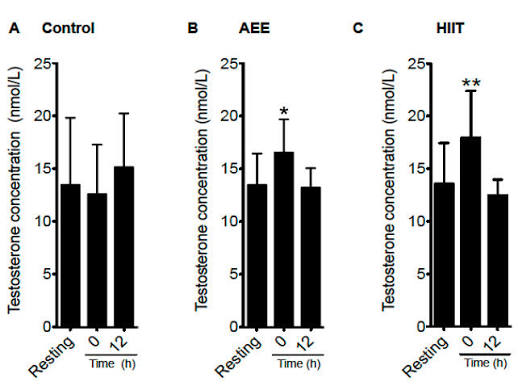
This is where the testosterone and cortisol antagonism mentioned earlier becomes visible in actual data. HIIT is a high intensity stressor. It acutely spikes testosterone, which is a known response to short burst intense exercise, but it also triggers a significant cortisol response. Cortisol rises during and after intense exercise as part of the body's stress recovery process, and that cortisol elevation is part of what drives testosterone back down below baseline at the 2 hour mark in Panel C. You can essentially see the testosterone-cortisol seesaw playing out in real time across those three bars.
Testosterone and cortisol do have a somewhat antagonistic relationship in the body. When cortisol is chronically elevated, testosterone production can be suppressed, and vice versa. That part is genuinely documented in endocrinology literature. The testicles are also genuinely temperature sensitive, which is why they sit outside the body in the first place. Core body temperature is too high for optimal sperm production, so the scrotum acts as a kind of external cooling system. That is real biology. Sunlight also genuinely affects hormone regulation, primarily through Vitamin D synthesis and its downstream effects on testosterone production. Studies have shown that men with higher Vitamin D levels tend to have higher testosterone. So sunlight and hormones do have a relationship.
This is where the testosterone and cortisol antagonism mentioned earlier becomes visible in actual data. HIIT is a high intensity stressor. It acutely spikes testosterone, which is a known response to short burst intense exercise, but it also triggers a significant cortisol response. Cortisol rises during and after intense exercise as part of the body's stress recovery process, and that cortisol elevation is part of what drives testosterone back down below baseline at the 2 hour mark in Panel C. You can essentially see the testosterone-cortisol seesaw playing out in real time across those three bars.