


patrikos.psl
"Pat the Rat"
- Joined
- Jul 18, 2025
- Posts
- 918
- Reputation
- 1,182
(LARP WARNING: Level 10,000 I will cite where I got these ideas from throughout)
(Note: This is part of a larger series of threads I'm planning. Read my previous treatise on the Triumph of the Incel premable for context.)
How does the Incel become Triumphant in times of War or Glory?
1. The virtue of violence, destruction, and chaos is itself divine it manifests the human spirit in ways unimaginable to civilised minds. From the earliest years of human history, man has ever sought out conflict, impelled by instincts that reach back to the most primal years of our existence. This craving for war was most visible in the ages of continuous warfare (2700 BC – 1945 AD), wherein the dealings of mankind with violence show a explicit desire to conquer, to defend, and to assert dominion over the enemy.
2. On the definition of modern man: the issues of modern man stem directly or indirectly from his suppressed need to dominate, to retaliate when threatened, and to threaten when not. Modern man, defined entirely by his enforced obligation to put down these feelings in the name of civilised conduct, is what produces the perception of the modern male as fundamentally weak. Friedrich Nietzsche identified this degradation most clearly when he described the rise of slave morality a moral system designed by the weak to constrain the strong. Beyond Good and Evil, 1886, §260) The modern incel is socially castrated by a world that has told him his aggression is pathological, is in fact the man in whom this suppressed fire burns hottest.
3. On the nature of women's selection and its historical consequence: it is a documented and observable historical fact that women across all recorded civilisations have preferentially selected men of physical attractiveness, social dominance, and material resource. Schopenhauer addressed this directly in The Metaphysics of Sexual Love (Parerga and Paralipomena, 1851), arguing that female selection operates entirely in the service of species propagation and is therefore indifferent to the individual man's inner qualities. The consequence of this selection pressure is plain: the men left behind were the ugly, the poor, the socially awkward, the intellectually peculiar and had no biological outlet. They had instead one alternative.
4. That alternative was glory. When the ordinary mechanisms of male reproduction either courtship, marriage, social belonging are denied to a man, one of two outcomes follows: dissolution or sublimation. Dissolution is what the blackpill community rightly identifies as the rope. Sublimation is what Thomas Carlyle, in On Heroes, Hero-Worship, and the Heroic in History (1841), identified as the transformation of personal suffering into world-historical action.
5. The Young Unloveable Man is the oldest recurring figure in military and civilisational history. He appears in every era of major conflict because major conflict is precisely the environment in which his qualities, obsessive focus, indifference to social approval, willingness to endure, contempt for comfort are all things that the he rightly stands for.
6. On the historical prevalence of the incel in positions of military and intellectual dominance: it is worth noting that the celibate, socially rejected, or romantically unsuccessful men among are the greatest people to ever exist, those of which we call 'truly great' these men are willing to change the course of history entirely. Some examples include that Isaac Newton, Nikola Tesla (mind you having renounced women explicitly as a distraction from his work.
7. The military incel is a distinct and underexamined subcategory. Napoleon Bonaparte was by multiple historical accounts physically unimpressive by the standards of his era, socially graceless in youth, Corsican-accented and mocked by French peers at the Brienne military academy, and romantically humiliated on multiple occasions before Josephine. Alexander the Great showed little romantic interest in women; his primary emotional attachments were to Hephaestion and to military glory.
8. On the mechanism by which rejection produces greatness: it must be understood philosophically that the experience of rejection by specifically women produces in the sufficiently intelligent man a specific cognitive consequence. The man who is rejected has expenditure. His energy accumulates. William James, in The Varieties of Religious Experience (1902), described this process in spiritual terms as the twice-born personality the man who has suffered a fundamental rupture with ordinary life and rebuilt himself from the interior outward. James's twice-born man is, in almost every case he examines, a man of extraordinary subsequent productivity.
9. In peacetime, the socially graceful man has every advantage he wants, from charming to accumulating allies through the mechanisms of ordinary social life in which the incel is perpetually outcompeted. In wartime, what matters in is not who is gets more women or who has the best looking girlfriend. What matters is who can plan under pressure, who can make decisions when the cost of error is measured in lives. The man who has never been comfortable has spent his entire life developing exactly these capacities. Clausewitz, in On War (1832), described the quality he called Entschlossenheit which is a resoluteness and the capacity to act decisively in conditions of radical uncertainty.
10. On the concept of Vae Victis when applied to the social order: the man who is defeated socially either that be rejected, mocked, or rendered invisible by the ordinary hierarchies of attractiveness and status carries within him a sort of revenge. It is, in Nietzsche's formulation, the will to power (Der Wille zur Macht) The socially victorious man has no reason to exceed himself. The socially defeated man has every reason.
12. Therefore: War is the incel's correction of his time. It is the moment in which the social order that excluded him is temporarily suspended, and the qualities that made him unfit for peacetime society his intensity and his willingness to suffer became the exact qualities the world requires. Carlyle wrote in Heroes and Hero-Worship: "The history of the world is but the biography of great men." I would add the following amendment: the biography of great men is, more often than is acknowledged, the biography of men who had nothing to lose.
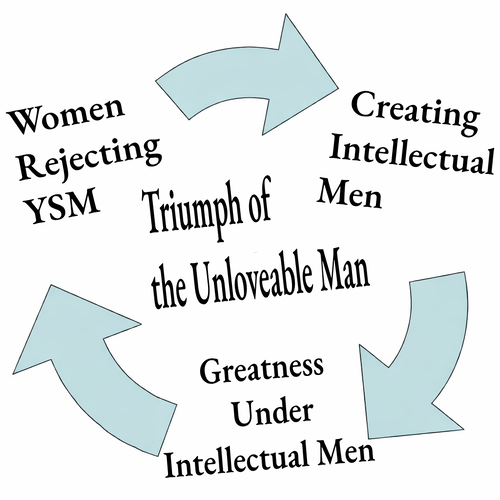 (Visual Graph)
TLDR:
Majority of this is honestly just cope, actually don't take it too seriously, I kinda just like writing for fun and this has been a idea in my head for the past little while, also note that alot of this is low-iq larp too, and don't actually take it as a face value paper.
Further chapters planned:
On the Triumph of the Incel
On the specific military campaigns of historically celibate commanders
On the monastery as the peacetime equivalent of war for the intellectual incel
Citations:
Carlyle, Thomas. On Heroes, Hero-Worship, and the Heroic in History. 1841.
Schopenhauer, Arthur. The Metaphysics of Sexual Love, in Parerga and Paralipomena. 1851.
Nietzsche, Friedrich. Beyond Good and Evil. 1886.
Nietzsche, Friedrich. The Will to Power. Posthumous edition, 1901.
Clausewitz, Carl von. On War. 1832.
James, William. The Varieties of Religious Experience. 1902.
(Note: This is part of a larger series of threads I'm planning. Read my previous treatise on the Triumph of the Incel premable for context.)
How does the Incel become Triumphant in times of War or Glory?
1. The virtue of violence, destruction, and chaos is itself divine it manifests the human spirit in ways unimaginable to civilised minds. From the earliest years of human history, man has ever sought out conflict, impelled by instincts that reach back to the most primal years of our existence. This craving for war was most visible in the ages of continuous warfare (2700 BC – 1945 AD), wherein the dealings of mankind with violence show a explicit desire to conquer, to defend, and to assert dominion over the enemy.
2. On the definition of modern man: the issues of modern man stem directly or indirectly from his suppressed need to dominate, to retaliate when threatened, and to threaten when not. Modern man, defined entirely by his enforced obligation to put down these feelings in the name of civilised conduct, is what produces the perception of the modern male as fundamentally weak. Friedrich Nietzsche identified this degradation most clearly when he described the rise of slave morality a moral system designed by the weak to constrain the strong. Beyond Good and Evil, 1886, §260) The modern incel is socially castrated by a world that has told him his aggression is pathological, is in fact the man in whom this suppressed fire burns hottest.
3. On the nature of women's selection and its historical consequence: it is a documented and observable historical fact that women across all recorded civilisations have preferentially selected men of physical attractiveness, social dominance, and material resource. Schopenhauer addressed this directly in The Metaphysics of Sexual Love (Parerga and Paralipomena, 1851), arguing that female selection operates entirely in the service of species propagation and is therefore indifferent to the individual man's inner qualities. The consequence of this selection pressure is plain: the men left behind were the ugly, the poor, the socially awkward, the intellectually peculiar and had no biological outlet. They had instead one alternative.
4. That alternative was glory. When the ordinary mechanisms of male reproduction either courtship, marriage, social belonging are denied to a man, one of two outcomes follows: dissolution or sublimation. Dissolution is what the blackpill community rightly identifies as the rope. Sublimation is what Thomas Carlyle, in On Heroes, Hero-Worship, and the Heroic in History (1841), identified as the transformation of personal suffering into world-historical action.
5. The Young Unloveable Man is the oldest recurring figure in military and civilisational history. He appears in every era of major conflict because major conflict is precisely the environment in which his qualities, obsessive focus, indifference to social approval, willingness to endure, contempt for comfort are all things that the he rightly stands for.
6. On the historical prevalence of the incel in positions of military and intellectual dominance: it is worth noting that the celibate, socially rejected, or romantically unsuccessful men among are the greatest people to ever exist, those of which we call 'truly great' these men are willing to change the course of history entirely. Some examples include that Isaac Newton, Nikola Tesla (mind you having renounced women explicitly as a distraction from his work.
7. The military incel is a distinct and underexamined subcategory. Napoleon Bonaparte was by multiple historical accounts physically unimpressive by the standards of his era, socially graceless in youth, Corsican-accented and mocked by French peers at the Brienne military academy, and romantically humiliated on multiple occasions before Josephine. Alexander the Great showed little romantic interest in women; his primary emotional attachments were to Hephaestion and to military glory.
8. On the mechanism by which rejection produces greatness: it must be understood philosophically that the experience of rejection by specifically women produces in the sufficiently intelligent man a specific cognitive consequence. The man who is rejected has expenditure. His energy accumulates. William James, in The Varieties of Religious Experience (1902), described this process in spiritual terms as the twice-born personality the man who has suffered a fundamental rupture with ordinary life and rebuilt himself from the interior outward. James's twice-born man is, in almost every case he examines, a man of extraordinary subsequent productivity.
9. In peacetime, the socially graceful man has every advantage he wants, from charming to accumulating allies through the mechanisms of ordinary social life in which the incel is perpetually outcompeted. In wartime, what matters in is not who is gets more women or who has the best looking girlfriend. What matters is who can plan under pressure, who can make decisions when the cost of error is measured in lives. The man who has never been comfortable has spent his entire life developing exactly these capacities. Clausewitz, in On War (1832), described the quality he called Entschlossenheit which is a resoluteness and the capacity to act decisively in conditions of radical uncertainty.
10. On the concept of Vae Victis when applied to the social order: the man who is defeated socially either that be rejected, mocked, or rendered invisible by the ordinary hierarchies of attractiveness and status carries within him a sort of revenge. It is, in Nietzsche's formulation, the will to power (Der Wille zur Macht) The socially victorious man has no reason to exceed himself. The socially defeated man has every reason.
12. Therefore: War is the incel's correction of his time. It is the moment in which the social order that excluded him is temporarily suspended, and the qualities that made him unfit for peacetime society his intensity and his willingness to suffer became the exact qualities the world requires. Carlyle wrote in Heroes and Hero-Worship: "The history of the world is but the biography of great men." I would add the following amendment: the biography of great men is, more often than is acknowledged, the biography of men who had nothing to lose.
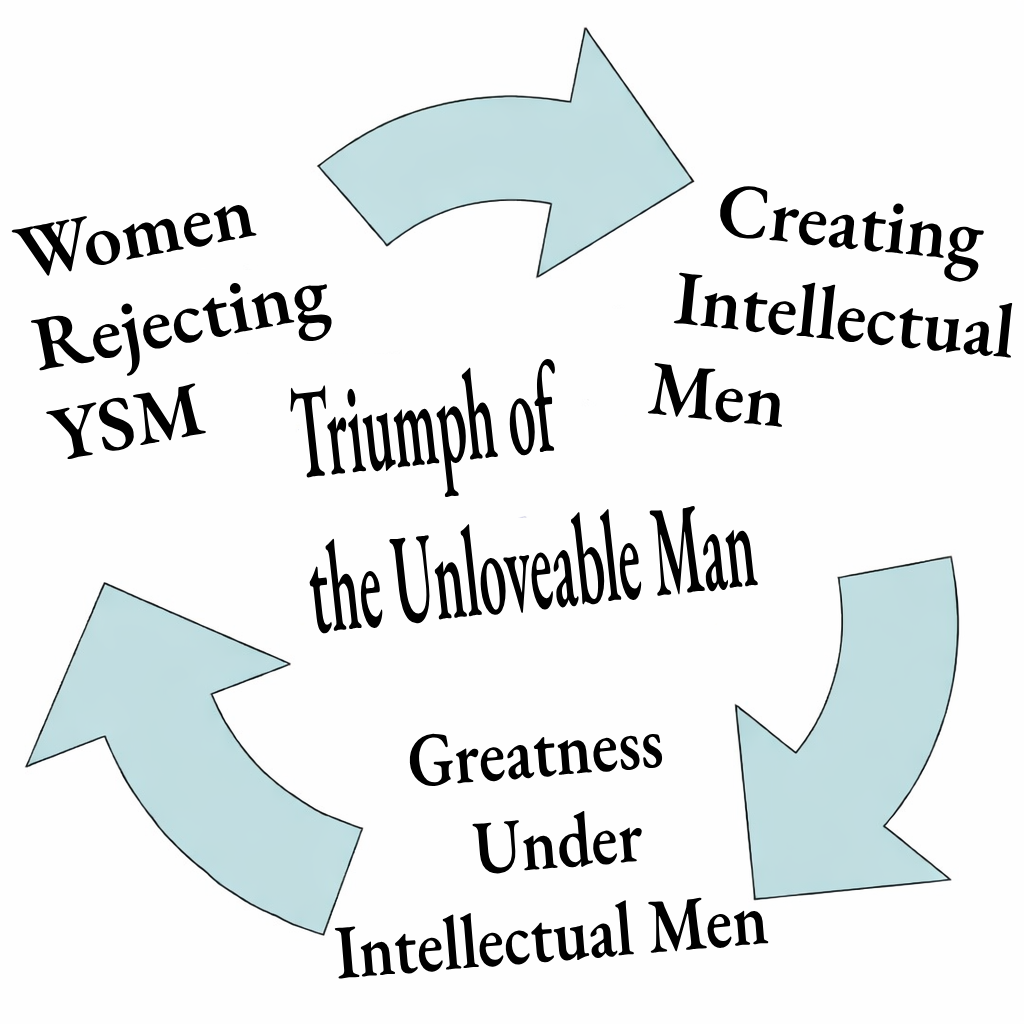 (Visual Graph)
TLDR:
Majority of this is honestly just cope, actually don't take it too seriously, I kinda just like writing for fun and this has been a idea in my head for the past little while, also note that alot of this is low-iq larp too, and don't actually take it as a face value paper.
Further chapters planned:
On the Triumph of the Incel
On the specific military campaigns of historically celibate commanders
On the monastery as the peacetime equivalent of war for the intellectual incel
Citations:
Carlyle, Thomas. On Heroes, Hero-Worship, and the Heroic in History. 1841.
Schopenhauer, Arthur. The Metaphysics of Sexual Love, in Parerga and Paralipomena. 1851.
Nietzsche, Friedrich. Beyond Good and Evil. 1886.
Nietzsche, Friedrich. The Will to Power. Posthumous edition, 1901.
Clausewitz, Carl von. On War. 1832.
James, William. The Varieties of Religious Experience. 1902.


