Subhuman

Fuchsia
- Joined
- Sep 23, 2025
- Posts
- 10,304
- Reputation
- 51,753
How the Germans beat the French in WWII
In May 1940, Nazi Germany attacks in the West. The Allied armies of France, Britain, Belgium, and the Netherlands have more men, guns, and tanks than the Germans do, and the French army is considered the best in the world. But in just 6 weeks, German forces shock the world and smash the Allies. So how did the allies lose so completely, so fast?
The Plans
Hitler ignores his general's warnings, and orders them to start planning an offensive to capture neutral Belgium and the Netherlands, and occupy enough of northern France to be able to strike at Britain. The start date is moved to November 25.
Chief of the Army General Staff Franz Halder quickly prepares a cautious plan, with the main German advance through central Belgium. But Hitler is frustrated: “This is just the old Schlieffen Plan with a strong right wing along the Atlantic coast – one cannot get away with such an operation a second time.” (Görlitz, S. 226)
The back-and-forth between army planners and Hitler lasts for months, during which time the offensive is delayed 29 times. Hitler leans ever more towards the idea of concentrating the relatively few German armored and motorized divisions for a strike through the thickly-forested Ardennes region, cutting off Allied forces if, as expected, they enter Belgium. Army brass think it’s too risky. Unbeknownst to Hitler, General Erich Von Manstein also favors the Ardennes route for what comes to be known as the "Sichelschnitt" or sickle cut plan but the army command throttles it. Then, in January 1940, a German Messerschmitt 108 “Taifun” carrying the plan crashes in Belgium, forcing the Germans to change it yet again.
Finally, on February 24, 1940, the final plan is approved – one that weakens Manstein’s idea of a double pincer from north and south : Army Group B will simply pin the Allies in the north, while the southern Army Group A will lead the attack through the Ardennes, cross the Meuse river at Sedan, and race for the town of Abbeville, where the river Somme meets the sea. This is a risky plan, with precious armor moving through dangerous narrow forest roads, and advancing with long vulnerable flanks.
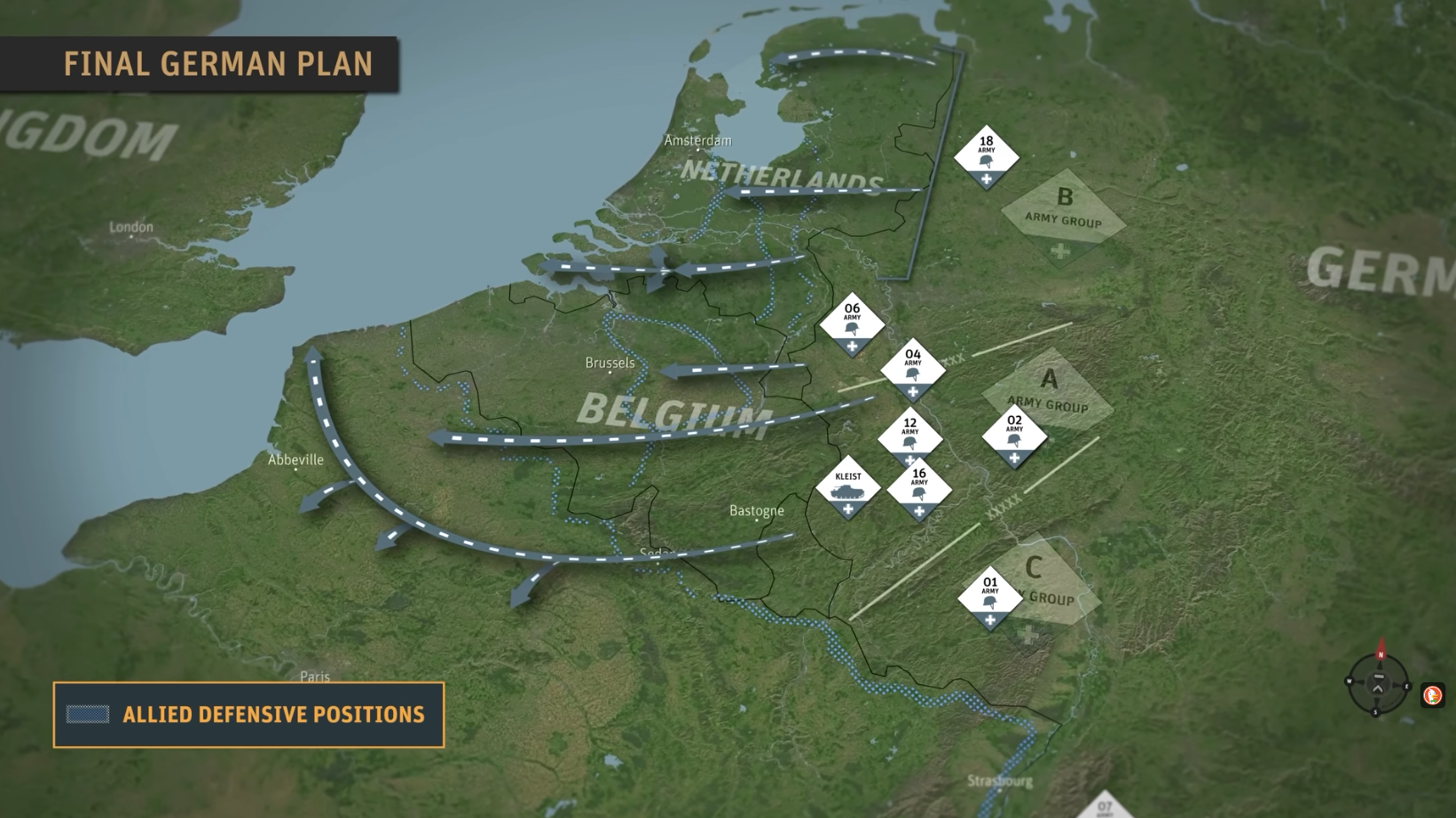
Army Group B commander General Fedor Von Bock tells Halder the plan is dangerous: “You will be creeping by 10 miles from the Maginot Line with the flank of your breakthrough and hope the French will watch inertly! You are cramming the mass of the tank units together into the sparse roads of the Ardennes mountain country, as if there were no such thing as air power! And you then hope to be able to lead an operation as far as the coast with an open southern flank 200 miles long, where stands the mass of the French Army?”
Meanwhile, the French and British are making plans as well, though international politics make things difficult. French and British planners are confident in the Maginot Line, and expect the Germans will attack through neutral Belgium and the Netherlands. The Dutch and Belgians though refuse to make detailed plans for Franco-British forces to enter their territory and cooperate with their armies in the hopes of not provoking the Germans. Nonetheless, this is still the focus of the Allies’ Plan D. The best French units and the British Expeditionary Force will move into the Low Countries if the Germans attack, and try to stop them along the Dyle river, the Albert Canal and forts like Eben Emael. Plan D is also risky: Allied forces won’t have the initiative, they will be advancing into the teeth of an enemy offensive, and the hinge of their line, the Ar-dennes, remains thinly defended since they consider it impassable for large armored forces. French intelligence reports point to the Ardennes, but the High Command does nothing. There is also no strategic reserve since the 7th French Army is to advance into the Netherlands – politically useful but militarily questionable.
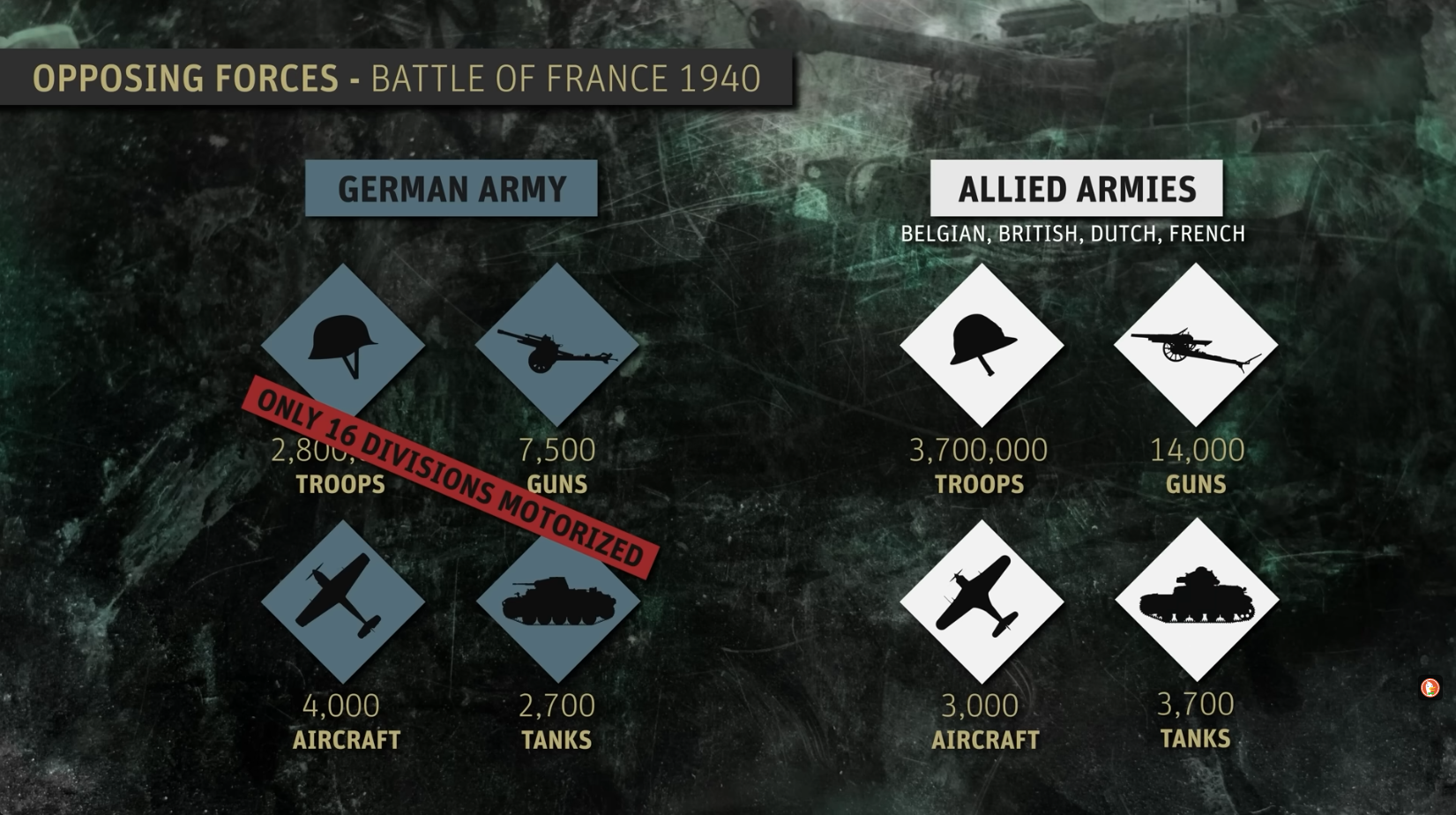
On the eve of battle, the Germans have 2.8 million men, 7500 guns, 4000 planes, and 2700 tanks and self-propelled guns on the Western Front. But only 16 of 157 German divisions are motorized. The Allies, including the still-neutral Dutch and Belgians, have 3.7 million men, 14,000 guns, 3000 planes, and 3700 tanks.
The Attack
So with the Germans hoping for a daring Sichelschnitt, the Allies plan an uncertain advance into the Low Countries. On May 10, 1940, the Germans launch Case Yellow, a campaign that would shock the world and the Germans themselves. The Germans pour across the border into the Low Countries. They want to give the impression their main strike is in the Netherlands, and they even use troops in Dutch uniforms to seize bridges by surprise. German paradrops at Dutch airports mostly fail though thanks to the Dutch army resistance. But in general, the Dutch offer little resistance. On May 14, the Luftwaffe bombs the port city of Rotterdam to terrify the Dutch into surrendering, and it works. The attacks kill 800 civilians (though in the chaos the Dutch government thinks 30,000 have been killed), and leave parts of the city in ruins, the Dutch government flees and the army surrenders on May 15.
Belgian troops also pull back quickly, though a few Belgian units don’t receive the retreat order, and manage to hold up German tanks for several hours, a lesson Allied commanders miss in the confusion. When Franco-British troops belatedly start to move in the evening, their progress is slow on roads choked with fleeing refugees. The Belgians hope that Fort Eben Emael will hinder the Germans, but despite the Belgians giving the German air and glider-borne troops a tough fight, the attackers prevail on May 11.
Further south, in the critical Ardennes, the Germans advance but encounter problems. The panzers are held up by blown bridges and road blocks, and form massive traffic jams up to 250km behind the front. Only now do the French realize the scale of the attack in the Ardennes. Local commanders requested reinforcements days ago, but none came . Now, French Commander in Chief Maurice Gamelin quickly sends 3 divisions to help. Some Allied commanders fear their armies might be walking into a trap in Belgium, but Gamelin expects it will take the horse-drawn German artillery nine days to reach the Meuse, and that it's too late to shift major forces south . On May 12, while a major tank battle rages at Hannut in which 630 German tanks defeat a French force of 470, the Germans reach the river farther south. General Erwin Rommel’s 7th Armored Division and Heinz Guderian’s XIX Corps both prepare to cross. In an ominous sign, French units facing Guderian withdraw without a fight. Many German tanks are the relatively weak Panzer I, II, and 38t’s, but they’re arrived en masse with the element of surprise.
Oberstleutnant Hermann Black notes the mindset of French some prisoners: “The French are per-forming worse than poorly. When asked why they are at war with us, prisoners say ‘Because England and the rich want war. We’re not waging war, war is being waged with us.’ Their eyes glow with hate when they speak of England. The French were never this bad before.”
On May 13, German infantry and recon cavalry cross the Meuse at Dinant and Sedan. The French can’t deal with the speed of the German advance, as one captured French general frankly admits: “You are much too fast, much too fast for us. It’s everything.” (Frieser 278) Even before the crossing, rumors spread amongst French troops that the Germans are already behind them, causing some units to break and flee. German success is due not only to the armored punch through the Ardennes, but also air power. The Luftwaffe consistently hits Allied columns, although air losses are very heavy on both sides. Aircraft like the Ju-87 Stuke dive bomber pound French defences on the Meuse before ground troops get across. German tanks cross the Meuse on the 14th, but have taken losses – some units are down to ¼ strength, and lack ammunition and fuel. French forces prepare to counterattack the still fragile bridgeheads, and if they don’t succeed, half of the Allied troops, and their best, motorized units, will be cut off to the north.
The crisis at the front is being felt in London and Paris as well. On May 10, Prime Minster Neville Chamberlain resigns and is replaced by Winston Churchill. A few days later, French Premier Paul Reynaud recalls General Maxime Weygand from Syria to take over command of the army, and ap-points Charles De Gaulle Deputy Minister of Defense. But he also asks First World War hero Philippe Petain to be deputy premier, even though Petain thinks the war is lost and blames Britain for starting it. Reynaud desperately requests 10 more British fighter squadrons be sent to France. Churchill wants to send them but the British cabinet is worried about home defense and only agrees to 4. Some in London have lost hope in the French army, especially when Gamelin admits he has no strategic reserve.
On the 15th, the Germans break out of their bridgeheads and advance up to 65km by evening. Gamelin recognizes the danger, and orders Allied troops in Belgium to retreat. General von Bock wants to press his Army Group B’s advantage in Belgium, but Army High Command worries that might ruin the Sickle Cut. Both Army Groups stop for three days, to keep the northern Al-lied armies in the developing pocket and so infantry can catch up to protect the flanks against expected French counterattacks, a problem Manstein’s version of the plan had foreseen. Allied commanders though, don’t take advantage. When a French general admits he has no idea what to do against the panzers, British General Henry Pownall loses his cool: “My God, how awful to be allied to so temperamental a race.”
On the other hand, an engagement at the village of Stonne shows what French armor is capable of, and why German commanders hesitate, Captain Pierre Billotte’s Char B1 bis destroys 11 Panzer IIIs, 2 Panzer IVs, and 2 anti-tank guns, one of the most remarkable single tank actions of the war. Despite Billotte’s heroics and the delay, on May 20, the 2nd Panzer Division reaches the sea at Abbeville. They catch many French troops unprepared, or in shock from continuous air attack. Lieutenant Alexander Stahlberg marvels at the destruction: “[The streets were] lined with the wreckage of a defeated French army. Shot up vehicles, pierced and burnt out tanks, abandoned cannon, a never ending chain of destruction.” (Beevor 114) More than 1 million British and French troops are trapped north of the Somme, and the RAF has lost 1/4 of its strength. The Allies desperately organize a double counterattack to hit the German flanks, but it’s not clear who is in command of the cut off forces, and the Germans are moving fast. Anglo-French forces do manage an effective attack near Arras on May 21 and 22 including Matilda tanks, but the hard-pressed Germans hold them off. Allied forces begin a fighting retreat to the port of Dunkirk for evacuation – a British decision that many French resent.
Last edited: