How orgasms can destroy your motivation, backed by biology.

liunars

liunars

based ricecel
Joined
Jun 16, 2025
Posts
116
Reputation
56
How orgasms can destroy your motivation.

I want to preface this by saying that this is my first actual thread with effort put into it. I am also not a neurologist. Feedback would be appreciated :feelsgood:

As we all know, masturbating doesn't necessarily cause a substantial increase or decrease in the levels of your testosterone. There isn't enough evidence to conclude that sex and orgasm do either. Studies show that time and time again, there is no real big difference in the testosterone of someone who does it and someone who doesn't. But, this doesn't mean that masturbation and orgasming won't have negative effects. To understand why, we must know what happens during an orgasm on a deeper level.

Theme


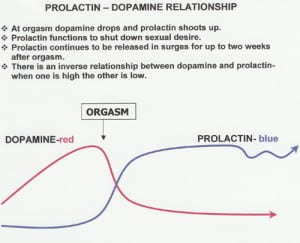
When you orgasm, a surge of oxytocin, serotonin, endorphins, dopamine, and prolactin. Put it simply, serotonin regulates your mood, circadian rhythm, and satiety. Endorphins dull the perception of pain and create a sense of euphoria. Dopamine is heavily involved in reward pathways, motivation, movement, and habit reinforcement. Prolactin stimulates the breasts to produce milk in women and modulates sexual and immune functions, while having a secondary role in modulating the release and reception of its brothers. The latter two are very important, as their relationship is instrumental to influencing your mood.

1786556754281

Image by Giovanni Castro, from Emotion, Brain & Behavior Laboratory.

Consult the graph. As you can see, during orgasm, dopamine spikes before prolactin also increases, and inhibits it. Dopamine is shut down and returns to baseline levels. However, this balance is shaky. Prolactin continues to be released weeks after orgasm, meaning that if you orgasm again within that range, the increases in prolactin may "stack" and start dragging your dopamine baseline down (1 - see sources). This is a major reason as to why hypersexual people (and those who consume copious amounts of porn) are more susceptible to depression. Prolactin also inhibits the release of GnRH through reducing kisspeptin gene expression and its secretion, though that's inconclusive because, again, orgasming isn't concretely shown to increase or decrease LH, FSH, testosterone, etc, though abstaining does increase sperm count, but that could be not correlated to orgasming.


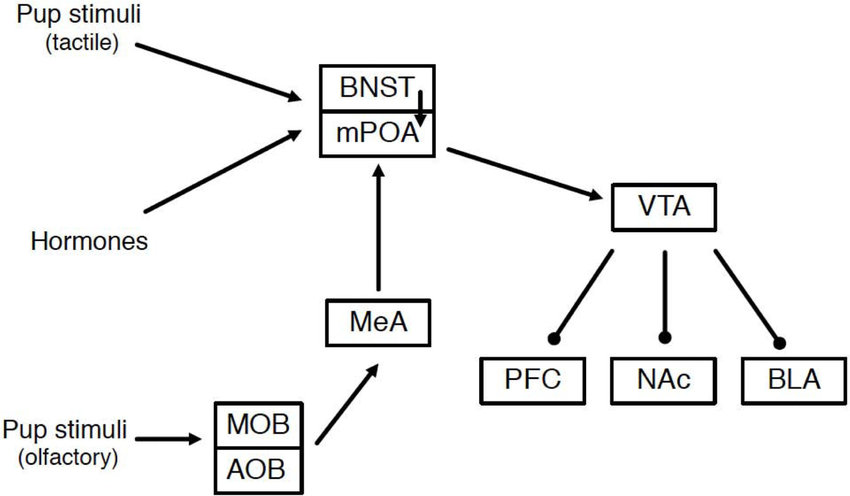
There are many androgen receptors in the brain, and there is an especially high concentration near the mPOA. These neurons project to the VTA, which is largely pointed to as the beginning part of the reward circuit. (3) It is responsible for the cravings and wants of rewards. When you orgasm, these receptors temporarily decrease due to the aforementioned spike in serotonin. (2 & 4) The spike of serotonin is also responsible for the refractory period and sexual satiation, and it returns to baseline after about an hour after orgasm. However, it takes a while after that for the androgen receptors to upregulate back to what you know as normal. I couldn't find an exact time frame but I posit that it takes a few days at minimum for it to begin recovering from my own observations. When I asked deepseek, it said it would return from 3 days to a week, so make your own conclusions.

1786564018556

Image by Millie Rincón-Cortés, Adaptations in reward-related behaviors and mesolimbic dopamine function during motherhood and the postpartum period.
This image and the study in general was made to represent maternal motivation, but it could also be applied to here. I didn't add it even though it was great evidence because I felt the evidence was sufficient. For further reading I'd recommend this study.

1786563662967

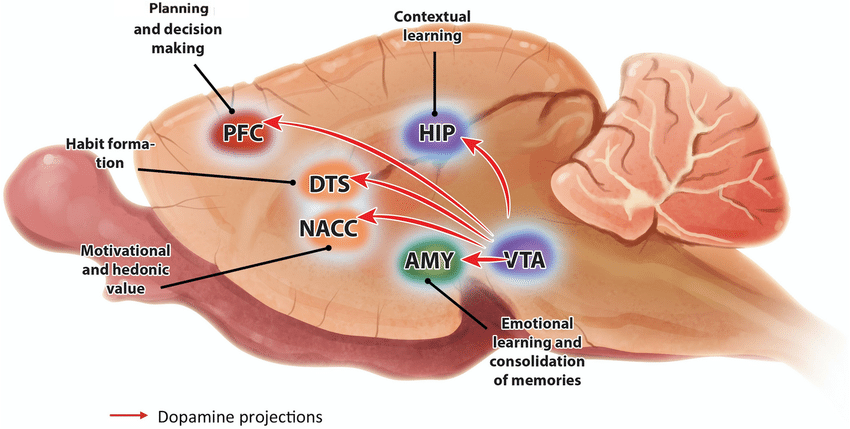
Image by centresstop.com, Addiction and Neurotransmitters: How the Brain Learns, Craves, and Changes
Just picture the mPOA behind the VTA.​


The evidence here is inconclusive, but I hypothesize that it's alleviated by oxytocin. Oxytocin promotes the activity of 5-alpha-reductase, which is the enzyme that catalyzes the conversion of test --> dht. (6) Dht is much more androgenic than testosterone. Oxytocin and vasopressin both play a critical role in the feeling of love, and couples have significantly higher amounts of oxytocin than single people. (5) I hypothesize that therefore oxytocin can help speed up the recovery of ARs in the brain after orgasms.


Uninstall all apps that your brain has a connection to masturbation with. Example - Chrome or safari or google on your phone.
Usually I get the worst urges whenever I'm bored, so I literally just started being more productive with my time, it helped instantly.


Simple. Just don't jerk off. You should feel increases in motivation within a week, though the biggest gains in productivity and baseline dopamine should happen around the two-week mark. After that, I don't think there is any more gain to abstaining though.

1786566443585


Conclusion
The absurd claims of NoFap and semen retention communities can be explained by this. I have experienced it myself, first hand, when I stopped beating my meat every time I got bored. Suddenly, I want to look for side hustles. Suddenly, I actually want to study. It's all due to the neuroendocrine effects that orgasms have.

I also hypothesize that this is why there is a disproportionately small amount of queens to kings, female CEOs to male CEOs, female billionaires to male billionaires. They biologically have less drive. :feelshah:

1786565738200


Written in APA format

(1): Kruger, T. H., Haake, P., Chereath, D., Knapp, W., Janssen, O. E., Exton, M. S., … & Hartmann, U. (2003). Specificity of the neuroendocrine response to orgasm during sexual arousal in men. Journal of Endocrinology, 177(1), 57-64.

(2): Putnam, S. K., Du, J., Sato, S., & Hull, E. M. (2001). Testosterone restoration of copulatory behavior correlates with medial preoptic dopamine release in male rats. Hormones and behavior, 39(3), 216-224.

(3): Barrot, (2014). The ventral tegmentum and dopamine: A new wave of diversity. Neuroscience, 39(1), 243-247.

(4): Mallick, H. N., Tandon, S., Jagannathan, N. R., Gulia, K. K., & Kumar, V. M. (2007). Brain areas activated after ejaculation in healthy young human subjects. Journal of physiology and pharmacology, 51(1), 81.

(5): Schneiderman, O.Z.S, J.F.L, R. Feldmann. (2012). Oxytocin during the initial stages of romantic attachment: Relations to couples’ interactive reciprocity. Psychoneuroendocrinology, 37(8), 1277-1285.

(6): Radmayr, C., Lunacek, A., Schwentner, C., Oswald, J., Klocker, H., & Bartsch, G. (2008). 5-alpha-reductase and the development of the human prostate. Indian journal of urology : IJU : journal of the Urological Society of India, 24(3), 309–312.
 

Attachments

  • 1786565686133.png
    1786565686133.png
    1.1 MB · Views: 0
  • +1
Reactions: finessed
How orgasms can destroy your motivation.

I want to preface this by saying that this is my first actual thread with effort put into it. I am also not a neurologist. Feedback would be appreciated :feelsgood:

As we all know, masturbating doesn't necessarily cause a substantial increase or decrease in the levels of your testosterone. There isn't enough evidence to conclude that sex and orgasm do either. Studies show that time and time again, there is no real big difference in the testosterone of someone who does it and someone who doesn't. But, this doesn't mean that masturbation and orgasming won't have negative effects. To understand why, we must know what happens during an orgasm on a deeper level.

Theme


When you orgasm, a surge of oxytocin, serotonin, endorphins, dopamine, and prolactin. Put it simply, serotonin regulates your mood, circadian rhythm, and satiety. Endorphins dull the perception of pain and create a sense of euphoria. Dopamine is heavily involved in reward pathways, motivation, movement, and habit reinforcement. Prolactin stimulates the breasts to produce milk in women and modulates sexual and immune functions, while having a secondary role in modulating the release and reception of its brothers. The latter two are very important, as their relationship is instrumental to influencing your mood.

View attachment 5505484
Image by Giovanni Castro, from Emotion, Brain & Behavior Laboratory.

Consult the graph. As you can see, during orgasm, dopamine spikes before prolactin also increases, and inhibits it. Dopamine is shut down and returns to baseline levels. However, this balance is shaky. Prolactin continues to be released weeks after orgasm, meaning that if you orgasm again within that range, the increases in prolactin may "stack" and start dragging your dopamine baseline down (1 - see sources). This is a major reason as to why hypersexual people (and those who consume copious amounts of porn) are more susceptible to depression. Prolactin also inhibits the release of GnRH through reducing kisspeptin gene expression and its secretion, though that's inconclusive because, again, orgasming isn't concretely shown to increase or decrease LH, FSH, testosterone, etc, though abstaining does increase sperm count, but that could be not correlated to orgasming.


There are many androgen receptors in the brain, and there is an especially high concentration near the mPOA. These neurons project to the VTA, which is largely pointed to as the beginning part of the reward circuit. (3) It is responsible for the cravings and wants of rewards. When you orgasm, these receptors temporarily decrease due to the aforementioned spike in serotonin. (2 & 4) The spike of serotonin is also responsible for the refractory period and sexual satiation, and it returns to baseline after about an hour after orgasm. However, it takes a while after that for the androgen receptors to upregulate back to what you know as normal. I couldn't find an exact time frame but I posit that it takes a few days at minimum for it to begin recovering from my own observations. When I asked deepseek, it said it would return from 3 days to a week, so make your own conclusions.

View attachment 5506056
Image by Millie Rincón-Cortés, Adaptations in reward-related behaviors and mesolimbic dopamine function during motherhood and the postpartum period.
This image and the study in general was made to represent maternal motivation, but it could also be applied to here. I didn't add it even though it was great evidence because I felt the evidence was sufficient. For further reading I'd recommend this study.
View attachment 5506037
Image by centresstop.com, Addiction and Neurotransmitters: How the Brain Learns, Craves, and Changes
Just picture the mPOA behind the VTA.​


The evidence here is inconclusive, but I hypothesize that it's alleviated by oxytocin. Oxytocin promotes the activity of 5-alpha-reductase, which is the enzyme that catalyzes the conversion of test --> dht. (6) Dht is much more androgenic than testosterone. Oxytocin and vasopressin both play a critical role in the feeling of love, and couples have significantly higher amounts of oxytocin than single people. (5) I hypothesize that therefore oxytocin can help speed up the recovery of ARs in the brain after orgasms.


Uninstall all apps that your brain has a connection to masturbation with. Example - Chrome or safari or google on your phone.
Usually I get the worst urges whenever I'm bored, so I literally just started being more productive with my time, it helped instantly.


Simple. Just don't jerk off. You should feel increases in motivation within a week, though the biggest gains in productivity and baseline dopamine should happen around the two-week mark. After that, I don't think there is any more gain to abstaining though.


View attachment 5506239


Conclusion
The absurd claims of NoFap and semen retention communities can be explained by this. I have experienced it myself, first hand, when I stopped beating my meat every time I got bored. Suddenly, I want to look for side hustles. Suddenly, I actually want to study. It's all due to the neuroendocrine effects that orgasms have.

I also hypothesize that this is why there is a disproportionately small amount of queens to kings, female CEOs to male CEOs, female billionaires to male billionaires. They biologically have less drive. :feelshah:



Written in APA format

(1): Kruger, T. H., Haake, P., Chereath, D., Knapp, W., Janssen, O. E., Exton, M. S., … & Hartmann, U. (2003). Specificity of the neuroendocrine response to orgasm during sexual arousal in men. Journal of Endocrinology, 177(1), 57-64.

(2): Putnam, S. K., Du, J., Sato, S., & Hull, E. M. (2001). Testosterone restoration of copulatory behavior correlates with medial preoptic dopamine release in male rats. Hormones and behavior, 39(3), 216-224.

(3): Barrot, (2014). The ventral tegmentum and dopamine: A new wave of diversity. Neuroscience, 39(1), 243-247.

(4): Mallick, H. N., Tandon, S., Jagannathan, N. R., Gulia, K. K., & Kumar, V. M. (2007). Brain areas activated after ejaculation in healthy young human subjects. Journal of physiology and pharmacology, 51(1), 81.

(5): Schneiderman, O.Z.S, J.F.L, R. Feldmann. (2012). Oxytocin during the initial stages of romantic attachment: Relations to couples’ interactive reciprocity. Psychoneuroendocrinology, 37(8), 1277-1285.

(6): Radmayr, C., Lunacek, A., Schwentner, C., Oswald, J., Klocker, H., & Bartsch, G. (2008). 5-alpha-reductase and the development of the human prostate. Indian journal of urology : IJU : journal of the Urological Society of India, 24(3), 309–312.

cope keep goon
 
  • +1
  • WTF
Reactions: Solaire, Alienmaxxer and liunars
i lowkey dont care about motivation bro orgasms are better
 
  • So Sad
  • +1
Reactions: Solaire and liunars
Nigger I was motivated until I saw your avi and cummed the entire screen
 
  • Woah
  • +1
Reactions: Solaire and liunars
How orgasms can destroy your motivation.

I want to preface this by saying that this is my first actual thread with effort put into it. I am also not a neurologist. Feedback would be appreciated :feelsgood:

As we all know, masturbating doesn't necessarily cause a substantial increase or decrease in the levels of your testosterone. There isn't enough evidence to conclude that sex and orgasm do either. Studies show that time and time again, there is no real big difference in the testosterone of someone who does it and someone who doesn't. But, this doesn't mean that masturbation and orgasming won't have negative effects. To understand why, we must know what happens during an orgasm on a deeper level.

Theme


When you orgasm, a surge of oxytocin, serotonin, endorphins, dopamine, and prolactin. Put it simply, serotonin regulates your mood, circadian rhythm, and satiety. Endorphins dull the perception of pain and create a sense of euphoria. Dopamine is heavily involved in reward pathways, motivation, movement, and habit reinforcement. Prolactin stimulates the breasts to produce milk in women and modulates sexual and immune functions, while having a secondary role in modulating the release and reception of its brothers. The latter two are very important, as their relationship is instrumental to influencing your mood.

View attachment 5505484
Image by Giovanni Castro, from Emotion, Brain & Behavior Laboratory.

Consult the graph. As you can see, during orgasm, dopamine spikes before prolactin also increases, and inhibits it. Dopamine is shut down and returns to baseline levels. However, this balance is shaky. Prolactin continues to be released weeks after orgasm, meaning that if you orgasm again within that range, the increases in prolactin may "stack" and start dragging your dopamine baseline down (1 - see sources). This is a major reason as to why hypersexual people (and those who consume copious amounts of porn) are more susceptible to depression. Prolactin also inhibits the release of GnRH through reducing kisspeptin gene expression and its secretion, though that's inconclusive because, again, orgasming isn't concretely shown to increase or decrease LH, FSH, testosterone, etc, though abstaining does increase sperm count, but that could be not correlated to orgasming.


There are many androgen receptors in the brain, and there is an especially high concentration near the mPOA. These neurons project to the VTA, which is largely pointed to as the beginning part of the reward circuit. (3) It is responsible for the cravings and wants of rewards. When you orgasm, these receptors temporarily decrease due to the aforementioned spike in serotonin. (2 & 4) The spike of serotonin is also responsible for the refractory period and sexual satiation, and it returns to baseline after about an hour after orgasm. However, it takes a while after that for the androgen receptors to upregulate back to what you know as normal. I couldn't find an exact time frame but I posit that it takes a few days at minimum for it to begin recovering from my own observations. When I asked deepseek, it said it would return from 3 days to a week, so make your own conclusions.

View attachment 5506056
Image by Millie Rincón-Cortés, Adaptations in reward-related behaviors and mesolimbic dopamine function during motherhood and the postpartum period.
This image and the study in general was made to represent maternal motivation, but it could also be applied to here. I didn't add it even though it was great evidence because I felt the evidence was sufficient. For further reading I'd recommend this study.

View attachment 5506037
Image by centresstop.com, Addiction and Neurotransmitters: How the Brain Learns, Craves, and Changes
Just picture the mPOA behind the VTA.​


The evidence here is inconclusive, but I hypothesize that it's alleviated by oxytocin. Oxytocin promotes the activity of 5-alpha-reductase, which is the enzyme that catalyzes the conversion of test --> dht. (6) Dht is much more androgenic than testosterone. Oxytocin and vasopressin both play a critical role in the feeling of love, and couples have significantly higher amounts of oxytocin than single people. (5) I hypothesize that therefore oxytocin can help speed up the recovery of ARs in the brain after orgasms.


Uninstall all apps that your brain has a connection to masturbation with. Example - Chrome or safari or google on your phone.
Usually I get the worst urges whenever I'm bored, so I literally just started being more productive with my time, it helped instantly.


Simple. Just don't jerk off. You should feel increases in motivation within a week, though the biggest gains in productivity and baseline dopamine should happen around the two-week mark. After that, I don't think there is any more gain to abstaining though.

View attachment 5506239


Conclusion
The absurd claims of NoFap and semen retention communities can be explained by this. I have experienced it myself, first hand, when I stopped beating my meat every time I got bored. Suddenly, I want to look for side hustles. Suddenly, I actually want to study. It's all due to the neuroendocrine effects that orgasms have.

I also hypothesize that this is why there is a disproportionately small amount of queens to kings, female CEOs to male CEOs, female billionaires to male billionaires. They biologically have less drive. :feelshah:


Written in APA format

(1): Kruger, T. H., Haake, P., Chereath, D., Knapp, W., Janssen, O. E., Exton, M. S., … & Hartmann, U. (2003). Specificity of the neuroendocrine response to orgasm during sexual arousal in men. Journal of Endocrinology, 177(1), 57-64.

(2): Putnam, S. K., Du, J., Sato, S., & Hull, E. M. (2001). Testosterone restoration of copulatory behavior correlates with medial preoptic dopamine release in male rats. Hormones and behavior, 39(3), 216-224.

(3): Barrot, (2014). The ventral tegmentum and dopamine: A new wave of diversity. Neuroscience, 39(1), 243-247.

(4): Mallick, H. N., Tandon, S., Jagannathan, N. R., Gulia, K. K., & Kumar, V. M. (2007). Brain areas activated after ejaculation in healthy young human subjects. Journal of physiology and pharmacology, 51(1), 81.

(5): Schneiderman, O.Z.S, J.F.L, R. Feldmann. (2012). Oxytocin during the initial stages of romantic attachment: Relations to couples’ interactive reciprocity. Psychoneuroendocrinology, 37(8), 1277-1285.

(6): Radmayr, C., Lunacek, A., Schwentner, C., Oswald, J., Klocker, H., & Bartsch, G. (2008). 5-alpha-reductase and the development of the human prostate. Indian journal of urology : IJU : journal of the Urological Society of India, 24(3), 309–312.

Dnr
 
How orgasms can destroy your motivation.

I want to preface this by saying that this is my first actual thread with effort put into it. I am also not a neurologist. Feedback would be appreciated :feelsgood:

As we all know, masturbating doesn't necessarily cause a substantial increase or decrease in the levels of your testosterone. There isn't enough evidence to conclude that sex and orgasm do either. Studies show that time and time again, there is no real big difference in the testosterone of someone who does it and someone who doesn't. But, this doesn't mean that masturbation and orgasming won't have negative effects. To understand why, we must know what happens during an orgasm on a deeper level.

Theme


When you orgasm, a surge of oxytocin, serotonin, endorphins, dopamine, and prolactin. Put it simply, serotonin regulates your mood, circadian rhythm, and satiety. Endorphins dull the perception of pain and create a sense of euphoria. Dopamine is heavily involved in reward pathways, motivation, movement, and habit reinforcement. Prolactin stimulates the breasts to produce milk in women and modulates sexual and immune functions, while having a secondary role in modulating the release and reception of its brothers. The latter two are very important, as their relationship is instrumental to influencing your mood.

View attachment 5505484
Image by Giovanni Castro, from Emotion, Brain & Behavior Laboratory.

Consult the graph. As you can see, during orgasm, dopamine spikes before prolactin also increases, and inhibits it. Dopamine is shut down and returns to baseline levels. However, this balance is shaky. Prolactin continues to be released weeks after orgasm, meaning that if you orgasm again within that range, the increases in prolactin may "stack" and start dragging your dopamine baseline down (1 - see sources). This is a major reason as to why hypersexual people (and those who consume copious amounts of porn) are more susceptible to depression. Prolactin also inhibits the release of GnRH through reducing kisspeptin gene expression and its secretion, though that's inconclusive because, again, orgasming isn't concretely shown to increase or decrease LH, FSH, testosterone, etc, though abstaining does increase sperm count, but that could be not correlated to orgasming.


There are many androgen receptors in the brain, and there is an especially high concentration near the mPOA. These neurons project to the VTA, which is largely pointed to as the beginning part of the reward circuit. (3) It is responsible for the cravings and wants of rewards. When you orgasm, these receptors temporarily decrease due to the aforementioned spike in serotonin. (2 & 4) The spike of serotonin is also responsible for the refractory period and sexual satiation, and it returns to baseline after about an hour after orgasm. However, it takes a while after that for the androgen receptors to upregulate back to what you know as normal. I couldn't find an exact time frame but I posit that it takes a few days at minimum for it to begin recovering from my own observations. When I asked deepseek, it said it would return from 3 days to a week, so make your own conclusions.

View attachment 5506056
Image by Millie Rincón-Cortés, Adaptations in reward-related behaviors and mesolimbic dopamine function during motherhood and the postpartum period.
This image and the study in general was made to represent maternal motivation, but it could also be applied to here. I didn't add it even though it was great evidence because I felt the evidence was sufficient. For further reading I'd recommend this study.

View attachment 5506037
Image by centresstop.com, Addiction and Neurotransmitters: How the Brain Learns, Craves, and Changes
Just picture the mPOA behind the VTA.​


The evidence here is inconclusive, but I hypothesize that it's alleviated by oxytocin. Oxytocin promotes the activity of 5-alpha-reductase, which is the enzyme that catalyzes the conversion of test --> dht. (6) Dht is much more androgenic than testosterone. Oxytocin and vasopressin both play a critical role in the feeling of love, and couples have significantly higher amounts of oxytocin than single people. (5) I hypothesize that therefore oxytocin can help speed up the recovery of ARs in the brain after orgasms.


Uninstall all apps that your brain has a connection to masturbation with. Example - Chrome or safari or google on your phone.
Usually I get the worst urges whenever I'm bored, so I literally just started being more productive with my time, it helped instantly.


Simple. Just don't jerk off. You should feel increases in motivation within a week, though the biggest gains in productivity and baseline dopamine should happen around the two-week mark. After that, I don't think there is any more gain to abstaining though.

View attachment 5506239


Conclusion
The absurd claims of NoFap and semen retention communities can be explained by this. I have experienced it myself, first hand, when I stopped beating my meat every time I got bored. Suddenly, I want to look for side hustles. Suddenly, I actually want to study. It's all due to the neuroendocrine effects that orgasms have.

I also hypothesize that this is why there is a disproportionately small amount of queens to kings, female CEOs to male CEOs, female billionaires to male billionaires. They biologically have less drive. :feelshah:


Written in APA format

(1): Kruger, T. H., Haake, P., Chereath, D., Knapp, W., Janssen, O. E., Exton, M. S., … & Hartmann, U. (2003). Specificity of the neuroendocrine response to orgasm during sexual arousal in men. Journal of Endocrinology, 177(1), 57-64.

(2): Putnam, S. K., Du, J., Sato, S., & Hull, E. M. (2001). Testosterone restoration of copulatory behavior correlates with medial preoptic dopamine release in male rats. Hormones and behavior, 39(3), 216-224.

(3): Barrot, (2014). The ventral tegmentum and dopamine: A new wave of diversity. Neuroscience, 39(1), 243-247.

(4): Mallick, H. N., Tandon, S., Jagannathan, N. R., Gulia, K. K., & Kumar, V. M. (2007). Brain areas activated after ejaculation in healthy young human subjects. Journal of physiology and pharmacology, 51(1), 81.

(5): Schneiderman, O.Z.S, J.F.L, R. Feldmann. (2012). Oxytocin during the initial stages of romantic attachment: Relations to couples’ interactive reciprocity. Psychoneuroendocrinology, 37(8), 1277-1285.

(6): Radmayr, C., Lunacek, A., Schwentner, C., Oswald, J., Klocker, H., & Bartsch, G. (2008). 5-alpha-reductase and the development of the human prostate. Indian journal of urology : IJU : journal of the Urological Society of India, 24(3), 309–312.

js goon n get money, if you goon so kuch u dont make money, theres a diff problem
 

Similar threads

uglyduckling.bp
Replies
30
Views
233
4miright
4
highcheekbones
Replies
2
Views
52
highcheekbones
highcheekbones
stonecold trucel
Replies
18
Views
336
stonecold trucel
stonecold trucel
sk4llyyy
Replies
5
Views
57
infra.nizar
infra.nizar

Users who are viewing this thread

Back
Top