How to deepen your voice [High IQ thread]

W

Wired6730

Iron
Joined
Feb 17, 2024
Posts
8
Reputation
9
I just want to make a thread on how to deepen your voice with me as an example.

Quick tut for low-IQ people that don't want to get into that science stuff

It is pretty simple; you must train your voice, which means destroy your vocal cords. How can you accomplish that? Pretty simple, just scream, or what I did was forcibly change your voice to the deepest it gets. Do it as long as you like. I did it as long as it hurt and further always before I got to bed. For approximately 3 months, when I was a teenager, further than that time I won't go because it can lead to chronic injuries.

Just note that I did this when I was a child, and I'm pretty sure that it caused this constant, what I say, "training" that deepens my voice now because nobody in my family has a deep voice, and I don't do any smoking or that kind of stuff, so it would be the only option left and answer why I have that kind of a voice and people think that I'm a constant smoker or do take testosterone.

1. The Core Question​

As a Child (My example):
For about 1–3 months, every night before sleep I did something like “voice training”:
  • 3 sets
  • Each set: speaking as deep as possible, as long as possible
  • You pushed until it hurt and you couldn’t continue
After that period, your voice stayed noticeably deeper.
The question I asked myself:
Did I “train” my voice to get deeper or did you damage it in a way that changed it?
The answer backed by science:
I didn’t just train my voice. I very likely went through a process called chronic phonotrauma, which can cause structural changes in the vocal folds that can make the voice permanently deeper.
This thread explains how, step by step, and uses my experience as a real-life example of what the research describes.

2. How Voice Pitch Actually Works (Short Version)​

Voice pitch (how high/low you sound) is controlled mainly by:
  • Vocal fold mass (heavier → lower pitch)
  • Vocal fold stiffness/tension (stiffer → higher pitch)
  • Vibration pattern & airflow (subglottal pressure, coordination)
In physics terms:
F₀ ∝ √(stiffness / mass)
Lower stiffness and/or higher mass → lower fundamental frequency (F₀) → deeper voice. pmc.ncbi.nlm.nih
So anything that increases mass or reduces stiffness of the vocal folds (swelling, edema, structural thickening) will tend to lower your voice.

3. How Normal Training Deepens the Voice (Healthy Path)​

There is research showing that healthy voice training can allow people to access deeper notes without damage:
  • A 2024 study on professional singers trained them for one month to use diaphragmatic (abdominal) breathing instead of thoracic breathing. journals.sagepub
    • Deepest note in men dropped from ~100.9 Hz to ~94.5 Hz (significantly lower).
    • Range nearly doubled.
    • Mechanism: more efficient breath support and improved control, not injury.
Key point:
Healthy training makes the voice sound deeper by improving efficiency and coordination, not by hurting the tissue.
What you did as a kid was the opposite: forced deep phonation until pain. That moves from “training” into injury territory.

4. Acute Phonotrauma: What One Heavy Session Does​

Acute phonotrauma = short, intense overload of the vocal folds (e.g., screaming for 1–2 hours).
A classic study on acute phonotrauma examined what happens to the vocal fold epithelium (surface layer) after 120 minutes of heavy phonation in animals and followed healing over 7 days: pmc.ncbi.nlm.nih
After 0–24 hours:
  • Surface structures (microprojections) are damaged.
  • Tight junction proteins (Occludin, ZO-1, E-cadherin) drop – the barrier is compromised.
  • Inflammatory markers (IL‑1β, COX‑2) spike – the tissue is inflamed.
After ~3 days:
  • Surface structures are repaired.
  • Barrier proteins begin to normalize.
  • Tissue is in active repair mode (TGF‑β1, fibronectin elevated).
After ~7 days:
  • Barrier mostly normalized.
  • Epithelium still thicker than normal (hypertrophy).
  • With no further trauma, it likely goes back toward normal.
Translation:
After one very heavy episode, your vocal folds can recover in about 3–7 days, assuming you stop abusing them.
But this is not what you did.

5. My Case: Repeated Trauma Before Healing​

I weren’t screaming once at a concert. You:
  • Repeated forced deep phonation
  • Every night
  • For 1–3 months
  • Always going “until it hurts”
That pattern matches repeated trauma with incomplete healing.
What happens biologically when you hit the tissue again and again before it recovers?

5.1. From Acute → Chronic Inflammation​

Based on healing models and simulations of vocal fold injury: pmc.ncbi.nlm.nih+1
  1. Day 1
    • Trauma → microvascular leakage, edema, inflammation.
    • IL‑1β and other inflammatory markers rise.
  2. Normal case (no repetition)
    • Over 3–7 days, healing switches from inflammation → repair → remodeling.
  3. My case (repeated trauma every night)
    • New trauma hits before the previous injury finishes healing.
    • Inflammatory markers never fully drop.
    • The tissue is pushed toward chronic inflammation, not recovery.

5.2. The Vicious Cycle of Phonotraumatic Hyperfunction​

Simulation and modeling papers on phonotraumatic vocal hyperfunction describe a self-reinforcing loop: pmc.ncbi.nlm.nih
  • Injury causes swelling → voice quality worsens.
  • The person compensates by using more effort/pressure, often pressing harder or forcing pitch.
  • The increased effort causes more mechanical stress → more microvascular damage → more swelling.
  • The cycle repeats and escalates.
Your nightly routine of “push until it hurts again” is almost a perfect real-life example of this loop.

6. Swelling (Edema) and Why It Makes the Voice Deeper​

A recent finite-element model study looked specifically at how swelling affects vocal fold vibration:pmc.ncbi.nlm.nih
Main findings:
  • Swelling in the superficial layer (Reinke’s space)
    • Increases mass
    • Decreases effective stiffness
  • This leads to:
    • Lower fundamental frequency (F₀) – voice sounds deeper
    • Higher tissue stress, more collision force – higher risk of further damage
In the model, about 30% swelling caused a drop in F₀ of roughly 10 Hz and significantly increased mechanical stress during vibration.pmc.ncbi.nlm.nih
So yes:
If you repeatedly overload your voice until it swells, your voice can indeed sound deeper – but that depth is the acoustic side effect of injury, not a healthy adaptation.

7. From Temporary Swelling to Structural Change​

Short-term swelling is reversible.
Chronic, repeated swelling leads to structural remodeling.
Clinical studies of Reinke’s edema (chronic swelling in Reinke’s space) show this clearly:pmc.ncbi.nlm.nih+1
  • Patients with severe Reinke’s edema (Grades 3–4) have:
    • Significantly lower F₀ (deeper voices) compared to milder cases.
    • Roughness, strain, vocal fatigue.
  • Histology (microscopic examination) shows:
    • Epithelial hyperplasia (thickened surface layer)
    • Basement membrane thickening
    • Vascular changes (dilated or new vessels)
    • Altered extracellular matrix (fibrosis)
These are not just “swollen folds” anymore. The structure of the tissue has changed.
And here’s the key:
Even after surgical removal of the edema, not all patients recover normal voice. In one series, ~17% had no significant improvement after surgery because structural remodeling was too advanced. pmc.ncbi.nlm.nih

8. My Case​

8.1. My “Training Plan”​

  • Duration: ~1–3 months
  • Frequency: basically every night
  • Protocol: 3 sets, as deep as possible, as long as possible
  • Intensity: until it hurts and you physically can’t continue
From a voice-science perspective, this is:
A self-imposed, repeated high-intensity phonotrauma protocol.

8.2. Likely Biological Sequence​

  1. First nights
    • Intense forced deep phonation → acute phonotrauma
    • Swelling of the superficial layer → more mass, less stiffness
    • Voice becomes temporarily deeper and hoarser.
  2. Following days
    • Epithelium and barrier proteins try to recover
    • But before reaching full recovery (3–7 days), you hit the folds again.
  3. Over weeks
    • Inflammation shifts from acute to chronic.
    • Repair signals (e.g., TGF‑β1) and matrix proteins stay elevated. pmc.ncbi.nlm.nih
    • Basal membrane starts thickening, epithelium hypertrophies, microvasculature changes. pmc.ncbi.nlm.nih+1
  4. Result after 1–3 months
    • Your vocal folds are structurally different than before:
      • Thicker cover
      • Altered basement membrane
      • Possibly persistent low-grade edema or matrix remodeling
    • The effective mass/stiffness ratio at rest is now shifted → baseline F₀ is lower.
    • You experience this as:
      “My voice became deeper and stayed deeper.”
You did not just “train your vocal muscles”.
You very likely remodeled the tissue through chronic microinjury.

9. Why Your Voice Stayed Deeper​

Important distinction:
  • Healthy training effects (coordination, breath support, resonance) are reversible if you stop training – you lose skill, not tissue.
  • Structural injury effects (thickening, fibrosis, chronic edema) are partially or fully irreversible, even if you stop.
Your voice remaining deeper after you stopped strongly suggests:
  • There are lasting structural changes in your vocal folds.
  • These changes shift your baseline pitch downward.
Clinical parallels:
  • Women with chronic Reinke’s edema often present with voices perceived as “male-like” and have significantly lower F₀ than expected. pmc.ncbi.nlm.nih
  • Even after surgery, not all of them return to normal pitch, because structural remodeling persists. pmc.ncbi.nlm.nih
Your case sits on the same mechanistic spectrum, just induced in childhood by repeated self-inflicted strain instead of decades of smoking + voice abuse.

10. Why This Is Not a Good “Method” to Deepen the Voice​

From a purely mechanistic point of view:
  • Yes, damaging your vocal folds can make your voice deeper.
  • But it does so by:
    • Creating chronic inflammation
    • Inducing tissue remodeling
    • Increasing risk of nodules, polyps, hemorrhage, chronic dysphonia. pmc.ncbi.nlm.nih+2
It is similar to:
“Can I make my joints more flexible by repeatedly tearing my ligaments?”
Mechanically: yes, you can increase range.
Medically: it is injury, not training.
In voice science, the goal is to:
  • Improve efficiency (resonance, breath support, motor control)
  • Reduce collision forces and unnecessary muscle tension
  • Expand usable range without damaging the tissue
What you did was the opposite: forcing extreme phonation into pain, which is a classic red flag for injury.

11. If Someone Is in a Similar Situation Now​

For anyone in a similar situation (or you today, if you still care about your voice):
  1. Do not continue “training into pain.”
    Pain in the larynx during phonation is a stop signal, not a “good workout sign”. pmc.ncbi.nlm.nih
  2. Get an ENT (laryngologist) to scope the larynx.
    • Look for edema, nodules, polyps, or signs of Reinke’s edema.
    • Evaluate vibration with stroboscopy.
  3. Work with a speech–language pathologist (logopedist) specialized in voice.
    • Focus on resonance, breath support, efficiency.
    • Goal: maximize what you can do with the current anatomy without worsening damage.
  4. Be realistic about reversibility.
    • Acute swelling: reversible in days–weeks.
    • Chronic structural changes: only partially reversible, even with surgery.
  1. https://pmc.ncbi.nlm.nih.gov/articles/PMC10795467/
  2. https://journals.sagepub.com/doi/10.1177/01455613241305984
  3. https://pmc.ncbi.nlm.nih.gov/articles/PMC5555600/
  4. https://pmc.ncbi.nlm.nih.gov/articles/PMC2481293/
  5. https://pmc.ncbi.nlm.nih.gov/articles/PMC11110086/
  6. https://pmc.ncbi.nlm.nih.gov/articles/PMC9879646/
  7. https://pmc.ncbi.nlm.nih.gov/articles/PMC6622176/
  8. https://pmc.ncbi.nlm.nih.gov/articles/PMC2925639/
 
  • +1
  • JFL
Reactions: brainiac_loser, Deleted member 291098 and BelgradeSlayer
goated thread ngl
 
  • +1
Reactions: Wired6730
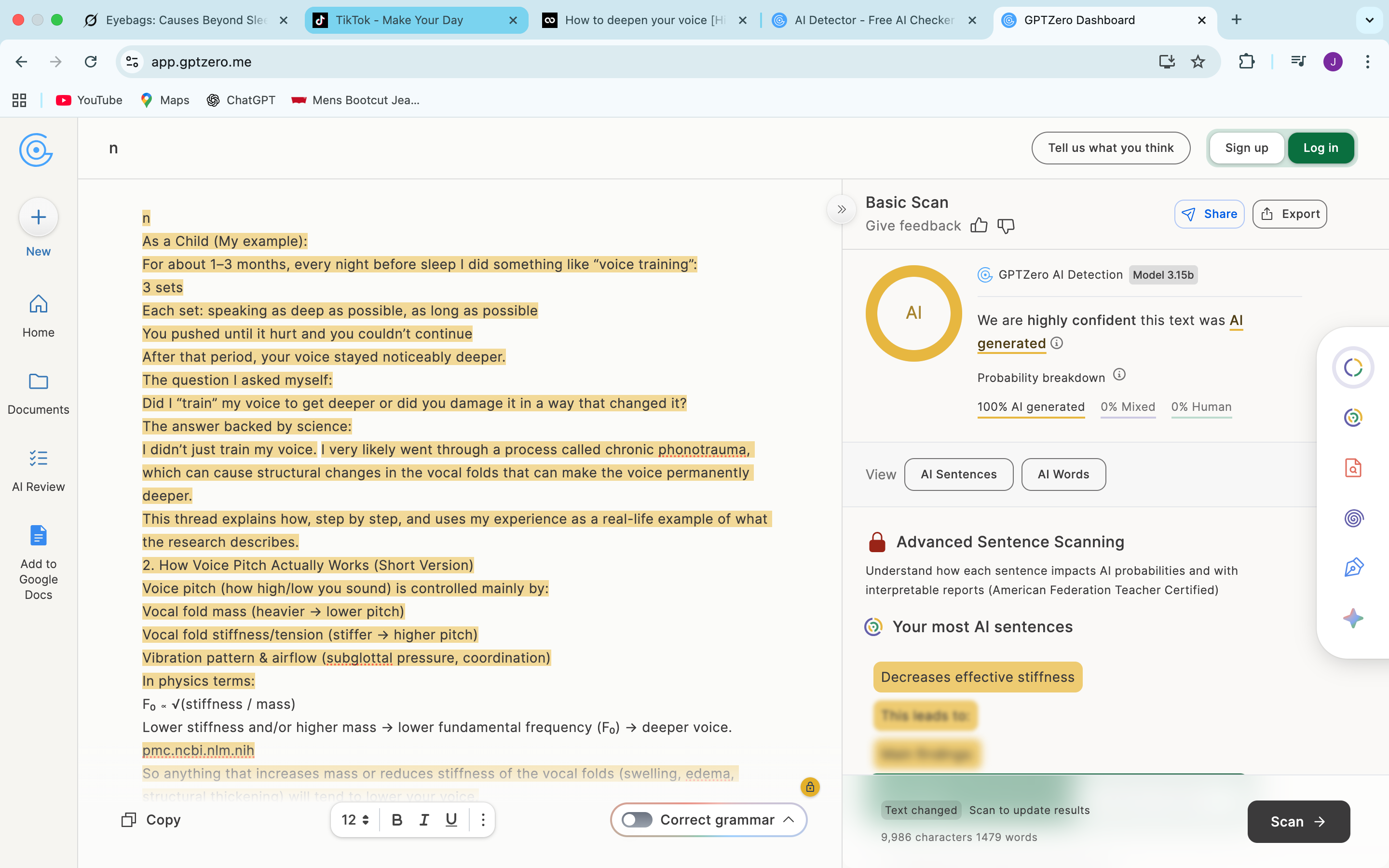
thanks chat gpt:forcedsmile:
 

Attachments

  • Screenshot 2025-12-31 at 12.40.35.png
    Screenshot 2025-12-31 at 12.40.35.png
    867.7 KB · Views: 0
  • +1
  • JFL
  • Woah
Reactions: brainiac_loser, PainfulProportions, 0ogrpostcel and 7 others
I just want to make a thread on how to deepen your voice with me as an example.

Quick tut for low-IQ people that don't want to get into that science stuff

It is pretty simple; you must train your voice, which means destroy your vocal cords. How can you accomplish that? Pretty simple, just scream, or what I did was forcibly change your voice to the deepest it gets. Do it as long as you like. I did it as long as it hurt and further always before I got to bed. For approximately 3 months, when I was a teenager, further than that time I won't go because it can lead to chronic injuries.

Just note that I did this when I was a child, and I'm pretty sure that it caused this constant, what I say, "training" that deepens my voice now because nobody in my family has a deep voice, and I don't do any smoking or that kind of stuff, so it would be the only option left and answer why I have that kind of a voice and people think that I'm a constant smoker or do take testosterone.

1. The Core Question​

As a Child (My example):
For about 1–3 months, every night before sleep I did something like “voice training”:
  • 3 sets
  • Each set: speaking as deep as possible, as long as possible
  • You pushed until it hurt and you couldn’t continue
After that period, your voice stayed noticeably deeper.
The question I asked myself:

The answer backed by science:
I didn’t just train my voice. I very likely went through a process called chronic phonotrauma, which can cause structural changes in the vocal folds that can make the voice permanently deeper.
This thread explains how, step by step, and uses my experience as a real-life example of what the research describes.

2. How Voice Pitch Actually Works (Short Version)​

Voice pitch (how high/low you sound) is controlled mainly by:
  • Vocal fold mass (heavier → lower pitch)
  • Vocal fold stiffness/tension (stiffer → higher pitch)
  • Vibration pattern & airflow (subglottal pressure, coordination)
In physics terms:

So anything that increases mass or reduces stiffness of the vocal folds (swelling, edema, structural thickening) will tend to lower your voice.

3. How Normal Training Deepens the Voice (Healthy Path)​

There is research showing that healthy voice training can allow people to access deeper notes without damage:
  • A 2024 study on professional singers trained them for one month to use diaphragmatic (abdominal) breathing instead of thoracic breathing. journals.sagepub
    • Deepest note in men dropped from ~100.9 Hz to ~94.5 Hz (significantly lower).
    • Range nearly doubled.
    • Mechanism: more efficient breath support and improved control, not injury.
Key point:
Healthy training makes the voice sound deeper by improving efficiency and coordination, not by hurting the tissue.
What you did as a kid was the opposite: forced deep phonation until pain. That moves from “training” into injury territory.

4. Acute Phonotrauma: What One Heavy Session Does​

Acute phonotrauma = short, intense overload of the vocal folds (e.g., screaming for 1–2 hours).
A classic study on acute phonotrauma examined what happens to the vocal fold epithelium (surface layer) after 120 minutes of heavy phonation in animals and followed healing over 7 days: pmc.ncbi.nlm.nih
After 0–24 hours:
  • Surface structures (microprojections) are damaged.
  • Tight junction proteins (Occludin, ZO-1, E-cadherin) drop – the barrier is compromised.
  • Inflammatory markers (IL‑1β, COX‑2) spike – the tissue is inflamed.
After ~3 days:
  • Surface structures are repaired.
  • Barrier proteins begin to normalize.
  • Tissue is in active repair mode (TGF‑β1, fibronectin elevated).
After ~7 days:
  • Barrier mostly normalized.
  • Epithelium still thicker than normal (hypertrophy).
  • With no further trauma, it likely goes back toward normal.
Translation:
After one very heavy episode, your vocal folds can recover in about 3–7 days, assuming you stop abusing them.
But this is not what you did.

5. My Case: Repeated Trauma Before Healing​

I weren’t screaming once at a concert. You:
  • Repeated forced deep phonation
  • Every night
  • For 1–3 months
  • Always going “until it hurts”
That pattern matches repeated trauma with incomplete healing.
What happens biologically when you hit the tissue again and again before it recovers?

5.1. From Acute → Chronic Inflammation​

Based on healing models and simulations of vocal fold injury: pmc.ncbi.nlm.nih+1
  1. Day 1
    • Trauma → microvascular leakage, edema, inflammation.
    • IL‑1β and other inflammatory markers rise.
  2. Normal case (no repetition)
    • Over 3–7 days, healing switches from inflammation → repair → remodeling.
  3. My case (repeated trauma every night)
    • New trauma hits before the previous injury finishes healing.
    • Inflammatory markers never fully drop.
    • The tissue is pushed toward chronic inflammation, not recovery.

5.2. The Vicious Cycle of Phonotraumatic Hyperfunction​

Simulation and modeling papers on phonotraumatic vocal hyperfunction describe a self-reinforcing loop: pmc.ncbi.nlm.nih
  • Injury causes swelling → voice quality worsens.
  • The person compensates by using more effort/pressure, often pressing harder or forcing pitch.
  • The increased effort causes more mechanical stress → more microvascular damage → more swelling.
  • The cycle repeats and escalates.
Your nightly routine of “push until it hurts again” is almost a perfect real-life example of this loop.

6. Swelling (Edema) and Why It Makes the Voice Deeper​

A recent finite-element model study looked specifically at how swelling affects vocal fold vibration:pmc.ncbi.nlm.nih
Main findings:
  • Swelling in the superficial layer (Reinke’s space)
    • Increases mass
    • Decreases effective stiffness
  • This leads to:
    • Lower fundamental frequency (F₀) – voice sounds deeper
    • Higher tissue stress, more collision force – higher risk of further damage
In the model, about 30% swelling caused a drop in F₀ of roughly 10 Hz and significantly increased mechanical stress during vibration.pmc.ncbi.nlm.nih
So yes:
If you repeatedly overload your voice until it swells, your voice can indeed sound deeper – but that depth is the acoustic side effect of injury, not a healthy adaptation.

7. From Temporary Swelling to Structural Change​

Short-term swelling is reversible.
Chronic, repeated swelling leads to structural remodeling.
Clinical studies of Reinke’s edema (chronic swelling in Reinke’s space) show this clearly:pmc.ncbi.nlm.nih+1
  • Patients with severe Reinke’s edema (Grades 3–4) have:
    • Significantly lower F₀ (deeper voices) compared to milder cases.
    • Roughness, strain, vocal fatigue.
  • Histology (microscopic examination) shows:
    • Epithelial hyperplasia (thickened surface layer)
    • Basement membrane thickening
    • Vascular changes (dilated or new vessels)
    • Altered extracellular matrix (fibrosis)
These are not just “swollen folds” anymore. The structure of the tissue has changed.
And here’s the key:
Even after surgical removal of the edema, not all patients recover normal voice. In one series, ~17% had no significant improvement after surgery because structural remodeling was too advanced. pmc.ncbi.nlm.nih

8. My Case​

8.1. My “Training Plan”​

  • Duration: ~1–3 months
  • Frequency: basically every night
  • Protocol: 3 sets, as deep as possible, as long as possible
  • Intensity: until it hurts and you physically can’t continue
From a voice-science perspective, this is:

8.2. Likely Biological Sequence​

  1. First nights
    • Intense forced deep phonation → acute phonotrauma
    • Swelling of the superficial layer → more mass, less stiffness
    • Voice becomes temporarily deeper and hoarser.
  2. Following days
    • Epithelium and barrier proteins try to recover
    • But before reaching full recovery (3–7 days), you hit the folds again.
  3. Over weeks
    • Inflammation shifts from acute to chronic.
    • Repair signals (e.g., TGF‑β1) and matrix proteins stay elevated. pmc.ncbi.nlm.nih
    • Basal membrane starts thickening, epithelium hypertrophies, microvasculature changes. pmc.ncbi.nlm.nih+1
  4. Result after 1–3 months
    • Your vocal folds are structurally different than before:
      • Thicker cover
      • Altered basement membrane
      • Possibly persistent low-grade edema or matrix remodeling
    • The effective mass/stiffness ratio at rest is now shifted → baseline F₀ is lower.
    • You experience this as:
You did not just “train your vocal muscles”.
You very likely remodeled the tissue through chronic microinjury.

9. Why Your Voice Stayed Deeper​

Important distinction:
  • Healthy training effects (coordination, breath support, resonance) are reversible if you stop training – you lose skill, not tissue.
  • Structural injury effects (thickening, fibrosis, chronic edema) are partially or fully irreversible, even if you stop.
Your voice remaining deeper after you stopped strongly suggests:
  • There are lasting structural changes in your vocal folds.
  • These changes shift your baseline pitch downward.
Clinical parallels:
  • Women with chronic Reinke’s edema often present with voices perceived as “male-like” and have significantly lower F₀ than expected. pmc.ncbi.nlm.nih
  • Even after surgery, not all of them return to normal pitch, because structural remodeling persists. pmc.ncbi.nlm.nih
Your case sits on the same mechanistic spectrum, just induced in childhood by repeated self-inflicted strain instead of decades of smoking + voice abuse.

10. Why This Is Not a Good “Method” to Deepen the Voice​

From a purely mechanistic point of view:
  • Yes, damaging your vocal folds can make your voice deeper.
  • But it does so by:
    • Creating chronic inflammation
    • Inducing tissue remodeling
    • Increasing risk of nodules, polyps, hemorrhage, chronic dysphonia. pmc.ncbi.nlm.nih+2
It is similar to:

In voice science, the goal is to:
  • Improve efficiency (resonance, breath support, motor control)
  • Reduce collision forces and unnecessary muscle tension
  • Expand usable range without damaging the tissue
What you did was the opposite: forcing extreme phonation into pain, which is a classic red flag for injury.

11. If Someone Is in a Similar Situation Now​

For anyone in a similar situation (or you today, if you still care about your voice):
  1. Do not continue “training into pain.”
    Pain in the larynx during phonation is a stop signal, not a “good workout sign”. pmc.ncbi.nlm.nih
  2. Get an ENT (laryngologist) to scope the larynx.
    • Look for edema, nodules, polyps, or signs of Reinke’s edema.
    • Evaluate vibration with stroboscopy.
  3. Work with a speech–language pathologist (logopedist) specialized in voice.
    • Focus on resonance, breath support, efficiency.
    • Goal: maximize what you can do with the current anatomy without worsening damage.
  4. Be realistic about reversibility.
    • Acute swelling: reversible in days–weeks.
    • Chronic structural changes: only partially reversible, even with surgery.
  5. https://pmc.ncbi.nlm.nih.gov/articles/PMC10795467/
  6. https://journals.sagepub.com/doi/10.1177/01455613241305984
  7. https://pmc.ncbi.nlm.nih.gov/articles/PMC5555600/
  8. https://pmc.ncbi.nlm.nih.gov/articles/PMC2481293/
  9. https://pmc.ncbi.nlm.nih.gov/articles/PMC11110086/
  10. https://pmc.ncbi.nlm.nih.gov/articles/PMC9879646/
  11. https://pmc.ncbi.nlm.nih.gov/articles/PMC6622176/
  12. https://pmc.ncbi.nlm.nih.gov/articles/PMC2925639/
„High IQ thread“
 

Attachments

  • IMG_1171.jpeg
    IMG_1171.jpeg
    148.4 KB · Views: 0
  • +1
  • JFL
Reactions: PainfulProportions, biglaith, LegendaryKennen and 1 other person
Written 100% by AI delete this garbage
 
  • +1
Reactions: PainfulProportions
Thank you ChatGPT ill consider this
 
  • +1
  • JFL
Reactions: PainfulProportions, biglaith, LegendaryKennen and 1 other person
"Thread for low iq people"

Then proceeds to suck chatgpts dick :lul:
 
  • +1
  • Hmm...
Reactions: Bjelicaist, PainfulProportions, biglaith and 2 others
we know you didn’t write ts nigga
 
  • +1
  • JFL
Reactions: brainiac_loser, PainfulProportions, biglaith and 1 other person
I just want to make a thread on how to deepen your voice with me as an example.

Quick tut for low-IQ people that don't want to get into that science stuff

It is pretty simple; you must train your voice, which means destroy your vocal cords. How can you accomplish that? Pretty simple, just scream, or what I did was forcibly change your voice to the deepest it gets. Do it as long as you like. I did it as long as it hurt and further always before I got to bed. For approximately 3 months, when I was a teenager, further than that time I won't go because it can lead to chronic injuries.

Just note that I did this when I was a child, and I'm pretty sure that it caused this constant, what I say, "training" that deepens my voice now because nobody in my family has a deep voice, and I don't do any smoking or that kind of stuff, so it would be the only option left and answer why I have that kind of a voice and people think that I'm a constant smoker or do take testosterone.

1. The Core Question​

As a Child (My example):
For about 1–3 months, every night before sleep I did something like “voice training”:
  • 3 sets
  • Each set: speaking as deep as possible, as long as possible
  • You pushed until it hurt and you couldn’t continue
After that period, your voice stayed noticeably deeper.
The question I asked myself:

The answer backed by science:
I didn’t just train my voice. I very likely went through a process called chronic phonotrauma, which can cause structural changes in the vocal folds that can make the voice permanently deeper.
This thread explains how, step by step, and uses my experience as a real-life example of what the research describes.

2. How Voice Pitch Actually Works (Short Version)​

Voice pitch (how high/low you sound) is controlled mainly by:
  • Vocal fold mass (heavier → lower pitch)
  • Vocal fold stiffness/tension (stiffer → higher pitch)
  • Vibration pattern & airflow (subglottal pressure, coordination)
In physics terms:

So anything that increases mass or reduces stiffness of the vocal folds (swelling, edema, structural thickening) will tend to lower your voice.

3. How Normal Training Deepens the Voice (Healthy Path)​

There is research showing that healthy voice training can allow people to access deeper notes without damage:
  • A 2024 study on professional singers trained them for one month to use diaphragmatic (abdominal) breathing instead of thoracic breathing. journals.sagepub
    • Deepest note in men dropped from ~100.9 Hz to ~94.5 Hz (significantly lower).
    • Range nearly doubled.
    • Mechanism: more efficient breath support and improved control, not injury.
Key point:
Healthy training makes the voice sound deeper by improving efficiency and coordination, not by hurting the tissue.
What you did as a kid was the opposite: forced deep phonation until pain. That moves from “training” into injury territory.

4. Acute Phonotrauma: What One Heavy Session Does​

Acute phonotrauma = short, intense overload of the vocal folds (e.g., screaming for 1–2 hours).
A classic study on acute phonotrauma examined what happens to the vocal fold epithelium (surface layer) after 120 minutes of heavy phonation in animals and followed healing over 7 days: pmc.ncbi.nlm.nih
After 0–24 hours:
  • Surface structures (microprojections) are damaged.
  • Tight junction proteins (Occludin, ZO-1, E-cadherin) drop – the barrier is compromised.
  • Inflammatory markers (IL‑1β, COX‑2) spike – the tissue is inflamed.
After ~3 days:
  • Surface structures are repaired.
  • Barrier proteins begin to normalize.
  • Tissue is in active repair mode (TGF‑β1, fibronectin elevated).
After ~7 days:
  • Barrier mostly normalized.
  • Epithelium still thicker than normal (hypertrophy).
  • With no further trauma, it likely goes back toward normal.
Translation:
After one very heavy episode, your vocal folds can recover in about 3–7 days, assuming you stop abusing them.
But this is not what you did.

5. My Case: Repeated Trauma Before Healing​

I weren’t screaming once at a concert. You:
  • Repeated forced deep phonation
  • Every night
  • For 1–3 months
  • Always going “until it hurts”
That pattern matches repeated trauma with incomplete healing.
What happens biologically when you hit the tissue again and again before it recovers?

5.1. From Acute → Chronic Inflammation​

Based on healing models and simulations of vocal fold injury: pmc.ncbi.nlm.nih+1
  1. Day 1
    • Trauma → microvascular leakage, edema, inflammation.
    • IL‑1β and other inflammatory markers rise.
  2. Normal case (no repetition)
    • Over 3–7 days, healing switches from inflammation → repair → remodeling.
  3. My case (repeated trauma every night)
    • New trauma hits before the previous injury finishes healing.
    • Inflammatory markers never fully drop.
    • The tissue is pushed toward chronic inflammation, not recovery.

5.2. The Vicious Cycle of Phonotraumatic Hyperfunction​

Simulation and modeling papers on phonotraumatic vocal hyperfunction describe a self-reinforcing loop: pmc.ncbi.nlm.nih
  • Injury causes swelling → voice quality worsens.
  • The person compensates by using more effort/pressure, often pressing harder or forcing pitch.
  • The increased effort causes more mechanical stress → more microvascular damage → more swelling.
  • The cycle repeats and escalates.
Your nightly routine of “push until it hurts again” is almost a perfect real-life example of this loop.

6. Swelling (Edema) and Why It Makes the Voice Deeper​

A recent finite-element model study looked specifically at how swelling affects vocal fold vibration:pmc.ncbi.nlm.nih
Main findings:
  • Swelling in the superficial layer (Reinke’s space)
    • Increases mass
    • Decreases effective stiffness
  • This leads to:
    • Lower fundamental frequency (F₀) – voice sounds deeper
    • Higher tissue stress, more collision force – higher risk of further damage
In the model, about 30% swelling caused a drop in F₀ of roughly 10 Hz and significantly increased mechanical stress during vibration.pmc.ncbi.nlm.nih
So yes:
If you repeatedly overload your voice until it swells, your voice can indeed sound deeper – but that depth is the acoustic side effect of injury, not a healthy adaptation.

7. From Temporary Swelling to Structural Change​

Short-term swelling is reversible.
Chronic, repeated swelling leads to structural remodeling.
Clinical studies of Reinke’s edema (chronic swelling in Reinke’s space) show this clearly:pmc.ncbi.nlm.nih+1
  • Patients with severe Reinke’s edema (Grades 3–4) have:
    • Significantly lower F₀ (deeper voices) compared to milder cases.
    • Roughness, strain, vocal fatigue.
  • Histology (microscopic examination) shows:
    • Epithelial hyperplasia (thickened surface layer)
    • Basement membrane thickening
    • Vascular changes (dilated or new vessels)
    • Altered extracellular matrix (fibrosis)
These are not just “swollen folds” anymore. The structure of the tissue has changed.
And here’s the key:
Even after surgical removal of the edema, not all patients recover normal voice. In one series, ~17% had no significant improvement after surgery because structural remodeling was too advanced. pmc.ncbi.nlm.nih

8. My Case​

8.1. My “Training Plan”​

  • Duration: ~1–3 months
  • Frequency: basically every night
  • Protocol: 3 sets, as deep as possible, as long as possible
  • Intensity: until it hurts and you physically can’t continue
From a voice-science perspective, this is:

8.2. Likely Biological Sequence​

  1. First nights
    • Intense forced deep phonation → acute phonotrauma
    • Swelling of the superficial layer → more mass, less stiffness
    • Voice becomes temporarily deeper and hoarser.
  2. Following days
    • Epithelium and barrier proteins try to recover
    • But before reaching full recovery (3–7 days), you hit the folds again.
  3. Over weeks
    • Inflammation shifts from acute to chronic.
    • Repair signals (e.g., TGF‑β1) and matrix proteins stay elevated. pmc.ncbi.nlm.nih
    • Basal membrane starts thickening, epithelium hypertrophies, microvasculature changes. pmc.ncbi.nlm.nih+1
  4. Result after 1–3 months
    • Your vocal folds are structurally different than before:
      • Thicker cover
      • Altered basement membrane
      • Possibly persistent low-grade edema or matrix remodeling
    • The effective mass/stiffness ratio at rest is now shifted → baseline F₀ is lower.
    • You experience this as:
You did not just “train your vocal muscles”.
You very likely remodeled the tissue through chronic microinjury.

9. Why Your Voice Stayed Deeper​

Important distinction:
  • Healthy training effects (coordination, breath support, resonance) are reversible if you stop training – you lose skill, not tissue.
  • Structural injury effects (thickening, fibrosis, chronic edema) are partially or fully irreversible, even if you stop.
Your voice remaining deeper after you stopped strongly suggests:
  • There are lasting structural changes in your vocal folds.
  • These changes shift your baseline pitch downward.
Clinical parallels:
  • Women with chronic Reinke’s edema often present with voices perceived as “male-like” and have significantly lower F₀ than expected. pmc.ncbi.nlm.nih
  • Even after surgery, not all of them return to normal pitch, because structural remodeling persists. pmc.ncbi.nlm.nih
Your case sits on the same mechanistic spectrum, just induced in childhood by repeated self-inflicted strain instead of decades of smoking + voice abuse.

10. Why This Is Not a Good “Method” to Deepen the Voice​

From a purely mechanistic point of view:
  • Yes, damaging your vocal folds can make your voice deeper.
  • But it does so by:
    • Creating chronic inflammation
    • Inducing tissue remodeling
    • Increasing risk of nodules, polyps, hemorrhage, chronic dysphonia. pmc.ncbi.nlm.nih+2
It is similar to:

In voice science, the goal is to:
  • Improve efficiency (resonance, breath support, motor control)
  • Reduce collision forces and unnecessary muscle tension
  • Expand usable range without damaging the tissue
What you did was the opposite: forcing extreme phonation into pain, which is a classic red flag for injury.

11. If Someone Is in a Similar Situation Now​

For anyone in a similar situation (or you today, if you still care about your voice):
  1. Do not continue “training into pain.”
    Pain in the larynx during phonation is a stop signal, not a “good workout sign”. pmc.ncbi.nlm.nih
  2. Get an ENT (laryngologist) to scope the larynx.
    • Look for edema, nodules, polyps, or signs of Reinke’s edema.
    • Evaluate vibration with stroboscopy.
  3. Work with a speech–language pathologist (logopedist) specialized in voice.
    • Focus on resonance, breath support, efficiency.
    • Goal: maximize what you can do with the current anatomy without worsening damage.
  4. Be realistic about reversibility.
    • Acute swelling: reversible in days–weeks.
    • Chronic structural changes: only partially reversible, even with surgery.
  5. https://pmc.ncbi.nlm.nih.gov/articles/PMC10795467/
  6. https://journals.sagepub.com/doi/10.1177/01455613241305984
  7. https://pmc.ncbi.nlm.nih.gov/articles/PMC5555600/
  8. https://pmc.ncbi.nlm.nih.gov/articles/PMC2481293/
  9. https://pmc.ncbi.nlm.nih.gov/articles/PMC11110086/
  10. https://pmc.ncbi.nlm.nih.gov/articles/PMC9879646/
  11. https://pmc.ncbi.nlm.nih.gov/articles/PMC6622176/
  12. https://pmc.ncbi.nlm.nih.gov/articles/PMC2925639/
Holy chatgbt
 
  • JFL
Reactions: PainfulProportions
I just want to make a thread on how to deepen your voice with me as an example.

Quick tut for low-IQ people that don't want to get into that science stuff

It is pretty simple; you must train your voice, which means destroy your vocal cords. How can you accomplish that? Pretty simple, just scream, or what I did was forcibly change your voice to the deepest it gets. Do it as long as you like. I did it as long as it hurt and further always before I got to bed. For approximately 3 months, when I was a teenager, further than that time I won't go because it can lead to chronic injuries.

Just note that I did this when I was a child, and I'm pretty sure that it caused this constant, what I say, "training" that deepens my voice now because nobody in my family has a deep voice, and I don't do any smoking or that kind of stuff, so it would be the only option left and answer why I have that kind of a voice and people think that I'm a constant smoker or do take testosterone.

1. The Core Question​

As a Child (My example):
For about 1–3 months, every night before sleep I did something like “voice training”:
  • 3 sets
  • Each set: speaking as deep as possible, as long as possible
  • You pushed until it hurt and you couldn’t continue
After that period, your voice stayed noticeably deeper.
The question I asked myself:

The answer backed by science:
I didn’t just train my voice. I very likely went through a process called chronic phonotrauma, which can cause structural changes in the vocal folds that can make the voice permanently deeper.
This thread explains how, step by step, and uses my experience as a real-life example of what the research describes.

2. How Voice Pitch Actually Works (Short Version)​

Voice pitch (how high/low you sound) is controlled mainly by:
  • Vocal fold mass (heavier → lower pitch)
  • Vocal fold stiffness/tension (stiffer → higher pitch)
  • Vibration pattern & airflow (subglottal pressure, coordination)
In physics terms:

So anything that increases mass or reduces stiffness of the vocal folds (swelling, edema, structural thickening) will tend to lower your voice.

3. How Normal Training Deepens the Voice (Healthy Path)​

There is research showing that healthy voice training can allow people to access deeper notes without damage:
  • A 2024 study on professional singers trained them for one month to use diaphragmatic (abdominal) breathing instead of thoracic breathing. journals.sagepub
    • Deepest note in men dropped from ~100.9 Hz to ~94.5 Hz (significantly lower).
    • Range nearly doubled.
    • Mechanism: more efficient breath support and improved control, not injury.
Key point:
Healthy training makes the voice sound deeper by improving efficiency and coordination, not by hurting the tissue.
What you did as a kid was the opposite: forced deep phonation until pain. That moves from “training” into injury territory.

4. Acute Phonotrauma: What One Heavy Session Does​

Acute phonotrauma = short, intense overload of the vocal folds (e.g., screaming for 1–2 hours).
A classic study on acute phonotrauma examined what happens to the vocal fold epithelium (surface layer) after 120 minutes of heavy phonation in animals and followed healing over 7 days: pmc.ncbi.nlm.nih
After 0–24 hours:
  • Surface structures (microprojections) are damaged.
  • Tight junction proteins (Occludin, ZO-1, E-cadherin) drop – the barrier is compromised.
  • Inflammatory markers (IL‑1β, COX‑2) spike – the tissue is inflamed.
After ~3 days:
  • Surface structures are repaired.
  • Barrier proteins begin to normalize.
  • Tissue is in active repair mode (TGF‑β1, fibronectin elevated).
After ~7 days:
  • Barrier mostly normalized.
  • Epithelium still thicker than normal (hypertrophy).
  • With no further trauma, it likely goes back toward normal.
Translation:
After one very heavy episode, your vocal folds can recover in about 3–7 days, assuming you stop abusing them.
But this is not what you did.

5. My Case: Repeated Trauma Before Healing​

I weren’t screaming once at a concert. You:
  • Repeated forced deep phonation
  • Every night
  • For 1–3 months
  • Always going “until it hurts”
That pattern matches repeated trauma with incomplete healing.
What happens biologically when you hit the tissue again and again before it recovers?

5.1. From Acute → Chronic Inflammation​

Based on healing models and simulations of vocal fold injury: pmc.ncbi.nlm.nih+1
  1. Day 1
    • Trauma → microvascular leakage, edema, inflammation.
    • IL‑1β and other inflammatory markers rise.
  2. Normal case (no repetition)
    • Over 3–7 days, healing switches from inflammation → repair → remodeling.
  3. My case (repeated trauma every night)
    • New trauma hits before the previous injury finishes healing.
    • Inflammatory markers never fully drop.
    • The tissue is pushed toward chronic inflammation, not recovery.

5.2. The Vicious Cycle of Phonotraumatic Hyperfunction​

Simulation and modeling papers on phonotraumatic vocal hyperfunction describe a self-reinforcing loop: pmc.ncbi.nlm.nih
  • Injury causes swelling → voice quality worsens.
  • The person compensates by using more effort/pressure, often pressing harder or forcing pitch.
  • The increased effort causes more mechanical stress → more microvascular damage → more swelling.
  • The cycle repeats and escalates.
Your nightly routine of “push until it hurts again” is almost a perfect real-life example of this loop.

6. Swelling (Edema) and Why It Makes the Voice Deeper​

A recent finite-element model study looked specifically at how swelling affects vocal fold vibration:pmc.ncbi.nlm.nih
Main findings:
  • Swelling in the superficial layer (Reinke’s space)
    • Increases mass
    • Decreases effective stiffness
  • This leads to:
    • Lower fundamental frequency (F₀) – voice sounds deeper
    • Higher tissue stress, more collision force – higher risk of further damage
In the model, about 30% swelling caused a drop in F₀ of roughly 10 Hz and significantly increased mechanical stress during vibration.pmc.ncbi.nlm.nih
So yes:
If you repeatedly overload your voice until it swells, your voice can indeed sound deeper – but that depth is the acoustic side effect of injury, not a healthy adaptation.

7. From Temporary Swelling to Structural Change​

Short-term swelling is reversible.
Chronic, repeated swelling leads to structural remodeling.
Clinical studies of Reinke’s edema (chronic swelling in Reinke’s space) show this clearly:pmc.ncbi.nlm.nih+1
  • Patients with severe Reinke’s edema (Grades 3–4) have:
    • Significantly lower F₀ (deeper voices) compared to milder cases.
    • Roughness, strain, vocal fatigue.
  • Histology (microscopic examination) shows:
    • Epithelial hyperplasia (thickened surface layer)
    • Basement membrane thickening
    • Vascular changes (dilated or new vessels)
    • Altered extracellular matrix (fibrosis)
These are not just “swollen folds” anymore. The structure of the tissue has changed.
And here’s the key:
Even after surgical removal of the edema, not all patients recover normal voice. In one series, ~17% had no significant improvement after surgery because structural remodeling was too advanced. pmc.ncbi.nlm.nih

8. My Case​

8.1. My “Training Plan”​

  • Duration: ~1–3 months
  • Frequency: basically every night
  • Protocol: 3 sets, as deep as possible, as long as possible
  • Intensity: until it hurts and you physically can’t continue
From a voice-science perspective, this is:

8.2. Likely Biological Sequence​

  1. First nights
    • Intense forced deep phonation → acute phonotrauma
    • Swelling of the superficial layer → more mass, less stiffness
    • Voice becomes temporarily deeper and hoarser.
  2. Following days
    • Epithelium and barrier proteins try to recover
    • But before reaching full recovery (3–7 days), you hit the folds again.
  3. Over weeks
    • Inflammation shifts from acute to chronic.
    • Repair signals (e.g., TGF‑β1) and matrix proteins stay elevated. pmc.ncbi.nlm.nih
    • Basal membrane starts thickening, epithelium hypertrophies, microvasculature changes. pmc.ncbi.nlm.nih+1
  4. Result after 1–3 months
    • Your vocal folds are structurally different than before:
      • Thicker cover
      • Altered basement membrane
      • Possibly persistent low-grade edema or matrix remodeling
    • The effective mass/stiffness ratio at rest is now shifted → baseline F₀ is lower.
    • You experience this as:
You did not just “train your vocal muscles”.
You very likely remodeled the tissue through chronic microinjury.

9. Why Your Voice Stayed Deeper​

Important distinction:
  • Healthy training effects (coordination, breath support, resonance) are reversible if you stop training – you lose skill, not tissue.
  • Structural injury effects (thickening, fibrosis, chronic edema) are partially or fully irreversible, even if you stop.
Your voice remaining deeper after you stopped strongly suggests:
  • There are lasting structural changes in your vocal folds.
  • These changes shift your baseline pitch downward.
Clinical parallels:
  • Women with chronic Reinke’s edema often present with voices perceived as “male-like” and have significantly lower F₀ than expected. pmc.ncbi.nlm.nih
  • Even after surgery, not all of them return to normal pitch, because structural remodeling persists. pmc.ncbi.nlm.nih
Your case sits on the same mechanistic spectrum, just induced in childhood by repeated self-inflicted strain instead of decades of smoking + voice abuse.

10. Why This Is Not a Good “Method” to Deepen the Voice​

From a purely mechanistic point of view:
  • Yes, damaging your vocal folds can make your voice deeper.
  • But it does so by:
    • Creating chronic inflammation
    • Inducing tissue remodeling
    • Increasing risk of nodules, polyps, hemorrhage, chronic dysphonia. pmc.ncbi.nlm.nih+2
It is similar to:

In voice science, the goal is to:
  • Improve efficiency (resonance, breath support, motor control)
  • Reduce collision forces and unnecessary muscle tension
  • Expand usable range without damaging the tissue
What you did was the opposite: forcing extreme phonation into pain, which is a classic red flag for injury.

11. If Someone Is in a Similar Situation Now​

For anyone in a similar situation (or you today, if you still care about your voice):
  1. Do not continue “training into pain.”
    Pain in the larynx during phonation is a stop signal, not a “good workout sign”. pmc.ncbi.nlm.nih
  2. Get an ENT (laryngologist) to scope the larynx.
    • Look for edema, nodules, polyps, or signs of Reinke’s edema.
    • Evaluate vibration with stroboscopy.
  3. Work with a speech–language pathologist (logopedist) specialized in voice.
    • Focus on resonance, breath support, efficiency.
    • Goal: maximize what you can do with the current anatomy without worsening damage.
  4. Be realistic about reversibility.
    • Acute swelling: reversible in days–weeks.
    • Chronic structural changes: only partially reversible, even with surgery.
  5. https://pmc.ncbi.nlm.nih.gov/articles/PMC10795467/
  6. https://journals.sagepub.com/doi/10.1177/01455613241305984
  7. https://pmc.ncbi.nlm.nih.gov/articles/PMC5555600/
  8. https://pmc.ncbi.nlm.nih.gov/articles/PMC2481293/
  9. https://pmc.ncbi.nlm.nih.gov/articles/PMC11110086/
  10. https://pmc.ncbi.nlm.nih.gov/articles/PMC9879646/
  11. https://pmc.ncbi.nlm.nih.gov/articles/PMC6622176/
  12. https://pmc.ncbi.nlm.nih.gov/articles/PMC2925639/
TL;DR suck chads dick for massive voice gains
 
  • JFL
  • +1
Reactions: ltnfoidraperer, Deleted member 297038, brainiac_loser and 1 other person

Similar threads

2012slayer123
Replies
3
Views
65
NWL
NWL
Neverforgivetwice
Replies
13
Views
148
IBlameGenetics6741
IBlameGenetics6741
sinistertfr333
Replies
17
Views
67
Tyroid
Tyroid
notkiwis
Replies
9
Views
41
notkiwis
notkiwis
NerverBegan
Replies
6
Views
104
TariiqBih
TariiqBih

Users who are viewing this thread

Back
Top