





luckycel
Iron
- Joined
- Jul 1, 2024
- Posts
- 171
- Reputation
- 208
What's up everyone, I've already posted about this but now I've found actual CT scans that prove that what I talked about is true. My initial hypothesis was that training your masseters will cause your gonions to exvert and "come down" as a result of larger masseters pulling down on bone. I evidenced this with the fact that masseter size is correlated with ramus length, but this is just a correlation. Now I've found hard evidence and CT scans that prove this is true in bruxism patients.
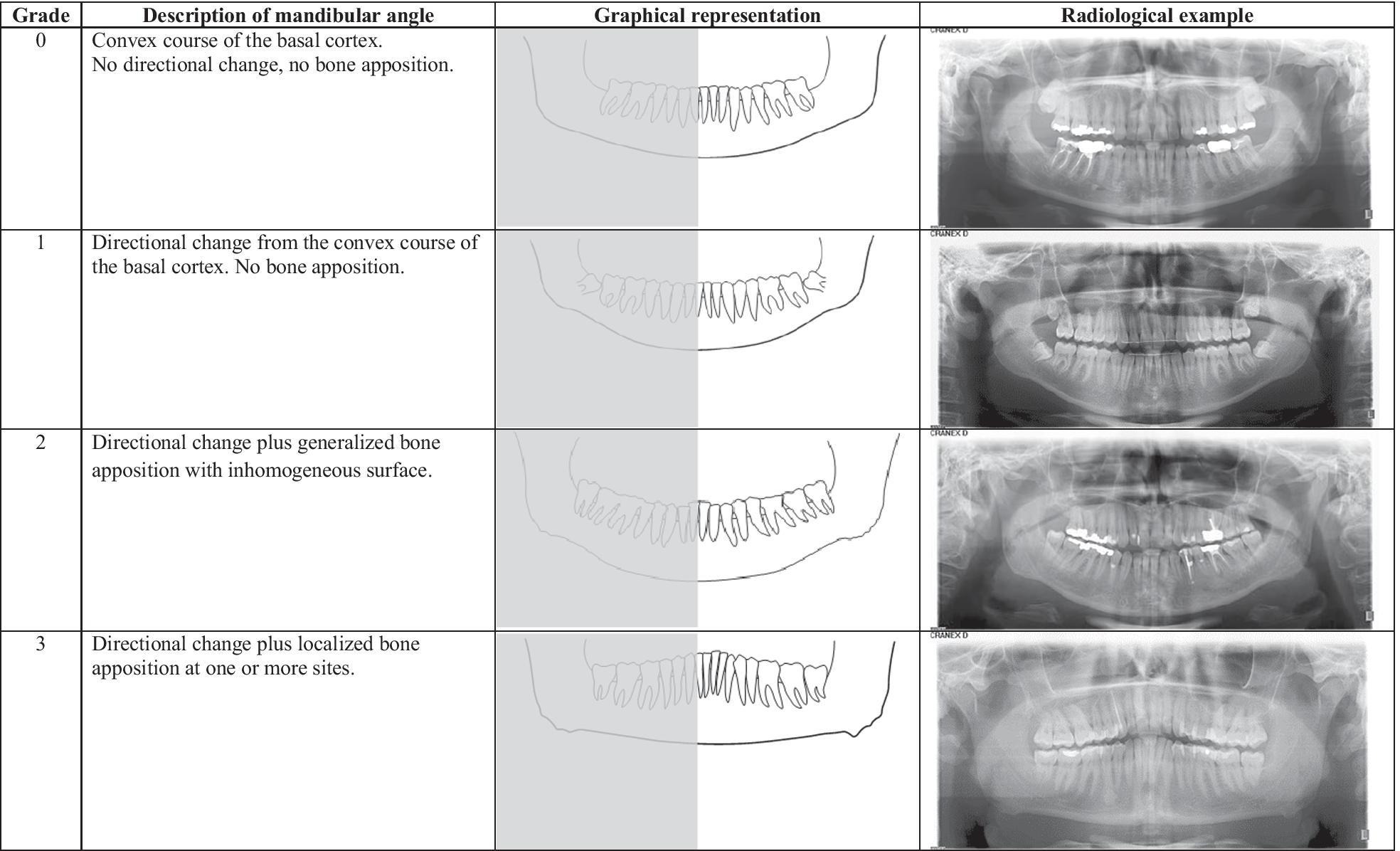
This is a figure from a study about bruxism patients that shows different grades of mandibular bone apposition. As we can see higher grade = More flared exverted gonions and an overall "squarer" jaw(lower gonial angle). What this study looked at is if bruxism patients who are adults are more likely to get bone apposition than children with bruxism. Note that grades 0 and 1 basically mean no apposition, while anything higher than that means there's probably bone apposition.
Now to the findings of the study:
In short, adults who have bruxism were extremely likely to show some kind of bone apposition. In fact, while bone apposition was practically absent in the control group of adolescents(who also had bruxism), six out of ten adult bruxers had it.
This is how the researchers explained it:
So, what does all of this mean?
If you want a more square mandible(as well as a taller ramus) clenching might be an option for you(basically try to imitate having bruxism). We don't exactly know how long it takes to see results, but it definitely works. The best thing about this is that you can do it even if you aren't a kid and your mandible will still adapt, best of luck to all of you.
This is a figure from a study about bruxism patients that shows different grades of mandibular bone apposition. As we can see higher grade = More flared exverted gonions and an overall "squarer" jaw(lower gonial angle). What this study looked at is if bruxism patients who are adults are more likely to get bone apposition than children with bruxism. Note that grades 0 and 1 basically mean no apposition, while anything higher than that means there's probably bone apposition.
Now to the findings of the study:
Apposition was observed in 95 mandibular angles (47.5%) of 59 adult patients with bruxism (grade 2 and 3). Almost two-thirds of these patients had bilateral appositions, but not necessarily to the same degree (Table 1). With the exception of two mandibular angles, each observed apposition was accompanied by a directional change of the corresponding mandibular angle. In contrast to the bruxism group, none of the adolescents showed bone remodeling. Instead, only grades 0 and 1 (36 and 64 adolescents, respectively) were observed. There were no side differences. The OR for individuals were 288 (95% CI 17–4772; p < 0.0001), meaning that an individual diagnosed with bruxism was almost 300 times more likely to show bone apposition than a non-bruxer. The ORs for mandibular angles were 363 (95% CI 22–5904; p < 0.0001).
In short, adults who have bruxism were extremely likely to show some kind of bone apposition. In fact, while bone apposition was practically absent in the control group of adolescents(who also had bruxism), six out of ten adult bruxers had it.
This is how the researchers explained it:
These findings may be well explained: It has been reported that functional and parafunctional loading of the mandible generate bending and torsional moments as well as shear forces that lead to tensile and compressive strains and bony deformation [21]. Under such compressive forces, the mandibular angles with their insertions of the masseter and medial pterygoid muscles—among other structures—are particularly stressed [21,22,23,24]. For example, using a finite element model Panagiotopoulou et al. [21] showed that when simulating nut chewing very high sagittal shear strains are produced at the lateral surface of the balancing-side mandible [21], at the insertion of the masseter and medial pterygoid muscles.
Basically, the mandible adapts to the masseters and becomes wider and more "square" as a result. This is a result of bone remodeling, it was not even seen in children so we can conclude that it's a long term adaptation to bruxism.The bone apposition at the mandibular angles should be interpreted as a functional adaptation to the long-term increased loads that occur during the contraction of the jaw closing muscles due to bruxism. Hence, radiologically diagnosed bone apposition may serve as an indication or confirmation of bruxism.
So, what does all of this mean?
If you want a more square mandible(as well as a taller ramus) clenching might be an option for you(basically try to imitate having bruxism). We don't exactly know how long it takes to see results, but it definitely works. The best thing about this is that you can do it even if you aren't a kid and your mandible will still adapt, best of luck to all of you.


