combatingNorwooding
.
- Joined
- Mar 1, 2026
- Posts
- 2,390
- Reputation
- 10,230
In this thread I will mainly talk about how to make your own split program rather than the whole gym program which I talked about in this thread, I also explained in the said thread about gym splits and how to make one for you but I read it again and felt like it wasn’t as specific and elaborated as it could’ve been, and I missed a couple of important things I want to touch in this guide.
I will also go through what each level of lifter should be doing (beginner-intermediate-advanced). After this guide I hope you will know exactly what to do and how to think for yourself about your split.
I learned a lot since that thread and wanted to change some things up. Also no spoilers this thread since I’m lazy asff.
I will talk solely about programming rather than general stuff about the fitness world.
HOW TO ACTUALLY PROGRAM VOLUME
volume is fundamentally based on frequency. Imagine I told you to do 20 sets of bicep curls and then told you you would need to do that every other day. This would lead to a frequency of 3.5x/week and overall weekly volume of 105 sets. Despite what some would have you believe, I cannot in any world imagine this to be effective training. And while I would still consider you crazy if you programmed biceps 1x/week with 30 sets, it would make far more sense than the prior option.
In other words, your volume is going to be HIGHLY dependent on your frequency with the two being inversely proportional (As volume per day goes up, frequency must come down). My guideline in the majority of cases (assuming sets taken to 0-1RIR) would be as follows:
* 3x/week frequency or more: 1-3 direct sets/day
* 2x/week frequency: 2-6 direct sets/day
* 1x/week frequency: 6+ (can obviously be quite high)
This may seem quite low (and compared to a lot of bodybuilding history it is) but I would contend that there are many reasons this can be highly effective. One reason is that many people simply don't train as intensely as they believe and therefore miss out on stimulus on a set per set basis. And the other is that I'm referring to DIRECT sets. Much of the literature involving volume gets heavily bogged down by indirect sets.
Hypothetically let's imagine a program that only uses single joint movements. The goal of the program is to train all of the major muscle groups most heavily associated with bodybuilding. Those are as follows:
Calves, Adductors, Hamstrings, Quads, Glutes, Erectors, Lats, Traps/Rhomboids, Chest, Biceps, Triceps, Abdominals, Shoulders (could be split into anterior, middle, and posterior, but we'll just keep them together for the example)
Here we are looking at a MINIMUM of 12 muscle groups and, if isolated/severely biased, 12 exercises. Automatically that would mean 36 total sets in a week for the 3x frequency MINIMUM and going over 100 total weekly sets if 3 direct sets were done each day. Add to this that many people who are currently attempting to isolate every possible exercise are also doing a majority of their exercises unilaterally AND doing multiple movements per muscle group for even more severe biasing. This is a maximalist way of viewing programming and can easily lead to hundreds of working sets.
That being said, part of the reason compound movements are so heavily relied upon is due to their ability to reduce overall set volume. Imagine if someone does a squat pattern and counts that towards glute, adductor and quadriceps volume. Throw in a chest press and a non chest supported row and you've now (in many people's minds) put at least some volume towards every muscle group listed other than the calves. 3 movements, 11 muscle groups. This would be the minimalist way of viewing programming. 1-2 sets in a day for each movement and you could be doing as little as 15-20 total working sets in a week.
As with most things, I personally believe that the true solution for the majority of people is going to lie somewhere in the middle. If the literature has taught us anything about maximizing muscle growth, much to the chagrin of absolutists, it has taught us that there are a number of very efficient ways to get to the same goal (huge muscles). My goal is to help you in the simplest ways I can to achieve a bodybuilder worthy physique. And don't worry if you have zero aspirations to become a competitor. You know what you do if you don't want to "get too big". Stop progressively overloading once you're happy with your size. But until you achieve that size (spoiler-it's probably going to take way more work than you think) you better be training and eating like you want to be the next Mr O.
HOW TO ACTUALLY PROGRAM FREQUENCY
First thing we need to decide is what general frequency you’re going to do for a muscle group. The overall body of literature seems to suggest that working a muscle group more than once a week is preferable for growth. There is heavy debate within the science based community on whether 2x or 3x is better. Some even argue for hitting a muscle group every other day (3.5x frequency), which is what I do.
In the end, your safest bet is going to be a training frequency that you enjoy and gives adequate stimulus and rest.
However if we look at things objectively (especially with lower volume training) it becomes very tough to argue 1x/week being able to compete with 2, 3 or 3.5 times per week frequency. Which brings me to my next important point. How many sets I suggest you program for a muscle group will change based on your overall frequency. If you are only training a muscle group 1x/week, I would suggest keeping your volume quite high. Simply put, you will both have a long time to recover and possibly a long time for atrophy if you go 7 full days without a significant stimulus. So while I don't generally advise training muscle groups 1x/week, if you do, I would prefer a rather high volume OR intensity techniques (drop sets, super sets etc) being added to some sets if you are planning on keeping set volume relatively low. If you have many variables right, it likely won't make an insane difference to have a couple that aren't absolute perfection.
With that out of the way, training with more than 1x/week frequency (if smartly managed) will likely lead to better results for the majority of lifters. This does NOT have to be exactly 2 or 3x frequency. As we alluded to before, some do 3.5x frequency or even higher. There is nothing inherently special about 7 days and your split does NOT need to be based around a calendar week. It is the format that most people adopt because humans like organization, but it is by no means a necessity.
PROGRAMMING AS A BEGINNER
Here is the most fundamental concept to understand. When you are completely new to the gym, muscle growth is EASY. Very basic guidelines can help you to pack on a lot of muscle. This is often why you'll hear advanced lifters say beginners need to "build their base" with very particular exercises like the squat, bench, and deadlift.
It is a very dumbed down way of saying that they'll gain plenty of muscle in the beginning if they just focus on big movements where the goal is to move a lot of weight with a large number of muscle groups. they're not far off the mark. While we're not going to get into Motor Unit Deficits (you can look this up on your own time if interested), the basic principle is new lifters just aren't that good at recruiting all of their muscle. So spending the majority of time in hyper specialization (unilateral single joint exercises) in my opinion doesn't make much sense.
I would much rather see a new lifter program 15-20 sets of compound movements in a training day and perhaps a few isolation sets (still bilateral) than some of the maximalist routines that are currently being performed. Here's a sample upper day that could make sense for someone new to the gym. All sets within 0-1RIR.
* Flat Chest Press - 4x6-10
* Chest Supported Row - 4x6-10
* Shoulder Press - 4x6-10
* Lat Pulldown - 4x6-10
* Lateral Raise - 2x8-12
* Bicep Curl - 2x8-12
* Tricep Extension - 2x8-12
And I'm sure many of you reading this are surprised at seeing a recommendation of 4 sets for exercises. Or the possibility of reps going above 10. But if you are new to the gym and you ran this exact upper day, you would gain A LOT of muscle in your first year of lifting. Does this mean that this structure is perfect for everyone? Of course not. But to deny that this would work efficiently for most beginners would be ignoring everything we see within the literature and anecdotal practices.
PROGRAMMING AS AN INTERMEDIATE
This is arguably tougher to manage than an advanced athlete. There’s a couple of reasons for this.
Now that we’ve made everyone question whether they are truly intermediate, major differences in programming are relatively minor on paper. The volume you COULD handle as a beginner is harder to handle as an intermediate. People often take that as saying you should automatically reduce your volume as an intermediate lifter. Not so. Perhaps you could have done more volume as a beginner lifter but simply didn't so there is no volume change going into your intermediate years. However, if you were maxing out volume in your first couple years you will almost certainly have to tone it back.
This often confuses people as they typically believe that in order to keep growing the volume has to go up not down. But as you become stronger and more capable of recruiting muscle to its fullest capacity, you will also be more capable of overdoing things from a damage and fatigue standpoint. For example, when sprinters are young they can run 100m as fast as they want and feel good to repeat that endeavor the next day, and the day after that. Professional sprinters know they cannot behave in the same manner. They would rip themselves apart. While the risks from slightly overdoing volume are not as great for lifters, they still exist.
Now onto how I think of programming for an intermediate (you’re perfectly free to disagree). Intermediates need to be a little more specific with their goals to keep progress coming quickly. Progress will inevitably be faster the first couple years even with basic programming, but intermediates might want to branch into biasing a little more heavily. This is when you start to think about weakpoints, managing fatigue a little more closely, heavier emphasis on isolation movements...etc.
A solid blend of heavier compounds and isolation movements make sense for an athlete in this phase. If you noticed with the beginner athlete we did not attempt to isolate any of the trunk muscles within the upper day. Shoulders, Biceps and Triceps were the only muscle groups that were given isolation. Now as an intermediate I think we can explore the idea of isolating trunk muscles as well. This does NOT mean that you must isolate everything that can be isolated. However, if you notice that the traps are behind other muscle groups, I personally believe adding in shrug variations would make sense. So let’s look at what upper programming MAY look like for said individual.
Yes, this might be too much for some, but not for most. Most people would likely recover from that, if YOU can’t, then you can lower the volume, training is so individual dependent. I don't believe there has been a valid study demonstrating this and if you happen to be a person who believes they personally need to stay under a certain amount of sets, that is fine. Just don't mistake your personal situation for the standard. And if you do find yourself in that situation, the solution is relatively simple. Reduce volume for the exercises.
PROGRAMMING AS AN ADVANCED
This will likely involve additional specialization if you believe certain muscle groups are behind. Can you apply some of these principles as an intermediate athlete? Of course. But the law of diminishing returns suggests that specialization will always matter more the further you get into your training career. HOWEVER, even now there are many people specializing beyond what I believe to be necessary.
The easiest way to understand how training changes as you move into this phase of your career is to simply think about a few variables and how it will change your programming. Again these principles will somewhat apply to intermediate lifters as well, just not to the same extent.
Volume:
Advanced lifters will have a harder time handling intense workouts with very high volume than people who are earlier in their training career.
Intensity:
While advanced lifters still need to train with intensity, they must also be very aware of how training with too high of intensity too often (failure, partials, intensity techniques, etc) can limit their ability to progress consistently.
Isolation/Severe Biasing:
This variable becomes more important to continue to grow as an athlete gets more advanced. Can they still grow with large compound lifts? Sure. But the further you push into your training career the harder it becomes.
Stability:
This variable also becomes increasingly important as you get further in your career. No this does not mean you can't grow with freeweights. It simply means that leaning towards more and more stable movements makes sense.
A beginner getting 5-6hrs of sleep a night will still grow. As an advanced athlete that schedule will be MUCH tougher to progress with.
What do all of these things look like in practicality? The first thing you should do is list out your muscle groups in order of priority (we will talk about this more thoroughly later) You can further subdivide if you'd like but most often I think of trainable/important muscle groups in this format.
* Lats
* Shoulders
* Triceps
* Abs
* Traps
* Erectors
* Quads
* Hamstrings
* Forearms
* Chest
* Biceps
* Adductors
* Calves
A VERY important note is that this is heavily simplified and many people don't look at muscle groups this way at all. Simply put they understand that muscle biasing is real so they subdivide A LOT further and add in additional muscle groups. Let me show you what that list could look like (and yes I'll be missing quite a bit in some people’s minds).
* Lats (Upper and Lower regions)
* Traps (Upper, Middle, and Lower)
* Chest (Clavicular head and Sternocostal)
* Shoulders (Anterior, Posterior, Middle) (not going to get into the 7 regions conversation)
* Erectors
* Biceps (Biceps, Brachialis, Brachioradialis)
* Triceps (Lateral/Medial and Long Head)
* Quads (Vastus Muscles, Rectus Femoris)
* Adductors
* Hamstrings (Short Head, Long Head, Regional hypertrophy conversations)
* Calves (Soleus, Lateral and Medial Gastroc)
* Abs
* Tibialis
* Serratus
* Obliques
* Neck
* Forearms (Flexors/Extensors)
You get the picture...
IMO, this is great depends on your split and volume.
The rise of the maximalists has been interesting though and I’m curious to see if they’ll continue in this fashion and what types of physiques they’ll build with it. Maybe they’ll pioneer in a new age. I simply have my doubts.
Using the original list that I made, advanced athletes should look at what they want to prioritize and write out a list from strongest to weakest points OR most important to least important desire for growth. For example, that list for myself might look something like this:
All that this means is that in my current thinking for programming, lats are the number 1 priority and andductors are the least of my concerns. Your program needs to reflect your priorities as an advanced athlete. Here is my preferred thought process (you can develop your own if you want) for how I prioritize muscle groups within my programming.
Exercise selection (stable/loadable/more severe isolation) —> Order (earlier placement in workouts) —> Volume (likely going to have higher volume than groups that are not the priority) —> Regions (if there is a way to bias different portions of the muscle I will ensure a variety of exercises to achieve that purpose) —> Unilateral movements (can possibly lead to increased motor unit recruitment
depending on the exercise and muscle group).
Obviously other than Order, you could do all of these things for all muscle groups. Increase volume, unilateral movements, multiple movements for more biasing within the muscle region...but a program that sought to maximize every muscle in this manner would end up ridiculously long and be impossible to recover from. The body can only handle so much.
This is where you have to be smart on when and where to specialize. And this is why listing out your own priorities is so important. To make this more clear, let's imagine a “Back+Bi Day” together. I know it's scary to talk about a Pull day in 2025, but I promise you it can be done in a smart manner (I don’t advice to do it btw). Regardless, the same principles that I apply to this day can be applied to any other day in whatever programming you decide to run with.
First list out the muscle groups you want to train in order. For the breakdown I gave you before it would be Lats —> Rear Delts —> Traps —> Biceps —> Erectors.
There are a TON of ways you could set up this day, but the most important thing is to take the order into account. If I wrote out the day like this and did bicep curls first, that would be counter to my goals. Similarly, someone who is wanting to prioritize their biceps, but chooses NOT to do bicep curls first because it's a "small muscle group" is also programming counter to their goals. Regardless of what bros have told you in the past, if your priorities dictate it, "small" muscle groups CAN and SHOULD go earlier in your workout.
Now that we've figured out what order we would like to train in, exercise selection is the next step. Here's what a basic structure might look like for this context.
* Lat Pulldowns (wide)
* close grip lat pulldown
* Reverse Pec Deck
* Elbow Flared Row (T bar, upper back row)
* Preacher Curl
* 45’s
“Wait, wait, wait... I thought you said this was advanced...” you’re right. I am very explicitly stating to every single person that reads this guide that even an advanced athlete could make progress with something like this if they had appropriate intensity and volume for these exercises. Now that we have that out of the way for anybody who likes to be a little more minimalistic in their approach, a CURRENT pull day for me might look something more like this. This is assuming 2x/week frequency.
* wide grip lat pulldown/keenan flaps in frontal plane - 2 sets 0-1 RIR
* close grip lat pulldown/keenan flaps in sagittal plane - 2 sets 0-1 RIR
* reverse pec deck - 2 sets 0-1 RIR
* Kelso Shrug - 2 sets 0-1 RIR
* Upright Smith Machine Shrug (optional) - 1-2 sets 0-1 RIR
* Elbow Supported Curl (Preacher or Shoulder Extended) - 2 sets 0-1 RIR
* Humerus Supported Pronated Preacher Curl (descending+ascending profiles) - 1 set 0 RIR
* 45’s - 2 sets 0-1 RIR.
UNDERSTANDING THE THOUGHT PROCESS
Yes, I am completely aware that there are arguments happening as to whether you can even bias the lower and upper lats. What we do know for sure is that both of these exercises work the lats well. So I will continue to include both in my programming. They also may be unilateral exercises as lats are my number one priority. Rear delts will be heavily involved in the lat exercises so they will only have 2 sets of direct work. Traps are a complex muscle group and have heavily varied orientation to the fibers. A couple angles makes sense. The elbow flexor muscles are heavily influenced by resistance profiles and supination/pronation so a couple variations for this also makes sense to ensure adequate work for the Brachii, Brachialis, and Brachioradialis. The erectors are not overly important so they come last and have the lowest volume, but still solid exercise selection. Honestly this exercise likely wouldn't even be necessary in the context of an overall program if I had a heavy hinge on my leg day, but I merely wanted to highlight the erectors being a component of back development.
This workout occupies a middle ground for a lot of the lifting sphere at the moment. Maximalists would say it’s not specific enough. Minimalists would say it’s too much. Bros would say there’s too much isolation... And if you fall into any of these categories, that is completely fine. My goal behind making this programming guide is not to have you train precisely as I do. But rather to understand how to blend scientific ideas and the gym together in a way that is productive for YOU. This should go without saying, but if you are able to continue progressing these lifts with standardized form, you will continue to make muscular progress even if it isn’t perfect (hint: it never will be) .
.
ADDITIONAL CONSIDERATIONS
Not everyone has the same amount of time available or desire to be in the gym. If you convinced me that being in the gym 4hrs/day 7 days a week would lead to the most muscle growth, guess how much time I would spend in the gym per week? 28hrs. So when it comes to intelligent programming you should also consider the cost and reward of your program. I legitimately believe most people could get the vast majority of their gains if they had VERY intelligent programming and were in the gym for 3hrs total per week. I believe they could still get good gains with only 2. I even believe they could get modest gains with 1. So you have to decide which type of person you are. Is the gym a semi interesting hobby, or do you absolutely love being there. Because I would not program the same way for each personality.
GENERALIZED PROGRAMS
Now this is what you all came here for. at some point I hope you can use some of the principles laid out in this guide to develop your own program. It is truly fun to work through solving the puzzle once you understand the approach.
I will have 3 overarching programs provided for you that I consider to be beginner to intermediate level. Advanced becomes too complex to give as a general program. HOWEVER, I would even venture to say that some advanced athletes could still benefit from some of the simple programs provided here. My only suggestion is to look it over and see how you can further tailor it to your specific needs (special exercise selection, unilateral work, adjusted volume for priorities, etc).
EXERCISE SELECTION
I mulled over how to do this for a very long time. There are too many exercises to go through all, so what I have decided to do instead is go over the major muscle groups and exercises that make sense for them. Some muscles have multiple functions and will need to be trained in multiple ways to grow "maximally". The only reason that word is in quotations is because you can never truly maximize your growth. But the goal should be to get as close to it as possible. There are also conflicting opinions on certain muscle groups and topics that I do NOT want to take a firm stance on.
As crazy as it sounds this IS the most science based view. Absolutist statements in an area that is anything but absolute are not scientific in the slightest. We should always be open to the possibility of being wrong. Even though I have written what many in the "science based" community would consider relatively basic takes, some could be wrong. This is a new area and we should view it with trepidation rather than foolhardy arrogance. Now that that is out of the way, let’s go over muscle groups and what I believe science has shown to be effective exercises.
There are also those in the sphere who disagree heavily on some of these topics, so I will attempt to say those I’m familiar with in those circumstances so you can see multiple perspectives. It is best not to be stuck in an echo chamber, but rather to entertain a variety of viewpoints and come to your own conclusions. And if you’d rather not do the thinking, fear not, there will be exercises here that I think everyone can agree are solid.
Calves
The calves are relatively simple in my opinion. They are made up of the gastroc and the soleus:

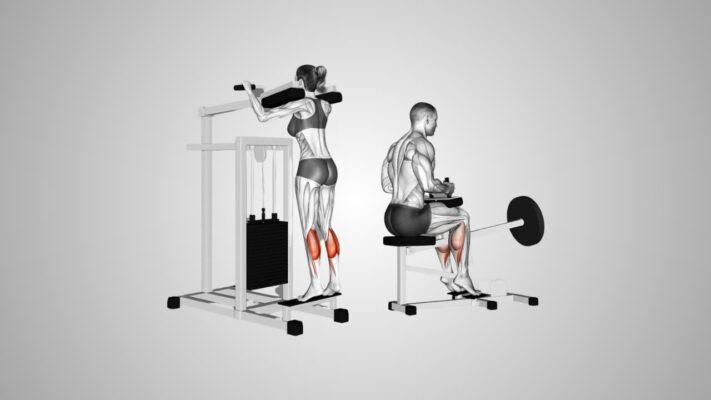
While some have argued the benefits of bent knee calf raises, the current literature tends to lean towards superior gastroc growth for straight leg variants. Typically when people are most concerned with aesthetic muscle growth they prefer to grow the gastroc muscles to a greater extent than the soleus. And seeing as the soleus will still grow while training gastroc muscles, many stick to only STRAIGHT leg calf raise variations. However, if you are looking to grow the soleus to its fullest extent, a seated BENT knee calf raise can also make sense. Two images are provided of common calf raise variations. While both are seated, the knee bend is what makes the difference.
There is at least one current study suggesting that lateral head gastroc growth may be greater with toes pointed outwards on a calf raise while medial head growth may be greater with toes pointed in. That being said, you will still get solid growth in both regions with a neutral foot position. If your goal was to emphasize inner or outer growth at some point in your career, it might make sense to incorporate this knowledge.
It is also worth noting that the majority of current literature leans towards favorable growth through completing the BOTTOM half of the range of motion for calf raises (training the calves at longer lengths). This does not mean you CAN'T go all the way up onto the toes. Only that loading at length appears to work very well and it is definitely worth considering doing at least some (if not all) of your calf work in the lower half.
Quadriceps
The quadriceps are relatively simple in theory.
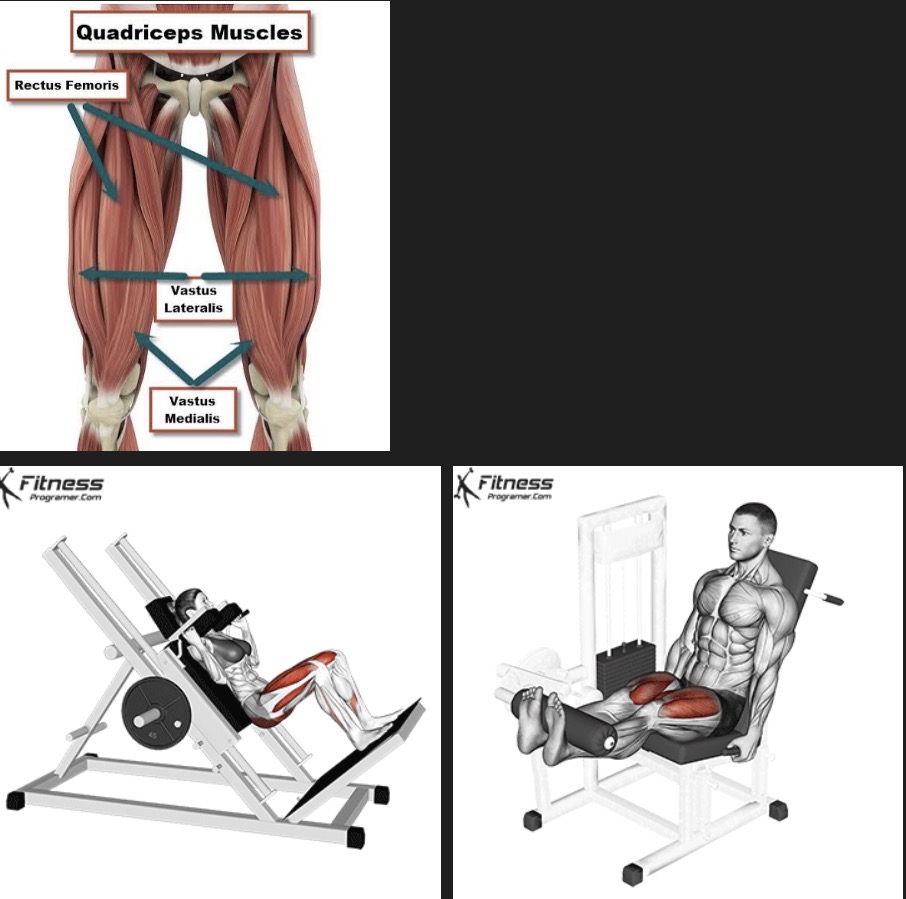
The Vastus muscles perform knee extension (straightening your leg) and the Rectus femoris performs knee extension and hip flexion. This means the Rectus femoris is only worked to a significant extent when either the hip or the knee remains stationary while the other flexes (think leg extensions or a leg raise). The vastus muscles will work regardless if the hip is stationary, so long as the knee extends (think squat patterns).
The Vastus muscles also work in exercises like leg extensions which has led to some very bold claims as of late. Because we are often looking for ways to isolate muscle groups, some have claimed that you may as well drop all pressing movements in favor of solely leg extensions. Because movements like the hack squat, barbell squat, and leg press involve glutes and adductors, they theorize that these movements are not worth performing.
We run into one tiny problem here...the literature. We have had MULTIPLE studies that have found better vastus growth with presses over extensions. The extensions, of course, repeatedly demonstrate better rectus femoris growth. So what would my suggestion be to you? To do what you see fit. I am personally not willing to toss aside results from studies as quickly as many others (they'll even go so far as to make fun of people who take outcome data seriously). I am not arrogant enough to believe that we have solved every mystery.
If all the above confused you and you're simply asking what I suggest it would be to have at least one pressing pattern and one extension pattern throughout your career. If we find out that the press was completely unnecessary in the long run, I'm willing to accept that. For now, I will keep them.
Hamstrings
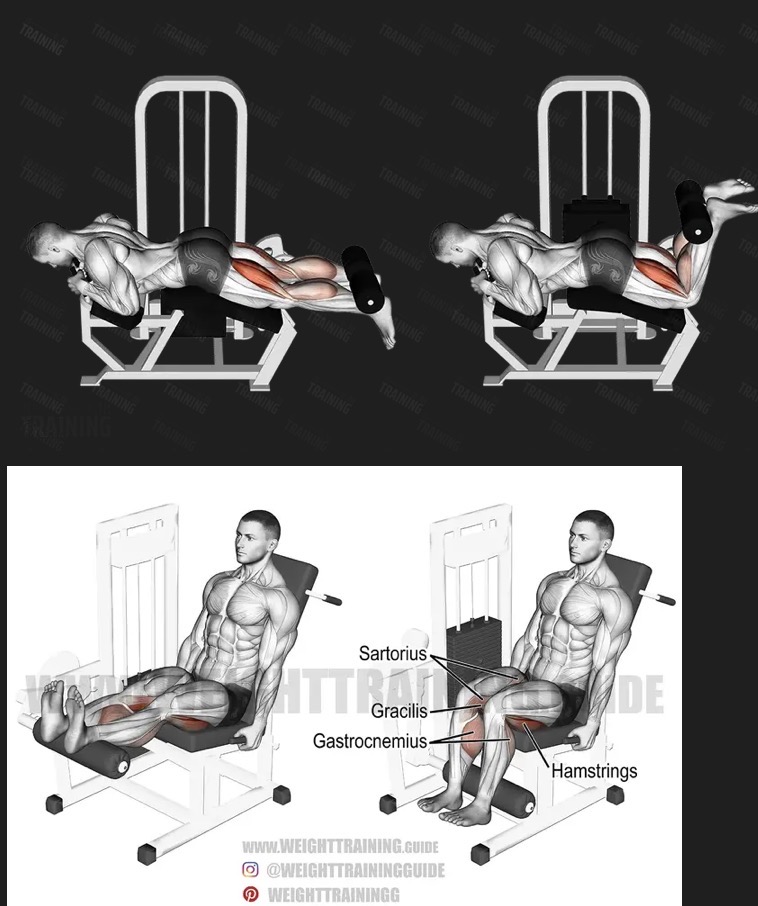
One thing is absolutely certain. Curls WORK. Seated hamstring curls appear lead to more overall growth (at least in the short term), but lying hamstring curls also provide a good stimulus especially in particular portions of the hamstrings and perhaps (according to one study) better growth for the sartorius (not a hamstring muscle). I personally do lying curl since I enjoy it more, but if you enjoy the seated leg curl more, it’s even better. So while I will suggest opting for the seated hamstring curl more often or when having to decide between the two, the lying ham curl still has its place in an overall career.
BUT the hamstrings (similar to the rec fem) play a more complicated role. They do not merely flex the knee, but also extend the hip (other than the short head of the biceps femoris). This means that loading with little to no knee bend, but extending the hip will also provide quality stimulus for the hamstrings. Most people have performed deadlift variations for this aspect of the hamstrings, with stiff leg deadlifts being the most popular. However there are other movement patterns like 45 extensions that are also great options.
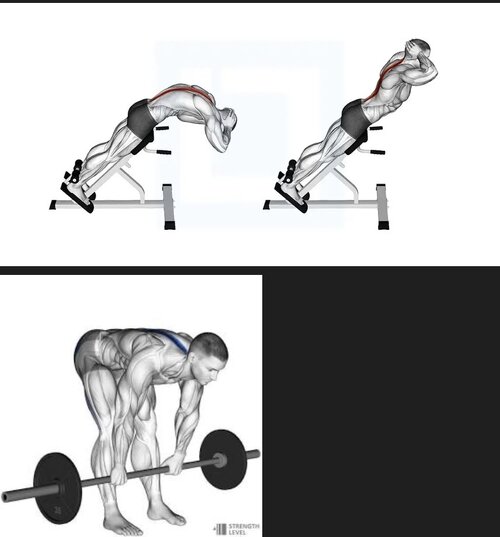
Due to possibilities in regional hypertrophy differences between hip extension (hinges), and knee flexion (curls) for the hamstrings, I suggest you incorporate both regularly. And you'll see this as a consistent theme. There are often debates when it comes to regional hypertrophy differences from a variety of exercises. My general take in these circumstances is (assuming both movement patterns are good for muscle growth) incorporate multiple movements. You saw this with the quads and now the hamstrings.
Adductors
The adductors are heavily involved in many gym movements. They are involved in hip hinges of any kind, and the motion of ADDUCTing your leg. Crazy I know. I’ll keep it brief for this muscle group as I don't think it needs belaboring. Your program will almost certainly have a hip hinge of some sort so you won't have to go out of your way for that function. But far and away the most isolated exercise for the adductors is the adductor machine.
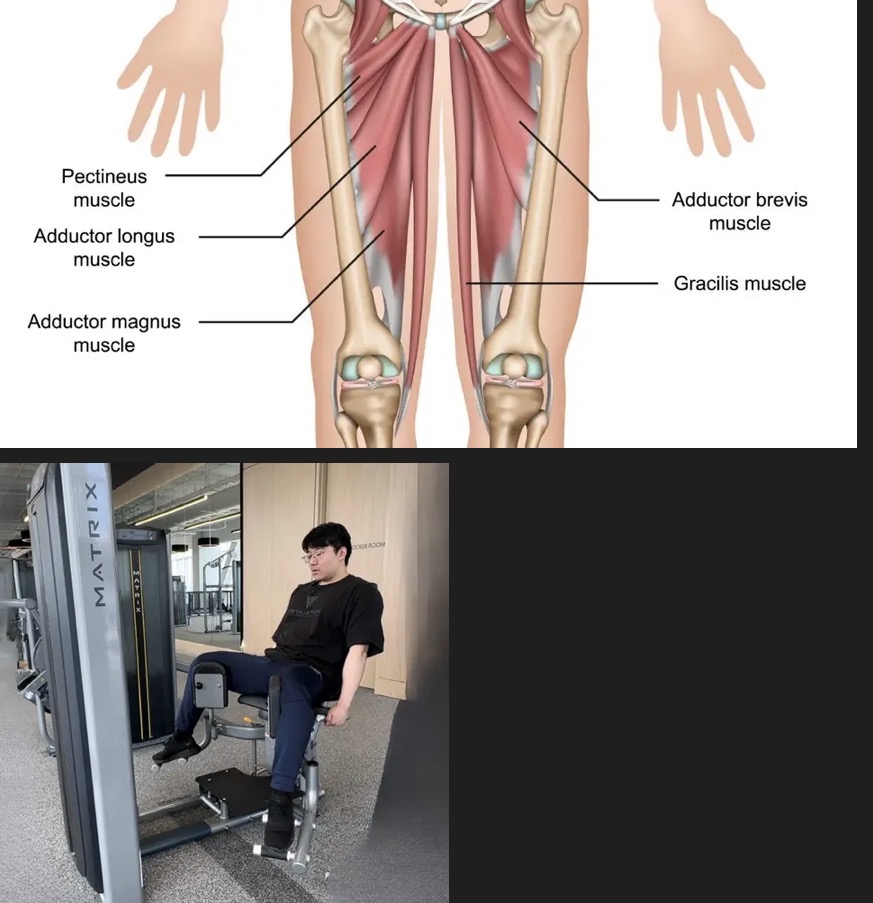
The one issue you will consistently run into with a variety of adductor machines is loading potential. Many are very light.
There are a few things you can do to fix this problem. The first one is to accept higher reps. While it's not ideal in my opinion to make a regular habit out of 15+ rep sets, you can certainly do it and experience good growth. Another option is adjust yourself in the seat. If the seat has a function to lean back, move as far back as possible and try to make the point of contact with the thigh pad at your knee rather than further up the leg. This will increase the difficulty of the exercise per pound on the machine. And last, you can use an additional pin to load the machine with plates. You should be able to find a pin from another machine at many gyms, but if you prefer you can also purchase something like a Gympin (if cost is an issue I've even seen people bring screwdrivers lol).
Glutes
I personally don’t train glutes because I find it very uncomfortable, boring and I’m lazy.
Glutes are arguably the most neglected large muscle group in the male fitness world. But this doesn't mean that men don't train them accidentally. Let me explain. The primary function of the gluteus maximus is hip extension. Any hinge pattern (think squat and deadlift patterns) involve hip extension. So, similar to the adductors, most people will be training their glutes to at least some extent within their programming. But if glutes are a focus for you, I suggest getting more specific. Including hip thrusts is the most basic way but there are multiple exercises that can hit the glutes in a shortened position including banded 45s, reverse hyper extensions, and GHD back extensions.
And while I'm not going to spend a lot of time talking through all the intricacies of the gluteus muscles, there are also abduction roles to the glutes which is why you’ll see people perform various rotational exercises or use the abductor machine both leaned forward and back. If you want to look into those further to maximally develop your glutes I suggest looking into people like Bret Contreras as this is definitely more of his specialty than mine. But for quality glute development in general I would suggest a hinge pattern, a short position flexed movement, and possibly some abductor machine movements. If those were the only three you did for the rest of your life I believe you would develop some very thick glutes.
Erectors
One of the most heavily misunderstood muscle groups for no apparent reason is the erectors. Contrary to popular belief they are both large AND visible, also they are not in your lower back, but rather they go in a straight line all the way your spine.
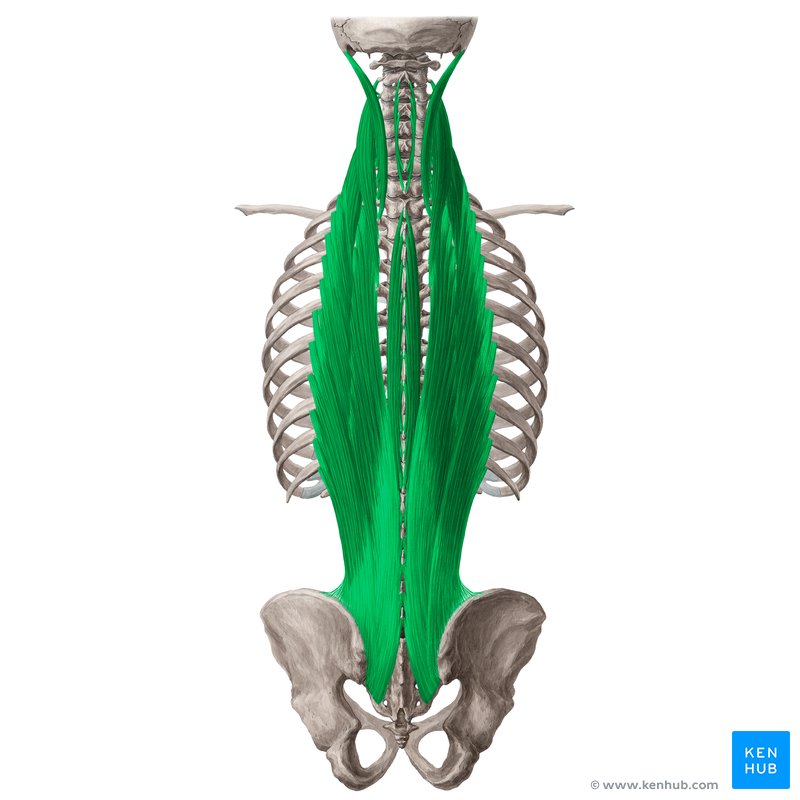
Due to the majority of the erectors sitting below the lats and traps, it has led people to mistakenly say that you can’t “see” this muscle group. But by this same logic you would have to conclude that you can’t “see” any muscles as they are covered by skin. Both rationales are illogical. Well developed erectors can be seen pushing the lats and traps backwards. They give thick column-like appearances running up the middle of the back. Below you can see underdeveloped erectors on the left vs well developed on the right.

One of the worst things that happened in science based lifting for awhile was the demonization of deadlifts. This led to many people taking heavy hinges entirely out of their program and led to weak and small erectors. Many people will get all the erector development they want so long as they master heavy hip hinges (think SLDLs, RDLs, 45s, etc). However you can do specific exercises to target the erectors if you think those aren't cutting it. My MAIN suggestion is to get these other lifts very strong first BEFORE trying to see if you need hyper specialized work to grow your erectors. It's very rare that someone SLDLing over 500lb for reps is going to need additional erector specialization work.
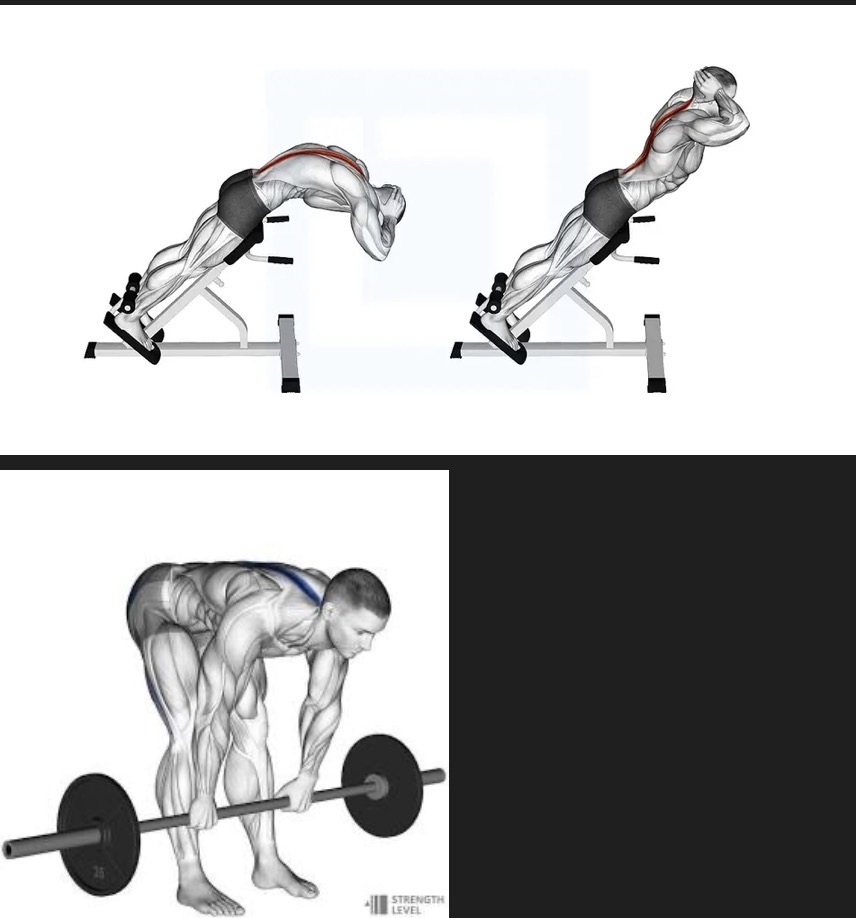
But for the most part loading your heavy hinges that work the hamstrings are going to give a robust stimulus to the erectors.
Abdominals
The rectus abdominis (6 pack muscles) is fairly simple. If you are able to load a motion that makes bringing the rib cage towards the pelvis difficult, it will work. There are various ways to do this including cable crunch/machine crunch variations, weighted situp variations, leg raises (that emphasize pelvis movement), abdominal machines, etc. Honestly this work is very boring to talk about and you simply have to find a movement that is stable and loadable that you can do consistently. Treat the abs like any other muscle group (doesn’t need excessive volume, reps, frequency like some would have you believe).
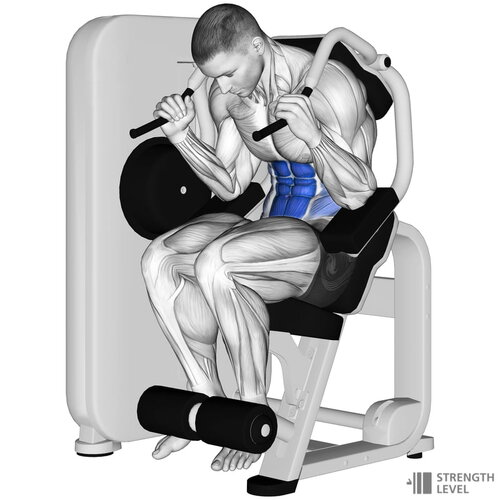
I advice to train obliques simply because it can make your waist a bit more blocky but if you have any intent to train obliques as well simply think of it the same way as the rectus abdominis EXCEPT instead of the rib to the pelvis motion being straight up and down, the left side of the rib cage should close the distance towards the right side of your pelvis when working one side of the obliques. Likewise, when working the other side the right side of your rib cage should close the distance towards the left side of your pelvis.
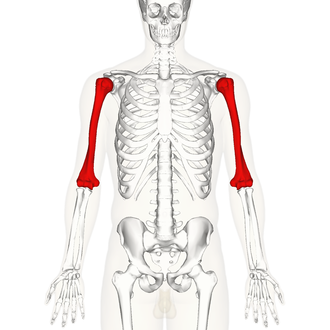
THE HUMERUS
I'm actually writing this after I've completed this guide. But when I began giving descriptions of exercises, I did not realize how important it is to explain what the humerus actually is. It is the bone between your shoulder and your elbow (where your tricep and bicep are located). This will be crucial to know before we move on. Now onto more upper body musculature.
Chest
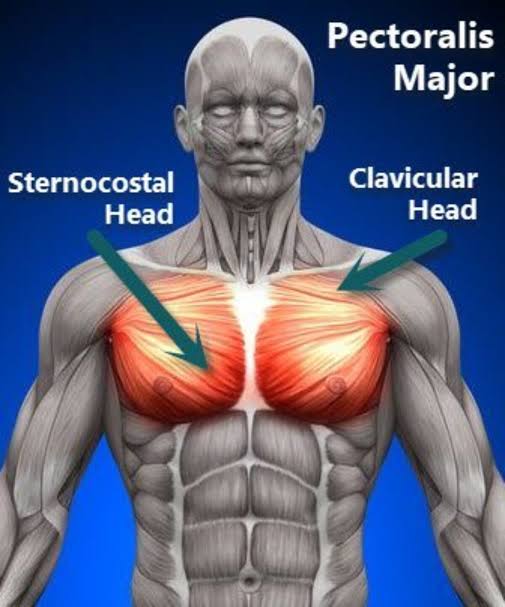
Here's where we get to the interesting stuff. People have often overcomplicated chest training, but if you understand a few basic principles, practical training becomes quite simple. First is that there are two heads (not three). This means two different insertions on the humerus and functions different enough that we definitely want to go out of our way to train each.
The primary function of the sternocostal head is horizontal adduction of the humerus (arm moving across the body). This is why flat presses and flat flys work this portion so well. So if you have a solid variation of either a fly or a press in your program, you will cover the majority of the sternocostal head efficiently.
There may be some data to show that you can get slight biasing of the lower chest fibers with different movements as well, however that is incredibly niche and the vast majority of people (even high level bodybuilders) will not need to worry about it in order to get the visual chest growth they are after. I personally don’t bias my lower chest fibers as well, it’s a boring movement for me and I think it’s useless if you’re doing any horizontal adduction movement.
The clavicular head on the other hand does not just play a role in adducting the humerus, but it is also a VERY solid shoulder flexor. This is why we see very high levels of activity in the clavicular head even on front raises that have no adduction component. Due to this (in my opinion) the most effective chest training will have at least two different movements. One of these movements should focus primarily on adduction and the other one should focus primarily on flexion. Keep in mind it doesn't have to be pure flexion. If it has slight adduction that is perfectly fine and perhaps (depending on who you ask) preferable.
The last thing to keep in mind is that even though the path of the arm (tighter to the body) is preferable for the upper pec (clavicular head), we do have some evidence to show that an incline angle for pressing movements does elicit slightly higher activity regardless when compared to flat. People debate the reason for this (a commonly cited argument being leverage) but regardless as to the reason it does seem to be a safe practice when trying to bias the clavicular head to have high amounts of tension in front of the body. On an incline press the hardest portion of the movement is when the humerus is parallel to the ground.
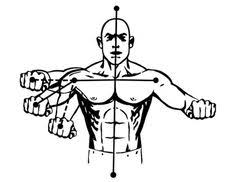
So when looking at this image above it would be important to note that when the arm is at a 90 degree angle to the body the bench should also be flat for more sternocostal biasing. Likewise when the arm is tucked close to the side, the bench should be on an incline for more clavicular biasing. If you want to know how this works for your flys, simply try to match the strength curve that we presented with the presses.
To make a very long story short, whether you choose to do a fly variant or a press, a tucked arm path will make more sense for the clavicular head (upper chest) and a flared arm path will make more sense for the sternocostal head (mid-lower chest).
Lats
This is going to be a very long section since the lats are a dreadful conversation as there is heavy debate both in how the lats operate and what exercises are best to grow them. My point in this guide is not yo confuse you, but to help you grow. So rather than get into hefty debates over biasing the lower/upper lats, talking through leverages, making you work through hyper specific ranges of motion or obfuscating the topic any further by going into every biomechanical argument that people are currently having, I will simply tell you what movements I currently recommend for large lats. And it's simpler than you think.
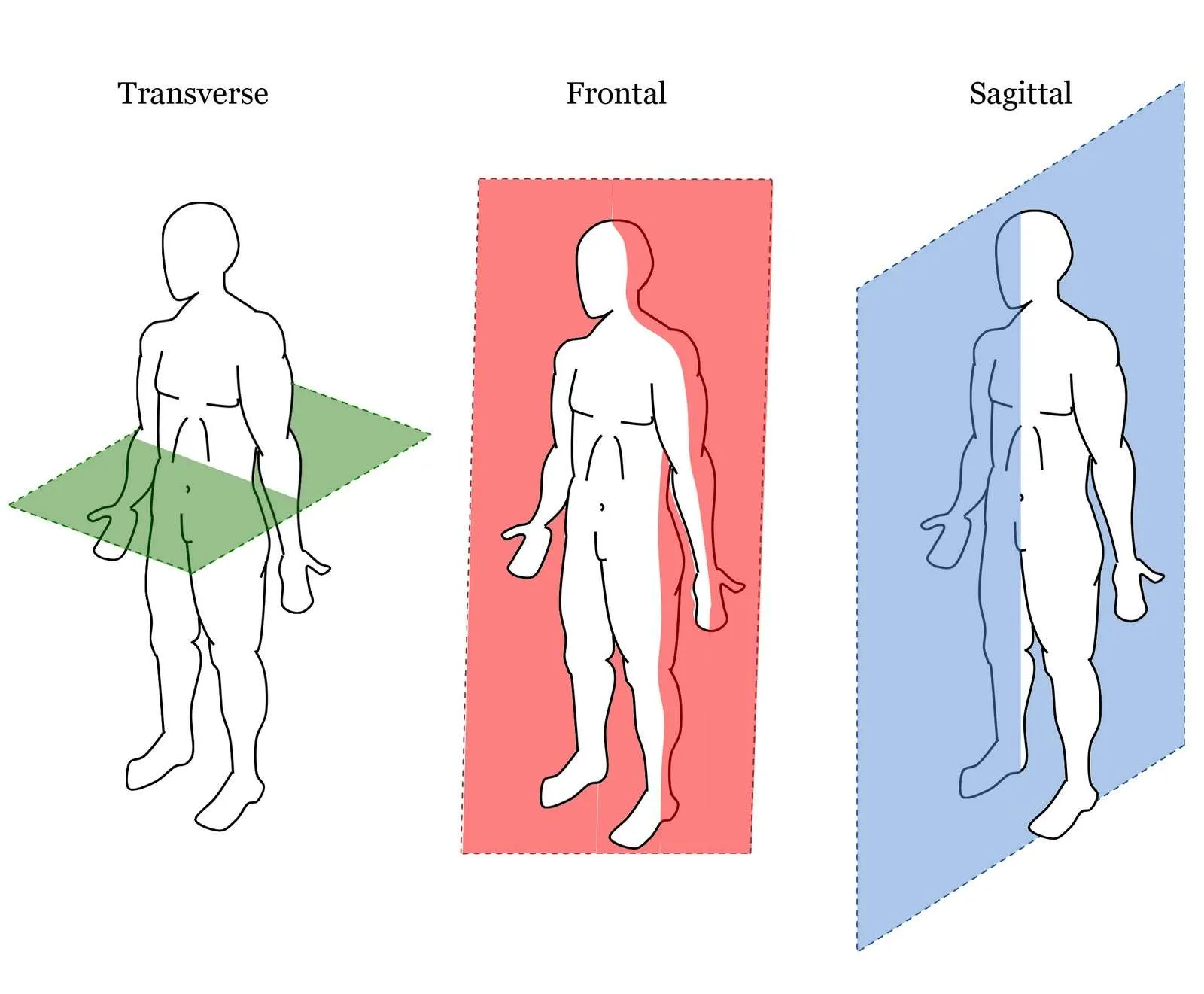
Everything I say from here on out is referring to the movement of the humerus (upper arm). Think of a straight out to the side lateral raise. That would be the humerus moving through the FRONTAL plane. Think about a pec deck fly. That would be the humerus moving through the TRANSVERSE plane. Think about a front raise. That would be the humerus moving through the SAGITTAL plane. Make sure you understand these planes before anything else.
Now that you understand the planes we can begin to discuss the movements you should be looking to perform. The lats play a heavy role in both adduction and shoulder extension.
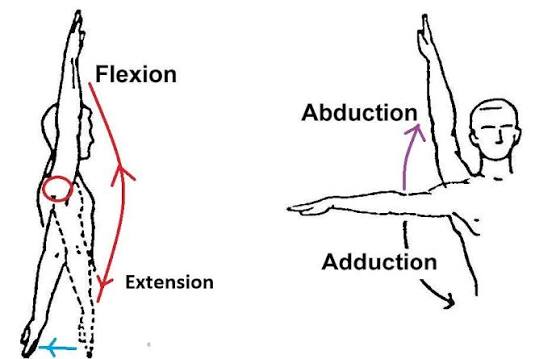
This means that having movements that have resistance opposing these motions will be good for growth. Beginning with the arm overhead and pulling it down towards your side in the FRONTAL plane is shoulder adduction.
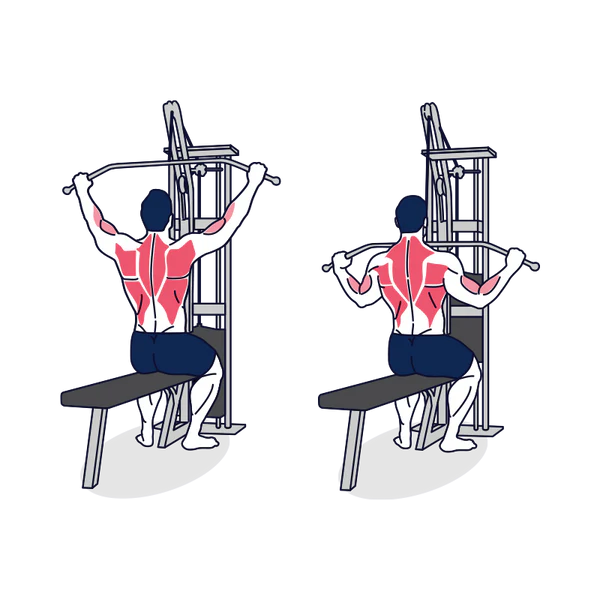
Starting with the arm over head and pulling it down towards your side in the SAGITTAL plane is shoulder extension.
It is important with each of these movements to not lean too far back. This allows us to stay closer to the frontal plane/sagittal and avoid turning it into a pulldown/row hybrid. For shoulder extension people tend to get more creative with the variety of movements they do, but here are many examples.
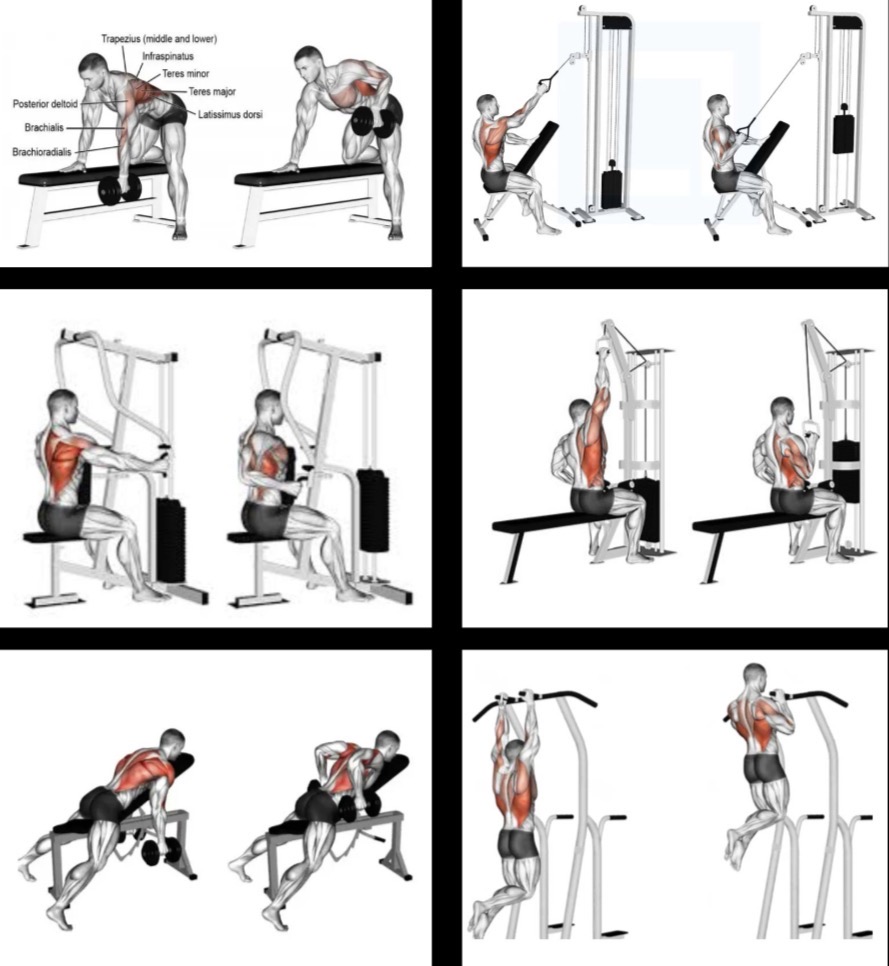
Now I’m going to make something VERY clear. If you progressively overloaded one of the shoulder adduction movements and one of the shoulder extension movements and did ONLY those two exercises for the rest of your life with adequate programming, you would (probably) get the vast majority of lat gains you could possibly want. So if anyone tells you that these are “bad” exercises or that you can’t get massive lats with them, this is patently false.
Now that that is out of the way, all of the movements listed to this point have been compound movements (multijoint). You can also train the lats with single joint variations. This is very popular in the sphere currently but it does have its drawbacks. The major drawback is ease of setup. Some have been popular for a long time where others have become popular more recently. Here are some of the exercises you may have seen that can be done in a solid manner for the lats.
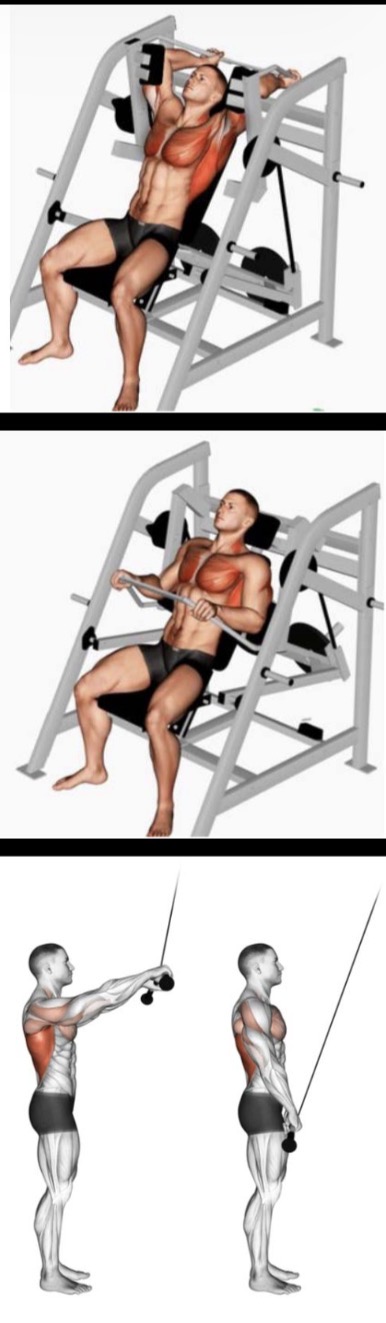
If I had to choose between these two exercises, I am most likely to choose the machine pullover. It is more stable, loadable and even has less joints at play due to the force going through a pad at the elbow rather than holding the attachment in your hand. A hotly debated topic currently is how high to allow the humerus to travel as well. Some argue an inability for the lats to produce significant force with the humerus overhead and therefore to only do the bottom two thirds of the motion, while others argue that the lengthening the lats experience overhead will be good for growth.
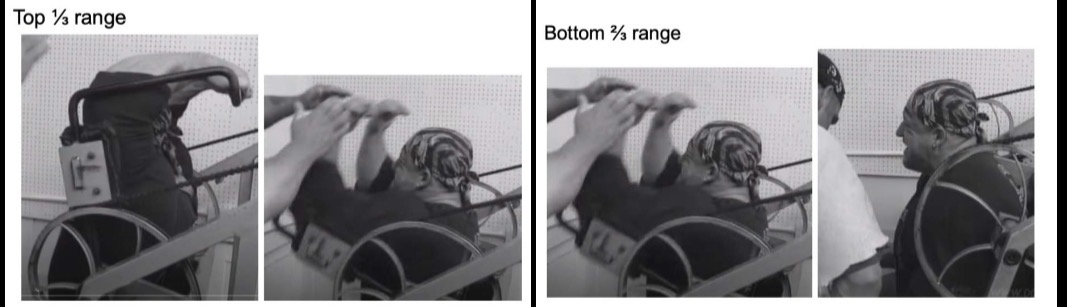
PERSONALLY, I find that there is a turnover between the bottom 2/3 of the range of motion and the top 1/3 that means strength through the movement is more limited. So REGARDLESS of the arguments people make I train both movements SEPARATELY (Pictured below). The top 1/3 ends up being its own movement in my programming and the bottom 2/3 ends up being its own movement in my programming. Here we are getting deep into the weeds though, so if you think these types of nuances are going to make or break your physique, you are sorely mistaken. However you end up deciding to train for yourself, make sure that the movement is stable and loadable and can be progressed over time.
“Flaps”
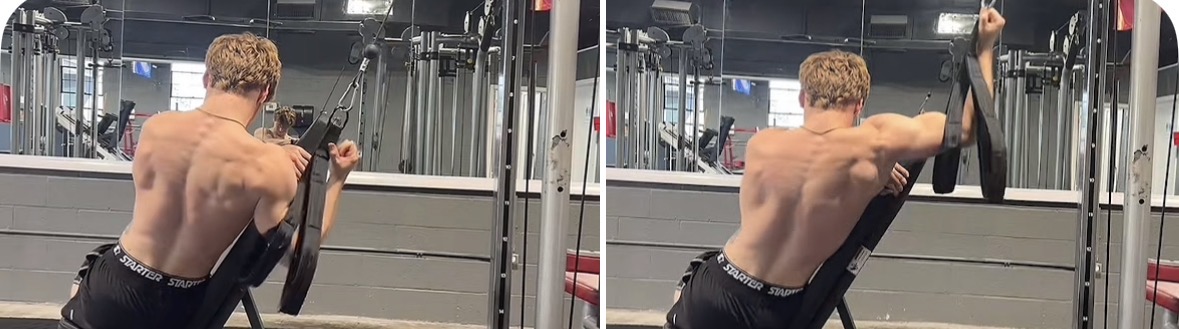
This deserves its own little section as flaps are a highly contentious topic at the moment, with some saying they are the best movements for lats with others saying they are completely unnecessary and maybe not even a lat movement (argue for it being more teres). As of now I do not see solid arguments for it being a POOR lat exercise modality. In fact the pullover machine is just a stable version of a sagittal flap. But due to the setup and many of the people currently using flaps, it has received a lot of backlash. This is what a frontal plane flap setup looks like (above) (attachment can go at the elbow or wrist).
I will make a VERY brief summary of the main arguments for and against this exercise. I am only doing this because popular members of the science based lifting community vehemently disagree on this topic.
One side argues that the lats have very good leverage in this position making this a highly efficient method to target the lats and the teres muscle simply comes along for the ride.
The other side argues that the teres has a high level of advantage in this movement and due to the humerus being limited in traveling upwards (as it would with a pulldown motion) the lats are not lengthening as much nor receiving as much of an advantage as they could.
To make a very long story short NEITHER side argues that flaps will not hit the lats. They simply argue the degree and effectiveness of it. If you want to look a little further into this topic and what people have argued here are the names of some of the people who have been more involved in these conversations: Keenan Malloy, Yotalks, N1 Coaching, Ben Yanes and many more. I suggest you look into the arguments from all sides and form your own opinion.
And as I said before (which you’ll find to be a common theme with many of these more nuanced conversations) you could have no clue that flaps exist or the conversation surrounding them, have stuck to doing more traditional lat exercises your entire life and got the vast majority if not all of your lat growth. I simply feel obligated to bring up the conversation as it is a hot button issue at the moment.
TLDR for the lats; pick a couple stable motions preferably 1 in the frontal (or close to frontal) plane, and one in the sagittal plane and progress those exercises over time for big lats.
Traps/Rhomboid's
The traps and rhomboids play a number of roles but the only real thing you need to be concerned about is how to train them. Due to the varying insertion and origin points, these muscles are fairly complex in terms of all they do, but training them is relatively simple (in my opinion).I would not train the upper traps since it can make the illusion of narrower clavicles. This is not to say that you can’t attempt to bias it at times (particularly as an advanced athlete) but the visual differences from this are likely to be much smaller compared to the middle traps, rhomboids development you go out of your way for.
Both rows and shrugs train the traps well. Don’t let anyone tell you otherwise. HOWEVER, shrugs are a slightly more direct route to training the upper traps as it is purely a focus on protraction/retraction or elevation/depression of the scapula. No matter what you decide to program, stability should be a point of emphasis. Chest support is going to allow you to more easily focus on simply working the traps vs coordination/neural demands. Can you still make progress without chest support? Of course. But I highly suggest using it where possible. Having said this, here are some of the exercises I suggest more frequently.
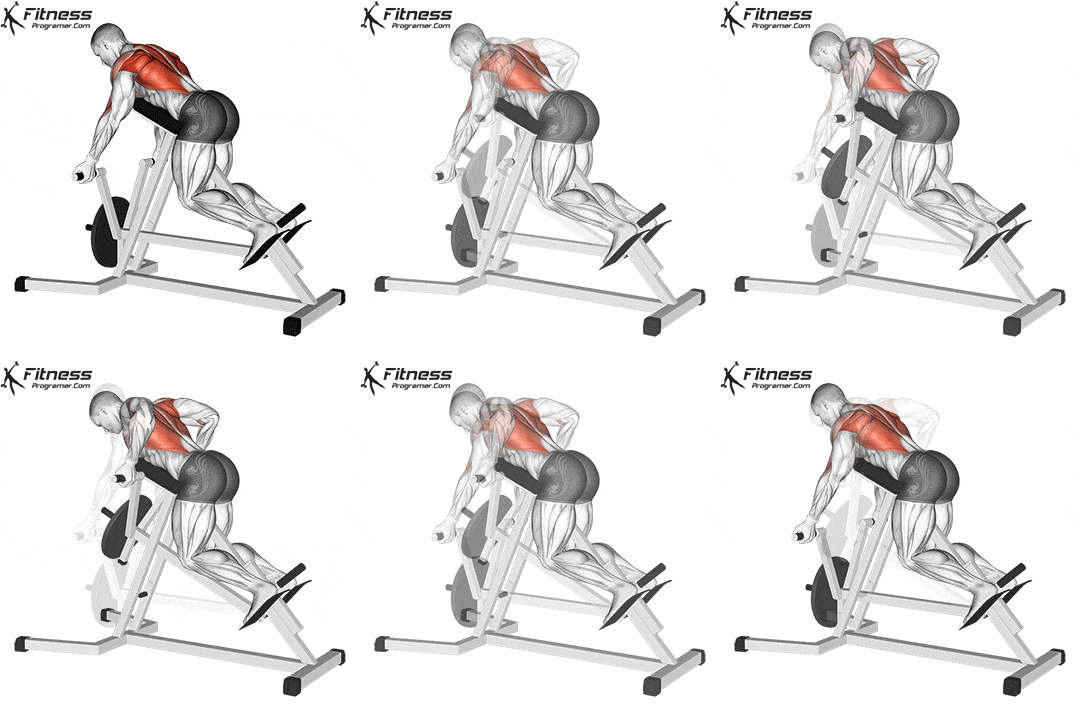
Although a row that has the elbows traveling closer to the sides will still hit the upper traps, they are more likely to involve the lats to a greater degree. My form suggestion (if traps is the goal) is to take a more flared elbow path on the rows. Also, keep in mind that any chest supported row variation can be turned into a kelso shrug by simply protracting and retracting the scapula (pictured below).
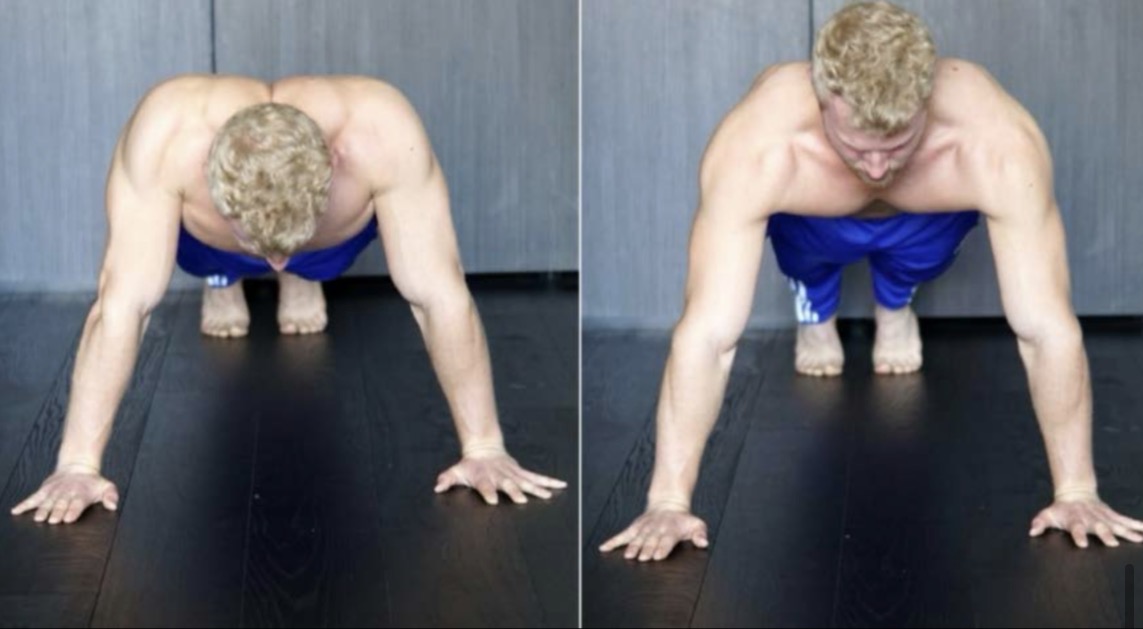
The shirtless man above is clearly not working his traps as resistance is moving in the opposite direction, but I wanted to show you what the protraction and retraction looks like on a horizontal (Kelso) shrug and this was one of the better images I found displaying it. So as long as that motion is being done with the chest supported setups I’ve shown with rows, you will be getting a solid stimulus.
Deltoids
The shoulders are one of the most unnecessarily overcomplicated muscle groups in my opinion.
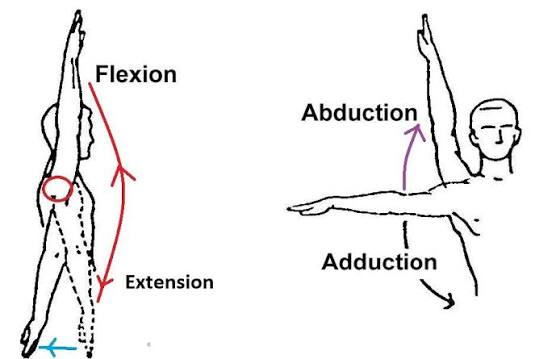
The anterior (front) deltoid is a solid shoulder flexor through this entire range and will get solid work through any resisted motion following this path for the humerus (yes, even when the upper chest is heavily involved).
Some solid exercises for the side delts are lateral raise variations (machine, cable, and dumbbell) as well as abducted shoulder presses (and yes this can include behind the neck if you can handle it).
The posterior deltoid contributes to pulling type motions (think shoulder extension, abduction and even external rotation). Due to its heavy role in pulling motions many within the community have moved to say isolating the rear delt is superfluous. I currently tend to disagree, but you can make that judgement for yourself.
Some solid exercises for the rear delts are the reverse pec deck, bent over db raises and rear delt cable extensions.
One thing to note about the shoulders, is the role of each portion is so different (the anterior and posterior even have OPPOSITE functions). So when I hear people talk about volume for the "shoulders" I smh. The different portions of the shoulder must be viewed separately when programming. There can be some crossover (think an abducted shoulder press through a full range of motion which will hit both the front and middle delt hard), but other motions will be entirely separate in terms of stimulus (think front raise vs reverse pec deck).
Triceps
The primary role of the triceps is to extend the elbow, however the longhead also plays a role in shoulder extension. This is because the long head crosses both the elbow and shoulder joint while the lateral and medial head only cross the elbow. This crossing of multiple joints is known as biarticular and it is the same thing we talked about earlier when it comes to the rectus femoris in the quads.
Due to its biarticular nature, even though presses involve elbow extension, we have direct literature to show that presses do not cause meaningful growth for the long head of the triceps. This is why the statement that a chest press works the tris and the chest is only partially true. It works the chest and the medial and lateral head of the tris, but not the longhead. Because of this, even if you were looking to save time with compound movements you would want to include a tricep extension with a fixed humerus in order to get adequate stimulus for the longhead.
TLDR for the triceps; you will absolutely need an isolated movement to get the majority of the growth out of your triceps as the longhead (the largest head) cannot be worked well with pressing movements.
We can talk about the shoulder extension component for the triceps as well, but honestly I don’t think it needs much discussion as the role it will play in long-term triceps growth is likely small (if any). My general recommendation for the triceps is to have at least two movements within your programming. A normal tricep extension with a fixed humerus and an overhead tricep extension with a fixed humerus are two phenomenal options. However, many people will also want to include a triceps biased press of some sort like a JM, That is totally fine, if not commendable. However, if there are already chest presses (2+) in your program having a specific triceps press will be less important.
so I would do a normal tricep extension and an overhead tricep extension/JM press.
Biceps (elbow flexors)
While Biceps is the main muscle people think of when referring to elbow flexors, we are going to talk about three:
The bicep Brachii: worked very well through elbow flexion, especially when supination of the wrist is involved and possibly greater biasing with a descending resistance profile. However the main thing is to flex the elbow with supination. If you can have elbow support, even better (pictured below). There is currently debate surrounding the importance of humerus position. Some argue that a humerus in anatomical position or behind the torso is even better for biceps growth. I cannot confirm that this MUST be true, but it is an idea worth exploring in your training (at least for now). Regardless both of these exercise variants are great for brachii hypertrophy.
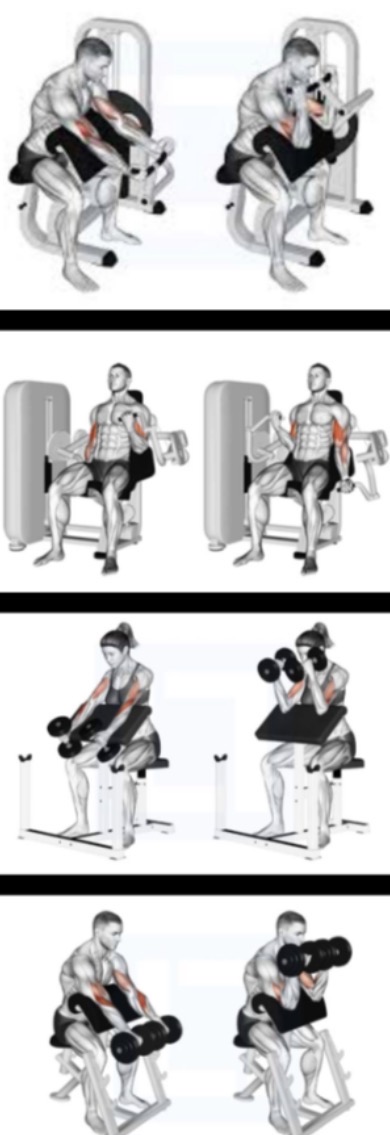
Brachialis: while it is a heavily contentious topic if you can truly "bias" the brachialis or not, it is a large elbow flexor that is worth noting. If we disadvantage the biceps by not supinating the wrist, the brachialis relatively takes more of the load. I also suggest elbow support for this exercise. One of the exercises I began doing for this was preacher machine hammer curls. I was then challenged further to attempt to disadvantage the biceps even more through full pronation with a descending resistance profile. Essentially a reverse curl that is heaviest at the bottom. Is it possible that this works better? Yes. Do I think that it is going to make a huge difference in your long-term growth? Probably not. I won’t get into the muh preacher curl is Brachialis not biceps argument since it’s stupid Imo.
Brachioradialis: The brachioradialis is most definitely going to operate more heavily with a pronated wrist. Reverse curls are the best way to grow this region. It is also possible that an ascending resistance profile (heavier towards the top of the movement) is best for this region. However the most important factor is certainly wrist pronation.
I could go through a wide host of curl variations, but this should give you the general idea as to what you’re looking for. The most important thing is wrist position (more supinated=more biceps and more pronated=more brachioradialis). The next is resistance profile with LIKELY descending more towards the biceps and ascending more towards the brachioradialis. A good mixture of these variables and you will have some amazing elbow flexors.
CREATING PROGRAMS
Creating a personalized program is NOT something everyone needs to do. Beginner athletes who have not spent enough time in the gym to determine true weakpoints should consider generalized programming before attempting to prioritize certain bodyparts. I want to make this very clear before you accuse me of overcomplicating the process. We discussed 14 muscle group categories above (this time I will give my own muscle groups I personally train). Here they are listed out:
ASSUMING you have been in the gym for long enough to determine true weak body parts, you can begin to rank your body parts based on strength. A really easy way to do this is to assign it a number 1 through 3. HOWEVER, you must give 4 bodyparts a 1, 4 bodyparts a 2 and 4 bodyparts a 3. 3 means strong, 2 means middle, and 1 means weak.
Body parts that receive a 3 should always be at the end of your sessions if you are looking to develop a more balanced physique. Body parts that receive a 1 should be at the beginning of your sessions, and body parts that receive a 2 should be in the middle.
Let’s say we were setting up a leg day and my legs came in with these numbers:
Calves-2
Quads-2
Hamstrings-1
Adductors-3
Glutes-1
A leg day that might make sense in this circumstance would look like this:
With all the principles we have talked about you SHOULD be able to program your own split and make it quite good. But just in case you’re still struggling with some of the concepts, I have provided some sample splits using some of the more popular general layouts. There is a TON of individual variety you can implement, so understand that EVERYTHING you see is guidelines. You can tailor exact set/rep numbers to your preferences. You can take more or less rest days. There are NO rules, but if you ensure continued progress on these movements, you WILL grow. It is that simple.
I will now list all the popular splits you can do, I won’t go into cons and pros etc. as I did that in the mega thread I made (I shared a link in the beginning of the thread, check it out).
Push Pull Legs:
PPL is a split where, exactly like it sounds, will be a separated split with 3 different days who are push pull and legs. Day 1 push, day 2 pull, day 3 legs. Most people do it 6 times a week while getting 2 times frequency, which is not quite optimal, but we’ll talk about this later on.
how i would program it; Best way to program it imo, would be to go 6 times a week (duh), do it PPLPPLR, you can put the rest days wherever you want it won’t really matter that much.
Push-
Pull-
Legs-
Anterior posterior:
anterior day:
Posterior day:
Upper Lower:
Upper Lower is one of the best splits to do, as a beginner and as an advanced lifter. This split, just like it sounds, split your upper and lower body in half. A typical upper lower week program will look like that if you go 4 times a week:
ULRULRR.
And if you go 6 times then it will look something like that:
ULULULR.
It’s a great split that can give you 3 times frequency and is also very enjoyable. In this split you can also prioritize both lower and upper body, you only need to do one more day of the upper or lower body and you will already prioritize them. For example if you want to prioritize legs, you can do ULULRL and if you go 6 times a week then you can just remove one upper day.
how I would program it: Upper Lower is one of the easiest splits to program since you need to only consider your upper and lower body when doing so.
You can choose wether you want to do it 6 or 4 times a week based on what you progress and recover best from. To minimize fatigue on upper day I would suggest you to do any dead lift variation and crunches (for abs) on lower days.
Upper day:
Lower day:
Full Body:
So. Yh, just Ike it sounds full body is a split that trains all the muscles in your body in one session. that aims to maximize the benefits of training frequency while being in the gym for as little as possible. Since the first set of each workout is the most stimulating set, and every set done after that set will be gradually less stimulating, a split that gives you a lot of frequency will be highly effective. You can do FB either 3 times a week or EOD, EOD is more effective for hypertrophy since you get 3.5 frequency compared to 3 times a week which you get 3 times frequency.
FB is a complicated split to program since it’s very easy to fatigue intra workout and you need to experiment what’s better for you. You can choose whether to do it EOD, 3 times per week or 2 times per week. It really depends on you and what you enjoy the most or recover best from. I would suggest to order your weak points first in the session and vice versa. I would opt for more compounds exercises and less single joints ones only for those who are short on time and want to finish the workout asap. For those who can be 1.5-2 hours in the gym, I would suggest to do as little compounds as possible since it will be very fatiguing.
A typical FB program would look like this
NOTES
1. Total daily sets should be dependent on what YOU believe you can recover from reasonably
2. If you ascribe to the belief you can only recover from less than 15 total sets per day, be more selective with your exercises and set numbers
3. The listed sets are guidelines not rules
4. Every listed exercise should be done at least 1x/week (preferably 2)
5. If every exercise can be performed with adequate intensity and progression they CAN be all done 3x/week
6. The starred exercises are the suggested adjustments from 3 to 2x/1x week if you are looking to lessen total volume but are programming 2-3x/week in general
7. Hack Squats and SLDLs overlap the most with other muscle groups worked
8. Exercise order is not set and should be based on your focuses or weak points (weak points earlier in session)
9. IMPORTANT: more does not always mean better so if you assume doing highest possible number of sets is best, you could get burned
10. Flys and presses can be interchanged to an extent (just keep in mind the extra tricep fatigue with presses)
11. It is important to note for ALL exercises that the main goal is to hit the target tissue with stability and the right resistance profile
12. If you want to swap out an exercise you always can, just make sure to not be swapping constantly
13. Once you find an exercise you like that accomplishes a similar purpose to the exercise listed in the program, stick with it for a solid amount of time (months to years not weeks)
14. You WILL have intelligent people tell you that these programs are overcomplicated and under complicated. You need to decide for yourself where you fall on this spectrum and there isn't necessarily a right or wrong answer
15. I ENCOURAGE you to think through your stances, but do NOT become an exercise or program hopper constantly switching. This WILL hinder longterm gains.
16. Exercise order can be rearranged based on what YOU specifically are trying to prioritize
17. Once you know what plan you are going to use, program it into a tracking app or digital or physical notepad. If you don't have a subscription to one there are apps you can use for free (like Hevy) so you can continue to log progress week after week
18. Every few weeks do video form checks to make sure progress is happening WITH the same technique and you aren't changing it in order to force "progress". If you find that you are, simply reduce the weight until your form gets back on track.
19. If you think there are too many exercises in a day (which is a perfectly reasonable stance), pick the ones that cover the most muscle groups and stick with them. For example, if you need to remove two exercises from the "Pull Day" it makes more sense to remove one of the lat exercises and one of the trap exercises than both lat exercises.
That’s it, I hope you found this guide helpful !
Tags: @irrumator praetor @Jensonsahighlander @mikre @includings @ce10098
I will also go through what each level of lifter should be doing (beginner-intermediate-advanced). After this guide I hope you will know exactly what to do and how to think for yourself about your split.
I learned a lot since that thread and wanted to change some things up. Also no spoilers this thread since I’m lazy asff.
I will talk solely about programming rather than general stuff about the fitness world.
HOW TO ACTUALLY PROGRAM VOLUME
volume is fundamentally based on frequency. Imagine I told you to do 20 sets of bicep curls and then told you you would need to do that every other day. This would lead to a frequency of 3.5x/week and overall weekly volume of 105 sets. Despite what some would have you believe, I cannot in any world imagine this to be effective training. And while I would still consider you crazy if you programmed biceps 1x/week with 30 sets, it would make far more sense than the prior option.
In other words, your volume is going to be HIGHLY dependent on your frequency with the two being inversely proportional (As volume per day goes up, frequency must come down). My guideline in the majority of cases (assuming sets taken to 0-1RIR) would be as follows:
* 3x/week frequency or more: 1-3 direct sets/day
* 2x/week frequency: 2-6 direct sets/day
* 1x/week frequency: 6+ (can obviously be quite high)
This may seem quite low (and compared to a lot of bodybuilding history it is) but I would contend that there are many reasons this can be highly effective. One reason is that many people simply don't train as intensely as they believe and therefore miss out on stimulus on a set per set basis. And the other is that I'm referring to DIRECT sets. Much of the literature involving volume gets heavily bogged down by indirect sets.
Hypothetically let's imagine a program that only uses single joint movements. The goal of the program is to train all of the major muscle groups most heavily associated with bodybuilding. Those are as follows:
Calves, Adductors, Hamstrings, Quads, Glutes, Erectors, Lats, Traps/Rhomboids, Chest, Biceps, Triceps, Abdominals, Shoulders (could be split into anterior, middle, and posterior, but we'll just keep them together for the example)
Here we are looking at a MINIMUM of 12 muscle groups and, if isolated/severely biased, 12 exercises. Automatically that would mean 36 total sets in a week for the 3x frequency MINIMUM and going over 100 total weekly sets if 3 direct sets were done each day. Add to this that many people who are currently attempting to isolate every possible exercise are also doing a majority of their exercises unilaterally AND doing multiple movements per muscle group for even more severe biasing. This is a maximalist way of viewing programming and can easily lead to hundreds of working sets.
That being said, part of the reason compound movements are so heavily relied upon is due to their ability to reduce overall set volume. Imagine if someone does a squat pattern and counts that towards glute, adductor and quadriceps volume. Throw in a chest press and a non chest supported row and you've now (in many people's minds) put at least some volume towards every muscle group listed other than the calves. 3 movements, 11 muscle groups. This would be the minimalist way of viewing programming. 1-2 sets in a day for each movement and you could be doing as little as 15-20 total working sets in a week.
As with most things, I personally believe that the true solution for the majority of people is going to lie somewhere in the middle. If the literature has taught us anything about maximizing muscle growth, much to the chagrin of absolutists, it has taught us that there are a number of very efficient ways to get to the same goal (huge muscles). My goal is to help you in the simplest ways I can to achieve a bodybuilder worthy physique. And don't worry if you have zero aspirations to become a competitor. You know what you do if you don't want to "get too big". Stop progressively overloading once you're happy with your size. But until you achieve that size (spoiler-it's probably going to take way more work than you think) you better be training and eating like you want to be the next Mr O.
HOW TO ACTUALLY PROGRAM FREQUENCY
First thing we need to decide is what general frequency you’re going to do for a muscle group. The overall body of literature seems to suggest that working a muscle group more than once a week is preferable for growth. There is heavy debate within the science based community on whether 2x or 3x is better. Some even argue for hitting a muscle group every other day (3.5x frequency), which is what I do.
In the end, your safest bet is going to be a training frequency that you enjoy and gives adequate stimulus and rest.
However if we look at things objectively (especially with lower volume training) it becomes very tough to argue 1x/week being able to compete with 2, 3 or 3.5 times per week frequency. Which brings me to my next important point. How many sets I suggest you program for a muscle group will change based on your overall frequency. If you are only training a muscle group 1x/week, I would suggest keeping your volume quite high. Simply put, you will both have a long time to recover and possibly a long time for atrophy if you go 7 full days without a significant stimulus. So while I don't generally advise training muscle groups 1x/week, if you do, I would prefer a rather high volume OR intensity techniques (drop sets, super sets etc) being added to some sets if you are planning on keeping set volume relatively low. If you have many variables right, it likely won't make an insane difference to have a couple that aren't absolute perfection.
With that out of the way, training with more than 1x/week frequency (if smartly managed) will likely lead to better results for the majority of lifters. This does NOT have to be exactly 2 or 3x frequency. As we alluded to before, some do 3.5x frequency or even higher. There is nothing inherently special about 7 days and your split does NOT need to be based around a calendar week. It is the format that most people adopt because humans like organization, but it is by no means a necessity.
PROGRAMMING AS A BEGINNER
Here is the most fundamental concept to understand. When you are completely new to the gym, muscle growth is EASY. Very basic guidelines can help you to pack on a lot of muscle. This is often why you'll hear advanced lifters say beginners need to "build their base" with very particular exercises like the squat, bench, and deadlift.
It is a very dumbed down way of saying that they'll gain plenty of muscle in the beginning if they just focus on big movements where the goal is to move a lot of weight with a large number of muscle groups. they're not far off the mark. While we're not going to get into Motor Unit Deficits (you can look this up on your own time if interested), the basic principle is new lifters just aren't that good at recruiting all of their muscle. So spending the majority of time in hyper specialization (unilateral single joint exercises) in my opinion doesn't make much sense.
I would much rather see a new lifter program 15-20 sets of compound movements in a training day and perhaps a few isolation sets (still bilateral) than some of the maximalist routines that are currently being performed. Here's a sample upper day that could make sense for someone new to the gym. All sets within 0-1RIR.
* Flat Chest Press - 4x6-10
* Chest Supported Row - 4x6-10
* Shoulder Press - 4x6-10
* Lat Pulldown - 4x6-10
* Lateral Raise - 2x8-12
* Bicep Curl - 2x8-12
* Tricep Extension - 2x8-12
And I'm sure many of you reading this are surprised at seeing a recommendation of 4 sets for exercises. Or the possibility of reps going above 10. But if you are new to the gym and you ran this exact upper day, you would gain A LOT of muscle in your first year of lifting. Does this mean that this structure is perfect for everyone? Of course not. But to deny that this would work efficiently for most beginners would be ignoring everything we see within the literature and anecdotal practices.
PROGRAMMING AS AN INTERMEDIATE
This is arguably tougher to manage than an advanced athlete. There’s a couple of reasons for this.
- Anybody who’s been in the gym for more than a few weeks assumes they're intermediate (they’re not)
- The true intermediates are often thinking they are advanced (they’re not)
- Intermediates assume they need highly advanced and specific training (they don’t)
Now that we’ve made everyone question whether they are truly intermediate, major differences in programming are relatively minor on paper. The volume you COULD handle as a beginner is harder to handle as an intermediate. People often take that as saying you should automatically reduce your volume as an intermediate lifter. Not so. Perhaps you could have done more volume as a beginner lifter but simply didn't so there is no volume change going into your intermediate years. However, if you were maxing out volume in your first couple years you will almost certainly have to tone it back.
This often confuses people as they typically believe that in order to keep growing the volume has to go up not down. But as you become stronger and more capable of recruiting muscle to its fullest capacity, you will also be more capable of overdoing things from a damage and fatigue standpoint. For example, when sprinters are young they can run 100m as fast as they want and feel good to repeat that endeavor the next day, and the day after that. Professional sprinters know they cannot behave in the same manner. They would rip themselves apart. While the risks from slightly overdoing volume are not as great for lifters, they still exist.
Now onto how I think of programming for an intermediate (you’re perfectly free to disagree). Intermediates need to be a little more specific with their goals to keep progress coming quickly. Progress will inevitably be faster the first couple years even with basic programming, but intermediates might want to branch into biasing a little more heavily. This is when you start to think about weakpoints, managing fatigue a little more closely, heavier emphasis on isolation movements...etc.
A solid blend of heavier compounds and isolation movements make sense for an athlete in this phase. If you noticed with the beginner athlete we did not attempt to isolate any of the trunk muscles within the upper day. Shoulders, Biceps and Triceps were the only muscle groups that were given isolation. Now as an intermediate I think we can explore the idea of isolating trunk muscles as well. This does NOT mean that you must isolate everything that can be isolated. However, if you notice that the traps are behind other muscle groups, I personally believe adding in shrug variations would make sense. So let’s look at what upper programming MAY look like for said individual.
- * Incline Chest Press - 2x5-8
- * Lat Pulldown/Weighted Pullup - 2x6-10
- * Pec Fly - 2x5-8
- * Chest Supported Row - 2x5-8
- * Lateral Raise - 2x5-8
- * Preacher Curl - 2x5-8
- * Tricep Extension Underhead - 2x5-8
- * JM press - 1x5-8
Yes, this might be too much for some, but not for most. Most people would likely recover from that, if YOU can’t, then you can lower the volume, training is so individual dependent. I don't believe there has been a valid study demonstrating this and if you happen to be a person who believes they personally need to stay under a certain amount of sets, that is fine. Just don't mistake your personal situation for the standard. And if you do find yourself in that situation, the solution is relatively simple. Reduce volume for the exercises.
PROGRAMMING AS AN ADVANCED
This will likely involve additional specialization if you believe certain muscle groups are behind. Can you apply some of these principles as an intermediate athlete? Of course. But the law of diminishing returns suggests that specialization will always matter more the further you get into your training career. HOWEVER, even now there are many people specializing beyond what I believe to be necessary.
The easiest way to understand how training changes as you move into this phase of your career is to simply think about a few variables and how it will change your programming. Again these principles will somewhat apply to intermediate lifters as well, just not to the same extent.
Volume:
Advanced lifters will have a harder time handling intense workouts with very high volume than people who are earlier in their training career.
Intensity:
While advanced lifters still need to train with intensity, they must also be very aware of how training with too high of intensity too often (failure, partials, intensity techniques, etc) can limit their ability to progress consistently.
Isolation/Severe Biasing:
This variable becomes more important to continue to grow as an athlete gets more advanced. Can they still grow with large compound lifts? Sure. But the further you push into your training career the harder it becomes.
Stability:
This variable also becomes increasingly important as you get further in your career. No this does not mean you can't grow with freeweights. It simply means that leaning towards more and more stable movements makes sense.
A beginner getting 5-6hrs of sleep a night will still grow. As an advanced athlete that schedule will be MUCH tougher to progress with.
What do all of these things look like in practicality? The first thing you should do is list out your muscle groups in order of priority (we will talk about this more thoroughly later) You can further subdivide if you'd like but most often I think of trainable/important muscle groups in this format.
* Lats
* Shoulders
* Triceps
* Abs
* Traps
* Erectors
* Quads
* Hamstrings
* Forearms
* Chest
* Biceps
* Adductors
* Calves
A VERY important note is that this is heavily simplified and many people don't look at muscle groups this way at all. Simply put they understand that muscle biasing is real so they subdivide A LOT further and add in additional muscle groups. Let me show you what that list could look like (and yes I'll be missing quite a bit in some people’s minds).
* Lats (Upper and Lower regions)
* Traps (Upper, Middle, and Lower)
* Chest (Clavicular head and Sternocostal)
* Shoulders (Anterior, Posterior, Middle) (not going to get into the 7 regions conversation)
* Erectors
* Biceps (Biceps, Brachialis, Brachioradialis)
* Triceps (Lateral/Medial and Long Head)
* Quads (Vastus Muscles, Rectus Femoris)
* Adductors
* Hamstrings (Short Head, Long Head, Regional hypertrophy conversations)
* Calves (Soleus, Lateral and Medial Gastroc)
* Abs
* Tibialis
* Serratus
* Obliques
* Neck
* Forearms (Flexors/Extensors)
You get the picture...
IMO, this is great depends on your split and volume.
The rise of the maximalists has been interesting though and I’m curious to see if they’ll continue in this fashion and what types of physiques they’ll build with it. Maybe they’ll pioneer in a new age. I simply have my doubts.
Using the original list that I made, advanced athletes should look at what they want to prioritize and write out a list from strongest to weakest points OR most important to least important desire for growth. For example, that list for myself might look something like this:
- Lats
- Traps
- Erectors
- Chest
- Biceps (Elbow Flexors)
- Quads
- Triceps
- Abs
- Hamstrings
- Calves
- Forearms
- Shoulders
- Adductors
All that this means is that in my current thinking for programming, lats are the number 1 priority and andductors are the least of my concerns. Your program needs to reflect your priorities as an advanced athlete. Here is my preferred thought process (you can develop your own if you want) for how I prioritize muscle groups within my programming.
Exercise selection (stable/loadable/more severe isolation) —> Order (earlier placement in workouts) —> Volume (likely going to have higher volume than groups that are not the priority) —> Regions (if there is a way to bias different portions of the muscle I will ensure a variety of exercises to achieve that purpose) —> Unilateral movements (can possibly lead to increased motor unit recruitment
depending on the exercise and muscle group).
Obviously other than Order, you could do all of these things for all muscle groups. Increase volume, unilateral movements, multiple movements for more biasing within the muscle region...but a program that sought to maximize every muscle in this manner would end up ridiculously long and be impossible to recover from. The body can only handle so much.
This is where you have to be smart on when and where to specialize. And this is why listing out your own priorities is so important. To make this more clear, let's imagine a “Back+Bi Day” together. I know it's scary to talk about a Pull day in 2025, but I promise you it can be done in a smart manner (I don’t advice to do it btw). Regardless, the same principles that I apply to this day can be applied to any other day in whatever programming you decide to run with.
First list out the muscle groups you want to train in order. For the breakdown I gave you before it would be Lats —> Rear Delts —> Traps —> Biceps —> Erectors.
There are a TON of ways you could set up this day, but the most important thing is to take the order into account. If I wrote out the day like this and did bicep curls first, that would be counter to my goals. Similarly, someone who is wanting to prioritize their biceps, but chooses NOT to do bicep curls first because it's a "small muscle group" is also programming counter to their goals. Regardless of what bros have told you in the past, if your priorities dictate it, "small" muscle groups CAN and SHOULD go earlier in your workout.
Now that we've figured out what order we would like to train in, exercise selection is the next step. Here's what a basic structure might look like for this context.
* Lat Pulldowns (wide)
* close grip lat pulldown
* Reverse Pec Deck
* Elbow Flared Row (T bar, upper back row)
* Preacher Curl
* 45’s
“Wait, wait, wait... I thought you said this was advanced...” you’re right. I am very explicitly stating to every single person that reads this guide that even an advanced athlete could make progress with something like this if they had appropriate intensity and volume for these exercises. Now that we have that out of the way for anybody who likes to be a little more minimalistic in their approach, a CURRENT pull day for me might look something more like this. This is assuming 2x/week frequency.
* wide grip lat pulldown/keenan flaps in frontal plane - 2 sets 0-1 RIR
* close grip lat pulldown/keenan flaps in sagittal plane - 2 sets 0-1 RIR
* reverse pec deck - 2 sets 0-1 RIR
* Kelso Shrug - 2 sets 0-1 RIR
* Upright Smith Machine Shrug (optional) - 1-2 sets 0-1 RIR
* Elbow Supported Curl (Preacher or Shoulder Extended) - 2 sets 0-1 RIR
* Humerus Supported Pronated Preacher Curl (descending+ascending profiles) - 1 set 0 RIR
* 45’s - 2 sets 0-1 RIR.
UNDERSTANDING THE THOUGHT PROCESS
Yes, I am completely aware that there are arguments happening as to whether you can even bias the lower and upper lats. What we do know for sure is that both of these exercises work the lats well. So I will continue to include both in my programming. They also may be unilateral exercises as lats are my number one priority. Rear delts will be heavily involved in the lat exercises so they will only have 2 sets of direct work. Traps are a complex muscle group and have heavily varied orientation to the fibers. A couple angles makes sense. The elbow flexor muscles are heavily influenced by resistance profiles and supination/pronation so a couple variations for this also makes sense to ensure adequate work for the Brachii, Brachialis, and Brachioradialis. The erectors are not overly important so they come last and have the lowest volume, but still solid exercise selection. Honestly this exercise likely wouldn't even be necessary in the context of an overall program if I had a heavy hinge on my leg day, but I merely wanted to highlight the erectors being a component of back development.
This workout occupies a middle ground for a lot of the lifting sphere at the moment. Maximalists would say it’s not specific enough. Minimalists would say it’s too much. Bros would say there’s too much isolation... And if you fall into any of these categories, that is completely fine. My goal behind making this programming guide is not to have you train precisely as I do. But rather to understand how to blend scientific ideas and the gym together in a way that is productive for YOU. This should go without saying, but if you are able to continue progressing these lifts with standardized form, you will continue to make muscular progress even if it isn’t perfect (hint: it never will be)
.ADDITIONAL CONSIDERATIONS
Not everyone has the same amount of time available or desire to be in the gym. If you convinced me that being in the gym 4hrs/day 7 days a week would lead to the most muscle growth, guess how much time I would spend in the gym per week? 28hrs. So when it comes to intelligent programming you should also consider the cost and reward of your program. I legitimately believe most people could get the vast majority of their gains if they had VERY intelligent programming and were in the gym for 3hrs total per week. I believe they could still get good gains with only 2. I even believe they could get modest gains with 1. So you have to decide which type of person you are. Is the gym a semi interesting hobby, or do you absolutely love being there. Because I would not program the same way for each personality.
GENERALIZED PROGRAMS
Now this is what you all came here for. at some point I hope you can use some of the principles laid out in this guide to develop your own program. It is truly fun to work through solving the puzzle once you understand the approach.
I will have 3 overarching programs provided for you that I consider to be beginner to intermediate level. Advanced becomes too complex to give as a general program. HOWEVER, I would even venture to say that some advanced athletes could still benefit from some of the simple programs provided here. My only suggestion is to look it over and see how you can further tailor it to your specific needs (special exercise selection, unilateral work, adjusted volume for priorities, etc).
EXERCISE SELECTION
I mulled over how to do this for a very long time. There are too many exercises to go through all, so what I have decided to do instead is go over the major muscle groups and exercises that make sense for them. Some muscles have multiple functions and will need to be trained in multiple ways to grow "maximally". The only reason that word is in quotations is because you can never truly maximize your growth. But the goal should be to get as close to it as possible. There are also conflicting opinions on certain muscle groups and topics that I do NOT want to take a firm stance on.
As crazy as it sounds this IS the most science based view. Absolutist statements in an area that is anything but absolute are not scientific in the slightest. We should always be open to the possibility of being wrong. Even though I have written what many in the "science based" community would consider relatively basic takes, some could be wrong. This is a new area and we should view it with trepidation rather than foolhardy arrogance. Now that that is out of the way, let’s go over muscle groups and what I believe science has shown to be effective exercises.
There are also those in the sphere who disagree heavily on some of these topics, so I will attempt to say those I’m familiar with in those circumstances so you can see multiple perspectives. It is best not to be stuck in an echo chamber, but rather to entertain a variety of viewpoints and come to your own conclusions. And if you’d rather not do the thinking, fear not, there will be exercises here that I think everyone can agree are solid.
Calves
The calves are relatively simple in my opinion. They are made up of the gastroc and the soleus:
While some have argued the benefits of bent knee calf raises, the current literature tends to lean towards superior gastroc growth for straight leg variants. Typically when people are most concerned with aesthetic muscle growth they prefer to grow the gastroc muscles to a greater extent than the soleus. And seeing as the soleus will still grow while training gastroc muscles, many stick to only STRAIGHT leg calf raise variations. However, if you are looking to grow the soleus to its fullest extent, a seated BENT knee calf raise can also make sense. Two images are provided of common calf raise variations. While both are seated, the knee bend is what makes the difference.
There is at least one current study suggesting that lateral head gastroc growth may be greater with toes pointed outwards on a calf raise while medial head growth may be greater with toes pointed in. That being said, you will still get solid growth in both regions with a neutral foot position. If your goal was to emphasize inner or outer growth at some point in your career, it might make sense to incorporate this knowledge.
It is also worth noting that the majority of current literature leans towards favorable growth through completing the BOTTOM half of the range of motion for calf raises (training the calves at longer lengths). This does not mean you CAN'T go all the way up onto the toes. Only that loading at length appears to work very well and it is definitely worth considering doing at least some (if not all) of your calf work in the lower half.
Quadriceps
The quadriceps are relatively simple in theory.
The Vastus muscles perform knee extension (straightening your leg) and the Rectus femoris performs knee extension and hip flexion. This means the Rectus femoris is only worked to a significant extent when either the hip or the knee remains stationary while the other flexes (think leg extensions or a leg raise). The vastus muscles will work regardless if the hip is stationary, so long as the knee extends (think squat patterns).
The Vastus muscles also work in exercises like leg extensions which has led to some very bold claims as of late. Because we are often looking for ways to isolate muscle groups, some have claimed that you may as well drop all pressing movements in favor of solely leg extensions. Because movements like the hack squat, barbell squat, and leg press involve glutes and adductors, they theorize that these movements are not worth performing.
We run into one tiny problem here...the literature. We have had MULTIPLE studies that have found better vastus growth with presses over extensions. The extensions, of course, repeatedly demonstrate better rectus femoris growth. So what would my suggestion be to you? To do what you see fit. I am personally not willing to toss aside results from studies as quickly as many others (they'll even go so far as to make fun of people who take outcome data seriously). I am not arrogant enough to believe that we have solved every mystery.
If all the above confused you and you're simply asking what I suggest it would be to have at least one pressing pattern and one extension pattern throughout your career. If we find out that the press was completely unnecessary in the long run, I'm willing to accept that. For now, I will keep them.
Hamstrings
One thing is absolutely certain. Curls WORK. Seated hamstring curls appear lead to more overall growth (at least in the short term), but lying hamstring curls also provide a good stimulus especially in particular portions of the hamstrings and perhaps (according to one study) better growth for the sartorius (not a hamstring muscle). I personally do lying curl since I enjoy it more, but if you enjoy the seated leg curl more, it’s even better. So while I will suggest opting for the seated hamstring curl more often or when having to decide between the two, the lying ham curl still has its place in an overall career.
BUT the hamstrings (similar to the rec fem) play a more complicated role. They do not merely flex the knee, but also extend the hip (other than the short head of the biceps femoris). This means that loading with little to no knee bend, but extending the hip will also provide quality stimulus for the hamstrings. Most people have performed deadlift variations for this aspect of the hamstrings, with stiff leg deadlifts being the most popular. However there are other movement patterns like 45 extensions that are also great options.
Due to possibilities in regional hypertrophy differences between hip extension (hinges), and knee flexion (curls) for the hamstrings, I suggest you incorporate both regularly. And you'll see this as a consistent theme. There are often debates when it comes to regional hypertrophy differences from a variety of exercises. My general take in these circumstances is (assuming both movement patterns are good for muscle growth) incorporate multiple movements. You saw this with the quads and now the hamstrings.
Adductors
The adductors are heavily involved in many gym movements. They are involved in hip hinges of any kind, and the motion of ADDUCTing your leg. Crazy I know. I’ll keep it brief for this muscle group as I don't think it needs belaboring. Your program will almost certainly have a hip hinge of some sort so you won't have to go out of your way for that function. But far and away the most isolated exercise for the adductors is the adductor machine.
The one issue you will consistently run into with a variety of adductor machines is loading potential. Many are very light.
There are a few things you can do to fix this problem. The first one is to accept higher reps. While it's not ideal in my opinion to make a regular habit out of 15+ rep sets, you can certainly do it and experience good growth. Another option is adjust yourself in the seat. If the seat has a function to lean back, move as far back as possible and try to make the point of contact with the thigh pad at your knee rather than further up the leg. This will increase the difficulty of the exercise per pound on the machine. And last, you can use an additional pin to load the machine with plates. You should be able to find a pin from another machine at many gyms, but if you prefer you can also purchase something like a Gympin (if cost is an issue I've even seen people bring screwdrivers lol
).Glutes
I personally don’t train glutes because I find it very uncomfortable, boring and I’m lazy.
Glutes are arguably the most neglected large muscle group in the male fitness world. But this doesn't mean that men don't train them accidentally. Let me explain. The primary function of the gluteus maximus is hip extension. Any hinge pattern (think squat and deadlift patterns) involve hip extension. So, similar to the adductors, most people will be training their glutes to at least some extent within their programming. But if glutes are a focus for you, I suggest getting more specific. Including hip thrusts is the most basic way but there are multiple exercises that can hit the glutes in a shortened position including banded 45s, reverse hyper extensions, and GHD back extensions.
And while I'm not going to spend a lot of time talking through all the intricacies of the gluteus muscles, there are also abduction roles to the glutes which is why you’ll see people perform various rotational exercises or use the abductor machine both leaned forward and back. If you want to look into those further to maximally develop your glutes I suggest looking into people like Bret Contreras as this is definitely more of his specialty than mine. But for quality glute development in general I would suggest a hinge pattern, a short position flexed movement, and possibly some abductor machine movements. If those were the only three you did for the rest of your life I believe you would develop some very thick glutes.
Erectors
One of the most heavily misunderstood muscle groups for no apparent reason is the erectors. Contrary to popular belief they are both large AND visible, also they are not in your lower back, but rather they go in a straight line all the way your spine.
Due to the majority of the erectors sitting below the lats and traps, it has led people to mistakenly say that you can’t “see” this muscle group. But by this same logic you would have to conclude that you can’t “see” any muscles as they are covered by skin
. Both rationales are illogical. Well developed erectors can be seen pushing the lats and traps backwards. They give thick column-like appearances running up the middle of the back. Below you can see underdeveloped erectors on the left vs well developed on the right.
One of the worst things that happened in science based lifting for awhile was the demonization of deadlifts. This led to many people taking heavy hinges entirely out of their program and led to weak and small erectors. Many people will get all the erector development they want so long as they master heavy hip hinges (think SLDLs, RDLs, 45s, etc). However you can do specific exercises to target the erectors if you think those aren't cutting it. My MAIN suggestion is to get these other lifts very strong first BEFORE trying to see if you need hyper specialized work to grow your erectors. It's very rare that someone SLDLing over 500lb for reps is going to need additional erector specialization work.
But for the most part loading your heavy hinges that work the hamstrings are going to give a robust stimulus to the erectors.
Abdominals
The rectus abdominis (6 pack muscles) is fairly simple. If you are able to load a motion that makes bringing the rib cage towards the pelvis difficult, it will work. There are various ways to do this including cable crunch/machine crunch variations, weighted situp variations, leg raises (that emphasize pelvis movement), abdominal machines, etc. Honestly this work is very boring to talk about and you simply have to find a movement that is stable and loadable that you can do consistently. Treat the abs like any other muscle group (doesn’t need excessive volume, reps, frequency like some would have you believe).
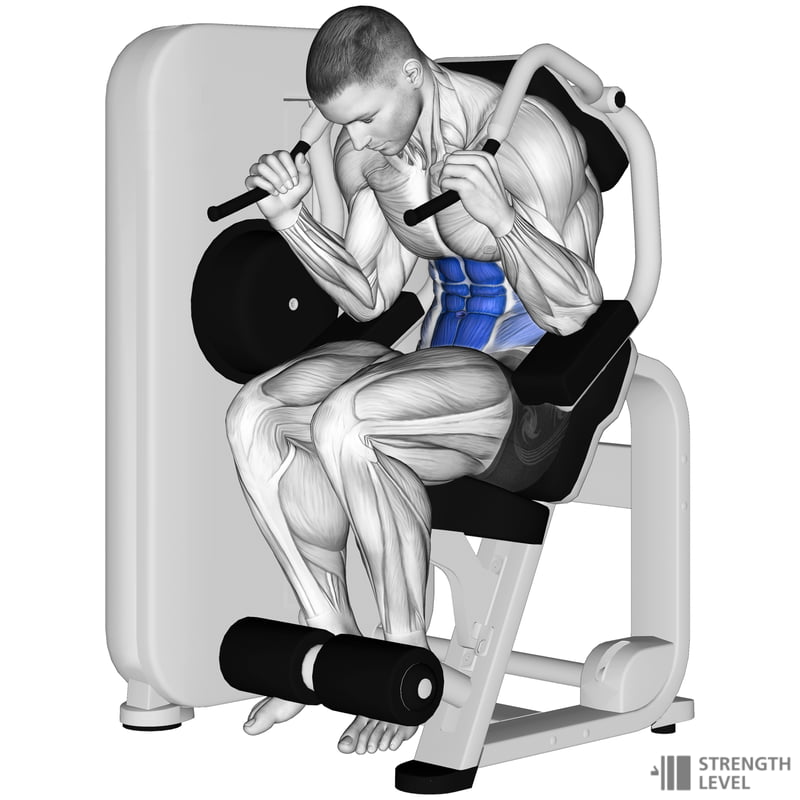
I advice to train obliques simply because it can make your waist a bit more blocky but if you have any intent to train obliques as well simply think of it the same way as the rectus abdominis EXCEPT instead of the rib to the pelvis motion being straight up and down, the left side of the rib cage should close the distance towards the right side of your pelvis when working one side of the obliques. Likewise, when working the other side the right side of your rib cage should close the distance towards the left side of your pelvis.
THE HUMERUS
I'm actually writing this after I've completed this guide. But when I began giving descriptions of exercises, I did not realize how important it is to explain what the humerus actually is. It is the bone between your shoulder and your elbow (where your tricep and bicep are located). This will be crucial to know before we move on. Now onto more upper body musculature.
Chest
Here's where we get to the interesting stuff. People have often overcomplicated chest training, but if you understand a few basic principles, practical training becomes quite simple. First is that there are two heads (not three). This means two different insertions on the humerus and functions different enough that we definitely want to go out of our way to train each.
The primary function of the sternocostal head is horizontal adduction of the humerus (arm moving across the body). This is why flat presses and flat flys work this portion so well. So if you have a solid variation of either a fly or a press in your program, you will cover the majority of the sternocostal head efficiently.
There may be some data to show that you can get slight biasing of the lower chest fibers with different movements as well, however that is incredibly niche and the vast majority of people (even high level bodybuilders) will not need to worry about it in order to get the visual chest growth they are after. I personally don’t bias my lower chest fibers as well, it’s a boring movement for me and I think it’s useless if you’re doing any horizontal adduction movement.
The clavicular head on the other hand does not just play a role in adducting the humerus, but it is also a VERY solid shoulder flexor. This is why we see very high levels of activity in the clavicular head even on front raises that have no adduction component. Due to this (in my opinion) the most effective chest training will have at least two different movements. One of these movements should focus primarily on adduction and the other one should focus primarily on flexion. Keep in mind it doesn't have to be pure flexion. If it has slight adduction that is perfectly fine and perhaps (depending on who you ask) preferable.
The last thing to keep in mind is that even though the path of the arm (tighter to the body) is preferable for the upper pec (clavicular head), we do have some evidence to show that an incline angle for pressing movements does elicit slightly higher activity regardless when compared to flat. People debate the reason for this (a commonly cited argument being leverage) but regardless as to the reason it does seem to be a safe practice when trying to bias the clavicular head to have high amounts of tension in front of the body. On an incline press the hardest portion of the movement is when the humerus is parallel to the ground.
So when looking at this image above it would be important to note that when the arm is at a 90 degree angle to the body the bench should also be flat for more sternocostal biasing. Likewise when the arm is tucked close to the side, the bench should be on an incline for more clavicular biasing. If you want to know how this works for your flys, simply try to match the strength curve that we presented with the presses.
To make a very long story short, whether you choose to do a fly variant or a press, a tucked arm path will make more sense for the clavicular head (upper chest) and a flared arm path will make more sense for the sternocostal head (mid-lower chest).
Lats
This is going to be a very long section since the lats are a dreadful conversation as there is heavy debate both in how the lats operate and what exercises are best to grow them. My point in this guide is not yo confuse you, but to help you grow. So rather than get into hefty debates over biasing the lower/upper lats, talking through leverages, making you work through hyper specific ranges of motion or obfuscating the topic any further by going into every biomechanical argument that people are currently having, I will simply tell you what movements I currently recommend for large lats. And it's simpler than you think.
Everything I say from here on out is referring to the movement of the humerus (upper arm). Think of a straight out to the side lateral raise. That would be the humerus moving through the FRONTAL plane. Think about a pec deck fly. That would be the humerus moving through the TRANSVERSE plane. Think about a front raise. That would be the humerus moving through the SAGITTAL plane. Make sure you understand these planes before anything else.
Now that you understand the planes we can begin to discuss the movements you should be looking to perform. The lats play a heavy role in both adduction and shoulder extension.
This means that having movements that have resistance opposing these motions will be good for growth. Beginning with the arm overhead and pulling it down towards your side in the FRONTAL plane is shoulder adduction.
Starting with the arm over head and pulling it down towards your side in the SAGITTAL plane is shoulder extension.
It is important with each of these movements to not lean too far back. This allows us to stay closer to the frontal plane/sagittal and avoid turning it into a pulldown/row hybrid. For shoulder extension people tend to get more creative with the variety of movements they do, but here are many examples.
Now I’m going to make something VERY clear. If you progressively overloaded one of the shoulder adduction movements and one of the shoulder extension movements and did ONLY those two exercises for the rest of your life with adequate programming, you would (probably) get the vast majority of lat gains you could possibly want. So if anyone tells you that these are “bad” exercises or that you can’t get massive lats with them, this is patently false.
Now that that is out of the way, all of the movements listed to this point have been compound movements (multijoint). You can also train the lats with single joint variations. This is very popular in the sphere currently but it does have its drawbacks. The major drawback is ease of setup. Some have been popular for a long time where others have become popular more recently. Here are some of the exercises you may have seen that can be done in a solid manner for the lats.
If I had to choose between these two exercises, I am most likely to choose the machine pullover. It is more stable, loadable and even has less joints at play due to the force going through a pad at the elbow rather than holding the attachment in your hand. A hotly debated topic currently is how high to allow the humerus to travel as well. Some argue an inability for the lats to produce significant force with the humerus overhead and therefore to only do the bottom two thirds of the motion, while others argue that the lengthening the lats experience overhead will be good for growth.
PERSONALLY, I find that there is a turnover between the bottom 2/3 of the range of motion and the top 1/3 that means strength through the movement is more limited. So REGARDLESS of the arguments people make I train both movements SEPARATELY (Pictured below). The top 1/3 ends up being its own movement in my programming and the bottom 2/3 ends up being its own movement in my programming. Here we are getting deep into the weeds though, so if you think these types of nuances are going to make or break your physique, you are sorely mistaken. However you end up deciding to train for yourself, make sure that the movement is stable and loadable and can be progressed over time.
“Flaps”
This deserves its own little section as flaps are a highly contentious topic at the moment, with some saying they are the best movements for lats with others saying they are completely unnecessary and maybe not even a lat movement (argue for it being more teres). As of now I do not see solid arguments for it being a POOR lat exercise modality. In fact the pullover machine is just a stable version of a sagittal flap. But due to the setup and many of the people currently using flaps, it has received a lot of backlash. This is what a frontal plane flap setup looks like (above) (attachment can go at the elbow or wrist).
I will make a VERY brief summary of the main arguments for and against this exercise. I am only doing this because popular members of the science based lifting community vehemently disagree on this topic.
One side argues that the lats have very good leverage in this position making this a highly efficient method to target the lats and the teres muscle simply comes along for the ride.
The other side argues that the teres has a high level of advantage in this movement and due to the humerus being limited in traveling upwards (as it would with a pulldown motion) the lats are not lengthening as much nor receiving as much of an advantage as they could.
To make a very long story short NEITHER side argues that flaps will not hit the lats. They simply argue the degree and effectiveness of it. If you want to look a little further into this topic and what people have argued here are the names of some of the people who have been more involved in these conversations: Keenan Malloy, Yotalks, N1 Coaching, Ben Yanes and many more. I suggest you look into the arguments from all sides and form your own opinion.
And as I said before (which you’ll find to be a common theme with many of these more nuanced conversations) you could have no clue that flaps exist or the conversation surrounding them, have stuck to doing more traditional lat exercises your entire life and got the vast majority if not all of your lat growth. I simply feel obligated to bring up the conversation as it is a hot button issue at the moment.
TLDR for the lats; pick a couple stable motions preferably 1 in the frontal (or close to frontal) plane, and one in the sagittal plane and progress those exercises over time for big lats.
Traps/Rhomboid's
The traps and rhomboids play a number of roles but the only real thing you need to be concerned about is how to train them. Due to the varying insertion and origin points, these muscles are fairly complex in terms of all they do, but training them is relatively simple (in my opinion).I would not train the upper traps since it can make the illusion of narrower clavicles. This is not to say that you can’t attempt to bias it at times (particularly as an advanced athlete) but the visual differences from this are likely to be much smaller compared to the middle traps, rhomboids development you go out of your way for.
Both rows and shrugs train the traps well. Don’t let anyone tell you otherwise. HOWEVER, shrugs are a slightly more direct route to training the upper traps as it is purely a focus on protraction/retraction or elevation/depression of the scapula. No matter what you decide to program, stability should be a point of emphasis. Chest support is going to allow you to more easily focus on simply working the traps vs coordination/neural demands. Can you still make progress without chest support? Of course. But I highly suggest using it where possible. Having said this, here are some of the exercises I suggest more frequently.
Although a row that has the elbows traveling closer to the sides will still hit the upper traps, they are more likely to involve the lats to a greater degree. My form suggestion (if traps is the goal) is to take a more flared elbow path on the rows. Also, keep in mind that any chest supported row variation can be turned into a kelso shrug by simply protracting and retracting the scapula (pictured below).
The shirtless man above is clearly not working his traps as resistance is moving in the opposite direction, but I wanted to show you what the protraction and retraction looks like on a horizontal (Kelso) shrug and this was one of the better images I found displaying it. So as long as that motion is being done with the chest supported setups I’ve shown with rows, you will be getting a solid stimulus.
Deltoids
The shoulders are one of the most unnecessarily overcomplicated muscle groups in my opinion.
The anterior (front) deltoid is a solid shoulder flexor through this entire range and will get solid work through any resisted motion following this path for the humerus (yes, even when the upper chest is heavily involved).
Some solid exercises for the side delts are lateral raise variations (machine, cable, and dumbbell) as well as abducted shoulder presses (and yes this can include behind the neck if you can handle it).
The posterior deltoid contributes to pulling type motions (think shoulder extension, abduction and even external rotation). Due to its heavy role in pulling motions many within the community have moved to say isolating the rear delt is superfluous. I currently tend to disagree, but you can make that judgement for yourself.
Some solid exercises for the rear delts are the reverse pec deck, bent over db raises and rear delt cable extensions.
One thing to note about the shoulders, is the role of each portion is so different (the anterior and posterior even have OPPOSITE functions). So when I hear people talk about volume for the "shoulders" I smh. The different portions of the shoulder must be viewed separately when programming. There can be some crossover (think an abducted shoulder press through a full range of motion which will hit both the front and middle delt hard), but other motions will be entirely separate in terms of stimulus (think front raise vs reverse pec deck).
Triceps
The primary role of the triceps is to extend the elbow, however the longhead also plays a role in shoulder extension. This is because the long head crosses both the elbow and shoulder joint while the lateral and medial head only cross the elbow. This crossing of multiple joints is known as biarticular and it is the same thing we talked about earlier when it comes to the rectus femoris in the quads.
Due to its biarticular nature, even though presses involve elbow extension, we have direct literature to show that presses do not cause meaningful growth for the long head of the triceps. This is why the statement that a chest press works the tris and the chest is only partially true. It works the chest and the medial and lateral head of the tris, but not the longhead. Because of this, even if you were looking to save time with compound movements you would want to include a tricep extension with a fixed humerus in order to get adequate stimulus for the longhead.
TLDR for the triceps; you will absolutely need an isolated movement to get the majority of the growth out of your triceps as the longhead (the largest head) cannot be worked well with pressing movements.
We can talk about the shoulder extension component for the triceps as well, but honestly I don’t think it needs much discussion as the role it will play in long-term triceps growth is likely small (if any). My general recommendation for the triceps is to have at least two movements within your programming. A normal tricep extension with a fixed humerus and an overhead tricep extension with a fixed humerus are two phenomenal options. However, many people will also want to include a triceps biased press of some sort like a JM, That is totally fine, if not commendable. However, if there are already chest presses (2+) in your program having a specific triceps press will be less important.
so I would do a normal tricep extension and an overhead tricep extension/JM press.
Biceps (elbow flexors)
While Biceps is the main muscle people think of when referring to elbow flexors, we are going to talk about three:
The bicep Brachii: worked very well through elbow flexion, especially when supination of the wrist is involved and possibly greater biasing with a descending resistance profile. However the main thing is to flex the elbow with supination. If you can have elbow support, even better (pictured below). There is currently debate surrounding the importance of humerus position. Some argue that a humerus in anatomical position or behind the torso is even better for biceps growth. I cannot confirm that this MUST be true, but it is an idea worth exploring in your training (at least for now). Regardless both of these exercise variants are great for brachii hypertrophy.
Brachialis: while it is a heavily contentious topic if you can truly "bias" the brachialis or not, it is a large elbow flexor that is worth noting. If we disadvantage the biceps by not supinating the wrist, the brachialis relatively takes more of the load. I also suggest elbow support for this exercise. One of the exercises I began doing for this was preacher machine hammer curls. I was then challenged further to attempt to disadvantage the biceps even more through full pronation with a descending resistance profile. Essentially a reverse curl that is heaviest at the bottom. Is it possible that this works better? Yes. Do I think that it is going to make a huge difference in your long-term growth? Probably not. I won’t get into the muh preacher curl is Brachialis not biceps argument since it’s stupid Imo.
Brachioradialis: The brachioradialis is most definitely going to operate more heavily with a pronated wrist. Reverse curls are the best way to grow this region. It is also possible that an ascending resistance profile (heavier towards the top of the movement) is best for this region. However the most important factor is certainly wrist pronation.
I could go through a wide host of curl variations, but this should give you the general idea as to what you’re looking for. The most important thing is wrist position (more supinated=more biceps and more pronated=more brachioradialis). The next is resistance profile with LIKELY descending more towards the biceps and ascending more towards the brachioradialis. A good mixture of these variables and you will have some amazing elbow flexors.
CREATING PROGRAMS
Creating a personalized program is NOT something everyone needs to do. Beginner athletes who have not spent enough time in the gym to determine true weakpoints should consider generalized programming before attempting to prioritize certain bodyparts. I want to make this very clear before you accuse me of overcomplicating the process. We discussed 14 muscle group categories above (this time I will give my own muscle groups I personally train). Here they are listed out:
- Side delts
- Upper back (rhomboids, traps)
- Lats
- Pecs
- Quads
- Hamstrings
- Adductors
- Calves
- Triceps
- Biceps
- Front delts
- Erectors (spinal erectors)
- Abdominals
- Brachioradialis
ASSUMING you have been in the gym for long enough to determine true weak body parts, you can begin to rank your body parts based on strength. A really easy way to do this is to assign it a number 1 through 3. HOWEVER, you must give 4 bodyparts a 1, 4 bodyparts a 2 and 4 bodyparts a 3. 3 means strong, 2 means middle, and 1 means weak.
Body parts that receive a 3 should always be at the end of your sessions if you are looking to develop a more balanced physique. Body parts that receive a 1 should be at the beginning of your sessions, and body parts that receive a 2 should be in the middle.
Let’s say we were setting up a leg day and my legs came in with these numbers:
Calves-2
Quads-2
Hamstrings-1
Adductors-3
Glutes-1
A leg day that might make sense in this circumstance would look like this:
- Lying Hamstring curls
- Hip Thrusts
- SLDLs
- Leg Extensions
- Seated Straight Leg Calf Raises
- Squat Pattern
- Adductor Machine
With all the principles we have talked about you SHOULD be able to program your own split and make it quite good. But just in case you’re still struggling with some of the concepts, I have provided some sample splits using some of the more popular general layouts. There is a TON of individual variety you can implement, so understand that EVERYTHING you see is guidelines. You can tailor exact set/rep numbers to your preferences. You can take more or less rest days. There are NO rules, but if you ensure continued progress on these movements, you WILL grow. It is that simple.
I will now list all the popular splits you can do, I won’t go into cons and pros etc. as I did that in the mega thread I made (I shared a link in the beginning of the thread, check it out).
Push Pull Legs:
PPL is a split where, exactly like it sounds, will be a separated split with 3 different days who are push pull and legs. Day 1 push, day 2 pull, day 3 legs. Most people do it 6 times a week while getting 2 times frequency, which is not quite optimal, but we’ll talk about this later on.
how i would program it; Best way to program it imo, would be to go 6 times a week (duh), do it PPLPPLR, you can put the rest days wherever you want it won’t really matter that much.
Push-
- Pec deck/chest press
- any incline press where you can do shoulder flexion
- Lateral raises (choose whatever variation you would like)
- Shoulder press
- Tricep extension
- JM press
Pull-
- Wide grip lat pulldown (shoulder adduction)
- Close grip row/one arm lat pulldown (shoulder extension)
- T bar row
- Reverse pec deck for rear delts (optional)
- Any bicep exercise you like, you can do here, but only do one exercise.
Legs-
- Leg extension
- Hack squat (any squat variation is decent)
- Seated/lying leg curl
- Adduction machine
- Calf raises
Anterior posterior:
anterior day:
- Chest press/ pec deck
- Incline press
- Lateral raises
- Shoulder press
- Preacher curl
- Crunches
- Adduction machine
- Leg extensions
- Reverse grip curl (optional)
Posterior day:
- Wide grip lat pulldown
- One arm lat pulldown/close grip row
- T bar
- Reverse pec deck
- Lying/seated leg curl
- Tricep extension
- JM press
- Any deadlift variation/back extension
- Calf raises
Upper Lower:
Upper Lower is one of the best splits to do, as a beginner and as an advanced lifter. This split, just like it sounds, split your upper and lower body in half. A typical upper lower week program will look like that if you go 4 times a week:
ULRULRR.
And if you go 6 times then it will look something like that:
ULULULR.
It’s a great split that can give you 3 times frequency and is also very enjoyable. In this split you can also prioritize both lower and upper body, you only need to do one more day of the upper or lower body and you will already prioritize them. For example if you want to prioritize legs, you can do ULULRL and if you go 6 times a week then you can just remove one upper day.
how I would program it: Upper Lower is one of the easiest splits to program since you need to only consider your upper and lower body when doing so.
You can choose wether you want to do it 6 or 4 times a week based on what you progress and recover best from. To minimize fatigue on upper day I would suggest you to do any dead lift variation and crunches (for abs) on lower days.
Upper day:
- Lateral raises
- Pec deck
- Incline bench
- T bar row
- Wide grip lat pulldown
- Tricep extension
- JM press
- Preacher curl
Lower day:
- Leg extension
- Hack squat
- Lying/seated leg curl
- Adduction machine
- Hip hinge
- SLDL/45’s
- Crunches
Full Body:
So. Yh, just Ike it sounds full body is a split that trains all the muscles in your body in one session. that aims to maximize the benefits of training frequency while being in the gym for as little as possible. Since the first set of each workout is the most stimulating set, and every set done after that set will be gradually less stimulating, a split that gives you a lot of frequency will be highly effective. You can do FB either 3 times a week or EOD, EOD is more effective for hypertrophy since you get 3.5 frequency compared to 3 times a week which you get 3 times frequency.
FB is a complicated split to program since it’s very easy to fatigue intra workout and you need to experiment what’s better for you. You can choose whether to do it EOD, 3 times per week or 2 times per week. It really depends on you and what you enjoy the most or recover best from. I would suggest to order your weak points first in the session and vice versa. I would opt for more compounds exercises and less single joints ones only for those who are short on time and want to finish the workout asap. For those who can be 1.5-2 hours in the gym, I would suggest to do as little compounds as possible since it will be very fatiguing.
A typical FB program would look like this
- Pec deck/chest press
- Incline press (optional)
- Lateral raises
- T bar row
- Wide grip lat pulldown
- Tricep extension
- Shoulder press (optional)
- Leg extension
- Hack squat
- SLDL/45’s
- Adductors
- Leg curl
- Calf raises
- Crunches
NOTES
1. Total daily sets should be dependent on what YOU believe you can recover from reasonably
2. If you ascribe to the belief you can only recover from less than 15 total sets per day, be more selective with your exercises and set numbers
3. The listed sets are guidelines not rules
4. Every listed exercise should be done at least 1x/week (preferably 2)
5. If every exercise can be performed with adequate intensity and progression they CAN be all done 3x/week
6. The starred exercises are the suggested adjustments from 3 to 2x/1x week if you are looking to lessen total volume but are programming 2-3x/week in general
7. Hack Squats and SLDLs overlap the most with other muscle groups worked
8. Exercise order is not set and should be based on your focuses or weak points (weak points earlier in session)
9. IMPORTANT: more does not always mean better so if you assume doing highest possible number of sets is best, you could get burned
10. Flys and presses can be interchanged to an extent (just keep in mind the extra tricep fatigue with presses)
11. It is important to note for ALL exercises that the main goal is to hit the target tissue with stability and the right resistance profile
12. If you want to swap out an exercise you always can, just make sure to not be swapping constantly
13. Once you find an exercise you like that accomplishes a similar purpose to the exercise listed in the program, stick with it for a solid amount of time (months to years not weeks)
14. You WILL have intelligent people tell you that these programs are overcomplicated and under complicated. You need to decide for yourself where you fall on this spectrum and there isn't necessarily a right or wrong answer
15. I ENCOURAGE you to think through your stances, but do NOT become an exercise or program hopper constantly switching. This WILL hinder longterm gains.
16. Exercise order can be rearranged based on what YOU specifically are trying to prioritize
17. Once you know what plan you are going to use, program it into a tracking app or digital or physical notepad. If you don't have a subscription to one there are apps you can use for free (like Hevy) so you can continue to log progress week after week
18. Every few weeks do video form checks to make sure progress is happening WITH the same technique and you aren't changing it in order to force "progress". If you find that you are, simply reduce the weight until your form gets back on track.
19. If you think there are too many exercises in a day (which is a perfectly reasonable stance), pick the ones that cover the most muscle groups and stick with them. For example, if you need to remove two exercises from the "Pull Day" it makes more sense to remove one of the lat exercises and one of the trap exercises than both lat exercises.
That’s it, I hope you found this guide helpful !
Tags: @irrumator praetor @Jensonsahighlander @mikre @includings @ce10098