How to Quit Porn Without Relying on Willpower: A Practical, Evidence-Based Guide

Demirs

Demirs

Iron
Joined
Apr 29, 2026
Posts
148
Reputation
134
Before We Start
If someone wants to stop or sharply reduce pornography use, the most evidence-based approach is not shame, “just use more willpower,” or one giant life overhaul. It is a layered plan: define the real problem clearly, track triggers, reduce easy access, practice short urge-management skills, build replacement routines, and have a structured response for slips. The best-studied psychotherapies for problematic pornography use and related compulsive sexual behavior are cognitive behavioral therapy approaches, including newer acceptance-based variants, but the overall direct evidence base is still limited and many studies are small or low quality. That means the practical plan should combine the best available PPU/CSBD research with stronger general behavior-change evidence on self-monitoring, implementation intentions, cue management, and mindfulness-based craving response.

A crucial framing point: not every concern about pornography use means a clinical disorder. What matters most is impaired control, increased priority over other parts of life, continuation despite adverse consequences, and meaningful distress or impairment. WHO recognizes compulsive sexual behavior disorder in ICD-11; at the same time, distress that is entirely due to moral disapproval is not enough by itself for diagnosis. That is why the tone of the plan should be nonjudgmental and focused on control, functioning, and values rather than shame.

For daily life, the strongest practical moves are usually simple: remove frictionless access on phone and laptop, block the obvious loopholes, move devices out of the bedroom, identify the time-place-feeling chain that precedes use, and learn one or two reliable 10-minute skills for urges. Urges often do not need to be “defeated”; they need to be survived without acting on them. Mindfulness-based “urge surfing” has evidence for changing how people respond to cravings, even if the urge itself does not disappear immediately.

Because the user’s age is unspecified, this report assumes an unknown age. If the person is a minor, guidance changes in two ways: involve a trusted adult sooner, and favor supervised parental-control settings and a pediatrician/school counselor over a secret “arms race” with devices. NIMH advises seeking help when symptoms or behaviors last for weeks, cause distress, interfere with functioning, or become unsafe.

What the evidence says​

WHO’s ICD-11 includes compulsive sexual behavior disorder as an impulse-control disorder. The core pattern is reduced control over repetitive sexual behavior, increasing priority given to it, and continuation despite negative consequences. That is a useful clinical anchor for a forum thread because it keeps the discussion on functioning and impairment rather than on moral panic or blanket claims that all porn use is “an addiction.” The parallel literature on moral incongruence also matters: some people feel “addicted” mainly because their behavior conflicts with their beliefs, even when the objective level of use is not extreme. A good public thread should acknowledge both realities.

The most comprehensive recent treatment reviews converge on the same bottom line: there are promising options, especially psychotherapy, but the direct evidence base for problematic pornography use is still not strong enough to promise one silver-bullet protocol. A 2024 systematic review found that most studies were low quality or very low quality by GRADE, with the majority focusing on second- and third-wave CBT approaches; a 2025 psychotherapy meta-analysis found psychotherapy outperformed controls on problematic pornography use, pornography frequency/duration, and sexual compulsivity. An earlier preregistered review similarly concluded that treatment appears to help, with the best evidence favoring CBT-based approaches.

Within that literature, CBT and ACT stand out. Group-administered CBT has randomized-trial support in men with hypersexual disorder, and ACT has randomized-trial evidence for problematic internet pornography use. That does not mean everyone needs therapy immediately, but it does mean the most credible self-help plan will usually look CBT/ACT-like: identify cues, challenge “permission-giving” thoughts, delay action, accept discomfort without obeying it, and build behavior around values and routines.

The behavior-change literature supports the mechanics of that plan. Self-monitoring is a core self-regulation technique across many behavior-change interventions; implementation intentions, or “if-then plans,” help turn intention into action; and newer habit-formation reviews show that behavior change improves when it is made cue-based, repeated, and specific rather than vague. That is why a useful anti-porn plan says, “If I get the urge after 11 p.m., I put the phone on the dresser, leave the bedroom, and start a 10-minute timer,” not “I’ll try harder next time.”

Mindfulness-based craving skills also fit. In an experimental study of smokers, brief urge-surfing-style instruction did not necessarily make urges vanish, but it did reduce subsequent smoking behavior over follow-up compared with control. Reviews of mindfulness-based treatment for addictive behaviors support the same general mechanism: the goal is to change the response to craving, not pretend craving never happens. This is highly transferable to problematic online sexual behavior.

Finally, the “boring” factors matter. Regular physical activity helps mental health and well-being, and more stable sleep timing is associated with better health outcomes than erratic schedules. In practice, many people’s highest-risk pornography use happens when they are underslept, isolated, bored, dysregulated, or lying in bed with a phone. A realistic plan should treat sleep and routine as relapse prevention, not as side quests.
Practical plan​

Clear goals and measurable outcomes​

A humane plan should define success broadly enough that people do not quit after the first slip. The clearest goals are:

  • reduce pornography sessions per week
  • reduce total minutes per week
  • reduce “automatic” use in high-risk contexts such as bed, bathroom, or after social media scrolling
  • increase the delay between urge and action
  • increase the number of urges survived without acting
  • eliminate escalation patterns, such as longer binges, more tabs, or use during class/work
  • improve functioning, sleep, concentration, mood, and relationship honesty where relevant
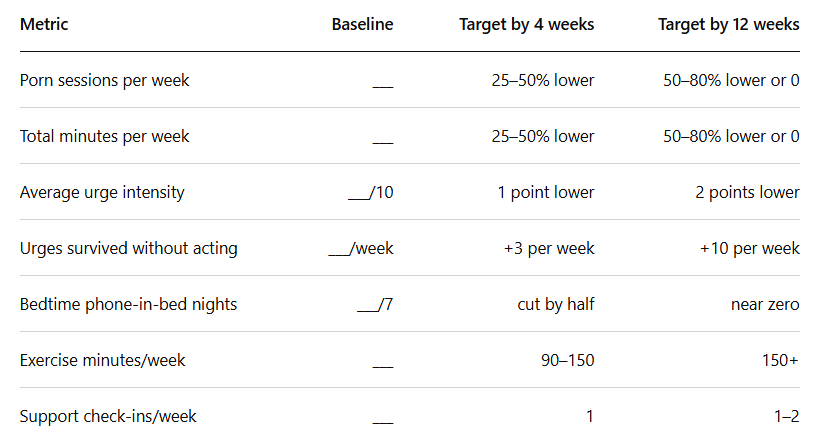
A simple dashboard works well:

Ekran grnts 2026 07 15 182644

These targets are consistent with the available psychotherapy and behavior-change evidence: meaningful progress can be measured by reductions in frequency, duration, compulsivity, and risk context, not only by perfect abstinence.
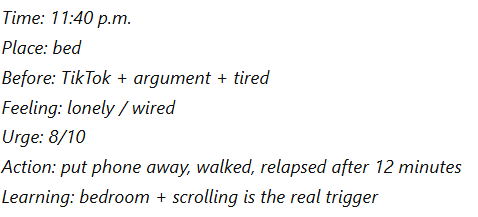
Trigger identification that actually helps​

The best trigger log is short enough to use while the urge is happening. Each time there is an urge or slip, log five things in 20 to 40 seconds:

  1. When did it happen.
  2. Where were you.
  3. What happened just before it.
  4. What you were feeling in one or two words.
  5. What you did next.
A useful template:
Ekran grnts 2026 07 15 182729

After 7 days, circle the top three patterns. Most people find that the behavior is not random. It clusters around a few loops: late night, boredom, loneliness, post-conflict stress, social media sexual cues, substance use, or unstructured time. Self-monitoring is a standard self-regulation mechanism in behavior change, and it is far more useful than trying to remember everything from memory at the end of the week.

Technical steps to reduce access on phones and computers​

The ideal setup is layered. One blocker alone is often too easy to bypass. The strongest practical stack is:

  • device-level controls for the phone or computer
  • search/video filtering for Google, Bing, YouTube
  • network-level DNS filtering at home Wi‑Fi or router
  • hard blockers for the specific times and devices where use happens most
  • environment changes such as no phone in bed and no laptop alone behind a closed door late at night

Minimum viable setup​

On iPhone / iPad / Mac

  • Use Screen TimeContent & Privacy RestrictionsWeb ContentLimit Adult Websites
  • Add specific high-risk sites under Never Allow
  • Use Downtime during your danger window, such as 11 p.m. to 7 a.m.
  • If possible, let a trusted person hold the Screen Time passcode.
On Android / Chromebook

  • If the user is a minor or has family supervision, use Family Link to try blocking explicit sites, manage Chrome/Web, and set Google Search to SafeSearch
  • Turn on YouTube Restricted Mode
  • Use Digital Wellbeing for Focus Mode and app/site timers during risk hours.
On Windows / Xbox / Edge

  • Use Microsoft Family Safety for web/search filters, blocked sites, and activity reporting, especially in family or supervised contexts.
At the network level

  • Set your router or device DNS to a family filter such as Cloudflare 1.1.1.1 for Families, OpenDNS FamilyShield, or CleanBrowsing Family Filter. This is especially useful for home Wi‑Fi and multiple devices.
For harder blocking

  • Use Freedom if cross-device scheduling matters
  • Use Cold Turkey if desktop use is the biggest problem and you need something harder to bypass
  • Use LeechBlock NG or BlockSite for fast browser-level blocking, knowing they are easier to disable than OS or network controls.
Important limitation

  • Google SafeSearch and Bing SafeSearch filter search results, not the whole internet
  • YouTube Restricted Mode reduces mature content exposure, but it is not a complete blocker
  • DNS filters can be bypassed by mobile data, VPNs, or changing DNS settings
  • Browser extensions are usually the easiest to disable.

Ten-to-fifteen-minute urge-management techniques​

These are not meant to feel profound. They are meant to get you through the next 10 minutes.

Urge surfing

  • Sit or stand still
  • Notice where the urge lives in the body
  • Name it: “tight chest,” “heat,” “restlessness,” “images”
  • Breathe and watch the urge rise, peak, and change without obeying it
  • Keep going for 3 to 5 minutes
    This is the most evidence-backed short skill here.
The 10-minute delay

  • Set a timer for 10 minutes
  • During the timer, you are not deciding forever, only delaying
  • Leave the trigger location immediately
  • Reassess when the timer ends
    Delaying and moving context are classic CBT-style interruption tools and fit the broader self-regulation evidence.
If-then script

  • “If I get the urge in bed, then I put the phone across the room and walk to the bathroom for cold water.”
  • “If I open a risky app after 10 p.m., then I text my check-in person and switch to a pre-chosen replacement.”
    Implementation intentions work best when they are specific and prewritten.
Rapid state shift

  • 20 pushups or 2 minutes of brisk stair walking
  • cold water on face
  • stand up, lights on, door open
  • move from private room to shared space
    This works less by “curing” the urge than by breaking the cue-state-action sequence. It also uses physical activation, which is consistent with broader mental health and self-regulation support.
One-page replacement list Keep a note with five replacements that are short and frictionless:

  • brief walk
  • shower
  • tea or water
  • message one person
  • read one page
  • stretch
  • 10 minutes of a game, instrument, or chores in a common area
The key is not to choose “ideal self” replacements that you will never do at 11:45 p.m. Choose replacements that are easy, boring, and available.

Relapse-response plan​

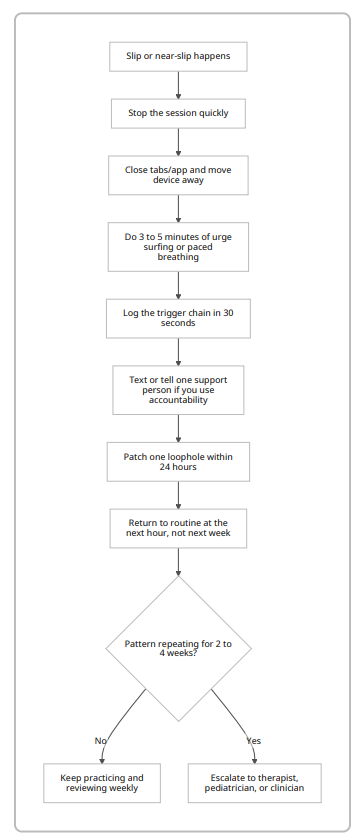
A slip should trigger analysis, not self-hatred. Shame often feeds the next binge. The response sequence should be immediate and standardized.

Ekran grnts 2026 07 15 182929

This flow synthesizes relapse-prevention principles from addictive behavior treatment with the direct PPU/CSBD evidence favoring structured psychotherapy and support.

Social support, sleep, routine, exercise, and nutrition​

Support reduces secrecy and helps turn a private pattern into a manageable one. That does not have to mean a dramatic confession thread or a highly moralized group. It can mean one trusted friend, partner, sponsor, therapist, or support group where the task is practical accountability: “I’m most at risk late at night; I’m going to text if I get stuck.” For people who want group support, mutual-help and 12-step options can provide community and reduce isolation, but the direct research base for 12-step approaches in this area is much thinner and more inconclusive than the evidence for structured psychotherapy.

Sleep and routine matter because risk often clusters in the margins of the day. A strong minimum rule is: same wake time most days, phone charges outside the bed area, and no “just scrolling” after the hour when slips usually begin. Sleep consistency is associated with better health outcomes, and WHO recommends regular physical activity for physical and mental health. A workable exercise target is the public-health standard: around 150 minutes of moderate activity weekly, plus two strength sessions if possible.

Nutrition does not need to become another obsession. The useful rule is simple: do not let the day become a chain of under-sleeping, under-eating, and overstimulation. Regular meals, hydration, and less late-night caffeine can reduce the “tired, wired, alone, scrolling” pattern that often precedes slips. This is best treated as vulnerability management, not as a purity ritual.

When and how to seek professional help​

Professional help is a good idea when any of the following are true:

  • repeated failed attempts for weeks or months
  • escalating use, longer binges, or increasingly distressing content patterns
  • strong shame, depression, anxiety, obsessive thinking, or trauma symptoms
  • major effects on school, work, relationships, sleep, or sexual functioning
  • secrecy is overwhelming you
  • you are a minor and this is causing distress or unsafe behavior
  • you have thoughts of self-harm or suicide
NIMH recommends seeking professional help when distressing symptoms last two weeks or more or interfere with usual functioning. For minors, NIMH recommends talking with caregivers, teachers, pediatricians, or a child mental-health professional, and seeking immediate help if behavior is unsafe or there is risk of harm. If there are suicidal thoughts, use emergency services or the 988 Lifeline in the U.S.; outside the U.S., use local crisis services.

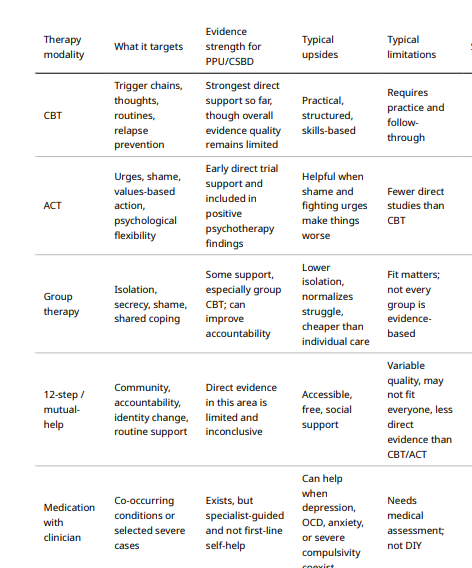
The best-fit professional is usually a therapist or clinician comfortable with CBT/ACT-style work, sexual health without shaming language, and treatment of co-occurring anxiety, depression, OCD, ADHD, trauma, or substance use. Medication may be considered in selected cases, especially for co-occurring conditions or specialist-managed CSBD, but that is not do-it-yourself territory.

Monitoring tools that are actually usable​

Start with the simplest tool you will use consistently:

  • Paper log or notes app: best privacy, fastest, easiest to maintain
  • Spreadsheet: good if you want weekly graphs of days, minutes, and triggers
  • Mood or habit app: useful only if it is simple and private
If using an app, choose one that makes it easy to track urge intensity, triggers, sleep, and slips without adding another feed to scroll. NIMH notes that mental-health apps differ widely in privacy, evidence, and quality, and that many have little peer-reviewed support, so caution is sensible.

A 30-second daily review is enough:

  • Did I use?
  • What was the main trigger?
  • How intense was the biggest urge?
  • What helped even a little?
  • What one loophole do I patch tomorrow?

Comparison tables​

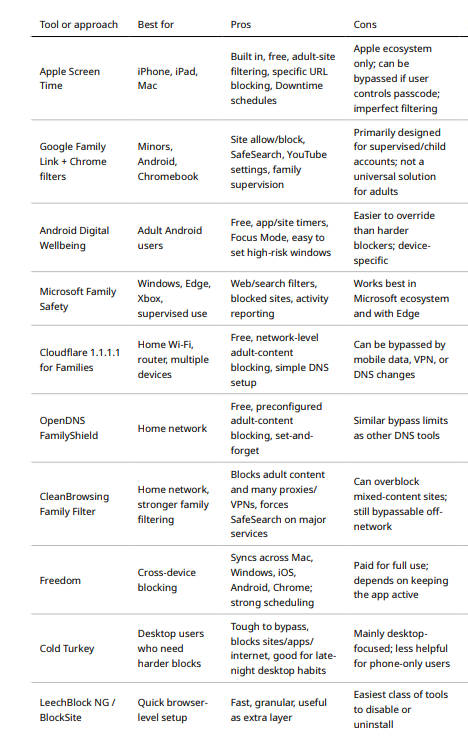
The tool comparison below uses official product or platform documentation plus major clinical reviews.
Ekran grnts 2026 07 15 183118

Ekran grnts 2026 07 15 183157

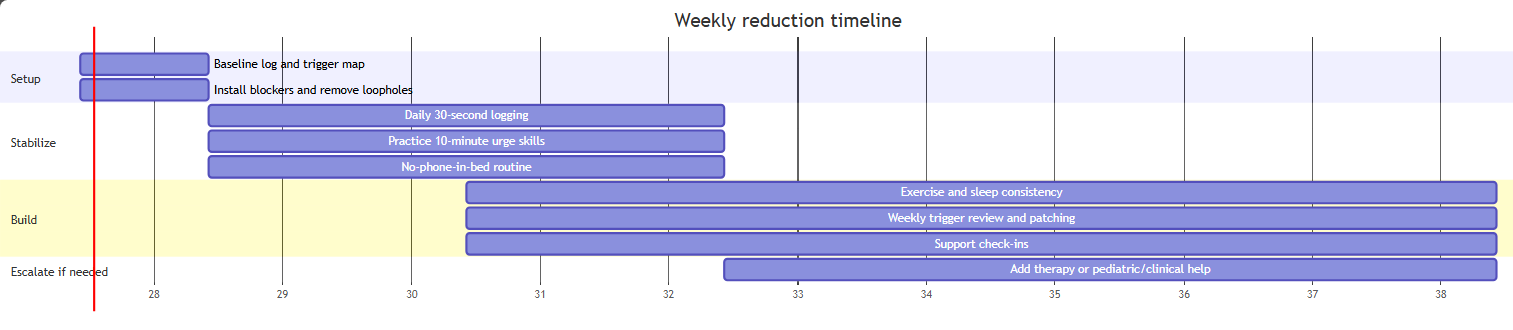
The timeline below is a practical synthesis of the literature: early wins come from access reduction and self-monitoring; medium-term change comes from routine, skill practice, and social support; longer-term stability comes from patching the recurring loopholes and, if needed, adding therapy.
Ekran grnts 2026 07 15 183232
 
  • +1
Reactions: mendeds and Eshtef
I used ChatGPT to correct grammar mistakes and assist with the research.
 
  • Love it
Reactions: Eshtef
Before We Start
If someone wants to stop or sharply reduce pornography use, the most evidence-based approach is not shame, “just use more willpower,” or one giant life overhaul. It is a layered plan: define the real problem clearly, track triggers, reduce easy access, practice short urge-management skills, build replacement routines, and have a structured response for slips. The best-studied psychotherapies for problematic pornography use and related compulsive sexual behavior are cognitive behavioral therapy approaches, including newer acceptance-based variants, but the overall direct evidence base is still limited and many studies are small or low quality. That means the practical plan should combine the best available PPU/CSBD research with stronger general behavior-change evidence on self-monitoring, implementation intentions, cue management, and mindfulness-based craving response.

A crucial framing point: not every concern about pornography use means a clinical disorder. What matters most is impaired control, increased priority over other parts of life, continuation despite adverse consequences, and meaningful distress or impairment. WHO recognizes compulsive sexual behavior disorder in ICD-11; at the same time, distress that is entirely due to moral disapproval is not enough by itself for diagnosis. That is why the tone of the plan should be nonjudgmental and focused on control, functioning, and values rather than shame.

For daily life, the strongest practical moves are usually simple: remove frictionless access on phone and laptop, block the obvious loopholes, move devices out of the bedroom, identify the time-place-feeling chain that precedes use, and learn one or two reliable 10-minute skills for urges. Urges often do not need to be “defeated”; they need to be survived without acting on them. Mindfulness-based “urge surfing” has evidence for changing how people respond to cravings, even if the urge itself does not disappear immediately.

Because the user’s age is unspecified, this report assumes an unknown age. If the person is a minor, guidance changes in two ways: involve a trusted adult sooner, and favor supervised parental-control settings and a pediatrician/school counselor over a secret “arms race” with devices. NIMH advises seeking help when symptoms or behaviors last for weeks, cause distress, interfere with functioning, or become unsafe.

What the evidence says​

WHO’s ICD-11 includes compulsive sexual behavior disorder as an impulse-control disorder. The core pattern is reduced control over repetitive sexual behavior, increasing priority given to it, and continuation despite negative consequences. That is a useful clinical anchor for a forum thread because it keeps the discussion on functioning and impairment rather than on moral panic or blanket claims that all porn use is “an addiction.” The parallel literature on moral incongruence also matters: some people feel “addicted” mainly because their behavior conflicts with their beliefs, even when the objective level of use is not extreme. A good public thread should acknowledge both realities.

The most comprehensive recent treatment reviews converge on the same bottom line: there are promising options, especially psychotherapy, but the direct evidence base for problematic pornography use is still not strong enough to promise one silver-bullet protocol. A 2024 systematic review found that most studies were low quality or very low quality by GRADE, with the majority focusing on second- and third-wave CBT approaches; a 2025 psychotherapy meta-analysis found psychotherapy outperformed controls on problematic pornography use, pornography frequency/duration, and sexual compulsivity. An earlier preregistered review similarly concluded that treatment appears to help, with the best evidence favoring CBT-based approaches.

Within that literature, CBT and ACT stand out. Group-administered CBT has randomized-trial support in men with hypersexual disorder, and ACT has randomized-trial evidence for problematic internet pornography use. That does not mean everyone needs therapy immediately, but it does mean the most credible self-help plan will usually look CBT/ACT-like: identify cues, challenge “permission-giving” thoughts, delay action, accept discomfort without obeying it, and build behavior around values and routines.

The behavior-change literature supports the mechanics of that plan. Self-monitoring is a core self-regulation technique across many behavior-change interventions; implementation intentions, or “if-then plans,” help turn intention into action; and newer habit-formation reviews show that behavior change improves when it is made cue-based, repeated, and specific rather than vague. That is why a useful anti-porn plan says, “If I get the urge after 11 p.m., I put the phone on the dresser, leave the bedroom, and start a 10-minute timer,” not “I’ll try harder next time.”

Mindfulness-based craving skills also fit. In an experimental study of smokers, brief urge-surfing-style instruction did not necessarily make urges vanish, but it did reduce subsequent smoking behavior over follow-up compared with control. Reviews of mindfulness-based treatment for addictive behaviors support the same general mechanism: the goal is to change the response to craving, not pretend craving never happens. This is highly transferable to problematic online sexual behavior.

Finally, the “boring” factors matter. Regular physical activity helps mental health and well-being, and more stable sleep timing is associated with better health outcomes than erratic schedules. In practice, many people’s highest-risk pornography use happens when they are underslept, isolated, bored, dysregulated, or lying in bed with a phone. A realistic plan should treat sleep and routine as relapse prevention, not as side quests.

Practical plan​

Clear goals and measurable outcomes​

A humane plan should define success broadly enough that people do not quit after the first slip. The clearest goals are:

  • reduce pornography sessions per week
  • reduce total minutes per week
  • reduce “automatic” use in high-risk contexts such as bed, bathroom, or after social media scrolling
  • increase the delay between urge and action
  • increase the number of urges survived without acting
  • eliminate escalation patterns, such as longer binges, more tabs, or use during class/work
  • improve functioning, sleep, concentration, mood, and relationship honesty where relevant
A simple dashboard works well:

View attachment 5366517
These targets are consistent with the available psychotherapy and behavior-change evidence: meaningful progress can be measured by reductions in frequency, duration, compulsivity, and risk context, not only by perfect abstinence.

Trigger identification that actually helps​

The best trigger log is short enough to use while the urge is happening. Each time there is an urge or slip, log five things in 20 to 40 seconds:

  1. When did it happen.
  2. Where were you.
  3. What happened just before it.
  4. What you were feeling in one or two words.
  5. What you did next.
A useful template:
View attachment 5366526
After 7 days, circle the top three patterns. Most people find that the behavior is not random. It clusters around a few loops: late night, boredom, loneliness, post-conflict stress, social media sexual cues, substance use, or unstructured time. Self-monitoring is a standard self-regulation mechanism in behavior change, and it is far more useful than trying to remember everything from memory at the end of the week.

Technical steps to reduce access on phones and computers​

The ideal setup is layered. One blocker alone is often too easy to bypass. The strongest practical stack is:

  • device-level controls for the phone or computer
  • search/video filtering for Google, Bing, YouTube
  • network-level DNS filtering at home Wi‑Fi or router
  • hard blockers for the specific times and devices where use happens most
  • environment changes such as no phone in bed and no laptop alone behind a closed door late at night

Minimum viable setup​

On iPhone / iPad / Mac

  • Use Screen TimeContent & Privacy RestrictionsWeb ContentLimit Adult Websites
  • Add specific high-risk sites under Never Allow
  • Use Downtime during your danger window, such as 11 p.m. to 7 a.m.
  • If possible, let a trusted person hold the Screen Time passcode.
On Android / Chromebook

  • If the user is a minor or has family supervision, use Family Link to try blocking explicit sites, manage Chrome/Web, and set Google Search to SafeSearch
  • Turn on YouTube Restricted Mode
  • Use Digital Wellbeing for Focus Mode and app/site timers during risk hours.
On Windows / Xbox / Edge

  • Use Microsoft Family Safety for web/search filters, blocked sites, and activity reporting, especially in family or supervised contexts.
At the network level

  • Set your router or device DNS to a family filter such as Cloudflare 1.1.1.1 for Families, OpenDNS FamilyShield, or CleanBrowsing Family Filter. This is especially useful for home Wi‑Fi and multiple devices.
For harder blocking

  • Use Freedom if cross-device scheduling matters
  • Use Cold Turkey if desktop use is the biggest problem and you need something harder to bypass
  • Use LeechBlock NG or BlockSite for fast browser-level blocking, knowing they are easier to disable than OS or network controls.
Important limitation

  • Google SafeSearch and Bing SafeSearch filter search results, not the whole internet
  • YouTube Restricted Mode reduces mature content exposure, but it is not a complete blocker
  • DNS filters can be bypassed by mobile data, VPNs, or changing DNS settings
  • Browser extensions are usually the easiest to disable.

Ten-to-fifteen-minute urge-management techniques​

These are not meant to feel profound. They are meant to get you through the next 10 minutes.

Urge surfing

  • Sit or stand still
  • Notice where the urge lives in the body
  • Name it: “tight chest,” “heat,” “restlessness,” “images”
  • Breathe and watch the urge rise, peak, and change without obeying it
  • Keep going for 3 to 5 minutes
    This is the most evidence-backed short skill here.
The 10-minute delay

  • Set a timer for 10 minutes
  • During the timer, you are not deciding forever, only delaying
  • Leave the trigger location immediately
  • Reassess when the timer ends
    Delaying and moving context are classic CBT-style interruption tools and fit the broader self-regulation evidence.
If-then script

  • “If I get the urge in bed, then I put the phone across the room and walk to the bathroom for cold water.”
  • “If I open a risky app after 10 p.m., then I text my check-in person and switch to a pre-chosen replacement.”
    Implementation intentions work best when they are specific and prewritten.
Rapid state shift

  • 20 pushups or 2 minutes of brisk stair walking
  • cold water on face
  • stand up, lights on, door open
  • move from private room to shared space
    This works less by “curing” the urge than by breaking the cue-state-action sequence. It also uses physical activation, which is consistent with broader mental health and self-regulation support.
One-page replacement list Keep a note with five replacements that are short and frictionless:

  • brief walk
  • shower
  • tea or water
  • message one person
  • read one page
  • stretch
  • 10 minutes of a game, instrument, or chores in a common area
The key is not to choose “ideal self” replacements that you will never do at 11:45 p.m. Choose replacements that are easy, boring, and available.

Relapse-response plan​

A slip should trigger analysis, not self-hatred. Shame often feeds the next binge. The response sequence should be immediate and standardized.

View attachment 5366534
This flow synthesizes relapse-prevention principles from addictive behavior treatment with the direct PPU/CSBD evidence favoring structured psychotherapy and support.

Social support, sleep, routine, exercise, and nutrition​

Support reduces secrecy and helps turn a private pattern into a manageable one. That does not have to mean a dramatic confession thread or a highly moralized group. It can mean one trusted friend, partner, sponsor, therapist, or support group where the task is practical accountability: “I’m most at risk late at night; I’m going to text if I get stuck.” For people who want group support, mutual-help and 12-step options can provide community and reduce isolation, but the direct research base for 12-step approaches in this area is much thinner and more inconclusive than the evidence for structured psychotherapy.

Sleep and routine matter because risk often clusters in the margins of the day. A strong minimum rule is: same wake time most days, phone charges outside the bed area, and no “just scrolling” after the hour when slips usually begin. Sleep consistency is associated with better health outcomes, and WHO recommends regular physical activity for physical and mental health. A workable exercise target is the public-health standard: around 150 minutes of moderate activity weekly, plus two strength sessions if possible.

Nutrition does not need to become another obsession. The useful rule is simple: do not let the day become a chain of under-sleeping, under-eating, and overstimulation. Regular meals, hydration, and less late-night caffeine can reduce the “tired, wired, alone, scrolling” pattern that often precedes slips. This is best treated as vulnerability management, not as a purity ritual.

When and how to seek professional help​

Professional help is a good idea when any of the following are true:

  • repeated failed attempts for weeks or months
  • escalating use, longer binges, or increasingly distressing content patterns
  • strong shame, depression, anxiety, obsessive thinking, or trauma symptoms
  • major effects on school, work, relationships, sleep, or sexual functioning
  • secrecy is overwhelming you
  • you are a minor and this is causing distress or unsafe behavior
  • you have thoughts of self-harm or suicide
NIMH recommends seeking professional help when distressing symptoms last two weeks or more or interfere with usual functioning. For minors, NIMH recommends talking with caregivers, teachers, pediatricians, or a child mental-health professional, and seeking immediate help if behavior is unsafe or there is risk of harm. If there are suicidal thoughts, use emergency services or the 988 Lifeline in the U.S.; outside the U.S., use local crisis services.

The best-fit professional is usually a therapist or clinician comfortable with CBT/ACT-style work, sexual health without shaming language, and treatment of co-occurring anxiety, depression, OCD, ADHD, trauma, or substance use. Medication may be considered in selected cases, especially for co-occurring conditions or specialist-managed CSBD, but that is not do-it-yourself territory.

Monitoring tools that are actually usable​

Start with the simplest tool you will use consistently:

  • Paper log or notes app: best privacy, fastest, easiest to maintain
  • Spreadsheet: good if you want weekly graphs of days, minutes, and triggers
  • Mood or habit app: useful only if it is simple and private
If using an app, choose one that makes it easy to track urge intensity, triggers, sleep, and slips without adding another feed to scroll. NIMH notes that mental-health apps differ widely in privacy, evidence, and quality, and that many have little peer-reviewed support, so caution is sensible.

A 30-second daily review is enough:

  • Did I use?
  • What was the main trigger?
  • How intense was the biggest urge?
  • What helped even a little?
  • What one loophole do I patch tomorrow?

Comparison tables​

The tool comparison below uses official product or platform documentation plus major clinical reviews.
View attachment 5366543
View attachment 5366552
The timeline below is a practical synthesis of the literature: early wins come from access reduction and self-monitoring; medium-term change comes from routine, skill practice, and social support; longer-term stability comes from patching the recurring loopholes and, if needed, adding therapy.

View attachment 5366555
dnr saved tho i will read

i can tell this is high effort thank you
 
  • +1
Reactions: Demirs
bro this is just cope all you need is find something to do instead of sitting home 24/7 then youll forget about porn
 
  • Love it
Reactions: Eshtef
Before We Start
If someone wants to stop or sharply reduce pornography use, the most evidence-based approach is not shame, “just use more willpower,” or one giant life overhaul. It is a layered plan: define the real problem clearly, track triggers, reduce easy access, practice short urge-management skills, build replacement routines, and have a structured response for slips. The best-studied psychotherapies for problematic pornography use and related compulsive sexual behavior are cognitive behavioral therapy approaches, including newer acceptance-based variants, but the overall direct evidence base is still limited and many studies are small or low quality. That means the practical plan should combine the best available PPU/CSBD research with stronger general behavior-change evidence on self-monitoring, implementation intentions, cue management, and mindfulness-based craving response.

A crucial framing point: not every concern about pornography use means a clinical disorder. What matters most is impaired control, increased priority over other parts of life, continuation despite adverse consequences, and meaningful distress or impairment. WHO recognizes compulsive sexual behavior disorder in ICD-11; at the same time, distress that is entirely due to moral disapproval is not enough by itself for diagnosis. That is why the tone of the plan should be nonjudgmental and focused on control, functioning, and values rather than shame.

For daily life, the strongest practical moves are usually simple: remove frictionless access on phone and laptop, block the obvious loopholes, move devices out of the bedroom, identify the time-place-feeling chain that precedes use, and learn one or two reliable 10-minute skills for urges. Urges often do not need to be “defeated”; they need to be survived without acting on them. Mindfulness-based “urge surfing” has evidence for changing how people respond to cravings, even if the urge itself does not disappear immediately.

Because the user’s age is unspecified, this report assumes an unknown age. If the person is a minor, guidance changes in two ways: involve a trusted adult sooner, and favor supervised parental-control settings and a pediatrician/school counselor over a secret “arms race” with devices. NIMH advises seeking help when symptoms or behaviors last for weeks, cause distress, interfere with functioning, or become unsafe.

What the evidence says​

WHO’s ICD-11 includes compulsive sexual behavior disorder as an impulse-control disorder. The core pattern is reduced control over repetitive sexual behavior, increasing priority given to it, and continuation despite negative consequences. That is a useful clinical anchor for a forum thread because it keeps the discussion on functioning and impairment rather than on moral panic or blanket claims that all porn use is “an addiction.” The parallel literature on moral incongruence also matters: some people feel “addicted” mainly because their behavior conflicts with their beliefs, even when the objective level of use is not extreme. A good public thread should acknowledge both realities.

The most comprehensive recent treatment reviews converge on the same bottom line: there are promising options, especially psychotherapy, but the direct evidence base for problematic pornography use is still not strong enough to promise one silver-bullet protocol. A 2024 systematic review found that most studies were low quality or very low quality by GRADE, with the majority focusing on second- and third-wave CBT approaches; a 2025 psychotherapy meta-analysis found psychotherapy outperformed controls on problematic pornography use, pornography frequency/duration, and sexual compulsivity. An earlier preregistered review similarly concluded that treatment appears to help, with the best evidence favoring CBT-based approaches.

Within that literature, CBT and ACT stand out. Group-administered CBT has randomized-trial support in men with hypersexual disorder, and ACT has randomized-trial evidence for problematic internet pornography use. That does not mean everyone needs therapy immediately, but it does mean the most credible self-help plan will usually look CBT/ACT-like: identify cues, challenge “permission-giving” thoughts, delay action, accept discomfort without obeying it, and build behavior around values and routines.

The behavior-change literature supports the mechanics of that plan. Self-monitoring is a core self-regulation technique across many behavior-change interventions; implementation intentions, or “if-then plans,” help turn intention into action; and newer habit-formation reviews show that behavior change improves when it is made cue-based, repeated, and specific rather than vague. That is why a useful anti-porn plan says, “If I get the urge after 11 p.m., I put the phone on the dresser, leave the bedroom, and start a 10-minute timer,” not “I’ll try harder next time.”

Mindfulness-based craving skills also fit. In an experimental study of smokers, brief urge-surfing-style instruction did not necessarily make urges vanish, but it did reduce subsequent smoking behavior over follow-up compared with control. Reviews of mindfulness-based treatment for addictive behaviors support the same general mechanism: the goal is to change the response to craving, not pretend craving never happens. This is highly transferable to problematic online sexual behavior.

Finally, the “boring” factors matter. Regular physical activity helps mental health and well-being, and more stable sleep timing is associated with better health outcomes than erratic schedules. In practice, many people’s highest-risk pornography use happens when they are underslept, isolated, bored, dysregulated, or lying in bed with a phone. A realistic plan should treat sleep and routine as relapse prevention, not as side quests.

Practical plan​

Clear goals and measurable outcomes​

A humane plan should define success broadly enough that people do not quit after the first slip. The clearest goals are:

  • reduce pornography sessions per week
  • reduce total minutes per week
  • reduce “automatic” use in high-risk contexts such as bed, bathroom, or after social media scrolling
  • increase the delay between urge and action
  • increase the number of urges survived without acting
  • eliminate escalation patterns, such as longer binges, more tabs, or use during class/work
  • improve functioning, sleep, concentration, mood, and relationship honesty where relevant
A simple dashboard works well:

View attachment 5366517
These targets are consistent with the available psychotherapy and behavior-change evidence: meaningful progress can be measured by reductions in frequency, duration, compulsivity, and risk context, not only by perfect abstinence.

Trigger identification that actually helps​

The best trigger log is short enough to use while the urge is happening. Each time there is an urge or slip, log five things in 20 to 40 seconds:

  1. When did it happen.
  2. Where were you.
  3. What happened just before it.
  4. What you were feeling in one or two words.
  5. What you did next.
A useful template:
View attachment 5366526
After 7 days, circle the top three patterns. Most people find that the behavior is not random. It clusters around a few loops: late night, boredom, loneliness, post-conflict stress, social media sexual cues, substance use, or unstructured time. Self-monitoring is a standard self-regulation mechanism in behavior change, and it is far more useful than trying to remember everything from memory at the end of the week.

Technical steps to reduce access on phones and computers​

The ideal setup is layered. One blocker alone is often too easy to bypass. The strongest practical stack is:

  • device-level controls for the phone or computer
  • search/video filtering for Google, Bing, YouTube
  • network-level DNS filtering at home Wi‑Fi or router
  • hard blockers for the specific times and devices where use happens most
  • environment changes such as no phone in bed and no laptop alone behind a closed door late at night

Minimum viable setup​

On iPhone / iPad / Mac

  • Use Screen TimeContent & Privacy RestrictionsWeb ContentLimit Adult Websites
  • Add specific high-risk sites under Never Allow
  • Use Downtime during your danger window, such as 11 p.m. to 7 a.m.
  • If possible, let a trusted person hold the Screen Time passcode.
On Android / Chromebook

  • If the user is a minor or has family supervision, use Family Link to try blocking explicit sites, manage Chrome/Web, and set Google Search to SafeSearch
  • Turn on YouTube Restricted Mode
  • Use Digital Wellbeing for Focus Mode and app/site timers during risk hours.
On Windows / Xbox / Edge

  • Use Microsoft Family Safety for web/search filters, blocked sites, and activity reporting, especially in family or supervised contexts.
At the network level

  • Set your router or device DNS to a family filter such as Cloudflare 1.1.1.1 for Families, OpenDNS FamilyShield, or CleanBrowsing Family Filter. This is especially useful for home Wi‑Fi and multiple devices.
For harder blocking

  • Use Freedom if cross-device scheduling matters
  • Use Cold Turkey if desktop use is the biggest problem and you need something harder to bypass
  • Use LeechBlock NG or BlockSite for fast browser-level blocking, knowing they are easier to disable than OS or network controls.
Important limitation

  • Google SafeSearch and Bing SafeSearch filter search results, not the whole internet
  • YouTube Restricted Mode reduces mature content exposure, but it is not a complete blocker
  • DNS filters can be bypassed by mobile data, VPNs, or changing DNS settings
  • Browser extensions are usually the easiest to disable.

Ten-to-fifteen-minute urge-management techniques​

These are not meant to feel profound. They are meant to get you through the next 10 minutes.

Urge surfing

  • Sit or stand still
  • Notice where the urge lives in the body
  • Name it: “tight chest,” “heat,” “restlessness,” “images”
  • Breathe and watch the urge rise, peak, and change without obeying it
  • Keep going for 3 to 5 minutes
    This is the most evidence-backed short skill here.
The 10-minute delay

  • Set a timer for 10 minutes
  • During the timer, you are not deciding forever, only delaying
  • Leave the trigger location immediately
  • Reassess when the timer ends
    Delaying and moving context are classic CBT-style interruption tools and fit the broader self-regulation evidence.
If-then script

  • “If I get the urge in bed, then I put the phone across the room and walk to the bathroom for cold water.”
  • “If I open a risky app after 10 p.m., then I text my check-in person and switch to a pre-chosen replacement.”
    Implementation intentions work best when they are specific and prewritten.
Rapid state shift

  • 20 pushups or 2 minutes of brisk stair walking
  • cold water on face
  • stand up, lights on, door open
  • move from private room to shared space
    This works less by “curing” the urge than by breaking the cue-state-action sequence. It also uses physical activation, which is consistent with broader mental health and self-regulation support.
One-page replacement list Keep a note with five replacements that are short and frictionless:

  • brief walk
  • shower
  • tea or water
  • message one person
  • read one page
  • stretch
  • 10 minutes of a game, instrument, or chores in a common area
The key is not to choose “ideal self” replacements that you will never do at 11:45 p.m. Choose replacements that are easy, boring, and available.

Relapse-response plan​

A slip should trigger analysis, not self-hatred. Shame often feeds the next binge. The response sequence should be immediate and standardized.

View attachment 5366534
This flow synthesizes relapse-prevention principles from addictive behavior treatment with the direct PPU/CSBD evidence favoring structured psychotherapy and support.

Social support, sleep, routine, exercise, and nutrition​

Support reduces secrecy and helps turn a private pattern into a manageable one. That does not have to mean a dramatic confession thread or a highly moralized group. It can mean one trusted friend, partner, sponsor, therapist, or support group where the task is practical accountability: “I’m most at risk late at night; I’m going to text if I get stuck.” For people who want group support, mutual-help and 12-step options can provide community and reduce isolation, but the direct research base for 12-step approaches in this area is much thinner and more inconclusive than the evidence for structured psychotherapy.

Sleep and routine matter because risk often clusters in the margins of the day. A strong minimum rule is: same wake time most days, phone charges outside the bed area, and no “just scrolling” after the hour when slips usually begin. Sleep consistency is associated with better health outcomes, and WHO recommends regular physical activity for physical and mental health. A workable exercise target is the public-health standard: around 150 minutes of moderate activity weekly, plus two strength sessions if possible.

Nutrition does not need to become another obsession. The useful rule is simple: do not let the day become a chain of under-sleeping, under-eating, and overstimulation. Regular meals, hydration, and less late-night caffeine can reduce the “tired, wired, alone, scrolling” pattern that often precedes slips. This is best treated as vulnerability management, not as a purity ritual.

When and how to seek professional help​

Professional help is a good idea when any of the following are true:

  • repeated failed attempts for weeks or months
  • escalating use, longer binges, or increasingly distressing content patterns
  • strong shame, depression, anxiety, obsessive thinking, or trauma symptoms
  • major effects on school, work, relationships, sleep, or sexual functioning
  • secrecy is overwhelming you
  • you are a minor and this is causing distress or unsafe behavior
  • you have thoughts of self-harm or suicide
NIMH recommends seeking professional help when distressing symptoms last two weeks or more or interfere with usual functioning. For minors, NIMH recommends talking with caregivers, teachers, pediatricians, or a child mental-health professional, and seeking immediate help if behavior is unsafe or there is risk of harm. If there are suicidal thoughts, use emergency services or the 988 Lifeline in the U.S.; outside the U.S., use local crisis services.

The best-fit professional is usually a therapist or clinician comfortable with CBT/ACT-style work, sexual health without shaming language, and treatment of co-occurring anxiety, depression, OCD, ADHD, trauma, or substance use. Medication may be considered in selected cases, especially for co-occurring conditions or specialist-managed CSBD, but that is not do-it-yourself territory.

Monitoring tools that are actually usable​

Start with the simplest tool you will use consistently:

  • Paper log or notes app: best privacy, fastest, easiest to maintain
  • Spreadsheet: good if you want weekly graphs of days, minutes, and triggers
  • Mood or habit app: useful only if it is simple and private
If using an app, choose one that makes it easy to track urge intensity, triggers, sleep, and slips without adding another feed to scroll. NIMH notes that mental-health apps differ widely in privacy, evidence, and quality, and that many have little peer-reviewed support, so caution is sensible.

A 30-second daily review is enough:

  • Did I use?
  • What was the main trigger?
  • How intense was the biggest urge?
  • What helped even a little?
  • What one loophole do I patch tomorrow?

Comparison tables​

The tool comparison below uses official product or platform documentation plus major clinical reviews.
View attachment 5366543
View attachment 5366552
The timeline below is a practical synthesis of the literature: early wins come from access reduction and self-monitoring; medium-term change comes from routine, skill practice, and social support; longer-term stability comes from patching the recurring loopholes and, if needed, adding therapy.

View attachment 5366555

Sources and Further Reading​


  1. Roza et al. (2024) — Treatment Approaches for Problematic Pornography Use: A Systematic Review
    https://pubmed.ncbi.nlm.nih.gov/37880509/
  2. Briken et al. (2024) — Assessment and Treatment of Compulsive Sexual Behavior Disorder: A Sexual Medicine Perspective
    https://pmc.ncbi.nlm.nih.gov/articles/PMC11214846/
  3. World Health Organization — ICD-11 Clinical Descriptions and Diagnostic Requirements
    https://www.who.int/publications/i/item/9789240077263
  4. Kraus et al. (2018) — Compulsive Sexual Behaviour Disorder in the ICD-11
    https://pubmed.ncbi.nlm.nih.gov/29352554/
  5. Twohig and Crosby (2010) — Acceptance and Commitment Therapy as a Treatment for Problematic Internet Pornography Viewing
    https://doi.org/10.1016/j.beth.2009.06.002
  6. Hallberg et al. (2019) — A Randomized Controlled Study of Group-Administered CBT for Hypersexual Disorder
  7. Bowen and Marlatt (2009) — Surfing the Urge: Brief Mindfulness-Based Intervention for Cravings
    https://pubmed.ncbi.nlm.nih.gov/20025372/
  8. National Cancer Institute — Implementation Intentions and “If–Then” Planning
    https://cancercontrol.cancer.gov/brp/research/constructs/implementation-intentions
  9. National Institute of Mental Health — Caring for Your Mental Health
    https://www.nimh.nih.gov/health/topics/caring-for-your-mental-health
  10. Apple Support — Blocking Adult Websites with Screen Time
    https://support.apple.com/guide/iphone/block-apps-app-downloads-websites-purchases-iph3ff83f3b1/ios
  11. Google — Family Link and Website Controls
    https://families.google/familylink/
  12. Microsoft — Family Safety Web and Search Filters
  13. Cloudflare — 1.1.1.1 for Families
    https://developers.cloudflare.com/1.1.1.1/setup/
  14. World Health Organization — Physical Activity Guidance
    https://www.who.int/news-room/fact-sheets/detail/physical-activity
 
  • +1
Reactions: Eshtef

Sources and Further Reading​


  1. Roza et al. (2024) — Treatment Approaches for Problematic Pornography Use: A Systematic Review
    https://pubmed.ncbi.nlm.nih.gov/37880509/
  2. Briken et al. (2024) — Assessment and Treatment of Compulsive Sexual Behavior Disorder: A Sexual Medicine Perspective
    https://pmc.ncbi.nlm.nih.gov/articles/PMC11214846/
  3. World Health Organization — ICD-11 Clinical Descriptions and Diagnostic Requirements
    https://www.who.int/publications/i/item/9789240077263
  4. Kraus et al. (2018) — Compulsive Sexual Behaviour Disorder in the ICD-11
    https://pubmed.ncbi.nlm.nih.gov/29352554/
  5. Twohig and Crosby (2010) — Acceptance and Commitment Therapy as a Treatment for Problematic Internet Pornography Viewing
    https://doi.org/10.1016/j.beth.2009.06.002
  6. Hallberg et al. (2019) — A Randomized Controlled Study of Group-Administered CBT for Hypersexual Disorder
  7. Bowen and Marlatt (2009) — Surfing the Urge: Brief Mindfulness-Based Intervention for Cravings
    https://pubmed.ncbi.nlm.nih.gov/20025372/
  8. National Cancer Institute — Implementation Intentions and “If–Then” Planning
    https://cancercontrol.cancer.gov/brp/research/constructs/implementation-intentions
  9. National Institute of Mental Health — Caring for Your Mental Health
    https://www.nimh.nih.gov/health/topics/caring-for-your-mental-health
  10. Apple Support — Blocking Adult Websites with Screen Time
    https://support.apple.com/guide/iphone/block-apps-app-downloads-websites-purchases-iph3ff83f3b1/ios
  11. Google — Family Link and Website Controls
    https://families.google/familylink/
  12. Microsoft — Family Safety Web and Search Filters
  13. Cloudflare — 1.1.1.1 for Families
    https://developers.cloudflare.com/1.1.1.1/setup/
  14. World Health Organization — Physical Activity Guidance
    https://www.who.int/news-room/fact-sheets/detail/physical-activity
mirin the effort man:feelsgood:
 
  • +1
Reactions: Demirs

Similar threads

Rayzo
Replies
1
Views
76
Tooru33
Tooru33
holyname
Replies
4
Views
78
LANCEPRETTYBOY
LANCEPRETTYBOY
TheSadAlbanian
Replies
67
Views
540
rsj
rsj
tokyo01010
Replies
7
Views
55
Tsl
Tsl

Users who are viewing this thread

  • dvakiriko070
Back
Top
Sponsored
Stake.us
America's #1 Social Casino
Slots, Poker & More
Join Now →