Economic hardship: Russia was mainly agrarian with a struggling economy, leading to widespread poverty.
Political repression: The Tsar had absolute power, limiting political freedoms and creating unrest.
Social inequality: The vast majority of the population were peasants, while a small elite controlled most wealth and power.
"Bloody Sunday" and its significance:
On January 22, 1905, peaceful protesters marched to Tsar Nicholas II’s palace to demand reforms but were fired upon by the soldiers. This massacre angered many and sparked the 1905 Revolution, leading to a wave of protests and strikes across the country.
The October Manifesto of 1905:
It promised political reforms, including the establishment of a legislative body (the Duma) and greater civil liberties. This was important as it offered some hope for change but was seen as a response to public pressure rather than a genuine commitment to reform.
Tsar Nicholas II's leadership style:
He was autocratic and resistant to change, refusing to share power or make meaningful reforms, which alienated many segments of society and led to growing dissatisfaction.
Food shortages in Russia:
Poor agricultural practices, war-related disruptions, and an inefficient economy led to food shortages, which were especially dire for peasants and urban workers, fueling frustration and unrest.
Economic hardship: Russia was mainly agrarian with a struggling economy, leading to widespread poverty.
Political repression: The Tsar had absolute power, limiting political freedoms and creating unrest.
Social inequality: The vast majority of the population were peasants, while a small elite controlled most wealth and power.
"Bloody Sunday" and its significance:
On January 22, 1905, peaceful protesters marched to Tsar Nicholas II’s palace to demand reforms but were fired upon by the soldiers. This massacre angered many and sparked the 1905 Revolution, leading to a wave of protests and strikes across the country.
The October Manifesto of 1905:
It promised political reforms, including the establishment of a legislative body (the Duma) and greater civil liberties. This was important as it offered some hope for change but was seen as a response to public pressure rather than a genuine commitment to reform.
Tsar Nicholas II's leadership style:
He was autocratic and resistant to change, refusing to share power or make meaningful reforms, which alienated many segments of society and led to growing dissatisfaction.
Food shortages in Russia:
Poor agricultural practices, war-related disruptions, and an inefficient economy led to food shortages, which were especially dire for peasants and urban workers, fueling frustration and unrest.
Economic hardship: Russia was mainly agrarian with a struggling economy, leading to widespread poverty.
Political repression: The Tsar had absolute power, limiting political freedoms and creating unrest.
Social inequality: The vast majority of the population were peasants, while a small elite controlled most wealth and power.
"Bloody Sunday" and its significance:
On January 22, 1905, peaceful protesters marched to Tsar Nicholas II’s palace to demand reforms but were fired upon by the soldiers. This massacre angered many and sparked the 1905 Revolution, leading to a wave of protests and strikes across the country.
The October Manifesto of 1905:
It promised political reforms, including the establishment of a legislative body (the Duma) and greater civil liberties. This was important as it offered some hope for change but was seen as a response to public pressure rather than a genuine commitment to reform.
Tsar Nicholas II's leadership style:
He was autocratic and resistant to change, refusing to share power or make meaningful reforms, which alienated many segments of society and led to growing dissatisfaction.
Food shortages in Russia:
Poor agricultural practices, war-related disruptions, and an inefficient economy led to food shortages, which were especially dire for peasants and urban workers, fueling frustration and unrest.
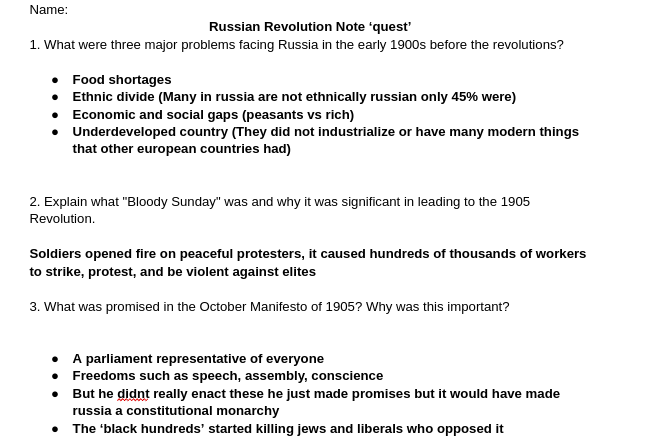
1. What were three major problems facing Russia in the early 1900s before the revolutions?
Food shortages
Ethnic divide (Many in russia are not ethnically russian only 45% were)
Economic and social gaps (peasants vs rich)
Underdeveloped country (They did not industrialize or have many modern things that other european countries had)
2. Explain what "Bloody Sunday" was and why it was significant in leading to the 1905 Revolution.
Soldiers opened fire on peaceful protesters, it caused hundreds of thousands of workers to strike, protest, and be violent against elites
3. What was promised in the October Manifesto of 1905? Why was this important?
A parliament representative of everyone
Freedoms such as speech, assembly, conscience
But he didnt really enact these he just made promises but it would have made russia a constitutional monarchy
The ‘black hundreds’ started killing jews and liberals who opposed it
This site uses cookies to help personalise content, tailor your experience and to keep you logged in if you register.
By continuing to use this site, you are consenting to our use of cookies.