


Natural.love
Bronze
- Joined
- Dec 22, 2025
- Posts
- 469
- Reputation
- 289
pubmed.ncbi.nlm.nih.gov/17022876
Ocular light plays a key role in human physiology by transmitting time of day information. The production of the pineal gland hormone melatonin is under the control of the light-dark cycle. Its profile of secretion defines biological night and it has been called the 'darkness hormone'. Light mediates a number of non-visual responses, such as phase shifting the internal circadian clock, increasing alertness, heart rate and pupil constriction. Both exogenous melatonin and light, if appropriately timed, can phase shift the human circadian system. These 'chronobiotic' effects of light and melatonin have been used successfully to alleviate and correct circadian rhythm disorders, such as those experienced following travel across time zones, in night shift work and in circadian sleep disorders. The effectiveness of melatonin and light are currently being optimized in terms of time of administration, light intensity, duration and wavelength, and melatonin dose and formulation. The aim of this review is not to replicate information that has been reported in a number of reviews of the human circadian timing system and the role of melatonin and light, but rather to extract findings relevant to the field of clinical biochemistry.
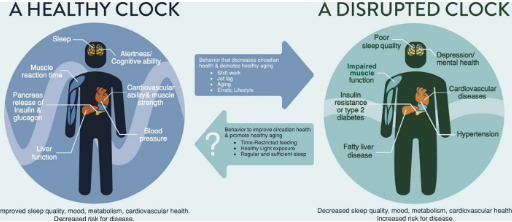
Bad Circadian Rythm:
Persistent Insomnia
Excessive Daytime Sleepiness
Irregular Sleep Schedules
Cognitive Decline
Mood Fluctuations
Good Circadian Rythm:
Morning Sunlight Exposure
Consistent Sleep Schedule
Time-Restricted Feeding
Evening Routin
Optimal Daytime Activity
Why is circadian rhythm important:
Sleep and Alertness Management
Hormonal Control
Metabolism and Digestion
Physical Health and Disease Prevention
Mental Well-being

 thinkwildlifefoundation.com
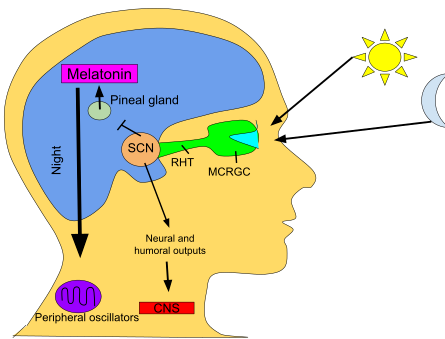
Circadian Rhythms are amongst the most critical of physiological processes to occur in mammals. This process refers to endogenous phenomena that modulates the sleep–wake cycle. Circadian Rhythms generally have periods of approximately 24 hours. The circadian cycle is effectuated by a molecular circadian clock, which synchronizes the internal biological time relative to the extrinsic environment. Diurnal patterns of light and darkness govern this cycle. The production of various hormones are altered by the absorption of light, through the Suprachiasmatic Nucleus (SCN). This in turn influences numerous physiological processes. Mutations to genes involved in Circadian Rhythms, such as CLOCK and PER2, have severe physiological implications, such as obesity and the proliferation of cancers.
Lil post
Ocular light plays a key role in human physiology by transmitting time of day information. The production of the pineal gland hormone melatonin is under the control of the light-dark cycle. Its profile of secretion defines biological night and it has been called the 'darkness hormone'. Light mediates a number of non-visual responses, such as phase shifting the internal circadian clock, increasing alertness, heart rate and pupil constriction. Both exogenous melatonin and light, if appropriately timed, can phase shift the human circadian system. These 'chronobiotic' effects of light and melatonin have been used successfully to alleviate and correct circadian rhythm disorders, such as those experienced following travel across time zones, in night shift work and in circadian sleep disorders. The effectiveness of melatonin and light are currently being optimized in terms of time of administration, light intensity, duration and wavelength, and melatonin dose and formulation. The aim of this review is not to replicate information that has been reported in a number of reviews of the human circadian timing system and the role of melatonin and light, but rather to extract findings relevant to the field of clinical biochemistry.
Bad Circadian Rythm:
Persistent Insomnia
Excessive Daytime Sleepiness
Irregular Sleep Schedules
Cognitive Decline
Mood Fluctuations
Good Circadian Rythm:
Morning Sunlight Exposure
Consistent Sleep Schedule
Time-Restricted Feeding
Evening Routin
Optimal Daytime Activity
Why is circadian rhythm important:
Sleep and Alertness Management
Hormonal Control
Metabolism and Digestion
Physical Health and Disease Prevention
Mental Well-being
Why are Circadian Rhythms important?
Circadian Rhythms are crucial physiological process which maintain mammalian functioning. Mutations to genes contronling these rhythms can prove very costly.
thinkwildlifefoundation.com
Circadian Rhythms are amongst the most critical of physiological processes to occur in mammals. This process refers to endogenous phenomena that modulates the sleep–wake cycle. Circadian Rhythms generally have periods of approximately 24 hours. The circadian cycle is effectuated by a molecular circadian clock, which synchronizes the internal biological time relative to the extrinsic environment. Diurnal patterns of light and darkness govern this cycle. The production of various hormones are altered by the absorption of light, through the Suprachiasmatic Nucleus (SCN). This in turn influences numerous physiological processes. Mutations to genes involved in Circadian Rhythms, such as CLOCK and PER2, have severe physiological implications, such as obesity and the proliferation of cancers.
Lil post


