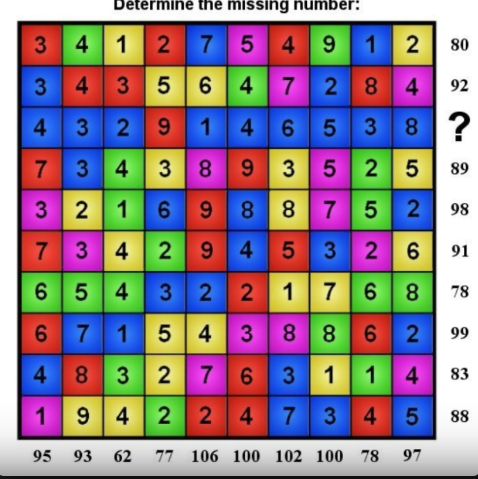
iq test for 115iq+ org members

i'm guessing the colors multiply

so we are solving an equation like
15R+4G+11Y+3B+11P=92
9R+13G+3Y+8B+5P=80
16R+6G+11Y+3B+8P=89
9R+G+10Y+16B+10P=98
21R+2G+10Y+7B+5P=91
put the coefficients into a matrix, multiply by the variable matrix [R G Y B P], set equal to solution matrix [92 80 89 98 91]
you'll get variable values (you will get no solutions if colors isn't the actual solution)
36B+9R=X (we are solving for X)
plug in B and R from the matrix, you get X, our answer

[15 4 11 3 11][R] [92]
[9 13 3 8 5][G] [80]
[16 6 11 3 8][Y] = [89]
[9 1 10 16 19] [98]
[21 2 10 7 5][P] [91]

can i use a calculator or do i have to solve the matrix out in my head
holy
 
  • +1
Reactions: Algernon
While your theory isn't quite right because the colors don't multiply or interact with each other, you are definitely on the right track by realizing that the colors themselves hold a secret mathematical value.

I will give you a hint, Instead of looking at how the colors connect across the whole grid, try treating each individual color as a fixed multiplier (like a point system from 1 to 5) that only multiplies the number sitting directly inside

You guys have Calculator for Brains its honestly impressive

Meanwhile all I can do is scroll through the comments and spectate
 
  • +1
Reactions: avenox and kogfish
i'm guessing the colors multiply

so we are solving an equation like
15R+4G+11Y+3B+11P=92
9R+13G+3Y+8B+5P=80
16R+6G+11Y+3B+8P=89
9R+G+10Y+16B+10P=98
21R+2G+10Y+7B+5P=91
put the coefficients into a matrix, multiply by the variable matrix [R G Y B P], set equal to solution matrix [92 80 89 98 91]
you'll get variable values (you will get no solutions if colors isn't the actual solution)
36B+9R=X (we are solving for X)
plug in B and R from the matrix, you get X, our answer

[15 4 11 3 11][R] [92]
[9 13 3 8 5][G] [80]
[16 6 11 3 8][Y] = [89]
[9 1 10 16 19] [98]
[21 2 10 7 5][P] [91]

can i use a calculator or do i have to solve the matrix out in my head
High iq
 

Attachments

  • image.gif
    image.gif
    159.2 KB · Views: 0
  • +1
Reactions: Algernon
yeah basically assign a value to each color

blue= x3 multiplier
red=x4 multiplier

etc..

but even then its hard to find the right combination because you have 5 variables
Its slightly easier than you think since you don't have to know the 5 variables only 2 since the ? mark row is only blue and red
 
  • +1
Reactions: kogfish
36B+9R=X (we are solving for X)

[15 4 11 5 11][R] [92]
[9 13 3 8 5][G] [80]
[16 6 11 3 13][Y] = [89]
[9 1 10 16 10]B [98]
[21 2 10 7 5][P] [91]
Call the right matrix A for answers, the 5x5 B for base values, V for variables

AV=B, multiply by inverse so V=BA^-1

idk if i did this right with associativity properties, maybe reversed

in my calculator (desmos matrix)

i got decimal values so i probably did the wrong coefficients in the matrix
 
Last edited:
  • +1
Reactions: GuyFromSingapore, ihatefoids87 and kiing_ronk
i'm guessing the colors multiply

so we are solving an equation like
15R+4G+11Y+3B+11P=92
9R+13G+3Y+8B+5P=80
16R+6G+11Y+3B+8P=89
9R+G+10Y+16B+10P=98
21R+2G+10Y+7B+5P=91
put the coefficients into a matrix, multiply by the variable matrix [R G Y B P], set equal to solution matrix [92 80 89 98 91]
you'll get variable values (you will get no solutions if colors isn't the actual solution)
36B+9R=X (we are solving for X)
plug in B and R from the matrix, you get X, our answer

[15 4 11 3 11][R] [92]
[9 13 3 8 5][G] [80]
[16 6 11 3 8][Y] = [89]
[9 1 10 16 19] [98]
[21 2 10 7 5][P] [91]

can i use a calculator or do i have to solve the matrix out in my head

9(4B+R)=X:feelskek:
 
  • +1
Reactions: GuyFromSingapore
Its slightly easier than you think since you don't have to know the 5 variables only 2 since the ? mark row is only blue and red
good point
 
  • +1
Reactions: kogfish and lonelynigga
i'm guessing the colors multiply

so we are solving an equation like
15R+4G+11Y+3B+11P=92
9R+13G+3Y+8B+5P=80
16R+6G+11Y+3B+8P=89
9R+G+10Y+16B+10P=98
21R+2G+10Y+7B+5P=91
put the coefficients into a matrix, multiply by the variable matrix [R G Y B P], set equal to solution matrix [92 80 89 98 91]
you'll get variable values (you will get no solutions if colors isn't the actual solution)
36B+9R=X (we are solving for X)
plug in B and R from the matrix, you get X, our answer

[15 4 11 3 11][R] [92]
[9 13 3 8 5][G] [80]
[16 6 11 3 8][Y] = [89]
[9 1 10 16 19] [98]
[21 2 10 7 5][P] [91]

can i use a calculator or do i have to solve the matrix out in my head
Mhh I don't think it's this complicated, what would the other numbers be for if you only need 5 rows to complete it
 
  • +1
Reactions: Algernon
haha holy all the real high iq members are coming out now
 
  • JFL
Reactions: kiing_ronk and lonelynigga
36B+9R=X (we are solving for X)

[15 4 11 5 11][R] [92]
[9 13 3 8 5][G] [80]
[16 6 11 3 8][Y] = [89]
[9 1 10 16 19] [98]
[21 2 10 7 5][P] [91]
Call the right matrix A for answers, the 5x5 B for base values, V for variables

AV=B, multiply by inverse so V=BA^-1

idk if i did this right with associativity properties, maybe reversed

in my calculator (desmos matrix)

i got decimal values so i probably did the wrong coefficients in the matrix
To fix it in Desmos, change your multiplication order to V=B−1⋅A (multiplying the inverse of your 5×5 matrix from the left). Also, ensure your coefficients represent the sum of the numbers inside the colored squares for that row, rather than just a count of the boxes. Fixing those minor miscounts in your grid will eliminate the decimals, giving you the clean, whole-number point values for each color.
 
  • +1
Reactions: Algernon
To fix it in Desmos, change your multiplication order to V=B−1⋅A (multiplying the inverse of your 5×5 matrix from the left). Also, ensure your coefficients represent the sum of the numbers inside the colored squares for that row, rather than just a count of the boxes. Fixing those minor miscounts in your grid will eliminate the decimals, giving you the clean, whole-number point values for each color.
Is that really the only way to do it though ? Usually this problems have a much simpler and cleaner solution. This one is weird because even if you understand the logic you can't really get the result easily, you'd have to manually calculate the multiplier for each color like that guy is doing.
 
  • +1
Reactions: Algernon
Is that really the only way to do it though. Usually this problems have a much simpler and cleaner solution. This one is weird because even if you understand the logic you can't really get the result easily, you'd have to manually calculate the multiplier for each color like that guy is doing
There's only 120 permutations sobyou could Def get lucky through guessing, I think you could do it intuitively if you compare larger and smaller numbers, also the two rows adding to 100 propably help
 
  • +1
Reactions: sonic55555
View attachment 5129951
This iq test is harder
Solve this your iq is above 115
Show your reasoning below

36B+9R=X (we are solving for X)

[15 4 11 5 11][R] [92]
[9 13 3 8 5][G] [80]
[16 6 11 3 13][Y] = [89]
[9 1 10 16 10]B [98]
[21 2 10 7 5][P] [91]
Call the right matrix A for answers, the 5x5 B for base values, V for variables

AV=B, multiply by inverse so V=BA^-1

idk if i did this right with associativity properties, maybe reversed

in my calculator (desmos matrix)

i got decimal values so i probably did the wrong coefficients in the matrix
i'm js going to round the values
R≈1.67
G≈2.3
Y≈2.66
B≈2.46
P≈1.45
36(1.67)+9(2.46)=82.26, using the multiple choice list 83 is the closest answer, so B

i don't think the colors are multipliers though unless decimal multipliera were intended
 
There's only 120 permutations sobyou could Def get lucky through guessing, I think you could do it intuitively if you compare larger and smaller numbers, also the two rows adding to 100 propably help
Yeah but if you need to get lucky through guessing it's not designed very well. I was also trying to look at the two columns adding to 100 and 78, I think that's a better way to do it
 
  • +1
Reactions: Algernon
Is that really the only way to do it though ? Usually this problems have a much simpler and cleaner solution. This one is weird because even if you understand the logic you can't really get the result easily, you'd have to manually calculate the multiplier for each color like that guy is doing.
it's possible, once i got to this step
36B+9R=X (we are solving for X)
[15 4 11 5 11][R] [92]
[9 13 3 8 5][G] [80]
[16 6 11 3 13][Y] = [89]
[9 1 10 16 10]B [98]
[21 2 10 7 5][P] [91]
you can row reduce the 5x5 matrix in your head, just takes a lot of time (subtract other existing matrices, flip, multiply etc)
after that you can solve for 1 variable, then plug in and start finding the rest
 
Yeah but if you need to get lucky through guessing it's not design very well. I was also trying to look at the two columns adding to 100 and 78, I think that's a better way to do it
The issue is w the numbers like 62 the average of each colour is so close that you can't narrow it down at All😭
 
it's possible, once i got to this step

you can row reduce the 5x5 matrix in your head, just takes a lot of time (subtract other existing matrices, flip, multiply etc)
after that you can solve for 1 variable, then plug in and start finding the rest
But what would the other rows and columns be there for, you are only using 5 here right ?
 
  • +1
Reactions: Algernon
@lonelynigga Do you have the way to solve it as well or do you just know the answer ?
 
technically he could use 2 rows aslong as they both contain all five colors, given that color actually represents a multiplier value

but i dont see what else it can be, maybe decimal multipliera sure
 
  • +1
Reactions: Algernon
But what would the other columns be there for, you are only using 5 rows here right ?
yeah i'm only usung 5, but you can solve for any row or column

tbh, the color multiplication i did is probably wrong since i got unclean decimals, or i messed up counting
 
1779982122966


Ok i will do the solution with reasoning

Step 1 look at ? mark row 9 squares are blue (4, 3, 2, 1, 4, 6, 5, 3, 8) 1 square is red 9 since nearly the entire row is blue we only have to figure out multiplier value for Blue and Red.

Step 2
Find Blue: Look at Column 10 (the far-right column). It has a total of 97.
Notice that the top 5 squares are all Purple and the bottom 5 squares are all Blue.
By comparing columns and rows, we find that Blue has a multiplier value of 2.
Find Red: Look at Row 1 (the top row), which totals 80.
By testing the numbers against our color values, we find that Red has a multiplier value of 1.

Step 3 Now, apply these two multipliers to Row 3:
Sum of blue squares
4 + 3 + 2 + 1 + 4 + 6 + 5 + 3 + 8 = 36
Multiple by 2 = 72
Sum of the red square
9*1 9
72 + 9 the answer is 81

 
Last edited:
  • +1
Reactions: GuyFromSingapore, sonic55555 and Algernon
technically he could use 2 rows aslong as they both contain all five colors
No you need at least 5 rows, if you are solving for 5 variables you need at least 5 equations. What I'm saying though is that here there is more than 5 rows and columns , so I don't think that's how you solve the problem
 
  • +1
Reactions: GuyFromSingapore and Algernon
yeah i'm only usung 5, but you can solve for any row or column

tbh, the color multiplication i did is probably wrong since i got unclean decimals, or i messed up counting
You did well
 
  • +1
Reactions: Algernon
View attachment 5130096

Ok i will do the solution with reasoning

Step 1 look at ? mark row 9 squares are blue (4, 3, 2, 1, 4, 6, 5, 3, 8) 1 square is red 9 since nearly the entire row is blue we only have to figure out multiplier value for Blue and Red.

Step 2
Find Blue: Look at Column 10 (the far-right column). It has a total of 97.
Notice that the top 5 squares are all Purple and the bottom 5 squares are all Blue.
By comparing columns and rows, we find that Blue has a multiplier value of 2.
Find Red: Look at Row 1 (the top row), which totals 80.
By testing the numbers against our color values, we find that Red has a multiplier value of 1.

Step 3 Now, apply these two multipliers to Row 3:
Sum of blue squares
4 + 3 + 2 + 1 + 4 + 6 + 5 + 3 + 8 = 36
Multiple by 2 = 72
Sum of the red square
9*1 9
72 + 9 the answer is 89
72+9=81
 
View attachment 5130096

Ok i will do the solution with reasoning

Step 1 look at ? mark row 9 squares are blue (4, 3, 2, 1, 4, 6, 5, 3, 8) 1 square is red 9 since nearly the entire row is blue we only have to figure out multiplier value for Blue and Red.

Step 2
Find Blue: Look at Column 10 (the far-right column). It has a total of 97.
Notice that the top 5 squares are all Purple and the bottom 5 squares are all Blue.
By comparing columns and rows, we find that Blue has a multiplier value of 2.
Find Red: Look at Row 1 (the top row), which totals 80.
By testing the numbers against our color values, we find that Red has a multiplier value of 1.

Step 3 Now, apply these two multipliers to Row 3:
Sum of blue squares
4 + 3 + 2 + 1 + 4 + 6 + 5 + 3 + 8 = 36
Multiple by 2 = 72
Sum of the red square
9*1 9
72 + 9 the answer is 81

dammit i just solved it before you wrote the solution was i right ? did anyone else came up to the solution in the thread ?
 
  • +1
Reactions: Algernon
either 89 or 81 cuz you can subtract 1 or 9
 
89
logic is add all the numbers in the row/coloumn and multiply by 2 then subtract from the number from identical colors in the row/coloumn
I don't understand, add all the numbers multiply by 2 then do what ?
 
  • +1
Reactions: Algernon
Impressive:HYPERCLAPHD:
 
  • +1
Reactions: Algernon and lonelynigga
View attachment 5130096

Ok i will do the solution with reasoning

Step 1 look at ? mark row 9 squares are blue (4, 3, 2, 1, 4, 6, 5, 3, 8) 1 square is red 9 since nearly the entire row is blue we only have to figure out multiplier value for Blue and Red.

Step 2
Find Blue: Look at Column 10 (the far-right column). It has a total of 97.
Notice that the top 5 squares are all Purple and the bottom 5 squares are all Blue.
By comparing columns and rows, we find that Blue has a multiplier value of 2.
Find Red: Look at Row 1 (the top row), which totals 80.
By testing the numbers against our color values, we find that Red has a multiplier value of 1.

Step 3 Now, apply these two multipliers to Row 3:
Sum of blue squares
4 + 3 + 2 + 1 + 4 + 6 + 5 + 3 + 8 = 36
Multiple by 2 = 72
Sum of the red square
9*1 9
72 + 9 the answer is 81

also i think ur solution method is wrong, or at least the method
colors on column (or row) 10 are not blue and purple only
also wdym comparing colors and multiplier value thats 90% of the problem
 
View attachment 5130096

Ok i will do the solution with reasoning

Step 1 look at ? mark row 9 squares are blue (4, 3, 2, 1, 4, 6, 5, 3, 8) 1 square is red 9 since nearly the entire row is blue we only have to figure out multiplier value for Blue and Red.

Step 2
Find Blue: Look at Column 10 (the far-right column). It has a total of 97.
Notice that the top 5 squares are all Purple and the bottom 5 squares are all Blue.
Wait that's not true or am I blind ?
By comparing columns and rows, we find that Blue has a multiplier value of 2.

Find Red: Look at Row 1 (the top row), which totals 80.
By testing the numbers against our color values, we find that Red has a multiplier value of 1.

Step 3 Now, apply these two multipliers to Row 3:
Sum of blue squares
4 + 3 + 2 + 1 + 4 + 6 + 5 + 3 + 8 = 36
Multiple by 2 = 72
Sum of the red square
9*1 9
72 + 9 the answer is 81

 
  • +1
Reactions: Algernon
also i think ur solution is wrong, or at least the method
colors on column (or row) 10 are not blue and purple only
also wdym comparing colors and multiplier value thats 90% of the problem
yeah exactly I don't understand the explanation either
 
  • +1
Reactions: Algernon

Similar threads

lonelynigga
Replies
43
Views
208
GoyLite
GoyLite
Light•
Replies
11
Views
103
JporkFoid
JporkFoid
vvvx33
Replies
8
Views
54
vvvx33
vvvx33
midface crisis
Replies
24
Views
123
Jason5000
Jason5000
theblueprints
Replies
3
Views
77
bboy12353
B

Users who are viewing this thread

Back
Top