leF
I post only HQ.
- Joined
- Jan 16, 2025
- Posts
- 172
- Reputation
- 1,004
How to reach your highest IQ Level and become a genius?
DISCLAIMER:
For the low IQ and the mentally challenged people who are gonna cry that I "use AI" because the text is well-written:
I write the paragraphs I struggle with in french and then run them through AI translation and finally edit them myself. That's it. English is my third language.
For two thousand years, people have tried to explain what makes someone go from being good at something to changing it completely. Their ideas keep repeating the same few points... and almost none of them are about being born smart.
One thing before you start: most of what follows is opinion and observation collected over hundreds of years, not proven science.
Part One - The Field Guide
Melencolia I
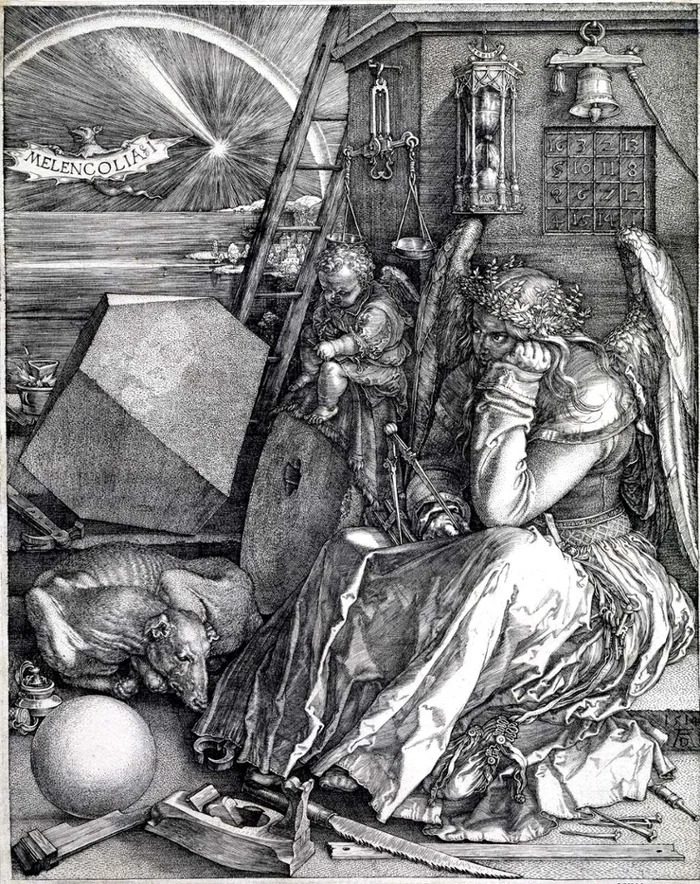
A woman sits with her head on her fist, staring at nothing, and every tool she could possibly need is lying around her. She has the instruments, she has the ability, and she isn't using any of it. People have argued about this image for five hundred years and the reading that stuck is that it shows the specific kind of sadness that comes with a mind like this. Not boredom and not depression exactly, but more the flat feeling of being able to see further than you can actually reach... You understand the problem, you have everything you need to solve it, and you still can't get there. That is what most of this post is really about, and it's the part nobody warns you about before you start. You will make sacrifices for becoming a genius.
I - Talent, genius, and how to tell them apart
Melencolia I
A woman sits with her head on her fist, staring at nothing, and every tool she could possibly need is lying around her. She has the instruments, she has the ability, and she isn't using any of it. People have argued about this image for five hundred years and the reading that stuck is that it shows the specific kind of sadness that comes with a mind like this. Not boredom and not depression exactly, but more the flat feeling of being able to see further than you can actually reach... You understand the problem, you have everything you need to solve it, and you still can't get there. That is what most of this post is really about, and it's the part nobody warns you about before you start. You will make sacrifices for becoming a genius.
I - Talent, genius, and how to tell them apart
Two words get used as if they mean the same thing. They don't, and keeping them apart makes everything else here easier to follow. Talent is doing the hard thing very well. Genius is doing the thing nobody knew was there.
- Talent hits a target no one else can hit. Genius hits a target no one else can see.
Arthur Schopenhauer
- To do easily what is difficult for others is the mark of talent. To do what is impossible for talent is the mark of genius.
Henri-Frédéric Amiel
- The world is always ready to receive talent with open arms. Very often it does not know what to do with genius.
Oliver Wendell Holmes
- A modern version, from a researcher who studied hundreds of eminent people: a genius is someone who transforms their field.
After Dean Keith Simonton
"Genius is the ability to react productively against your own training"
That line belongs to the art critic Bernard Berenson, and it is doing a lot of work.Everything you have been taught is someone else's finished answer.
Talent gets very good at those answers. Genius takes the training seriously enough to master it; and then notices where it stops being true.
Note the word productively. Rejecting your training and building nothing is not genius. It is just a bad mood.
II - How they are made: attention, solitude, and time alone
In the 1950s a psychologist named Harold McCurdy read the childhood biographies of twenty famous thinkers;
John Stuart Mill, Goethe, Pascal, Coleridge, Voltaire and others
looking for what they had in common. He came back with three conditions, and they show up together again and again.
- One adult paying close attention: a parent, a teacher, a coach
- A lot of time away from same-age friends
- Long hours alone with books and daydreams
A private world of ideas, mostly built before twenty
↓
Raw material for original work, twenty years later
Condition one : Somebody took them seriously
Not praise but ATTENTION. An adult who talked to them like a real person, taught them things early, and expected something. Usually there was plenty of love from at least one parent as well.
Buckminster Fuller put it shortest: geniuses are just people who had good mothers.
Condition two : They weren't stuck with their own age group
A room full of eight-year-olds knows what eight-year-olds know. Time with adults, older siblings, or good books moves a child forward faster than time spent matching the group.
Condition three : They had hours to fill on their own
McCurdy's phrase was a rich flowering of imagination. In practice: years of reading, building, taking things apart, and thinking with nobody watching.
Alone is not the same as lonely
Solitude is a skill you learn by having no other option. When there is nothing to do, you have to become interesting to yourself; and reading, drawing and tinkering are what fill that space. People who have never been bored rarely develop it.
McCurdy's conclusion about school and the caveat
He argued that mass schooling reduces all three conditions to a minimum : less individual attention, constant same-age company, no unstructured solitude. So, he reasoned, it should tend to suppress genius.
Read that as one researcher's interpretation of twenty biographies, not a proven fact. Plenty of original people came through ordinary schools, and school does things no reading list can. The useful part is narrower: if those three conditions matter, most days won't hand them to you. You have to build them on purpose.
III - The engine: attention, stamina, and the long flat middle
High intelligence is far more common than great work. Hospitals, universities and companies are full of very quick people who never discover anything, and they are not lazy or unkind. What is rare is the ability to point yourself at one subject and stay there for years.Habit 01 Read constantly
Nearly all eminent people were voracious readers. The reason isn't romantic; books are where the information is. There's no faster way to absorb centuries of other people's thinking.
- Dean Keith Simonton
Habit 02 Stay on one thing
Every great work comes from patience and concentration on a single subject, for months or years. Cajal, who mapped the nervous system, said the goal is to let in no thought unrelated to your problem.
- Santiago Ramón y Cajal
Habit 03 Guard the quiet
A great mind drops to ordinary the moment it's interrupted, because its whole advantage comes from focusing all its strength on one subject. This is why deep thinkers are famously sensitive to noise.
- Arthur Schopenhauer
Habit 04 Let it be love, not duty
To learn something difficult, Goethe said, you have to love it; otherwise the hours required don't make sense. Mozart put it more simply: love is the soul of genius.
- Goethe and Mozart
Habit 05 Outlast the boring part
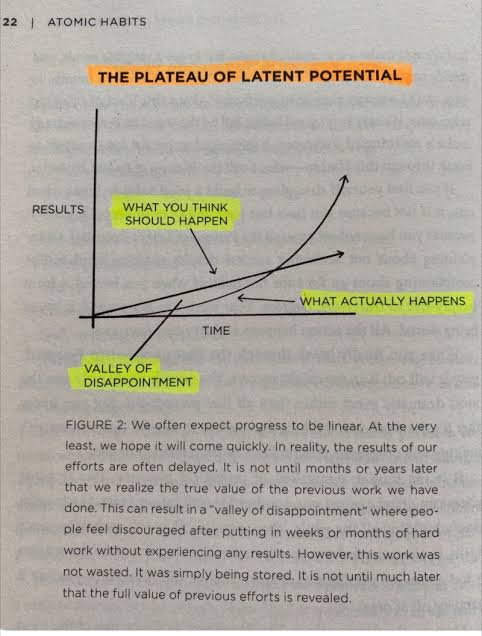
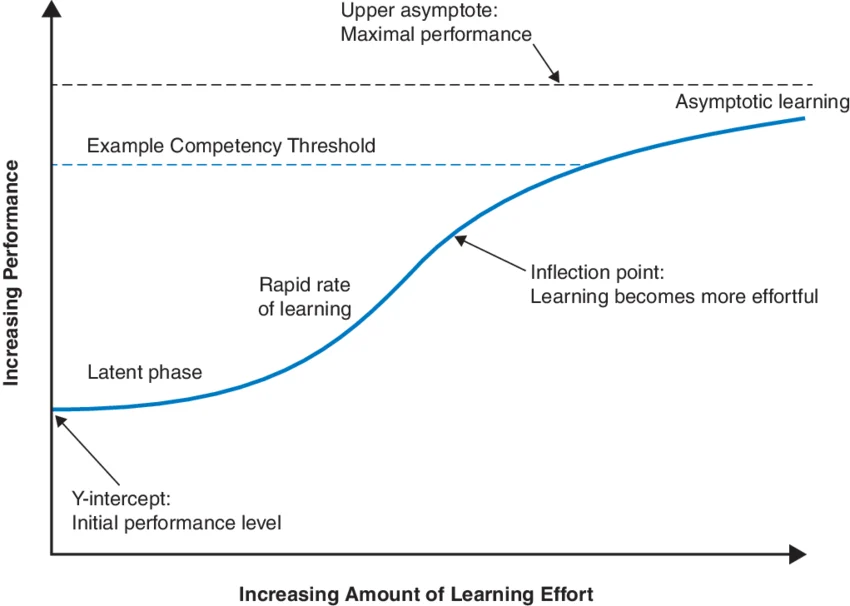
Every hard subject has a long, flat stretch where nothing feels like progress. Getting through it isn't a talent you either have or don't. It's mostly a decision you keep making.
Stamina is itself a skill, which means it can be trained
Garry Kasparov, the world chess champion, named two things as talents that nobody usually calls talents: being able to work hard for days in a row, and still taking in new information after hours of study. Both of these get better with practice, just like anything else.
Charles Darwin went even further: even people who aren't geniuses can out-think most of the world; if they build the right thinking habits. That might be the most useful sentence in this whole guide.
IV - The gap: why depth makes you harder to talk to
The deeper you go into any subject, the fewer people can follow you into it. That is not arrogance and it is not a personality defect. It is what happens when your knowledge of one thing outruns everyone nearby.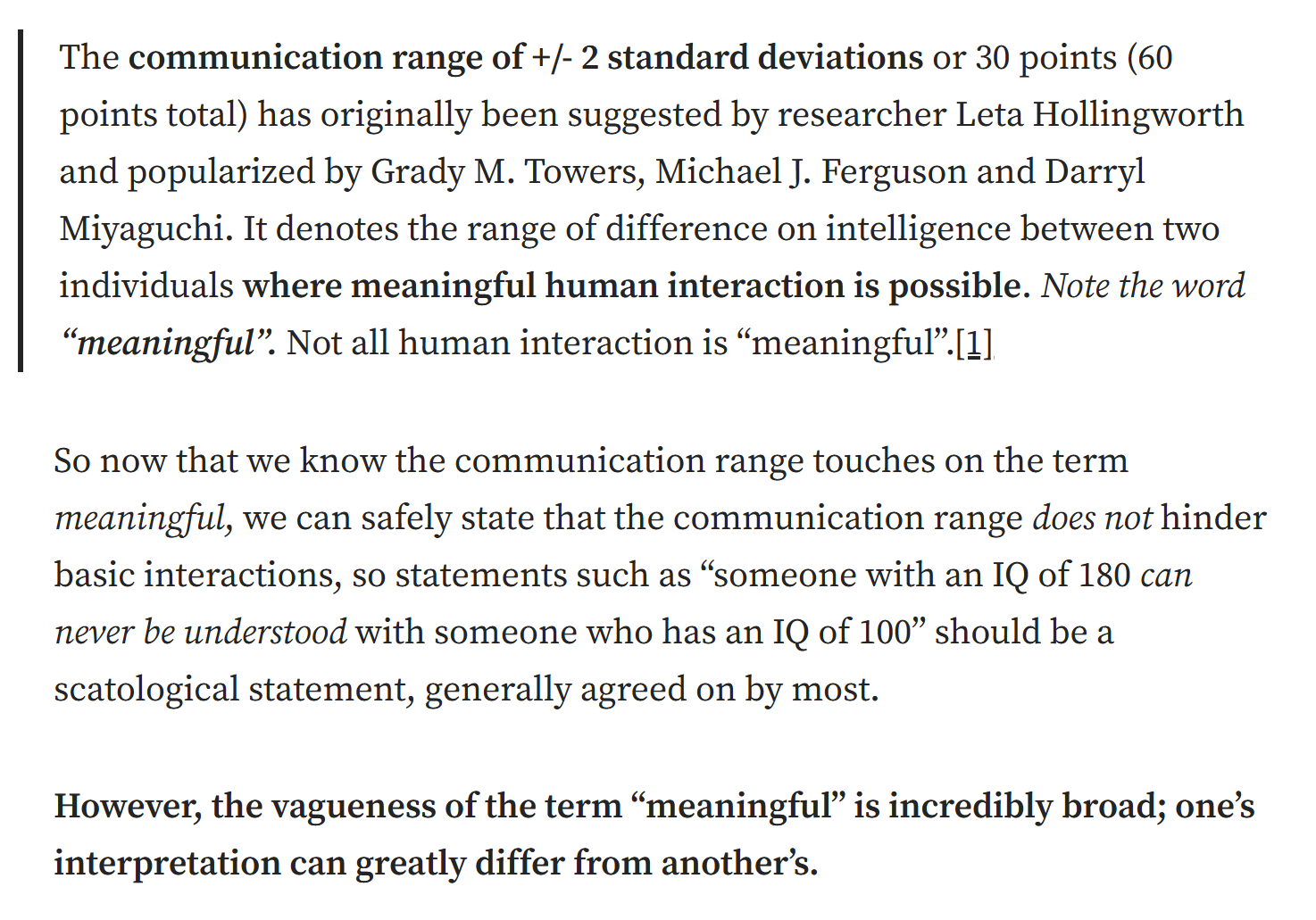
Medium.com/source
Quora.com/source
The psychologist Leta Hollingworth studied children with very high IQs and noticed this pattern, calling it the communication range. Roughly: once two people are about thirty points apart in a subject, conversation gets difficult in both directions. Neither one is being unkind. They just have almost no common ground to stand on, so both walk away with an unflattering theory about the other.
It is worth noticing that this is not really about IQ scores. The same gap opens up between a specialist and anyone else, in any field; plumbing, chess, tax law, engine repair. The wider the gap, the shorter the conversation.
In every work of genius we recognise our own rejected thoughts. They come back to us with a certain alienated majesty.
Ralph Waldo Emerson
To be great is to be misunderstood.Ralph Waldo Emerson
Ralph Waldo Emerson
Mediocrity knows nothing higher than itself, but talent instantly recognises genius.
Arthur Conan Doyle
Highly creative people tend to be logical, practical, and non-conforming. They learn early that they will not be understood.
After John T. Molloy
Some people won't be impressed but they'll be threatened.
Advertising writer David Ogilvy added a darker point to Conan Doyle's idea: mediocre people don't just fail to notice ability, they recognize it, resent it, and feel the urge to tear it down. That matches what I've seen. If you've ever been quietly frozen out of something you were good at, that's likely what happened.
The practical response isn't glamorous: don't argue, don't try to win them over; just spend less time around them. You can't talk someone out of feeling small.
Loneliness here is a matching problem, not a numbers problem. One person who understands your field is worth fifty who don't. Section VI covers how to find them and what to do once you have; because conversation turns out to be a working tool, not just a comfort.
V - The wall: why institutions resist the new thing
Schools, hospitals, journals and companies all run on the same fuel: things that can be repeated reliably. Original work is, by definition, not repeatable yet. That is the whole source of the friction; and it is mostly structural, not personal.You find a better way
↓
It contradicts how things are currently done
↓
Someone is paid well for the current way
↓
Objections arrive, dressed as technical ones
↓
You are ignored, mocked, or quietly moved aside
↓
The idea survives only if it is really true ⇢ (dotted, meaning "eventually") ⇢ Years later, it looks obvious
Colleges hate geniuses just as convents hate saints.
Ralph Waldo Emerson
Genius can only breathe freely in an atmosphere of freedom.
John Stuart Mill
Inventors and men of genius have almost always been regarded as fools at the beginning of their careers.
Fyodor Dostoevsky
The dread of censure is the death of genius.
William Gilmore Simms
Being right and being rewarded are separate events
When a better method threatens someone's income, the objection usually shows up disguised as science. It sounds like methodology. Often it's really just self-interest. This is why scientists who make genuinely disruptive discoveries sometimes lose their jobs instead of getting promoted.
Keep some perspective, though. The same institutions that create this friction also fund, house, train, and preserve most of the good work that ever gets done; including the work that eventually proves them wrong. The friction is real, but it's not the whole story. Being cynical about it isn't the same as understanding it.
| Where they cluster | Where they don't | |
| Opinion | You are allowed to hold an unpopular one out loud. | One approved answer, enforced from above. |
| Rivalry | Close competition between people who can judge the work. | Rewards for seniority and for not making waves. |
| Support | Someone pays for the work and then leaves you alone. | Funding tied to producing the expected result. |
| Examples | Athens in the fifth century BC. Renaissance Italy. | Long stretches where the art of a whole empire barely changes. |
Notice that both columns are about conditions, not about people. The Greeks were not born with better brains than their neighbours. They had small independent cities, trade with foreigners, and a culture where you could argue in public; so their playwrights and philosophers arrived in clusters. James Conant, who ran Harvard, drew the practical conclusion in one sentence: find able people, back them heavily, and leave them to direct themselves.
VI - The loop: how the work actually gets done
We're told genius happens in a flash, but people who've actually experienced it describe something duller, and more encouraging: doing the same loop again and again until it finally works.Read widely, from opposite viewpoints
↓
Notice what does not fit
↓
Say it out loud to someone who knows the field
↓
Spot the pattern, or the analogy
↓
Test it against real cases
↓
Write it down in fewer words
↺ (loops back to) Read widely, from opposite viewpoints
Move 01 - Follow the confusion
Discoveries usually start with something that doesn't add up; a case that contradicts the textbook, a number that keeps coming out wrong. Most people dismiss this as noise. Treat it as a signal instead.
Move 02 - Read the opposite sides
On any question, read someone living it, someone studying it, and someone who disagrees with both. Insight tends to show up in the gaps between these different views, not inside just one of them.
Move 03 - Look for the analogy
Aristotle believed the surest sign of genius was making good metaphors. Arthur Koestler said discovery is really just seeing an analogy no one else has seen before, noticing that two separate things are actually the same idea.
- Aristotle · Arthur Koestler
Move 04 - Say it out loud
Henry Fielding wrote that there's a kind of knowledge no book can teach, only conversation can. Mathematician John von Neumann's output actually dropped after he left university, because he lost the people he used to argue ideas with.
Move 05 - Cut the words
Schopenhauer said using many words to express few ideas is a sign of mediocrity, while packing a lot of thought into few words is a sign of genius. Rewriting one email until it's tighter is real practice for this.
Move 06 - Keep the model simple
Statistician George Box said all models are wrong, but some are useful, and over-complicating things is often a sign of mediocrity. If your explanation needs endless extra parts, you might be decorating it instead of actually explaining it.
Northrop Frye pointed out that it takes real ability to answer the simplest questions in science and philosophy; because it takes real ability to notice they are still questions at all. Everyone else has already filed them as settled.
So being creative is first a matter of discovering a question. That is also why it is available to you today, with no budget and no laboratory.
VII - The price: time, people, and what you trade away
Everything above costs something, and the accounts are worth reading before you sign. None of this is an argument against doing it. It is an argument for going in with your eyes open.Cost 01 - Time, in enormous quantities
Will Durant called consuming toil the price of genius, and said that artists who want their work to outlive them pay for it out of their personal lives. There is no version where the hours are optional.
Cost 02 - You become harder to live with
Someone who reads for twelve hours on a Saturday is not fully available to the people around them. That is a real loss for them, not just an inconvenience, and it's worth negotiating honestly rather than pretending it isn't happening.
Cost 03 - Career risk, occasionally serious
A genuine breakthrough can cost you credibility before it earns you any. Risk-taking is not a side effect of creative work; it is part of the job description.
Cost 04 - Everything else has to get smaller
Francis Galton noticed that gifted people achieve most when they are free of grinding maintenance work and constant small worries. William James said it plainly: hand as much of daily life over to routine as you can, and your higher powers are freed for their proper work.
Nothing in the world can take the place of persistence. Talent will not; nothing is more common than unsuccessful people with talent. Genius will not; unrewarded genius is almost a proverb.
- Calvin Coolidge
Which brings the guide back around to something more hopeful than where it started. Almost none of the traits collected here are fixed at birth. Reading, staying on one problem, protecting quiet hours, following your own confusion, finding one good person to argue with, cutting your sentences down; every one of those is a habit, and habits are available to anyone who decides they want them.You do not need to be a genius for any of it to work. That was Darwin's point, and he had reason to know.
Part Two - The quotations, in full
Een geleerde in zijn studievertrek
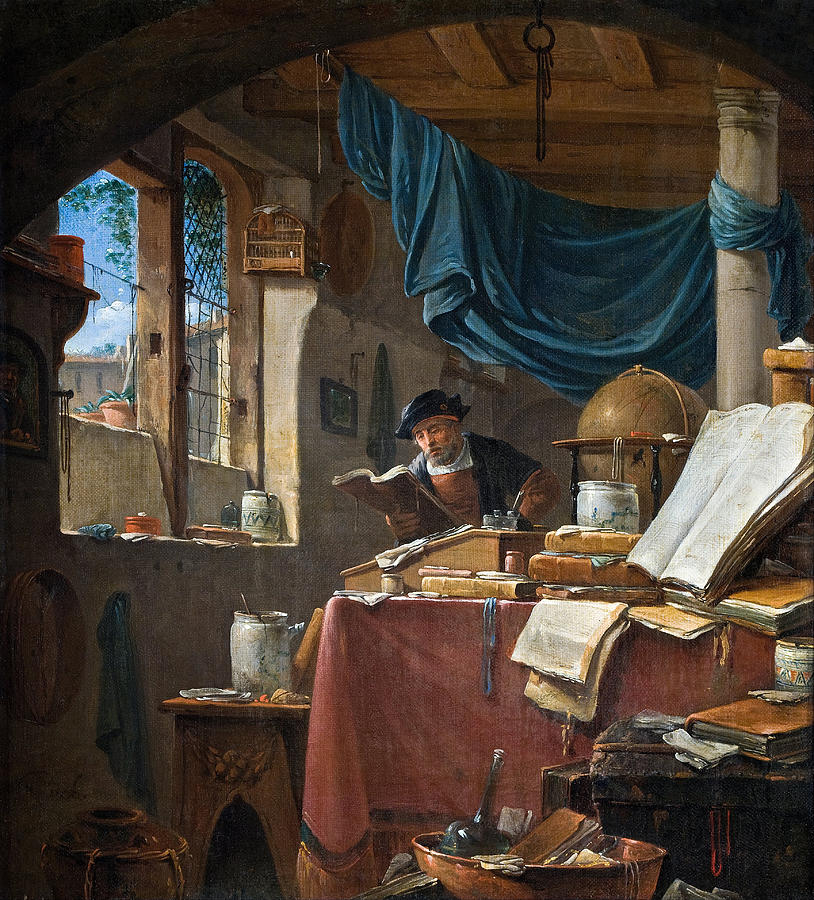
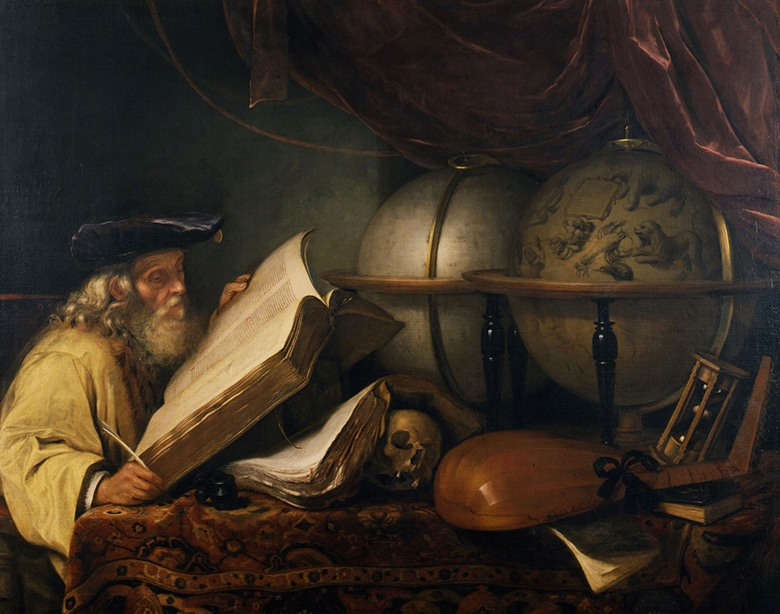
This was put here on purpose. : which just means a scholar in his study. it's a man, alone in a room, surrounded by books. Nobody is in there with him and nothing is happening. And we talk about that on Chapter II : hours alone, with books, building something in your head that nobody else can see yet. It looks boring from the outside and that's the point, because this is what the work actually looks like when it's going well. It's also the right image for Part Two, since everyone quoted below spent a large part of their life in a room like that one.
Sacrifice for becoming a genius.
Een geleerde in zijn studievertrek
This was put here on purpose. : which just means a scholar in his study. it's a man, alone in a room, surrounded by books. Nobody is in there with him and nothing is happening. And we talk about that on Chapter II : hours alone, with books, building something in your head that nobody else can see yet. It looks boring from the outside and that's the point, because this is what the work actually looks like when it's going well. It's also the right image for Part Two, since everyone quoted below spent a large part of their life in a room like that one.
Sacrifice for becoming a genius.
I - Talent, genius, and the difference
Almost every writer on this subject starts in the same place: separating the person who is very good from the person who is doing something else entirely.
I.1 - Henri-Frédéric Amiel, Swiss philosopher, 1821–1881
- "To do easily what is difficult for others is the mark of talent. To do what is impossible for talent is the mark of genius."
This is the line I opened with, and almost everything after it is a variation on the same idea. Notice that talent isn't being insulted here. It's being placed.
I.2 - Arthur Schopenhauer, German philosopher, 1788–1860
- "Talent hits a target no one else can hit. Genius hits a target no one else can see. Talent works for money and fame. Genius works for motives less easy to determine."
Schopenhauer is the best writer there is on the psychology of genius, and he shows up in this collection more than anyone else. The second half is the part people always forget: the motive is the tell.
I.3 - Arthur Schopenhauer, German philosopher, 1788–1860
- "Scholars are those who have read in books, but thinkers, men of genius, world enlighteners and reformers of mankind are those who have read directly in the book of the world."
A useful corrective to the rest of this guide, which is heavy on reading. Reading is how you catch up with everyone else. Looking at the world directly is how you get past them.
I.4 - Arthur Schopenhauer, German philosopher, 1788–1860
- "Intellect is a magnitude of intensity, not of extensity; which is why in this respect one man can confidently know more than a thousand. A thousand fools do not make one wise man."
Intensity means depth of learning; extensity means breadth. Pair it with the line attributed to Galileo: intellect is like a horse race, which is why one stallion can outrun a thousand plough horses.
I.5 - Dean Keith Simonton, American psychologist, from his work on the origins of genius
- "A genius is someone who transforms their field."
I think this is the best working definition on the list, because it sets the bar at an achievement instead of a trait. Nobody is a genius in the abstract; something in the field has to be different afterwards.
I.6 - Dean Keith Simonton, American psychologist
- "Nearly all eminent people were voracious readers."
This is the key point of the whole post, and Schopenhauer gives the reason: books are simply where the information is. There's a social cost though. A friend of mine reads two or three hours every night and his girlfriend asks him almost weekly what is wrong with him, why he can't just watch something with her. He isn't doing anything to her. He's just somewhere she can't follow.
I.7 - Robert Schumann, German composer, 1810–1856
- "Talent works, genius creates."
Three words, and it survives next to all the long ones. Which is itself an argument Schopenhauer makes later in this collection.
I.8 - Johann Kaspar Lavater, Swiss writer, 1741–1801
- "Who can produce more has vigour. Who can produce better quality has talent. Who can produce what no one else can has genius."
A three-rung ladder: quantity, quality, then the thing nobody else could have made. Most careers stop honourably on the second rung.
I.9 - Franz Grillparzer, Austrian dramatist, 1791–1872
- "Talent produces only fragments of beauty and originality. A genius integrates everything into a beautiful whole, with its beauty and its originality."
Making it all hold together is what takes the years. Anyone can have a good fragment.
I.10 - Charles Bukowski, American writer, 1920–1994
- "Genius might be the ability to say a profound thing in a simple way. Almost everyone is born a genius and buried an idiot."
On the first half: the simplest sounding lines usually cost the most work. On the second, I agree. A lot of kids show real intellectual promise and then get quietly sidetracked, and it's almost always social.
I.11 - Oliver Wendell Holmes Sr., American physician and writer, 1809–1894
- "The world is always ready to receive talent with open arms. Very often it does not know what to do with genius."
The full passage, which appears again in Part VII, is the sharpest thing in the collection on why the two get treated so differently.
I.12 - Bernard Berenson, Art critic, 1865–1959
- "Genius is the capacity for productive reaction against one's training."
Rare enough to be a real marker. Almost nobody can go against how they were trained and see a better way. Medicine is the standing example: a whole system organised around prescribing, in a world where a huge part of chronic disease turns on diet and environment.
II - Where it comes from: childhood, solitude, school
The developmental material, which is where this gets genuinely contentious. Read the school claims as arguments, not findings.
II.1 - Harold McCurdy, Psychologist, summarising biographies of twenty men of genius including Mill, Goethe, Pascal, Coleridge and Voltaire
- "The typical developmental pattern includes: a high degree of attention focused upon the child by parents and other adults, expressed in intensive educational measures and usually abundant love; isolation from other children, especially outside the family; and a rich efflorescence of fantasy as a reaction to the preceding conditions."
The pattern is easy to spot in individual cases: one parent who pushes the books and one who supplies the warmth, in some combination. The second condition is the contentious one; the claim that too much time with same age kids holds a child back, because none of them knows any more than the others.
II.2 - Harold McCurdy, Psychologist
- "The mass education of our public school system has the effect of reducing all three of these factors to a minimum. Accordingly it should tend to suppress the occurrence of genius."
The blunt reading is that schools want everyone conforming and predictable. I'd hold that at arm's length. It's an inference from twenty biographies, not a measured result, and plenty of original people came out of ordinary schools.
II.3 - Bertrand Russell, British philosopher, 1872–1970
- "Something of the hermit's temper is an essential element in many forms of excellence, since it enables men to resist the lure of popularity, to pursue important work in spite of general indifference or hostility, and to arrive at opinions which are opposed to prevalent errors."
Set this against classroom life. School teaches everyone to think alike and to accept whoever the local authority is. Years spent reading old books and dead thinkers leaves you arriving at conclusions nobody around you can predict.
II.4 - Buckminster Fuller, American designer and inventor, 1895–1983
- "Geniuses are just people who had good mothers."
The shortest version of McCurdy's first condition, and a deliberate provocation aimed at people who prefer to explain genius by brain scans.
II.5 - Raymond Moore, American educator, from his work on home schooling
- "More of family, less of school. More of parents, less of peers. More of creative freedom, less of formal lessons."
This is the version people describe when they imagine starting over: schooled at home, studying alone, then finding like minded students and teachers. Instead of years memorising things for tests everyone knows they'll forget.
II.6 - Raymond Moore, American educator
- "There is not one replicated study that suggests little children should be in school at five or six years of age. Not even one."
A strong empirical claim, and one where you should go and look at the evidence yourself rather than take either side's word for it. The weaker version, that early formal schooling is oversold, is much easier to defend than the strong one.
II.7 - Ludwig von Mises, Austrian economist, 1881–1973
- "Innovators and creative geniuses cannot be reared in schools. They are precisely the men who defy what the school has taught them."
Mises goes on that schools are not nurseries of progress but conservatories of tradition, and that a genius is always self made. The practical version: when somebody is good, leave them alone. They'll work harder on their own than you could ever make them.
II.8 - Ralph Waldo Emerson, American essayist, 1803–1882
- "Colleges hate geniuses just as convents hate saints."
Emerson's reason: universities are hostile to people who see and use ways of their own, because doing so discredits the routine everyone else is following.
II.9 - John Stuart Mill, English philosopher, 1806–1873
- "Persons of genius are a small minority, but in order to have them it is necessary to preserve the soil in which they grow. Genius can only breathe freely in an atmosphere of freedom."
Mill is at his best here and much weaker elsewhere; he was a lot less enthusiastic about freedom for people outside his own class. Taking the good argument without buying the whole man is a skill this collection rewards.
III - Attention, obsession, and sheer work
The largest group in the talk, and the one I am most confident about. The claim underneath all of it is that stamina, not brightness, is the scarce resource.
III.1 - Santiago Ramón y Cajal, Spanish neuroanatomist, 1852–1934, Nobel laureate
- "Every great work is the fruit of patience, perseverance and concentration during months and years upon one specific subject. He who wants to discover a new truth must be capable of the strictest abstinence and renunciation."
Cajal adds that the ideal is to let in no thought unrelated to the problem, and that anyone who can stay absorbed like this multiplies their strength. Anyone properly gripped by a subject knows the state. A friend of mine got obsessed with sleep for about eight months and physically could not read about anything else. Everything else he picked up, he put back down.
III.2 - Arthur Schopenhauer, German philosopher, 1788–1860
- "A great intellect sinks to ordinary when it is interrupted and distracted, because its superiority depends on the power of focusing all of its strength on one theme. To see the general in the particular is the foundation of genius. Intellect is invisible to the man who has none."
This is why deep thinkers famously hate noise: it evicts the idea from your head before you've finished turning it over. It goes further than most people want to admit. An hour in the car with loud music instead of an audiobook is an hour of attention spent somewhere else.
III.3 - Claude Adrien Helvétius, French philosopher, 1715–1771
- "Genius comes from sustained attention. It is the strong passions which impart to us that continuous earnest attention necessary for great intellectual efforts."
You have to be fascinated, because the work takes enormous time and pays almost nothing back during the early and middle stretches.
III.4 - Lord Chesterfield, English statesman and letter-writer, 1694–1773
- "Steady attention to one object is a sure mark of a superior genius."
Three centuries of writers keep landing on the same word, attention, long before anyone had a way to measure it.
III.5 - Garry Kasparov, Russian world chess champion
- "The ability to work hard for days on end is a talent. The ability to keep on absorbing new information after many hours of study is a talent."
Great achievers are almost all workaholics, and calling stamina a talent is the useful part of this framing. It stops people treating a shortage of it as a character flaw instead of something they can train.
III.6 - Stendhal, French novelist, 1783–1842
- "The man of genius is he, and he alone, who finds such joy in his art that he will work at it come hell or high water."
I watched this exact thing at university. Two of us at the same desk: my friend found five hours on a Saturday brutal and I could do ten without noticing. Same hours, completely different relationship to them. I wanted to be there and he didn't.
III.7 - Ian Fleming, English novelist, 1908–1964
- "All the greatest men are maniacs. They are possessed by a mania which drives them forward towards their goal. Mania is as priceless as genius."
The same fanatical narrowing shows up in athletes and in serious scholars and it looks identical from the outside. The warning attached to it: simplify your life so nothing else takes your time, but keep some part of a social life or you'll end up isolated and miserable. I've watched people get this half right, and the half they dropped was always the second one.
III.8 - Calvin Coolidge, American president, 1872–1933
- "Nothing in the world can take the place of persistence. Talent will not; nothing is more common than unsuccessful men with talent. Genius will not; unrewarded genius is almost a proverb. Education will not; the world is full of educated derelicts. Persistence and determination alone are omnipotent."
You see it in scientists who make a real breakthrough. Not brilliance so much as something close to mania in the sheer effort poured in.
III.9 - Thomas Edison, American inventor, 1847–1931
- "Genius is one percent inspiration and ninety-nine percent perspiration."
The most quoted line on this list and the least examined. Note that Edison is not saying inspiration does not matter; he is saying it is the cheap part.
III.10 - Thomas Fuller, English churchman and writer, 1608–1661
- "The real difference between men is energy. A strong will, a settled purpose and an invincible determination can accomplish almost anything, and this is the distinction between great men and little men."
Written three hundred and fifty years before anyone reached for the word productivity, and it holds up better than most of what replaced it.
III.11 - Matthew Arnold, English poet and critic, 1822–1888
- "Genius is mainly an affair of energy."
The modern restatement is just arithmetic: at equal ability and equal method, the person working ten hours a day arrives before the person working five.
III.12 - W. H. Auden, Anglo-American poet, 1907–1973
- "Geniuses are the luckiest of mortals, because what they must do is the same as what they most want to do."
The wrestler John Smith described inventing a new technique as if he were curing cancer. Athletes and scholars at the top describe the same thing, and among them it's normal rather than exceptional.
III.13 - Maxim Gorky, Russian writer, 1868–1936
- "The higher goal a person pursues, the quicker his ability develops."
The caveat: the goal has to be one you believe is at least remotely possible. An impossible target doesn't pull you forward. It just makes you tired.
III.14 - Charles Darwin, English naturalist, 1809–1882
- "Even people who are not geniuses can outthink the rest of mankind if they develop certain thinking habits."
The most useful line in the whole collection, and the best reason to take study skills seriously. Students pay enormous tuition and never learn how to study; that's close to being handed thirty or forty points of working intelligence and turning them down.
III.15 - Francis Galton, English polymath, 1822–1911, on what intelligence alone fails to explain
- "Ability combined with zeal and the capacity for hard labour."
Galton helped invent the modern concept of intelligence and then argued it wasn't enough on its own. The traits have to arrive together. The evidence is all around you: enormous numbers of high IQ people never try to discover anything, and almost none of them are lazy.
IV - The temperament: madness, humour, love of the thing
What these people are like to be around. The collection is unusually consistent here, and not always flattering.
IV.1 - Aristotle, Greek philosopher, 384–322 BC
- "Great geniuses always have some touch of madness."
The strangeness might not be a side effect you could remove and keep the rest. Newton is the standing example. He wrote more about scripture than about physics and was a heretic by the standards of his day.
IV.2 - Samuel Taylor Coleridge, English poet, 1772–1834
- "People of humour are always in some degree people of genius. No mind is thoroughly well organised that is deficient in a sense of humour."
This works as a field test. The genuinely brilliant people I've met were funny, warm and human. The impressive on paper ones, hundreds of publications and a talk full of safe platitudes, never joked about anything at all.
IV.3 - Paul Russo, Writer on creativity
- "Monomania can develop into genius as the individual delves deeper into the process, leaving normal parameters behind."
The clinical-sounding version of Fleming's maniacs. The phrase worth keeping is leaving normal parameters behind; that is the cost as well as the method.
IV.4 - Edward Dutton and Bruce Charlton, From their argument about a modern shortage of genius
- "Something deep within the genius makes him want to fully comprehend, improve or express the nature of reality."
Their claim is that the drive is inward rather than social, and that attention normally spent on status and social life gets redirected into the work. The rider is sharper: in most professions there's now no incentive whatever to discover anything, because a discovery mainly buys you enemies.
IV.5 - Mihaly Csikszentmihalyi, Hungarian-American psychologist, on what innovators share
- "They are interested in unique goals, different from those of the masses."
Look around any profession. Most people want to pass their exams, get the job they wanted, earn well and raise a family. All perfectly good aims, and not one of them requires you to see anything more deeply than the day demands.
IV.6 - David Ogilvy, Advertising executive, 1911–1999
- "Few of the great creators have bland personalities. They are cantankerous egoists, the kind of men who are unwelcome in the modern corporation."
Ogilvy's advice on these people is to keep them; they lay golden eggs. You have to let them stay idiosyncratic or you lose everything else they can do. The price of the ability is the personality it arrived attached to.
IV.7 - Edgar Allan Poe, American writer, 1809–1849
- "The true genius shudders at incompleteness."
Seven words for the itch that makes someone rewrite a finished thing. If you have it you already know; if you do not, it looks like a waste of a weekend.
IV.8 - Mozart, Austrian composer, 1756–1791
- "True genius is more than lofty intelligence and imagination. Love, love, love. That is the soul of genius."
It ties straight into Goethe's claim that to learn a complex subject you have to love it, because of what the middle of the learning curve is like. Fast exciting start, then a long tedious plateau of details, and only after that the freedom to be creative with it.
IV.9 - Goethe, German writer, 1749–1832
- "The first and last thing required of genius is the love of truth."
Placed next to Mozart's line, this is the whole emotional engine of the collection: love of the subject to get you through the work, love of truth to keep you honest once you are good enough to fool people.
IV.10 - Simone de Beauvoir, French philosopher, 1908–1986
- "One is not born a genius, one becomes a genius."
She adds that the people honoured with the name are the ones who took on the fate of humanity in their own lives. That sets a hierarchy worth keeping: a discovery that helps everyone is a higher order of thing than one that just dazzles.
IV.11 - Benjamin Franklin, American polymath, 1706–1790, attributed
- "Genius is the ability to hold one's vision steady until it becomes reality."
The timescale for that steadiness is often a couple of years and sometimes decades, which is why Franklin is quietly enviable. Rich by thirty eight and free to do science for the rest of his life. Almost nobody gets that deal.
V - Seeing: metaphor, analogy, and the hidden question
The perceptual half of the subject. Not how hard these people worked, but what they were able to notice.
V.1 - Aristotle, Greek philosopher, 384–322 BC
- "The greatest thing is to be a master of metaphor. It is the mark of a genius to make good metaphors."
A usable test for a real writer or thinker: the metaphor arrives out of nowhere and you recognise instantly that it's both correct and useful. Two and a half thousand years later, this one still holds.
V.2 - Arthur Koestler, Hungarian-British author, 1905–1983
- "The real achievement in discoveries is seeing an analogy where no one saw it before."
Which explains why discoveries look obvious afterwards and weren't obvious before. Conventional thinking puts obstacles in front of the connection until somebody clears them away.
V.3 - William James, American psychologist and philosopher, 1842–1910
- "Genius means little more than the faculty of perceiving in an unhabitual way. Genius is the capacity for seeing relationships where lesser men see none."
James also notes that the first thing the intellect does with anything new is file it with something it already knows. Perceiving unhabitually means refusing that first reflex.
V.4 - Northrop Frye, Canadian literary critic, 1912–1991
- "Only a great genius can answer the simplest questions in science and philosophy, because it takes a great genius to become aware of them as questions."
This is the hinge of the whole method. The hard part isn't answering the fundamental question; it's noticing that a question everyone treats as settled is still open.
V.5 - Mason Cooley, American aphorist, 1927–2002
- "Genius knows where the questions are hidden."
The usual shape is a whole field spending its time on trivialities while an obvious basic question sits there unaddressed. Nutrition research is the standard example: decades spent isolating single nutrients when much of the signal shows up at the level of whole diets.
V.6 - Eric Sotto, Author on learning and teaching
- "The most eminent scientists and artists are people who see questions where most people see only the prevailing answers."
The same idea as Frye, phrased for people who work in schools. Being creative, on this account, begins as an act of noticing rather than an act of making.
V.7 - Dave Trott, British advertising writer
- "It gradually dawned on me what the creative geniuses all had in common. They had inquiring minds."
Trott's marker is the question why does it have to be that way at all. Look at how rarely anyone asks it. Most people in medicine can't picture treating diabetes or hypertension with anything but a drug, and not because the alternatives were weighed and rejected. The premise was never up for examination.
V.8 - Alfred North Whitehead, English mathematician and philosopher, 1861–1947
- "A clash of doctrines is not a disaster; it is an opportunity. Fundamental progress has to do with the reinterpretation of basic ideas."
It's also exactly where the trouble starts. Progress requires thinking in a new way, thinking in a new way means rejecting the conventional way, and a great many people are making a living from the conventional way.
V.9 - Thomas Henry Huxley, English biologist, 1825–1895
- "Sit down before fact as a little child, be prepared to give up every preconceived notion, follow humbly wherever nature leads, or you shall learn nothing."
Huxley continues that scepticism is the highest of duties and blind faith the one unpardonable sin, and that every great advance in knowledge has involved rejecting authority. A friend of mine who's a doctor told me the textbook he treated as gospel in medical school now reads to him like a comic book on half the diseases that matter. Same book. Twenty years of looking at real cases.
V.10 - George Box, British statistician, 1919–2013
- "All models are wrong, but some are useful."
Box adds that over elaboration is often the mark of mediocrity. Rough test: open a journal with forty papers in it and count how many carry usable information once you strip out the statistics. The honest number is one or two.
VI - Getting it out: conversation, writing, other people
The part of the process that happens out loud. This is a working tool, not a social nicety.
VI.1 - Henry Fielding, English novelist, 1707–1754
- "There is a sort of knowledge beyond the power of learning to bestow, and this is to be had in conversation. So necessary is this to the understanding of the characters of men that none are more ignorant of them than those learned pedants whose lives have been entirely consumed in colleges and among books."
John von Neumann is the case in point. His output dropped when he left the university environment and no longer had people to argue with. The everyday version is familiar: the moment you work something out you want to phone someone, because saying it out loud is what makes it solid.
VI.2 - Roger Schank, American cognitive scientist, 1946–2023
- "We learn by doing, by mutual story exchange and conversation, when we have a goal, something we are trying to accomplish, and when we have peers and mentors with whom we can discuss."
It looks like this in practice: two people who actually know the field, over one problem, trading things they've each seen before, arriving somewhere neither would have got to alone. One observation that confuses you plus two people with real experience is where most of it comes from.
VI.3 - Thomas Henry Huxley, English biologist, 1825–1895
- "The most effective method of clearing up one's mind on any subject is talking it over with men of real power and grasp who have considered it from a totally different point of view."
The operative words are totally different point of view. Talking it over with someone who already agrees is a pleasant way of learning nothing.
VI.4 - Arthur Schopenhauer, German philosopher, 1788–1860
- "To use many words to communicate few thoughts is the unmistakable sign of mediocrity. To gather much thought into few words stamps the man of genius."
The training method is small and repeatable. Every time you write anything, even a message to a friend, ask how it could be shorter and better. Putting thought into the small parts of the day is how the skill actually moves.
VI.5 - Joseph Addison, English essayist, 1672–1719
- "Books are the legacies that a great genius leaves to mankind."
Worth setting next to Schopenhauer's scholars-and-thinkers line in Part I. Books are the inheritance; they are not the estate.
VI.6 - Friedrich Nietzsche, German philosopher, 1844–1900
- "Make the development of yourself the creation of a work of art. You must be objective enough to see the flaws in the early versions of the work so that you can recognise and correct them."
The practical translation: if you have a mentor, you have to let yourself be criticised. My writing only started improving when a friend who writes for a living went through it and told me exactly what was wrong with it. It stung and he was right. Style guides hand you rules, and rules teach you very little.
VI.7 - Friedrich Nietzsche, German philosopher, 1844–1900
- "Someone who has completely lost his way in a forest, but strives with uncommon energy to get out of it in whatever direction, will sometimes discover a new unknown way. This is how geniuses come into being, and they are then praised for their originality."
The right quote to end on, and the one most people read autobiographically. It's usually some kind of desperation that sends someone through thousands of pages on writing, philosophy, study skills and the lives of people who got there first.
VI.8 - Goethe, German writer, 1749–1832
- "Through practice, teaching and reflection, success and failure, and again and again reflection, a man's mind unconsciously will link what he acquires with his innate gifts, so that a unity results which will leave the world amazed."
Goethe describes his own task as distilling his particular abilities again and again. Most of us face the opposite arithmetic: five days a week owed to the job and maybe one left over for the work we'd rather be doing.
VI.9 - Alfred Whitney Griswold, American historian and university president, 1906–1963
- "Creative ideas do not spring from groups. They spring from individuals."
Griswold's framing question is whether Hamlet could have been written by a committee. I'd extend the scepticism to the modern research lab, with an honest exception for engineering, where better scanners, better sequences and better tools really did come out of big teams.
VI.10 - James Conant, American chemist and university president, 1893–1978, on the one proven method of advancing pure science
- "Picking men of genius, backing them heavily, and leaving them to direct themselves."
Three conditions, and the third is the one institutions find hardest. Money with direction attached is not the same offer.
VI.11 - Kenneth Clark, British art historian, 1903–1983
- "I value a society that makes their existence possible."
Athens and Renaissance Italy had three things in common: room to hold an opinion out loud, close competition between people who could judge the work, and money to pay for it. No need to romanticise them, the Greeks kept slaves, but the conditions were real.
VII - The cost: misunderstood, resisted, resented
The longest and bleakest section, and the one that gets most personal.
VII.1 - Ralph Waldo Emerson, American essayist, 1803–1882
- "There are men too superior to be seen except by the few, as their notes are too high for the scale of most ears."
Put it next to Schopenhauer's line that a great intellect lives like an eagle, far from society. The mechanism is unglamorous: the further into advanced work you go, the fewer people share either the expertise or the interest.
VII.2 - Ralph Waldo Emerson, American essayist, 1803–1882
- "In every work of genius we recognise our own rejected thoughts. They come back to us with a certain alienated majesty."
Worth reading twice, because there's a practical lesson buried in it. Part of becoming a serious thinker is learning to trust your own judgement, since a lot of expert opinion doesn't survive contact with the evidence. With the honest caveat that sometimes you're just the ignorant one, and then the fix is to go and read.
VII.3 - Ralph Waldo Emerson, American essayist, 1803–1882
- "To be great is to be misunderstood."
Read it statistically, not romantically. The further you are from average in your field, the smaller the number of people equipped to follow you. Being ahead of your time mostly means nobody can tell yet what you're doing.
VII.4 - Ralph Waldo Emerson, American essayist, 1803–1882
- "Great works of art teach us to abide by our own spontaneous impression with good-humoured inflexibility, the most when the whole cry of voices is on the other side."
Good-humoured is doing a lot of work in that sentence. Inflexibility without the good humour is just a difficult colleague.
VII.5 - Ralph Waldo Emerson, American essayist, 1803–1882
- "Talent says things which he has heard but once. Genius says things which he has never heard."
A neat description of what an examination actually measures, and of why doing well in one predicts less than everybody hopes.
VII.6 - John Stuart Mill, English philosopher, 1806–1873
- "Persons of genius are more individual than other people, and consequently less capable of fitting themselves, without hurtful compression, into any of the small number of moulds which society provides."
A real fork in the road, and worth saying plainly: you can take the conventional route, which pays better and promotes faster, or you can try to do something great and accept the friction. John Boyd used to put the same choice to younger officers. To be somebody, or to do something.
VII.7 - John Stuart Mill, English philosopher, 1806–1873
- "Originality is the one thing which unoriginal minds cannot feel the use of."
Mill notes that nearly everyone will agree originality is admirable and then quietly conclude they could do without it. Medicine gives the example: once you've seen what diet can do for coronary disease, the thin institutional interest in it is hard to explain any other way.
VII.8 - Arthur Conan Doyle, British writer, 1859–1930
- "Mediocrity knows nothing higher than itself, but talent instantly recognises genius."
The pattern is oddly specific. Students love being around someone who knows more, because they learn fast. So do the genuinely able, because the conversation is good. The friction comes from a narrow band in between: the guy used to being the smartest in the room who has just worked out that he isn't.
VII.9 - David Ogilvy, Advertising executive, 1911–1999
- "Mediocre men recognise genius, resent it, and feel compelled to destroy it."
Ogilvy's harsher amendment to Conan Doyle. The only response that works, and you usually learn it slowly, is to stop trying to win the person over and just spend less time near them.
VII.10 - Fyodor Dostoevsky, Russian novelist, 1821–1881
- "Inventors and men of genius have almost always been regarded as fools at the beginning, and very often at the end, of their careers."
Anyone who has presented something in an unconventional shape knows the look that comes back from the senior people in the room. The irony is that the person getting that look is usually as serious as it's possible to be. They're just not doing it in the expected form.
VII.11 - Loren Eiseley, American anthropologist and writer, 1907–1977
- "It is frequently the tragedy of the great artist, as it is of the great scientist, that he frightens the ordinary man. Subconsciously the genius is feared as an image breaker."
Eiseley adds that the great artist is known for absolute unexpectedness, and that plenty of observers have written about the loneliness of the process. The everyday version: a mediocre institution often doesn't want a very good person anywhere near it, because the comparison is unwelcome. A friend of mine offered to run free study skills workshops at his old school. Three polite refusals and silence from everyone else.
VII.12 - Jacques Barzun, French-American historian, 1907–2012, on the history of creation
- "A succession of battles between genius amateurs, inspired heretics and orthodox professionals."
The amateur usually has no connections and gets called a heretic. The professionals have the institutions, the funding and the perks. The shock, if you grew up on books about discovery, is finding out that people do not welcome a good new idea. The books promised otherwise.
VII.13 - William Gilmore Simms, American writer, 1806–1870
- "The dread of censure is the death of genius."
Nine words for something very concrete. There are things you know to be true and don't say, because saying them costs you. Whatever that is, it isn't a functioning search for truth.
VII.14 - Oscar Wilde, Irish writer, 1854–1900
- "Ridicule is the tribute paid to genius by mediocrities."
Comforting, and dangerous. Being ridiculed is genuinely common among original people; it is also extremely common among people who are simply wrong.
VII.15 - Oliver Wendell Holmes Sr., American physician and writer, 1809–1894
- "Talent is a docile creature. It bows its head meekly while the world slips a collar over it. But genius is always impatient of its harness. Its every word is a trespass against somebody's vested ideas."
The harness goes on early. A friend of mine in medical training kept getting asked why he was so intense, why he didn't just relax and enjoy the good life the job was offering. He'd swapped his comfortable placements for the hardest hospital he could get into, because that's where the difficult cases were. Nobody thanked him for it.
VII.16 - Arthur Conan Doyle, British writer, 1859–1930, attributed
- "Skill is fine and genius is splendid, but the right contacts are more valuable than either."
True and depressing. Unremarkable people do very well by being friendly with whoever does the hiring. The corollary runs the other way though: if you want to be genuinely expert rather than just employed, you have to work on the topics you're quietly expected to avoid.
VIII - The second life: time, money, and what it is for
Where all of this ends up. Having laid out the costs, the last group of quotations is about buying the time to do the work at all.
VIII.1 - Arthur Schopenhauer, German philosopher, 1788–1860
- "University professors learn not for the sake of knowledge and insight, but to be able to chatter. Their real concern is to earn an honest livelihood, and to enjoy a certain prestige in the eyes of the public."
Schopenhauer, who never got a university post, goes on to say it has been one of the rarest events in history for a real philosopher to also be a lecturer in philosophy. The modern parallel: if the work you want to do sits outside what your field currently pays for, the job may not exist, and you'll have to build it yourself.
VIII.2 - Arthur Schopenhauer, German philosopher, 1788–1860
- "No difference in rank is so great as the gulf between the countless millions who use their head only in the service of their belly, and those very few who have the courage to say: my brain is too good for that, it shall be active only in its own service."
Schopenhauer says a person like this leads a second life purely of the intellect, constantly extending real knowledge instead of mere learning, and eventually comes to treat that second life as the main one. Of everything in this collection, this is the passage people recognise themselves in.
VIII.3 - Francis Galton, English polymath, 1822–1911
- "A gifted man will achieve greatness if he can avoid constant professional toil for the maintenance of a large family, domestic sorrow, anxieties and petty cares."
Worth being honest about how this works in a household. Somebody absorbs the admin and the busy work, and that should be an arrangement both people agreed to, not one that just happened. Worth being equally honest that most people choose the steady job over gambling their family's security on the other life, and they aren't wrong to.
VIII.4 - William James, American psychologist and philosopher, 1842–1910
- "The more of our daily life we can hand over to automatism, the more our higher powers will be set free for their own proper work."
The most immediately actionable line in the collection. Automate, delegate or routinise the busywork, and what is left is the only material creative work can be made from.
VIII.5 - William James, American psychologist and philosopher, 1842–1910
- "Geniuses are ferments, and when they come together, as they have done in certain lands at certain times, the whole population seems to share the higher energy which they awaken. The effects are incalculable."
James thought the wealth of a nation consists more than anything else in the number of superior people it harbours. Read alongside Part II, it is the same claim from the other end: these conditions can be built, and when they are, the effect is not confined to the people who built them.
VIII.6 - Will Durant, American historian, 1885–1981
- "Consuming toil is the price of genius. Those artists who desire immortality for their work must pay for it with their personal lives."
Durant also held that the real history of humanity is the record of what its great individuals contributed. His footnote on Renaissance Italy: the talent went where the commissions were, and then competition between them did the rest.
VIII.7 - Oscar Wilde, Irish writer, 1854–1900, at customs
- "I have nothing to declare but my genius."
After eighty-odd sober quotations about solitude, resistance and consuming toil, the collection ends with a joke. Coleridge, in Part IV, would say that is exactly right.
Thank you for reading.
⚠
This is an advanced guide, and it won't be like my first one, which was simple: eat healthy food (eggs, fresh juice, blueberries, honey, etc), excellent sleep, lift weights, meditate, read books, polymath, deep work, environment and network, and so on. So start with the first one, then end with this.
This youtuber stole my post and made a video about it without crediting me: https://looksmax.org/threads/k-shami-is-a-fraud-he-stole-my-shit.1870183/
Thank you.