

robotchicken
somalian jew
- Joined
- Jun 11, 2025
- Posts
- 1,093
- Reputation
- 1,396
now that enough time has passed from all that peptide bullshit going around
Follow along with the video below to see how to install our site as a web app on your home screen.

Note: this_feature_currently_requires_accessing_site_using_safari



no its not comparable hgh is a lot betternow that enough time has passed from all that peptide bullshit going around



no its not comparable hgh is a lot betternow that enough time has passed from all that peptide bullshit going around
explainyou should take both

what about safety wiseno its not comparable hgh is a lot better
i took cjc ipa, it does increase igf1 ultimately but the bottom line is that hgh is far more effective
cjc ipa is a billion times saferwhat about safety wise
ignore this retardexplain


Yeah take something that boosts natural GH production even though you have ZERO natural production from pinning exogenous HGHyou should take both

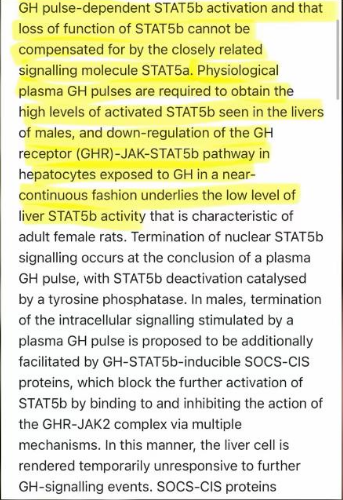
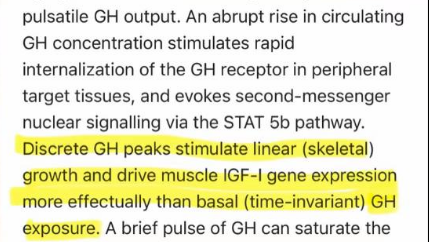
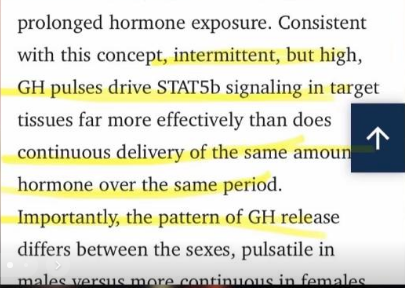
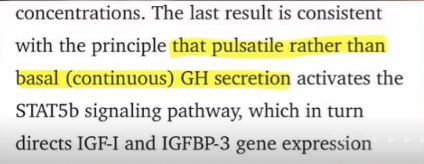
may you guys here should learn somethings about pulsatile hghYeah take something that boosts natural GH production even though you have ZERO natural production from pinning exogenous HGH
ignore this retard
why would you take a GH releasing peptide, then inject GH?
the amount of retards on the forum nowadays
DISCUSS WITH A WALL AND YES IT AI ASSISTEDexplain
use ctrl + shift + v next time nigga i cant read the black textmay you guys here should learn somethings about pulsatile hgh
View attachment 4936560View attachment 4936563View attachment 4936565View attachment 4936568
gh administration lower endogenous production dose-dependitly via increasing circularting IGF-1 which in turn promotes more Somastostatin that directly affects Somatotrophes in the pituary. However, GHRELIN via GHS-R1A activation locally antagonizes Somastostatin in the pituary.
Additionally, it is common knowledge that GHRPs and GHRHs produce synergistic GH increases through different protein kinase pathways, but GHRH also decreases GHS-R1A desensitization.
Moreover, GHS-R1A and GHRH-R are present in muscle, bone and cartilage and have GH-R and IGF-1/2R sensitizing properties. GHRH-R also decreases the STAT5/3 transcription ratio in the liver which can keep syst. IGF-1 in the high phys/ low supra range even on high dose rHGH (anecdotally).
Therefore, not only is Somatostatin very effectively inhibited, but also disproportionally lower than with GH only which further spirals the cascade upwards because the GHS yield even more GH -> perpetuum mobile
1. The Synergistic Effect (1+1=3) (AI cover)
GHRPs (Growth Hormone Releasing Peptides) and GHRHs (Growth Hormone Releasing Hormones) work on different receptors in the pituitary gland.
- GHRH initiates the "pulse" of Growth Hormone.
- GHRP amplifies that pulse and inhibits Somatostatin (the hormone that tells your body to stop producing GH).
By using both, you are simultaneously pressing the gas pedal and cutting the brake lines.
2. Preventing Desensitization
Usually, when you overstimulate a receptor, the body shuts it down to protect itself (desensitization). The text claims that GHRH actually helps keep the GHS-R1A receptors sensitive, meaning the drugs continue to work effectively for longer periods without needing higher doses.
3. Local Sensitivity in Tissues
The text mentions that these receptors are present directly in muscle, bone, and cartilage. This suggests that the substances don't just work through the liver; they make the target tissues themselves more "hungry" or sensitive to the IGF-1 and GH circulating in the blood.
4. The "Perpetuum Mobile" Cascade
By lowering Somatostatin levels disproportionately compared to using exogenous GH alone, the body stays in a state where it is constantly primed to release more of its own hormone. This creates a feedback loop (the "cascade") that keeps IGF-1 levels at the high end of the physiological range or even slightly above (supraphysiological), maximizing recovery and growth.
With regards to PK: In rat studies, pulsatile GH administration was superior (3-5x IGF-1mRNA). However, in human administration and pathophysiology (acromegaly), even physiological amounts of continuous GH yield higher hepatic and local IGF-1mRNA. My hypothesis is that ID8835 is a species-specific AUC integrater; in rats time-weighed (extended STAT5B is more detrimental than Cmax) and in humans amplitude-weighed, making the exactly opposite signaling patterns optimal for each species
As already implied, the goal is to create an insane AUC of GH with extremely potent, self-potentiating local IGF-1 signaling:
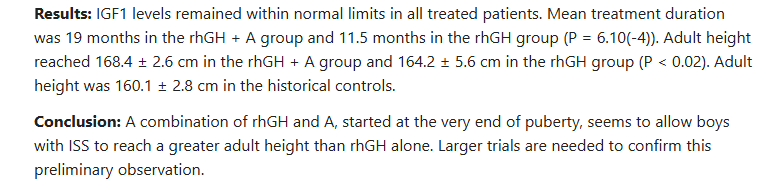
- rHGH >= 0,07 mg/kg/day (if allometrically scaled x<1; 80 kg bw -> 16,8 IU/day) showed statistically significant increases in under a year of administration of Tanner 3+ boys (Rothenbuhler et al 2015.). May be titrated to or over 0,1 mg/kg/day (e.g. 80 kg bw -> 24 IU/day)"
View attachment 4936634
DISCUSS WITH A WALL AND YES IT AI ASSISTED
1. The Synergistic Effect (1+1=3) (AI ASSISTED)use ctrl + shift + v next time nigga i cant read the black text

But exogenous hgh can shutdown the bodys own production (negative feedback system)no its not comparable hgh is a lot better
i took cjc ipa, it does increase igf1 ultimately but the bottom line is that hgh is far more effective
no it doesnt niggaBut exogenous hgh can shutdown the bodys own production (negative feedback system)
Exogenous human growth hormone (HGH) suppresses your body’s natural production through negative feedback. Normally, the brain (via the hypothalamus and pituitary gland) releases GH in pulses, but when external HGH is present, it signals that there’s already enough. This reduces secretion of hormones like GHRH (which stimulates GH) and increases somatostatin (which inhibits it). Over time, the pituitary gland decreases its own GH output. The longer and higher the dosing, the stronger this shutdown effect becomes.no it doesnt nigga
it creates desensitisation not shutdown of natural production
Once exogenous HGH is stopped, the feedback signal clears and the pituitary resumes pulsatile GH release, usually within a week or so.Exogenous human growth hormone (HGH) suppresses your body’s natural production through negative feedback. Normally, the brain (via the hypothalamus and pituitary gland) releases GH in pulses, but when external HGH is present, it signals that there’s already enough. This reduces secretion of hormones like GHRH (which stimulates GH) and increases somatostatin (which inhibits it). Over time, the pituitary gland decreases its own GH output. The longer and higher the dosing, the stronger this shutdown effect becomes.
It is as if you would have to use as much hgh to cover your bodies baseline hgh + the wanted surplus. Using a ghrh or ghrp is more worth itOnce exogenous HGH is stopped, the feedback signal clears and the pituitary resumes pulsatile GH release, usually within a week or so.
knowing this, there is 0 reason to not use hgh
shit is not the same as testosterone suppression
"more worth it" what does this meanIt is as if you would have to use as much hgh to cover your bodies baseline hgh + the wanted surplus. Using a ghrh or ghrp is more worth it
dnr nigga1. The Synergistic Effect (1+1=3) (AI ASSISTED)
GHRPs (Growth Hormone Releasing Peptides) and GHRHs (Growth Hormone Releasing Hormones) work on different receptors in the pituitary gland.
- GHRH initiates the "pulse" of Growth Hormone.
- GHRP amplifies that pulse and inhibits Somatostatin (the hormone that tells your body to stop producing GH).
By using both, you are simultaneously pressing the gas pedal and cutting the brake lines.
2. Preventing Desensitization
Usually, when you overstimulate a receptor, the body shuts it down to protect itself (desensitization). The text claims that GHRH actually helps keep the GHS-R1A receptors sensitive, meaning the drugs continue to work effectively for longer periods without needing higher doses.
3. Local Sensitivity in Tissues
The text mentions that these receptors are present directly in muscle, bone, and cartilage. This suggests that the substances don't just work through the liver; they make the target tissues themselves more "hungry" or sensitive to the IGF-1 and GH circulating in the blood.
4. The "Perpetuum Mobile" Cascade
By lowering Somatostatin levels disproportionately compared to using exogenous GH alone, the body stays in a state where it is constantly primed to release more of its own hormone. This creates a feedback loop (the "cascade") that keeps IGF-1 levels at the high end of the physiological range or even slightly above (supraphysiological), maximizing recovery and growth.
Its more expensive"more worth it" what does this mean
if you want maximum results then choose HGH
peptides do not compare to hgh


