SQL2VD
Suki Suki Daisuki!
- Joined
- Jun 23, 2025
- Posts
- 1,550
- Reputation
- 1,686
I know what you may be thinking, "muh raw milk is cope", but you're imagining this thread to be one saying how raw milk is this miracle milk that turns you into Prime Arnold Schwarzenegger overnight. You are mistaken.
Pasteurised milk is chilled raw milk that is briefly heated to temperatures sufficient to kill bacteria. The milk is cooled, mixed with appropriate milkfat content (which is removed during heating), homogenised to prevent separation, and often fortified with Vitamins A and D before being packaged for sale.¹
Raw milk is a living food, with claimed nutritional and biological properties. It usually comes from cows, goats, and sheep, or other domesticated ruminants that have been grass-fed, and it could vary between individual animals from the same specie ... . Raw milk consists of unpasteurised and unhomogenised milk and often considered a "complete food" —since it contains natural enzymes, fatty acids, vitamins, and minerals. Common descriptors encompass "fresh," "real," "alive," "creamy," "full of flavours," "rich," "distinct," "satisfying," "tastier," and "delicious"; and it is surely a food possessing a superior flavour and texture relative to pasteurised and homogenised milk.²
Now that we know the differences between Raw and Pasteurised milk, which is safest to drink?
Raw Milk Institute (RAWMI) completed a study on their listed farmers and claim that they are surpassing pasteurised milk standards. In analysing all of the test data from RAWMI Listed farmers over the last 14 years, they found that the following for raw milk that was to be used for direct human consumption.³
Coliforms
- 11,826 total tests
- Average of all tests = 2.1 cfu/mL
- 11,470 total tests
- Average of all tests = 960 cfu/mL
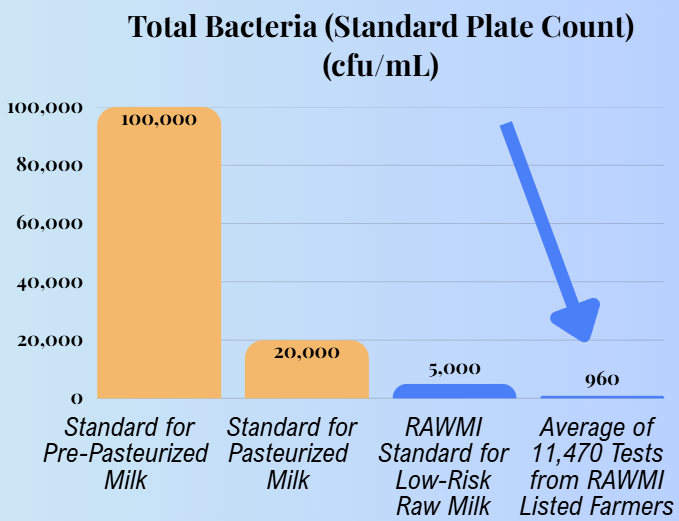
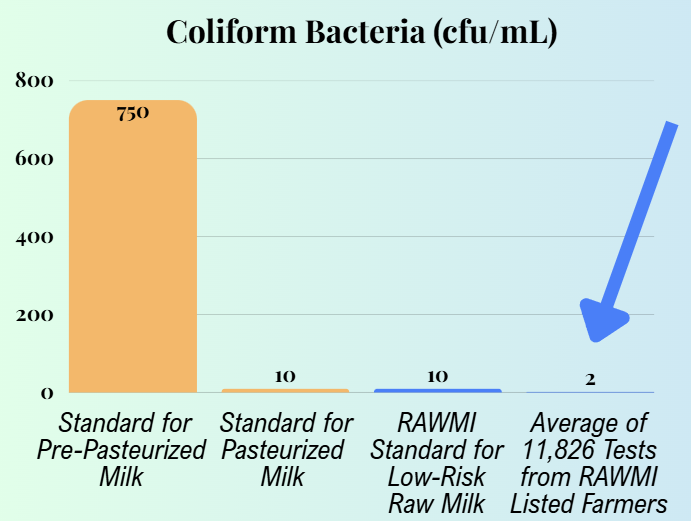
The study shows us the total bacteria averages from RAWMI Listed farmers. On average, raw milk purchased from RAWMI Listed farms is safer than pasteurised.
"But SQL2VD, this is only for RAWMI Listed farms!" Good looking out, little Timmy.
I have another article that was produced in 1997, this time it tells us of a study performed in the Camembert region of Normandy.
Raw milk from 27 farms was sampled over 6 months for bacteria groups. Total bacterial counts and somatic cell counts were measured. They found that the bacterias most common were; Pseudomonas: about 2,000 cfu/mL, Lactococci: about 760 cfu/mL, Micrococcaceae: about 720 cfu/mL. They found lactic acid bacteria in all samples, meaning they were always present. They also looked closely at some hygiene-indicator and pathogen groups such as Coliforms, Staphylococcus aureus and E. coli. They found that Coliforms were found in most samples, but 84% of samples had fewer than 100 cfu/mL, which is relatively low. Staph. aureus was present in 62% of the milk samples with an average of 410 cfu/mL. About 80% of milk supples had 10 or fewer E. coli cfu/mL, which is also comparatively low.⁴
Out of all the milk samples tested:
- Salmonella was found in 2 samples (about 2.9%)
- Listeria monocytogenes in 4 samples (about 5.8%)
- Yerisinia enterocolitica in 25 samples (about 36%)
- Campylobacter in 1 sample (about 1.4%)
I'm unsure of how to conclude this, but I will just say it as it is. Raw milk and pasteurised milk isn't all that different in terms of dangers and benefits, they both vary depending on the source/farm. It is up to you guys on which you prefer, and I will allow you guys to research into the benefits of either one in your spare time.