pentaChad_doomer
refinement
- Joined
- Jul 13, 2025
- Posts
- 598
- Reputation
- 525
An Oxford-led genetic study indicates that the eastern Iron Age Saka–Scythian genetic legacy shows stronger continuity among Kyrgyz and related Siberian–Central Asian populations than among modern Tajiks or Iranians
Ancient DNA from eastern Saka–Scythian burials in the Altai, Tuva, eastern Kazakhstan, and the Minusinsk Basin shows that many of these groups carried downstream branches of R1a-Z93, particularly within the Z2124/Z2125 cluster, including lineages such as R-S23592.
These specific paternal subclades today are found at higher frequencies among historically related Siberian and Central Asian populations — including Khakas, Shors, Southern Altaians, and the Tian Shan Kyrgyz — than among modern Iranian-speaking populations such as Tajiks or Persians.
The Dai et al. study further shows that:
•Tajik populations derive most of their ancestry from Bronze Age BMAC + Andronovo-related sources, with additional Tarim_EMBA1 input.
•Kyrgyz populations show stronger genetic affinity to Iron Age and Historical Era eastern steppe groups, including Saka–Tian Shan and Xiongnu-related populations.
Thus, while Tajiks clearly possess Steppe-derived ancestry through Andronovo-related expansions, the eastern Iron Age Scytho-Siberian genetic horizon appears to have left a more pronounced legacy among Kyrgyz and certain Siberian steppe populations.
Modern Genetic Continuity
According to data from the FamilyTreeDNA database, the lineage associated with the “Golden Man” from Eleke Sazy and related Saka groups shows 71 modern Y-DNA matches distributed across the following countries:
• 48 — Kyrgyzstan (including KAF President)
• 3 — Altai Krai / Altai Republic (Russia)
• 3 — Kazakhstan
• 2 — Bulgaria
• 2 — Turkey
• 1 each — United Kingdom, United States, Belarus, Lithuania, Portugal, and Germany
• 0 — Tajikistan
• 0 — Iran
Taken together, these results suggest a strong pattern of eastern steppe continuity between Early Iron Age Saka populations and modern Kyrgyz groups, positioning the Kyrgyz among the principal cultural and genetic heirs of the eastern Scythian world.
© “The Genetic Echo of the Tarim Mummies in Modern Central Asians” byShan-Shan Dai et al.
Over for that iranian/tajik/afghan larpers who claimed scythian status
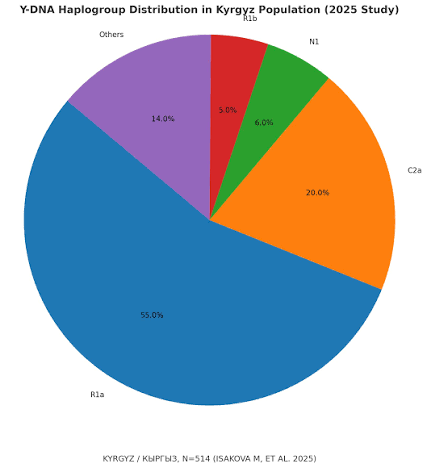
Ancient DNA from eastern Saka–Scythian burials in the Altai, Tuva, eastern Kazakhstan, and the Minusinsk Basin shows that many of these groups carried downstream branches of R1a-Z93, particularly within the Z2124/Z2125 cluster, including lineages such as R-S23592.
These specific paternal subclades today are found at higher frequencies among historically related Siberian and Central Asian populations — including Khakas, Shors, Southern Altaians, and the Tian Shan Kyrgyz — than among modern Iranian-speaking populations such as Tajiks or Persians.
The Dai et al. study further shows that:
•Tajik populations derive most of their ancestry from Bronze Age BMAC + Andronovo-related sources, with additional Tarim_EMBA1 input.
•Kyrgyz populations show stronger genetic affinity to Iron Age and Historical Era eastern steppe groups, including Saka–Tian Shan and Xiongnu-related populations.
Thus, while Tajiks clearly possess Steppe-derived ancestry through Andronovo-related expansions, the eastern Iron Age Scytho-Siberian genetic horizon appears to have left a more pronounced legacy among Kyrgyz and certain Siberian steppe populations.
Modern Genetic Continuity
According to data from the FamilyTreeDNA database, the lineage associated with the “Golden Man” from Eleke Sazy and related Saka groups shows 71 modern Y-DNA matches distributed across the following countries:
• 48 — Kyrgyzstan (including KAF President)
• 3 — Altai Krai / Altai Republic (Russia)
• 3 — Kazakhstan
• 2 — Bulgaria
• 2 — Turkey
• 1 each — United Kingdom, United States, Belarus, Lithuania, Portugal, and Germany
• 0 — Tajikistan
• 0 — Iran
Taken together, these results suggest a strong pattern of eastern steppe continuity between Early Iron Age Saka populations and modern Kyrgyz groups, positioning the Kyrgyz among the principal cultural and genetic heirs of the eastern Scythian world.
© “The Genetic Echo of the Tarim Mummies in Modern Central Asians” byShan-Shan Dai et al.
Over for that iranian/tajik/afghan larpers who claimed scythian status