D
Deleted member 439
what would jordan do?
- Joined
- Oct 20, 2018
- Posts
- 3,292
- Reputation
- 6,630
Learned Helplessness : The sense that nothing that you do really has any effect on what is happening in your life.
The concept of learned helplessness was discovered accidentally by psychologists Martin Seligman and Steven F. Maier. They had initially observed helpless behavior in dogs that were classically conditioned to expect an electrical shock after hearing a tone.
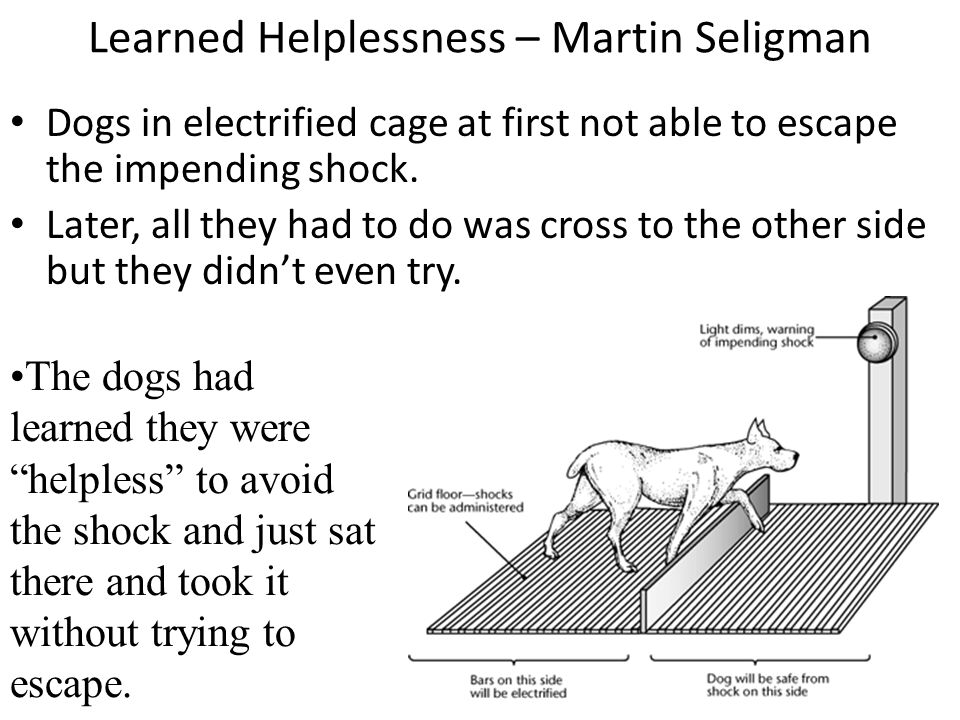
Later, the dogs were placed in a shuttlebox that contained two chambers separated by a low barrier. The floor was electrified on one side, and not on the other. The dogs previously subjected to the classical conditioning made no attempts to escape, even though avoiding the shock simply involved jumping over a small barrier.
To investigate this phenomenon, the researchers then devised another experiment.
The dogs were then placed in a shuttlebox. Dogs from the first and second group quickly learned that jumping the barrier eliminated the shock. Those from the third group, however, made no attempts to get away from the shocks. Due to their previous experience, they had developed a cognitive expectation that nothing they did would prevent or eliminate the shocks.
How can we relate this to us?
Many of us are here because we have struggled with LTRs and relationships in the past. Just like the dogs in group 3, happiness and dating seems out of control. In fact that is the fundamental premise of the blackpill, that it began at birth and its over for most of us. Years of failure, rejection and heartbreak lead to this phenomenon of learned helpnessness occuring for us. The belief gym is cope, personality is cope, blackpill is cope are all examples of learned helplessness. Just like the dogs in the cage, we have convinced ourselves that nothing we can do will get us out of our situation.
Symptoms of learned helplessness include:
When you are able to succeed at easy tasks, hard tasks feel possible to accomplish. When you are unable to succeed at small tasks, everything seems harder. While its not possible to fix this easily, there are things you can do to unlearn helplessness. Start with small tasks which you can accomplish and succeed in. Suffer because you want to not because you have to. Helplessness manifests itself in all areas of life, the danger is that its a self-fullfilling prophecy. When you repeatedly tell yourself you cant do something you probably wont be able to do it. Remember that you feel this way due to a well studied psychological phenomenon, not because youre truly helpless.
What makes you feel out of control? There are somethings which truly might be out of your control, but others are a result of learned helplessness. Make a list of these things and see which ones you can conquer. Prove to yourself that you can overcome obsticles put in your path.
The concept of learned helplessness was discovered accidentally by psychologists Martin Seligman and Steven F. Maier. They had initially observed helpless behavior in dogs that were classically conditioned to expect an electrical shock after hearing a tone.
Later, the dogs were placed in a shuttlebox that contained two chambers separated by a low barrier. The floor was electrified on one side, and not on the other. The dogs previously subjected to the classical conditioning made no attempts to escape, even though avoiding the shock simply involved jumping over a small barrier.
To investigate this phenomenon, the researchers then devised another experiment.
- In group one, the dogs were strapped into harnesses for a period of time and then released.
- In group two, the dogs were placed in the same harnesses but were subjected to electrical shocks that could be avoided by pressing a panel with their noses.
- In group three, the dogs received the same shocks as those in group two, except that those in this group were not able to control the shock. For those dogs in the third group, the shocks seemed to be completely random and outside of their control.
The dogs were then placed in a shuttlebox. Dogs from the first and second group quickly learned that jumping the barrier eliminated the shock. Those from the third group, however, made no attempts to get away from the shocks. Due to their previous experience, they had developed a cognitive expectation that nothing they did would prevent or eliminate the shocks.
How can we relate this to us?
Many of us are here because we have struggled with LTRs and relationships in the past. Just like the dogs in group 3, happiness and dating seems out of control. In fact that is the fundamental premise of the blackpill, that it began at birth and its over for most of us. Years of failure, rejection and heartbreak lead to this phenomenon of learned helpnessness occuring for us. The belief gym is cope, personality is cope, blackpill is cope are all examples of learned helplessness. Just like the dogs in the cage, we have convinced ourselves that nothing we can do will get us out of our situation.
Symptoms of learned helplessness include:
- Frustration
- Giving up
- Lack of effort
- Low self-esteem
- Passivity
- Poor motivation
- Procrastination
When you are able to succeed at easy tasks, hard tasks feel possible to accomplish. When you are unable to succeed at small tasks, everything seems harder. While its not possible to fix this easily, there are things you can do to unlearn helplessness. Start with small tasks which you can accomplish and succeed in. Suffer because you want to not because you have to. Helplessness manifests itself in all areas of life, the danger is that its a self-fullfilling prophecy. When you repeatedly tell yourself you cant do something you probably wont be able to do it. Remember that you feel this way due to a well studied psychological phenomenon, not because youre truly helpless.
What makes you feel out of control? There are somethings which truly might be out of your control, but others are a result of learned helplessness. Make a list of these things and see which ones you can conquer. Prove to yourself that you can overcome obsticles put in your path.
Last edited: