nuke84
Iron
- Joined
- Nov 8, 2025
- Posts
- 58
- Reputation
- 44
Table of contents
- Introduction
- Joint Support
- Enhanced Collagen Metabolism
- Increased Synovial Joint Fluid Balance
- Left Ventricular Hypertrophy
- Sexual Dysfunction
- Impaired Learning and Memory
- Hematopoiesis
- Blood Boosting
- Ergogenic
- Vascularity
- Conclusion
Introduction
Nandrolone (17β-hydroxyestr-4-ene-3-one; 19-nortestosterone; 19-nor-4-androsten-17β-ol-3-one; Deca durabolin®; NPP), a member of the androst-4-ene-3-one class of anabolic-androgenic steroids (AAS), is aromatized to estradiol (E2) at 20% the rate of T and 5α-reduced to dihydronandrolone (DHN; 17β-hydroxy-5α-estran-3-one), a weak AR ligand, thus its action in CNS, scalp, and sex tissue is relatively weakened.Nandrolone is an AAS that confers particular benefits for joints and sinews by its procollagenous effects, increasing type I collagen deposition, but by this same mechanism inducing cardiac tissue remodeling. Nandrolone, too, affects dopamine metabolism unfavorably, by increasing serum homovanillic acid (HVA), indicative of net dopamine breakdown. This results in unfavorable effects on mood, learning, memory, and sexual function.
Nandrolone is regarded as a classical anabolic that is suited to bulking phases where the bodybuilder is keen to accrue quality mass. The particular aesthetic aspects of nandrolone’s classical visual look (“three-dimensional,” “lean,” or “quality muscle”) can only be hypothesized to relate to its effects on collagen, perhaps affecting the sarcoplasm of the muscle fiber, enzymatically and in the mode of a reduced aromatization to estradiol (E2). It certainly is particularly hematopoeitic as well, perhaps relating to its qualitative effects on vascularity.
Joint Support
Joints are the nexus at which two bones meet, about which tendons pull muscle, and ligaments connect bone to bone, to move about the joint’s articulation to provide locomotion. Plausible mechanisms for nandrolone’s renowned joint support (e.g., during heavy lifting) are, firstly, increased collagen deposition, and secondly, increased synovial fluid, in joints.Enhanced Collagen Metabolism
Since fibrous components provide a lattice of pliable support to joint, including tendons, ligaments, and cartilage, enhanced collagen metabolism provides support to the joint. Nandrolone increases matrix type I collagen deposition in tendon. Type I collagen is associated with bone, tendon, and ligament metabolism. Nandrolone likely regulates extracellular matrix remodeling via type I collagen deposition into the soft tissues (tendon, ligament) and collagenous ends of bone (periosteum) in a manner that can be of benefit for joints tasked with heavy lifting in the weight room.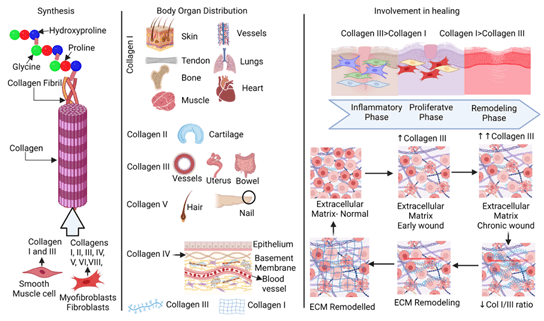
Increased Synovial Joint Fluid Balance
Nandrolone activates the renin-angiotensin-aldosterone system (RAAS), increasing angiotensin I-converting enzyme (ACE) in blood, and AT₁-R (angiotensin II) and mineralocorticoid receptor (MR) mRNA expression in the heart. The classical arm of the RAAS includes angiotensinogen, renin, angiotensin I, angiotensin II, aldosterone, and AT₁-R. The AT₁-R stimulates water retention. Likewise, the MR turns on water retention, and is activated by aldosterone – the MR is otherwise known as the mineralocorticoid receptor. Notably, the RAAS, besides regulating water balance, is also involved in regulating connective tissue cell growth, and the metabolism of loose and dense connective tissue and sites of tissue repair. Joints are comprised of these connective tissues, bone, tendon, ligaments. Nandrolone likely increases synovial fluid balance via the RAAS’s effects on connective tissue growth and metabolism.Left Ventricular Hypertrophy
RAAS activation is associated with vasoconstriction, cardiac hypertrophy (i.e., left ventricular hypertrophy; LVH), and fibrosis that causes myocardial infarction. Nandrolone blocks the adaptive cardioprotective benefit of aerobic-endurance training in a model of heart disease, and causes cardiac hypertrophy via increased collagen deposition. This growth to left ventricle heart tissue is preventable by AT₁-R blockade (losartan) and/or MR blockade (spironolactone), according to this data.The duality of these effects – on the one hand, joint support – and on the other, left ventricular hypertrophy – is yet another case where the user must weigh the benefit of robust joints to support heavy and voluminous loading versus the harms to the heart, however seemingly invisible and reversible they might be.
Sexual Dysfunction
Nandrolone notoriously causes sexual dysfunction with such consistency that the phenomenon is aptly dubbed, “Deca dick.” Nandrolone increases serum homovanillic acid (HVA) in man, reflecting increased dopamine metabolism (i.e., breakdown). Erotic stimuli of an audiovisual nature (i.e., pornography) decreases HVA, reflecting increased dopamine activity associated with sexual arousal.Impaired Learning and Memory
The neurotransmitter dopamine integrates learning and motivation. Experimental evidence suggests that nandrolone impairs learning by reducing dopamine D(1)- receptor number in the nucleus accumbens of the brain, part of the striatum. Similar evidence suggests that nandrolone impairs spatial memory and reduces IGF-I in the hippocampus, or memory center, of the brain. Interestingly, this same evidence suggests that growth hormone (GH) reverses this effect – it improves spatial memory and increases IGF-I in the hippocampus.Hematopoiesis
Blood Boosting
Nandrolone is remarkably erythropoietic, meaning stimulatory of red cell mass, or “blood boosting.” Indeed, it is more potently hematinic than oxymetholone (Anadrol), that has long been used clinically for that effect. Mechanistically, the effect on red cell mass is understood to occur through stimulation of erythopoietin (EPO) production and red blood cell secretion by the bone marrow, with hepcidin and erythroferrone involvement, implicating iron metabolism in a manner that “pushes” yet further the bone marrow’s production of red blood cells, called erythrocytes.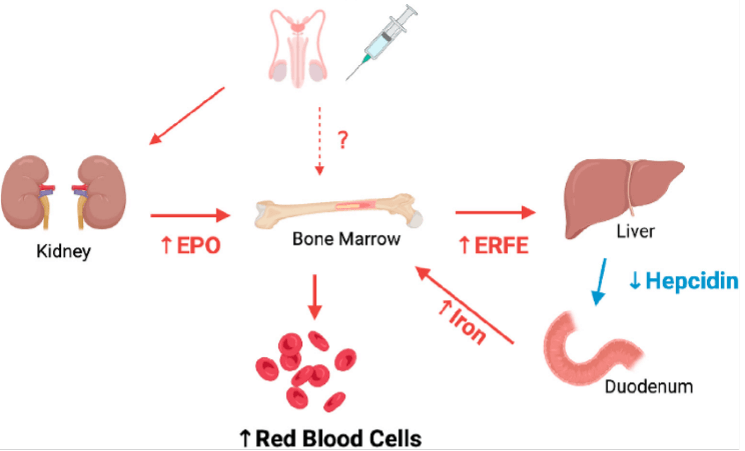
Erythrocytosis, or polycythymia, is the condition that is associated with hematocrit levels above than 54% or hemoglobin above 17.5 g/dL. Hemoglobin is the binding protein in erythrocytes that binds to oxygen (O₂); and hematocrit is the percentage (%) of blood volume occupied by erythrocytes. Essentially, then, nandrolone particularly enhances the oxygen-carrying capacity of the blood.
It’s important to note that despite theoretical risks for thromboembolic events like heart attacks or strokes, the elevations that occur to hematocrit/hemoglobin in patients treated by testosterone replacement therapy (TRT) have to date never been found to have clinical significance in any randomized-controlled trial; nor have even minor instances, like deep vein thromboses or transient ischemic attacks been observed.
Ergogenic
Through the lens of enhanced performance, hematopoietic effects are beneficial. The potency of nandrolone to oxygenate the blood means that it increases VO₂max, or maximal O₂ uptake. VO₂max is a measure of the absolute quantity of O₂ that can be used at the cellular level by your body’s tissues during exercise. The O₂ demand of exercising muscle relates to the mass of that muscle and exercise intensity, and so by increasing the quantity of O₂ in blood, aerobic capacity is enhanced such that perceived effort goes down and tolerable training volumes go up. Moreover, since aerobic respiration is involved in recovery from training with heavy weights, this unfairly maligned “side” effect of nandrolone might fairly be viewed as a blessing in disguise!Vascularity
AR is expressed in both endothelial & vascular smooth muscle cells. Endothelial cells modulation blood coagulation in the vasculature, secreting vasoactive compounds including nitric oxide (NO). Through its rapid nongenomic pathways (e.g., PKA, PKC, MAPK), nandrolone can stimulate rapid vasodilation via endothelium -dependent and -independent mechanisms. The former results from increased NO bioavailability via AR-mediated eNos activation and release of vasodilatory factors into vascular smooth muscle cells.Through the lens of enhanced physique, activation of the RAAS and increased red cell mass converge in the vasculature, causing the “vein popping” effect associated with nandrolone. By activating the RAAS to increase blood volume, stimulating erythropoiesis by increasing EPO and iron bioavailability to increase the density of red blood cells that deliver O₂ to the body’s tissues, and by vasoactive effects on the endothelial cells of the vasculature, nandrolone enhances vascularity.