



greekgymcel
Iron
- Joined
- Jul 4, 2026
- Posts
- 1
- Reputation
- 1
New here, wanted to do a few explanations of concepts in the gym, workout advice and I will drop my split.
STAGE 1: Sets & Repetitions
Sets and repetitions are actually very decisive for muscle growth and yes it does make a huge difference.
Why it matters: Sets and reps matter because they decide how your body adapts to exercises. Varying the number of repetitions and sets changes the stress on your muscles and nervous system, making hypertrophy and endurance the main factors
How many should I do?: It depends completely on what you're targeting, not all people train for aesthetics (I feel like I'm BSing since most gymcels train for aesthetics), but in general you've got to descend yourself into 2 factors.
Once you've decided what category you descend into, you can follow the advice for the specific category.
Hypertrophy: Focus on progressive overload (explained below), and lower overall sets and repetitions. You should aim for heavier weight and going to absolute
failure, that mechanical tension is actually what builds muscle.
-> Example: 4 sets of 30 repetitions / 6 sets of 20 repetitions
STAGE 2: Splits
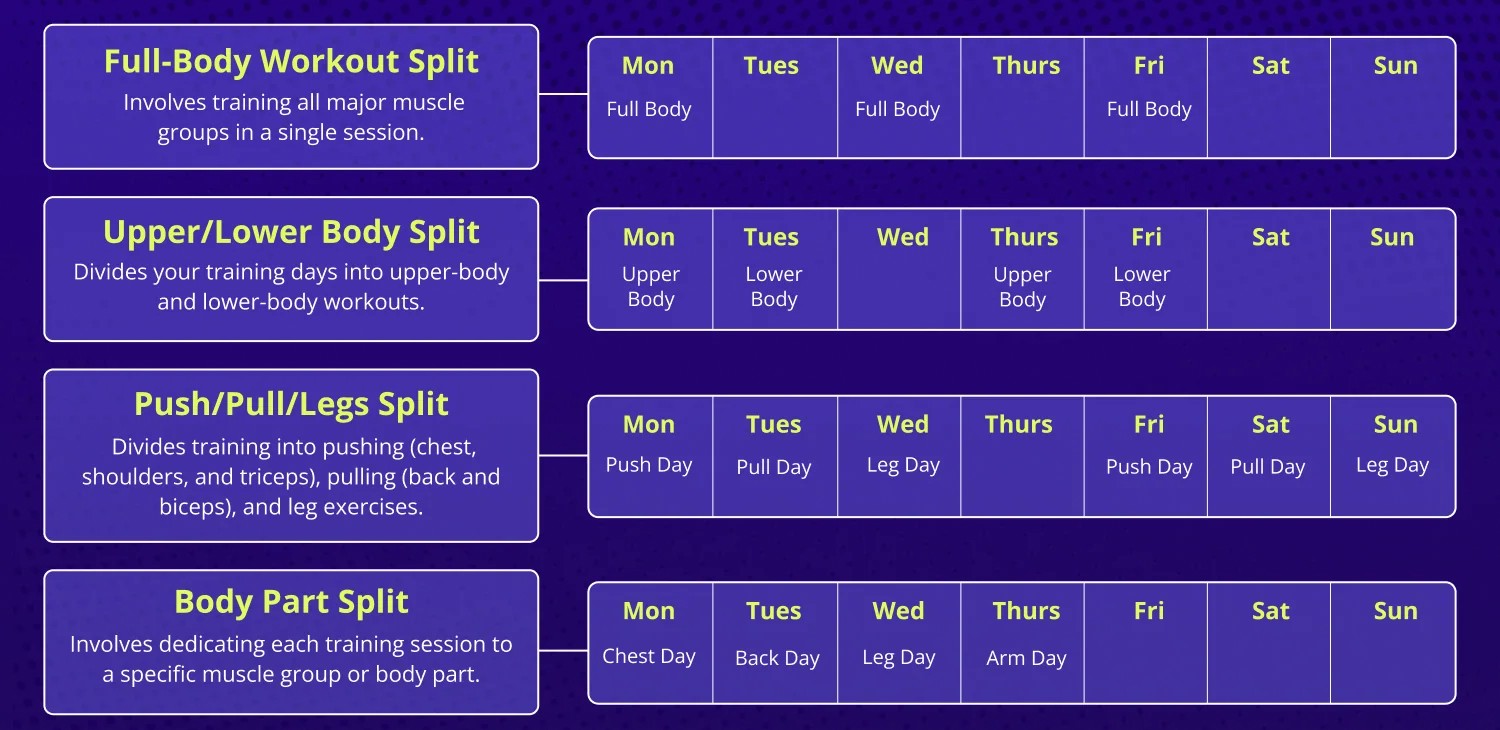
A split is a schedule that organizes your weekly exercises. Instead of working random muscle groups in every session, you target specific muscle groups or movement patterns on different days.
Why it matters: Splits are insanely important for muscle growth, rejecting to use one results to poor training volume, insufficient recovery, or low training frequency, a chaotic or missing split often results in useless volume, excessive fatigue and neglected muscle groups.
Examples that I borrowed off of google:
Important:
When doing a split 2 things are very important.
-> Frequency: is how frequently you train muscle groups, 2x a week is minimum and is optimal. While 3x a week is excellent but can cause built-up fatigue for beginners.
-> Session overlap: Accidentally targeting a muscle group on a day it's not trained on, this produces fatigue. For example hitting your chest and back but doing compound movements mostly, this also targets muscles on the arm which causes fatigue on an arm and shoulder day.
Recommendations: I recommend for beginners splits like Upper/Lower and Push/Pull/Legs. But as soon as you reach intermediate I heavily advise 3x frequency FBEOD (Full Body Every Other Day), the other splits are still fantastic though.
STAGE 3: Exercises
You can have the best split in the world and still make zero progress if your exercise selection is garbage.
There are hundreds of exercises for basically every muscle, but that does NOT mean every exercise is equally good.
Why it matters: The exercise you choose determines which muscles are doing most of the work, how easily you can progressively overload it, how stable you are, and how much fatigue you generate.
A good exercise should ideally have:
-> Good stability: You don't want half of your energy going into trying not to fall over.
-> Good range of motion: The muscle should be able to stretch and contract properly.
-> Progressive overload potential: You should be able to increase weight, reps, or improve execution over time.
-> Good stimulus-to-fatigue ratio: You want as much muscle stimulus as possible without feeling way too much fatigue.
-> Good individual comfort: If an exercise constantly causes joint pain, there is no reason to force yourself to use it just because some random dumbass said it is the best exercise.
Compound vs Isolation:
As I explained above, compounds use multiple muscles at once while isolations focus much more heavily on one muscle.
Compound examples:
A bench press is NOT automatically better than a cable fly just because it uses more muscles.
If I'm trying to grow my chest, a bench press is great because I can load it heavily and progressively overload it.
But if I already have enough pressing volume and want more chest stimulus without adding a ton of triceps and front delt fatigue, an isolation movement can be very useful.
Exercise selection:
When building a split, you should not just throw 10 exercises together you saw on tiktok like that african curls bullshit.
You want to cover the muscles you actually are targeting while avoiding unnecessary overlap.
For example:
Doing bench press → incline bench → dips → shoulder press → front raises, is going to give your front delts and triceps alot of stress and built up fatigue.
STAGE 4 (FINAL): Failure & RIR
Failure: The point where you cannot complete another repetition with proper technique.
There are also different levels of how close you are to failure.
RIR = Reps In Reserve
RIR basically means how many good reps you could have done
So:
0 RIR: Absolute failure.
1 RIR: You probably had one good rep left.
2 RIR: You probably had two good reps left.
3 RIR: You probably had three good reps left.
And so on.
Anyways that's it! hope you gymcels found my first post helpful, I will be posting more thank you.
STAGE 1: Sets & Repetitions
Sets and repetitions are actually very decisive for muscle growth and yes it does make a huge difference.
Why it matters: Sets and reps matter because they decide how your body adapts to exercises. Varying the number of repetitions and sets changes the stress on your muscles and nervous system, making hypertrophy and endurance the main factors
Disclaimer: Training for raw strength is bs if you think it means "functional strength". Muscle = Strength, Raw strength just means you do not care about your body fat percentage while training.
How many should I do?: It depends completely on what you're targeting, not all people train for aesthetics (I feel like I'm BSing since most gymcels train for aesthetics), but in general you've got to descend yourself into 2 factors.
- Hypertrophy: Training solely on building muscle as soon as possible.
- Endurance: Training for how long your muscle can stay active, useful in sports like soccer and basketball.
Once you've decided what category you descend into, you can follow the advice for the specific category.
Hypertrophy: Focus on progressive overload (explained below), and lower overall sets and repetitions. You should aim for heavier weight and going to absolute
failure, that mechanical tension is actually what builds muscle.
Endurance: Focus on slightly higher sets and way more repetitions, you should be doing lighter weights but not too light that it is incredibly easy.Progressive overload: is gradually increasing weight over a period of time, you can do it correctly by doing lower reps and going to absolute failure until you can comfortably do higher repetitions (8-10), then switching to a heavier weight and repeating the process. This forces your muscles to grow and adapt much faster than normal.
-> Example: 4 sets of 30 repetitions / 6 sets of 20 repetitions
STAGE 2: Splits
A split is a schedule that organizes your weekly exercises. Instead of working random muscle groups in every session, you target specific muscle groups or movement patterns on different days.
Why it matters: Splits are insanely important for muscle growth, rejecting to use one results to poor training volume, insufficient recovery, or low training frequency, a chaotic or missing split often results in useless volume, excessive fatigue and neglected muscle groups.
Examples that I borrowed off of google:
Important:
When doing a split 2 things are very important.
-> Frequency: is how frequently you train muscle groups, 2x a week is minimum and is optimal. While 3x a week is excellent but can cause built-up fatigue for beginners.
-> Session overlap: Accidentally targeting a muscle group on a day it's not trained on, this produces fatigue. For example hitting your chest and back but doing compound movements mostly, this also targets muscles on the arm which causes fatigue on an arm and shoulder day.
Compound movements: A compound movement is when you use multiple muscle groups on the side to help the main muscle group you're targeting to lift heavier, this builds more muscle.
Isolation movements: An isolation movement is when you isolate one single muscle group to lift assuring it does not overlap other muscles.
Recommendations: I recommend for beginners splits like Upper/Lower and Push/Pull/Legs. But as soon as you reach intermediate I heavily advise 3x frequency FBEOD (Full Body Every Other Day), the other splits are still fantastic though.
STAGE 3: Exercises
You can have the best split in the world and still make zero progress if your exercise selection is garbage.
There are hundreds of exercises for basically every muscle, but that does NOT mean every exercise is equally good.
Why it matters: The exercise you choose determines which muscles are doing most of the work, how easily you can progressively overload it, how stable you are, and how much fatigue you generate.
A good exercise should ideally have:
-> Good stability: You don't want half of your energy going into trying not to fall over.
-> Good range of motion: The muscle should be able to stretch and contract properly.
-> Progressive overload potential: You should be able to increase weight, reps, or improve execution over time.
-> Good stimulus-to-fatigue ratio: You want as much muscle stimulus as possible without feeling way too much fatigue.
-> Good individual comfort: If an exercise constantly causes joint pain, there is no reason to force yourself to use it just because some random dumbass said it is the best exercise.
Compound vs Isolation:
As I explained above, compounds use multiple muscles at once while isolations focus much more heavily on one muscle.
Compound examples:
Isolation examples:Bench press → Chest + triceps + front delts
Pull-ups → Lats + biceps + upper back
Squat → Quads + glutes + adductors
Overhead press → Front delts + triceps + other shoulder musculature
This doesn't mean compounds are just better because they activate more muscle growth.Lateral raise → Side delts
Leg extension → Quads
Leg curl → Hamstrings
Preacher curls → Biceps
Overhead extensions → Triceps
A bench press is NOT automatically better than a cable fly just because it uses more muscles.
If I'm trying to grow my chest, a bench press is great because I can load it heavily and progressively overload it.
But if I already have enough pressing volume and want more chest stimulus without adding a ton of triceps and front delt fatigue, an isolation movement can be very useful.
Exercise selection:
When building a split, you should not just throw 10 exercises together you saw on tiktok like that african curls bullshit.
You want to cover the muscles you actually are targeting while avoiding unnecessary overlap.
For example:
Doing bench press → incline bench → dips → shoulder press → front raises, is going to give your front delts and triceps alot of stress and built up fatigue.
STAGE 4 (FINAL): Failure & RIR
Failure: The point where you cannot complete another repetition with proper technique.
There are also different levels of how close you are to failure.
RIR = Reps In Reserve
RIR basically means how many good reps you could have done
So:
0 RIR: Absolute failure.
1 RIR: You probably had one good rep left.
2 RIR: You probably had two good reps left.
3 RIR: You probably had three good reps left.
And so on.
Anyways that's it! hope you gymcels found my first post helpful, I will be posting more thank you.




 . Sets,reps and shit like that doesn't mean anything. Just hammer your muscles with heavy iron. Maybe 5-6 sets sometimes 7-8 sets,everything works as long as you eating and sleeping good.


