


Wuffy101
Non-Larper
- Joined
- Jun 19, 2025
- Posts
- 605
- Reputation
- 351
As of today, Dr. Paley has announced exclusive access to the new PRECICE MAX (PMAX) Limb Lengthening Nail. This is the third generation of internal limb-lengthening technology, following the widely used PRECICE 2, which was already considered a major breakthrough in the field.
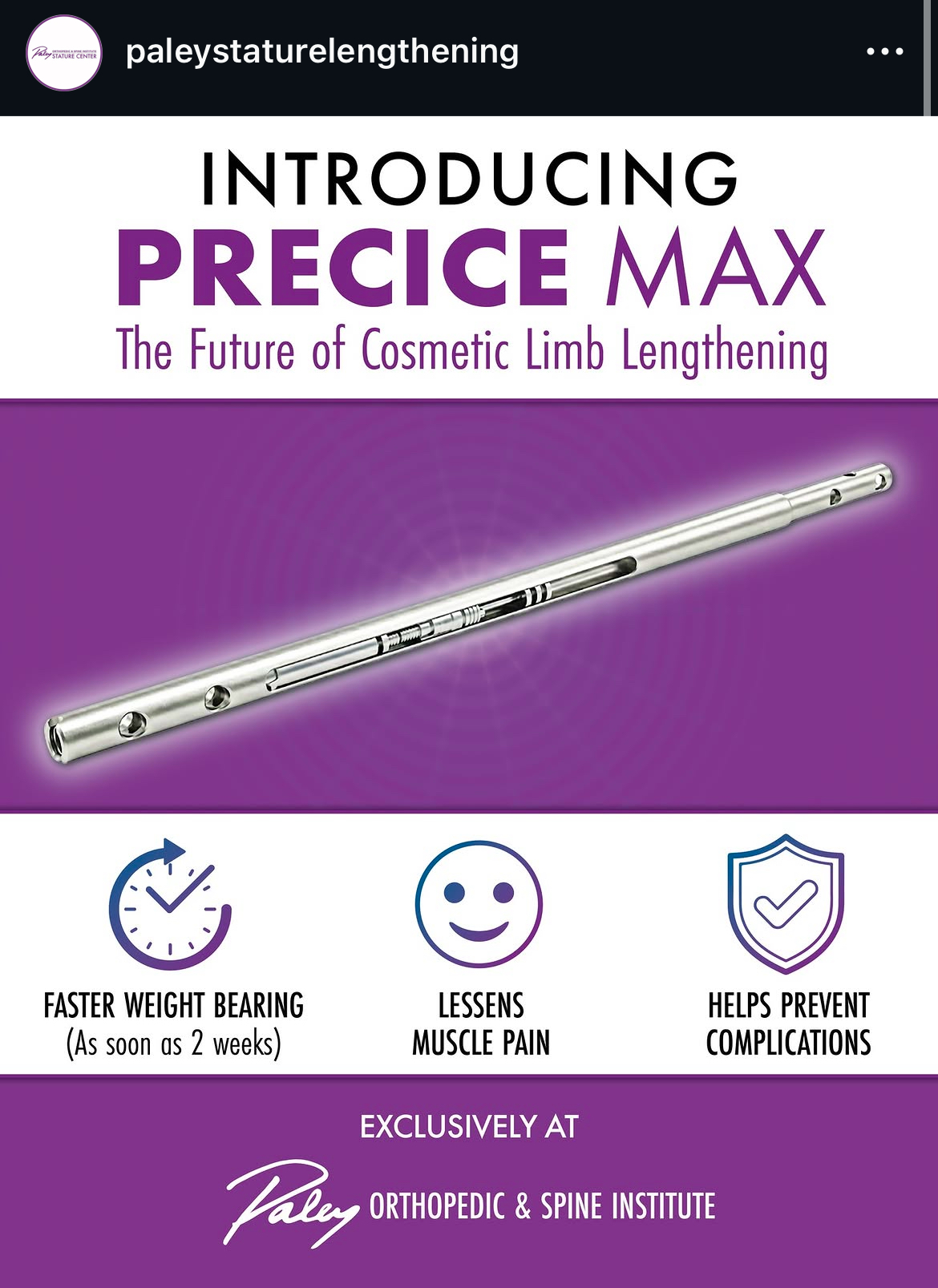
PMAX received FDA approval in December 2023, with Dr. Paley performing his first surgery using the device in February 2024. Until now, the nail has only been available on a limited, case-by-case basis. Beginning July 12, it will officially become an option offered exclusively through the Paley Institute.
For those unfamiliar with how internal limb lengthening works, here's a brief explanation.
The PRECICE 2 system requires surgeons to perform an osteotomy (a controlled surgical break) of the femur, tibia, or both. A telescoping intramedullary nail is then inserted into the bone, where it remains completely internal throughout the treatment process.
After surgery, the patient uses an external remote controller to activate the nail, gradually lengthening the bone. The typical distraction rate is approximately 1 mm per day, allowing new bone to regenerate in the gap as it slowly widens.
According to Dr. Paley's website, the maximum recommended lengthening and estimated costs for the PRECICE 2 system are:
PMAX is also claimed to reduce muscle pain, preserve muscle strength, and lower the risk of certain complications associated with prolonged non-weight-bearing, such as muscle atrophy and joint stiffness. Earlier walking may also promote healthier bone regeneration by allowing controlled loading of the healing bone. While these potential benefits are promising, PMAX is still a relatively new implant. Although it has been used in a limited number of patients with encouraging early results, more long-term clinical data will be needed to fully confirm these advantages over the well-established PRECICE 2 system.
With this new nail coming out, it gives me hope that, if everything goes smoothly for patients using it over the next few years, my lengthening experience may not be as difficult as I've been preparing myself for based on the notoriously challenging recovery associated with the PRECICE 2 system. I believe that if PMAX proves successful and isn't recalled, it could become the next major innovation in limb lengthening, giving people who are hesitant about the surgery greater confidence that the procedure has reached a new level of comfort and convenience.
Overall, I'm very excited to follow people's experiences with PMAX over the coming years. In the meantime, I'll be saving up for my own surgery.
PMAX received FDA approval in December 2023, with Dr. Paley performing his first surgery using the device in February 2024. Until now, the nail has only been available on a limited, case-by-case basis. Beginning July 12, it will officially become an option offered exclusively through the Paley Institute.
For those unfamiliar with how internal limb lengthening works, here's a brief explanation.
The PRECICE 2 system requires surgeons to perform an osteotomy (a controlled surgical break) of the femur, tibia, or both. A telescoping intramedullary nail is then inserted into the bone, where it remains completely internal throughout the treatment process.
After surgery, the patient uses an external remote controller to activate the nail, gradually lengthening the bone. The typical distraction rate is approximately 1 mm per day, allowing new bone to regenerate in the gap as it slowly widens.
According to Dr. Paley's website, the maximum recommended lengthening and estimated costs for the PRECICE 2 system are:
- Bilateral femurs (up to 8 cm / 3.2 in.): approximately $95,500
- Bilateral tibias (up to 5 cm / 2 in.): approximately $106,000
- Combined femur and tibia lengthening (performed simultaneously or about three weeks apart, up to 10 cm / 4 in.): approximately $191,500–$209,500
How Does PMAX Compare?
The biggest advantage of PMAX is its increased weight-bearing capability. According to Dr. Paley and the manufacturer, patients may be able to begin partial to substantial weight bearing as early as two weeks after surgery, significantly reducing the need for prolonged wheelchair use or crutches during recovery. This represents a major shift from the PRECICE 2 system, where patients typically remained limited to minimal weight bearing until the distraction (lengthening) phase was complete, a process that often lasts 3-4 months, depending on the amount of lengthening and individual healing.PMAX is also claimed to reduce muscle pain, preserve muscle strength, and lower the risk of certain complications associated with prolonged non-weight-bearing, such as muscle atrophy and joint stiffness. Earlier walking may also promote healthier bone regeneration by allowing controlled loading of the healing bone. While these potential benefits are promising, PMAX is still a relatively new implant. Although it has been used in a limited number of patients with encouraging early results, more long-term clinical data will be needed to fully confirm these advantages over the well-established PRECICE 2 system.
My Thoughts
I myself am 5'5" due to ISS (confirmed by an endocrinologist who said I would've been a candidate for HGH if it had been caught earlier). I had pretty much told myself before being diagnosed that if I was done growing, I'd get limb lengthening surgery. That ended up being the case, so I'm planning to have the surgery in my early 20s, as many people do.With this new nail coming out, it gives me hope that, if everything goes smoothly for patients using it over the next few years, my lengthening experience may not be as difficult as I've been preparing myself for based on the notoriously challenging recovery associated with the PRECICE 2 system. I believe that if PMAX proves successful and isn't recalled, it could become the next major innovation in limb lengthening, giving people who are hesitant about the surgery greater confidence that the procedure has reached a new level of comfort and convenience.
Overall, I'm very excited to follow people's experiences with PMAX over the coming years. In the meantime, I'll be saving up for my own surgery.


