D
Deleted member 409448
Solstice
- Joined
- Apr 25, 2026
- Posts
- 2,362
- Reputation
- 2,559
Craniometry is the measurement of cranial features in order to classify people according to race, criminal temperament,
intelligence, etc[1]
Using the skull-based categorization, anthropologists identified three or four racial groups;
• Caucasoidcharacterized by a tall dolichocephalic skull, receded zygomas, large brow ridge and projecting-narrow nasal apertures.
• Negroid characterized by a short dolichocephalic skull, receded zygomas and wide nasal apertures.
• Mongoloid characterized by a medium brachycephalic skull, projecting zygomas, small brow ridge and small nasal apertures.[2]
When using phenotypic variation to measure the similarity between the populations of a species one should analyse the variation in several characters simultaneously. This is a statistical procedure and is known as multivariate analysis. Multivariate analysis of phenotypic variation, unlike some other methods, has the advantage of not being dependent on
living specimens.[3]
Normal skull thickness has been measured in a general hospital population of 300 blacks and 200 whites in America. In both groups, there is a rapid increase in skull thickness during the first two decades of life, followed by a small uniform increase reaching a peak in the fifth and sixth decades. The sex differences are variable, but in certain age groups the females in both races have significantly thicker parietal and occipital bones than their male counterpart. The frontal bone is thicker in the white male than in the black, and the parieto-occipital thicker in
the blacks than in the whites.[4]
This article is concerned with the description and racial incidence of minor morphological variations in the human skull. Although such variants can be found in every system in the body, this study is confined to those which occur in the cranium, because of the large amount of available material. A few of them have been utilized as anthropological markers, e.g. persistence of the medio-
frontal suture; mandibular, auditory and maxillary tori; imperfect transverse foramina of the cervical vertebrae [5].Given below describes the incidence of thirty epigenetic variants in 585 crania from eight different localities, and points out some of the anthropological and anatomical implications of being able to genetically characterize populations in this way.
Most of these are 'classical' variants described by Wood- Jones (1930-31) and Brothwell (1963);
1. Highest nuchal line present The inferior and superior nuchal
lines form well-marked ridges running horizontally across the occipital bone. A third line (the highest) is sometimes present. It arises with the superior at the external occipital protuberance, and arches anteriorly and laterally, providing attachment for the epicranial eponeurosis.
2. Ossicle at the lambda A bone may occur at the junction of the sagittal and lambdoid sutures (the positionof the posterior fontanelle).
3. Lambdoid ossicle present One or more ossicles may occur in the lambdoid suture. Up to about twelve distinct bones may be present on either side.
4. arietal foramen present This pierces the parietal bone near the sagittal suture a few centimetres in front of the lambda. It transmits a small emissary vein, and sometimes a small branch of the occipital artery.
5. Bregmatic bone present A sutural bone (the bregmatic or interfrontal) may occur at the junction of the sagittal suture with the coronal one (the position of the anterior fontanelle).
6. Metopism The medio-frontal suture disappears within the first two years of life. In a few individuals it persists throughout life: this condition is known as metopism.
7. Coronal ossicle present Ossicles are sometimes found in the coronal suture.
8. Epipteric bone present A sutural bone (the epipteric bone or pterion ossicle) may be inserted between the anterior inferior angle of the parietal bone and the greater wing of the sphenoid.
9. Fronto-temporal articulation Normally the frontal bone is separated from the squamous part of the temporal bone by the greater wing of the sphenoid and the anterior inferior angle of the parietal bone. Occasionally the frontal and
temporal bones are in direct contact, forming a fronto-
temporal articulation.
10. Parietal notch bone present The parietal notch is that part of
the parietal bone that protrudes between the squamous and the mastoid portions of the temporal bone. It may form a separate ossicle which is known as the parietal notch bone.
11. Ossicle at asterion The junction of the posterior inferior angle of the parietal bone with the occipital bone and mastoid portion of the temporal bone is known as the asterion. A sutural bone may occur at this junction.
12. Auditory torus present Rarely a bony ridge or torus is found on the floor of the external auditory meatus.
13. Foramen of Huschke present This is a foramen occurring in the floor of the external auditory meatus. It is always present in young children but only occasionally does it persist after the fifth year.
14. Mastoid foramen exsutural
15. Mastoid foramen absent When present, the mastoid foramen
usually lies in the suture between the mastoid part of the
temporal bone and the occipital bone.
16. The posterior condylar canal usually pierces the condylar
fossa which lies immediately posterior to the occipital condyle. Sometimes it ends blindly in the bone, and has only been scored as patent when a seeker can be passed through it.
17. Condylar facet double Occasionally the articular surface of the occipital condyle is divided into two distinct facets.
18. Precondylar tubercle present Occasionally a bony tubercle lies immediately anterior and medial to the occipital condyle.
19. Anterior condylar canal double This canal (foramen
hypoglossi) pierces the anterior part of the occipital condyle and transmits the hypoglossal nerve. Embryologically the nerve originates from several segments and this may result in the canal being divided into two for part or all of its length.
20. Foramen ovate incomplete Rarely the postero-lateral wall of the foramen ovale is incomplete so that the foramen is continuous with the foramen spinosum.
21. Foramen spinosum open The posterior wall of the foramen spinosum is sometimes deficient.
22. Accessory lesser palatine foramen present The lesser palatine foramina lie on both sides of the posterior border of the hard palate immediately posterior to the greater palatine foramen, and transmit the lesser palatine nerves.
23. Palatine torus present Rarely, a bony ridge runs longitudinally down the mid-line of the hard palate. This is the palatine torus. Although it occurs in c. 10 % of British skulls (Brothwell, 1963), it was seen only once among the 600 skulls classified in this study (see Discussion).
24. Maxillary torus present The maxillary torus is a bony ridge running along the lingual aspects of the roots of the molar teeth. It was not seen in this study.
25. Zygomatico-facialforamen absent This is a small foramen which pierces the zygomatic bone opposite the junction of the infraorbital and lateral margins of the orbit. It transmits a nerve and small artery, and may be single, multiple or absent.
26. Supraorbital foramen complete The supraorbital foramen transmits the supraorbital vessels and nerve. It is frequently incomplete (or open). In this case it is often described as a 'supraorbital notch'.
27. Frontal notch or foramen present A well-defined secondary foramen in the vicinity of (usually lateral to) the supraorbital foramen has been scored as a frontal foramen. Frequently a cluster of tiny foramina are present, but these have been ignored.
28. Anterior ethmoidforamen exsutural The anterior ethmoid foramen pierces the medial wall of the orbit. It normally lies on the suture between the medial edge of the orbital plates of the frontal and ethmoid bones, but it occasionally emerges above the suture.
29. Posterior ethmoidforamen absent The posterior ethmoid foramen lies just behind the anterior ethmoid foramen on the same suture line. Its absence can only be scored satisfactorily in well-preserved skulls.
30. Accessory infraorbital foramen present A second foramen may lie immediately adjacent to the infraorbital foramen.
RESULT:
Umme Salma Durbar /J. Pharm. Sci. & Res. Vol. 6(11), 2014, 370-372
Egypt-250
Nigeria-56
Palestine-54
India-53
Burma-51
North america-53 South america-51
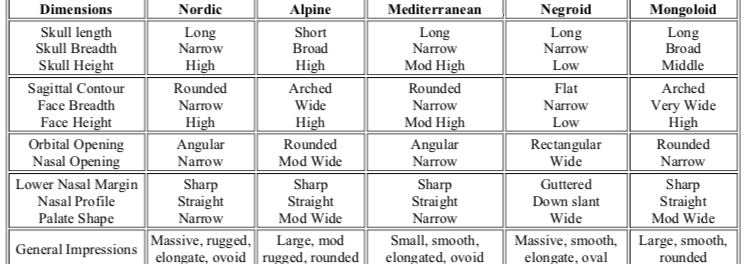
Non-Metrical Morphological Characters of the Skull include: Ossa Suturarum, Type of the Pterion, Epipteric Bones., Foramen Ethmoidale Anterius., The Form of the Orbit., Nasal Bones.,[7]
A Negroid cranium is long in length, narrow in breadth, and low in height. Black, or Negroid, skulls feature a broad and round nasal cavity and no dam or nasal sill. There is notable facial projection in the jaw and mouth area and a rectangular palate. The eye orbit shape is square or rectangular. The skull is dolichocephalic, which means longer from front to back proportionally.The sagittal contour is flat and the occipital profile is quite rounded. a Negroid mandible has a "...lower, wider, and more vertical ramus; greater corpal and dental arch length, i.e., a long U- shaped dental arch; relatively smaller breadth dimensions; a less dominant chin.[9]
The Mongoloid cranium is long in length. The Mongoloid cranium is broad in breadth and average in height, categorised between the high Caucasoid cranium and the low Negroid cranium. The occipital profile is angular and the nuchal muscle markings are moderate. The malar bones (zygomatic bones) retreat in the Caucasoid skull which can make the skull appear somewhat "pointed"[10].
Umme Salma Durbar /J. Pharm. Sci. & Res. Vol. 6(11), 2014, 370-372
Caucasian, or white, European descended people have relatively no prognathism
REFERENCES:
http://www.skepdic.com/cranial.html Wikipedia
Adelola Adeloye1,Kenneth R. Kattan2, Frederic N. Silverman3 Thickness of the normal skull in the American blacks and whites. 3 MAY 2005 DOI: 10.1002/ajpa.1330430105. American Journal of Physical Anthropology Volume 43, Issue 1, pages 23–30.
biometric analysis of geographic variation and racial
3. R.S.Thorpe
affinities 21 jan 2008 DOI: 10.1111/j.1469-185X.1976.tb01063.x
5. A.Caroline Berry , R. J. Berry Epigenetic variation in human skullJ Anat. Apr 1967; 101(Pt 2): 361–379.6.
Shultz in Krogman & Iscan 1986:280 The Human Skeleton in Forensic Medicine. W. M. Krogman. Thomas, Springfield, Ill., 1961 Skinner, M., and R.A. Lazenby 1983 Found Human Remains: A Field Manual for the Recovery of Recent Human Skeletnns. Simon Frazer University, Archaeology Press, Burnaby, Australia.
Ubelaker 1989: 119. Human Skeletal Remains: Excavation, Analysis, Interpretation
Jodi Blumenfeld Racial
Wood-Jones F. The Non-Metrical Morphological Characters of the Skull as Criteria for Racial Diagnosis: Part IV. The Non-Metrical Morphological Characters of the Northern Chinese Skull.J
Anat. 1933 Oct;68(Pt 1):96–108.
Identification in the Skull and
Teeth," Totem: The University of Western Ontario Journal of
Anthropology: Vol. 8: Iss. 1, Article 4.
intelligence, etc[1]
Using the skull-based categorization, anthropologists identified three or four racial groups;
• Caucasoidcharacterized by a tall dolichocephalic skull, receded zygomas, large brow ridge and projecting-narrow nasal apertures.
• Negroid characterized by a short dolichocephalic skull, receded zygomas and wide nasal apertures.
• Mongoloid characterized by a medium brachycephalic skull, projecting zygomas, small brow ridge and small nasal apertures.[2]
When using phenotypic variation to measure the similarity between the populations of a species one should analyse the variation in several characters simultaneously. This is a statistical procedure and is known as multivariate analysis. Multivariate analysis of phenotypic variation, unlike some other methods, has the advantage of not being dependent on
living specimens.[3]
Normal skull thickness has been measured in a general hospital population of 300 blacks and 200 whites in America. In both groups, there is a rapid increase in skull thickness during the first two decades of life, followed by a small uniform increase reaching a peak in the fifth and sixth decades. The sex differences are variable, but in certain age groups the females in both races have significantly thicker parietal and occipital bones than their male counterpart. The frontal bone is thicker in the white male than in the black, and the parieto-occipital thicker in
the blacks than in the whites.[4]
This article is concerned with the description and racial incidence of minor morphological variations in the human skull. Although such variants can be found in every system in the body, this study is confined to those which occur in the cranium, because of the large amount of available material. A few of them have been utilized as anthropological markers, e.g. persistence of the medio-
frontal suture; mandibular, auditory and maxillary tori; imperfect transverse foramina of the cervical vertebrae [5].Given below describes the incidence of thirty epigenetic variants in 585 crania from eight different localities, and points out some of the anthropological and anatomical implications of being able to genetically characterize populations in this way.
Most of these are 'classical' variants described by Wood- Jones (1930-31) and Brothwell (1963);
1. Highest nuchal line present The inferior and superior nuchal
lines form well-marked ridges running horizontally across the occipital bone. A third line (the highest) is sometimes present. It arises with the superior at the external occipital protuberance, and arches anteriorly and laterally, providing attachment for the epicranial eponeurosis.
2. Ossicle at the lambda A bone may occur at the junction of the sagittal and lambdoid sutures (the positionof the posterior fontanelle).
3. Lambdoid ossicle present One or more ossicles may occur in the lambdoid suture. Up to about twelve distinct bones may be present on either side.
4. arietal foramen present This pierces the parietal bone near the sagittal suture a few centimetres in front of the lambda. It transmits a small emissary vein, and sometimes a small branch of the occipital artery.
5. Bregmatic bone present A sutural bone (the bregmatic or interfrontal) may occur at the junction of the sagittal suture with the coronal one (the position of the anterior fontanelle).
6. Metopism The medio-frontal suture disappears within the first two years of life. In a few individuals it persists throughout life: this condition is known as metopism.
7. Coronal ossicle present Ossicles are sometimes found in the coronal suture.
8. Epipteric bone present A sutural bone (the epipteric bone or pterion ossicle) may be inserted between the anterior inferior angle of the parietal bone and the greater wing of the sphenoid.
9. Fronto-temporal articulation Normally the frontal bone is separated from the squamous part of the temporal bone by the greater wing of the sphenoid and the anterior inferior angle of the parietal bone. Occasionally the frontal and
temporal bones are in direct contact, forming a fronto-
temporal articulation.
10. Parietal notch bone present The parietal notch is that part of
the parietal bone that protrudes between the squamous and the mastoid portions of the temporal bone. It may form a separate ossicle which is known as the parietal notch bone.
11. Ossicle at asterion The junction of the posterior inferior angle of the parietal bone with the occipital bone and mastoid portion of the temporal bone is known as the asterion. A sutural bone may occur at this junction.
12. Auditory torus present Rarely a bony ridge or torus is found on the floor of the external auditory meatus.
13. Foramen of Huschke present This is a foramen occurring in the floor of the external auditory meatus. It is always present in young children but only occasionally does it persist after the fifth year.
14. Mastoid foramen exsutural
15. Mastoid foramen absent When present, the mastoid foramen
usually lies in the suture between the mastoid part of the
temporal bone and the occipital bone.
16. The posterior condylar canal usually pierces the condylar
fossa which lies immediately posterior to the occipital condyle. Sometimes it ends blindly in the bone, and has only been scored as patent when a seeker can be passed through it.
17. Condylar facet double Occasionally the articular surface of the occipital condyle is divided into two distinct facets.
18. Precondylar tubercle present Occasionally a bony tubercle lies immediately anterior and medial to the occipital condyle.
19. Anterior condylar canal double This canal (foramen
hypoglossi) pierces the anterior part of the occipital condyle and transmits the hypoglossal nerve. Embryologically the nerve originates from several segments and this may result in the canal being divided into two for part or all of its length.
20. Foramen ovate incomplete Rarely the postero-lateral wall of the foramen ovale is incomplete so that the foramen is continuous with the foramen spinosum.
21. Foramen spinosum open The posterior wall of the foramen spinosum is sometimes deficient.
22. Accessory lesser palatine foramen present The lesser palatine foramina lie on both sides of the posterior border of the hard palate immediately posterior to the greater palatine foramen, and transmit the lesser palatine nerves.
23. Palatine torus present Rarely, a bony ridge runs longitudinally down the mid-line of the hard palate. This is the palatine torus. Although it occurs in c. 10 % of British skulls (Brothwell, 1963), it was seen only once among the 600 skulls classified in this study (see Discussion).
24. Maxillary torus present The maxillary torus is a bony ridge running along the lingual aspects of the roots of the molar teeth. It was not seen in this study.
25. Zygomatico-facialforamen absent This is a small foramen which pierces the zygomatic bone opposite the junction of the infraorbital and lateral margins of the orbit. It transmits a nerve and small artery, and may be single, multiple or absent.
26. Supraorbital foramen complete The supraorbital foramen transmits the supraorbital vessels and nerve. It is frequently incomplete (or open). In this case it is often described as a 'supraorbital notch'.
27. Frontal notch or foramen present A well-defined secondary foramen in the vicinity of (usually lateral to) the supraorbital foramen has been scored as a frontal foramen. Frequently a cluster of tiny foramina are present, but these have been ignored.
28. Anterior ethmoidforamen exsutural The anterior ethmoid foramen pierces the medial wall of the orbit. It normally lies on the suture between the medial edge of the orbital plates of the frontal and ethmoid bones, but it occasionally emerges above the suture.
29. Posterior ethmoidforamen absent The posterior ethmoid foramen lies just behind the anterior ethmoid foramen on the same suture line. Its absence can only be scored satisfactorily in well-preserved skulls.
30. Accessory infraorbital foramen present A second foramen may lie immediately adjacent to the infraorbital foramen.
RESULT:
Umme Salma Durbar /J. Pharm. Sci. & Res. Vol. 6(11), 2014, 370-372
Egypt-250
Nigeria-56
Palestine-54
India-53
Burma-51
North america-53 South america-51
Non-Metrical Morphological Characters of the Skull include: Ossa Suturarum, Type of the Pterion, Epipteric Bones., Foramen Ethmoidale Anterius., The Form of the Orbit., Nasal Bones.,[7]
A Negroid cranium is long in length, narrow in breadth, and low in height. Black, or Negroid, skulls feature a broad and round nasal cavity and no dam or nasal sill. There is notable facial projection in the jaw and mouth area and a rectangular palate. The eye orbit shape is square or rectangular. The skull is dolichocephalic, which means longer from front to back proportionally.The sagittal contour is flat and the occipital profile is quite rounded. a Negroid mandible has a "...lower, wider, and more vertical ramus; greater corpal and dental arch length, i.e., a long U- shaped dental arch; relatively smaller breadth dimensions; a less dominant chin.[9]
The Mongoloid cranium is long in length. The Mongoloid cranium is broad in breadth and average in height, categorised between the high Caucasoid cranium and the low Negroid cranium. The occipital profile is angular and the nuchal muscle markings are moderate. The malar bones (zygomatic bones) retreat in the Caucasoid skull which can make the skull appear somewhat "pointed"[10].
Umme Salma Durbar /J. Pharm. Sci. & Res. Vol. 6(11), 2014, 370-372
Caucasian, or white, European descended people have relatively no prognathism
REFERENCES:
http://www.skepdic.com/cranial.html Wikipedia
Adelola Adeloye1,Kenneth R. Kattan2, Frederic N. Silverman3 Thickness of the normal skull in the American blacks and whites. 3 MAY 2005 DOI: 10.1002/ajpa.1330430105. American Journal of Physical Anthropology Volume 43, Issue 1, pages 23–30.
biometric analysis of geographic variation and racial
3. R.S.Thorpe
affinities 21 jan 2008 DOI: 10.1111/j.1469-185X.1976.tb01063.x
5. A.Caroline Berry , R. J. Berry Epigenetic variation in human skullJ Anat. Apr 1967; 101(Pt 2): 361–379.6.
Shultz in Krogman & Iscan 1986:280 The Human Skeleton in Forensic Medicine. W. M. Krogman. Thomas, Springfield, Ill., 1961 Skinner, M., and R.A. Lazenby 1983 Found Human Remains: A Field Manual for the Recovery of Recent Human Skeletnns. Simon Frazer University, Archaeology Press, Burnaby, Australia.
Ubelaker 1989: 119. Human Skeletal Remains: Excavation, Analysis, Interpretation
Jodi Blumenfeld Racial
Wood-Jones F. The Non-Metrical Morphological Characters of the Skull as Criteria for Racial Diagnosis: Part IV. The Non-Metrical Morphological Characters of the Northern Chinese Skull.J
Anat. 1933 Oct;68(Pt 1):96–108.
Identification in the Skull and
Teeth," Totem: The University of Western Ontario Journal of
Anthropology: Vol. 8: Iss. 1, Article 4.