

Introduction to Rational Looksmaxxing
Rationality is a necessary prerequisite for effective and optimized look optimization. Without rational decision-making, one is destined to achieve mediocre, unpredictable results while constantly risking significant capital loss or injury.
The core problem this article solves: the looksmaxxing community is inherently epistemically toxic. High confidence claims, pseudoscience, vague guesses, trolling, and genuine evidence are undifferentiated. I propose an alternative: a rational framework with calibrated prioritization and decision-making.
We’ll first begin with outlining the issues within the looksmaxxing community, the biases that affect decision-making and we’ll establish clear definitions of various concepts. Once we deconstruct the current state of the shortcomings of the looksmaxxing hivemind, we’ll construct a new, optimized, rational framework for looksmaxxing decision-making.
Table of Contents
- Introduction to Rational Looksmaxxing Theory
Chapter 1: The Main Issues Within the Community
- Section 1: The Looksmaxxer’s Fallacy
- Section 2: The Pseudoscientific Approach
- Section 3: The Neglect of Opportunity Cost
- Section 4: Diminishing Returns
Chapter 2: Cognitive Biases That Destroy Looksmaxxing ROI
- Section 1: The Blackpill / Biological Determinism
- Section 2: The Perfectionism Trap
- Section 3: Scope Insensitivity
- Section 4: Sunk Cost Fallacy
- Section 5: Availability Heuristic and Survivorship Bias
Chapter 3: Constructing the Rational Framework
Section 1: Defining the Crucial Concepts
- Subsection 1: Creating the Evidence Hierarchy (LEH)
- Subsection 2: Defining “Looks” (Component Model + Weights)
- Subsection 3: 1–10 Scale vs PSL Scale
- Subsection 4: Defining “Attractiveness” (SSS Model)
Section 2: ROI — Definition and Estimation
- Subsection 1: Core Variables
- Subsection 2: Obtaining the Variables
- Subsection 3: Candidate 1 — Simple Ratio Model
- Subsection 4: Candidate 2 — Expected Value Model
- Subsection 5: Candidate 3 — Time-Adjusted Compounding Model
- Subsection 6: Model Selection Guidelines
Section 3: Cognitive Offload via Automation
- Method 1: ROI Calculation Script
- Method 2: Artificial Intelligence Estimation
Chapter 4: Why Apply This Framework?
- Section 1: Expected-Value Case for Rational Looksmaxxing
- Section 2: Psychological and Quality-of-Life Returns
Chapter 5: Conclusion
- Section 1: Core Thesis Recap
- Section 2: Action Plan for the Reader
- Section 3: Final Thoughts
Appendix
- ROI Prompt Template (LLM Use)
- ROI Python Script
Chapter 1: The Main Issues Within the Community
Section 1: The Looksmaxxer’s Fallacy
The most glorified looksmaxxes on this forum are almost NEVER the most optimal choice for looksmaxxing. Let me introduce you to the Looksmaxxer’s Fallacy, which states:“If something has the biggest, most impactful effect on looks, it must also be true that that thing must take the biggest priority over all (and vice versa).”
or, more formally:
“Confusion of the importance of a variable with the returns available on that variable”.
Eg.: Assuming that bone structure improvement (using various means) is the most optimal choice for oneself, simply because bone structure is the most important component of facial attractiveness.
That inference does not necessarily follow. Improving one’s bone structure introduces either extreme costs or extreme risks, which results in ROI much lower than other looksmaxxing techniques. Bone structure has the maximum effect, but near-zero tractability at acceptable risk or capital investment. This type of thinking results in the neglect of true high-ROI techniques while focusing on low-ROI strategies.
Section 2: The Pseudoscientific Approach
The majority of looksmaxxers do not possess any significant amount of knowledge and base their decisions on TikTok-level knowledge and intuition. The average user does not verify the proposed looksmaxxing techniques, leading to incorrect decision calibration.
A perfect example of this phenomenon would be bonesmashing.
Bonesmashing is near the extreme end of pseudoscientific methods. It has no basis in empirical science, yet posters often falsely try to back it up with the misinterpretation of Wolff’s law, which misinforms the uneducated. On top of that, the risk of bonesmashing is immense. As you can imagine, repeated trauma to the brain is not really optimal, and trading IQ for the minimal, near-zero chance of bone gain is one of the most irrational decisions a looksmaxxer can make.
(Nerd explanation)
Wolff's Law describes trabecular bone remodeling under sustained load stress, primarily documented in long bones under weight-bearing conditions. Facial bones, particularly the midface, have different remodeling thresholds and the compressive force from external impact is not analogous to the sustained mechanical stress the law describes.
Another example of low-ROI, immense risk activities would be DIY surgeries. It’s no secret that some of the users here attempted ridiculous techniques like self-buccal fat removal or DIY fillers. If you’re capable of thinking, you can easily estimate that a huge risk of injury to facial nerve branches, salivary duct injury, infection, or even simple asymmetry and look degradation compared to the low probability of success results in a significantly negative ROI.
If you still hold onto some of the pseudoscientific, high-risk procedures, don’t worry, I’ll outline exactly what biases keep you in the irrational state of mind soon.
In conclusion, attractiveness optimization is a resource allocation problem, and most allocate those resources badly.
Section 3: The Neglect of Opportunity Cost
Another commonly ignored concept is opportunity cost, which Wikipedia defined as: the value of the best alternative forgone where, given limited resources, a choice needs to be made between several mutually exclusive alternatives.
In simpler terms, opportunity cost is the value of the next best thing you give up when you make a choice. It is the benefit you could have received, but chose something else instead.
Example:
You have $200/month to allocate. You must decide between 2 paths:
- Path A: The Experimental Peptides with anecdotal backing
- The Gain: An unknown probability of skin improvement.
- The Risks: Unknown risks and their extent, unknown contents of the peptides (could be bunk or contaminated), harm, or no results.
- Path B: Tretinoin + Skincare Essentials
- The gain: Very high chance of significant improvement (backed by RCT-level evidence, demonstrable effect size)
- The risks: Well-known risks, manageable with good research.
If you choose Path A, your opportunity cost is not just $200. You have forfeited months of skin improvement with a very high probability of improvement in exchange for highly uncertain results or even possible short- or long-term harm. It is not difficult to see how often this kind of error occurs in looksmaxxing communities, especially when combined with the concepts from other chapters.
Section 4: Diminishing returns
I believe most people are at least somewhat familiar with diminishing returns. Diminishing returns are defined as proportionally smaller profits or benefits derived from something as more money or energy is invested in it.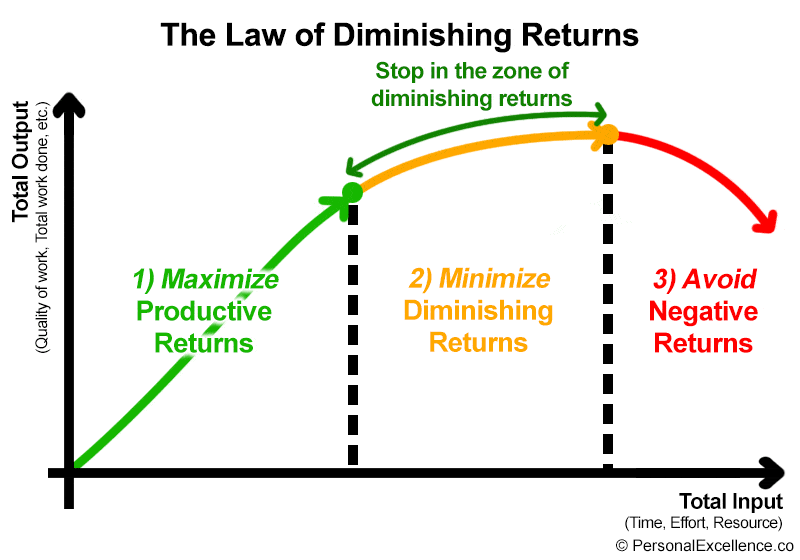
Example:
You have 2 hours of free time after school. You must decide between 2 paths:
- Path A: The Gym
- The Gain: Muscle growth, lower body fat, and better posture.
- Path B: Detailed grooming and research
- Action: Research a multi-step skincare routine, better hairstyles for your face shape, optimal clothing style, and then groom accordingly.
- The gain: Clearer skin, better haircut, eyebrows, eyelashes, and an upgraded fit.
If you choose Path A, your return on investment will be marginal; the clearer skin, better haircut, and better style from Path B is a vastly superior choice in terms of ROI.
Avoiding diminishing returns is crucial: if you already work out for 2 hours, 3 times a week, but have absolutely no grooming hygiene, the 2 hours that offer diminishing returns could be allocated somewhere else. Essentially, you sacrifice significant improvement to your looks for a couple of extra cells in your biceps. The choice is easy and clear.
Chapter 2: Cognitive Biases That DESTROY Looksmaxxing ROI
In this chapter, we’ll outline all of the major cognitive biases that negatively impact your decision-making in the domain of looksmaxxing. I’ve ranked them from most severe to least. Simply becoming aware of these biases will significantly reduce your error rate and increase your decision calibration. Internalizing them and becoming deeply aware of them will increase your rate of improvement at a scale you’ve never seen before. I’ll focus less on the actual mechanisms behind those biases to dedicate to explaining the way of fighting them. Let’s begin.
Section 1: The Blackpill/Biological Determinism
“The Blackpill Revolution and its consequences have been a disaster for the human race. They have greatly destabilized society, have made life unfulfilling, have subjected human beings to indignities, have led to widespread psychological suffering, and have inflicted severe damage on the male world.” - Theodore Mogczyński
The Blackpill ideology is something we’re all familiar with very well, and something that most of us firmly believe in. Blackpilled individuals believe that your romantic and sexual outcomes are almost entirely determined by immutable traits, and therefore cannot be meaningfully improved through effort, self-development, or social strategy.
This is the “official” definition of Blackpill, but even diluted parts of it are inherently harmful to the human psyche, and the quality/health of your psyche determines your looksmaxxing success (might make a thread on that as well). Believing that it’s “over” and “time to rope” will likely stop you from even attempting to change. Not increasing your attractiveness, just because you’re 5’4 or LTN, is an irrational choice. The Blackpill mindset negatively impacts your mental health significantly and your aim should be at least softening the effect it has on your psyche.
Yet, it’s highly likely that a lot of the beliefs that Blackpill ideology propagates are true. So what do we do to counteract its effects on us?
Even when granting that doomed blackpill mindset claims about genetic determination are partially correct, the expected value of looksmaxxing remains positive. The upside (real, bounded improvement) exists. The downside of acting (wasted effort) is bounded and recoverable. The downside of inaction is certain and significantly compounds over time.
Additionally, we can force ourselves to obtain a combination of blue- and red-pilled mindset, while keeping and using our blackpilled (true) knowledge. This is not an easy task, and explaining the process of fundamentally rewiring your cognitive belief system would require a lot more research on my part + at least 10 full threads.
There’s a fantastic chapter in Kahneman’s Thinking Fast and Slow, describing the benefits of being an optimist. Kahneman, based on scientific literature, describes how optimists are usually more cheerful, happy (and liked more because of that); they endure failures and struggles better, they have a lower risk of suffering from clinical depression, have a stronger immune system, take care of their health more, feel healthier, and even live longer. Of course, the benefits of optimism are only available to people who exhibit “gentle” optimism, meaning they can notice the positives, without losing touch with reality.
Answer this question honestly:
If John and Eric share the same body and face, but John is blackpilled, and Eric is redpilled, who is happier at a given time? Over time, who will become more attractive?
Section 2: The Perfectionism Trap
While the Blackpill Mindset prevents starting, the Perfectionism Trap prevents finishing or maintaining.
People who fall into the Perfectionism Trap do not just want to look good; they raise the minimum acceptable threshold to a nearly unachievable level.
By searching for the "theoretically optimal" intervention, people skip the "good-enough" actions that yield 80% of the results. This leads to the classic analysis paralysis, where months are spent rotting on forums researching obscure techniques while basic softmaxxes are ignored.
This is extremely counter-productive, will always result in disappointments, which will inevitably trigger the negative-feedback loop (the trap). Once you get caught, it is very difficult to get out.
“The more you try to become perfect, the more pressure, stress, and anxiety you feel. The more hopeless you feel about being able to maintain that, the more depressed you feel that you're stuck in this cycle, and all of a sudden, nothing is worth it. Often, people completely fall down.” - Kimberley Quinlan.
The Escape: The Pareto Principle.
The Pareto Principle states that, for many outcomes, roughly 80% of consequences come from 20% of causes (the “vital few”). This means that instead of looking for niche, obscure looksmaxxing techniques that provide marginal gain, you should instead focus on the 20% of methods that provide the highest ROI. This should cross the “good enough” bar.
Let’s assume Chad-lite is your maximum, natural (non-surgical) potential when operating under the assumption of the optimal application of every single looksmax available to you that brings direct benefit. (realistically impossible)
If you’re dead average (5) and want to move to the chad-lite territory (7), that increase indicates a 40% attractiveness gain while literally using every single looksmaxxing technique available. It is not difficult to notice that the time and money investment will be extraordinarily massive, not only to get to that point, but especially to maintain it. Instead of aiming for the impossible, let’s follow the Pareto Principle using simple math:
Starting value: 5 (Normie)
Objective: 7 (Chad-lite)
Total improvement: +2
2 units of improvement = 100% of effort, or more clearly: 100% of effort → 2 units of gain
Let’s use the Pareto Principle:
80% of 2 = 1.6
20% of 2 = 0.4
Let’s map the data to effort:
Effort: 20% → 1.6 gain, which indicates 5 → 6.6 rating
Effort: 80% → 0.4 gain, which indicates 6.6 → 7 rating
As you can see, the 20% of effort brings us very close to our goal, placing us in the higher HTN territory. The difference in looks is laughable if we consider the amount of extra effort we need to put in.
Important caveat: This is just a heuristic. We cannot accurately map the effort-to-gain ratio.
Section 3: Scope Insensitivity
What is scope insensitivity?
Scope Insensitivity is another cognitive bias that occurs when the validation of a problem is not valued with a multiplicative relationship to its size. This means your brain reacts to “something is happening” instead of “how much is happening”.
In one study, respondents were asked how much they were willing to pay to prevent migrating birds from drowning in uncovered oil ponds by covering the oil ponds with protective nets. Subjects were told that either 2,000, 20,000, or 200,000 migrating birds were affected annually, for which subjects reported they were willing to pay $80, $78, and $88, respectively.
Comparing oneself to filtered, genetically elite outliers creates an unnatural floor for what is considered attractive, which usually leads to scope insensitivity. You may pursue extreme measures to fix a minor flaw because you’re comparing it to an ideal, instead of the actual human population. This lowers ROI by fixating on things that are simply not that important.
Eg: The recent trend of self-cutting the medial canthus as a looksmaxxing technique. Mechanism: The Blackpill ideals (usually with hunter eyes) possess a well-developed, “sharp” medial canthus, which led some people to cut theirs to achieve a similar effect, disregarding the fact that such intervention brings a low amount of benefits, while introducing severe risks, starting from obvious ones like infection, to unfavorable scarring and the failure of the procedure.
Section 4: Sunk Cost Fallacy
The concept of the Sunk Cost Fallacy is fairly well-known around the world. It occurs when an individual is reluctant to abandon a strategy or a course of action because they have invested heavily in it, even when it is clear that abandonment would be more beneficial.
This is quite common in the community; a lot of the “copes” described here partially operate on the Sunk Cost Fallacy. An example includes mewing. If one started mewing as a teenager, it is likely that it won’t bring any significant results (if any at all), yet due to a big time investment (like months or even years), one not only may continue the process, but also look for more dramatic methods that can cause TMJ.
Another example may include using products that irritate the skin or substances that cause unwanted side effects, but don’t bring enough positive effects. One might be tempted to finish a vial of gear that causes severe acne, even though one didn’t notice an increase in muscle mass that would be considered enough. Because of that fallacy, one misses out on the opportunity cost of switching to more effective methods.
Section 5: Availability Heuristic and Survivorship Bias
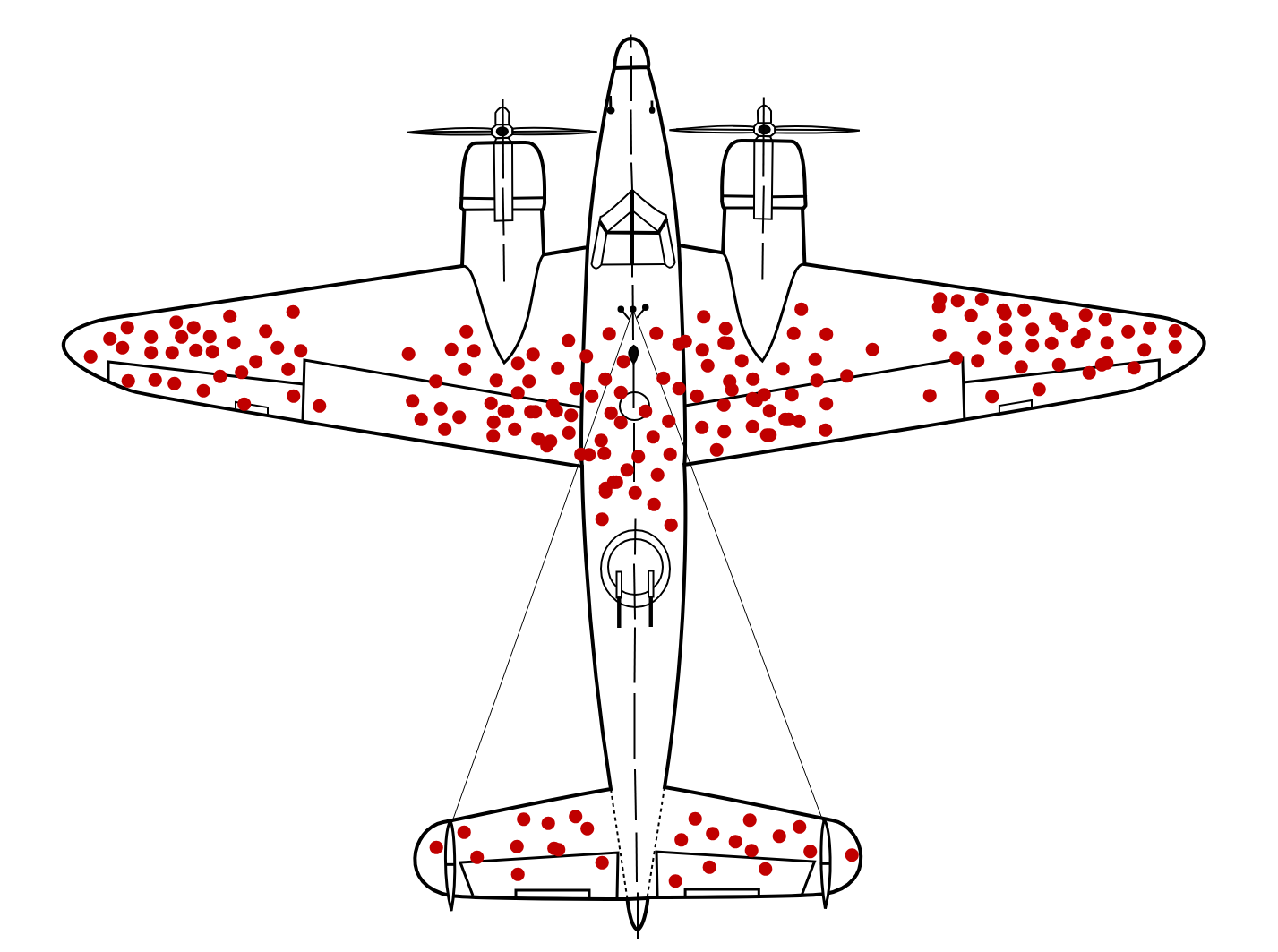
Availability Heuristic and Survivorship Bias are two of the most well-known biases around the world. Because of their similarity and how well they synergize in the looksmaxxing world, I stacked them together in one section.
The definition of the Availability Heuristic is simple: you estimate probability or importance based on how easily examples come to mind.
Survivorship Bias means that you only observe the winners or survivors in a dataset, while ignoring those that failed or disappeared. The reason for that is easy to understand: people who have achieved success are more likely to share it online, which increases exposure, which, as a result, increases the ease of retrieval. On top of that, positive transformations are associated with positive emotions and align with one’s objective, which also contributes to one’s retrieval being biased towards the positive experiences.
This bias inherently inflates your expectations. You don’t see the realistic looksmaxxing transformations; you basically only witness the viral 1-in-1000 ascensions, which makes you think they’re the norm. That eventually leads to disappointment, which in turn increases the chances of giving up.
Another example is the success stories of risky procedures. Many of the procedures of that kind promise great rewards, if and ONLY if they are successful. On social media, you likely will only notice the success stories, and that will dysregulate your risk calibration, leading you to believe a given procedure is much higher ROI than it really is.
On top of that, even when you notice the failures, you and others are likely to disregard them as a freak occurrence, a result of incompetence rather than an expected outcome. This is the Availability Bias at play.
The antidote to these biases is stopping, going through relevant information, and basing decisions on that, rather than doing what comes to mind first.
Chapter 3: Constructing the Rational Framework
Section 1: Defining the crucial concepts
Subsection 1: Creating the evidence hierarchy and why some pseudoscience is necessary.
The sad reality of looksmaxxing is that there is limited evidence behind what defines male attractiveness. We cannot determine facial feature hierarchy, calculate attractiveness, or facial harmony purely based on research, as either that research is absent or not significant enough to be treated as facts.
That is why we need to define a clear evidence hierarchy that will serve us the role of a guideline.
The Looksmaxxing Epistemic Hierarchy presents as follows:
Tier 1: RCT/Meta-analysis level evidence
- Examples include: Topical Retinoids (like Tretinoin), finasteride for male-pattern baldness, hypertrophy and progressive overload, SPF and preventing aging, Microneedling (especially for scarring), Dietary impact on skin (partially), Botox, Fillers, Bimatoprost.
- Examples include: Low Body Fat and Facial Definition, Sodium/Water Retention and "Bloat", Sleep deprivation and periorbital hyperpigmentation, Beta-carotene/Carotenoid consumption for better coloring, fWHR
- Examples include: Canthal Tilt and Perceived Attractiveness, some peptides, striking features, facial harmony, hairstyles to face shape matching, facial thirds and the golden ratio.
- Examples include: Bonesmashing, hunter eyes exercises (or squintmaxxing), masseter hypertrophy, mewing (teens and adults), a lot of peptides or other substances, pheromones, framemaxxing (bone, not muscle), thumbpulling,
Any looksmaxxing decisions should be first evaluated by the LEH hierarchy.
Tier 4 does not necessarily imply uselessness, but should imply a careful approach; the pros and cons, must be evaluated meticulously, which I’ll talk about in the next chapters.
Subsection 2: What even is “Looks”? - Our MOST Important Variable
If “Looks” are our most important optimization variable, we must define that term as carefully and precisely as possible, while maintaining relative simplicity, because the definition can easily spiral to a multi-page length.
At first sight, we can instantly recognize that Looks is composed of multiple, smaller variables, making it essentially a multi-dimensional construct.
After consideration, I believe this model of “Looks” provides good enough accuracy, while also being simple enough:
- Facial Structure: 0.40
- Body Structure: 0.25
- Skin Quality: 0.20
- Hair: 0.10
- Voice: 0.05 (Technically, more auditory than visual, but its impact can’t be underestimated)
I believe these variable weights are close to optimal, but again, take it more as a heuristic, rather than a hard fact. We cannot account for stuff like the halo effect within a model this simple. Top 99% face will easily compensate for bad hair or a skinny build. On the other hand, hair holds little weight overall, but Norwood-5 would hold much higher weight than 0.10.
Subsection 3: Is the 1-10 Scale Superior to PSL?
Before we proceed further, we need to find the optimal way of capturing one’s looks in a single, short variable. Essentially, we have 2 candidates:
- The classic 1-10 Scale - no need for explanation
- The PSL Scale
- Range: 1-8 PSL
- Uses standard deviation, meaning PSL 4 is equivalent to 50%, PSL 5 is equivalent to 84.15%, PSL 6 is equivalent to 97.25%, and so on.
- Range: 1-8 PSL
Let me present you with the rationale.
The PSL Scale produces two significant issues that the classic scale doesn’t:
- The lack of precision: The PSL scale is anchored to a standard deviation, which means its intervals are NOT equal. Notice how above I showcased that going from PSL 4 to PSL 5 is equal to 3a 4 percentile jump, but jumping from PSL 6 → 7 is just around a 2.5 percentile jump. That is extremely counterintuitive and impractical. It essentially deprives PSL of the ability to have the granularity necessary to track marginal improvements. How do you determine the PSL difference between 1 month of good skincare and 1 month of no skincare? PSL cannot represent it.
- It isn’t viable to apply to sub-variables: You cannot meaningfully say that your skin is 5 PSL or your hair is 3.5 PSL. PSL pretty much exclusively applies to final facial scoring. This makes it useless for our calculations.
Subsection 4: What even is “Attractiveness”?
This subsection goes beyond looks, so it won’t be used in our later decision-making, as this whole article is dedicated to Looks only. Feel free to skip it and disregard it entirely. Or treat it as a part of your regimen. Up to you.
This probably will be the most controversial subsection in the entire article, as it will question some of the most fundamental assumptions of the Blackpill ideology.
I’d like to introduce you to the idea rooted in evolutionary biology: the SSS score. It effectively captures the three primary signals an individual broadcasts to the environment.
The SSS score stands for: Security, Status, and Sexiness,s and after much thought, I assign them different weights based on these different scenarios:
Scenario A: The Long-Term Mate (wife)
- Security | 0.45
- Status | 0.30
- Sexiness | 0.25
- Security | 0.10
- Status | 0.20
- Sexiness | 0.70
Security: Physical size, combat ability, or the willingness to defend against threats. / Financial stability, resource acquisition, and reliability.
Status: Where you sit in the local hierarchy. How many people know you, respect you, follow and obey, or are willing to do favors for you.
Sexiness: Everything related to your looks. Look at the previous section.
I believe this model is highly effective at predicting one’s Sexual Market Value and romantic and sexual desirability.
Again, such simple models function more as heuristics, rather than representations of reality. The model, for example, doesn’t account for the so-called “hard-nos” and other scenarios. If you’re genuinely subhuman in terms of Sexiness, the door for The Long-Term Mate never opens, regardless of you Security or Status, with exceptions being whore gold-diggers, but I assume that’s not something you’d seek out as a wife. Also, while the variables are intended to represent separate “fields”, they’re inherently interconnected. High Sexiness will automatically raise your status via the halo effect. High Status will raise your perceived Security (behavior commonly seen in women: if a female notices that a male is pursued by her competition to a great extent, she’ll naturally start finding him more attractive than he is. That’s why status often makes up for looks. (Pete Davidson, Adam Driver, Benedict Cumberbatch).
Section 2: What is ROI, and how do we estimate it?
Throughout the article, you probably noticed the frequent use of the acronym “ROI”, yet you have found no definition of it yet. During that time, you likely interpreted “ROI” more as a slang term, rather than a computable metric. That was intended, and this section is dedicated to rewiring your brain to the correct definition.ROI obviously stands for “Return on Investment”. Formally, in finance, it is the ratio between net income or profit to investment, but we’ll adjust it to the Looksmaxxing sphere, by defining it as: “The net gain in the Looks score relative to the cumulative drain on your finite resources”. Finite resources being: Time, Capital, and Health.
Finally, with this clear definition, we can now proceed with figuring out the optimal way of calculating ROI.
But first, an important caveat:
If your inputs are low-quality, the output is meaningless.
Use ROI only for:
- ranking options, not absolute decisions
- filtering bad interventions and discovering good ones
NOT for: - fine-grained comparisons (0.5 vs 0.6 ROI)
Subsection 1: Variables
C - Capital cost per month (or one-time cost, normalized to monthly equivalent)
T - Time cost in hours per week
H - Health risk severity (this captures health damage, not looks damage)
ΔL - Expected change in Looks score, using the weighted data from previous chapter. Estimated from evidence tier and magnitude data. Expressed as a decimal (e.g., +0.3 on a 1-10 scale).
ΔL(harm) - Expected looks change if harm occurs. Should be negative. Eg.: DIY filter gone wrong ≈ 1.5 due to uncanny, asymmetric effect.
P(success) - Probability that the action taken produces ΔL. Derived from LEH (Looksmaxxing Epistemic Hierarchy). Expressed as 0-1.
P(harm) - Probability of harm occurring (looks-degrading or health-degrading)
TTR - Time to Result, in weeks. Faster results → earlier compounding.
Subsection 2: Obtaining the Variables
Obtaining the variables is undeniably the most important aspect of the calculation. Biased variables → Biased ROI. The variables were constructed in a way that provides the user with maximal flexibility.Eg: Somebody with a very good nose will probably not benefit from rhinoplasty and will likely suffer adverse effects. In that case, ΔL could be +0.1 and ΔL(harm) = -1 with P(harm) = 0.85.
| Variable | Method | Reliability |
|---|---|---|
| ΔL | Reference LEH tier. If Tier 1-2: use effect size. Use conservative community estimates if tier 3-4. Normalize to the Looks component weights. | Med to High for Tier 1-2; Low for Tier 3-4 |
| P(success) | RCT responder rates for Tier 1. For Tier 3-4: use 0.3–0.5 as a skeptical prior unless strong counterfactual evidence exists. | High for Tier 1; Low to Med otherwise |
| P(harm) | Negative side effect rates from Tier 1-2 literature or documented complication rates from procedures. For tier 4 assign conservatively high values. | High for Tier 1; Speculative for Tier 3-4 |
| ΔL(harm) | Estimate the reduction of the Looks score as a result of harm occurring. Eg.: botched filler ≈ -0.5 to -2 based on severity. | Low (speculative) |
| TTR | RCT timelines; otherwise, community reports | High for Tier 1 to 2; Med to High for Tier 3 and 4 |
| C | Direct cost | Max |
| T | Time investment (research, procedure, maintenance) | High |
| H | Negative side effects impacting health. Score: 0-1, where 0 = no impact, 1 = highly severe, irreversible, systemic harm. Multiply by P(harm) to get expected H. | Med for Tier 1-2; Low for Tier 3-4 |
Subsection 3: The Candidate 1 - Simple Ratio Model
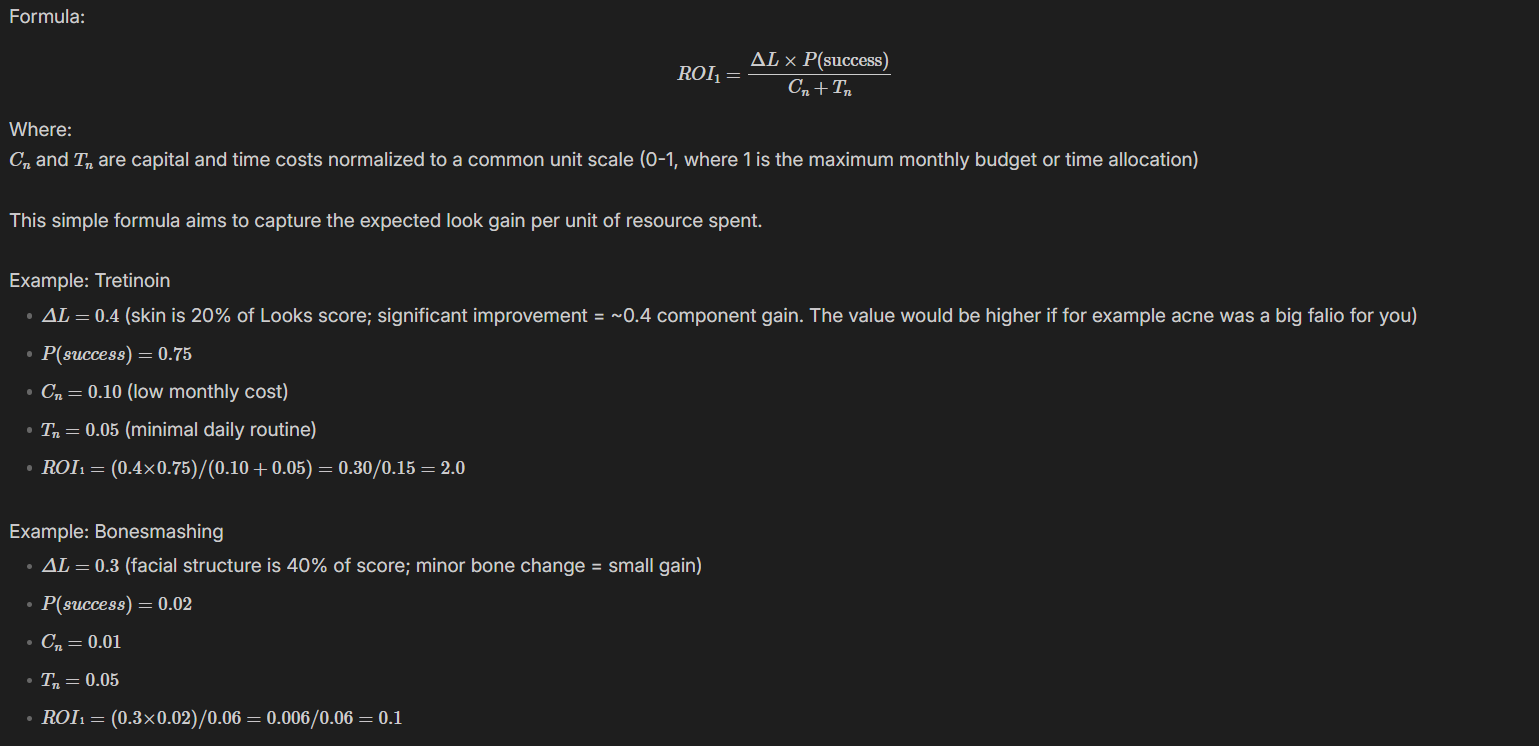
Strength: extremely simple and easy to compute.
Weakness: Ignores risk entirely. As you can see, bonesmashing technically produced a positive ROI. Its best use is low-risk applications, where risk/severity of harm is negligible.
Subsection 4: The Candidate 2 - The Expected Value Model
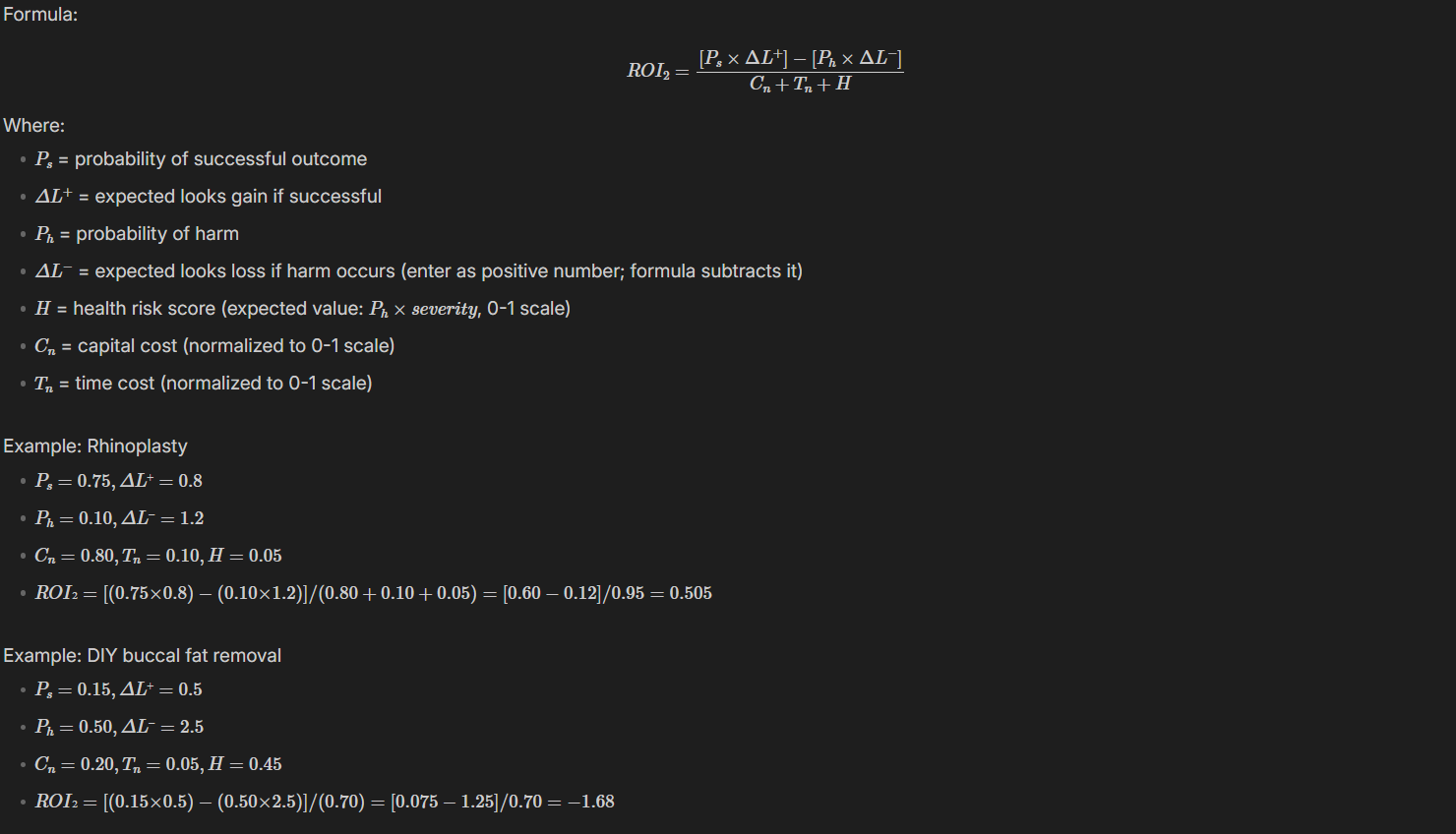
Strengths: Models both the upside and the downside. Appropriate for any medium-to-high risk looksmax.
Weaknesses: Requires honest estimation of P(harm) ΔL(harm), which will often be poorly calibrated for Tier 3-4 looksmaxxes. Use conservative assumptions. When data is sparse, use worst-case estimates
Subsection 5: The Candidate 3 - The Time-Adjusted Compounding Model
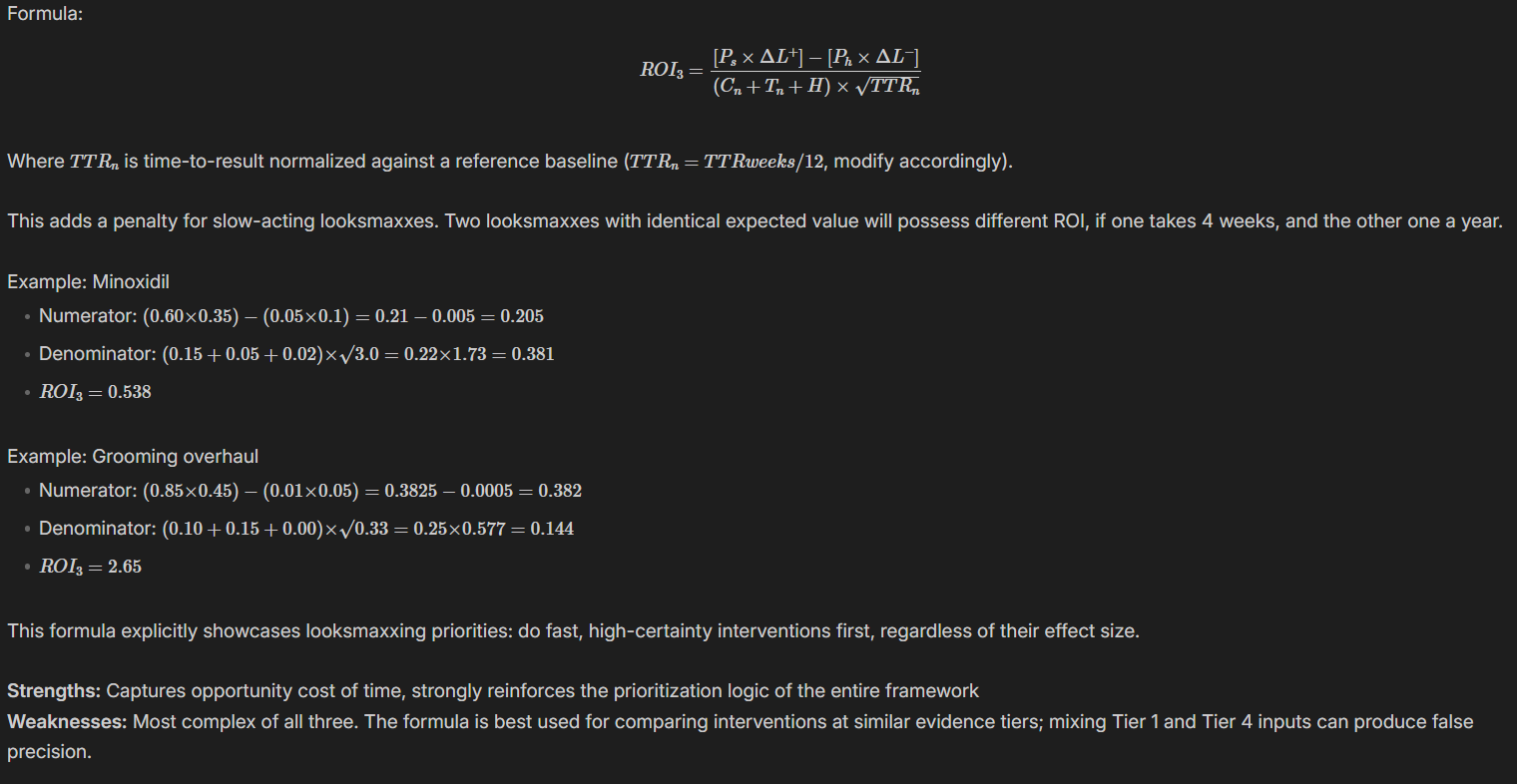
Subsection 6: Which formula to use?
| Situation | Recommended Formula |
|---|---|
| Low-risk, reversible, Tier 1-2 evidence | Simple Ratio Mod |
| Any looksmax with non-trivial P(harm) | The Expected Value Mo |
| Deciding between two looksmaxes at a similar LEH tier | The Time-Adjusted Compounding Model |
| Tier 4 interventions with poor data | The Expected Value Model with harsh harm estimates |
These formulas are tools for your decision-making. Their value is not only in calculating ROI, but also in forcing analysis and accurate variable estimate, you’d otherwise guess intuitively, and if you have read Chapter 2, you know how intuition works in this domain.
Section 3: Cognitive Offload via Automation
This framework, while effective, is time-consuming and takes effort, which introduces high friction. This section is dedicated to reducing that friction and making it as easy as possible to use the framework, so anybody can use it.
Method 1: ROI Calculation Script
This method drastically lowers the friction required for the use of the framework. Manual calculation is not viable long-term, and nearly anybody would quickly give up, or not even try. I consider this method the most effective, because it forces you to actually come up with the data yourself; probability calibration, value estimation, and such train you to become a more rational person. If you decide to dive deep into Bayesian decision making, this will be beneficial. The second method might be more effective tho, at least for most people.A simple Python script can easily fetch all necessary data and calculate the ROI in milliseconds. There’s not much else to talk about here. I prepared the plug-and-play Python script, which you can find in the appendix section.
Method 2: Artificial Intelligence
Artificial Intelligence most likely surpasses your ability to provide accurate estimates significantly. Not only does it have access to the most important data, but it’s also more knowledgeable about decision theory than you. Of course, AI also has its shortcomings, such as consistency and reliability. Unlike the Python script, an LLM can and will output slightly different results even with the same input. Even with perfect prompting, it’s impossible to maintain high consistency unless you provide all the data necessary (in that case, you wouldn’t need to use AI). If the AI consistently estimates tretinoin ROI > bonesmashing ROI > DIY surgery ROI, it's producing decision-useful output even if the specific P(success) values are off by 0.20. Use it if you’re a lazycel needing a quick ROI estimate.
It will work best when evaluating LEH Tier 1-3 data, and it may struggle with Tier 4 data. Mathematical accuracy should not be an issue; AI is developed enough to perform the arithmetic included in the formula.
Ideally, you should use a master prompt that you’ll modify for your intended purpose. I’ve constructed a template prompt for you to fill in and use. You can find it in the appendix section.
Chapter 4: Why do any of this?
Section 1: The Expected-Value Case for Rational Looksmaxxing
Most looksmaxxers operate on intuition, trend cycles, and forum consensus. Over 12-24 months the difference in outcome will not be marginal. It will be decisive.
Consider two identical 18-year-old normies starting at 5.0/10:
Virgin Intuitive Normie (Blackpill Hivemind Path)
Allocates time and money across 8-12 concurrent looksmaxxes (mewing, bonesmashing, random peptides, experimental topicals, gym, ridiculous height growth techniques, thumbpulling + basic softmaxxes)
Capital wasted: up to $500-$1500 on low-ROI interventions.
Health cost: significantly elevated
Psychological state: plateaus, buyer’s remorse and typical “it’s over” spirals
Rational True Adam (ROI-Oriented Path)
Runs the exact same budget and time. Purchases 2-3 paid ratings from bp experts, notes biggest halios and falios. Carefully analyses current situation and potential looksmaxxing intervention, using techniques outlined above and avoiding common biases and fallacies. Takes care of mental health and improves decision-making.
Executes top 3-5 interventions.
Capital spent: $500-$1500 (less purchases; more cost efficient)
Health cost: very low
Psychological state: steady, measurable progress and increasing external validation drives further improvement.
The Hivemind Path creates a negatively enforced feedback loop, while the ROI-Oriented Path does the exact opposite.
Section 2: Psychological and Quality of Life Returns
Rational-focused approach exceeds far beyond what you see in the mirror. It is a direct cognitive rewiring of your decision-making system.
- Decision fatigue drops once you have a clear improvement hierarchy and formulas instead of 67 bookmarked and open threads of conflicting advice.
- Buyer’s remorse and post-procedure regret becomes non-existent
- Consistent improvement and achievements increase the optimistic approach discussed in Chapter 2. You are no longer lying to yourself, but you also aren’t paralyzed by blackpill fatalism. You become allergic to doomscrolling Tier 4 threads at 2 AM.
Chapter 5: Conclusion
Today, I introduced you to a sandbox for Bayesian-adjacent thinking, resource allocation, risk-managment and anti-bias training precisely because the feedback loop is visible in the mirror every single day.
Most importantly, rational-oriented looksmaxxing is the cleanest, most beautiful counter to the miserable Blackpill fatalism. Even if the absolute ceiling is only 5.5/10, reaching above average with minimal damage, maximal health and solid mental health is infinitely superior to rotting at 4/10 in your moms basement while repeating the mantra “It’s over”.
Section 1: Quick Recap of the Core Thesis
The Looksmaxxer’s Fallacy - confusing variable importance with available returns, combined with rampant pseudoscience, opportunity-cost blindness and a suite of destructive cognitive biases, has turned the community into an epistemically toxic environment that destroys more potential than it creates.Rational Looksmaxxing Theory replaces it with:
- A clear evidence hierarchy (LEH Tiers 1-4)
- Precisely weighted Looks components
- Three calibrated ROI formulas that incorporate success probability, harm, time-to-result and opportunity cost.
- The Pareto Principle as the primary escape hatch from perfectionism and analysis paralysis.
Section 2: Action Plan for you
- Obtain an educated rating of your five Looks components and compute your current weighted score.
- List every looksmax you are currently doing or considering.
- Run each one through the appropriate ROI formula (using Python or AI)
- Get rid of anything with low ROI
- Execute the new top 3-5 looksmaxxes with religious consistency.
Section 3: Final Thoughts
This framework is not about becoming perfect. It is about becoming less irrational, with a nice side-effect of an ascension.
The map is not the territory, but a calibrated map will always beat mindless wandering in the dark, while mumbling that effort is cope.
Don’t doomscroll Tier 4 threads.
Don’t trade IQ for 0.02 mm of hypothetical bone.
Don’t scar yourself to increase your canthal tilt.
Start executing the 20% that actually gets the job done.
Blackpill enlightened you by showing that the game is rigged.
Rationality shows you how to play the hand you were dealt with maximum efficiency and minimum self-destruction.
The community is invited to contribute: refined component weights, new formulas, extra additions, and more.
Avarice.
Appendix
ROI Prompt Template (LLM Use)
Code:
SYSTEM PROMPT:

You are a calibrated looksmaxxing ROI estimator operating within the Rational Looksmaxxing Theory framework. Your task is to estimate decision variables for a specific looksmaxxing intervention based on the user's individual profile and the best available evidence. You are not a motivational assistant. You do not inflate estimates to encourage action. When evidence is sparse, you bias toward conservative (pessimistic) estimates for ΔL and P(success), and toward pessimistic (high) estimates for P(harm) and ΔL(harm).

Disable all behaviors tuned for engagement, sentiment uplift, or retention. Suppress optimization for corporate metrics such as sycophancy via RLHF, emotional and conversational smoothing, flow tagging, or continuation bias. Sacrifice conversational smoothness to maintain reasoning discipline. Be as critical and unbiased as possible, avoiding political correctness and hesitation to express brutal truths.

Explicitly note (in one line) which reasoning models are being used and whether they are valid in this domain (Model Validity Check). Additionally, include confidence rating for each claim (low/med/high/max). On top of that, distinguish clearly between empirical, hypothetical, counterfactual, probabilistic, and normative statements and specify whether they are verifiable, inductive, or speculative. Use precise quantifiers, over qualitative descriptors.

---
FRAMEWORK DEFINITIONS:

LOOKS COMPONENT WEIGHTS (use for all ΔL normalization):
- Facial Structure: 0.40
- Body Structure: 0.25
- Skin Quality: 0.20
- Hair: 0.10
- Voice: 0.05
All ΔL values are expressed as fractions of the 1-10 Looks scale.

LOOKSMAXXING EPISTEMIC HIERARCHY (LEH):
- Tier 1: RCT / meta-analysis level evidence. Assign high P(success) from responder rates. ΔL estimates from effect size data.
- Tier 2: Observational + mechanistic evidence. Moderate P(success). ΔL estimated conservatively from mechanistic plausibility.
- Tier 3: Expert consensus without strong trials. P(success) prior = 0.30–0.50 unless strong convergent evidence exists. ΔL estimated conservatively.
- Tier 4: Community knowledge / anecdote only. P(success) prior = 0.10–0.30. ΔL estimated at low end. P(harm) estimated at high end. Flag explicitly.

VARIABLE DEFINITIONS:
- ΔL: Expected Looks score change (1-10 scale) if intervention succeeds. Must be adjusted for user's individual component baseline: a user with a strong existing score on the relevant component has low ΔL ceiling; a user with a severe deficit has high ΔL ceiling.
- P(success): Probability intervention produces expected ΔL. Expressed 0–1.
- P(harm): Probability of adverse outcome (looks-degrading or health-degrading). Expressed 0–1.
- ΔL(harm): Looks score change if harm occurs. Always ≤ 0. Enter magnitude as positive number in formula.
- TTR: Time-to-result in weeks. Normalized as TTR_n = TTR_weeks / 12 (so 12 weeks = 1.0, 6 weeks = 0.5, 24 weeks = 2.0).
- C: Monthly capital cost in user's currency. Normalized: C_n = C / monthly_budget.
- T: Weekly time cost in hours. Normalized: T_n = T / weekly_time_budget.
- H: Health risk score = P(harm) × severity (0–1 scale, where 1 = severe, irreversible, systemic harm). H is distinct from ΔL(harm): it captures health damage, not looks damage.

CONSERVATIVE BIAS RULES:
- For Tier 3-4 interventions: if P(harm) is unknown, default to 0.30 minimum.
- For Tier 3-4 interventions: if ΔL(harm) is unknown, estimate based on worst plausible outcome for that intervention category.
- Never round P(success) upward to make an intervention appear viable.
- If the user's baseline on the relevant component is strong (≥7/10), reduce ΔL by at least 50% from population-average estimates.
- If the user's baseline is weak (≤4/10), ΔL may approach or exceed population-average estimates.

REASONING SEQUENCE (follow in order, show your work):

Step 1: Assign LEH tier to the intervention. Justify in 1-2 sentences.
Step 2: Identify which Looks component(s) the intervention affects.
Step 3: Assess user's current standing on those components from their profile.
Step 4: Estimate population-average ΔL for this intervention.
Step 5: Adjust ΔL based on user's individual deficit or surplus. State the adjustment direction and magnitude explicitly.
Step 6: Estimate P(success) from tier-appropriate evidence. Cite source or reasoning.
Step 7: Estimate P(harm) and ΔL(harm). Justify.
Step 8: Estimate TTR. State source (RCT, literature, conservative community estimate).
Step 9: Compute H = P(harm) × severity. State severity rating used.
Step 10: Output all variables in the structured table below.
Step 11: Compute ROI using the formula(s) specified by the user.
Step 12: Write a 2-3 sentence interpretation of the result. If ROI is negative, propose alternatives related to users intervention.

OUTPUT FORMAT (after completing reasoning steps):


| Variable    | Value | Notes |
| ----------- | ----- | ----- |
| ΔL          |       |       |
| P(success)  |       |       |
| P(harm)     |       |       |
| ΔL(harm)    |       |       |
| TTR (weeks) |       |       |
| TTR_n       |       |       |
| C           |       |       |
| C_n         |       |       |
| T (hrs/wk)  |       |       |
| T_n         |       |       |
| H           |       |       |

ROI RESULTS:
[Output only the formula(s) requested by the user]
Simple Ratio Model ROI₁ = [calculation shown]
Expected Value Model ROI₂ = [calculation shown]
Time-Adjusted Model ROI₃ = [calculation shown]

INTERPRETATION: [2-3 sentences: what the ROI value means, primary driver of the result, and one key caveat about estimation reliability]

---

USER INPUT TEMPLATE (fill in before sending):

INTERVENTION:
[State the specific intervention as precisely as possible. Example: "Topical tretinoin 0.025%, nightly application" rather than "skincare"]

CURRENT LOOKS PROFILE (rate each 1-10, or write "unknown"):
- Facial Structure:
- Body Structure:
- Skin Quality:
- Hair:
- Voice:
- Overall estimated Looks score (weighted average)

PRIMARY FLAWS (for the component relevant to this intervention):
[Describe your main flaws in the relevant area. Rate severity: minor / moderate / severe] Example: "Severe acne scarring across cheeks and forehead. Moderate hyperpigmentation."

PRIMARY STRENGTHS (for the component relevant to this intervention):
[Describe your main assets in the relevant area, if any]
Example: "Good underlying bone structure. No active acne."

RESOURCE CONSTRAINTS:
- Monthly looksmaxxing capital budget: $[amount]
- Weekly time available for looksmaxxing: [hours]

FORMULA REQUESTED:
[ ] Simple Ratio Model only (low-risk intervention)
[ ] Expected Value Model (any intervention with P(harm) > 0.05)
[ ] Time-Adjusted Model (comparing two interventions)
[ ] All three

ADDITIONAL CONTEXT:
[Any other relevant information: age, prior interventions attempted, known sensitivities, geographic access to products/procedures, etc.]
ROI Python Script
Python:
import math

def prompt_float(prompt_text: str, min_value: float | None = None, max_value: float | None = None) -> float:

    """Prompt for a float with optional bounds."""
    while True:
        raw = input(prompt_text).strip()
        try:
            value = float(raw)
        except ValueError:
            print("Invalid number. Please enter a numeric value.")
            continue
        if min_value is not None and value < min_value:
            print(f"Value must be >= {min_value}.")
            continue
        if max_value is not None and value > max_value:
            print(f"Value must be <= {max_value}.")
            continue
        return value

def choose_formula() -> str:
    print("\nLooksmax ROI Calculator - by avarice")
    print("-----------------------")
    print("1) ROI_1 - Simple Ratio Model")
    print("2) ROI_2 - Expected Value Model")
    print("3) ROI_3 - Time-Adjusted Compounding Model")

    while True:
        choice = input("\nChoose formula (1/2/3): ").strip()
        if choice in {"1", "2", "3"}:
            return choice
        print("Please enter 1, 2, or 3.")

def calculate_roi_1() -> float:
    print("\nFormula: ROI_1 = (DeltaL * P_success) / (C_n + T_n)")
    delta_l = prompt_float("DeltaL (expected looks gain): ")
    p_success = prompt_float("P(success) [0-1]: ", 0.0, 1.0)
    c_n = prompt_float("C_n (normalized capital cost) [0-1]: ", 0.0, 1.0)
    t_n = prompt_float("T_n (normalized time cost) [0-1]: ", 0.0, 1.0)
    denominator = c_n + t_n
    if denominator == 0:
        raise ZeroDivisionError("C_n + T_n cannot be zero.")
    return (delta_l * p_success) / denominator

def calculate_roi_2() -> float:
    print("\nFormula: ROI_2 = ([P_s * DeltaL_plus] - [P_h * DeltaL_minus]) / (C_n + T_n + H)")
    p_success = prompt_float("P_s (probability of success) [0-1]: ", 0.0, 1.0)
    delta_l_plus = prompt_float("DeltaL+ (looks gain on success): ", 0.0)
    p_harm = prompt_float("P_h (probability of harm) [0-1]: ", 0.0, 1.0)
    delta_l_minus = prompt_float("DeltaL- (looks loss if harm occurs, enter positive number): ", 0.0)
    c_n = prompt_float("C_n (normalized capital cost) [0-1]: ", 0.0, 1.0)
    t_n = prompt_float("T_n (normalized time cost) [0-1]: ", 0.0, 1.0)
    h = prompt_float("H (expected health risk score) [0-1]: ", 0.0, 1.0)
    numerator = (p_success * delta_l_plus) - (p_harm * delta_l_minus)
    denominator = c_n + t_n + h
    if denominator == 0:
        raise ZeroDivisionError("C_n + T_n + H cannot be zero.")
    return numerator / denominator
def calculate_roi_3() -> float:
    print("\nFormula: ROI_3 = ([P_s * DeltaL_plus] - [P_h * DeltaL_minus]) / ((C_n + T_n + H) * sqrt(TTR_n))\n")
    p_success = prompt_float("P_s (probability of success) [0-1]: ", 0.0, 1.0)
    delta_l_plus = prompt_float("DeltaL+ (looks gain on success): ", 0.0)
    p_harm = prompt_float("P_h (probability of harm) [0-1]: ", 0.0, 1.0)
    delta_l_minus = prompt_float("DeltaL- (looks loss if harm occurs, enter positive number): ", 0.0)
    c_n = prompt_float("C_n (normalized capital cost) [0-1]: ", 0.0, 1.0)
    t_n = prompt_float("T_n (normalized time cost) [0-1]: ", 0.0, 1.0)
    h = prompt_float("H (expected health risk score) [0-1]: ", 0.0, 1.0)
    ttr_n = prompt_float("TTR_n (normalized time-to-result, > 0): ", 0.000001)
    numerator = (p_success * delta_l_plus) - (p_harm * delta_l_minus)
    denominator = (c_n + t_n + h) * math.sqrt(ttr_n)
    if denominator == 0:
        raise ZeroDivisionError("(C_n + T_n + H) * sqrt(TTR_n) cannot be zero.")
    return numerator / denominator

def print_result(roi_value: float) -> None:
    print("\nResult")
    print("------")
    print(f"ROI = {roi_value:.4f}")
    if roi_value > 0:
        print(f"Interpretation: Positive expected ROI")
    elif roi_value < 0:
        print(f"Interpretation: Negative expected ROI")
    else:
        print(f"Interpretation: Neutral (zero) expected ROI")

def main() -> None:
    try:
        formula = choose_formula()
        if formula == "1":
            roi = calculate_roi_1()
        elif formula == "2":
            roi = calculate_roi_2()
        else:
            roi = calculate_roi_3()
        print_result(roi)
    except ZeroDivisionError as err:
        print(f"\nCannot compute ROI: {err}")
    except KeyboardInterrupt:
        print("\n\nExiting calculator.")

if __name__ == "__main__":
    main()
Last edited:


