myusufs
25 max
- Joined
- May 5, 2026
- Posts
- 41
- Reputation
- 11
RUNMAXXING
Most studies on head stabilization during locomotion have focused on walking which is more common and less costly than running. For most people, the most efficient speed of walking is about 1.2-1.5 m/sec (this value is largely function of leg length), which costs about 160 ml. O/kg/km. As we walk faster, the cost rises sharply, and we typically switch to a running gait at about 2.0-2.5 m/sec, when running be comes more economical, costing about 200-230 mL. O,/kg/km. Compared to most mammals, humans are terrible sprinters: the world's fastest humans can run at about 10 m/sec for less than 30 seconds; in contrast, a cheetah can run at 25 m/sec for about four minutes. However, we are phenomenal long-distance, aerobic endurance runners at moderate speeds (<6 m/sec), equaling or surpassing the best quadrupedal runners, such as dogs and horses, particularly in hot, arid conditions. Humans excel at long-distance running thanks to many derived anatomical and physiological specializations, many of which play no role in walking and which therefore suggest that selection for endurance-running capabilities played an important role in human evolution.
Running is different from fast walking and has fundamentally different effects on the head. Most critically, running is an inherently bouncy gait (not unlike a biped's version of a trot), in which the legs act as springs. In contrast to walking, running has an aerial phase in which both feet are off the ground. In addition, when the foot contacts the ground (at foot strike) during a run, the hip, knee, and ankle flex so that the body's center of mass falls for the first half of the stance phase, before the leg straightens and we jump the energy of the body's fall into elastic strain energy that is stored in the tendons and ligaments of the leg; this energy is subsequently released during the second half of stance, helping to propel the body forward and upward.
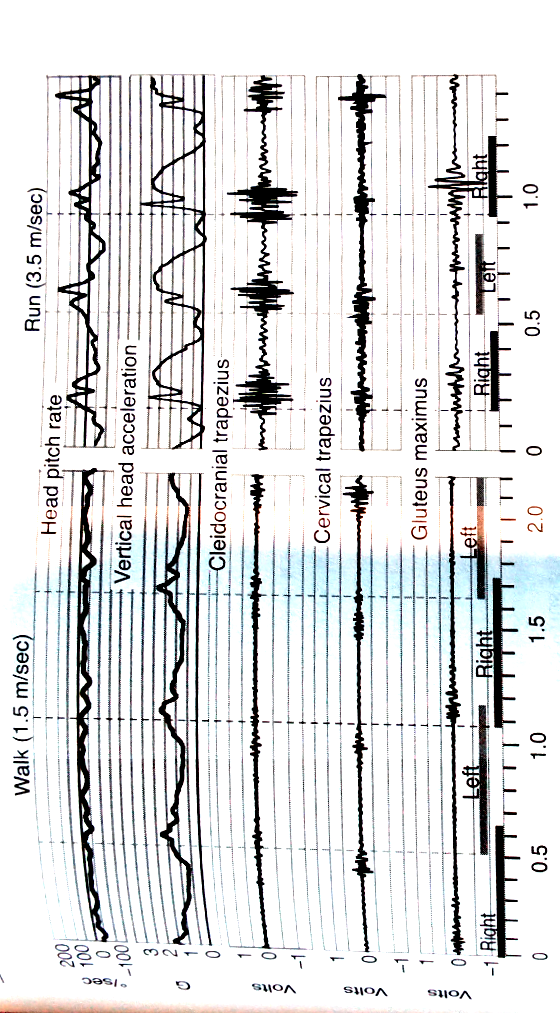
One difference between walking and running is how much the head bounces. Whereas the head rises and falls about 4-5 cm per stride in a typical walk in experiences vertical displacements of as much as 10 cm per stride during a typical run. When a dog or an ostrich runs, its head stays remarkably still, as if the body is moving independently of the head. This stability occurs because a dog or ostrich can flex and extend its neck, which is partly horizontal and can tilevered relative to the trunk, and can also flex and extend the head, which is cantilevered relative to the neck. But humans bounce vertically when they run with upright trunks, extended legs, and a short, vertical neck. These anatomical and postural differences cause angular rotations that challenge the head's stability in several ways. The first challenge occurs when the foot strikes the ground after the aerial phase in running. Runners who land on their heels (heel strike) generate an impulsive ground reaction force (GRF) that is typically twice that of a walk and can approach 3 times body mass. The HST impulse travels rapidly up the relatively straight leg and spine to the head within 6-10 milli-seconds, contributing to a peak of vertical acceleration in the head that can reach 2-4 G (G is the acceleration of gravity, 9.81 m/sec²), Runners who land on the ball of the foot (a forefoot strike) have no appreciable impact transient (they land more gently), but the upper body still decelerates somewhat after about 1-2 G. the foot contacts the ground, causing smaller vertical accelerations in the head.
Vertical accelerations such as the HST tend to pitch the head forward when there is also some degree of anterior acceleration, be cause the resultant of vertical and horizontal accelerations causes a forward-directed moment (a force times a moment arm). This moment can be substantial and rapid in humans right after a heel strike, causing the head's rate of pitching to increase from 0 to 100°/sec in less than 10 milliseconds (ms); this figure would exceed 200 "/sec in less than 20-30 ms if unchecked. Because VOR performance decreases significantly above 200% sec, such pitching is undesirable. And because 20-30 ms is too short a period for any normal reflexes, including the VCR, to control a motion the human head needs a self-stabilizing system to control head pinch in some way that does not rely on reflexes.
An even bigger challenge to head stabilization during running comes from the motion of the trunk. During a walk, the trunk is usually positioned above the hips and sways only slightly. But the much greater vector of the GRF during running, which passes well behind the trunk's center of mass, causes the trunk to pitch forward faster. In some ways, running is like a controlled, forward fall. This tendency is com pounded by the fact that humans typically incline the trunk more, at about 10°, at endurance speeds. At a moderate speed (3.5 m/sec), forward pitching of the trunk during phase 2 is typically 150-200°/sec and sometimes higher. We avoid falling down with every step because muscles of the lower back and hip, especially the gluteus maximus (the largest muscle in the human body), contract forcefully, quickly decelerating the trunk during phase 3. Because the head and neck are connected to the trunk, some stabilizing mechanism is necessary to prevent them from pitching first forward and then backward at similarly high angular velocities, thus challenging the vestibular system.
Finally, although pitching is a major concern, the head also has a tendency to roll, usually toward the stance-side foot at heel strike and then toward the swing side of the body by mid-stance. Yawing motions are comparatively minor. Another issue related to head stability is the position of the upper torso and arms. During the aerial phase of running, one leg swings forward rapidly. while the opposite leg swings rapidly behind the body. These movements generate considerable angular momentum around a vertical axis that must be counteracted to prevent the runner from moving in a zigzag path. Because the body has no foot contact with the ground to counteract these twisting forces, we swing the arms forward in opposite phase to the legs and rotate the torso in the direction of the stance foot, thereby generating nearly equal opposite angular momentum with the upper body. Because the whole upper body twists, a runner must rotate the neck in the opposite direction from the trunk to keep the head pointed forward.
4. A muscular reflex involves the time it takes for the stimulus to be sensed and transduced (about 5-10 ms) plus the latency period between the onset of muscle stimulation and the initiation of force usually more than 30 ms.
Although running poses more substantial challenges for head stabilization than walking, we evidently manage quite well. Human runners typically keep the angular velocity of the head below 140°/sec, well within range of the VOR for integrating ocular and vestibular sensory data to stabilize gaze. In fact, humans actually control head pitching better during running in the aerobic speed range (2.5-6.5 m/sec) than during very fast walking.
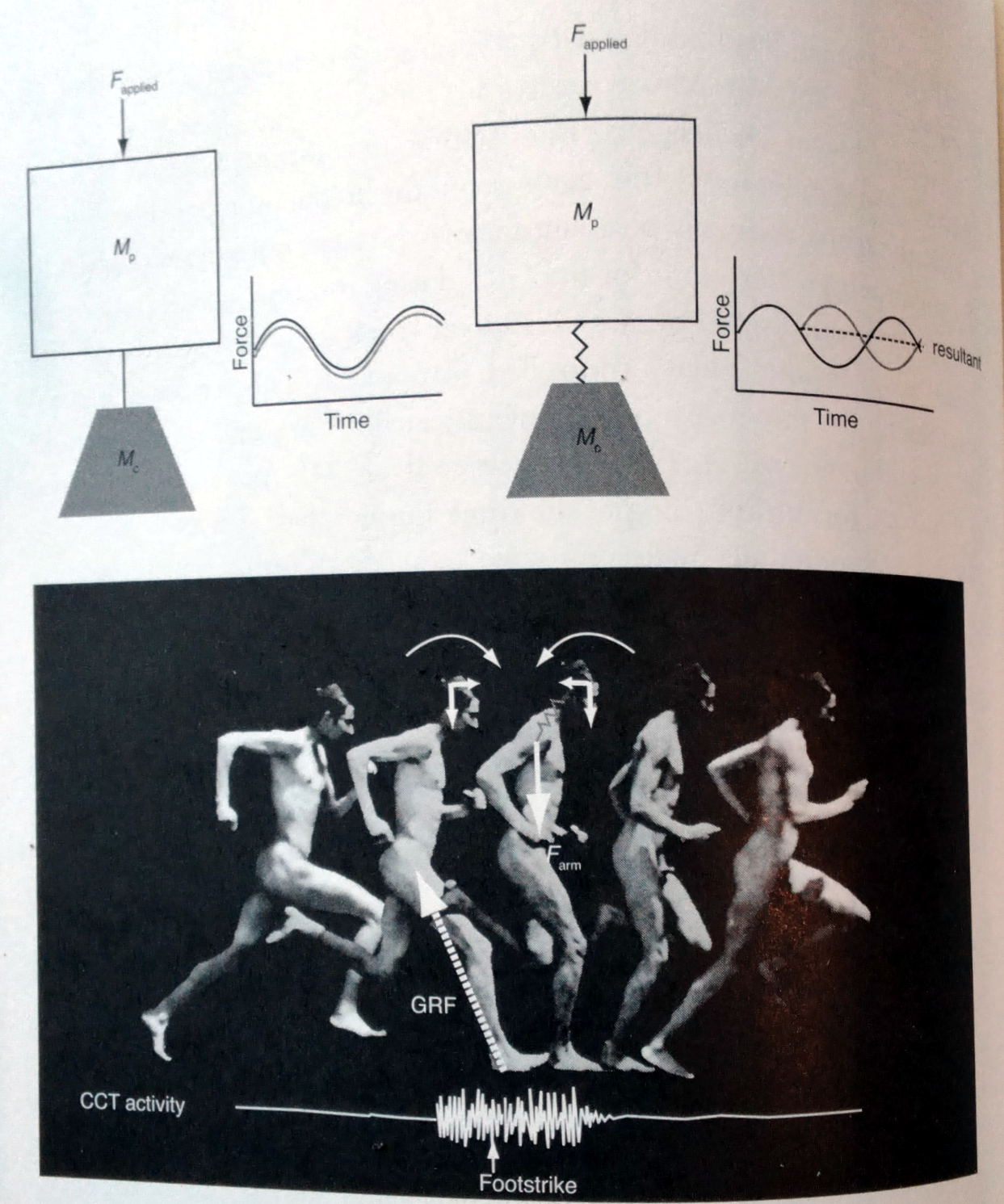
How do we do it? humans partly stabilize the head during running against vertical accelerations which induce pitching by using the mass of the arm as a counterbalance. This unusual system is analogous to a mechanism known as a mass-damper that engineers use to control vibrations in objects like buildings. Mass dampers work to protect a primary mass (M) from the force of a periodic external impulse such as wind, an earthquake, or an HST. If one connects this mass to another mass (M) via a rigid connection, then forces applied to the primary mass will generate accelerations in both masses that are in phase (the waves are synchronized). But if the two masses are connected by a spring with some degree of elasticity, then the second mass will be-have as a countermass, accelerating out of phase (out of sync) with the primary mass. As the primary mass accelerates in one direction, the countermass accelerates in the opposite direction, thereby damping the oscillation. In running, the head is the primary mass, and the stance-side arm is the countermass.
Several derived aspects of human anatomy and running kinematics enable humans to use the stance-side arm as a mass-damper for the head. Anatomically, humans differ from apes in having low, wide shoulders in which the only muscle that connects the back of the head and the shoulder girdle is a straplike portion of the trapezius, the cleidocranial trapezius (CCT). The CCT originates on the posterior occipital and inserts on the distal clavicle and the acromion process of the scapula. In contrast, apes have narrow, high, and massive shoulders in which several prominent muscles (trapezius and rhomboideus) extensively connect the shoulder girdle and occiput. This gives apes the appearance of permanently hunched shoulders. A second difference is the nuchal ligament in humans (absent in apes), which acts as the spring in the mass-damping system. Finally, each human arm constitutes about 8 percent of total body mass, almost the same as the head (5-6 kg); in contrast, the forelimb in a chimpanzee constitutes about 16 percent of body mass (about 7-8 kg), approximately twice the weight of the head.
Several aspects of human kinematics are also relevant to the head's mass-damping system. Most important, during a run, humans habitually rotate the arms and the shoulder girdle in a direction opposite to the motion of the legs; we also habitually contract the biceps to flex the elbow so that the forearm is carried at about 90° to the upper arm. As noted above, arm and shoulder rotations help to oppose the reverse angular mo-mentum generated by the legs during the aerial phase of running, but they also position the stance-side shoulder and the linked mass of the arm posterior to the neck at heel strike, thus in line with the nuchal ligament and CCT. In addition, the CCT contracts on just the stance side before foot strike, well before any other neck extensors are activated. Therefore, just after the head starts pitching forward after foot con-tact, downward force from the falling stance-side arm is coupled elastically by the CCT and nuchal ligament to the back of the head. Because the arm accelerates downward after the head starts pitching forward, the inertial mass of the arm both dampens the peak vertical acceleration of the head and acts to extend the head, thereby countering its tendency to pitch forward. Another important muscle that contracts before heel strike with greater intensity on the stance side is the biceps brachii. Because this muscle crosses both the elbow and shoulder joints, it links the mass of the forearm to the head via the upper arm and shoulder. We have found that volunteers asked to run without swinging their arms normally have higher vertical accelerations in the head as well as higher rates of head pitching.
One useful feature of this system is that it is self-adjusting. By coupling the arms and head via the CCT and nuchal ligament, the inertial forces in the stance-side arm and the head (which have nearly the same mass) tend to counterbalance each other regardless of speed, because the forces that drive the mass-damping system come from the same external source the ground-rather than muscles. Thus when running, bipedal humans can passively control head pitching at a wide range of speeds and on many different kinds of terrain.
The other major stabilization problem that confronts the human head during running is the rapid, forceful pitching (first forward, then backward) of the upright trunk. The derived anatomy of the human head-neck complex, in which the low shoulders are much less coupled than in apes to the head by muscles, also helps the head to stabilize itself passively from trunk pitching. Notably, the head and neck operate as a single segment partially independent from the trunk. Newton's third law states that for every action there is an equal and opposite reaction: so when the trunk accelerates forward and then backward (an angular acceleration), the head and neck accelerate backward and then forward at the AOJ (again, this is an angular acceleration), much as a passenger's head gets "whiplashed" in a car that suddenly lurches forward and then back. The elegance of the system is that it is self-stabilizing. The more the trunk pitches, the more the head reacts. However, this inertial damping mechanism is possible only when there are not extensive, stiff connections between the head and the upper trunk (that is, the head and neck need to flop independently of the trunk).
In other words, when hominins evolved to be bipedal, they created some challenges for head stabilization, especially during running. At some point, natural selection may have favored several derived mechanisms to keep the head stable during running. Notably, the arm functions as a mass-damping counterbalance, and the head can pitch (whiplash) backward, then forward, as the trunk pitches forward, then backward. These stabilization mechanisms may help explain several derived features of the human head-neck complex that are otherwise hard to account for in terms of function: a nuchal ligament; low and wide disconnected shoulders, which have lost most of their muscular connection to the head: and relatively larger anterior and posterior semicircular canals, which increase sensitivity to pitching accelerations. To this list, we might add a more balanced head. As noted above, walking imposes minimal pitching forces on the head, and other mammals (and birds) use their necks to control head movements when running. Because humans use inertial forces to passively control pitching forces, decreasing the moment arm from the AOJ to the head's COG decreases the inertial force necessary to stabilize the head.
The unique human system for head stabilization may be a good example of evolutionary tinkering. Once hominins became bipedal, they lost many of the mechanisms that quadrupeds employ to stabilize the head. In addition, up-right trunks posed new problems for stability. When endurance running be-came an important behavior, probably sometime after the evolution of the genus Homo, there might have been selection for hominins that were better at running. If so, then hominins better able to stabilize their heads, thanks to features such as the nuchal ligament and more disconnected shoulders, would have had some advantage. The likely disadvantage of the human system, how-ever, is that it cannot operate with the anatomical configuration of our ape-like arboreal ancestors. Great apes (and possibly australopiths) have a narrow upper thorax, along with massive scapular rotators, such as the trapezius and rhomboids, that connect the occiput and shoulder girdle. These rotators are advantageous for arboreal locomotion because they help pull the body up from a hanging position, but they would impede independent movements of the head and pectoral girdle that are crucial to controlling head pitch in humans during running (but not walking). Perhaps selection for stabilizing the head during running explains why the genus Homo lost some features of the upper body that were useful for climbing trees.