


serraticalanterior
young sensitive afro-greek man
- Joined
- Feb 6, 2026
- Posts
- 141
- Reputation
- 76
THE ONLY WAY TO GROW TALLER IS UNDERSTANDING HOW LONGTITUDAL GROWTH WORKS.
DISCLAIMER: THIS IS NOT MEDICAL ADVICE, DON'T TRY AND MANIPULATE YOUR HEIGHT GROWTH.
DISCLAIMER: THIS IS NOT MEDICAL ADVICE, DON'T TRY AND MANIPULATE YOUR HEIGHT GROWTH.
Human Growth Hormone (Somatropin) will not make you taller than 1-7cm, even with high dosages. HGH is a synthetic of GH (Growth Hormone,) a protein that your pituitary gland secretes in bursts throughout the day. Growth Hormone (GH) assists your body in protein synthesis, lipolysis, and bone-growth during childhood. Through a hormonal downstream, GH will stimulate the liver to create IGF-1 (Insulin-like Growth Factor 1.) IGF-1 is the mechanism that tells your cells to grow; it makes osteoblasts (the cells that grow bone) multiply and mineralize. GH will only cling to the receptors of these bones to stimulate the production of IGF-1.
In theory, HGH will significantly increase your height, but in practice, there is little longitudinal benefit for non GH-deficit teens. Osteogenesis (bone growth) doesn't solely use GH--although it is the main mechanism for Osteogenesis. In order to maximize bone growth, you have to directly stimulate the cells. Cell production is not linear to an excess in GH. GH will only support the pathways the cells are made, not create or inhibit them, meaning you are NOT maximizing longitudinal growth.
Yes, people with gigantism produce an excess in GH, but that's only half of the equation as to why they get so tall. Their endocrine systems typically have tumors on the pituitary glands. As a result, their brain fails to create a negative feedback loop between Somatostatin and GH. Somatostatin is a hormone that shuts down your natural production of GH until the excess leaves your body. In order to replicate this, you'd have to target far more than just IGF-1 production hormonally, which is just not possible due to the many pathways GH influences. Gigantism is not the same as CATSHL Syndrome

"Figure 3. Regulatory feedback loops in the hypothalamic control of pituitary growth hormone secretion. Growth hormone-releasing hormone (GHRH) and somatostatin (SS) are the principal stimulatory and inhibitory factors mediating GH secretion. GH stimulates the synthesis and release of insulin-like growth factor-I (IGF-I) from hepatocytes, which inhibits GH secretion from the pituitary. GH also inhibits its own secretion by a short-loop feedback circuit involving the stimulation of somatostatin neurons in the periventricular nucleus (PeVN) of the hypothalamus. A common neural mechanism leading to the inhibition of GH secretion is the activation of somatostatin neurons. Stimulatory and inhibitory neuronal synapses are represented by circular terminals marked with a plus or minus sign, respectively. Stimulatory and inhibitory hormonal pathways are represented by arrows with a plus sign or bars with a minus sign, respectively. Arc N, Arcuate nucleus." Somatostatin Release
In conclusion, Somatropin in theory can increase final adult height, but there are many genetic factors to how you'll respond to the hormone. If you really want to grow, it shouldn't be your sole and only. Optimize your hormones for height growth, (healthy e2 and test,) but don't expect hormones alone to make you a 6'0" slayer. For us without fucked up endocrine systems, we should focus on cellular manipulation, instead.
Sources:
Effect of GH/IGF-1 on Bone Metabolism and Osteoporsosis
Growth Hormone, Insulin-Like Growth Factors, and the Skeleton
In theory, HGH will significantly increase your height, but in practice, there is little longitudinal benefit for non GH-deficit teens. Osteogenesis (bone growth) doesn't solely use GH--although it is the main mechanism for Osteogenesis. In order to maximize bone growth, you have to directly stimulate the cells. Cell production is not linear to an excess in GH. GH will only support the pathways the cells are made, not create or inhibit them, meaning you are NOT maximizing longitudinal growth.
Yes, people with gigantism produce an excess in GH, but that's only half of the equation as to why they get so tall. Their endocrine systems typically have tumors on the pituitary glands. As a result, their brain fails to create a negative feedback loop between Somatostatin and GH. Somatostatin is a hormone that shuts down your natural production of GH until the excess leaves your body. In order to replicate this, you'd have to target far more than just IGF-1 production hormonally, which is just not possible due to the many pathways GH influences. Gigantism is not the same as CATSHL Syndrome
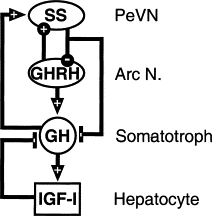
"Figure 3. Regulatory feedback loops in the hypothalamic control of pituitary growth hormone secretion. Growth hormone-releasing hormone (GHRH) and somatostatin (SS) are the principal stimulatory and inhibitory factors mediating GH secretion. GH stimulates the synthesis and release of insulin-like growth factor-I (IGF-I) from hepatocytes, which inhibits GH secretion from the pituitary. GH also inhibits its own secretion by a short-loop feedback circuit involving the stimulation of somatostatin neurons in the periventricular nucleus (PeVN) of the hypothalamus. A common neural mechanism leading to the inhibition of GH secretion is the activation of somatostatin neurons. Stimulatory and inhibitory neuronal synapses are represented by circular terminals marked with a plus or minus sign, respectively. Stimulatory and inhibitory hormonal pathways are represented by arrows with a plus sign or bars with a minus sign, respectively. Arc N, Arcuate nucleus." Somatostatin Release
In conclusion, Somatropin in theory can increase final adult height, but there are many genetic factors to how you'll respond to the hormone. If you really want to grow, it shouldn't be your sole and only. Optimize your hormones for height growth, (healthy e2 and test,) but don't expect hormones alone to make you a 6'0" slayer. For us without fucked up endocrine systems, we should focus on cellular manipulation, instead.
Sources:
Effect of GH/IGF-1 on Bone Metabolism and Osteoporsosis
Growth Hormone, Insulin-Like Growth Factors, and the Skeleton
There are two kinds of bone growth; Intramembranous and endochondral ossification. Endochondral ossification is the bone growth centered around the axial, and most importantly, appendicular skeleton. Intramembranous forms the flat bones, so we won't focus on that, but it is important to know as they overlap.
When fetuses are developing they have a transient cartilaginous skeleton, which means their skeleton is cartilage and mineralizes into real bone through endochondral ossification. The remnants of your fetal cartilage is your growth plates (epiphyseal plates,) which allow for longitudinal growth until the hormone estrogen signals cartilage to ossify into bone.
Sources explaining ossification
Embryology, Bone Ossification
Bone Development and Growth
Patterning of cartilaginous condensations in the developing facial skeleton
Evidence That Estrogen Hastens Epiphyseal Fusion and Cessation of Longitudinal Bone Growth by Irreversibly Depleting the Number of Resting Zone Progenitor Cells in Female Rabbits
When fetuses are developing they have a transient cartilaginous skeleton, which means their skeleton is cartilage and mineralizes into real bone through endochondral ossification. The remnants of your fetal cartilage is your growth plates (epiphyseal plates,) which allow for longitudinal growth until the hormone estrogen signals cartilage to ossify into bone.
Sources explaining ossification
Embryology, Bone Ossification
Bone Development and Growth
Patterning of cartilaginous condensations in the developing facial skeleton
Evidence That Estrogen Hastens Epiphyseal Fusion and Cessation of Longitudinal Bone Growth by Irreversibly Depleting the Number of Resting Zone Progenitor Cells in Female Rabbits
Longitudinal growth is only possible with chondrocytes, cells that make up cartilage and allow for it's flexibility and survival with little blood vessels. Chondrocytes secrete EM (extracellular matrix,) which is the precursor to real bone. Your height depends on how much EM your Chondrocytes can produce, as overtime, EM will calcify into bone. Chondrocytes will die overtime, secreting a peptide that causes the migration of osteoblasts and osteoclasts (bone cells) that'll replace the cartilage and close your growth plates for good. The only way to produce more EM pharmaceutically is a FGFR3 (signaling pathway) inhibitor.
To manipulate the endochondral process; you first must understand signaling pathways. Your body uses chemical cues to know when and how to do things. For longitudinal growth, the effectiveness of these pathways are largely genetic, although external factors will dictate how well the body can produce the hormones for this process. (sleep, nutrition, weight, etc.) Sleep & nutrition directly affect GH levels, meanwhile a higher body fat % increases your body's estrogen (closes growth plates early, ending the process.)

Paracrine control of growth plate.
Notes. Ihh (Indian hedgehog) enhances the proliferation and maturation of chondrocytes and induces the expression of parathyroid hormone-related protein (PTHrP) in the periarticular region. PTHrP prevents premature hypertrophic differentiation. The negative feedback loop between Ihh and PTHrP keeps chondrocytes in the proliferating state, controls chondrocyte proliferation, and maintains the lengths of columns.
Ihh and bone morphogenic protein (BMP) are in a positive feedback loop with each other and up-regulate chondrocyte proliferation together. In addition, BMP inhibits the development of terminally differentiated chondrocytes.
Fibroblast growth factor (FGF) signalling is antagonistic to BMP activity. FGF expression down-regulates chondrocyte proliferation and hypertrophy by inhibiting Ihh and promotes chondrocyte differentiation.
Runt-related transcription factor 2 (RUNX2) positively regulates Ihh expression and promotes chondrocyte proliferation, but it is inhibited by PTHrP, which is induced by Ihh.
Sox-9 signalling contributes to chondrogenesis in different steps. Sox-9 up-regulates chondrogenic mesenchymal condensation, chondrocyte differentiation, and normal chondrocyte proliferation and inhibits the transition of proliferating chondrocytes to hypertrophy.
Insulin-like growth factor 1 (IGF-1) signalling modulates chondrogenesis by both suppressing PTHrP production and inducing the mammalian target of rapamycin (mTOR) signalling activity, which plays a role in all stages of chondrocyte maturation.
The Gigantism equivalent of cellular pathways causing abnormal height growth is CATSHL syndrome. CATSHL is caused by the FGFR3 not inhibiting bone growth, and they end up extremely deformed, although there has only been 30 documented cases. Perhaps TYRA?
Sources explaining pathways & growth:
The growth plate: a physiologic overview
Bone morphogenetic protein 2 stimulates endochondral ossification by regulating periosteal cell fate during bone repair
FGF signaling pathways in endochondral and intramembranous bone development and human genetic diseas
To manipulate the endochondral process; you first must understand signaling pathways. Your body uses chemical cues to know when and how to do things. For longitudinal growth, the effectiveness of these pathways are largely genetic, although external factors will dictate how well the body can produce the hormones for this process. (sleep, nutrition, weight, etc.) Sleep & nutrition directly affect GH levels, meanwhile a higher body fat % increases your body's estrogen (closes growth plates early, ending the process.)
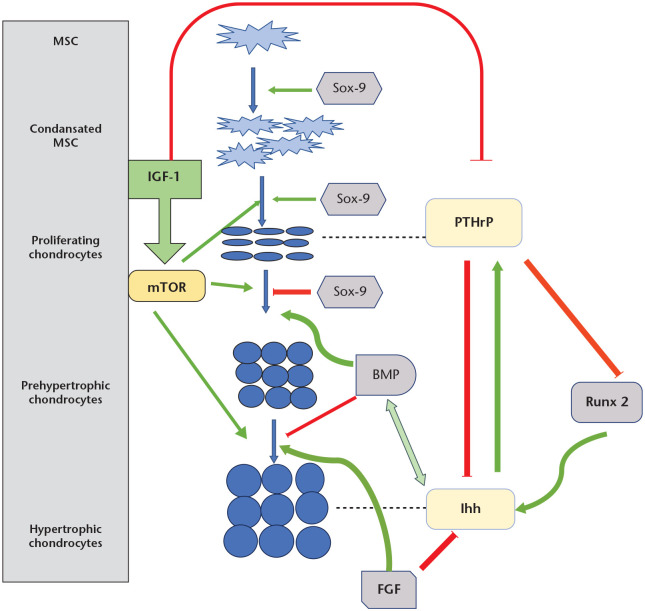
Paracrine control of growth plate.
Notes. Ihh (Indian hedgehog) enhances the proliferation and maturation of chondrocytes and induces the expression of parathyroid hormone-related protein (PTHrP) in the periarticular region. PTHrP prevents premature hypertrophic differentiation. The negative feedback loop between Ihh and PTHrP keeps chondrocytes in the proliferating state, controls chondrocyte proliferation, and maintains the lengths of columns.
Ihh and bone morphogenic protein (BMP) are in a positive feedback loop with each other and up-regulate chondrocyte proliferation together. In addition, BMP inhibits the development of terminally differentiated chondrocytes.
Fibroblast growth factor (FGF) signalling is antagonistic to BMP activity. FGF expression down-regulates chondrocyte proliferation and hypertrophy by inhibiting Ihh and promotes chondrocyte differentiation.
Runt-related transcription factor 2 (RUNX2) positively regulates Ihh expression and promotes chondrocyte proliferation, but it is inhibited by PTHrP, which is induced by Ihh.
Sox-9 signalling contributes to chondrogenesis in different steps. Sox-9 up-regulates chondrogenic mesenchymal condensation, chondrocyte differentiation, and normal chondrocyte proliferation and inhibits the transition of proliferating chondrocytes to hypertrophy.
Insulin-like growth factor 1 (IGF-1) signalling modulates chondrogenesis by both suppressing PTHrP production and inducing the mammalian target of rapamycin (mTOR) signalling activity, which plays a role in all stages of chondrocyte maturation.
The Gigantism equivalent of cellular pathways causing abnormal height growth is CATSHL syndrome. CATSHL is caused by the FGFR3 not inhibiting bone growth, and they end up extremely deformed, although there has only been 30 documented cases. Perhaps TYRA?
Sources explaining pathways & growth:
The growth plate: a physiologic overview
Bone morphogenetic protein 2 stimulates endochondral ossification by regulating periosteal cell fate during bone repair
FGF signaling pathways in endochondral and intramembranous bone development and human genetic diseas
The factors of height growth are so varying that it's not easy to just inject IGF-1 or HGH and expect to grow from it. There are up to 10,000 genes, each with their own signaling pathways and feedback loops. Scientists are focusing on FGF, specifically FGFR3. If an inhibitor drops, maybe our grandkids can be 6'5" and avoid hypergamy, or get CATSHL 
First high iq post btw
First high iq post btw


