




Social Class: "I left the house at 18. It built character"

Seth Walsh

Seth Walsh

Iconoclast
Contributor
Joined
Jan 12, 2020
Posts
10,904
Reputation
22,273
No long thread here just a simple analysis.

Let's take two 40 year olds.

They were both 18 in June 2004.

€1.8k per month on rent (on average throughout the years).

Person A moved out on his/her 18th birthday. Paid €1.8k per month, non stop, on average, since June 2004.

Other person lived with parents 'til 33-34 (circa 2018). And saved and invested the difference throughout.

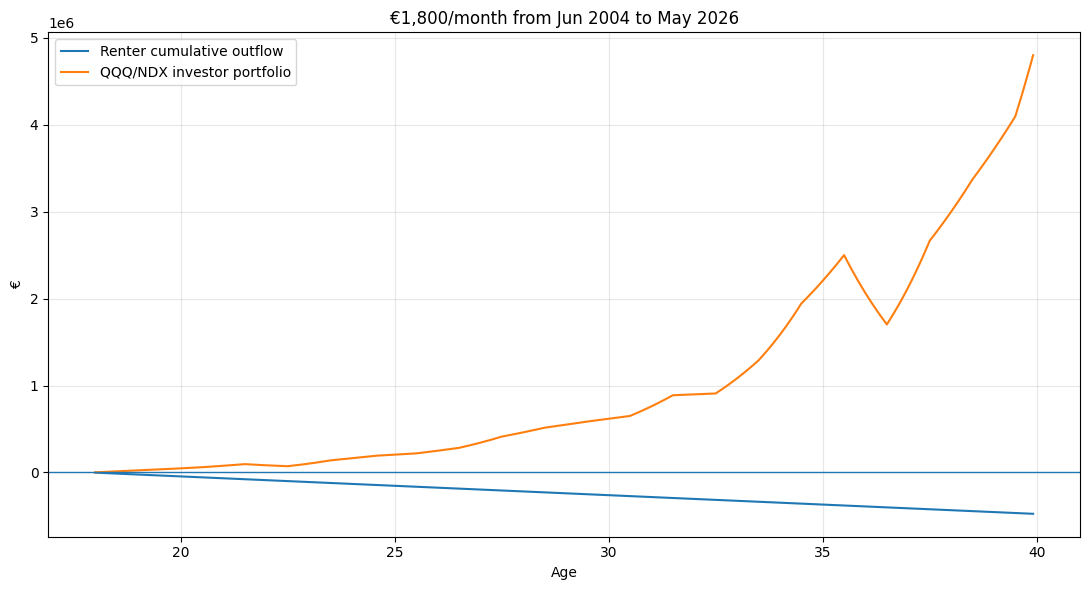
The below graphs speak for themselves.
1779528034670

1779528049533


The crazy part is that the investor didn’t do anything magical.
They just consistently bought ownership in the fastest-growing companies on earth for 22 years instead of handing that same money over in rent every month.
That €1.8k wasn’t just “saved.” It became shares in Apple, Microsoft, Nvidia, Amazon, Google, Meta, etc. Every crash, recovery, bubble, AI wave, smartphone wave, cloud boom and tech expansion kept compounding underneath them.
Meanwhile the renter was still spending the exact same amount of money every month — but at the end of it, there was nothing left compounding for them.
By 40, the difference isn’t just financial. It’s psychological and structural.
One person has:
  • millions in appreciating assets
  • optionality
  • freedom to take risks
  • freedom to walk away from bad jobs
  • capital producing more capital
The other is still dependent on monthly income to maintain their position.
That’s why low burn + early investing is so powerful. It’s not about frugality aesthetics. It’s about getting ownership exposure early enough that time starts working for you instead of against you.
 
  • +1
Reactions: theübermenschboy, bluebandz, overtier1011 and 12 others
mirin
 
  • +1
  • Love it
Reactions: Deleted member 77427, cattboy, stigmaboy and 1 other person
  • +1
Reactions: theübermenschboy, Deleted member 77427, Hernan and 3 others
good thread man
 
  • +1
  • Love it
Reactions: Deleted member 77427, stigmaboy and Seth Walsh
the only one accurate there is UK outside of london

the average rent for single apartment is NOT £1500-£2k/mo:lul:
In the city of London, Bishopsgate, Spittalfields. It absolutely is
 
  • +1
Reactions: theübermenschboy and Deleted member 77427
@ducksoover lol that's like 20k a year for rent alone. imagine.

pretty sure that's just cope money for people who never learned to mog. it's over for landlords anyway.
 
  • +1
Reactions: Deleted member 77427
In the city of London, Bishopsgate, Spittalfields. It absolutely is
oh so in the most expensive areas in the UK, right

you base the average rent prices off the most expensive areas in the country, stop spreading misinformation

most people are paying £800-1200
 
  • +1
Reactions: Deleted member 77427
oh so in the most expensive areas in the UK, right

you base the average rent prices off the most expensive areas in the country, stop spreading misinformation

most people are paying £800-1200
Basing it where jobs are now where there's Sheep and Cows
 
  • +1
Reactions: Deleted member 77427
Basing it where jobs are now where there's Sheep and Cows
i live in south east, very close to london and most are paying £800-£1200
 
  • +1
Reactions: Seth Walsh
No long thread here just a simple analysis.

Let's take two 40 year olds.

They were both 18 in June 2004.

€1.8k per month on rent (on average throughout the years).

Person A moved out on his/her 18th birthday. Paid €1.8k per month, non stop, on average, since June 2004.

Other person lived with parents 'til 33-34 (circa 2018). And saved and invested the difference throughout.

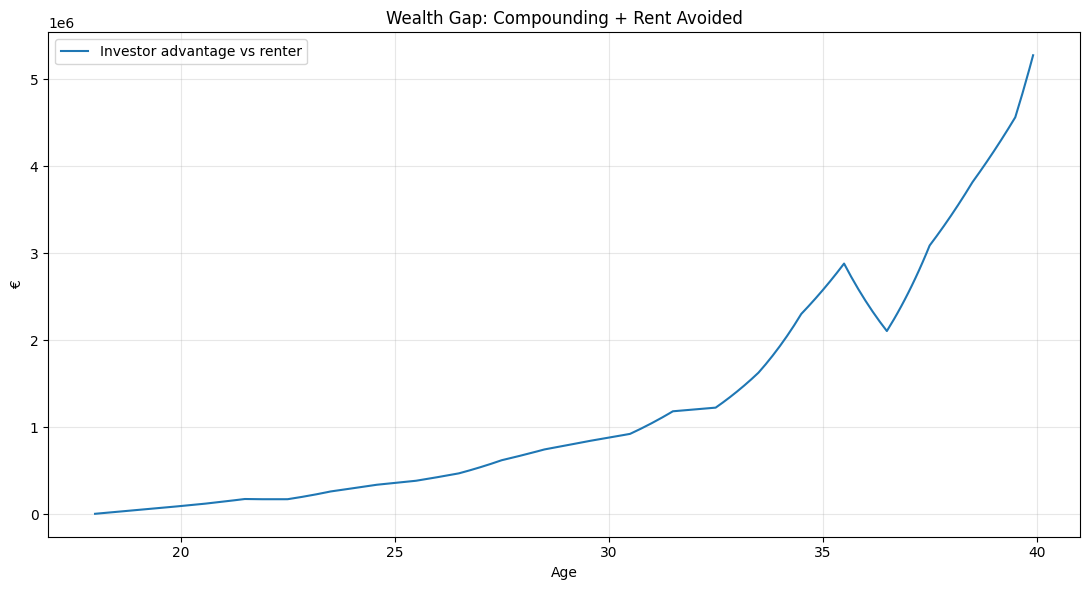
The below graphs speak for themselves.
View attachment 5105079
View attachment 5105081

The crazy part is that the investor didn’t do anything magical.
They just consistently bought ownership in the fastest-growing companies on earth for 22 years instead of handing that same money over in rent every month.
That €1.8k wasn’t just “saved.” It became shares in Apple, Microsoft, Nvidia, Amazon, Google, Meta, etc. Every crash, recovery, bubble, AI wave, smartphone wave, cloud boom and tech expansion kept compounding underneath them.
Meanwhile the renter was still spending the exact same amount of money every month — but at the end of it, there was nothing left compounding for them.
By 40, the difference isn’t just financial. It’s psychological and structural.
One person has:
  • millions in appreciating assets
  • optionality
  • freedom to take risks
  • freedom to walk away from bad jobs
  • capital producing more capital
The other is still dependent on monthly income to maintain their position.
That’s why low burn + early investing is so powerful. It’s not about frugality aesthetics. It’s about getting ownership exposure early enough that time starts working for you instead of against you.
Living till 33 with your parents is genuinely hell though, why would you spend your twenties willingly rotting with your parents

I don't think any financial benefit can justify that lack of freedom tbh
 
important

JUMP
 
Living till 33 with your parents is genuinely hell though, why would you spend your twenties willingly rotting with your parents

I don't think any financial benefit can justify that lack of freedom tbh
Paying €2k a month and calling it freedom is cope.

All of the higher class live with their parents and go to University Ball with Stacy and marry etc.

Renting is no longer viewed as "freedom", it's accepted as lower class, lower/no capital accumulation.
 
  • Woah
Reactions: FutureExoticChad
Chatgpt thread but true moving out at 18 is extreme cope and I don't know why parents encourage that.
 
  • +1
Reactions: Seth Walsh
You can get a job while living with your parents anyways.
 
  • +1
Reactions: Seth Walsh
Chatgpt thread but true moving out at 18 is extreme cope and I don't know why parents encourage that.
Yup
 
  • +1
Reactions: ase
This is flawed because the investor will be socially shunned and end up with severe career disadvantages. You have to move out or you simply won’t be taken seriously. Perhaps you can just lie about it, idk.

Not to mention rents were not 1.8k in 2004, that’s dumb.
 
Last edited:
This is flawed because the investor will be socially shunned and end up with severe career disadvantages. You have to move out or you simply won’t be taken seriously. Perhaps you can just lie about it, idk.

Not to mention rents were not 1.8k in 2004, that’s dumb.
You don't have to move out to be taken seriously and yeah you can just lie and say you rent when you live with your parents.

I think you're overweighting "just network bro" as a legitimate way to boost career earnings; that's not the truth.

Also another blackpill is that most "renters" that are thriving have all their expenses (including the rent) fully subsidized by their parents. With their parents network doing a lot of the work institutionally/prestige wise too.

The most successful people I know are those in high paid career tracks living at home, banking the surplus each month and compounding.
 
You don't have to move out to be taken seriously and yeah you can just lie and say you rent when you live with your parents.

I think you're overweighting "just network bro" as a legitimate way to boost career earnings; that's not the truth.

Also another blackpill is that most "renters" that are thriving have all their expenses (including the rent) fully subsidized by their parents. With their parents network doing a lot of the work institutionally/prestige wise too.

The most successful people I know are those in high paid career tracks living at home, banking the surplus each month and compounding.
The alternative is to cancel out your entire monthly pay check and live in survival mode just to perform independence, when others' "independence" is fully subsidized by the family balance sheet?

This is the core point of my 250+ threads on social class / family balance sheet stuff.
 
This is flawed because the investor will be socially shunned and end up with severe career disadvantages. You have to move out or you simply won’t be taken seriously. Perhaps you can just lie about it, idk.

Not to mention rents were not 1.8k in 2004, that’s dumb.
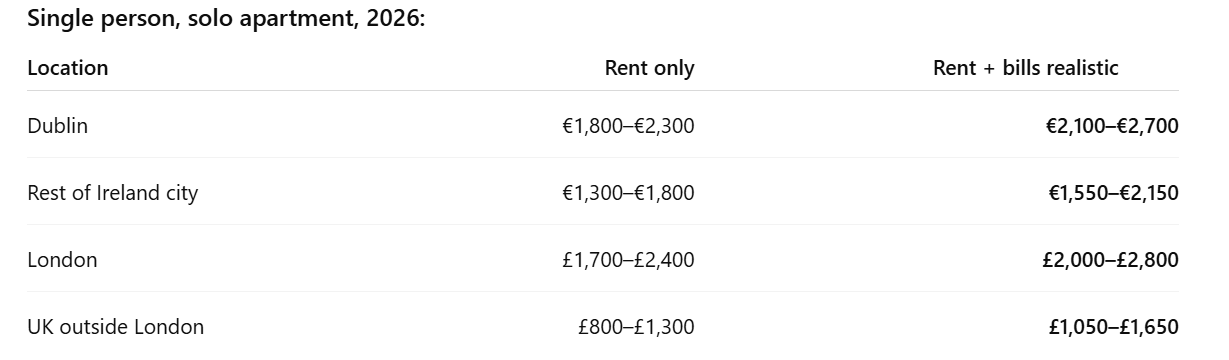
I used 1.8k as a smoothed average since currently the average rent for a 1 bed without accounting for expenses is like €2.2k in Ireland. With utilities, food, wifi etc it's closer to €2.7k. If you want to have 5 incel low class roommates you can pay €1.1k minimum and nerf your net take home pay by at least 33% before even beginning to play the same game as capital backed nepos.
 
You don't have to move out to be taken seriously and yeah you can just lie and say you rent when you live with your parents.

I think you're overweighting "just network bro" as a legitimate way to boost career earnings; that's not the truth.

Also another blackpill is that most "renters" that are thriving have all their expenses (including the rent) fully subsidized by their parents. With their parents network doing a lot of the work institutionally/prestige wise too.

The most successful people I know are those in high paid career tracks living at home, banking the surplus each month and compounding.

Not sure, I’m a pariah at work because I admitted to living with my parents and I can’t help but think having such a poor reputation with the team means I’m always going to be passed over for promotions and be first on the chopping block for layoffs.

Perhaps it’s different in high paid career tracks, mine is low paid so maybe more value is placed on conformity here rather than outright wealth building. I did try my best to get into what was a high paying field at the time I did my education but unfortunately the whole field crumbled into a quasi-minimum wage shithole in the last decade.
 
Not sure, I’m a pariah at work because I admitted to living with my parents and I can’t help but think having such a poor reputation with the team means I’m always going to be passed over for promotions and be first on the chopping block for layoffs.

Perhaps it’s different in high paid career tracks, mine is low paid so maybe more value is placed on conformity here rather than outright wealth building. I did try my best to get into what was a high paying field at the time I did my education but unfortunately the whole field crumbled into a quasi-minimum wage shithole in the last decade.
Your managers are viewing it from a different lens. They are annoyed, and a bit jealous that you have no fixed costs. It means you're (likely) less dependent on the next wage check.

Many companies run stealth operational risk checks and try to model cost-centre employees based off their ability to leave at any time. When they hear no fixed costs, they don't think "lives with parents, not serious adult" .. they think "fuck this guy can quit and look for a new job without having fixed-cost deadlines. He's likely more liquid than we'd want him. Can he quit at the drop of a hat? If so, how do we contain him or extract more from him before he leaves".

Unless your job has real innovation and revenue centres, you ain't getting promoted or paid more. Even a lot of people who get promotions internally just get inflated titles unless they're apart of old-guard or inner-circle/existing ownership.

The career ladder is different for late Millenials and GenZ especially in Finance, IT, infotech etc..

Doctors, Lawyers etc should expect hard grind and stepwise promotions. But any company where you are classified as a cost-centre and not a profit-centre; you're just a cost to be supressed. Anyone talking about "he lives at home" is just trying to manipulate you because they know it's harder to underpay you since you have less fixed cost dependencies and probably more personal liquidity than someone your age who needs to pay the landlord and absorb more random shocks.

Basically - your managers opinion of you is never why you are promoted. The answer as to why you are/aren't getting a pay rise lies in the incentives and the economics.

If you can perform exceptionally and still not get a significant pay rise in your company over years; it is because you're being contained not because you're living with your parents.


Basically most companies incentives don't reward loyalty. You would get higher pay if you could price yourself against the market and get a job at a different company in a slightly more senior role where your skills apply.
 
  • +1
Reactions: jacxb
No long thread here just a simple analysis.

Let's take two 40 year olds.

They were both 18 in June 2004.

€1.8k per month on rent (on average throughout the years).

Person A moved out on his/her 18th birthday. Paid €1.8k per month, non stop, on average, since June 2004.

Other person lived with parents 'til 33-34 (circa 2018). And saved and invested the difference throughout.

The below graphs speak for themselves.

View attachment 5105079
View attachment 5105081

The crazy part is that the investor didn’t do anything magical.
They just consistently bought ownership in the fastest-growing companies on earth for 22 years instead of handing that same money over in rent every month.
That €1.8k wasn’t just “saved.” It became shares in Apple, Microsoft, Nvidia, Amazon, Google, Meta, etc. Every crash, recovery, bubble, AI wave, smartphone wave, cloud boom and tech expansion kept compounding underneath them.
Meanwhile the renter was still spending the exact same amount of money every month — but at the end of it, there was nothing left compounding for them.
By 40, the difference isn’t just financial. It’s psychological and structural.
One person has:
  • millions in appreciating assets
  • optionality
  • freedom to take risks
  • freedom to walk away from bad jobs
  • capital producing more capital
The other is still dependent on monthly income to maintain their position.
That’s why low burn + early investing is so powerful. It’s not about frugality aesthetics. It’s about getting ownership exposure early enough that time starts working for you instead of against you.
takes 50iq to figure this one out gj bro
 
No long thread here just a simple analysis.

Let's take two 40 year olds.

They were both 18 in June 2004.

€1.8k per month on rent (on average throughout the years).

Person A moved out on his/her 18th birthday. Paid €1.8k per month, non stop, on average, since June 2004.

Other person lived with parents 'til 33-34 (circa 2018). And saved and invested the difference throughout.

The below graphs speak for themselves.

View attachment 5105079
View attachment 5105081

The crazy part is that the investor didn’t do anything magical.
They just consistently bought ownership in the fastest-growing companies on earth for 22 years instead of handing that same money over in rent every month.
That €1.8k wasn’t just “saved.” It became shares in Apple, Microsoft, Nvidia, Amazon, Google, Meta, etc. Every crash, recovery, bubble, AI wave, smartphone wave, cloud boom and tech expansion kept compounding underneath them.
Meanwhile the renter was still spending the exact same amount of money every month — but at the end of it, there was nothing left compounding for them.
By 40, the difference isn’t just financial. It’s psychological and structural.
One person has:
  • millions in appreciating assets
  • optionality
  • freedom to take risks
  • freedom to walk away from bad jobs
  • capital producing more capital
The other is still dependent on monthly income to maintain their position.
That’s why low burn + early investing is so powerful. It’s not about frugality aesthetics. It’s about getting ownership exposure early enough that time starts working for you instead of against you.
Yeah but who wants to live with their parents till 34?
who the fuck paying that for a single person?
Thats like a pretty low amount where im from
 
  • +1
Reactions: Seth Walsh
  • +1
Reactions: bluebandz
Brutal one - bump.
 

Similar threads

I
Replies
44
Views
261
itssonotoverbro
I
brownmogger67
Replies
7
Views
56
profesional incel
profesional incel
Another_Loser
Replies
2
Views
58
brielarsonbf
brielarsonbf
brownmogger67
Replies
0
Views
36
brownmogger67
brownmogger67

Users who are viewing this thread

Back
Top
Sponsored
Stake.us
America's #1 Social Casino
Slots, Poker & More
Join Now →