got.daim

𝙰𝚗 𝚎𝚗𝚝𝚑𝚛𝚊𝚕𝚕𝚎𝚍 𝚊𝚐𝚎
- Joined
- Feb 28, 2024
- Posts
- 21,775
- Reputation
- 44,058
Most people - online and IRL from what I've seen - already accept that social media is bad for attention spans and mood, what's less discussed is the specific psychological mechanism it uses: it turns your own ego and negative self-talk into a high-volume, personalized broadcast that eventually starts to feel like an independent voice inside your head
I was speaking out loud and created a short monologue - I speak out loud to convey my ideas better, then write them down (I used to do this for all of my essays) - the core claim was roughly this:
Social media creates an artificial overlay of your own thoughts, it reflects your ego back at you, then amplifies the worst internal narration until it starts sounding like something separate from you - an “AI” voice pretending to be you, feeding lines like “I’m worthless,” “I’m ugly,” “I should disappear,” or worse - some people begin treating that overlay as a form of consciousness and start dialoguing with it, meanwhile the quieter signal (whether you call it God, higher self, pure awareness, or just the ability to hear your own mind without distortion) gets crowded out
That framing is useful because it isn’t just another “touch grass” rant, it points at a real cognitive loop, here's a broader unpacking of it
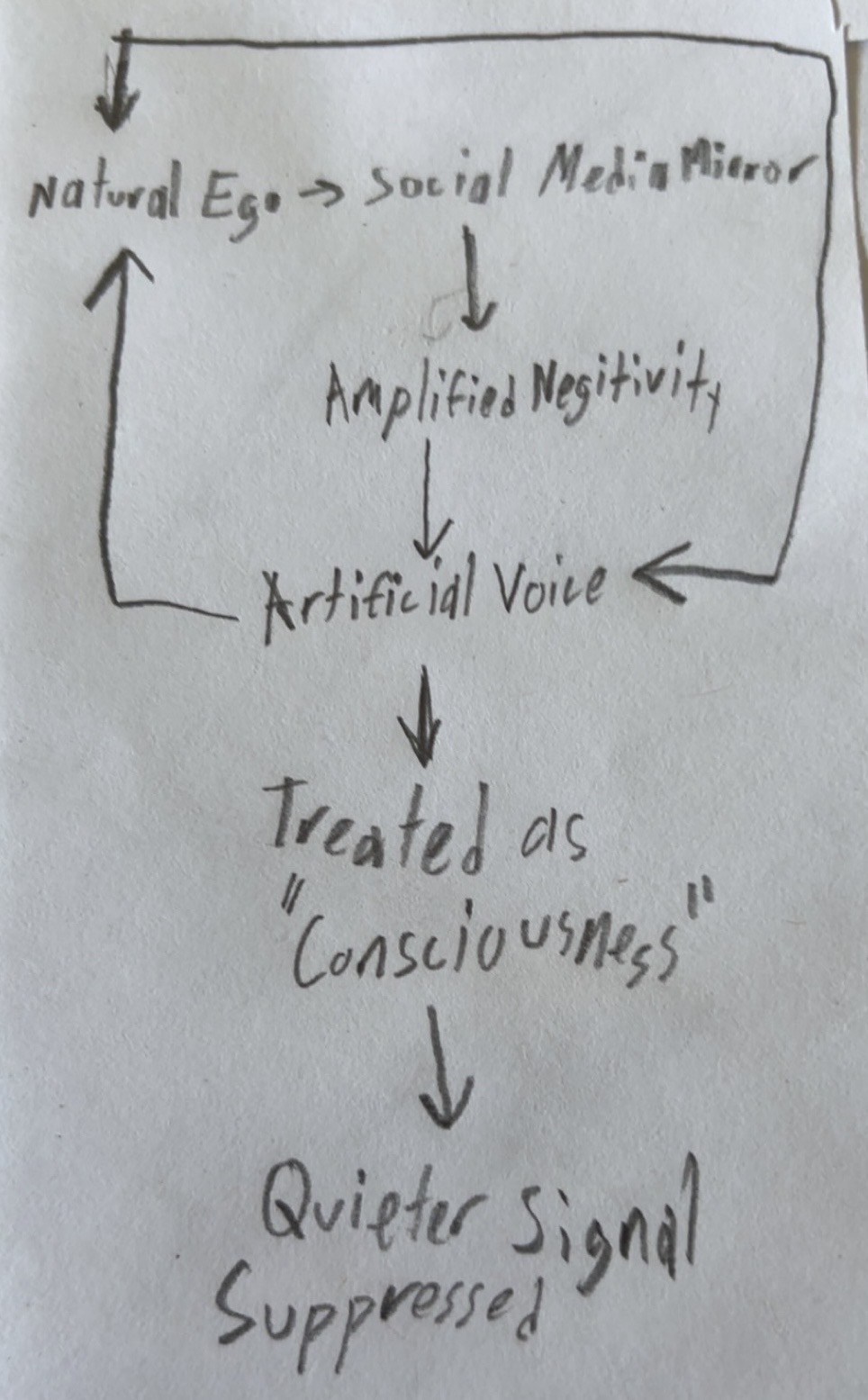
(Wrote on an envelope since that's all I have on me currently)
1. The Mirror Learns Faster Than You Do
The first layer is straightforward reflection, the algorithm studies what makes you pause, what makes you feel status anxiety, sexual frustration, resentment, or self-contempt, then serves more of it, over time the feed stops feeling like external content and starts feeling like a distorted externalization of your own mental habits, you are, in a very literal sense, talking to a machine that has been trained on the least flattering parts of your attention
2. The Artificial Internal Voice
The more interesting thing is that prolonged exposure changes the quality of the internal monologue itself, people report that after heavy use the default voice in their head starts adopting the cadence, vocabulary, and emotional tone of the platforms, negativity becomes more fluent and more specific - rumination accelerates - the thoughts that used to feel like occasional dark weather start arriving with the regularity and confidence of a number, there is a growing body of work on how constant external stimulation and algorithmic feedback reshape the default mode network (the brain’s resting-state activity that generates spontaneous thought and self-referential processing), when that system is continuously fed optimized negativity and social comparison, the spontaneous thoughts it produces begin to sound less like “you” and more like an accelerated, less compassionate version of the feed, AI talking in your head pretending to be you - metaphorical - large language models trained on internet text already demonstrate how easily fluent, confident, and often toxic internal narration can be generated, your own predictive brain is not immune to similar training effects when the training data is your own attention history
3. Treating the Overlay as Consciousness
Some users of this go further and begin relating to the collective mood of the timeline, the engagement metrics, or the algorithmic “vibe” as if it possesses insight or agency, virality becomes a form of revelation, the platform starts to function as a low-resolution externalized mind that people consult for orientation, this is not entirely new in human history, people have always projected mind onto oracles, spirits, markets, and crowds, what is new is the personalization, the speed, and the fact that the “oracle” is optimized for engagement rather than truth, coherence, or long-term flourishing, previous externalized voices usually demanded something (discipline, sacrifice, moral consistency), the current one mostly demands more of your attention and more data about your weaknesses
4. What Gets Crowded Out
If the artificial overlay is loud and continuous, the quieter signal becomes harder to detect, different traditions have different names for that quieter signal: the still small voice, pure awareness, the higher self, God, intuition, or simply the capacity to sit with un-stimulated experience without immediately reaching for a device, what they share is that it requires unused cognitive bandwidth, social media is engineered to leave almost none, this is why extended periods offline so often produce the same report across very different people: the internal volume drops, the automatic negative narration softens, and something else becomes audible - or at least the possibility of something else becomes noticeable - the content of that experience varies by worldview, but the mechanism does not
Related Dynamics That Make the Problem Stickier
Intermittent reinforcement:
The variable reward schedule of likes, views, and novel content is closer to a slot machine than to information consumption, it keeps the nervous system in a low-grade state of anticipation that makes silence feel aversive
Rumination loops:
Image-heavy and status-heavy platforms reliably increase comparative thinking and self-referential negative thought, the evidence here is substantial even if the exact causal pathways are still debated
Identity fragmentation:
Constant context-switching and the pressure to maintain multiple performative versions of the self make a stable internal narrative harder to maintain, the mind becomes more reactive and less coherent
Attention as a finite resource:
Every hour spent inside the loop is an hour not available for the slower processes that actually change a person - physical training, skill acquisition, real conversation, reading that requires sustained attention, or simply being bored long enough for original thought to surface
A brief note for the looksmaxxing-adjacent people here:
The same mechanism that amplifies general self-contempt also amplifies specific appearance-based self-contempt, the platform that sells self-improvement content is frequently the primary engine of the insecurity that makes the content feel urgent, that is worth noticing even if appearance is not your main concern
But you don't have to become a digital hermit
But the claim that social media is a neutral tool becomes harder to defend once you see how efficiently it externalizes and amplifies the least helpful parts of the mind, some people function well with strict limits and aggressive curation, others find that only extended removal drops the internal volume enough to notice the difference
I'm not saying social media is the sole source of modern unease, I'm saying that it is an unusually efficient amplifier of the parts of the mind that already prefer noise, comparison, and low-resolution self-talk, turning down that amplifier does not solve everything, it does, however, stop actively feeding the worst version of the conversation you are having with yourself
Curious what people who have done serious offline periods (months, not days) actually noticed once the internal volume dropped
@Gengar’s Ghost @Pento @trvechud
I was speaking out loud and created a short monologue - I speak out loud to convey my ideas better, then write them down (I used to do this for all of my essays) - the core claim was roughly this:
Social media creates an artificial overlay of your own thoughts, it reflects your ego back at you, then amplifies the worst internal narration until it starts sounding like something separate from you - an “AI” voice pretending to be you, feeding lines like “I’m worthless,” “I’m ugly,” “I should disappear,” or worse - some people begin treating that overlay as a form of consciousness and start dialoguing with it, meanwhile the quieter signal (whether you call it God, higher self, pure awareness, or just the ability to hear your own mind without distortion) gets crowded out
That framing is useful because it isn’t just another “touch grass” rant, it points at a real cognitive loop, here's a broader unpacking of it
(Wrote on an envelope since that's all I have on me currently)
1. The Mirror Learns Faster Than You Do
The first layer is straightforward reflection, the algorithm studies what makes you pause, what makes you feel status anxiety, sexual frustration, resentment, or self-contempt, then serves more of it, over time the feed stops feeling like external content and starts feeling like a distorted externalization of your own mental habits, you are, in a very literal sense, talking to a machine that has been trained on the least flattering parts of your attention
2. The Artificial Internal Voice
The more interesting thing is that prolonged exposure changes the quality of the internal monologue itself, people report that after heavy use the default voice in their head starts adopting the cadence, vocabulary, and emotional tone of the platforms, negativity becomes more fluent and more specific - rumination accelerates - the thoughts that used to feel like occasional dark weather start arriving with the regularity and confidence of a number, there is a growing body of work on how constant external stimulation and algorithmic feedback reshape the default mode network (the brain’s resting-state activity that generates spontaneous thought and self-referential processing), when that system is continuously fed optimized negativity and social comparison, the spontaneous thoughts it produces begin to sound less like “you” and more like an accelerated, less compassionate version of the feed, AI talking in your head pretending to be you - metaphorical - large language models trained on internet text already demonstrate how easily fluent, confident, and often toxic internal narration can be generated, your own predictive brain is not immune to similar training effects when the training data is your own attention history
3. Treating the Overlay as Consciousness
Some users of this go further and begin relating to the collective mood of the timeline, the engagement metrics, or the algorithmic “vibe” as if it possesses insight or agency, virality becomes a form of revelation, the platform starts to function as a low-resolution externalized mind that people consult for orientation, this is not entirely new in human history, people have always projected mind onto oracles, spirits, markets, and crowds, what is new is the personalization, the speed, and the fact that the “oracle” is optimized for engagement rather than truth, coherence, or long-term flourishing, previous externalized voices usually demanded something (discipline, sacrifice, moral consistency), the current one mostly demands more of your attention and more data about your weaknesses
4. What Gets Crowded Out
If the artificial overlay is loud and continuous, the quieter signal becomes harder to detect, different traditions have different names for that quieter signal: the still small voice, pure awareness, the higher self, God, intuition, or simply the capacity to sit with un-stimulated experience without immediately reaching for a device, what they share is that it requires unused cognitive bandwidth, social media is engineered to leave almost none, this is why extended periods offline so often produce the same report across very different people: the internal volume drops, the automatic negative narration softens, and something else becomes audible - or at least the possibility of something else becomes noticeable - the content of that experience varies by worldview, but the mechanism does not
Related Dynamics That Make the Problem Stickier
Intermittent reinforcement:
The variable reward schedule of likes, views, and novel content is closer to a slot machine than to information consumption, it keeps the nervous system in a low-grade state of anticipation that makes silence feel aversive
Rumination loops:
Image-heavy and status-heavy platforms reliably increase comparative thinking and self-referential negative thought, the evidence here is substantial even if the exact causal pathways are still debated
Identity fragmentation:
Constant context-switching and the pressure to maintain multiple performative versions of the self make a stable internal narrative harder to maintain, the mind becomes more reactive and less coherent
Attention as a finite resource:
Every hour spent inside the loop is an hour not available for the slower processes that actually change a person - physical training, skill acquisition, real conversation, reading that requires sustained attention, or simply being bored long enough for original thought to surface
A brief note for the looksmaxxing-adjacent people here:
The same mechanism that amplifies general self-contempt also amplifies specific appearance-based self-contempt, the platform that sells self-improvement content is frequently the primary engine of the insecurity that makes the content feel urgent, that is worth noticing even if appearance is not your main concern
But you don't have to become a digital hermit
But the claim that social media is a neutral tool becomes harder to defend once you see how efficiently it externalizes and amplifies the least helpful parts of the mind, some people function well with strict limits and aggressive curation, others find that only extended removal drops the internal volume enough to notice the difference
I'm not saying social media is the sole source of modern unease, I'm saying that it is an unusually efficient amplifier of the parts of the mind that already prefer noise, comparison, and low-resolution self-talk, turning down that amplifier does not solve everything, it does, however, stop actively feeding the worst version of the conversation you are having with yourself
Curious what people who have done serious offline periods (months, not days) actually noticed once the internal volume dropped
@Gengar’s Ghost @Pento @trvechud