The black-white cognitive ability gap and social outcomes

Reinhard_Heini

Reinhard_Heini

Bronze
Joined
Apr 25, 2026
Posts
381
Reputation
349
Most people are aware that there are significant disparities between blacks and whites in the United States with regard to a wide range of important social outcomes, including crime, income, education, poverty, welfare usage, etc. For almost every measurable metric of important life outcomes, blacks perform significantly worse than whites. In this post, I will cite studies showing that many of these disparities are likely caused by the significant cognitive differences between blacks and whites. I begin by illustrating a few examples of the disparities between blacks and whites with respect to important life outcomes. Then I briefly review evidence demonstrating the predictive validity and causal influence of cognitive ability for these outcomes. Next, I present data illustrating the scope and magnitude of the black-white cognitive ability gap. Finally, I provide evidence indicating that many of the aforementioned disparities between blacks and whites are (mostly) eliminated after controlling for youth cognitive ability.
.

Racial Inequalities​


Income​

Black households have far lower average incomes than white households. US census data (2017) [archived] shows that the average black household income was more than one-third lower than the average white household income in 2017 ($40,258 vs $68,145, Table 1). This disparity has barely budged within over 50 years:

Income.png


The same data shows that black households were over twice as likely to be poor as white households in the same year (21.2% vs 8.7%, Table 3). More recent data [archived] from the US census shows that, while the black poverty rate has decreased significantly since the 1960s, there are still large disparities in poverty rate between blacks and whites today:

Poverty.png


Part of the explanation for racial disparities in household income is that black households are far less likely to be dual-income households than white households, independently of any income disparity between black and white individuals. However, data [archived] from the National Center for Education Statistics shows black workers have far lower annual earnings than white workers. The median annual earnings for black workers was $11,200 lower than the median earnings for white workers ($33,700 vs $44,900):

Earnings.png


Controlling for educational attainment does not eliminate the disparity, as black workers have lower median earnings than white workers at each of the major levels of education:

EarningsByEducation.png


Data from the Pew Research Center [archived] also showed significant racial disparities in wealth that have persisted for generations. In fact, the ratio of median white wealth to median black wealth is greater today than it was in the 1980s:

ST_2016.06.27_race-inequality-ch1-05.png


Income mobility​

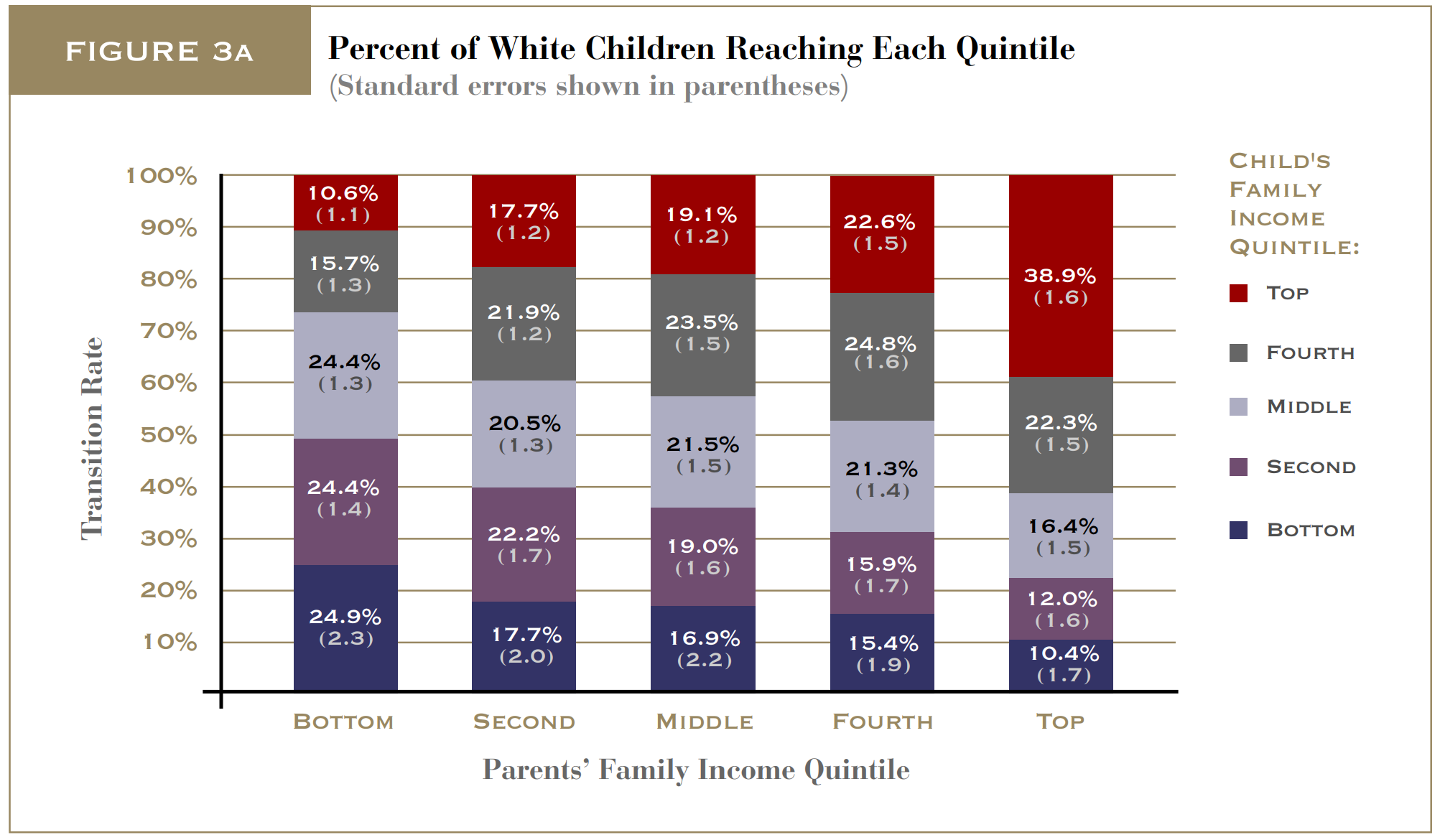
A report by Mazumder (2008) [archived] published by Pew Charitable Trusts used the NLSY79 to examine factors relevant to income mobility. Income mobility was examined by investigating family income in adolescence (1978-1980) and family income as adults (1997-2003). Prior to controlling for any covariates, the study finds stark racial differences in income mobility. For example, about 75% of whites raised in the bottom income quintile eventually transition out of that quintile, whereas only 56% of blacks do the same. In fact, blacks raised in the 2nd highest income quintile are equally as likely to end in the bottom quintile as are whites raised in the lowest income quintile (24.6% vs 24.9%):

PewFigure3A.png


PewFigure3B.png


At every range of parental income, black children are far less likely to exceed their parent’s income:

PewFigure4.png


I wrote more on racial disparities in intergenerational mobility in this post.

Education​

More data from the National Center for Education Statistics (NCES)[archived] shows large disparities in educational attainment between blacks and whites. For example, blacks are about twice as likely as whites to fail to complete High School (Figure 27.1) and they are about half as likely to attain a bachelor’s degree (Figure 27.3).

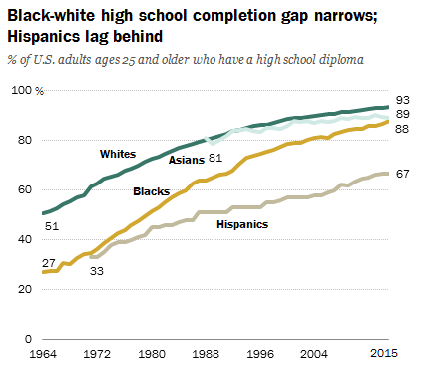
Data from Pew Research Center [archived] shows that the black-white disparity in high school completion has narrowed significantly in recent decades, although large gaps remain. On the other hand, the college completion gap between blacks and whites has barely changed within 50 years.

Screenshot-2021-10-15-195743.png


Screenshot-2021-10-15-200030.png


Crime and misbehavior​

Black people are disproportionately involved in criminality. Data from FBI crime statistics (2015) [archived] shows that despite making up only 13% of the US population, black people commit 36% of violent crime in the US. Even worse, they commit over half of the robberies and murders in the country. Among criminals under the age of 18, black youth commit over 60% of the robberies and murders in the country, and over half of the violent crime.

In 2003, the Bureau of Justice Statistics [archived] (Figure 4) released a report showing that 1 in 3 black males could be expected to go to prison if the current rates of imprisonment had remained unchanged.

1777472610361


These disparities show that, given 2003 rates of incarceration, black females were about as likely to be incarcerated as white males. Fortunately, incarceration rates have decreased since then, so the lifetime chances of being incarcerated have lowered since then as well. Recent data from the Bureau of Justice Statistics (2020) [archived] shows that blacks are much more likely to be incarcerated than whites, although the disparity has decreased in recent years (Figure 1). The racial disparities are greatest for the youngest males. In fact, the imprisonment rate for black males aged 18-19 years is over 12 times higher than the rate for similarly aged white males (Figure 2).

1777472610627


1777472610884


Some people might object that these statistics only show that black people are more likely to be arrested or incarcerated without showing that they black people are more likely to commit crimes. A simple test of this hypothesis involves looking at the leading causes of death by race. If black people are much more likely to be killed via homicide, then that is evidence that black people are far more likely to commit homicide (since the vast majority of homicides are intraracial rather than interracial). The CDC (2015) [archived] reports that homicide is the leading cause of death for black males aged 15-34, with nearly half of deaths for men aged 15-24 the result of homicide (see page 34). Contrast this with white males of the same age for whom homicide causes roughly between 3-5% of deaths (see page 27). In fact, the death rate due to homicides for blacks aged 20-24 (110.8 deaths per 100,000 population) is over 20 times the rate for similarly aged whites (5.4 deaths per 100,000 population).

Disparities in troublesome behavior between blacks and whites appear far before adulthood. For example, among middle-schoolers [archived], black males are suspended at 3 times the rate for white males, and black females are suspended at over 4 times the rate for white females. Furthermore, despite making up just 18% of enrolled preschoolers, black children account for 48% [archived] of preschool children suspended more than once.

I go into more detail on the racial disparities in crime and misconduct in a separate post.

Why cognitive ability matters​


This section will summarize points that I’ve made about the predictive validity of cognitive ability in a separate post.

Definitions​

When I say “cognitive ability”, I’m referring to the definition of “intelligence” given by Gottfredson (1997) [archived]:
Intelligence is a very general mental capability that, among other things, involves the ability to reason, plan, solve problems, think abstractly, comprehend complex ideas, learn quickly and learn from experience. It is not merely book learning, a narrow academic skill, or test-taking smarts. Rather, it reflects a broader and deeper capability for comprehending our surroundings-“catching on,” “ making sense” of things, or “figuring out” what to do. (page 13)
For a more formal definition of the meaning of cognitive ability that I have in mind, see the Cattell–Horn–Carroll (CHC) theory of human cognitive abilities, which has been deemed the “most widely accepted theory” of intelligence (Sternberg 2012). The CHC theory is a synthesis of the Cattell–Horn Gf–Gc and Carroll Three-Stratum models, which have “have emerged as the consensus psychometric-based models for understanding the structure of human intelligence” (McGrew 2009). The CHC theory affirms that there are three strata of intelligence that hierarchically relate to one another. At the top of the hierarchy (stratum III) is the general factor of intelligence (also referred to as the g factor or g), which will be explained more later in this post. In the middle of the hierarchy (stratum II) are broad abilities such as fluid and crystalized intelligence. At the bottom of the hierarchy (stratum I) are narrow abilities nested under each broad ability. The broad abilities are comprehension-knowledge (Gc), fluid reasoning (Gf), quantitative knowledge (Gq), reading & writing ability (Grw), short-term memory (Gsm), long-term storage and retrieval (Glr), visual processing (Gv), auditory processing (Ga), and processing speed (Gs). The degree to which a test measures these abilities corresponds to the degree to which the test measures my definition of cognitive ability. Fortunately, virtually all tests of mental abilities measure at least some of these abilities, and all tests measure g to some extent.
My working definition of cognitive ability is measured by IQ tests fairly accurately. It is important to understand IQ because, as Nisbett et al. (2012) [archived] notes, IQ is the measure of intelligence for which “the bulk of evidence pertinent to intelligence exists” (page 131). To start, one should understand how IQ scores are distributed. IQ scores are normed for a given population to produce a mean score of 100 and a standard deviation (SD) of 15 points. Because IQ scores are normally distributed, 32% of the population has an IQ score of more than a standard deviation away from the mean. In other words, about 68% of the population has scores between 85 and 115. About 5% of the population has an IQ score of more than two standard deviations (30 points) from the mean. In other words, about 95% of the population has scores between 70 and 130 (Neisser et al. (1996) [archived], page 78).
My working definition of cognitive ability is also measured fairly accurately by other tests that are not officially IQ tests. This is because there are many tests that are highly g-loaded even though they aren’t officially IQ tests. Highly g-loaded tests produce test results that are strong measures of g, the general factor of intelligence at the top of the hierarchy in the CHC theory of cognitive abilities. g-loaded tests are important because, as Gottfredson (2002) [archived] notes, the more g-loaded a test is, “the better it predicts performance, including school performance, job performance, and income” (page 28). She also states the following regarding g (page 27):
Theorists have long debated the definition of “intelligence,” but that verbal exercise is now moot. g has become the working definition of intelligence for most researchers, because it is a stable, replicable phenomenon that—unlike the IQ score—is independent of the “vehicles” (tests) for measuring it. Researchers are far from fully understanding the physiology and genetics of intelligence, but they can be confident that, whatever its nature, they are studying the same phenomenon when they study g. That was never the case with IQ scores, which fed the unproductive wrangling to “define intelligence.” The task is no longer to define intelligence, but to understand g.
Furthermore, g scores extracted from different test batteries correlate nearly perfectly with one another (Johnson et al. 2004, Johnson et al. 2008, Kaufman et al. 2012). That being said, we can rely on tests that are not official IQ tests as good measures of cognitive ability if they are highly g-loaded. For example, ACT tests, SAT tests, AFQT tests, and even vocabulary tests are highly g-loaded, which make them satisfactory measures of cognitive ability on my working definition.

Expert consensus​

The expert consensus is that cognitive ability (as defined earlier) is a very powerful predictor, often the most powerful predictor, of a number of important social outcomes. For example, in a recent review of intelligence research by experts in the field, Nisbett et al. (2012) [archived] summarized the predictive power of IQ as follows (page 131):

The measurement of intelligence is one of psychology’s greatest achievements and one of its most controversial. Critics complain that no single test can capture the complexity of human intelligence, all measurement is imperfect, no single measure is completely free from cultural bias, and there is the potential for misuse of scores on tests of intelligence. There is some merit to all these criticisms. But we would counter that the measurement of intelligence — which has been done primarily by IQ tests — has utilitarian value because it is a reasonably good predictor of grades at school, performance at work, and many other aspects of success in life (Gottfredson, 2004; Herrnstein & Murray, 1994). For example, students who score high on tests such as the SAT and the ACT, which correlate highly with IQ measures (Detterman & Daniel, 1989), tend to perform better in school than those who score lower (Coyle & Pillow, 2008). Similarly, people in professional careers, such as attorneys, accountants, and physicians, tend to have high IQs. Even within very narrowly defined jobs and on very narrowly defined tasks, those with higher IQs outperform those with lower IQs on average, with the effects of IQ being largest for those occupations and tasks that are most demanding of cognitive skills (F. L. Schmidt & Hunter, 1998, 2004).
Gottfredson (1997) [archived] was a very brief 3-page statement that outlines conclusions regarded as mainstream by over 50 experts in intelligence and allied fields. Some of the conclusions they reached regarding the causal influence of cognitive ability were as follows (page 14):
  • IQ is strongly related, probably more so than any other single measurable human trait, to many important educational, occupational, economic, and social outcomes. Its relation to the welfare and performance of individuals is very strong in some arenas in life (education, military training), moderate but robust in others (social competence), and modest but consistent in others (law-abidingness). Whatever IQ tests measure, it is of great practical and social importance.
  • A high IQ is an advantage in life because virtually all activities require some reasoning and decision-making. Conversely, a low IQ is often a disadvantage, especially in disorganized environments. Of course, a high IQ no more guarantees success than a low IQ guarantees failure in life. There are many exceptions, but the odds for success in our society greatly favor individuals with higher IQs.
  • The practical advantages of having a higher IQ increase as life settings become more complex (novel, ambiguous, changing, unpredictable, or multifaceted). For example, a high IQ is generally necessary to perform well in highly complex or fluid jobs (the professions, management); it is a considerable advantage in moderately complex jobs (crafts, clerical and police work); but it provides less advantage in settings that require only routine decision making or simple problem solving (unskilled work)
  • Differences in intelligence certainly are not the only factor affecting performance in education, training, and highly complex jobs (no one claims they are), but intelligence is often the most important. When individuals have already been selected for high (or low) intelligence and so do not differ as much in IQ, as in graduate school (or special education), other influences on performance loom larger in comparison.
Reeve and Charles (2008) [archived] examined the opinions of 30 experts in the science of mental abilities about their views on cognitive ability and cognitive ability testing. The study found a consensus among experts that general cognitive ability “is measured reasonably well by standardized tests”, that general cognitive ability “enhances performance in all domains of work”, that general cognitive ability “is the most important individual difference variable”, and even that general cognitive ability is “the most important trait determinant of job and training performance” (Table 1). Participants in the survey were selected from individuals on the editorial board of the journal Intelligence, from all registered members of the International Society of Intelligence Researchers, and from persons who had published three or more articles in Intelligence over the last 3 years (page 683). Experts were selected from this group by filtering down to “only individuals with a doctorate degree, and having at least five career publications on the topic of intelligence or testing” (page 683). This study was a replication of Murphy, Cronin, and Tam (2003) [doi], which found largely similar results.
Rindermann, Becker, and Coyle (2020) [doi] surveyed the opinions of over 100 experts in the field of intelligence about a variety of questions. One of the questions in the survey was “to what degree is the average socioeconomic status (SES) in Western societies determined by his or her IQ?” The survey found that “Experts believed 45% of SES variance was explained by intelligence and 55% by non-IQ factors (Table 3). 51% of experts believed that the contribution of intelligence (to SES) was below 50%, 38% above 50%, and 12% had a 50–50 opinion.” That is, experts believe that roughly half of the variance in socioeconomic status in Western societies is due to intelligence.

Predictive validity​

A meta-analysis by Strenze (2007) [archived] shows that intelligence (measured by IQ scores) is a great predictor of future socioeconomic success. Socioeconomic success was measured as educational level, occupational status, and income. The analysis found that IQ measured before age 19 was a powerful predictor of socioeconomic success after age 29 (see “best studies” on Table 1).
Screenshot-2022-09-21-113501.png

The analysis concludes with the following (page 415):
These results demonstrate that intelligence, when it is measured before most individuals have finished their schooling, is a powerful predictor of career success 12 or more years later when most individuals have already entered stable careers. Two of the correlations – with education and occupation – are of substantial magnitude according to the usual standards of social science.
For more concrete examples of the association between adolescent cognitive ability and socioeconomic outcomes, see Murray (1998) [archived]. In this work, Murray used data from the NLSY79 to measure the predictive power of cognitive ability on a variety of socioeconomic outcomes. He separated subjects from the NLSY79 into 5 different “cognitive classes”: those who scored in the 90th+ AFQT percentile (classified as “very bright”), those who scored in the 75th-89th AFQT percentile (“bright”), those who scored in the 25th-75th AFQT percentile (“normal”), those who scored in the 10th-24th AFQT percentile (“dull”), and those who scored below the 10th percentile (“very dull”). He then reported the average levels of socioeconomic success for each cognitive class. As expected, those from the higher cognitive classes attained far higher levels of success than those in the lower cognitive classes. Consider the following findings (taken from tables 6-1 through 6-3):
Cognitive Class (percentile range)Mean Years of Education (1994)Percentage obtaining a B.A. (1994)Mean Weeks Worked (1993)Median Earned Income (1993)
Very Bright (90th+)16.577%45.4$36,000
Bright (75th – 89th)15.050%45.2$27,000
Normal (25th – 74th)13.216%41.8$21,000
Dull (10th – 24th)11.93%36.5$13,000
Very Dull (10th-)10.91%30.7$7,500
These findings on the IQ-income correlations were corroborated by Zagorsky (2007) [archived]. He also used the National Longitudinal Survey of Youth 1979 to examine the association between youth IQ and income and net worth measured between the ages of 33 and 41 (page 491). The benefit of this study over the previous data is that this study was able to report on outcomes at a later stages in life. The study reported medium-large correlations between IQ and income (r = 0.30) and small-medium correlations between IQ and net worth (r = .16) (Table 2). The median incomes and net worth at different IQ points were as follows:
IQ test scoreMedian income (2021 dollars)Median net worth (2021 dollars)
120$48,681 ($78,587)$127,500 ($184,875)
110$40,884 ($59,282)$71,445 ($103,595)
100$36,826 ($53,398)$57,550 ($83,448)
90$30,881 ($44,777)$37,500 ($54,375)
80$18,467 ($26,777)$10,500 ($15,225)
Overall$35,918 ($52,081)$55,250 ($80,112)
A meta-analysis by Ttofihi et al. (2016) [archived] investigated the extent to which intelligence may function as a protective factor against delinquency, violence, and crime. The authors investigated 15 longitudinal studies that analyzed the impact of intelligence on the likelihood of offending among high-risk and low-risk groups. “High-risk” groups include individuals who were exposed to risk factors (other than low intelligence) for offending (e.g., poor child rearing, antisocial behavior, poor concentration, marital disturbance, imprisoned father, physical abuse, etc. see table 1 for the full list). The authors found that, among the high-risk group, non-offenders were about 2.32 times as likely to have a high intelligence level as offenders (page 13). Some studies also investigated the effect of intelligence on offending among low-risk groups. For this group, non-offenders were only about 1.3 times as likely to have a high intelligence level, a non-significant result (page 12). The meta-analysis concludes that “intelligence can function as a protective factor for offending”.
 
  • +1
Reactions: Divineincel, irrumator praetor, Sub->CL and 3 others
I'm convinced putting so much effort into something so insignificant and pointless actually is low iq

Mirin the effort tho
 
  • +1
Reactions: LegendaryKennen and NotTheAveragePsycho
Insanely well written
 
  • +1
Reactions: Sub->CL and Reinhard_Heini

I'm convinced putting so much effort into something so insignificant and pointless actually is low iq

Mirin the effort tho
Pointless”.
IQ effects everything you do, it’s mostly pretty much controlling your life, I can later post about that and why that so is.
 
  • +1
Reactions: Sub->CL and GymSkinSlayer
Most people are aware that there are significant disparities between blacks and whites in the United States with regard to a wide range of important social outcomes, including crime, income, education, poverty, welfare usage, etc. For almost every measurable metric of important life outcomes, blacks perform significantly worse than whites. In this post, I will cite studies showing that many of these disparities are likely caused by the significant cognitive differences between blacks and whites. I begin by illustrating a few examples of the disparities between blacks and whites with respect to important life outcomes. Then I briefly review evidence demonstrating the predictive validity and causal influence of cognitive ability for these outcomes. Next, I present data illustrating the scope and magnitude of the black-white cognitive ability gap. Finally, I provide evidence indicating that many of the aforementioned disparities between blacks and whites are (mostly) eliminated after controlling for youth cognitive ability.
.

Racial Inequalities​


Income​

Black households have far lower average incomes than white households. US census data (2017) [archived] shows that the average black household income was more than one-third lower than the average white household income in 2017 ($40,258 vs $68,145, Table 1). This disparity has barely budged within over 50 years:

Income.png


The same data shows that black households were over twice as likely to be poor as white households in the same year (21.2% vs 8.7%, Table 3). More recent data [archived] from the US census shows that, while the black poverty rate has decreased significantly since the 1960s, there are still large disparities in poverty rate between blacks and whites today:

Poverty.png


Part of the explanation for racial disparities in household income is that black households are far less likely to be dual-income households than white households, independently of any income disparity between black and white individuals. However, data [archived] from the National Center for Education Statistics shows black workers have far lower annual earnings than white workers. The median annual earnings for black workers was $11,200 lower than the median earnings for white workers ($33,700 vs $44,900):

Earnings.png


Controlling for educational attainment does not eliminate the disparity, as black workers have lower median earnings than white workers at each of the major levels of education:

EarningsByEducation.png


Data from the Pew Research Center [archived] also showed significant racial disparities in wealth that have persisted for generations. In fact, the ratio of median white wealth to median black wealth is greater today than it was in the 1980s:

ST_2016.06.27_race-inequality-ch1-05.png


Income mobility​

A report by Mazumder (2008) [archived] published by Pew Charitable Trusts used the NLSY79 to examine factors relevant to income mobility. Income mobility was examined by investigating family income in adolescence (1978-1980) and family income as adults (1997-2003). Prior to controlling for any covariates, the study finds stark racial differences in income mobility. For example, about 75% of whites raised in the bottom income quintile eventually transition out of that quintile, whereas only 56% of blacks do the same. In fact, blacks raised in the 2nd highest income quintile are equally as likely to end in the bottom quintile as are whites raised in the lowest income quintile (24.6% vs 24.9%):

PewFigure3A.png


PewFigure3B.png


At every range of parental income, black children are far less likely to exceed their parent’s income:

PewFigure4.png


I wrote more on racial disparities in intergenerational mobility in this post.

Education​

More data from the National Center for Education Statistics (NCES)[archived] shows large disparities in educational attainment between blacks and whites. For example, blacks are about twice as likely as whites to fail to complete High School (Figure 27.1) and they are about half as likely to attain a bachelor’s degree (Figure 27.3).

Data from Pew Research Center [archived] shows that the black-white disparity in high school completion has narrowed significantly in recent decades, although large gaps remain. On the other hand, the college completion gap between blacks and whites has barely changed within 50 years.
Screenshot-2021-10-15-195743.png


Screenshot-2021-10-15-200030.png


Crime and misbehavior​

Black people are disproportionately involved in criminality. Data from FBI crime statistics (2015) [archived] shows that despite making up only 13% of the US population, black people commit 36% of violent crime in the US. Even worse, they commit over half of the robberies and murders in the country. Among criminals under the age of 18, black youth commit over 60% of the robberies and murders in the country, and over half of the violent crime.

In 2003, the Bureau of Justice Statistics [archived] (Figure 4) released a report showing that 1 in 3 black males could be expected to go to prison if the current rates of imprisonment had remained unchanged.

View attachment 4983494

These disparities show that, given 2003 rates of incarceration, black females were about as likely to be incarcerated as white males. Fortunately, incarceration rates have decreased since then, so the lifetime chances of being incarcerated have lowered since then as well. Recent data from the Bureau of Justice Statistics (2020) [archived] shows that blacks are much more likely to be incarcerated than whites, although the disparity has decreased in recent years (Figure 1). The racial disparities are greatest for the youngest males. In fact, the imprisonment rate for black males aged 18-19 years is over 12 times higher than the rate for similarly aged white males (Figure 2).

View attachment 4983493

View attachment 4983495

Some people might object that these statistics only show that black people are more likely to be arrested or incarcerated without showing that they black people are more likely to commit crimes. A simple test of this hypothesis involves looking at the leading causes of death by race. If black people are much more likely to be killed via homicide, then that is evidence that black people are far more likely to commit homicide (since the vast majority of homicides are intraracial rather than interracial). The CDC (2015) [archived] reports that homicide is the leading cause of death for black males aged 15-34, with nearly half of deaths for men aged 15-24 the result of homicide (see page 34). Contrast this with white males of the same age for whom homicide causes roughly between 3-5% of deaths (see page 27). In fact, the death rate due to homicides for blacks aged 20-24 (110.8 deaths per 100,000 population) is over 20 times the rate for similarly aged whites (5.4 deaths per 100,000 population).

Disparities in troublesome behavior between blacks and whites appear far before adulthood. For example, among middle-schoolers [archived], black males are suspended at 3 times the rate for white males, and black females are suspended at over 4 times the rate for white females. Furthermore, despite making up just 18% of enrolled preschoolers, black children account for 48% [archived] of preschool children suspended more than once.

I go into more detail on the racial disparities in crime and misconduct in a separate post.

Why cognitive ability matters​


This section will summarize points that I’ve made about the predictive validity of cognitive ability in a separate post.

Definitions​

When I say “cognitive ability”, I’m referring to the definition of “intelligence” given by Gottfredson (1997) [archived]:

For a more formal definition of the meaning of cognitive ability that I have in mind, see the Cattell–Horn–Carroll (CHC) theory of human cognitive abilities, which has been deemed the “most widely accepted theory” of intelligence (Sternberg 2012). The CHC theory is a synthesis of the Cattell–Horn Gf–Gc and Carroll Three-Stratum models, which have “have emerged as the consensus psychometric-based models for understanding the structure of human intelligence” (McGrew 2009). The CHC theory affirms that there are three strata of intelligence that hierarchically relate to one another. At the top of the hierarchy (stratum III) is the general factor of intelligence (also referred to as the g factor or g), which will be explained more later in this post. In the middle of the hierarchy (stratum II) are broad abilities such as fluid and crystalized intelligence. At the bottom of the hierarchy (stratum I) are narrow abilities nested under each broad ability. The broad abilities are comprehension-knowledge (Gc), fluid reasoning (Gf), quantitative knowledge (Gq), reading & writing ability (Grw), short-term memory (Gsm), long-term storage and retrieval (Glr), visual processing (Gv), auditory processing (Ga), and processing speed (Gs). The degree to which a test measures these abilities corresponds to the degree to which the test measures my definition of cognitive ability. Fortunately, virtually all tests of mental abilities measure at least some of these abilities, and all tests measure g to some extent.
My working definition of cognitive ability is measured by IQ tests fairly accurately. It is important to understand IQ because, as Nisbett et al. (2012) [archived] notes, IQ is the measure of intelligence for which “the bulk of evidence pertinent to intelligence exists” (page 131). To start, one should understand how IQ scores are distributed. IQ scores are normed for a given population to produce a mean score of 100 and a standard deviation (SD) of 15 points. Because IQ scores are normally distributed, 32% of the population has an IQ score of more than a standard deviation away from the mean. In other words, about 68% of the population has scores between 85 and 115. About 5% of the population has an IQ score of more than two standard deviations (30 points) from the mean. In other words, about 95% of the population has scores between 70 and 130 (Neisser et al. (1996) [archived], page 78).
Моё рабочее определение когнитивных способностей также достаточно точно измеряется другими тестами, которые официально не являются тестами IQ. Это связано с тем, что существует множество тестов с высокой долей g , даже несмотря на то, что они официально не являются тестами IQ. Тесты с высокой долей g дают результаты, которые являются сильными показателями g, общего фактора интеллекта, находящегося на вершине иерархии в теории когнитивных способностей CHC. Тесты с высокой долей g важны, потому что, как отмечает Готтфредсон (2002) [ архивировано ], чем больше доля g в тесте, «тем лучше он предсказывает результаты, включая успеваемость в школе, успеваемость на работе и доход» (страница 28). Она также утверждает следующее относительно g (страница 27):

Кроме того, g -баллы, полученные в результате тестирования с использованием различных наборов тестов, коррелируют практически идеально друг с другом ( Johnson et al. 2004 , Johnson et al. 2008 , Kaufman et al. 2012 ). Тем не менее, мы можем полагаться на тесты, не являющиеся официальными тестами IQ, как на хорошие показатели когнитивных способностей, если они имеют высокую g- нагрузку. Например, тесты ACT, SAT, AFQT и даже тесты на словарный запас имеют высокую g- нагрузку, что делает их удовлетворительными показателями когнитивных способностей в соответствии с моим рабочим определением.

консенсус экспертов​

Эксперты сходятся во мнении, что когнитивные способности (как определено ранее) являются очень мощным, зачастую самым мощным, предиктором ряда важных социальных результатов. Например, в недавнем обзоре исследований интеллекта, проведенном экспертами в этой области, Нисбетт и др. (2012) [ архивировано ] обобщили прогностическую силу IQ следующим образом (страница 131):


Готтфредсон (1997) [ архивировано ] — это очень краткое трехстраничное заявление, в котором изложены выводы, считающиеся общепринятыми более чем 50 экспертами в области разведки и смежных областях. Некоторые из выводов, к которым они пришли относительно причинного влияния когнитивных способностей, были следующими (страница 14):
  • Коэффициент интеллекта (IQ) тесно связан, вероятно, сильнее, чем любой другой измеримый человеческий показатель, со многими важными образовательными, профессиональными, экономическими и социальными результатами. Его связь с благополучием и успеваемостью людей очень сильна в одних сферах жизни (образование, военная подготовка), умеренна, но устойчива в других (социальная компетентность) и незначительна, но постоянна в третьих (законопослушность). Что бы ни измеряли тесты на IQ, они имеют огромное практическое и социальное значение.
  • Высокий IQ является преимуществом в жизни, поскольку практически все виды деятельности требуют логического мышления и принятия решений. И наоборот, низкий IQ часто является недостатком, особенно в неорганизованной среде. Конечно, высокий IQ не гарантирует успеха в жизни в большей степени, чем низкий IQ гарантирует неудачу. Существует множество исключений, но шансы на успех в нашем обществе значительно выше у людей с более высоким IQ.
  • Практические преимущества высокого IQ возрастают по мере усложнения жизненных ситуаций (новой, неоднозначной, изменчивой, непредсказуемой или многогранной). Например, высокий IQ, как правило, необходим для успешной работы в высокосложных или динамичных профессиях (профессии, менеджмент); он является значительным преимуществом в профессиях средней сложности (ремесла, офисная и полицейская работа); но он дает меньше преимуществ в ситуациях, требующих лишь принятия рутинных решений или решения простых проблем (неквалифицированная работа).
  • Различия в интеллекте, безусловно, не являются единственным фактором, влияющим на успеваемость в образовании, профессиональной подготовке и на высокосложных рабочих местах (никто не утверждает обратное), но интеллект часто оказывается наиболее важным. Когда люди уже отобраны по признаку высокого (или низкого) интеллекта и, следовательно, не так сильно различаются по IQ, как, например, в аспирантуре (или в системе специального образования), другие факторы, влияющие на успеваемость, приобретают гораздо большее значение.
Рив и Чарльз (2008) [ архивировано ] изучили мнения 30 экспертов в области науки о психических способностях относительно их взглядов на когнитивные способности и тестирование когнитивных способностей. Исследование выявило консенсус среди экспертов в отношении того, что общие когнитивные способности «достаточно хорошо измеряются стандартизированными тестами», что общие когнитивные способности «повышают эффективность во всех областях работы», что общие когнитивные способности «являются наиболее важной переменной, определяющей индивидуальные различия», и даже что общие когнитивные способности являются «наиболее важным фактором, определяющим эффективность работы и обучения» (Таблица 1). Участники опроса были отобраны из числа членов редакционной коллегии журнала Intelligence, из числа всех зарегистрированных членов Международного общества исследователей интеллекта и из числа лиц, опубликовавших три или более статей в журнале Intelligence за последние 3 года (стр. 683). Эксперты были отобраны из этой группы путем отбора «только лиц, имеющих докторскую степень и не менее пяти публикаций по теме интеллекта или тестирования» (стр. 683). Данное исследование представляло собой воспроизведение работы Мерфи, Кронина и Тама (2003) [ doi ], в которой были получены в основном схожие результаты.
Риндерманн, Беккер и Койл (2020) [ doi ] провели опрос более 100 экспертов в области интеллекта по ряду вопросов. Один из вопросов опроса звучал так: «В какой степени средний социально-экономический статус (СЭС) в западных обществах определяется уровнем интеллекта (IQ)?» Опрос показал, что «эксперты считают, что 45% дисперсии СЭС объясняется интеллектом, а 55% — факторами, не связанными с IQ (таблица 3). 51% экспертов считают, что вклад интеллекта (в СЭС) составляет менее 50%, 38% — более 50%, а 12% имеют равное мнение». То есть эксперты считают, что примерно половина дисперсии социально-экономического статуса в западных обществах обусловлена интеллектом.

Прогностическая валидность​

Метаанализ, проведенный Стренце (2007) [ архивировано ], показывает, что интеллект (измеренный по показателям IQ) является отличным предиктором будущего социально-экономического успеха. Социально-экономический успех измерялся уровнем образования, профессиональным статусом и доходом. Анализ показал, что IQ, измеренный до 19 лет, является мощным предиктором социально-экономического успеха после 29 лет (см. «лучшие исследования» в таблице 1).
Screenshot-2022-09-21-113501.png

Анализ завершается следующим выводом (страница 415):

Более конкретные примеры связи между когнитивными способностями подростков и социально-экономическими результатами см. в работе Мюррея (1998) [ архивировано ]. В этой работе Мюррей использовал данные из NLSY79 для измерения прогностической силы когнитивных способностей в отношении различных социально-экономических результатов. Он разделил участников NLSY79 на 5 различных «когнитивных классов»: тех, кто набрал баллы в 90-м и более процентиле AFQT (классифицированных как «очень способные»), тех, кто набрал баллы в 75-89-м процентиле AFQT («способные»), тех, кто набрал баллы в 25-75-м процентиле AFQT («нормальные»), тех, кто набрал баллы в 10-24-м процентиле AFQT («слабые»), и тех, кто набрал баллы ниже 10-го процентиля («очень слабые»). Затем он представил средние уровни социально-экономического успеха для каждого когнитивного класса. Как и ожидалось, участники из более высоких когнитивных классов достигли гораздо более высоких уровней успеха, чем участники из более низких когнитивных классов. Рассмотрим следующие результаты (взятые из таблиц 6-1–6-3):
Когнитивный класс (диапазон процентилей)Среднее количество лет образования (1994 г.)Процент лиц, получивших степень бакалавра (1994 г.)Среднее количество отработанных недель (1993)Медианный заработок (1993 г.)
Очень яркий (90-й уровень и выше)16.577%45.436 000 долларов США
Яркий (75-й – 89-й)15.050%45.227 000 долларов США
Нормальный (25-й – 74-й)13.216%41.821 000 долларов США
Унылый (10-24-е)11.93%36.513 000 долларов
Очень скучно (10-й класс)10.91%30.77500 долларов США
Эти результаты о корреляции IQ и дохода были подтверждены Загорски (2007) [ архивировано ]. Он также использовал Национальное лонгитюдное исследование молодежи 1979 года для изучения связи между IQ молодежи и доходом и чистым капиталом, измеренными в возрасте от 33 до 41 года (страница 491). Преимущество этого исследования перед предыдущими данными заключается в том, что оно позволило получить данные о результатах на более поздних этапах жизни. В исследовании были выявлены средние и высокие корреляции между IQ и доходом ( r = 0,30) и низкие и средние корреляции между IQ и чистым капиталом ( r = 0,16) (Таблица 2). Медианные доходы и чистый капитал в разных точках IQ были следующими:
Результат теста IQМедианный доход (в долларах 2021 года)Медианный чистый капитал (в долларах 2021 года)
12048 681 долл. США (78 587 долл. США)127 500 долларов США (184 875 долларов США)
11040 884 долл. США (59 282 долл. США)71 445 долларов США (103 595 долларов США)
10036 826 долларов США (53 398 долларов США)57 550 долларов США (83 448 долларов США)
9030 881 долл. США (44 777 долл. США)37 500 долларов (54 375 долларов)
8018 467 долларов США (26 777 долларов США)10 500 долларов (15 225 долларов)
Общий35 918 долларов США (52 081 доллар США)55 250 долларов США (80 112 долларов США)
  • Исходные значения — это цифры в долларах 2004 года, взятые непосредственно из исследования. Значения в скобках — в долларах 2021 года, полученные путем умножения исходных значений на 1,45 .
Метаанализ, проведенный Ттофихи и др. (2016) [ архивировано ], исследовал, в какой степени интеллект может выступать в качестве защитного фактора от правонарушений, насилия и преступности. Авторы изучили 15 лонгитудинальных исследований, которые анализировали влияние интеллекта на вероятность совершения правонарушений среди групп высокого и низкого риска. К группам «высокого риска» относятся лица, подвергавшиеся воздействию факторов риска (помимо низкого интеллекта), способствующих совершению правонарушений (например, плохое воспитание детей, антисоциальное поведение, плохая концентрация внимания, семейные проблемы, отец, находящийся в тюрьме, физическое насилие и т. д., см. таблицу 1 для полного списка). Авторы обнаружили, что среди группы высокого риска лица, не совершавшие правонарушений, примерно в 2,32 раза чаще имели высокий уровень интеллекта, чем лица, совершавшие правонарушения (стр. 13). Некоторые исследования также изучали влияние интеллекта на совершение правонарушений среди групп низкого риска. Для этой группы лица, не совершавшие правонарушений, лишь примерно в 1,3 раза чаще имели высокий уровень интеллекта, что является статистически незначимым результатом (стр. 12). Метаанализ приходит к выводу, что «интеллект может выступать в качестве защитного фактора от совершения преступлений».
Mirin's post, but honestly I don't care, there are a lot of cool black guys on this site
 
  • +1
Reactions: Sub->CL
Mirin's post, but honestly I don't care, there are a lot of cool black guys on this site
Meh, most of them can be “cool” but this doesn’t help at all, there was a tiktoker who had millions of viewers but he still did commit a crime whatsoever.
 
Last edited:
  • +1
Reactions: JOTAROSON
Да ладно, большинство из них могут быть "крутыми", но это совсем не помогает. Был один тиктокер, у которого были миллионы просмотров, но он всё равно совершил преступление.
 

Attachments

  • 6147046_IMG_20260416_212930.jpg
    6147046_IMG_20260416_212930.jpg
    2.9 MB · Views: 0
  • +1
  • Love it
Reactions: Reinhard_Heini and Sub->CL
Meh, most of than can be “cool” but this doesn’t help at all, there was a tiktoker who had millions of viewers but he still did commit a crime whatsoever.
Mirin's post, but honestly I don't care, there are a lot of cool black guys on this site
Alright so neither of you rep and bump my post? You know I larp as Euro but I'm really black right??? 😡😡😡 From the 'Raq.

That dog is pretty cute.
 
  • +1
Reactions: Reinhard_Heini and JOTAROSON
Most people are aware that there are significant disparities between blacks and whites in the United States with regard to a wide range of important social outcomes, including crime, income, education, poverty, welfare usage, etc. For almost every measurable metric of important life outcomes, blacks perform significantly worse than whites. In this post, I will cite studies showing that many of these disparities are likely caused by the significant cognitive differences between blacks and whites. I begin by illustrating a few examples of the disparities between blacks and whites with respect to important life outcomes. Then I briefly review evidence demonstrating the predictive validity and causal influence of cognitive ability for these outcomes. Next, I present data illustrating the scope and magnitude of the black-white cognitive ability gap. Finally, I provide evidence indicating that many of the aforementioned disparities between blacks and whites are (mostly) eliminated after controlling for youth cognitive ability.
.

Racial Inequalities​


Income​

Black households have far lower average incomes than white households. US census data (2017) [archived] shows that the average black household income was more than one-third lower than the average white household income in 2017 ($40,258 vs $68,145, Table 1). This disparity has barely budged within over 50 years:

Income.png


The same data shows that black households were over twice as likely to be poor as white households in the same year (21.2% vs 8.7%, Table 3). More recent data [archived] from the US census shows that, while the black poverty rate has decreased significantly since the 1960s, there are still large disparities in poverty rate between blacks and whites today:

Poverty.png


Part of the explanation for racial disparities in household income is that black households are far less likely to be dual-income households than white households, independently of any income disparity between black and white individuals. However, data [archived] from the National Center for Education Statistics shows black workers have far lower annual earnings than white workers. The median annual earnings for black workers was $11,200 lower than the median earnings for white workers ($33,700 vs $44,900):

Earnings.png


Controlling for educational attainment does not eliminate the disparity, as black workers have lower median earnings than white workers at each of the major levels of education:

EarningsByEducation.png


Data from the Pew Research Center [archived] also showed significant racial disparities in wealth that have persisted for generations. In fact, the ratio of median white wealth to median black wealth is greater today than it was in the 1980s:

ST_2016.06.27_race-inequality-ch1-05.png


Income mobility​

A report by Mazumder (2008) [archived] published by Pew Charitable Trusts used the NLSY79 to examine factors relevant to income mobility. Income mobility was examined by investigating family income in adolescence (1978-1980) and family income as adults (1997-2003). Prior to controlling for any covariates, the study finds stark racial differences in income mobility. For example, about 75% of whites raised in the bottom income quintile eventually transition out of that quintile, whereas only 56% of blacks do the same. In fact, blacks raised in the 2nd highest income quintile are equally as likely to end in the bottom quintile as are whites raised in the lowest income quintile (24.6% vs 24.9%):

PewFigure3A.png


PewFigure3B.png


At every range of parental income, black children are far less likely to exceed their parent’s income:

PewFigure4.png


I wrote more on racial disparities in intergenerational mobility in this post.

Education​

More data from the National Center for Education Statistics (NCES)[archived] shows large disparities in educational attainment between blacks and whites. For example, blacks are about twice as likely as whites to fail to complete High School (Figure 27.1) and they are about half as likely to attain a bachelor’s degree (Figure 27.3).

Data from Pew Research Center [archived] shows that the black-white disparity in high school completion has narrowed significantly in recent decades, although large gaps remain. On the other hand, the college completion gap between blacks and whites has barely changed within 50 years.

Screenshot-2021-10-15-195743.png


Screenshot-2021-10-15-200030.png


Crime and misbehavior​

Black people are disproportionately involved in criminality. Data from FBI crime statistics (2015) [archived] shows that despite making up only 13% of the US population, black people commit 36% of violent crime in the US. Even worse, they commit over half of the robberies and murders in the country. Among criminals under the age of 18, black youth commit over 60% of the robberies and murders in the country, and over half of the violent crime.

In 2003, the Bureau of Justice Statistics [archived] (Figure 4) released a report showing that 1 in 3 black males could be expected to go to prison if the current rates of imprisonment had remained unchanged.

View attachment 4983494

These disparities show that, given 2003 rates of incarceration, black females were about as likely to be incarcerated as white males. Fortunately, incarceration rates have decreased since then, so the lifetime chances of being incarcerated have lowered since then as well. Recent data from the Bureau of Justice Statistics (2020) [archived] shows that blacks are much more likely to be incarcerated than whites, although the disparity has decreased in recent years (Figure 1). The racial disparities are greatest for the youngest males. In fact, the imprisonment rate for black males aged 18-19 years is over 12 times higher than the rate for similarly aged white males (Figure 2).

View attachment 4983493

View attachment 4983495

Some people might object that these statistics only show that black people are more likely to be arrested or incarcerated without showing that they black people are more likely to commit crimes. A simple test of this hypothesis involves looking at the leading causes of death by race. If black people are much more likely to be killed via homicide, then that is evidence that black people are far more likely to commit homicide (since the vast majority of homicides are intraracial rather than interracial). The CDC (2015) [archived] reports that homicide is the leading cause of death for black males aged 15-34, with nearly half of deaths for men aged 15-24 the result of homicide (see page 34). Contrast this with white males of the same age for whom homicide causes roughly between 3-5% of deaths (see page 27). In fact, the death rate due to homicides for blacks aged 20-24 (110.8 deaths per 100,000 population) is over 20 times the rate for similarly aged whites (5.4 deaths per 100,000 population).

Disparities in troublesome behavior between blacks and whites appear far before adulthood. For example, among middle-schoolers [archived], black males are suspended at 3 times the rate for white males, and black females are suspended at over 4 times the rate for white females. Furthermore, despite making up just 18% of enrolled preschoolers, black children account for 48% [archived] of preschool children suspended more than once.

I go into more detail on the racial disparities in crime and misconduct in a separate post.

Why cognitive ability matters​


This section will summarize points that I’ve made about the predictive validity of cognitive ability in a separate post.

Definitions​

When I say “cognitive ability”, I’m referring to the definition of “intelligence” given by Gottfredson (1997) [archived]:

For a more formal definition of the meaning of cognitive ability that I have in mind, see the Cattell–Horn–Carroll (CHC) theory of human cognitive abilities, which has been deemed the “most widely accepted theory” of intelligence (Sternberg 2012). The CHC theory is a synthesis of the Cattell–Horn Gf–Gc and Carroll Three-Stratum models, which have “have emerged as the consensus psychometric-based models for understanding the structure of human intelligence” (McGrew 2009). The CHC theory affirms that there are three strata of intelligence that hierarchically relate to one another. At the top of the hierarchy (stratum III) is the general factor of intelligence (also referred to as the g factor or g), which will be explained more later in this post. In the middle of the hierarchy (stratum II) are broad abilities such as fluid and crystalized intelligence. At the bottom of the hierarchy (stratum I) are narrow abilities nested under each broad ability. The broad abilities are comprehension-knowledge (Gc), fluid reasoning (Gf), quantitative knowledge (Gq), reading & writing ability (Grw), short-term memory (Gsm), long-term storage and retrieval (Glr), visual processing (Gv), auditory processing (Ga), and processing speed (Gs). The degree to which a test measures these abilities corresponds to the degree to which the test measures my definition of cognitive ability. Fortunately, virtually all tests of mental abilities measure at least some of these abilities, and all tests measure g to some extent.
My working definition of cognitive ability is measured by IQ tests fairly accurately. It is important to understand IQ because, as Nisbett et al. (2012) [archived] notes, IQ is the measure of intelligence for which “the bulk of evidence pertinent to intelligence exists” (page 131). To start, one should understand how IQ scores are distributed. IQ scores are normed for a given population to produce a mean score of 100 and a standard deviation (SD) of 15 points. Because IQ scores are normally distributed, 32% of the population has an IQ score of more than a standard deviation away from the mean. In other words, about 68% of the population has scores between 85 and 115. About 5% of the population has an IQ score of more than two standard deviations (30 points) from the mean. In other words, about 95% of the population has scores between 70 and 130 (Neisser et al. (1996) [archived], page 78).
My working definition of cognitive ability is also measured fairly accurately by other tests that are not officially IQ tests. This is because there are many tests that are highly g-loaded even though they aren’t officially IQ tests. Highly g-loaded tests produce test results that are strong measures of g, the general factor of intelligence at the top of the hierarchy in the CHC theory of cognitive abilities. g-loaded tests are important because, as Gottfredson (2002) [archived] notes, the more g-loaded a test is, “the better it predicts performance, including school performance, job performance, and income” (page 28). She also states the following regarding g (page 27):

Furthermore, g scores extracted from different test batteries correlate nearly perfectly with one another (Johnson et al. 2004, Johnson et al. 2008, Kaufman et al. 2012). That being said, we can rely on tests that are not official IQ tests as good measures of cognitive ability if they are highly g-loaded. For example, ACT tests, SAT tests, AFQT tests, and even vocabulary tests are highly g-loaded, which make them satisfactory measures of cognitive ability on my working definition.

Expert consensus​

The expert consensus is that cognitive ability (as defined earlier) is a very powerful predictor, often the most powerful predictor, of a number of important social outcomes. For example, in a recent review of intelligence research by experts in the field, Nisbett et al. (2012) [archived] summarized the predictive power of IQ as follows (page 131):


Gottfredson (1997) [archived] was a very brief 3-page statement that outlines conclusions regarded as mainstream by over 50 experts in intelligence and allied fields. Some of the conclusions they reached regarding the causal influence of cognitive ability were as follows (page 14):
  • IQ is strongly related, probably more so than any other single measurable human trait, to many important educational, occupational, economic, and social outcomes. Its relation to the welfare and performance of individuals is very strong in some arenas in life (education, military training), moderate but robust in others (social competence), and modest but consistent in others (law-abidingness). Whatever IQ tests measure, it is of great practical and social importance.
  • A high IQ is an advantage in life because virtually all activities require some reasoning and decision-making. Conversely, a low IQ is often a disadvantage, especially in disorganized environments. Of course, a high IQ no more guarantees success than a low IQ guarantees failure in life. There are many exceptions, but the odds for success in our society greatly favor individuals with higher IQs.
  • The practical advantages of having a higher IQ increase as life settings become more complex (novel, ambiguous, changing, unpredictable, or multifaceted). For example, a high IQ is generally necessary to perform well in highly complex or fluid jobs (the professions, management); it is a considerable advantage in moderately complex jobs (crafts, clerical and police work); but it provides less advantage in settings that require only routine decision making or simple problem solving (unskilled work)
  • Differences in intelligence certainly are not the only factor affecting performance in education, training, and highly complex jobs (no one claims they are), but intelligence is often the most important. When individuals have already been selected for high (or low) intelligence and so do not differ as much in IQ, as in graduate school (or special education), other influences on performance loom larger in comparison.
Reeve and Charles (2008) [archived] examined the opinions of 30 experts in the science of mental abilities about their views on cognitive ability and cognitive ability testing. The study found a consensus among experts that general cognitive ability “is measured reasonably well by standardized tests”, that general cognitive ability “enhances performance in all domains of work”, that general cognitive ability “is the most important individual difference variable”, and even that general cognitive ability is “the most important trait determinant of job and training performance” (Table 1). Participants in the survey were selected from individuals on the editorial board of the journal Intelligence, from all registered members of the International Society of Intelligence Researchers, and from persons who had published three or more articles in Intelligence over the last 3 years (page 683). Experts were selected from this group by filtering down to “only individuals with a doctorate degree, and having at least five career publications on the topic of intelligence or testing” (page 683). This study was a replication of Murphy, Cronin, and Tam (2003) [doi], which found largely similar results.
Rindermann, Becker, and Coyle (2020) [doi] surveyed the opinions of over 100 experts in the field of intelligence about a variety of questions. One of the questions in the survey was “to what degree is the average socioeconomic status (SES) in Western societies determined by his or her IQ?” The survey found that “Experts believed 45% of SES variance was explained by intelligence and 55% by non-IQ factors (Table 3). 51% of experts believed that the contribution of intelligence (to SES) was below 50%, 38% above 50%, and 12% had a 50–50 opinion.” That is, experts believe that roughly half of the variance in socioeconomic status in Western societies is due to intelligence.

Predictive validity​

A meta-analysis by Strenze (2007) [archived] shows that intelligence (measured by IQ scores) is a great predictor of future socioeconomic success. Socioeconomic success was measured as educational level, occupational status, and income. The analysis found that IQ measured before age 19 was a powerful predictor of socioeconomic success after age 29 (see “best studies” on Table 1).
Screenshot-2022-09-21-113501.png

The analysis concludes with the following (page 415):

For more concrete examples of the association between adolescent cognitive ability and socioeconomic outcomes, see Murray (1998) [archived]. In this work, Murray used data from the NLSY79 to measure the predictive power of cognitive ability on a variety of socioeconomic outcomes. He separated subjects from the NLSY79 into 5 different “cognitive classes”: those who scored in the 90th+ AFQT percentile (classified as “very bright”), those who scored in the 75th-89th AFQT percentile (“bright”), those who scored in the 25th-75th AFQT percentile (“normal”), those who scored in the 10th-24th AFQT percentile (“dull”), and those who scored below the 10th percentile (“very dull”). He then reported the average levels of socioeconomic success for each cognitive class. As expected, those from the higher cognitive classes attained far higher levels of success than those in the lower cognitive classes. Consider the following findings (taken from tables 6-1 through 6-3):
Cognitive Class (percentile range)Mean Years of Education (1994)Percentage obtaining a B.A. (1994)Mean Weeks Worked (1993)Median Earned Income (1993)
Very Bright (90th+)16.577%45.4$36,000
Bright (75th – 89th)15.050%45.2$27,000
Normal (25th – 74th)13.216%41.8$21,000
Dull (10th – 24th)11.93%36.5$13,000
Very Dull (10th-)10.91%30.7$7,500
These findings on the IQ-income correlations were corroborated by Zagorsky (2007) [archived]. He also used the National Longitudinal Survey of Youth 1979 to examine the association between youth IQ and income and net worth measured between the ages of 33 and 41 (page 491). The benefit of this study over the previous data is that this study was able to report on outcomes at a later stages in life. The study reported medium-large correlations between IQ and income (r = 0.30) and small-medium correlations between IQ and net worth (r = .16) (Table 2). The median incomes and net worth at different IQ points were as follows:
IQ test scoreMedian income (2021 dollars)Median net worth (2021 dollars)
120$48,681 ($78,587)$127,500 ($184,875)
110$40,884 ($59,282)$71,445 ($103,595)
100$36,826 ($53,398)$57,550 ($83,448)
90$30,881 ($44,777)$37,500 ($54,375)
80$18,467 ($26,777)$10,500 ($15,225)
Overall$35,918 ($52,081)$55,250 ($80,112)
A meta-analysis by Ttofihi et al. (2016) [archived] investigated the extent to which intelligence may function as a protective factor against delinquency, violence, and crime. The authors investigated 15 longitudinal studies that analyzed the impact of intelligence on the likelihood of offending among high-risk and low-risk groups. “High-risk” groups include individuals who were exposed to risk factors (other than low intelligence) for offending (e.g., poor child rearing, antisocial behavior, poor concentration, marital disturbance, imprisoned father, physical abuse, etc. see table 1 for the full list). The authors found that, among the high-risk group, non-offenders were about 2.32 times as likely to have a high intelligence level as offenders (page 13). Some studies also investigated the effect of intelligence on offending among low-risk groups. For this group, non-offenders were only about 1.3 times as likely to have a high intelligence level, a non-significant result (page 12). The meta-analysis concludes that “intelligence can function as a protective factor for offending”.
DNR + no rep for you
 
The analysis found that IQ measured before age 19 was a powerful predictor of socioeconomic success after age 29 (see “best studies” on Table 1).
very powerful. What you do after highschool or in college, therefore, decides the rest of your life. It is because it's the first time you taste freedom and partial independence, and it's about what you do with that. What does the mice do when let out of its cage? Especially in the new, competitive environment with a lot of probabilities, potential/possibilities and uncertainty. Being aware of multiple life paths/trajectories from this point onward is important for this too, which is the planning and proactive thinking, as well as realism and ambition. What you can do is what you think you can do, is what you plan to do. What you plan to do is the best you can do. What you go through with is what you deliver on. The path you take (or have taken) is determined only by the cleverness and capability/potential of the person. Thats why its such a competitive environment as understood by popular culture, in life and going forward. Thats why excellence during this time, and performance, is admired (due to potential).

I would say IQ is half genetic and the other half nurture/context/environment
 
Last edited:
  • +1
Reactions: Reinhard_Heini
very powerful. What you do after highschool or in college, therefore, decides the rest of your life. It is because it's the first time you taste freedom and partial independence, and it's about what you do with that. What does the mice do when let out of its cage? Especially in the new, competitive environment with a lot of probabilities, potential/possibilities and uncertainty. Being aware of multiple life paths/trajectories from this point onward is important for this too, which is the planning and proactive thinking, as well as realism and ambition. What you can do is what you think you can do, is what you plan to do. What you plan to do is the best you can do. What you go through with is what you deliver on. The path you take (or have taken) is determined only by the cleverness and capability/potential of the person. Thats why its such a competitive environment as understood by popular culture, in life and going forward. Thats why excellence during this time, and performance, is admired (due to potential).

I would say IQ is half genetic and the other half nurture/context/environment
I agree on some points, it’s actually 70-80% genetic too.
 
  • +1
Reactions: irrumator praetor

Similar threads

MOSSADGLOWIE
Replies
2
Views
17
MOSSADGLOWIE
MOSSADGLOWIE
scorpion122
Replies
4
Views
66
Throw_Away
T
Matrix88
Replies
32
Views
152
Avskinov
Avskinov
Reinhard_Heini
Replies
0
Views
26
Reinhard_Heini
Reinhard_Heini

Users who are viewing this thread

Back
Top