


Seth Walsh

Iconoclast
Contributor
- Joined
- Jan 12, 2020
- Posts
- 11,075
- Reputation
- 22,654
The Calendar Pill: high social class is owning the future before it happens

Social class is not just what you can buy.
It is what parts of the future you are allowed to reserve.
High social class is not merely:
All of that matters.
But there is a deeper layer people almost never notice:
calendar ownership.
The higher class person does not just have more resources.
He can commit time forward.
He can say:
Low class life is the opposite.
It is not just having less.
It is having your future constantly re-opened by someone above you.
1. The hidden asset is not time. It is predictable time.
Everyone has 24 hours.
That line is technically true and socially retarded.
A barrister with a booked diary, a salaried consultant with paid leave, and a retail worker waiting for next week's rota do not own the same kind of hour.
One hour can be:
Or one hour can be:
That is the class distinction.
Not “busy vs lazy.”
Booked vs interruptible.
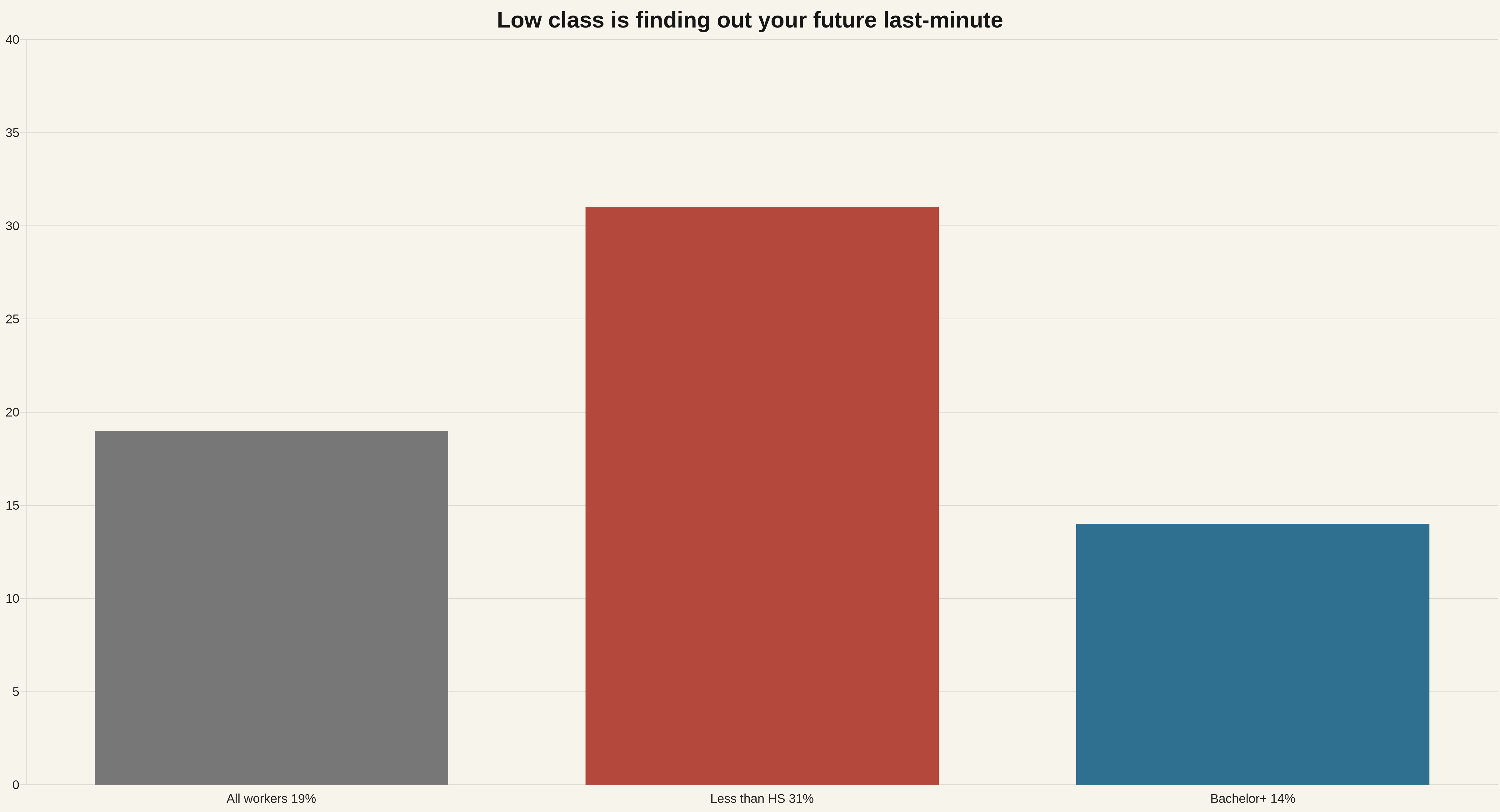
The BLS found that among U.S. wage and salary workers, 19% learned their work schedule less than one week in advance.
But the gradient is class-coded:
That is not a small lifestyle detail.
That is the difference between building a life and merely reacting to one.
2. The upper class lives in calendars. The lower class lives in alerts.
Look at the interface difference.
High class time is arranged in advance:
Low class time is often distributed by notification:
This is why the “just be disciplined” advice is often fake.
Discipline compounds when the environment gives you a stable surface.
If your week is liquid, discipline becomes triage.
You can be high conscientiousness and still get beaten by a chaotic calendar.
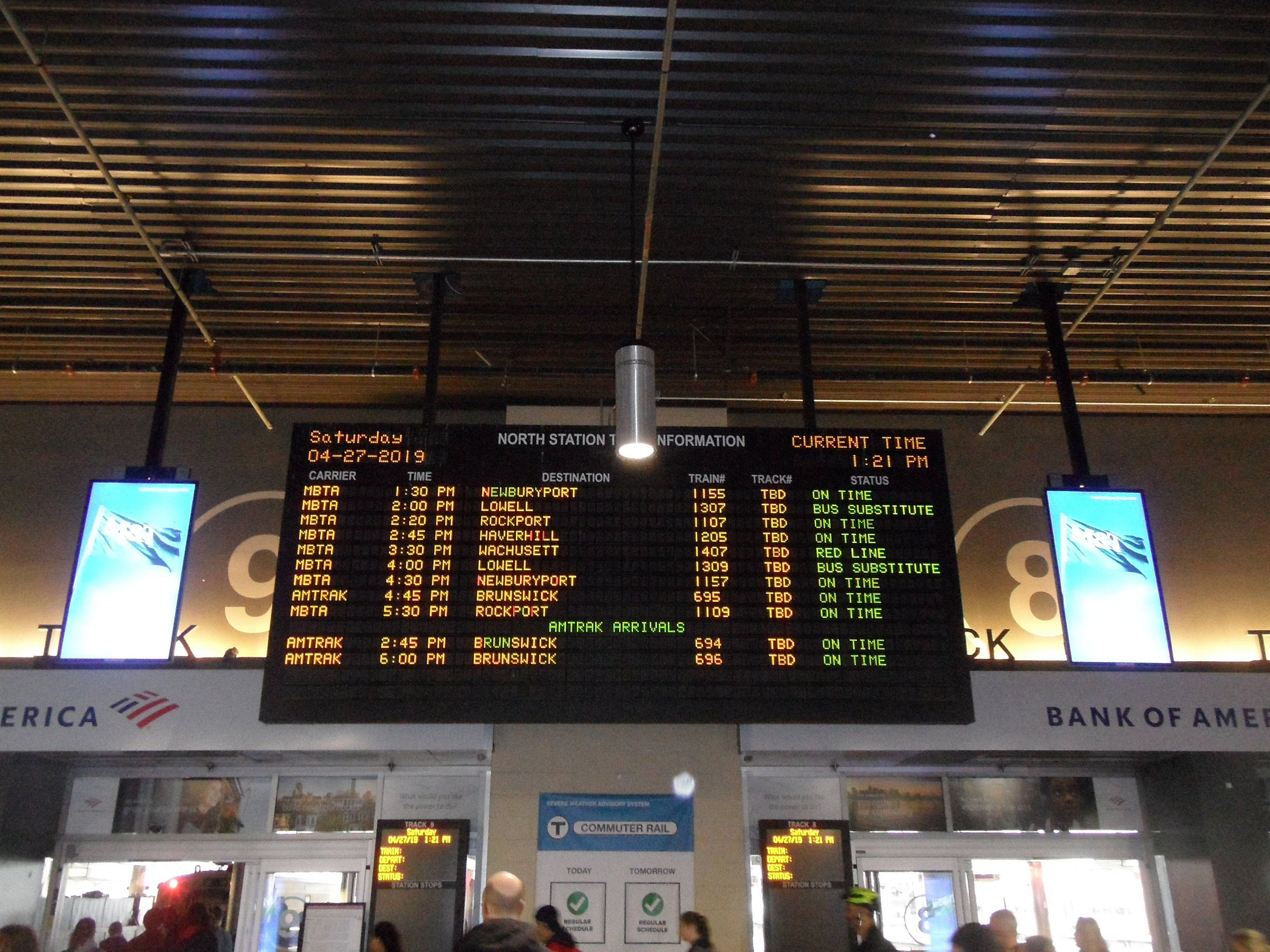
There is a reason elite people are obsessive about diaries.
Because a calendar is not admin.
A calendar is a legal claim on future reality.
If the world respects your calendar, you have status.
If the world can overwrite it at any time, you are subordinate.
3. Paid leave is class privilege disguised as normal employment.
The most obvious version of calendar ownership is this:
Can you be absent without being punished?
Not emotionally punished.
Economically punished.
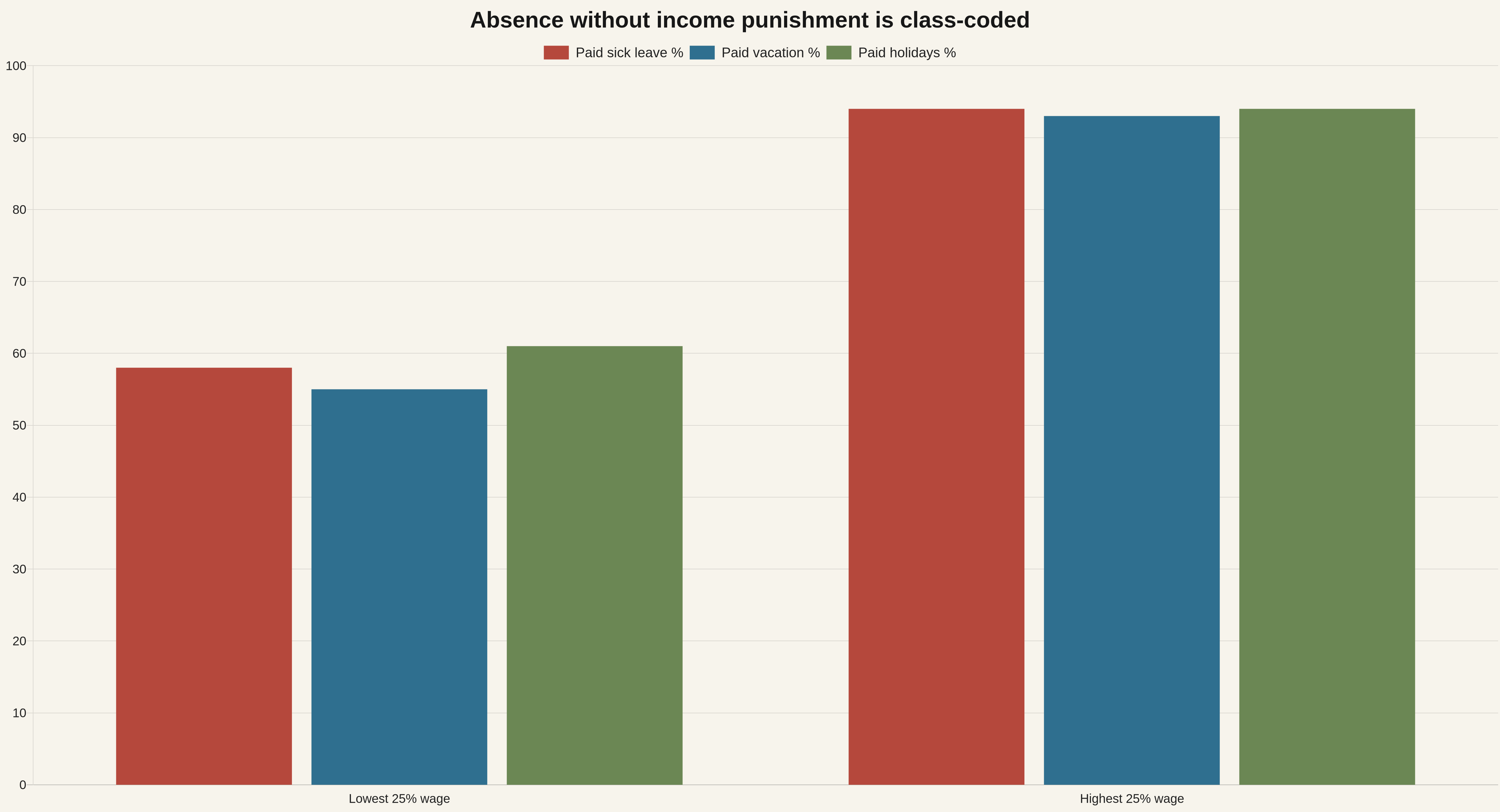
In the 2025 BLS employee benefits table for private industry:
This is brutal because the people with the least financial slack are also the ones least likely to be allowed to disappear safely.
High class people call it “taking time.”
Low class people call it “losing hours.”
Same illness.
Different calendar regime.
Same family emergency.
Different permission structure.
Same bank holiday.
Different bank account.
4. Zero-hours contracts are the anti-calendar.
The anti-calendar is a life where your employer owns an option on your future, but you do not own a matching option on theirs.
You must stay available.
They do not have to guarantee you the hours.
That is not flexibility.
That is asymmetry.
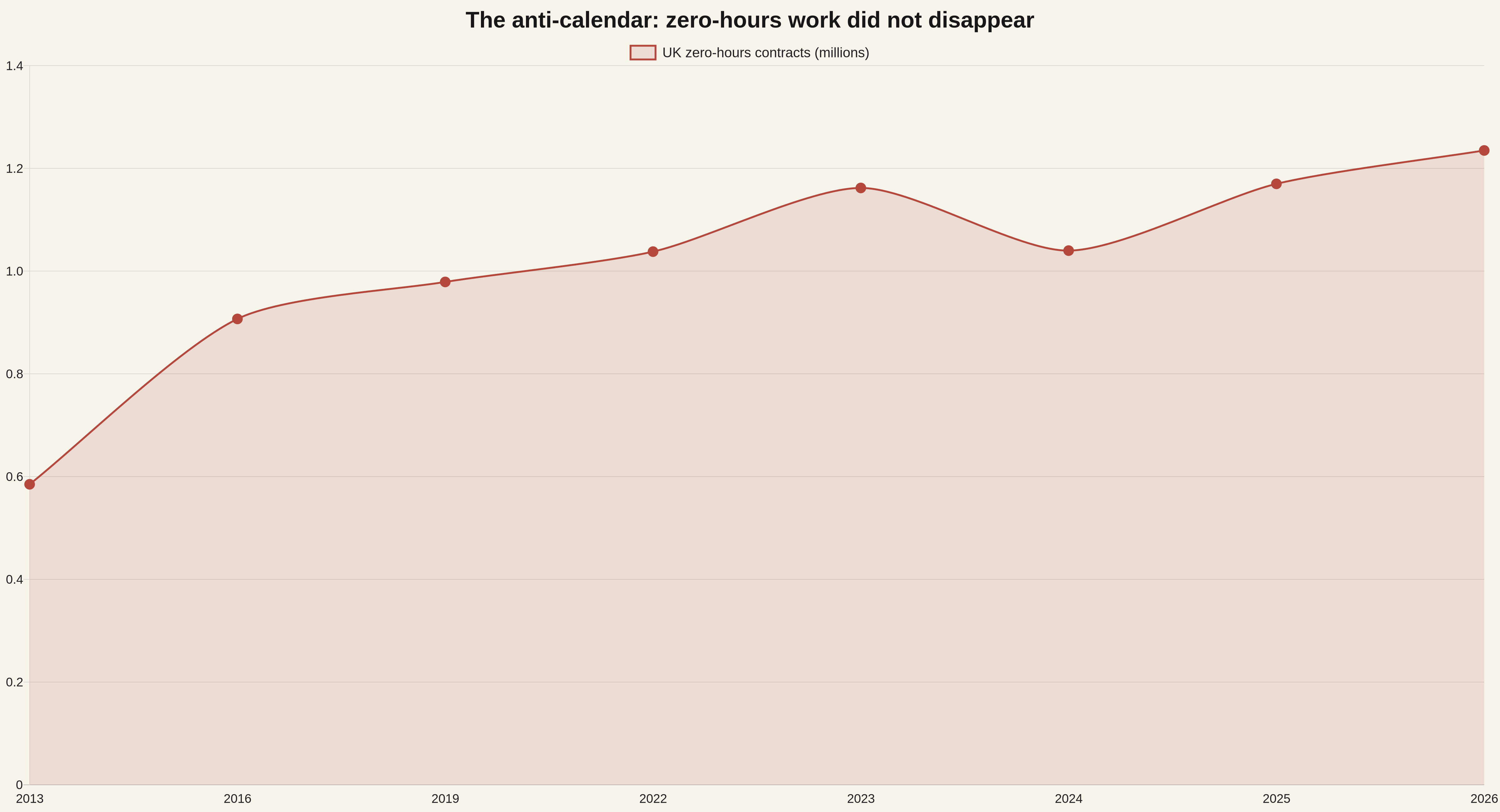
The latest ONS EMP17 release shows 1.235 million people in the UK on zero-hours contracts in Jan-Mar 2026, equal to 3.59% of people in employment.
The number was about 585k in Oct-Dec 2013.
Again, do not read this as “some people have weird jobs.”
Read it as:
If you cannot know your hours, you cannot cleanly plan:
The lower class person is not just poorer.
He is made temporally illiquid.
5. Remote work is not comfort. It is calendar leverage.
People talk about remote work as if it is pajamas and Slack.
Wrong.
Remote work is often the right to reclaim the dead zones around work.
Commute buffer.
Lunch logistics.
Delivery windows.
School pickup.
Laundry between calls.
Doctor appointment without losing half a day.
Deep work before meetings.
These are not “little conveniences.”
They are margin.
And margin is class.
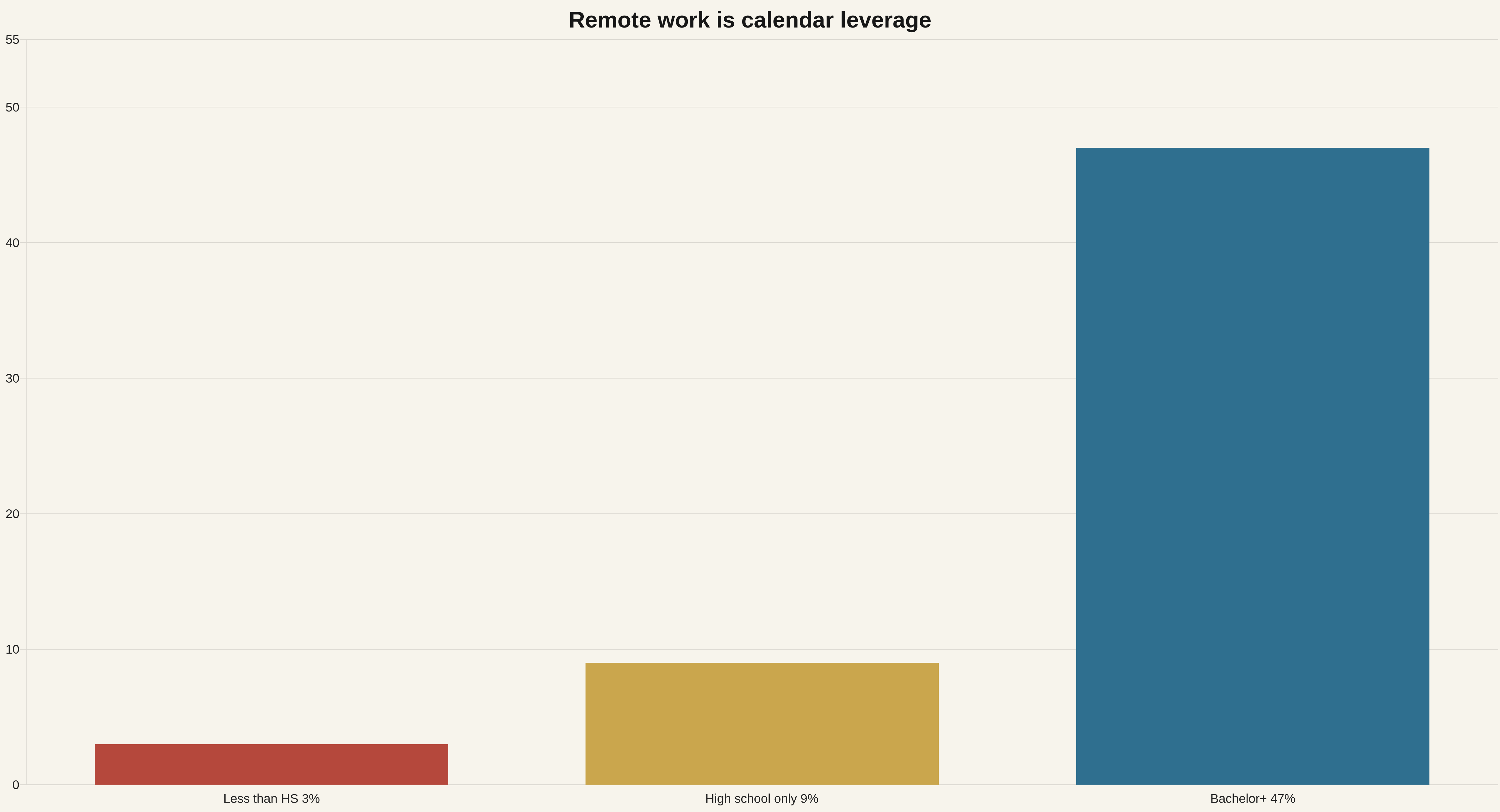
BLS 2017-18 data showed that among wage and salary workers age 25+:
So when white-collar people say “I just need flexibility,” they are naming a real need.
But when low-wage people need predictability, the culture calls it entitlement.
This is the class tell.
Elite flexibility = autonomy.
Prole flexibility = availability.
6. Why this matters more than it sounds
Most status advice is built for people who already own their calendar.
“Network more.”
When?
“Go to events.”
With what notice?
“Join a sport.”
On which fixed evening?
“Get therapy.”
Can you keep the appointment?
“Take a course.”
Can you attend weekly?
“Build a side business.”
Can you defend the same 2-hour block for 18 months?
This is why class reproduces itself so efficiently.
Upper-middle-class children grow up inside calendared institutions:
They learn that the future is schedulable.
Lower-class life often teaches the opposite:
That belief is not psychological weakness.
It is often accurate.
7. The Fair Workweek data proves this is political class power, not vibes
This is why predictable scheduling laws are so revealing.
The moment the state forces firms to respect workers' calendars, the worker becomes slightly less subordinate.
A 2026 Science Advances paper on Fair Workweek laws found that these laws increased the share of workers receiving at least two weeks' schedule notice by 13 percentage points, about a 29% increase, while also reducing clopenings and last-minute changes.
That is a clean example of class power being converted into calendar power.
The firm loses a tiny bit of option value.
The worker gains a future.
That is the whole battle.
8. The real hierarchy
Here is the class ladder nobody writes down:
This is why high class people seem calmer.
They are not magically more composed.
They live with fewer hostile interrupts.
Their week has load-bearing walls.
They can say no without losing rent.
They can book a holiday without wondering if the rota will mutate.
They can attend a wedding without performing economic surgery.
They can stack habits because the floor stays still.
The pill
Money matters.
Looks matter.
Network matters.
Accent matters.
But social class also lives in something far more boring:
who is allowed to plan.
Low class is not just being broke today.
It is having tomorrow kept deliberately vague.
High class is not just having more.
It is being able to tell the future:
And the future actually obeys.
Sources
BLS Employee Benefits in the United States, March 2025, Table 6: paid leave access by wage category
BLS Job Flexibilities and Work Schedules Summary, 2017-18 ATUS module
BLS Job Flexibilities and Work Schedules PDF, education/work-at-home and schedule-notice details
ONS EMP17: People in employment on zero-hours contracts, release date 19 May 2026
The Shift Project: work schedule instability and worker/family consequences
Science Advances: Fair Workweek laws in the U.S., 2026
Images: Clocking In Machine by Tim Sheerman-Chase, CC BY 4.0; North Station departure board by Karlunun, CC BY-SA 4.0; charts rendered from source data via QuickChart.
Social class is not just what you can buy.
It is what parts of the future you are allowed to reserve.
High social class is not merely:
• nicer clothes
• better parents
• a cleaner accent
• a more respectable LinkedIn
• better holidays
• “knowing the right people”
• better parents
• a cleaner accent
• a more respectable LinkedIn
• better holidays
• “knowing the right people”
All of that matters.
But there is a deeper layer people almost never notice:
calendar ownership.
The higher class person does not just have more resources.
He can commit time forward.
He can say:
I will be in Lisbon in September.
I will study every Tuesday night.
I can take Friday off.
I can attend that dinner.
I can book that appointment.
I can recover next week.
I can build a 6-month plan and expect reality to cooperate.
I will study every Tuesday night.
I can take Friday off.
I can attend that dinner.
I can book that appointment.
I can recover next week.
I can build a 6-month plan and expect reality to cooperate.
Low class life is the opposite.
It is not just having less.
It is having your future constantly re-opened by someone above you.
1. The hidden asset is not time. It is predictable time.
Everyone has 24 hours.
That line is technically true and socially retarded.
A barrister with a booked diary, a salaried consultant with paid leave, and a retail worker waiting for next week's rota do not own the same kind of hour.
One hour can be:
• reserved
• defended
• compounded
• spent without income panic
• traded for future status
• defended
• compounded
• spent without income panic
• traded for future status
Or one hour can be:
• cancellable
• unpaid
• summoned
• moved by a manager
• blocked off because you might be needed
• unpaid
• summoned
• moved by a manager
• blocked off because you might be needed
That is the class distinction.
Not “busy vs lazy.”
Booked vs interruptible.
The BLS found that among U.S. wage and salary workers, 19% learned their work schedule less than one week in advance.
But the gradient is class-coded:
• less than high school: 31%
• bachelor's degree or higher: 14%
• bachelor's degree or higher: 14%
That is not a small lifestyle detail.
That is the difference between building a life and merely reacting to one.
2. The upper class lives in calendars. The lower class lives in alerts.
Look at the interface difference.
High class time is arranged in advance:
calendar invites
school terms
annual leave
conference dates
reservation systems
blocked focus hours
recurring appointments
family logistics planned months out
school terms
annual leave
conference dates
reservation systems
blocked focus hours
recurring appointments
family logistics planned months out
Low class time is often distributed by notification:
shift posted
shift changed
shift cancelled
cover needed
manager called
bus delayed
overtime offered
childcare collapsed
benefits appointment moved
shift changed
shift cancelled
cover needed
manager called
bus delayed
overtime offered
childcare collapsed
benefits appointment moved
This is why the “just be disciplined” advice is often fake.
Discipline compounds when the environment gives you a stable surface.
If your week is liquid, discipline becomes triage.
You can be high conscientiousness and still get beaten by a chaotic calendar.
There is a reason elite people are obsessive about diaries.
Because a calendar is not admin.
A calendar is a legal claim on future reality.
If the world respects your calendar, you have status.
If the world can overwrite it at any time, you are subordinate.
3. Paid leave is class privilege disguised as normal employment.
The most obvious version of calendar ownership is this:
Can you be absent without being punished?
Not emotionally punished.
Economically punished.
In the 2025 BLS employee benefits table for private industry:
Lowest 25% wage category
paid sick leave: 58%
paid vacation: 55%
paid holidays: 61%
Highest 25% wage category
paid sick leave: 94%
paid vacation: 93%
paid holidays: 94%
paid sick leave: 58%
paid vacation: 55%
paid holidays: 61%
Highest 25% wage category
paid sick leave: 94%
paid vacation: 93%
paid holidays: 94%
This is brutal because the people with the least financial slack are also the ones least likely to be allowed to disappear safely.
High class people call it “taking time.”
Low class people call it “losing hours.”
Same illness.
Different calendar regime.
Same family emergency.
Different permission structure.
Same bank holiday.
Different bank account.
4. Zero-hours contracts are the anti-calendar.
The anti-calendar is a life where your employer owns an option on your future, but you do not own a matching option on theirs.
You must stay available.
They do not have to guarantee you the hours.
That is not flexibility.
That is asymmetry.
The latest ONS EMP17 release shows 1.235 million people in the UK on zero-hours contracts in Jan-Mar 2026, equal to 3.59% of people in employment.
The number was about 585k in Oct-Dec 2013.
Again, do not read this as “some people have weird jobs.”
Read it as:
some people are structurally prevented from treating next week as real.
If you cannot know your hours, you cannot cleanly plan:
• gym progression
• sleep timing
• social events
• dating logistics
• childcare
• study blocks
• therapy
• side business execution
• travel
• compounding skills
• sleep timing
• social events
• dating logistics
• childcare
• study blocks
• therapy
• side business execution
• travel
• compounding skills
The lower class person is not just poorer.
He is made temporally illiquid.
5. Remote work is not comfort. It is calendar leverage.
People talk about remote work as if it is pajamas and Slack.
Wrong.
Remote work is often the right to reclaim the dead zones around work.
Commute buffer.
Lunch logistics.
Delivery windows.
School pickup.
Laundry between calls.
Doctor appointment without losing half a day.
Deep work before meetings.
These are not “little conveniences.”
They are margin.
And margin is class.
BLS 2017-18 data showed that among wage and salary workers age 25+:
• less than high school: 3% worked at home at least occasionally
• high school only: 9%
• bachelor's degree or higher: 47%
• high school only: 9%
• bachelor's degree or higher: 47%
So when white-collar people say “I just need flexibility,” they are naming a real need.
But when low-wage people need predictability, the culture calls it entitlement.
This is the class tell.
Elite flexibility = autonomy.
Prole flexibility = availability.
6. Why this matters more than it sounds
Most status advice is built for people who already own their calendar.
“Network more.”
When?
“Go to events.”
With what notice?
“Join a sport.”
On which fixed evening?
“Get therapy.”
Can you keep the appointment?
“Take a course.”
Can you attend weekly?
“Build a side business.”
Can you defend the same 2-hour block for 18 months?
This is why class reproduces itself so efficiently.
Upper-middle-class children grow up inside calendared institutions:
music lessons
exam cycles
sports seasons
family holidays booked early
parents who can leave work
routine dental appointments
summer internships arranged months ahead
quiet Sunday planning
term dates
school portals
application deadlines
exam cycles
sports seasons
family holidays booked early
parents who can leave work
routine dental appointments
summer internships arranged months ahead
quiet Sunday planning
term dates
school portals
application deadlines
They learn that the future is schedulable.
Lower-class life often teaches the opposite:
the future is provisional.
That belief is not psychological weakness.
It is often accurate.
7. The Fair Workweek data proves this is political class power, not vibes
This is why predictable scheduling laws are so revealing.
The moment the state forces firms to respect workers' calendars, the worker becomes slightly less subordinate.
A 2026 Science Advances paper on Fair Workweek laws found that these laws increased the share of workers receiving at least two weeks' schedule notice by 13 percentage points, about a 29% increase, while also reducing clopenings and last-minute changes.
That is a clean example of class power being converted into calendar power.
The firm loses a tiny bit of option value.
The worker gains a future.
That is the whole battle.
8. The real hierarchy
Here is the class ladder nobody writes down:
Bottom: your time is summoned.
Lower-middle: your time is scheduled, but by someone else.
Middle: your time is stable if nothing goes wrong.
Upper-middle: your time is planned and defended.
Upper: other people's calendars bend around yours.
Lower-middle: your time is scheduled, but by someone else.
Middle: your time is stable if nothing goes wrong.
Upper-middle: your time is planned and defended.
Upper: other people's calendars bend around yours.
This is why high class people seem calmer.
They are not magically more composed.
They live with fewer hostile interrupts.
Their week has load-bearing walls.
They can say no without losing rent.
They can book a holiday without wondering if the rota will mutate.
They can attend a wedding without performing economic surgery.
They can stack habits because the floor stays still.
The pill
Money matters.
Looks matter.
Network matters.
Accent matters.
But social class also lives in something far more boring:
who is allowed to plan.
Low class is not just being broke today.
It is having tomorrow kept deliberately vague.
High class is not just having more.
It is being able to tell the future:
hold this slot for me.
And the future actually obeys.
Sources
BLS Employee Benefits in the United States, March 2025, Table 6: paid leave access by wage category
BLS Job Flexibilities and Work Schedules Summary, 2017-18 ATUS module
BLS Job Flexibilities and Work Schedules PDF, education/work-at-home and schedule-notice details
ONS EMP17: People in employment on zero-hours contracts, release date 19 May 2026
The Shift Project: work schedule instability and worker/family consequences
Science Advances: Fair Workweek laws in the U.S., 2026
Images: Clocking In Machine by Tim Sheerman-Chase, CC BY 4.0; North Station departure board by Karlunun, CC BY-SA 4.0; charts rendered from source data via QuickChart.


