stillxyz
least grey grey on org
- Joined
- Jan 25, 2026
- Posts
- 308
- Reputation
- 252
MEGAPOST - DEFINITIVE GUIDE TO FACIAL LEANESS & BONE DEFINITION
The single biggest mistake people make on face and beauty forums is thinking every soft lower face, weak jawline, or round face comes strictly from fixed bone structure. While your skeleton sets your hard limits, over 60% of how sharp your face looks at low body fat levels (10-14%) comes down to extra water trapped under the skin (swelling/edema), backed-up neck fluid channels (lymphatic system), bad tongue and neck muscle placement, and body-wide inflammation.
Anatomy of Facial Soft-Tissue Layers & Lymphatic Clearance
Facial soft tissue has 5 distinct anatomical layers.
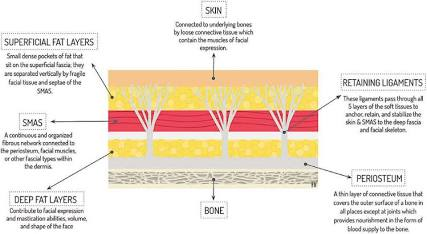
Cross-section of the 5 Facial Layers and SMAS Retaining Ligaments. Source: ResearchGate
Layers:
- Skin: The outer skin layer (epidermis and dermis). It reacts instantly to how much water you drink and how well blood flows through small vessels.
- Top Fat Layer: Sits right under the skin and above the muscle sheet (under-eye, smile-line, middle cheek, and under-chin fat pads). These fat pockets act like sponges filled with tiny blood vessels that swell up when water pressure rises inside your body.
- SMAS Muscle Sheet: A strong, rubbery wall of connective tissue and muscle. It acts like a dividing screen that keeps top water and fat separated from deeper face structures.
- Deep Fat & Tissue Straps: Home to deeper fat pockets (under-eye deep fat and the deep cheek pad) held up by tight bone-to-skin straps (ligaments).
- Bone Cover / Deep Tissue: The hard, dense skin wrapper that coats your face bones directly.
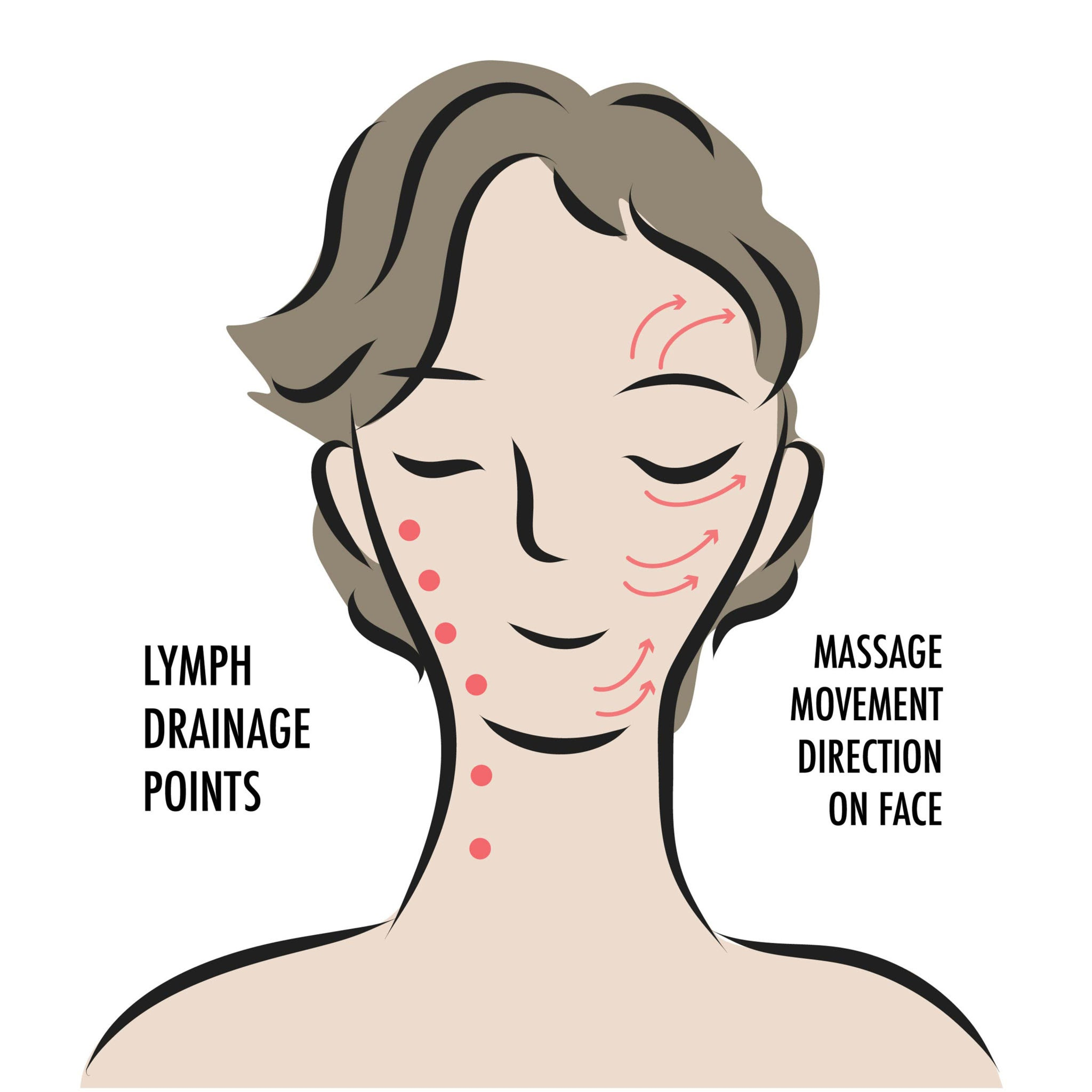
Facial & Cervical Lymphatic Drainage Nodes and Flow Directions. Source: Papapapong / Getty Images
Unlike your blood, which gets pumped around by your heart, your body's fluid-cleaning system (lymph system) has no pump. Trapped fluid in your mid-face drops downward through three main filter chains in your neck.
- Parotid Nodes (Ear/Jaw Joint Area): Drains water away from your upper cheeks, outer eye corners, and cheekbones.
- Submandibular Nodes (Under-Jaw Area): Drains fluid from your middle cheeks, upper lip, and the middle side of your jawbone.
- Submental Nodes (Under-Chin Area): Drains water out from your lower lip, chin point, and the center under-chin spot.
How It Works: Fluid gets stuck when your neck is bent forward or when your face muscles stay still for too long. Gravity alone cannot drain these fluid tubes if your neck muscles (like the big SCM muscle on the side of your neck) stay tight and pinched shut.
Hormones & Water Retention
Extra water held in your face fat pads is controlled by three main hormone systems in your body: the Salt-Water Control Loop (RAAS), the Water-Holding Hormone (ADH/Vasopressin), and the Stress Hormone (Cortisol).
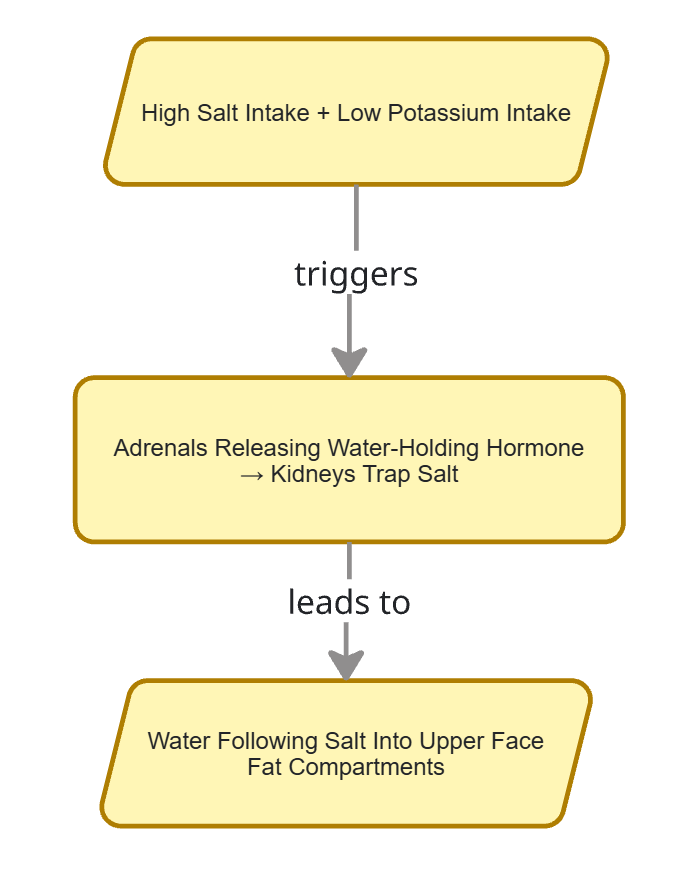
Direct Hormone Actions:
- The Salt-Retaining Hormone (Aldosterone): Eating lots of salt without enough potassium makes your body dump this hormone from your adrenal glands. It forces your kidneys to hold onto salt and kick out potassium. Water naturally follows salt, spilling into your face fat pads and puffing them up.
- The Anti-Pee Hormone (Vasopressin / ADH): Not drinking enough water makes your blood thick, telling your brain to send out ADH. ADH opens special water-catching gates in your kidneys to hold onto every drop of water in your body. This creates fast, heavy face bloat.
- The Stress Hormone (Cortisol): Long-term high stress ramps up cortisol, which tricks your body into holding extra salt and water while storing fat around your cheeks and neck (often called "stress face" or "moon face").
How Face Muscle Works: The Neck Bone & Tongue Posture
A saggy or smooth under-chin area (double chin) at low body fat is almost always caused by bad physical placement of your neck bone (hyoid bone) and weak floor-of-mouth muscles.
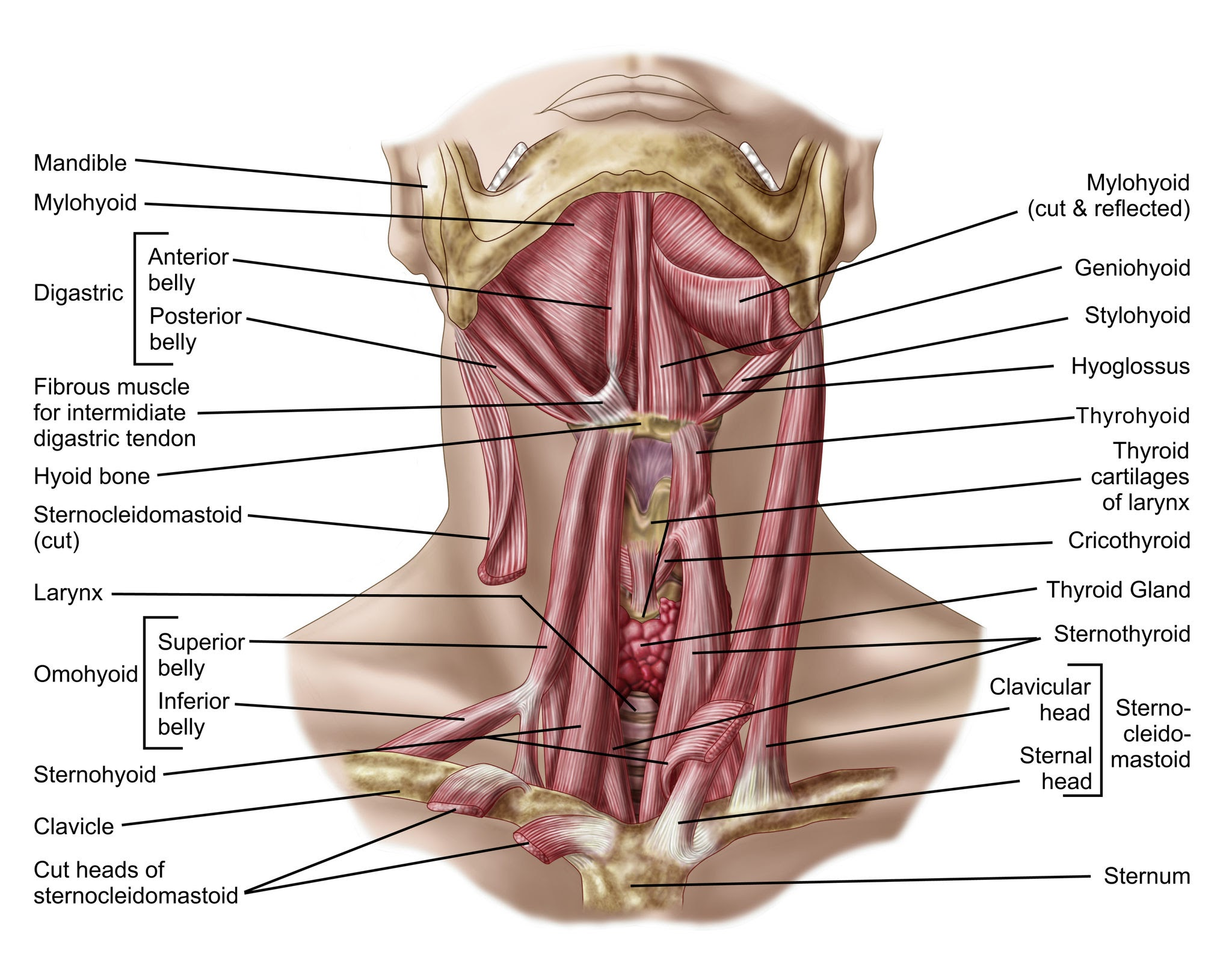
Anatomy of the Hyoid Bone and Associated Submental Musculature. Source: Stocktrek Images / Getty Images
Lower Jaw Muscles Explained:
- Mylohyoid Muscle: Forms the main hammock or floor across the bottom of your mouth. When tightened, it lifts the whole floor of your mouth upward.
- Geniohyoid Muscle: Runs from the inside tip of your chin straight back to your neck bone. It pulls the neck bone up and forward.
- Digastric Muscle: Helps pull your neck bone upward when swallowing and holds steady tension when your tongue rests correctly against the roof of your mouth.
Pressing your entire tongue (especially the back third) firmly flat against the roof of your mouth creates a winch effect:
- The back of the tongue flexes key lifting muscles (palatoglossus and hyoglossus).
- This pulls your floating neck bone (hyoid bone) up and forward toward the inside tip of your chin.
- Loose skin, fat, and throat muscle are pulled up tight against your jawline, sharpening a sloped 120° neck angle into a clean 90° L-shape.
Neck Posture: Spinal Position & Head Angles
Forward Head Posture (slouching your neck forward) ruins your jawline appearance no matter how low your body fat is or how strong your jawbone is underneath.
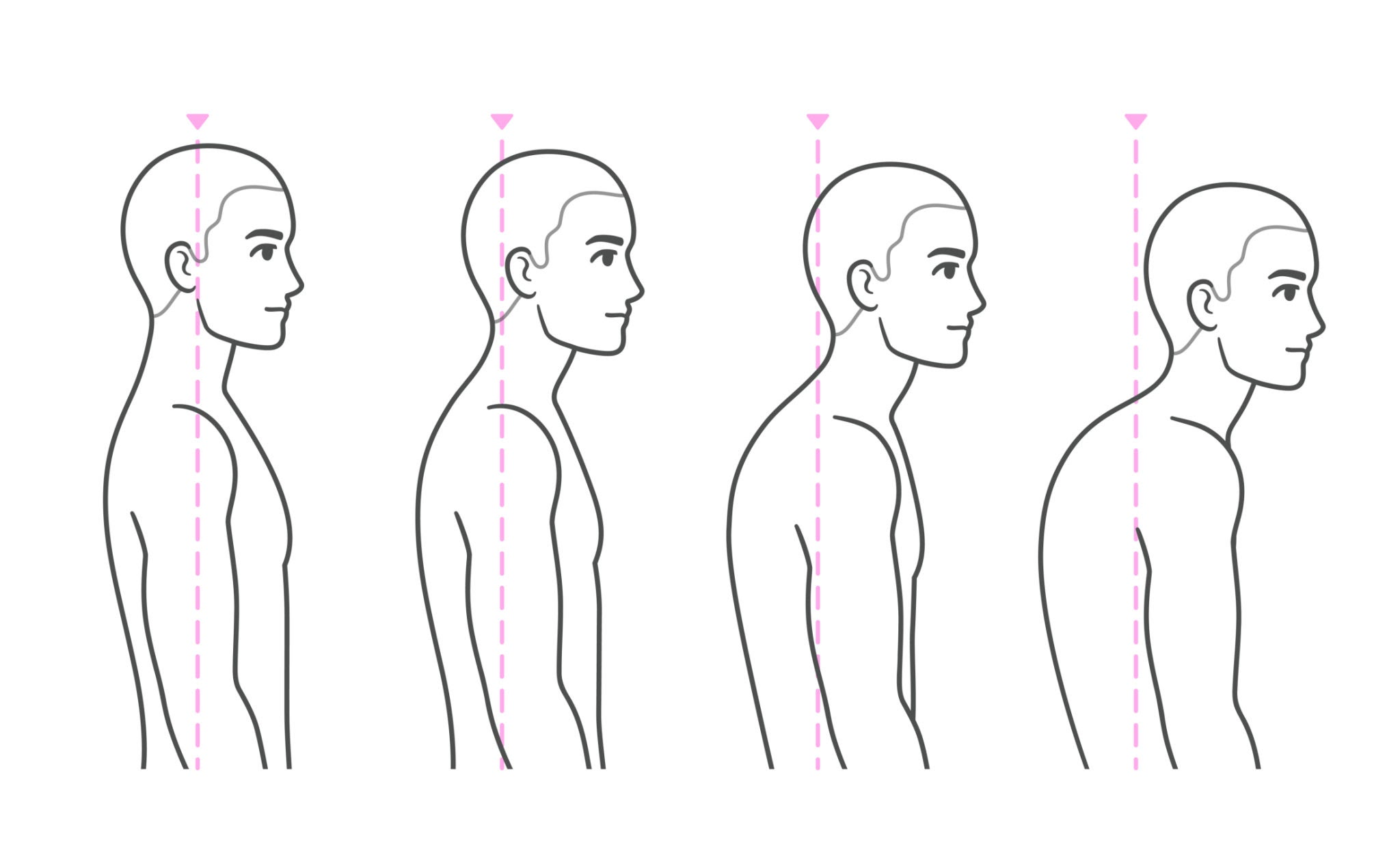
Cervical Spine Shifts in Forward Head Posture (FHP). Source: Sudowoodo / Getty Images
What Slouching Does to Your Face:
- Extra Weight Lever: For every 1 inch your head pokes forward past your shoulders, it feels like an extra 10lbs (5 kg) of pulling force on your neck spine.
- Stretching Lower Neck Muscles: Leaning your head forward stretches out the front neck muscles (sternohyoid and omohyoid).
- Pulling Down the Neck Bone: Stretched lower neck muscles drag your floating neck bone down and back toward your collarbones. This drags the floor of your mouth with it, creating a soft double chin even if you are very lean (10% body fat).
Jaw Muscle Building vs. Jaw Joint Damage
Making your masseter muscle (chewing muscle) bigger increases the side width of your jaw corner (gonial angle), giving your lower face a squarer look. However, heavy chewing comes with clear joint risks.
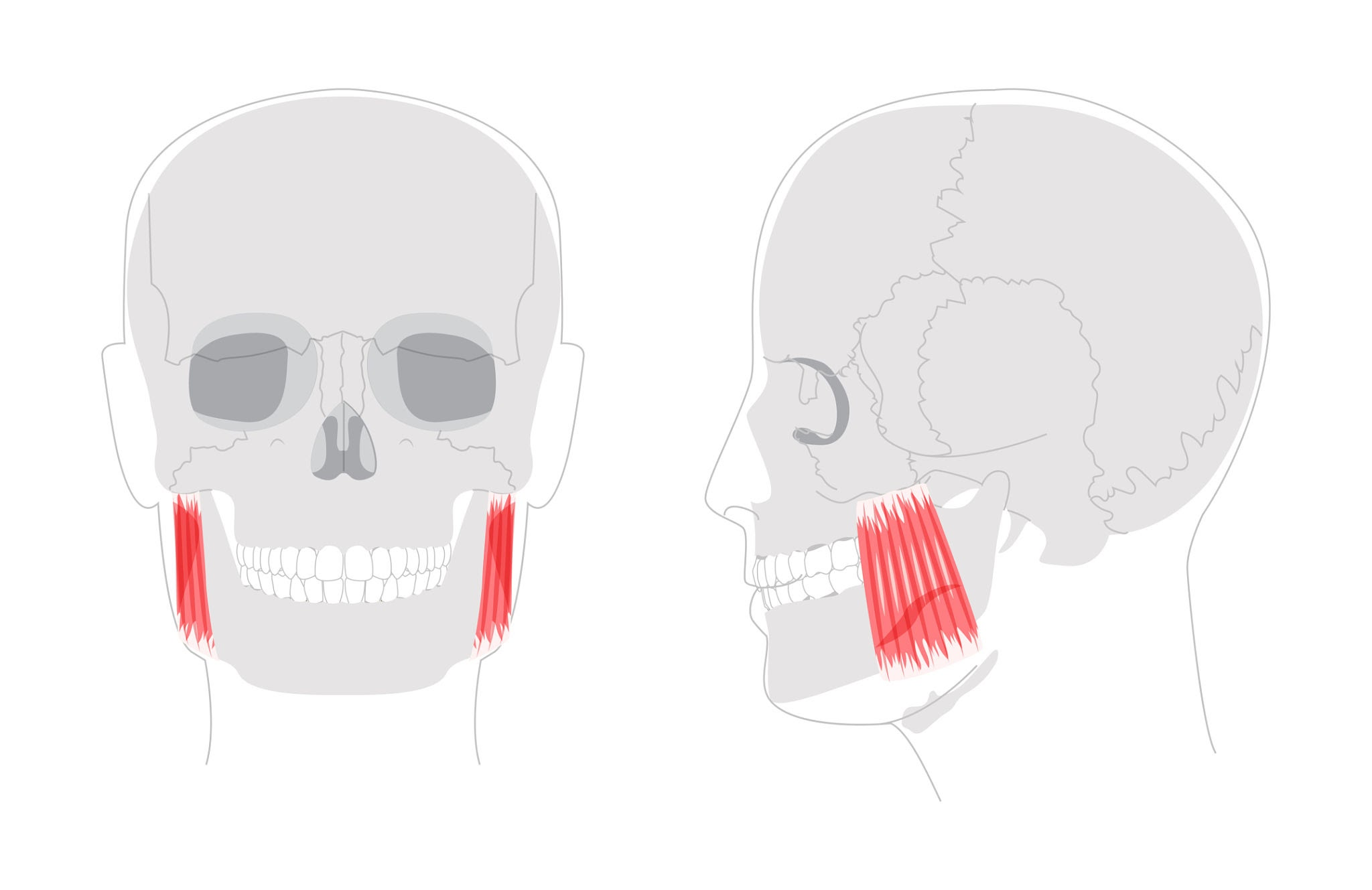
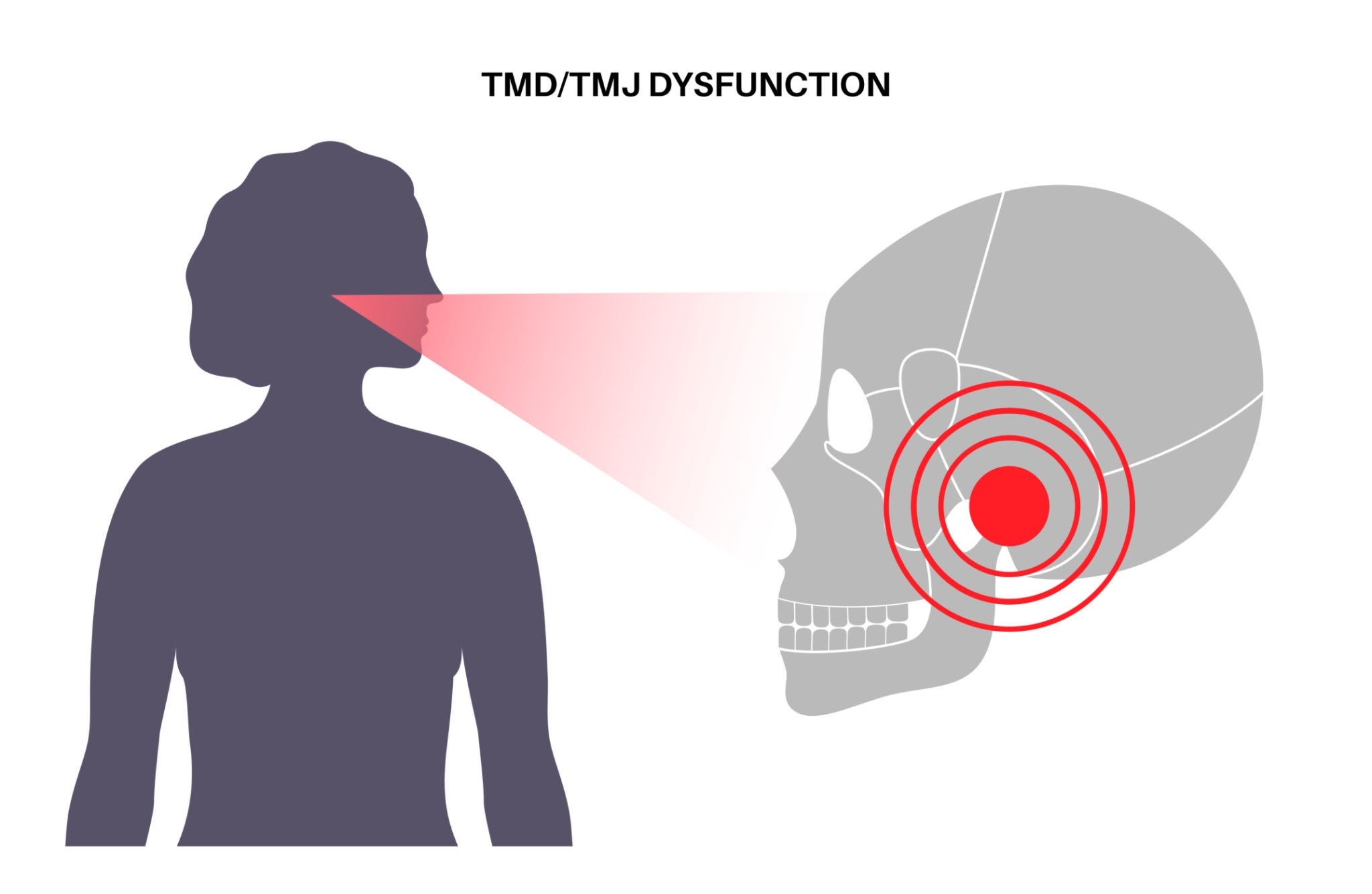
Anatomy of the Masseter Muscle (Superficial & Deep Layers). Source: Katya Golovchyn / Getty Images (left)
Temporomandibular Joint (TMJ) Articular Disc Displacement Profile. Source: Pikovit44 / Getty Images (right)
Chewing Muscle Growth vs. Jaw Joint Wear:
- Outer Chewing Layer: The main muscle block used for hard bite force. It gets bigger through heavy chewing work (progressive tension).
- Inner Chewing Layer: Used for steady jaw position and pulling your jaw backward. Overworking it causes tight knots, tension headaches, and neck pain.
- Jaw Joint Cushion Slip: Your jaw joint has a smooth rubbery cushion (articular disc) that keeps bone from grinding on bone. Chewing hard rubber or tough gum for hours every day puts severe twisting force on the joint straps. This can slip the joint cushion forward out of place, which causes popping, clicking and permanent joint damage.
Real Cope vs. Not Cope:
The internet is full of bad beauty advice. Here is a science-backed breakdown of what is completely useless versus what actually changes your face.
COMPLETELY USELESS / FAKE (Things People Think Work, But Don't)
- "Gua Sha Stones or Face Rollers Permanently Change Your Bone or Melt Fat"
- Why it's fake: Changing bone shape requires direct, heavy physical load over years (known in science as Wolff's Law). Soft stone rollers only push top skin layer water around for 2 to 3 hours. They do zero bone shaping and burn zero fat cells.
- "Face Yoga or Face Exercises Burn Face Fat in One Spot"
- Why it's fake: Losing fat in just one body spot (spot reduction) is proven to be impossible (Journal of Strength and Conditioning Research, 2013). Working out small face muscles can actually make your mid-face thicker sideways, making your face look rounder instead of leaner.
- "Chewing Hard Rubber 4 Hours a Day Makes a Recessed Jaw Grow Forward"
- Why it's fake: Building chewing muscles adds side width over your jaw angle. It does not push your lower jawbone forward once you are an adult and your growth plates are locked. You are simply risking bad jaw joint clicking for 1-2 mm of muscle thickness.
- "Saunas Permanently Melt Cheek Fat"
- Why it's fake: Saunas make your whole body lose water weight through sweat. The smaller face look is 100% temporary water loss that disappears within 6 hours of drinking water. Heat does not kill fat cells.
- "Slapping Your Face or Tapping Your Jaw Makes Bones Grow"
- Why it's fake: Slapping your skin causes light injury, swelling, and histamine release, making your face look more puffy in the short term while doing nothing to grow real bone.
- "Fixing Your Salt-to-Potassium Ratio Drops Face Water Fast"
- Why it works: Lowering salt while eating more potassium turns off water-retaining hormones within 24 to 48 hours (American Journal of Physiology). This makes your kidneys flush out 2-4 lbs of extra body water, instantly sharpening your jawline and under-cheek curves.
- "Pressing Your Tongue to the Roof of Your Mouth Tightens Under-Chin Skin Instantly"
- Why it works: This is basic physical movement, not magic. Raising the back of your tongue flexes your lower mouth muscles, pulling your floating neck bone up and holding loose under-chin skin tight against your lower jaw arch.
- "Fixing Forward Head Slouching Sharpens the Jawline"
- Why it works: Pulling your neck back relieves pull on your lower neck muscles, allowing your floating neck bone to rest higher. This removes the sloped neck look and cleans up your jaw edge.
- "Dropping Overall Body Fat Down to 10-12%"
- Why it works: Face fat pockets are among the very last spots your body burns for energy during weight loss. Reaching 10-12% body fat empties out those top fat pockets, letting underlying cheekbones and jawlines show through.
- "Cutting Out Foods That Upset Your Stomach Reduces Face Puffiness"
- Why it works: Unfound food sensitivities (like dairy or gluten issues) cause gut leakage and release inflammatory chemical signals (TNF-a, IL-6). This leaks extra fluid out of tiny blood vessels and into your face skin, causing chronic face swelling.
Master Daily Action Plan
Step 1: Morning Water Balance & Cold Splash (07:00 AM)
- Electrolyte Hydration Drink:
- Mix 750ml of water with 1,200mg potassium citrate, 200mg magnesium glycinate, and a tiny pinch 200mg of natural salt.
- Goal: Turns off overnight water-retaining hormones and pulls water out of skin spaces back into your cells.
- Ice Water Face Dip:
- Fill a large bowl with cold water and ice (40-50 °F; 4.44-10°C). Submerge your face 4 times for 30 seconds each.
- Goal: Shrinks tiny skin blood vessels quickly, pushing trapped water out toward your neck drainage tubes.
- Wall Head Retractions (Chin Tucks):
- Stand with heels, glutes, upper back, and head flat against a wall. Pull your head straight back to make a double chin. Hold for 3 seconds.
- Reps: Do 3 sets of 15 reps.
- Roof-of-Mouth Tongue Hold:
- Press the full flat surface of your tongue (focusing on the back third) as hard as you can against the roof of your mouth with teeth lightly touching and lips closed. Hold for 10 seconds.
- Reps: Do 5 sets of 5 holds.
- Neck Muscle Rub Down:
- Gently rub the long muscle running from behind your ear down to your collarbone using two fingers in a downward motion to open up blocked neck drainage tubes.
Clinical Science References & Research Studies
- Journal of Biological Chemistry (2019): Regulation of Extracellular Fluid Volume and Systemic Edema by the Aldosterone-Na+/K+-ATPase Axis. Proves that eating more potassium relative to salt shuts off water-holding hormones and reduces skin water accumulation.
- American Journal of Orthodontics and Dentofacial Orthopedics (2020): The Impact of Cervical Spine Alignment on Hyoid Bone Position and Submental Soft Tissue Geometry. Confirms that leaning your head forward drops your neck bone, directly causing under-chin tissue sag.
- Journal of Cranio-Maxillofacial Surgery (2018): Anatomy and Volumetric Changes of Facial Fat Compartments During Weight Loss. Shows that top face fat pockets shrink heavily below 12% body fat, uncovering cheekbone and jawlines.
- Journal of Oral Rehabilitation (2021): Mechanical Loading of Masticatory Muscles: Hypertrophy versus Temporomandibular Joint Disc Displacement. Sets safety limits for chewing workouts to prevent jaw joint cushion damage.
THE END.
Time To Research: 11 Hours
Time To Write: 7 Hours
Mirin post?

Feedback? Comment here.
If this helped you or you find it interesting, please rep me
!Any questions or need any advice? Feel free to DM me.
guide by stillxyz
12/08/2026
12th August 2026
01:00 AM CET time.
12/08/2026
12th August 2026
01:00 AM CET time.